54
Developing Threshold Learning Outcomes
for Agricultural Science
Tina Botwright Acuñaa, Jo-Anne Kelderb, Peter Lanea, Greg Hannanc and Susan Jonesd
Corresponding author: [email protected] a
Tasmanian Institute of Agriculture and School of Agricultural Science, University of Tasmania, Hobart TAS 7001, Australia
b
Faculty of Health Science, University of Tasmania, Hobart TAS 7001, Australia c
Faculty of Science, Engineering and Technology, Hobart TAS 7001, Australia dSchool of Zoology, University of Tasmania, Hobart TAS 7001, Australia
Keywords
: vocational training, curriculum mappingInternational Journal of Innovation in Science and Mathematics Education, 21(5), 54-66, 2013
Abstract
Learning and Teaching Academic Standard (LTAS) Statements have recently been published across a number of disciplines and have contributed to the national regulation and quality assurance framework being developed by the Higher Education Standards Panel. The Science Standards Statement (SSS) contains a statement on the Nature and Extent of Science and articulated Threshold Learning Outcome (TLOs) statements representing the minimum levels of achievement expected of a bachelor level Science graduate. Our project aimed to adapt the SSS, in particular, the TLOs for Science to the Agricultural Science discipline to reflect the discipline-specific attributes and to achieve a measure of national consensus on Agricultural Science TLOs including endorsement from the Australian Council of Deans of Agriculture. We report on the process and outcomes of developing a draft Agricultural Science Standards Statement (AgSSS). The project method broadly followed that of the national LTAS Science project (2010/11) on a smaller scale. A targeted consultation process through facilitated workshops with teaching academics from the University of Tasmania’s School of Agricultural Science provided qualitative data. This data informed the adaptation of the survey used by the LTAS Science Project to include Agricultural Science. The Agricultural Science survey was administered to staff of the Tasmanian Institute of Agriculture and two interstate universities. Key findings are that a statement on the nature and extent of Agricultural Science needs to capture its multi-disciplinary nature and that TLOs should incorporate minimum levels of achievement in vocational knowledge. Project outcomes will contribute to the future renewal and revitalization of the Agricultural Science curriculum and facilitate meeting reporting requirements, such as those required by the Tertiary Education Quality Standards Agency (TEQSA). The process can serve as one model for wider dissemination and adapting the Science TLOs within UTAS and other universities. The next phase of the project is to define course-level learning outcomes more specifically for Agricultural Science degrees at UTAS as a first step towards aligning our curriculum and assessment with nationally-agreed Agriculture TLOs.
Academic standards
55
The HESF includes ‘threshold’ standards, which relate to providers and qualifications, and ‘non-threshold’ standards for learning and teaching, research and information. The latter have not yet been defined, but the HESP is intending to recommend that future revisions of the HESF include standards in these areas (Higher Education Standards Panel, 2013). The Australian Learning and Teaching Council (ALTC) was commissioned by the Australian Government to support the development of Learning and Teaching Academic Standards (LTAS) through a process that was driven by broad consultation with academics within discipline communities of practice and coordinated by ALTC Discipline Scholars (Hay, 2012). This process engaged not only academics, but also industry, accrediting bodies, students and other stakeholders in the sector.
The LTAS project for the Science discipline developed high-level statements articulating a national consensus on minimum levels of achievement expected on a bachelor level Science graduate. The final Science Standards Statement (SSS) demonstrated that the Science threshold learning outcomes it articulated could be adapted for a sub-discipline or major (Chemistry) within a broader science degree and for higher level of achievement (honours) (Jones, Yates, & Kelder, 2011). The SSS was endorsed by the Australian Council of Deans of Science and publically acknowledged by the Chair of the Australian Higher Education Standards Panel in September 2012 as one approach for universities to demonstrate that they meet the standards audited by TEQSA. At a national level several Science disciplines and universities are now applying the SSS and TLOs to their specific curricula using curriculum mapping. Published literature shows that curriculum mapping is an excellent method to interrogate learning outcomes and inform curriculum renewal to the benefit of both participating staff and higher education institutions (Oliver, Ferns, Whelan, & Lilly, 2010).
At the conclusion of the LTAS national project, Professors Susan Jones and Brian Yates (Science) and Professor Jonathon Holmes (Creative and Performing Arts) continued their work as Australian Learning and Teaching Council (ALTC) Discipline Scholars with a remit to develop the discipline networks generated by the project activities. The University of Tasmania (UTAS) appointed them as Learning and Teaching Professors in 2011 to lead the LTAS@UTAS project. The LTAS@UTAS project aims to establish a comprehensive approach to academic standards, expressed as degree learning outcomes across all faculties and degrees. The approach adopted by LTAS@UTAS was to work with published learning standards where they existed and to establish a direct link to learning outcomes of components of degrees, to demonstrate how they connected student development to identified graduate learning outcomes (Holmes, Jones, & Yates, 2012).
In the Faculty of Science, Engineering and Technology, the LTAS@UTAS project was initially implemented through mapping the majors in the Bachelor of Science (BSc) degree against the SSS; the outcomes of that exercise are now being used to inform curriculum renewal in the BSc degree. At UTAS, Agricultural Science has a largely prescribed, four-year degree structure with embedded honours; the school has well-established links with industry. The consultative approach used to develop the SSS included a representative from the Agriculture discipline on the reference group, but did not broadly engage with industry stakeholders. One of the aims of this project was to adapt the broadly based SSS to the specific disciplinary context of Agricultural Science, leveraging the strong relationship between industry and the School of Agricultural Science.
56
(SaMnet). SaMnet’s focus was leadership training and the project team consisted of an early- to mid-career academic, an educational developer and senior academics including a degree coordinator and Associate Dean of Learning and Teaching. Co-location of the ALTC Discipline Scholars for Science at UTAS also provided an informal avenue for expert advice. The SaMnet approach was to facilitate local support and mentoring for the early to mid-career academic and the opportunity for leadership training in scholarship of teaching via SaMnet (Rifkin, Sharma, Crampton, Yates, Matthews, Beames, Varavsky, Johnson, Jones, Zadnik, & Pyke, 2012) in the context of a learning and teaching project. The UTAS team proposed a project to align an Agricultural Science curriculum with the national Science threshold learning outcomes.
The overall aims of the project were to: A. Demonstrate that the nationally agreed TLOs for Science can be adapted successfully to the specialist, Agricultural Science discipline and B. seek national consensus on the draft Agricultural Science TLOs from the Australian Council of Deans of Agriculture.
Teaching of Agricultural Science in Australia
Teaching of agriculture in Australia can be traced back to the establishment of agricultural colleges around 1890: these emphasized vocational education with an applied science and management focus (Black, 1976). In this respect the agricultural colleges were broadly similar to the Land Grant universities of the United States, established slightly earlier following the Morrill Act of 1862. One of the earliest Agricultural Science degrees commenced at the University of Melbourne in 1905 and was based on a foundation of science in the context of research in agriculture. Agriculture and related disciplines (e.g. Wine Science, Horticulture, Agricultural Economics and Agribusiness) are currently offered in 14 Australian universities. As outlined by McSweeney and Rayner (2011), the structure of Australian agricultural degrees is variable with some as traditional specialist 3 or 4-year degrees with an embedded or additional honours year, as is the case at UTAS. Other universities have a major in agriculture in a generalist BSc that articulates into postgraduate training in agriculture or a related discipline. The majority of agriculture degrees have an applied focus that features strong links with industry and a requirement for work placement.
The Australian Council of Deans of Agriculture (ACDA), formed in 2007, provides a forum for strategic, collective projects in agriculture in the higher education sector and a unified voice to government and other stakeholders (ACDA, 2009). The ACDA and others have noted with concern a current skills shortage in agriculture, with annually some 2000 jobs available relative to the 800 graduates in agriculture and related disciplines (McSweeney & Rayner, 2011; Pratley, Copeland, & ACDA, 2008). Strategies are being implemented regionally and nationally, through the ACDA and the Primary Industry Centre for Science Education (PICSE), in collaboration with industry, to promote agricultural science as an attractive and worthwhile career option for young and mature-age students. With the agricultural sector contributing more than 3% Gross Domestic Product (NFF, 2012) there is increasing pressure for the development of strategies to address the agriculture skills shortage. Universities have a key role in meeting this demand.
57
components of curriculum rejuvenation (Bellotti, 2012; Dunne, 2010).
A specific Standards Statement including the nature and extent of Agricultural Science and associated TLOs will contribute to addressing these issues by informing curriculum design. At UTAS, this would enable constructive alignment (Biggs & Tang, 2007) between course and unit-level learning outcomes, and complete the curriculum review process that begun with the development of a generic assessment framework in agricultural science during 2008 – 2010 (Botwright Acuna, 2009a, 2009b). The project is a first step in developing nationally-agreed Standards Statement for the broader Agriculture discipline.
Method: Developing threshold learning outcomes for agricultural science
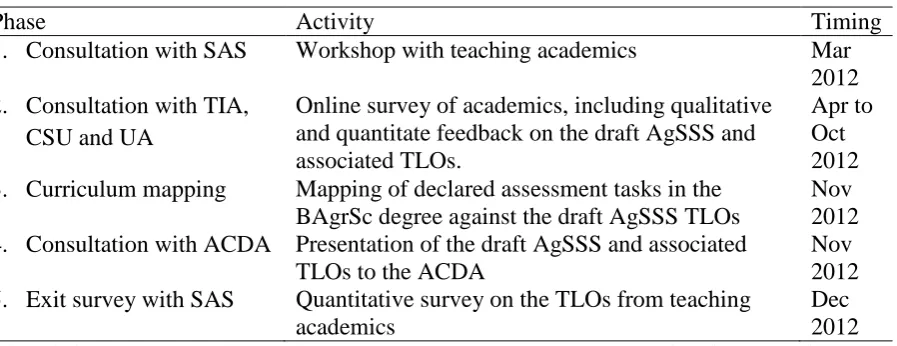
The project’s scope was limited to the 4-year, Agricultural Science degree offered at UTAS. Project engagement is outlined in Table 1 following the approach used by Hinton, Gannaway, Berry, and Moore (2011) that includes; assessing the climate of readiness for change, which is established in the introduction to this paper; engagement throughout the project; and transfer of project outcomes.
Table 1: Project engagement and timing of activities.
Phase Activity Timing
1. Consultation with SAS Workshop with teaching academics Mar
2012 2. Consultation with TIA,
CSU and UA
Online survey of academics, including qualitative and quantitate feedback on the draft AgSSS and associated TLOs.
Apr to Oct 2012 3. Curriculum mapping Mapping of declared assessment tasks in the
BAgrSc degree against the draft AgSSS TLOs
Nov 2012 4. Consultation with ACDA Presentation of the draft AgSSS and associated
TLOs to the ACDA
Nov 2012 5. Exit survey with SAS Quantitative survey on the TLOs from teaching
academics
Dec 2012 Abbreviations: AgSSS, Agricultural Science Standard Statement; SAS, School of Agricultural Science; TIA, Tasmanian Institute of Agriculture; CSU, Charles Sturt University; UA, The University of Adelaide.
Project engagement was divided into the five phases outlined in Table 1. We engaged with a range of stakeholders: teaching academics in the School of Agricultural Science; research academics in the Tasmanian Institute of Agriculture (TIA); academics in agriculture or related disciplines from Charles Sturt University (CSU) and the University of Adelaide (UA); and the Australian Council of Deans of Agriculture. Based on 2006 data, these three universities together represent around 25% of graduates in agriculture and related disciplines in Australia (Pratley et al., 2008). Data were collected using a mix of quantitative and qualitative methods (Creswell, 2003). Due to the small number of participants, data in the quantitative surveys undertaken in Phase 2 of the project were combined, where appropriate, across academics in the School of Agricultural Science, Tasmanian Institute of Agriculture, University of Adelaide and Charles Sturt University. Ethics approval for data collection was gained from the UTAS Social Sciences Human Ethics Research Committee before the start of the project (HREC 12090).
58
project was designed to inform the preparation of a statement of the nature and extent of the discipline. Key attributes of the discipline were identified as: applied; multidisciplinary; integrates social, economic and environmental issues; and has an element of vocational training. These discipline attributes are described in the draft statement on the nature and extent of Agricultural Science (Table 2).
Table 2: Draft statement on the nature and extent of Agricultural Science
1. Agricultural Science
a. Transforms the environment for the sustainable production of food, fibre and fuel. b. Is a multidisciplinary field that includes the components of biological,
environmental, economic and social sciences that are used in the management and understanding of agriculture.
c. May consider elements of agricultural systems at a range of scales, from the microscopic and molecular levels through to the landscape.
d. Is applied in the development of new methods, processes and systems to address real-world issues facing agriculture and agribusiness; and their sustainability. e. Promotes the basic or theoretical understanding of agricultural processes and
systems.
f. Has a foundation in the scientific method to test hypotheses and use empirical evidence to support or refute these hypotheses. Data and other forms of evidence may be either qualitative or quantitative and may require the use of appropriate statistical methods in analysis and interpretation.
2. Agricultural scientists:
a. Have the responsibility to communicate the outcomes of their work clearly, accurately and without bias to their peers and society.
b. Must maintain the professional standards of science and conduct themselves in an ethical manner (as per Science statement).
In addition, academics were asked ‘How can the Science TLOs be modified to suit the Agricultural Science discipline’. This feedback was used to inform the preparation of TLOs for Agricultural Science (Table 3), which are broadly similar to those for Science, but written in the context of the discipline. There is greater emphasis on knowledge and understanding across disciplines, reflected in a subtle change in reorganising the order of the description for TLO 2 (scientific knowledge). For example, this would be the case in the later years of the degree, where students have the opportunity to focus on a discipline area, usually during honours.
59 of high importance.
Table 3: Draft Threshold Learning Outcomes for Agricultural Science
Upon completion of a bachelor degree in agricultural science, graduates will: 1. Understanding agricultural science
Demonstrate a coherent understanding of agricultural science by:
a. Articulating the methods of science and explaining why current scientific knowledge is both contestable and testable by further inquiry.
b. Explaining the role and relevance of agriculture, agribusiness and science in society. 2. Scientific knowledge
Exhibit depth and breadth of scientific knowledge of agriculture by: a. Demonstrating knowledge in several discipline areas.
b. Demonstrating well-developed knowledge in at least one discipline area. 3. Vocational knowledge
Exhibit technical skills in the application of agricultural science by:
a. Attaining professional standards or certification relevant to their discipline area, (when possible).
b. Demonstrating proficiency in technical skills relevant to their discipline area (in the workplace).
4. Inquiry and problem solving
Critically analyse and solve scientific problems by:
a. Gathering, synthesising and critically evaluating information from a range of sources.
b. Designing and planning an investigation.
c. Selecting and applying appropriate and/or theoretical techniques or tools in order to conduct an investigation.
d. Collecting, accurately recording, interpreting and drawing conclusions from scientific data.
5. Communication
Be effective communicators by:
a. Communicating scientific results, information, or arguments, to a range of audiences, for a range of purposes, and using a variety of modes within an agricultural context.
6. Personal and professional responsibility
Be accountable for their own learning and scientific work by: a. Being independent and self-directed learners.
b. Working effectively, responsibly and safely in an individual or team context. c. Demonstrating knowledge of the regulatory frameworks relevant to their
disciplinary area and personally practising ethical conduct.
60
not have the opportunity to develop these enough.” Another respondent had the opposite view “Can’t see why students should learn to drive a tractor. [It is] more important to understand how machinery influences soil structure and biology.” Other respondents provided qualifiers, such as “The issue here is whether graduates enter a research career or applied (e.g. extension, consultancy career), and depending on career path, the relative importance of specific skill sets will vary.”
Table 4: Combined responses from academics in the School of Agricultural Science, Tasmanian Institute of Agriculture, University of Adelaide and Charles Sturt University on the importance of TLOs for all Agricultural Science graduates n=26. The mean is ± SD, where ‘high’ is rated at 5.
TLO Descriptor % Respondents Mean
Low High
1 Understanding agricultural science 0 0 8 27 65 4.58 ± 0.64
2 Scientific knowledge 0 0 8 27 65 4.69 ± 0.62
3 Vocational knowledge 8 12 38 35 8 3.28 ± 1.02
4 Inquiry & problem solving 0 0 15 15 69 4.54 ± 0.76
5 Communication 0 0 12 31 58 4.46 ± 0.71
6 Personal & professional responsibility 0 0 4 28 68 4.65 ± 0.56
The approach to mapping TLOs in the Agricultural Science degree in Phase 3 was based on a UTAS Teaching Development Grant Project that mapped unit assessment in each major of the Bachelor of Science degree at UTAS, against the Science Learning and Teaching Academic Standards Statement for Science (Jones et al., 2011). Unit (or course) coordinators mapped assessment in all 26 UTAS units offered in the school against the Agricultural Science TLOs, and the outcomes were collectively discussed in a workshop (Table 5). There was a general trend for the majority of coordinators of introductory and intermediate level units to report that their units did not meet all graduate-level TLO standards. Exceptions to this trend were a few intermediate level units where academics regarded the assessment to be at graduate level. The majority of advanced-level students met or exceeded the graduate-level TLOs. When exceeded, this was mostly in TLO 4 (problem solving), where students were assessed on their skills in all aspects of applied experimental research, with minimal supervision. Of the advanced-level units, few met TLO 6.3 (demonstrating knowledge of regulatory frameworks and personally practicing ethical conduct); while similarly, only a few units partially met TLO 3.1 (attaining professional standards). Overall this example has demonstrated that the school was meeting or exceeding the Agricultural Science TLOs, given that not all units need to meet the TLOs and units can meet the TLOs at a range of levels.
61
Table 5: Map of TLOs for Agricultural Science at UTAS; refer to Table 6 for details. TLO5 has been split into 5.1, communication to a scientific audience; 5.2, communication to other audiences. Units (courses) are divided into introductory, intermediate and advanced (levels 1x, 2x and 3x, respectively) and for simplicity the unit codes have been placed by letters.
TLO Introductory
1a 1b 2a 2b 2c 2d 2e 2f 2g 2h 3a 3b 3c 3d 3e 3f 3h 3i 3j 3k 3l 3m 3n 3o 3p 3q 3r
TLO 1. Understanding agricultural science 1.1
1.2
2.1 2.2
3.1 3.2
TLO 4. Inquiry and problem solving 4.1
4.2 4.3 4.4
5.1 5.2
TLO 6. Personal and professional responsibility 6.1
6.2 6.3
Assessed TLOs are:
Below graduate TLO (introductory) Partially meets graduate TLO Exceeds graduate TLO Below graduate TLO (intermediate) Meets graduate TLO
Intermediate Advanced
TLO 2. Scientific Knowledge
TLO 3. Vocational knowledge
62
The exit survey in Phase 5 of the project was completed by academic staff in the School of Agricultural Science who had participated in mapping the TLOs against assessment in each of the units (courses) offered in the degree. Using t-tests analysis (P = 0.05) there were no significant differences found between Phase 2 and Phase 5 ratings. For example, similar to the survey in Phase 2, when asked to ‘Please rate the teaching learning outcome (TLO) statements, which are attributes that agricultural science students should have on graduation’ the majority of respondents (>73%) rated all TLOs, with the exception of TLO 3 (vocational knowledge) as highly important (Table 6).
Table 6: Exit survey of TLOs by academics in the School of Agricultural Science, UTAS. n=11. The mean is ± SD, where ‘high’ is rated at 5.
TLO Descriptor % respondents Mean
Low High
1 Understanding agricultural science 0 0 0 27 73 4.73 ± 0.47
2 Scientific knowledge 0 0 0 18 82 4.82 ± 0.40
3 Vocational knowledge 0 0 70 30 0 3.27 ± 0.47
4 Inquiry & problem solving 0 0 0 18 82 4.82 ± 0.40
5 Communication 0 0 0 27 73 4.73 ± 0.47
6 Personal & professional responsibility 0 0 0 27 73 4.73 ± 0.47
Outcomes and Recommendations
The project had relied on the commitment and engagement of academic and industry professionals within the Agricultural Science discipline for successfully completing a draft Agricultural Science Standards Statement (AgSSS). That a draft statement was developed and validated as a basis for further work indicates that the climate was, and continues to be, ready for change in the direction of developing and establishing national standards for learning outcomes that can be used in curriculum mapping. The process of engagement was constrained by resources and could not replicate the reach of the national Science Standards project. However the principles of collegiality and consultation and the methods for ensuring stakeholder engagement and buy-in were effective on the smaller scale of this project. This section will set out the distinctive aspects of the AgSSS (in particular the TLOs) in the context of the SSS. It then discusses the general relevance of the AgSSS to curriculum mapping and describes how it is being applied in the UTAS context and perceived benefits. An unanticipated outcome of the process of engagement adopted by the project is the development of a community of practice in the School of Agricultural Science, and more broadly, a network of practice (Brown & Duguid, 2000) in Agricultural Science education centred on developing an agreed standard for measuring quality in higher education related to student learning outcomes. These discipline relationships are described and the implications for further development of the AgSSS and its dissemination outlined.
63
The relevance of TLO 3 to Agricultural Science is an interesting issue. As outlined earlier, VET education in agriculture in Australia has traditionally been undertaken by agricultural colleges (Black, 1976) and is one pathway to tertiary education. Several of these colleges have amalgamated with the university sector e.g. Muresk in Western Australia, Gatton in Queensland and Roseworthy in South Australia. Despite the contrary opinions of some academics, there is disconnect between the requirement for work-related training common in many of the universities that teach agriculture at the exclusion of vocational skills (Bellotti, 2012; McSweeney & Rayner, 2011). Furthermore, at UTAS, many units actively seek participation from industry in delivery of the curriculum and in participation through student-led research that can be applied to real-world issues. Some institutions, such as the University of New England, are developing Dual Sector degrees that enable students to undertake concurrent articulation in the Bachelor of Agrifood Business and VET qualifications through TAFE.
Another possible source of tension is that universities deliver ‘employment-ready’ graduates, armed with content knowledge and generic skills applicable to the work force (Bath, Smith, Stein, & Swann, 2004), as opposed to ‘job-ready’ graduates who typically require on the job training, such as that provided through graduate recruitment programs (Bennett, Dunne, & Carré, 1999). These programs are common in Government but increasingly also in the private sector faced with competition for graduates from prospective employers in higher-demand industries, such as mining. Again, wider discussion with a range of stakeholders is required to explore the details and clarify this proposed TLO and how it relates to generic graduate attributes. Alternatively, one possible approach could be to separate TLO 3; for example, moving ‘certification’ into the TLO relating to professional and personal responsibility, and emphasising applied and authentic learning in TLOs 1 and 2 that relate to knowledge and understanding, respectively.
Curriculum mapping
The process described here has generated the curriculum map through a ‘declared’ approach, as outlined by English (1978), where academics audited the TLOs in their own units (or courses). The alternative approaches of either ‘taught’ or ‘assessed’ may have provided a different outcome. There are some examples in the higher education literature where curriculum mapping has used a combination two of these approaches e.g. Spencer, Riddle, and Knewstubb (2011).
64
that will enable better linkages between units and better defined learning pathways from introductory through to advanced level units (courses).
Communities of practice – the agriculture discipline
Communities of practice aim to bring together academics to work together collaboratively and to engage them in research and practice in learning and teaching (Lave & Wenger, 1991). Within the School of Agricultural Science, the participation of academics has strengthened our community of practice in learning and teaching and created connections with communities of practice in other universities. This process has built on peer-to-peer professional learning previously used in the development of a generic assessment framework for the School of Agricultural Science in response to an external imperative to implement criterion-referenced assessment at UTAS (Botwright Acuna, 2009a, 2009b). Not only can the generic assessment framework inform the development and implementation of TLOs for Agricultural Science, but staff familiarity with the process of peer-to-peer learning increased the likelihood of success of this project. The project has contributed to the further development of a community of practice emerging in the School of Agricultural Science focused on teaching and learning. Outcomes of the project will include supporting the School to meet TEQSA requirements for regulation and quality assurance of tertiary education against agreed standards.
To date, while there are isolated patches of activity in the scholarship of learning and teaching in agriculture at university, there is currently no national discipline network or well-established communities of practice in local contexts. As reviewed, for example by Hunt, Birch, Coutts, and Vanclay (2012), sessions on education at conferences in agriculture or related disciplines tend to focus on extension activities in farming communities, or andragogy – for which agriculture has a well-established reputation - rather than pedagogical practice at university level. The shift in the regulatory environment may change this. Already, as is the case at UTAS, we are experiencing an increased emphasis on the quality of learning and teaching that is reflected in the UTAS statement on the expectations for academics that places emphasis on sustained academic contribution to teaching practice, curriculum design and scholarship of teaching, as well as discipline research.
Conclusion
65
Acknowledgements
The authors would like to acknowledge support from SaMnet; ACDA for an invitation to present this research at their Spring meeting in 2012; ALTC Discipline Scholar for Science, Brian Yates; Yann Guisard and Andrea Crampton (Charles Sturt University); Amanda Able and Simon Pyke (the University of Adelaide).
References
ACDA. (2009). The Australian Council of Deans of Agriculture Retrieved March 2013, from http://www.csu.edu.au/special/acda/.
Higher Education Standards Framework (Theshold Standards), F2012L00003 C.F.R. (2011). Australian Qualifications Framework. (2013). The Australian Qualifications Framework. Australian
Qualifications Framework Council.
Bath, D., Smith, C., Stein, S., & Swann, R. (2004). Beyond mapping and embedding graduate attributes: bringing together quality assurance and action learning to create a validated and living curriculum. Higher Education Research & Development, 23(3), 313-328.
Bellotti, W. (2012). Human capacity to meet the sustainable intensification challenge. In J. Mullen, M. Tester, M. Goddard, K. Goss, P. Carberry, B. Keating, B, Bellotti (Eds.) Assessing the opportunities for achieving future productivity growth in Australian agriculture, 68-82. Australian Farm Institute.
Bennett, N., Dunne, E., & Carré, C. (1999). Patterns of core and generic skill provision in higher education.
Higher Education, 37(1), 71-93.
Biggs, J., & Tang, C. (2007). Teaching for quality learning at university (3rd ed.). Maidenhead, England: Open University Press McGraw Hill.
Black, A. (1976). Organisational genesis and development: A study of Australian Agricultural Colleges. St Lucia: University of Queensland Press.
Botwright Acuna, T. (2009a). A generic assessment framework as a tool for teacher development in agricultural science. Paper presented at the Teaching Matters Conference 2009, Hobart, Tas., 26 Nov.
Botwright Acuna, T. (2009b). A generic assessment framework for unit consistency in Agricultural Science.
Paper presented at the ATN Assessment Conference 2009: Assessment in Different Dimensions, Melbourne, Vic, 19 - 20 Nov.
Brown, J., & Duguid, P. (2000). The Social Life of Information: Harvard Business Press.
Creswell, J. (2003). Research design: Qualitative, quantitative, and mixed methods approaches (2nd ed.). London: Thousand Oaks.
Dunne, A. (2010). Contemporary issues in the provision of tertiary agriculutre programs: a case study of The University of Queensland. Australian Agribusiness Perspective.
English, F. (1978). Quality control in curriculum development. Arlington, VA: American Association of School Administrators.
Hay, I. (2012). Over the threshold-setting minimum learning outcomes (benchmarks) for undergraduate geography majors in Australian universities. Journal of Geography in Higher Education, 36, 481-198. Higher Education Standards Panel. (2013). Retrieved March 2013, 2013, from http://www.hestandards.gov.au/ Hinton, T., Gannaway, D., Berry, B., & Moore, K. (2011). The D-Cubed Guide: Planning for Effective
Dissemination. Australian Teaching and Learning Council.
Holmes, J., Jones, S., & Yates, B. (2012). Being TEQSA Ready: Mapping helps provide the evidence. Campus Review.
Hunt, W., Birch, C., Coutts, J., & Vanclay, F. (2012). The many turnings of agricultural extension in Australia.
The Journal of Agricultural Education, 18, 9-26.
Jones, S., Yates, B., & Kelder, J. (2011). Learning and Teaching Academic Standards Statement for Science. Australian Learning and Teaching Council.
Lave, J., & Wenger, E. (1991). Situated learning: Legitimate peripheral participation. United Kingdom: Cambridge University Press.
McSweeney, P., & Rayner, J. (2011). Developments in Australian agricultural and related education. Journal of Higher Education Policy and Management, 33(4), 415-425.
NFF. (2012). NFF Farm Facts: 2012. National Farmers Federation.
Oliver, B., Ferns, S., Whelan, B., & Lilly, L. (2010). Mapping the curriculum for quality enhancement: Refining a tool and processes for the purpose of curriculum renewal. Paper presented at the Proceedings of the AuQF 2010. 'Quality in Uncertain Times', Gold Coast, Australia 30 June - 02 July 2010.
66
Rifkin, W., Sharma, M., Crampton, A., Yates, B., Matthews, K., Beames, S., Varavsky, C., Johnson, E., Jones, S., Zadnik, M., & Pyke, S. (2012). Learning to lead change: SaMnet's action-learning projects. Australian Journal of Education in Chemistry, 72, 9-15.
Spencer, D., Riddle, M., & Knewstubb, B. (2011). Curriculum mapping to embed graduate capabilities. Higher Education Research & Development, 31(2), 217-231.