Inform the Development of Best Practice in
Interprofessional Training for Collaborative
Primary Healthcare
Michael W. Bentley, BSc, MA, DrPH;
Rohan Kerr, MBBS, FRACGP, JCCA (Anaes), FARGP; & Susan Powell, BSW, GradCert (Health Services Management)
Abstract
Background: Primary healthcare (PHC) education and training is directed to a diverse range of health professionals at undergraduate, postgraduate, and profes-sional levels. Increasing emphasis is being placed on PHC profesprofes-sionals working together in delivering better care and improving patient outcomes. This article reports on using a modified Delphi technique to determine the level of consensus on a series of statements across four domains of interprofessional education (IPE) for collaborative practice: big picture, organization, capabilities, teaching, and learning.
Methods and Findings: The modified Delphi technique used three Delphi rounds: the first round comprising workshops, interviews, or online survey; the remaining rounds used online surveys. A panel of 56 PHC medical, nursing, allied health, and workforce experts participated. There was consensus on a set of capabilities for interprofessional learning outcomes and on a range of teaching and learning strategies. Areas for further consideration included identifying interprofessional training opportunities through continuing professional development, and tailor-ing team-based approaches to diverse PHC setttailor-ings.
Conclusion: The modified Delphi technique used in this project demonstrated a successful engagement of a heterogeneous panel of PHC experts. The principles of IPE for collaborative practice and strategies for delivering interprofessional training could apply across various PHC settings.
Keywords:Primary healthcare; Interprofessional workforce training; Continuing professional development
Introduction
Primary healthcare services, such as health promotion/illness prevention, care for the sick and injured, mental health, and allied health services, are considered neces-sary for good health outcomes in a community [1]. The provision of these primary healthcare services, through general practices, community health services, and other non-government agencies, requires a diverse range of health professionals, including general practitioners (GPs), nurses, and allied health professionals, who are increas-ingly expected to work together in delivering patient care [2]. There is no single approach to education and training needed to support interprofessional,
collabora-Journal of Research in Interprofessional Practice and Education
Vol. 6.1 June 2016
Journal of Research in Interprofessional Practice and Education (JRIPE) Vol. 6.1
© 2016
Journal of Research in Interprofessional Practice and Education
Vol. 6.1 June 2016 2
Delphi Technique in Interprofessional Training
Bentley, Kerr, & Powell
tive, and integrated primary health care [3]. Hammick, Freeth, Koppel, Reeves, and Barr [4] report that although:
Interprofessional education is generally well received, enabling knowledge and skills necessary for collaborative working to be learnt; it is less able to positively influence attitudes and perceptions towards others in the service delivery team [p. 735].
However, “detailed planning, stakeholder enthusiasm and commitment appear to be essential to the success of interprofessional continuing education” [5, p. 111]. Moreover, there are many systemic and organizational determinants of successful collaboration, including the educational and professional systems [6]. Several issues from the organi-zational change literature are relevant to the implementation of initiatives in interpro-fessional education for collaborative practice:
At the level of the individual: the existence of strong professional cul-tures and the need to motivate change. At the level of the organiza-tion, the context of and leadership for interprofessional education (IPE) and collaborative practice are relevant. At the system level, a discussion of incremental versus radical forces for change is particu-larly germane [7, p. 177].
Although interprofessional education is seen as a response to a fragmented health system [2], there are research gaps and more evidence is needed [8]. Many questions about interprofessional education and teamwork, such as when to educate, who to educate, and how to educate, remain unanswered and open to future research [9]. In Australia, for instance, the training of primary healthcare professionals occurs at sev-eral levels (undergraduate, postgraduate, continuing professional development) and many organizations are involved. Meeting continuing professional development standards is a registration requirement for many medical, nursing, and allied health professionals.
Context
For the purpose of clarity, the following definitions will be used in this article [10]:
Interprofessional education (IPE): “occasions when two or more pro-•
fessions learn from and about each other to improve collaboration and the quality of care.” [p. 24]
Collaborative patient-centred practice: “is designed to promote the •
active participation of each discipline in patient care. It enhances patient and family centred goals and values, provides mechanisms for continuous communication among caregivers, and optimizes staff participation in clinical decision making within and across dis-ciplines fostering respect for disciplinary contributions of all profes-sionals.” [p. 24]
The research question was: What features of interprofessional education for col-laborative practice could inform the development of an integrated roadmap to best practice primary healthcare training in Tasmania? This article reports on the use of a modified Delphi technique to determine the level of consensus on a series of state-ments across four domains of interprofessional education for collaborative prac-tice—the big picture, capabilities, teaching and learning, and organization [11].
Methods
The Delphi technique is “a structured process that uses a series of questionnaires or ‘rounds’ to gather information which are continued until ‘group’ consensus is reached” [12, p. 206]. We chose the Delphi technique because it is an appropriate method for topics where there is limited evidence and wide opinion [13], such as interprofessional, collaborative, and integrated primary healthcare. Furthermore, the method is also suitable for when participants work in diverse geographic locations and where there is a need to ensure that individual opinion does not dominate the process of seeking consensus across a wide group of experts [13]. The Delphi tech-nique has been used in areas related to our study [1,14-17]. To inform the Delphi process, a rapid review (see Appendix 1) of the literature (a search of PubMed) was used to identify reviews of primary healthcare training that featured integrated, col-laborative, interprofessional approaches. Search terms included integration, collabo-ration, multidisciplinary, interdisciplinary, interprofessional, primary (health) care, general practice, and team (work). The PubMed database was searched for reviews written in English and published between January 2001 and November 2013. Rapid reviews are commonly used when there are limited time and resource constraints [18]. As this project was conducted over a twelve-month timeframe, a more rigorous systematic review was not feasible [19]. The streamlined methods used (published reviews, limited inclusion criteria by date and language, one researcher (MB) con-ducting the review) are common approaches to rapid reviews [19].
Thirty-three reviews were identified (see Appendix 1). Reference lists of these reviews were searched for relevant studies, perspectives, and models. Framework analysis [20], a qualitative data analysis method that generates a matrix of cases and themes, was used to summarize these papers and categorize the themes against the
Journal of Research in Interprofessional Practice and Education
Vol. 6.1 June 2016 3
Delphi Technique in Interprofessional Training
findings (positive, negative, inconclusive, propositions to be tested). This analysis was discussed and agreed upon by the research team (MB, RK, SP) and used to develop statements about interprofessional capabilities and education strategies to test for consensus using the modified Delphi consensus technique.
To select a heterogeneous panel of primary healthcare stakeholders for the Delphi technique, a criterion sampling strategy was used [21]. The criteria comprised: state wide and regional representation; a mix of medical, nursing, allied health profession-als and workforce specialists; perspectives from academics, health service managers, and practitioners. The project’s reference group provided important assistance. Potential participants were sent a letter of invitation via email or post with a partici-pant information sheet and consent form. A modified Delphi technique was used. In a modified Delphi technique, the first round uses focus groups and/or interviews to generate initial interest and commitment to the process [13]. Our modified Delphi consensus technique had three rounds.
In Round 1, three workshops were conducted in the northwest, north, and south of Tasmania. The workshops lasted for approximately one hour. Participants were asked not to disclose details of the discussion in the workshops in order to protect participants’ anonymity and maintain confidentiality of the information gathered. Participants who were unable to attend a workshop were offered the opportunity of an interview with the research officer or completion of an online survey. The inter-views took approximately twenty to thirty minutes and were conducted by telephone or in person. The workshops, interviews, and online survey used two open-ended questions: 1) What are the training gaps that exist in the current and future primary healthcare workforce environment in Tasmania? 2) What are possible integrated solutions or models (that use interprofessional approaches to collaborative practice) to address these gaps?
In Round 2 of the project, participants were asked to rate and comment on a series of statements in relation to interprofessional education for collaborative practice. There were thirty-three statements, which were developed from the findings of the focused scan of the international literature, and thematic analysis [22] of the work-shops, interviews, and survey conducted in Round 1. The statements were grouped under four sections, using a conceptual framework developed for the Australian con-text [11]: 1) Big picture (the why?); 2) Capabilities (the what?); 3) Teaching & learn-ing (the how?); and 4) Organization (the where?). This framework captured the themes from Round 1. Five-point Likert items were used for each of the statements and participants were asked to rate each statement. Statements asked for level of agree-ment (“strongly disagree,” “disagree,” “neither disagree nor agree,” “agree,” “strongly agree”), level of importance (“not at all important,” “unimportant,” “neither unimpor-tant nor imporunimpor-tant,” “imporunimpor-tant,” “very imporunimpor-tant”) or level of usefulness (“not at all useful,” “not very useful,” “neither not useful nor useful,” “somewhat useful,” “very use-ful”). Participants were also asked to provide reasons for their ratings of each state-ment via a comstate-ments box. In addition, participants were asked to identify the main priority focus areas where interprofessional education for collaborative practice was needed. See Appendix 2 for the complete list of Round 2 survey statements.
Journal of Research in Interprofessional Practice and Education
Vol. 6.1 June 2016 4
Delphi Technique in Interprofessional Training
There are no agreed guidelines on what constitutes consensus in a Delphi study [12]. Consensus measurement includes level of agreement, median scores, and interquartile ranges [23]. In this study we used all three types of measurements as they are all commonly used in health research [12]. We applied the following criteria for consensus: ≥ 70 percent of participants either “agree” or “strongly agree” with the statement (or rated the statement as “important” or “very important,” “somewhat use-ful” or “very useuse-ful”) andmedian score ≥ 4 andinterquartile range ≤ 1. In Round 3, the median score needed to be ≥ 3, as Likert items used in this round were changed from a five-point scale to a four-point scale, removing the middle (neutral) option to elicit an opinion for or against a statement [24].
In Round 3 of the project, participants were asked to rate and comment on the statements in relation to interprofessional education for collaborative practice that did not achieve consensus in Round 2. Participants received the median score, level of agreement/disagreement and comments on the statement from Round 2. Participants were also given the results for the statements that reached consensus. In this round four-point Likert items were used. The middle response, e.g., “neither dis-agree nor dis-agree,” was removed to determine the level of dis-agreement or disdis-agreement. Participants were asked to tick the N/A box if they had no opinion on a statement. Participants were also asked to comment on what interprofessional education is needed for collaborative practice in the priority areas identified in Round 2. See Appendix 3 for the complete list of Round 3 survey statements.
The three rounds were conducted between April and August 2014. Surveys were developed and administered using the SurveyMonkey® web-based format, which has been shown to increase data quality and response rates [25]. Additionally, we aimed to minimize non-response in the three rounds by using personalized emails and two email reminders [26]. Responses were analyzed using Microsoft Excel 2013
®
. All par-ticipants were sent emails with links to the surveys. Ethics approval was obtained from the Tasmania Social Sciences Human Research Ethics Committee.Results
We identified 477 key stakeholders from organizations with a primary healthcare workforce-training role in Tasmania. This large list included 244 medical practition-ers working in general practice (114 GP supervisors and 130 GP registrars currently training for vocational registration as a GP); GPs receive many requests to partici-pate in research and we anticipartici-pated a low rate of participation from this group [27]. The response rates were: Allied Health—60 percent; Nursing—21 percent; General Practice—6 percent; and Other—42 percent (the “Other” category mainly comprised university academics and program managers from local primary healthcare organi-zations). The final Delphi panel comprised 56 members.
Round 1: Sixteen people participated in the workshops. Six additional face-to-face/telephone interviews were conducted. An online survey was sent to 35 partici-pants with 22 responses (63% response rate). The overall participation rate in Round 1 was 77 percent. An online survey was used in Rounds 2 and 3. The response rate to the Round 2 online survey was 74 percent (42 respondents). The response rate to
Journal of Research in Interprofessional Practice and Education
Vol. 6.1 June 2016 5
Delphi Technique in Interprofessional Training
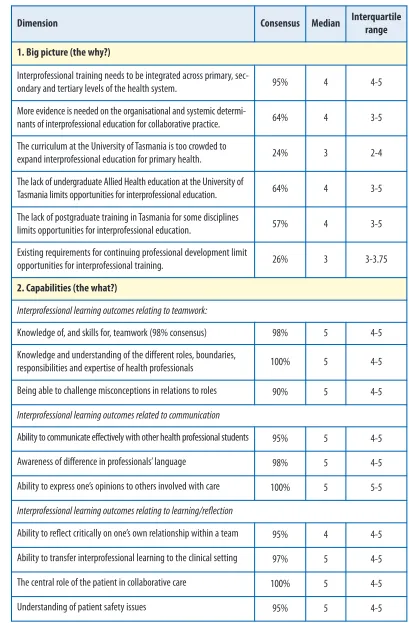
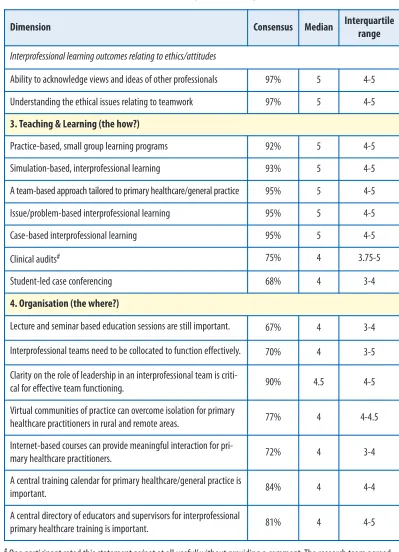
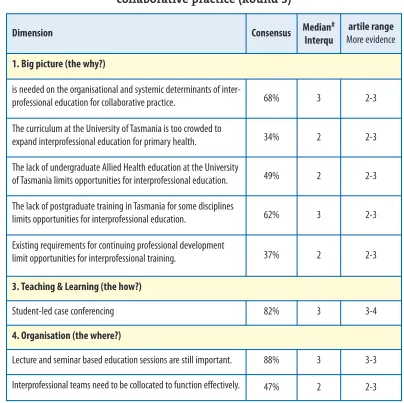
the Round 3 online survey was 73 percent (41 respondents). The results from Round 2 and Round 3 are detailed in Table 2 and Table 3, respectively. Results in each of the four sections—the why, the what, the how, and the where—are discussed in turn.
Journal of Research in Interprofessional Practice and Education
Vol. 6.1 June 2016 6
Delphi Technique in Interprofessional Training
Bentley, Kerr, & Powell
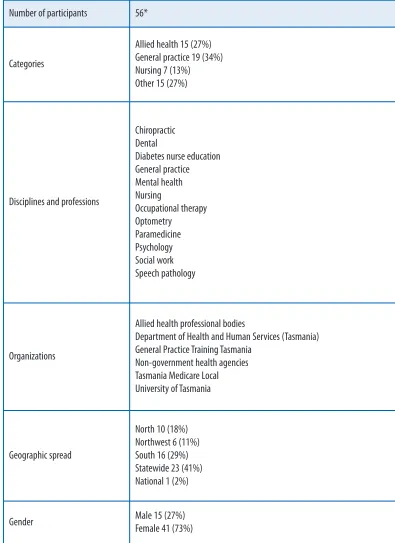
Table 1 details the characteristics of the Delphi panel.
*Originally 57 members—two members left their positions during the process, one joined after Round 1. Number of participants 56*
Categories
Allied health 15 (27%) General practice 19 (34%) Nursing 7 (13%) Other 15 (27%)
Disciplines and professions
Chiropractic Dental
Diabetes nurse education General practice Mental health Nursing
Occupational therapy Optometry
Paramedicine Psychology Social work Speech pathology
Organizations
Allied health professional bodies
Department of Health and Human Services (Tasmania) General Practice Training Tasmania
Non-government health agencies Tasmania Medicare Local University of Tasmania
Geographic spread
North 10 (18%) Northwest 6 (11%) South 16 (29%) Statewide 23 (41%) National 1 (2%)
Gender Male 15 (27%)
Table 2: Delphi consensus on interprofessional training for collaborative practice (Round 2)
Journal of Research in Interprofessional Practice and Education
Vol. 6.1 June 2016 7
Delphi Technique in Interprofessional Training
Bentley, Kerr, & Powell
Dimension Consensus Median Interquartile
range 1. Big picture (the why?)
Interprofessional training needs to be integrated across primary,
sec-ondary and tertiary levels of the health system. 95% 4 4-5
More evidence is needed on the organisational and systemic
determi-nants of interprofessional education for collaborative practice. 64% 4 3-5
The curriculum at the University of Tasmania is too crowded to
expand interprofessional education for primary health. 24% 3 2-4
The lack of undergraduate Allied Health education at the University of
Tasmania limits opportunities for interprofessional education. 64% 4 3-5
The lack of postgraduate training in Tasmania for some disciplines
limits opportunities for interprofessional education. 57% 4 3-5
Existing requirements for continuing professional development limit
opportunities for interprofessional training. 26% 3 3-3.75
2. Capabilities (the what?)
Interprofessional learning outcomes relating to teamwork:
Knowledge of, and skills for, teamwork (98% consensus) 98% 5 4-5
Knowledge and understanding of the different roles, boundaries,
responsibilities and expertise of health professionals 100% 5 4-5
Being able to challenge misconceptions in relations to roles 90% 5 4-5
Interprofessional learning outcomes related to communication
Ability to communicate effectively with other health professional students 95% 5 4-5
Awareness of difference in professionals’ language 98% 5 4-5
Ability to express one’s opinions to others involved with care 100% 5 5-5
Interprofessional learning outcomes relating to learning/reflection
Ability to reflect critically on one’s own relationship within a team 95% 4 4-5
Ability to transfer interprofessional learning to the clinical setting 97% 5 4-5
The central role of the patient in collaborative care 100% 5 4-5
Table 2: (continued)
#One participant rated this statement as ‘not at all useful’ without providing a comment. The research team agreed
that this response was ambiguous and accepted the consensus for the statement. Journal of Research in
Interprofessional Practice and Education
Vol. 6.1 June 2016 8
Delphi Technique in Interprofessional Training
Bentley, Kerr, & Powell
Dimension Consensus Median Interquartile
range
Interprofessional learning outcomes relating to ethics/attitudes
Ability to acknowledge views and ideas of other professionals 97% 5 4-5
Understanding the ethical issues relating to teamwork 97% 5 4-5
3. Teaching & Learning (the how?)
Practice-based, small group learning programs 92% 5 4-5
Simulation-based, interprofessional learning 93% 5 4-5
A team-based approach tailored to primary healthcare/general practice 95% 5 4-5
Issue/problem-based interprofessional learning 95% 5 4-5
Case-based interprofessional learning 95% 5 4-5
Clinical audits# 75% 4 3.75-5
Student-led case conferencing 68% 4 3-4
4. Organisation (the where?)
Lecture and seminar based education sessions are still important. 67% 4 3-4
Interprofessional teams need to be collocated to function effectively. 70% 4 3-5
Clarity on the role of leadership in an interprofessional team is
criti-cal for effective team functioning. 90% 4.5 4-5
Virtual communities of practice can overcome isolation for primary
healthcare practitioners in rural and remote areas. 77% 4 4-4.5
Internet-based courses can provide meaningful interaction for
pri-mary healthcare practitioners. 72% 4 3-4
A central training calendar for primary healthcare/general practice is
important. 84% 4 4-4
A central directory of educators and supervisors for interprofessional
Table 3: Delphi consensus on interprofessional training for collaborative practice (Round 3)
Note: #The Likert items used in Round 3 were changed from a five-point scale to a four-point scale, removing the middle (neutral) option to elicit an opinion for or against a statement. Participants were asked to tick the N/A box, if they had no opinion on a statement.
Big-picture decisions: The why
The panel agreed that interprofessional training needs to be integrated across pri-mary, secondary, and tertiary levels of the health system. The panel did not reach consensus on whether more evidence on the organizational and systemic determi-nants of interprofessional education for collaborative practice is required. Comments suggested that IPE for collaborative practice initiatives should proceed, but still required evaluation evidence. Further consideration is needed: 1) to explore opportunities to foster interprofessional education for primary health in the curricu-lum at the University of Tasmania; 2) to address the lack of undergraduate courses for many allied health professions; 3) to identify more opportunities for interprofes-sional education in postgraduate training; and 4) to maximize opportunities for interprofessional training through continuing professional development.
Journal of Research in Interprofessional Practice and Education
Vol. 6.1 June 2016 9
Delphi Technique in Interprofessional Training
Bentley, Kerr, & Powell
Dimension Consensus Median#
Interqu
artile range
More evidence
1. Big picture (the why?)
is needed on the organisational and systemic determinants of
inter-professional education for collaborative practice. 68% 3 2-3
The curriculum at the University of Tasmania is too crowded to
expand interprofessional education for primary health. 34% 2 2-3
The lack of undergraduate Allied Health education at the University
of Tasmania limits opportunities for interprofessional education. 49% 2 2-3
The lack of postgraduate training in Tasmania for some disciplines
limits opportunities for interprofessional education. 62% 3 2-3
Existing requirements for continuing professional development
limit opportunities for interprofessional training. 37% 2 2-3
3. Teaching & Learning (the how?)
Student-led case conferencing 82% 3 3-4
4. Organisation (the where?)
Lecture and seminar based education sessions are still important. 88% 3 3-3
Defining and understanding capabilities: The what
The panel agreed on a set of capabilities for interprofessional learning outcomes relating to:
Teamwork (knowledge of, and skills for, teamwork; knowledge and •
understanding of the different roles, boundaries, responsibilities, and expertise of health professionals; and being able to challenge misconceptions in relations to roles);
Communication (ability to communicate effectively with other health •
professional students; awareness of difference in professionals’ language; and ability to express one’s opinions to others involved with care); Learning/reflection (ability to reflect critically on one’s own relation-•
ship within a team; and ability to transfer interprofessional learning to the clinical setting);
The patient/client (the central role of the patient in collaborative •
care; and understanding of patient safety issues); and
Ethics/attitudes (ability to acknowledge views and ideas of other pro-•
fessionals; and understanding the ethical issues relating to teamwork).
The principles of interprofessional training for collaborative practice can be applied to primary healthcare training topics in health areas such as mental health, chronic conditions, emergency medicine, musculoskeletal conditions, use of medi-cines, and wound management, and for population groups such as Aboriginal health, lesbian, gay, bisexual, transgender, and intersex health, refugee health, women’s and children’s health, youth health, and the ageing population.
Teaching and learning: The how
The panel agreed on a range of teaching and learning strategies: a team-based approach tailored to primary healthcare/general practice; case-based interprofes-sional learning; issue/problem-based interprofesinterprofes-sional learning; practice-based, small group learning programs; simulation-based interprofessional learning; stu-dent-led case conferencing, and clinical audits.
Organization: The where
The panel agreed that lecture/seminar sessions are still important for interprofes-sional training, as they offer opportunities to hear from specialists and network with other health professionals. Coordinating training, via a central training calendar for primary healthcare/general practice and a central directory of educators and super-visors for interprofessional primary healthcare training, was seen as important. This support was qualified by comments attesting to the difficulty of achieving coordina-tion when there are disparate providers of events and training.
The panel agreed that clarity on the role of leadership in an interprofessional team is critical for effective team functioning. However, the panel, while tending to agree in Round 2 that interprofessional teams need to be co-located to function effectively, was evenly split on the statement after Round 3. In Round 2, there was a 20 percent
“neu-Journal of Research in Interprofessional Practice and Education
Vol. 6.1 June 2016 10
Delphi Technique in Interprofessional Training
tral” response (i.e., neither agree nor disagree). In Round 3, 22 percent elected for the “not applicable” option. However, the reasons for the shift from 70 percent support in Round 2 to 47 percent support in Round 3 are not clear. Responses in the comments box that followed the statement indicated that while it was seen as desirable for inter-professional teams to be co-located (e.g., for patient access, proximity), co-location was not always possible (e.g., remote sites). Some panel members also suggested com-munication and respect as key factors to effective team functioning.
Discussion
The panel agreed on “the what” (the principles that apply to interprofessional ing for collaborative practice) and “the how” (ways to deliver interprofessional train-ing). These results are, perhaps, not surprising. The principles of interprofessional education have been well articulated [2, 28]. Ways to deliver interprofessional train-ing in general practice and primary healthcare have been described in the literature, which was used to inform this Delphi process. In particular, small-group learning [29] and simulation-based training [30] are well established in general practice. Case-based learning [31] and problem-Case-based learning [32] are widely used for students and health professionals. Students can also work together using case conferencing [33] and clinical audits [34] as mechanisms for interprofessional learning.
Some of the questions on “the why” and “the where” of interprofessional training for collaborative practice require further consideration in the context of the local delivery of primary health education and training. A recent scoping paper identified three levels of interventions for interprofessional collaboration: interprofessional training at the individual level; interprofessional interventions at the practice-based level; and interventions at the organization level [35]. It is at the organizational level where the influence of context (local and “big picture”) is important [10,11,36]. Tasmania has one university, one regional training organisation for GP registrars, one Primary Health Network [37], and one Tasmanian Health Service [38], which offers opportunities for a coordinated approach to interprofessional education and training. At the practice-based level, distance need not be a barrier to interprofessional learning [39], yet there are implications for collaborative practice where services are dispersed. The shift in opinion on whether interprofessional teams need to be co-located to function effectively was a notable finding in the Delphi process. There are primary healthcare services in Tasmania where teams are co-located, but also many isolated services that depend on visiting health professionals [40,41]. Integrated care centres have been set up by the Tasmanian health department to accommodate a range of health services across both primary and acute care [40]. Co-locating services do not always mean that professionals in such services will necessarily work together [42]. Factors such as team premises, size and composition of the team, and organiza-tional support are important structures needed for successful team-working, as well as processes that include team meetings, clear goals and objectives, and audit [43]. A review of nurse practitioners and medical practitioners showed it takes time to develop collaborative practice [44]. Whether teams are co-located or dispersed, com-munication, support, and respect are key factors for health professionals [6,45].
Journal of Research in Interprofessional Practice and Education
Vol. 6.1 June 2016 11
Delphi Technique in Interprofessional Training
At the individual level, overcoming isolation is important. In the rural and regional context, strategies such as virtual communities of practice have been used for GP registrars [46]. However, general practitioners still prefer face-to-face learn-ing for continulearn-ing medical education [47]. There are questions about how to provide meaningful interaction in internet-based education [48] and integrating face-to-face and e-learning methods (i.e., blended learning) across health education requires more evidence [49].
Reflections on the use of the modified Delphi technique
Self-selection, recruitment, and non-responder bias, researcher bias, and a drop off in participation are all limitations of the Delphi technique [12,13].
We had a low response rate from general practice. However, the Delphi panel included several GP supervisors and GP registrars. The main group missing from the invitation list was Practice Managers, who are usually non-medical staff. There was a higher response rate from medical educators (41%). The only allied health pro-fessions not represented on the panel were dietetics and physiotherapy (in Tasmania, there are no local undergraduate or postgraduate courses available in these profes-sions). In nursing, the response rate for nurses involved in education was higher than for those involved in management (31% c.f. 20%). Given that this was a study con-cerned with health education and training, it is not surprising that the response rates were higher from people directly involved in this area. However, social desirability bias was minimized by the use of anonymous web-based surveys in Rounds 2 and 3. The Delphi technique, like other non-probability sampling techniques, “does not ensure accurate representation and results cannot be generalized to other settings or to a wider population” [11, p. 208]. Therefore, a limitation of this study is that it is spe-cific to the Tasmanian context. However, the modified Delphi technique could be adapted and applied to other primary healthcare settings across and outside Australia where an interprofessional approach is sought.
While there is no standard sample size for a Delphi panel, most Delphi panels in health research use a sample size between 10 and 100 participants [13]. A recent Australian study seeking interdisciplinary consensus on academic program struc-ture identified fifty-three academics as key stakeholders [15]. The large number of participants (N= 56) on our panel improved the reliability of the study.
To address the potential that participants may know each other, which can make anonymity difficult, we used the concept of quasi-anonymity [50]. That is:
It is often the case that panel members know each other, but they cannot attribute responses to any one member. It is like being in an elite ‘expert’ club where the membership is known but they do not meet face to face to discuss the issues. In fact, knowing that you are a member of an exclusive club may help motivate panellists to par-ticipate [13, p. 10].
We addressed some of the threats to the validity of the study by maintaining a high response rate (≥ 73%) in each round of the study and by using researcher
triangula-Journal of Research in Interprofessional Practice and Education
Vol. 6.1 June 2016 12
Delphi Technique in Interprofessional Training
tion to avoid researcher bias [13]. Logistical constraints (time and resources) limited the Delphi process to three rounds. It is unclear whether further rounds would have altered the level of consensus on the remaining statements from Round 3.
The number of items on Likert scales used in the Delphi technique varies. While a nine-point scale has been recommended [51], it also causes confusion [52]. One study found that five- or seven-point scales are “likely to produce slightly higher mean scores relative to the highest possible attainable score, compared to that produced from a 10-point scale” [53, p. 61]. We chose the five-10-point scale because it was the most common scale used in studies similar to ours [1,14-16].
Implications for further research
Australia is not alone in its focus on general practice as a central provider of primary healthcare services [54]. The move toward more teamwork in general practice is widely recognized across Europe [55] and teamwork has been shown to improve job satisfaction in Australian general practice [56]. Moreover, in Canadian family prac-tices, the commitment by and leadership of GPs is crucial to the successful imple-mentation of interprofessional and collaborative care [57].
Two areas for further consideration include research on tailoring team-based approaches to diverse PHC settings, and identifying interprofessional training opportunities through continuing professional development. As this study focuses on the education side of interprofessional training for collaborative practice, the views of patient are absent. Further research is also needed on how patients/clients can be integrated into the collaborative healthcare team [58].
Conclusion
The modified Delphi technique, as used in this study, demonstrated a successful engagement of a heterogeneous panel of stakeholders in primary health education and training. While some of the findings are specific to the Tasmanian context, the agreed principles reflect those of the Centre for the Advancement of Interprofessional Education [28]. The agreed ways of delivering interprofessional training for collaborative practice could apply across diverse primary healthcare set-tings, such as community health and general practice [6].
Acknowledgements
This research was part of a partnership project of General Practice Training Tasmania and Tasmania Medicare Local. MB was employed by GPTT to conduct the project. RK is an employee of GPTT. SP is an employee of Primary Health Tasmania. The information and discussion do not necessarily reflect the views or policy of General Practice Training Tasmania or Primary Health Tasmania.
Abbreviations
GP General Practitioner
GPTT General Practice Training Tasmania IPE Interprofessional Education
Journal of Research in Interprofessional Practice and Education
Vol. 6.1 June 2016 13
Delphi Technique in Interprofessional Training
References
Thomas, Susan L., Wakerman, John, & Humphreys, John S. (2014). What core primary health care 1.
services should be available to Australians living in rural and remote communities? BMC Family Practice, 15, 143.
World Health Organization. (2010). Framework for action on interprofessional education & collabo-2.
rative practice. Geneva, CH: WHO.
Freeth, Della, & Reeves, Scott (2004). Learning to work together: Using the presage, process, product 3.
(3P) model to highlight decisions and possibilities. Journal of Interprofessional Care, 18(1), 43–56. Hammick, Marilyn, Freeth, Della, Koppel, Ivan, Reeves, Scott, & Barr, Hugh (2007). A best evidence 4.
systematic review of interprofessional education: BEME Guide no. 9. Medical Teacher, 29(8), 735–751.
Davidson, Megan, Smith, Robyn A., Dodd, Karen J., Smith, Jenni S., & O’Laughlan, Meredith J. 5.
(2008). Interprofessional pre-qualification clinical education: A systematic review. Australian Health Review, 32(1), 111–120.
San Martinez-Rodriguez, Leticia, Beaulieu, Marie-Dominique, D’Amour, Danielle, & Ferrada-6.
Videla, Marcela (2005). The determinants of successful collaboration: A review of theoretical and empirical studies. Journal of Interprofessional Care, 19(supplement 1), 132–147.
Ginsburg, Liane, & Tregunno, Deborah (2005). New approaches to interprofessional education and 7.
collaborative practice: Lessons from the organizational change literature. Journal of Interprofessional Care, 19(supplement 1), 177–187.
Reeves, Scott, Perrier, Laure, Goldman, Joanne, Freeth, Della, & Zwarenstein, Merrick (2013). 8.
Interprofessional education: Effects on professional practice and healthcare outcomes (update). Cochrane Database of Systematic Reviews, No. 3, Art. No. CD002213. URL: http://onlinelibrary .wiley.com/doi/10.1002/14651858.CD002213.pub3/full [November 12, 2015]
Hall Pippa, & Weaver, Lynda (2001). Interdisciplinary education and teamwork: A long and wind-9.
ing road. Medical Education, 35(9), 867–875.
Oandasan, Ivy, & Reeves, Scott (2005). Key elements for interprofessional education. Part 1: the learner, 10.
the educator and the learning context. Journal of Interprofessional Care, 19 (supplement 1), 21–38. Lee, Alison, Steketee, Carole, Rogers, Gary, & Moran, Monica (2013). Towards a theoretical frame-11.
work for curriculum development in health professional education. Focus on Health Professional Education, 14(3), 64–70.
Keeney, Sinead, Hasson, Felicity, & McKenna, Hugh (2006). Consulting the oracle: Ten lessons from 12.
using the Delphi technique in nursing research. Journal of Advanced Nursing, 53(2), 205–212. Keeney, Sinead, Hasson, Felicity, & McKenna, Hugh (2010). The Delphi technique in nursing and 13.
health research. Chichester, UK: Wiley.
Junod Perron, Noelle, Cerutti, Bernard, Picchiottino, Patricia, Empeyta, Sebastien, Cinter, Francoise, 14.
& van Gessel, Elisabeth (2014). Needs assessment for training in interprofessional skills in Swiss primary care: A Delphi study. Journal of Interprofessional Care, 28(3), 273–275.
O’Keefe, Maree, Elshaugh, Adam, Burgess, Teresa, Peirce, Eleanor, & Nettlebeck, Ted (2012). Use of 15.
the Delphi technique to facilitate interdisciplinary consensus on academic program structure. Focus on Health Professional Education, 14(1), 55–66.
Attieh, Randa, Gagnon, Marie-Pierre, Estabrooks, Carole A., Légaré, France, Ouimet, Mathieu, 16.
Vazquez, Patricia, & Nuño, Roberto (2014) Organizational readiness for knowledge translation in chronic care: A Delphi study. BMC Health Services Research, 14(1), 534.
McKenna, Hugh, Keeney, Sinead, & Bradley, Martin (2003). Generic and specialist nursing roles: 17.
Views of community nurses, general practitioners, senior policymakers and members of the public. Health & Social Care in the Community, 11(6), 537–545.
Ganann, Rebecca, Ciliska, Donna, & Thomas, Helen (2010). Expediting systematic reviews: 18.
Methods and implications of rapid reviews. Implementation Science, 5(1), 56.
Tricco, Andrea C., Antony, Jesmin, Zarin, Wasifa, Strifler, Lisa, Ghassemi, Marco, Ivory, John, Perrier, 19.
Laure, Hutton, Brian, Moher, David, & Straus, Sharon E. (2015). A scoping review of rapid review methods. BMC Medicine, 13(1), 1.
Ritchie, Jan, & Spencer, Liz (2002). Qualitative data analysis for applied policy research. In: A. 20.
Michael Huberman, & Matthew B. Miles (Eds), The qualitative researcher’s companion, pp. 305–329. Thousand Oaks, CA: Sage.
Hasson, Felicity, Keeney, Sinead, & McKenna, Hugh (2000). Research guidelines for the Delphi sur-21.
vey technique. Journal of Advanced Nursing, 32(4), 1008–1015.
Miles, Matthew B., & Huberman, A. Michael (1994). Qualitative data analysis (2nd ed.). Thousand 22.
Oaks, CA: Sage. Journal of Research in
Interprofessional Practice and Education Vol. 6.1 June 2016 14 Delphi Technique in Interprofessional Training
von der Gracht, Heiko A. (2012). Consensus measurement in Delphi studies: Review and implica-23.
tions for future quality assurance. Technological Forecasting and Social Change, 79, 1525–1536. Garland, Ron (1991). The mid-point on a rating scale: Is it desirable? Marketing Bulletin, 2(Research 24.
Note 3), 66–70.
Gill, Fenella J., Leslie, Gavin D., Grech, Carol, & Latour, Jos M. (2013). Using a web-based survey 25.
tool to undertake a Delphi study: Application for nurse education research. Nursing Education Today, 33(11), 1322–1328.
Hsu, Chia-Chien., & Sandford, Brian A. (2007). Minimizing non-response in the Delphi process: 26.
How to respond to non-response. Practical Assessment, Research & Evaluation, 12, 17.
McKinn, Shannon, Bonner, Carissa, Jansen, Jesse, & McCaffery, Kirsten (2015). Recruiting general 27.
practitioners as participants for qualitative and experimental primary care studies in Australia. Australian Journal of Primary Health, 21(3), 354–359.
Barr, Hugh, & Low, Helena (2011). Principles of interprofessional education. Fareham, UK: Centre 28.
for the Advancement of Interprofessional Education (CAIPE).
Stelter, Klaus, & Marangoni, Silvana (2011). Small group learning: A general practice program. 29.
Australian Family Physician, 40(10), 831–834.
van Soeren, Mary, Devlin-Cop, Sandra, MacMillan, Kathleen, Baker, Lindsay, Egan-Lee, Eileen, & 30.
Reeves, Scott (2011). Simulated interprofessional education: An analysis of teaching and learn-ing processes. Journal of Interprofessional Care, 25(6), 434–440.
Thistlethwaite, Jill E., Davies, David, Ekeocha, Samilia, Kidd, Jane M., MacDougall, Colin, Matthews, 31.
Paul, Purkis, Judith, & Clay, Diane (2012). The effectiveness of case-based learning in health pro-fessional education. A BEME systematic review: BEME Guide No. 23. Medical Teacher, 34(6), e421–e444.
Dahlgren, Lars O. (2009). Interprofessional and problem-based learning: A marriage made in 32.
heaven? Journal of Interprofessional Care, 2009, 23(5), 448–454.
Stew, Graham (2005). Learning together in practice: A survey of interprofessional education in clin-33.
ical settings in South-East England. Journal of Interprofessional Care, 19(3), 223–235.
Chambers, Ruth, & Wakley, Gill (2005). Clinical audit in primary care: Demonstrating quality and 34.
outcomes. Abingdon, UK: Radcliffe Publishing.
Goldman, Joanne, Zwarenstein, Merrick, Bhattacharyya, Onil, & Reeves, Scott (2009). Improving 35.
the clarity of the interprofessional field: Implications for research and continuing interprofes-sional education. Journal of Continuing Education in the Health Professions, 29(3), 151–156. Lemieux-Charles, Louise, & McGuire, Wendy L. (2006). What do we know about health care team 36.
effectiveness? A review of the literature. Medical Care Research and Review, 63(3), 263–300. Department of Health. (2014). Primary health networks. URL: http://www.health.gov.au/internet 37.
/main/publishing.nsf/content/primary_health_networks [November 12, 2015].
Department of Health and Human Services. (2014). One state, one health system, better outcomes. 38.
URL: http://www.dhhs.tas.gov.au/onehealthsystem [November 12, 2015].
Stone, J. (2008). Interprofessional working, distance no barrier. CAIPE Bulletin, April, 15–16. 39.
Department of Health and Human Services. (n.d.). Services. URL: http://www.dhhs.tas.gov.au/ 40.
[November 12, 2015].
Tasmania Medicare Local. (2014). 2013 Census of Tasmanian general practices. Hobart, AU: 41.
Tasmania Medicare Local.
Lawn, Sharon, Lloyd, Andrea, King, Alison, Sweet, Linda, & Gum, Lyn (2014). Integration of pri-42.
mary health services: Being put together does not mean they will work together. BMC Research Notes, 7, 66.
Xyrichis, Andreas, & Lowton, Karen (2008). What fosters or prevents interprofessional teamwork-43.
ing in primary and community care? A literature review. International Journal of Nursing Studies, 45, 140–153.
Schadewaldt, Verena, McInnes, Elizabeth, Hiller, Janet E., & Gardner, Anne (2013). Views and expe-44.
riences of nurse practitioners and medical practitioners with collaborative practice in primary health care – an integrative review. BMC Family Practice, 14, 132.
Mitchell, Geoffrey K., Tieman, Jennifer J., & Shelby-James, Tania M. (2008). Multidisciplinary care 45.
planning and teamwork in primary care. Medical Journal of Australia, 188(8), S61–S64. Barnett, Stephen, Jones, Sandra C., Bennett, Sue, Iverson, Don, & Bonney, Andrew (2012). General 46.
practice training and virtual communities of practice - a review of the literature. BMC Family Practice, 13, 87.
Yee, Melissa, Simpson-Young, Virginia, Paton, Rebecca, & Zuo, Yeqin (2014). How do GPs want to 47.
learn in the digital era? Australian Family Physician, 43(6), 399–402. Journal of Research in
Interprofessional Practice and Education Vol. 6.1 June 2016 15 Delphi Technique in Interprofessional Training
Wong, Geoff, Greenhalgh, Trisha, & Pawson, Ray (2010). Internet-based medical education: A real-48.
ist review of what works, for whom and in what circumstances. BMC Medical Education, 10, 12. Rowe, Michael, Frantz, Jose, & Bozalek, Vivienne (2012). The role of blended learning in the clini-49.
cal education of healthcare students: A systematic review. Medical Teacher, 34(4), e216–e221. McKenna, H. (1994). The Delphi technique: A worthwhile research approach for nursing? Journal 50.
of Advanced Nursing, 19, 1221–1225.
Boulkedid, Rym, Abdoul, Hendy, Loustau, Marine, Sibony, Olivier, & Alberti, Corinne (2011). Using 51.
and reporting the Delphi method for selecting healthcare quality indicators: A systematic review. PloS One, 6(6), e20476.
Syed, Ahmed, Hjarnø, Lulu, & Aro, Arja R. (2009). The Delphi technique in developing international 52.
health policies: Experience from the SARSControl project. The Internet Journal of Health, 8, 2. Dawes, John G. (2008). Do data characteristics change according to the number of scale points 53.
used? An experiment using 5 point, 7 point and 10 point scales. International Journal of Market Research, 51, 1.
Willcox, Sharon, Lewis, Geraint, & Burgers, Jako (2011). Strengthening primary care: Recent 54.
reforms and achievements in Australia, England, and the Netherlands. Issue Brief (Commonwealth Fund), 27, 1–19.
Boeckxstaens, Pauline, & De Graaf, Pim (2011). Primary care and care for older persons: Position 55.
paper of the European Forum for Primary Care. Quality in Primary Care, 19(6), 369–389. Harris, Mark F., Proudfoot, Judy G., Jayasinghe, Upali W., Holton, Christine H., Powell Davies, 56.
Gawaine P., Amoroso, Cheryl L., Bubner, Tanya K., & Bielby, Justin J. (2007). Job satisfaction of staff and the team environment in Australian general practice. Medical Journal of Australia, 186(11), 570.
Drummond, Neil, Abbott, Karen, Williamson, Tyler, & Somji, Behnaz (2012). Interprofessional pri-57.
mary care in academic family medicine clinics: Implications for education and training. Canadian Family Physician, 58(8), e450–e458.
D’Amour, Danielle, Ferrada-Videla, Marcela, San Martin-Rodriguez, Leticia, & Beaulieu, Marie-58.
Dominique. (2005). The conceptual basis for interprofessional collaboration: Core concepts and theoretical frameworks. Journal of Interprofessional Care, 19(S1), 116–131.
Journal of Research in Interprofessional Practice and Education
Vol. 6.1 June 2016 16
Delphi Technique in Interprofessional Training
Journal of Research in Interprofessional
Delphi Technique in Interprofessional Training
Bentley, Kerr, & Powell
Appendix 1
Rapid review papers
Area Country Type Reference Conclusions from abstract
Case-based learning
Australia Systematic review
Thistlethwaite JE, Davies D, Ekeocha S, Kidd JM, MacDougall C, Matthews P, Purkis J, Clay D. The effectiveness of case-based learning in health professional education. A BEME systematic review: BEME Guide No. 23. Medical Teacher. 2012; 34(6):e421-444.
The empirical data taken as a whole are inconclusive as to the effects on learning compared with other types of activity. Teachers enjoy CBL, partly because it engages, and is perceived to motivate, students. CBL seems to foster learning in small groups though whether this is the case delivery or the group learning effect is unclear.
Clinical education United Kingdom
Review Pollard C, Ellis L, Stringer E, Cockayne D. Clinical education: a review of the literature. Nurse Education in Practice. 2007; 7(5):315-322.
Clinical educators have reported to have been introduced to meet the professional educational needs of the workforce but there is little empirical or theoretical evidence to support or refute this.
Clinical supervision policy – allied health
Australia Review Fitzpatrick S, Smith M, Wilding C. Quality allied health clinical supervision policy in Australia: a literature review. Australian Health Review. 2012; 6(4):461-465.
A clear understanding of clinical supervision and how to implement it in allied health is currently lacking … gaining an understanding of what high quality clinical supervision is and how it is best put into practice … will form the first step in developing an understandable and useful universal supervision policy for all allied health professionals.
Collaboration Canada Review San Martín-Rodríguez L, Beaulieu MD, D'Amour D, Ferrada-Videla M. The determinants of successful collaboration: a review of theoretical and empirical studies. Journal of Interprofessional Care. 2005; 19 Suppl 1:132-147.
Very little of the empirical work has dealt with determinants of interprofessional collaboration in health, particularly its organizational and systemic determinants. Furthermore, a systemic approach should be adopted in evaluative research on the determinants of effective collaborative practice.
Collaborative practice
USA Review and
case study
Chambers R, Tullys T, Mayer K, Wigand D. Regional collaborative practice in psychiatric rehabilitation and recovery: a best practice model. Journal of Social Work in Disability & Rehabilitation. 2008; 7(3-4):187-231.
This article reviews the current literature related to the elements that make
Journal of Research in Interprofessional
Delphi Technique in Interprofessional Training
Bentley, Kerr, & Powell
Appendix 1 (cont.)
Area Country Type Reference Conclusions from abstract
Communities of practice
Australia Systematic review
Ranmuthugala G, Plumb JJ, Cunningham FC, Georgiou A, Westbrook JI, Braithwaite J. How and why are communities of practice established in the healthcare sector? A systematic review of the literature. BMC Health Services Research. 2011; 11:273.
Cultivating CoPs to improve healthcare performance requires a greater understanding of how to establish and support CoPs to maximise their potential to improve healthcare.
Communities of practice
Australia Review Barnett S, Jones SC, Bennett S, Iverson D, Bonney A. General practice training and virtual communities of practice - a review of the literature. BMC Family Practice. 2012; 13:87.
Virtual communities of practice (VCoPs) in business have been shown to be effective in improving knowledge sharing, thus reducing professional and structural isolation. … Further research is needed to clarify whether this framework is an effective
method of health VCoP development and if these VCoPs overcome isolation and thus improve rural retention of General Practice registrars.
Interdisciplinary education and teamwork
Canada Review Hall P, Weaver L. Interdisciplinary education and teamwork: a long and winding road. Medical Education. 2001; 35(9):867-875.
Much of the literature pertained to programme evaluations of academic activities, and did not compare interdisciplinary education with traditional methods. Many questions about when to educate, who to educate and how to educate remain unanswered and open to future research.
Integrated care United Kingdom
Review Howarth M, Holland K, Grant MJ. Education needs for integrated care: a literature review. Journal of Advanced Nursing. 2006; 56(2):144-156.
Six themes were identified which indicate essential elements needed for integrated care: need for effective communication between professional groups within teams and an emphasis on role awareness; education about the importance of partnership working and the need for professionals to develop skills in relation to practice development and leadership through professional and personal development.
Internet-based learning
USA Systematic
review
Cook DA, Levinson AJ, Garside S, Dupras DM, Erwin PJ, Montori VM. Internet-based learning in the health professions: a meta-analysis. JAMA. 2008; 300(10):1181-1196.
Journal of Research in Interprofessional
Delphi Technique in Interprofessional Training
Bentley, Kerr, & Powell
Appendix 1 (cont.)
Area Country Type Reference Conclusions from abstract
Internet-based medical education
United Kingdom
Review Wong G, Greenhalgh T, Pawson R. Internet-based medical education: a realist review of what works, for whom and in what circumstances. BMC Medical Education. 2010; 10:12.
Learners were more likely to accept a course if it offered a perceived advantage over available non-Internet alternatives, was easy to use technically, and compatible with their values and norms. 'Interactivity' led to effective learning only if learners were able to enter into a dialogue - with a tutor, fellow students or virtual tutorials - and gain formative feedback. … When designing or choosing an Internet-based course, attention must be given to the fit between its technical attributes and learners' needs and priorities; and to ways of providing meaningful interaction.
Interprofessional clinical education
Australia Systematic review
Davidson M, Smith RA, Dodd KJ, Smith JS, O'Loughlan MJ. Interprofessional pre-qualification clinical education: a systematic review. Australian Health Review. 2008; 32(1):111-120.
Detailed planning, stakeholder enthusiasm and commitment appear to be essential to the success of IPCE. The literature provides guiding principles for establishing a program; however, there is limited evidence to support a particular approach.
Interprofessional education
Australia Review Lapkin S, Levett-Jones T, Gilligan C. A systematic review of the effectiveness of interprofessional education in health professional programs. Nurse Education Today. 2013; 33(2):90-102.
Student's attitudes and perceptions towards interprofessional collaboration and clinical decision-making can be potentially enhanced through interprofessional education. However, the evidence for using interprofessional education to teach communication skills and clinical skills is inconclusive and requires further investigation.
Interprofessional education
United Kingdom/ Australia
Review Thistlethwaite J, Moran M. Learning outcomes for
interprofessional education (IPE): Literature review and synthesis. Journal of Interprofessional Care. 2010; 24(5):503–513
There is a variety in the way learning outcomes are presented but there are many similarities between specific outcomes and/or objectives. Papers describing educational interventions do not always include specific outcomes or objectives.
Interprofessional education
USA Review Lavin MA, Ruebling I, Banks R, Block L, Counte M, Furman G, Miller P, Reese C, Viehmann V, Holt J. Interdisciplinary health professional education: a historical review. Advances in Health Science Education Theory & Practice. 2001; 6(1):25-47.
Journal of Research in Interprofessional
Delphi Technique in Interprofessional Training
Bentley, Kerr, & Powell
Appendix 1 (cont.)
Area Country Type Reference Conclusions from abstract
Interprofessional education
United Kingdom
Systematic review
Hammick M, Freeth D, Koppel I, Reeves S, Barr H. A best evidence systematic review of interprofessional education: BEME Guide no. 9. Medical Teacher. 2007; 29:735-751.
Staff development is a key influence on the effectiveness of IPE for learners who all have unique values about themselves and others. Authenticity and customization of IPE are important mechanisms for positive outcomes of IPE. Interprofessional education is generally well received, enabling knowledge and skills necessary for collaborative working to be learnt; it is less able to positively influence attitudes and perceptions towards others in the service delivery team. In the context of quality improvement initiatives interprofessional education is frequently used as a mechanism to enhance the development of practice and improvement of services.
Interprofessional education
Canada Systematic review
Reeves S., Zwarenstein M, Goldman J, Barr H, Freeth D, Koppel I, Hammick M. The effectiveness of interprofessional education: Key findings from a new systematic review. Journal of Interprofessional Care. 2010; 24(3): 230–241.
Four out of the six studies reported a range of positive outcomes providing further incentive to continue to understand, in more comprehensive terms, the effects of IPE. The findings from this review can contribute to the accumulating evidence that has been generated by the growing amount of research and systematic reviews
completed in recent years. The findings from this review point to the need to continue to strengthen the quality of studies employing both quantitative and qualitative methods to ensure they can provide comprehensive insights into the effects of IPE.
Interprofessional education
Canada Systematic review
Zwarenstein M, Goldman J, Reeves S. Interprofessional collaboration: effects of practice-based interventions on professional practice and healthcare outcomes. Cochrane Database of Systematic Reviews. 2009; Issue 3. Art. No.: CD000072. DOI: 10.1002/14651858.CD000072.pub2.
Monthly multidisciplinary team meetings improved prescribing of psychotropic drugs in nursing homes. Videoconferencing compared to audioconferencing
Journal of Research in Interprofessional
Delphi Technique in Interprofessional Training
Bentley, Kerr, & Powell
Appendix 1 (cont.)
Area Country Type Reference Conclusions from abstract
Interprofessional education
Canada Systematic review
Reeves S, Zwarenstein M, Goldman J, Barr H, Freeth D, Hammick M, Koppel I. Interprofessional education: effects on professional practice and health care outcomes. Cochrane Database of Systematic Reviews. 2008; Issue 1. Art. No.:
CD002213. DOI: 10.1002/14651858.CD002213.pub2.
Although these studies reported some positive outcomes, due to the small number of studies, the heterogeneity of interventions, and the methodological limitations, it is not possible to draw generalisable inferences about the key elements of IPE and its
effectiveness. More rigorous IPE studies are needed to provide better evidence of the impact of IPE on professional practice and healthcare outcomes. These studies should also include data collection strategies that provide insight into how IPE affects changes in health care processes and patient outcomes.
Interprofessional education
Canada Review D’Amour D, Ferrada-Videla M, San Martin Rodriguez L, Beaulieu M-D. The conceptual basis for interprofessional collaboration: Core concepts and theoretical frameworks. Journal of Interprofessional Care. 2005; Supplement 1: 116–131.
Our results demonstrate that: (1) the concept of collaboration is commonly defined through five underlying concepts: sharing, partnership, power, interdependency and process; (2) the most complete models of collaboration seem to be those based on a strong theoretical background, either in organizational theory or in organizational sociology and on empirical data; (3) there is a significant amount of diversity in the way the various authors
conceptualized collaboration and in the factors influencing collaboration; (4) these frameworks do not establish clear links between the elements in the models and the outputs; and (5) the literature does not provide a serious attempt to determine how patients could be integrated into the health care team, despite the fact that patients are recognized as the ultimate justification for providing collaborative care.
Interprofessional education and collaborative practice
Canada Review Ginsburg L, Tregunno D. New approaches to
interprofessional education and collaborative practice: lessons from the organizational change literature. Journal of Interprofessional Care. 2005; 19 Suppl 1:177-187.
Journal of Research in Interprofessional
Delphi Technique in Interprofessional Training
Bentley, Kerr, & Powell
Appendix 1 (cont.)
Area Country Type Reference Conclusions from abstract
Interprofessional learning
United Kingdom
Review Mattick K, Bligh J. Interprofessional learning involving medical students or doctors. Medical Education. 2003; 37(11):1008-1111.
More and better quality research is required as more resources become available to academic and health care organisations for interprofessional learning.
Interprofessional simulation-based education
United Kingdom
Review Gough S, Hellaby M, Jones N, MacKinnon R. A review of undergraduate interprofessional simulation-based education (IPSE). Collegian. 2012; 19(3):153-170.
Key IPSE drivers included capacity planning, preparedness for disaster management and improving patient care through the evaluation of teambuilding, teamwork skills or communicating within inter-disciplinary teams.
Interprofessional teamworking
United Kingdom
Review Xyrichis A, Lowton K. What fosters or prevents interprofessional teamworking in primary and community care? A literature review. International Journal of Nursing Studies. 2008; 45(1):140-153.
Two main themes emerged that had an impact on interprofessional teamworking: team structure and team processes. Within these two themes, six categories were identified: team premises; team size and composition; organisational support; team meetings; clear goals and objectives; and audit.
Peer teaching and learning
Australia Systematic review
Secomb J. A systematic review of peer teaching and learning in clinical education. Journal of Clinical Nursing. 2008; 17(6):703-716.
Journal of Research in Interprofessional
Delphi Technique in Interprofessional Training
Bentley, Kerr, & Powell
Appendix 1 (cont.)
Area Country Type Reference Conclusions from abstract
Post-graduate training
Belgium Systematic review
Damen A, Remmen R, Wens J, Paulus D. Evidence based post graduate training. A systematic review of reviews based on the WFME quality framework. BMC Medical Education. 2011; 11:80.
Indicators used for quality assessment purposes of post graduate training should be based on this evidence but further research is needed for some areas in particular to assess the quality of the training process.
Practice-based small group learning programs
Canada Systematic review
Zaher E, Ratnapalan S. Practice-based small group learning programs: systematic review. Canadian Family Physician. 2012; 58(6):637-642, e310-316.
Current evidence suggests that PBSGL is a promising method of continuing professional development for FPs. Such programs can be adapted according to learning needs. Future studies that focus on the changes in practice effected by PBSGL will strengthen the evidence for this form of learning and motivate physicians and institutions to adopt it.
Preceptors Australia Systematic review
Stagg P, Prideaux D, Greenhill J, Sweet L. Are medical students influenced by preceptors in making career choices, and if so how? A systematic review. Rural & Remote Health. 2012; 12:1832.
Through a mix of short- and long-term preceptorships, clerkships and rotations, medical students are exposed to a wider range of preceptors, mentors and role models than has traditionally been the case. … Preceptors who are judged (by students) as high quality teachers have the greatest influence on student career choice by up to four-fold. When students judged a preceptor as being a negative role model, a poor teacher or lacking discipline specific knowledge they will turn away from that field. The positive influence of relationships between preceptors and students on career choice is strongest where there is continuity of preceptors, continuity of care, and continuity of patient interactions. The longer the duration of the preceptorship the greater the influence on student career choice, particularly in primary cares environments.
Preceptors Australia Review Walters L, Worley P, Prideaux D, Rolfe H, Keaney C. The impact of medical students on rural general practitioner preceptors. Education for Health. 2005; 18(3):338-355.
Journal of Research in Interprofessional
Delphi Technique in Interprofessional Training
Bentley, Kerr, & Powell
Appendix 1 (cont.)
Area Country Type Reference Conclusions from abstract
Rural placements USA Review Barrett FA, Lipsky MS, Lutfiyya MN. The impact of rural training experiences on medical students: a critical review. Academic Medicine. 2011; 86(2):259-263.
This review shows that placement in rural settings is a positive learning experience that students and preceptors value. It is not clear whether rotations reinforce pre-existing interest or have the ability to motivate previously uninterested students to consider careers in primary care or rural medicine.
Teaching effectiveness in medical education
Canada Systematic review
Steinert Y, Mann K, Centeno A, Dolmans D, Spencer J, Gelula M, Prideaux D. A systematic review of faculty development initiatives designed to improve teaching effectiveness in medical education: BEME Guide No. 8. Medical Teacher. 2006; 28(6):497-526.
Key features of effective faculty development contributing to effectiveness included the use of experiential learning, provision of feedback, effective peer and colleague relationships, well-designed interventions following principles of teaching and learning, and the use of a diversity of educational methods within single interventions.
Undergraduate community-based education
Pakistan Systematic review
Ladhani Z, Scherpbier AJ, Stevens FC. Competencies for undergraduate community-based education for the health professions--a systematic review. Medical Teacher. 2012; 34(9):733-743.
Competencies identified under six themes: Public Health; Cultural Competence; Leadership and Management; Community Development; Research; and Generic Competencies. … The literature on CBE competencies is limited in number and in its geographical span as most of the studies found was from developed countries.
Undergraduate student learning
United Kingdom
Systematic review
Buckley S, Coleman J, Davison I, Khan KS, Zamora J, Malick S, Morley D, Pollard D, Ashcroft T, Popovic C, Sayers J. The educational effects of portfolios on undergraduate student learning: a Best Evidence Medical Education (BEME) systematic review. BEME Guide No. 11. Medical Teacher. 2009; 31(4):282-98.
Journal of Research in Interprofessional
Delphi Technique in Interprofessional Training
Bentley, Kerr, & Powell
Appendix 1 (cont.)
Big picture decisions – the why?
The literature review reveals that very little of the empirical work has dealt with determinants of interprofessional collaboration in health, particularly its organizational and systemic determinants (San Martinez et al, 2005).
Interprofessional education is generally well received, enabling knowledge and skills necessary for collaborative working to be learnt; it is less able to positively influence attitudes and perceptions towards others in the service delivery team (Hammick et al, 2007).
Detailed planning, stakeholder enthusiasm and commitment appear to be essential to the success of IPCE. The literature provides guiding principles for establishing a program; however, there is lim-ited evidence to support a particular approach (Davidson et al, 2008).
Defining and understanding capabilities – the what?
The six broad themes of the outcomes are: teamwork; roles and responsibilities; communication; learning and reflection; the patient/client; ethics and attitudes (Thistlethwaite & Moran, 2010).
Teaching and learning – the how?
Case based learning
Teachers enjoy CBL, partly because it engages, and is perceived to motivate, students. However, the empirical data taken as a whole are inconclusive as to the effects on learning compared with other types of activity. CBL seems to foster learning in small groups though whether this is the case delivery or the group learning effect is unclear (Thistlethwaite et al. 2012).
Communities of practice