Issues
ISSN: 2146-4138
available at http: www.econjournals.com
International Journal of Economics and Financial Issues, 2016, 6(S5) 72-79.
The Virtual Space Simulation of the Regional Governance System
Oleg M. Barbakov
1*, Marina L. Belonozhko
2, Svetlana S. Siteva
3, Anatoliy L. Koltunov
4,
Lidia N. Belonozhko
51Department of Business Informatics and Mathematics, Industrial University of Tyumen, Tyumen, Russia, 2Department of Marketing
and Public Administration, Industrial University of Tyumen, Tyumen, Russia, 3Department of Marketing and Public Administration,
Industrial University of Tyumen, Tyumen, Russia, 4Department of Marketing and Public Administration, Industrial University of
Tyumen, Tyumen, Russia, 5Department of Marketing and Public Administration, Industrial University of Tyumen, Tyumen, Russia.
*Email: [email protected]
ABSTRACT
The article substantiates the study methodology of social experiment in the virtual space within the system of regional governance. It enables to identify the main alternatives in the formulation and decision-making processes of enhancing the effectiveness of administrative structures using automated information technologies and to transfer the results of the virtual experiment to the actual practice of the regional governance system. The authors suggest their own option of the use of a new pattern recognition technology in formulating and solving problems of regional governance, the establishment of information and sociological grounds as the information base for the experiment with managerial interactions in the virtual space.
Keywords: Regional Governance, Public Administration, Pattern Recognition JEL Classifications: C6, H72, R58
1. INTRODUCTION
We live in an era of immense technological and information revolution. A set of computers connected to the network are currently in use in various fields of human knowledge and practice, which progress makes the science and practice of information technology to improve. At the same time, computerization makes stronger impact on the livelihoods of the people of society. This is especially true for the regional space, where there are immediate subject and subject-object interactions. The effectiveness of different social regional processes depends on the level of automation and informatization in all spheres of life. To handle large amounts of information, which reflect these processes, formulation and management decisions mass of human resources are required, since a person, despite of his powerful intellect, uses his brain by only 15%. However, even a person uses the brain capabilities more, one would never cope with the avalanche of information and knowledge of the world.
Then, the new collection, processing technology, storage and analysis of information, the new information technologies based on the use of computer technology help a man and that makes it possible to magnify the opportunity to manage vital functions of society, social phenomena and processes.
Then, the regional management processes achieve a qualitatively new level by creating such a system setting and solving management tasks where the computer takes over the majority of processing and analysis of information, and the person - A manager performs only the functions of strategic management and control of the management of interactions.
any management processes. In most cases they are predetermined with the patterns. The patterns intersect by different values of indirect properties; inside the patterns there may be their own sub-patterns: Grouping objects - fields within larger ones. In the process of formulation of an administrative task they determine an optimal complex of the most informative indirect properties in which space the patterns of direct properties are clearly recognized (Dougherty, 2012).
2. THEORETICAL GROUNDS ON THE
POSSIBILITY OF A VIRTUAL SPACE
SOCIAL EXPERIMENT OF THE REGIONAL
GOVERNANCE SYSTEM
It seems that using virtual reality with new automated information management technologies makes it possible to conduct a social experiment, simulation management at a regional administration system, to design the best forecasting models and to show their effectiveness.
Forecasting is a special scientific and practical research, the subject of which is the prospects for the development of any phenomenon or process. To predict how it will develop this or that management structure when you change the management system is one of the objectives of managers. One should answer the question of whether it is possible by changing some parameters of control components to achieve the progressive development of the effective system of regional administration.
Bestuzhev-Lada determined the forecast “as a probabilistic science-based judgment about the prospects of possible states of a phenomenon in the future” (Bestuzhev-Lada, 1982).
In Russia, in a period of social and economic crisis, it is the predictive and probabilistic approach to the development prospects of the country that can identify the main trends of exit from the crisis, particularly in terms of the organization of administrative cooperation. Any modern computer technology makes it possible to arrange any management structure of a virtual environment, where it is possible to create forecasting models to optimize its operations, as a basis which will make really existing information base.
The administrative structures of a regional administration system with the of the proposed technologies of social experiment in the virtual space can make the practical forecast of the future regional situation and determine the factors that need to be changed, in order to achieve an optimal situation and to solve regional problems. These forecasts will enable regional government bodies to provide a solution of the whole complex of social, economic and political problems of the region, to achieve a balanced and dynamic growth of the area economy, to create an effective system of protection of the environment and efficient use of resources.
Social experiment was the subject of research by many scientists such as Milgram (2006), Bell (1973), Hirsck (1976), Clark (1926) and others.
Before to conduct a social experiment in the virtual space, one must define the subjects and objects of regional administration. It is clear that the subject of management is a person who creates the various social groups involved in the management. Regional administration is no exception; a person creates a regional administration, management structures, which organize management interaction. At the same time, subjects (individual or group) of life of the regional society, social groups with their specific social roles and functions are objects of regional administration. On the other hand, all the property, which supports the activities of governments, businesses and various institutions of social and cultural sphere, various funds, resources, budget, energy systems, communications and information systems, transport and so on, all that with the organization of effective administrative interaction ensures the functioning of social, economic, socio-cultural, political and other regional processes, and is also the objects of regional administration.
Thus, there are regional management subject-subject relationships in the management structures of the interactions of different regional government bodies, and the purpose of these interactions and the criterion of their effectiveness should be the optimum satisfaction of social needs of the population of the territories that can provide a comprehensive development of the region.
In line with this purpose, according to Dorogov (1997), tasks of regional governance are:
• Analysis and assessment of the general situation (the list and the severity of the regional problems). It is hard enough to hold the aggregate (cumulative) assessment on one or more criteria indicators due to the inconsistency of the processes occurring in the region. In this case, as evidenced by the global territorial management experience it is necessary to use a set of comprehensive assessments of major regional situations in which it is possible to identify all possible alternatives; • Analysis and assessment of the specific issues that require
priority action (local unemployment, suspension of production, business failures, bank closures, etc.);
• Analysis and assessment of the effects of the progress of the reforms. Some regulations that affect the regional interests, and properly track the effects of this is difficult (land reform and property reform, changes in the regional structure of ownership, new sources of fiscal revenue, the commercialization of social services, etc.).
Assessment and analysis of the situation makes it possible to identify specific measures to address regional issues, cooperation in optimizing the management of the regional government bodies.
and the complexity of the relationships, the presence of the subjective factor and the focus of social systems, qualifications difficulties - these and other features of social phenomena and processes cause significant difference between social models as a tool for learning from models used in natural and technical sciences.”
In circumstances where there is no clear understanding of the objects of social management, their aims, objectives, about the laws of their functioning, it is almost impossible to create a theory to explain and implement the mechanisms of such process control, it is much easier to develop a methodology for management decision-making through the use of non-standard methods of applied mathematics, for example, a new pattern recognition technology (Budyanskiy, 1992).
This technology allows creating the optimum forecasting model of the system of regional administration by conducting a social experiment in the virtual space. Not coincidentally, Babosov emphasized, that the social experiment is one of the methods in management, the implementation of which is a change of
the situation on the basis of the information received about the
quantitative and qualitative performance indicators of a managed social object, and the factors that determine a particular process in an object are being modified, acquire new characteristics required and controlled by the experimenter (Babosov, 2006).
Thus, “any hypothesis in the study of social facilities should be tested by means of a social experiment that actually allows mentally simulating the real situation of social activity with the objectives of its subjects, reveal the basic connection and interaction between its elements, to assess the conditions and factors affecting its results substantiate these or other alternatives of the implementation of public entities goals and objectives, to predict the best results of the activities” (Kiselev et al., 2015).
Using the applied mathematical methods in conducting a social experiment concerning administrative interactions predetermined its transfer to the information space, which is called virtual reality, which is a created by technical means of simulation artificial illusory world in which a person plunges and with which he interacts. The methodology of the social experiment in the virtual space uses virtual reality not to experiment on human beings, it’s dangerous and not effective, but to substantiate the main trends and directions of development of society in the simulation models in the information space based on the application of new information technologies.
The automated system of regional administration uses virtual reality, creating the database of all the information about the phenomena and processes taking place in the region as a social object, and the system processing this information. There is a necessity to create a simulated and interactive virtual reality. Simulated realities make it possible to create their detached, independent from the reality image, which includes a set of models of regional situations when these or other ways of solving regional problems are used. Interactive virtual realities help to relate this image with the reality in the regional administration system, to
change the image by changing the shape of objects and participate in this change so as to involve itself in the virtual reality of any daily activities.
When conducting a social experiment in the virtual reality of this kind controlled and managed conditions of cause-and-effect relationships between phenomena and processes based on the use of information on social phenomena are achieved, modeling social processes on the computer. Each social process is defined by a set of social conditions and the factors and criteria, and the researcher can simultaneously vary the values of the whole complex of experimental factors in the dynamics of their interaction, which allows setting and meeting the challenges of a comprehensive study of complex social, economic, political, socio-cultural processes. A comprehensive description and analysis of these processes makes it possible to more fully and consistently go to the level of their forecasting. Thus, the social phenomena and processes in the region, described by a set of formalized social indicators, constitute the knowledge base of social experiment in the regional administration system in the virtual space.
In this system of the social experiment it is possible to offer hypotheses, to choose experimental and control object (or states of objects), to determine neutral, factor (will be changed) and control (will be followed) characteristics of the object. On the basis of this the confirmation or refutation of hypotheses about cause-and-effect relationships between phenomena will be achieved.
3. METHODOLOGY OF REGIONAL
GOVERNANCE SYSTEM SIMULATION
Information basis of a social experiment in the virtual space is the information database created on the stage of collecting, entering and organizing of storing information about the region. Such a database includes social experiment objects presented by the sets of social indicators, grouped in indices based on which future management decisions are made. Arrays of these indicators and indices form an information-sociological landfill of raw experimental data, which is a set of images, i.e., the system elements of the object, each of which is characterized by its own set of sociological characteristics, including political, socio-economic, socio-cultural, etc., These images with their indices are used later in the construction of predictive models for the management interactions (Barbakov et al., 2005).
At the stage of the information base of a social experiment indicators of individual elements of the regional system are being identified, they are aggregated into indices within the allocated three subsystems - the economic, environmental and social (Belonozko et al., 2015).
The state of the environmental subsystem is described by two indices: Given endowments of natural resources and the quality of the natural environment, which is determined based on an assessment of pollution of the individual components of the environment: Water, air, soil, subsurface, biosphere (Belonozhko and Silin, 2014a).
The state of the social subsystem is characterized by two indices: Population and an index of social development (ISD), which is being built by weighting and combining separate, more detailed characteristics - “Health,” “well-being,” “education and culture,” “social security,” “social activity” using reference values, synthesized according to the different regions of the Russian Federation for a period of time (Belonozhko and Silin, 2014b).
Health is described in the model by the index of the forthcoming average lifespan. Well-being is based on the individual indices such as housing, real estate, social security, income indices. The index of education and culture is defined by three components of its indicators - Education, culture, physical culture. The index of social security is defined in terms of crime and unemployment.
Family relations are characterized by two indices, determined by the number of divorces per 1000 marriages and share of incomplete (one-parent) families. The economic subsystem in the model is presented in the context of interbranch interactions that affect not only the completeness of the description of the economic subsystem, but also the description of its interaction with the social and environmental subsystems. After calculating the indices the objects of management are ranked on them (Barbakov et al., 2005).
So, the first step is to create an information database of a social experiment in regional administration system, the second step is forecasting, generated information - forecasting model is generated. In the process of simulation a broad series of numerical experiments with the participation of experts and managers-practitioners is conducted that justify the selection of the regional development strategy and a set of recommended strategies for individuals or bodies taking decisions with real practical benefit to the region in the face of uncertainty. These compared model experiments differ qualitatively playing the role of some of the content scenarios.
When organizing scenario forecasts various social indicators (indices) are changed in order to follow the trends in other indicators (indices) and to identify the optimal set of changes for the optimum integrated factor of social well-being of the region.
It is expected that at the first stage of the forecasting social indicators (indices) to be changed will be determined. At the second stage of forecasting changes are made and at the third the trends in other social indicators (indices) and complex
factor of social well-being of the region, including all the social characteristics of the socio-ecological-economic system of the region are calculated.
At the fourth stage of forecasting the most optimal scenario forecasts of changes in social indicators (indices) and integrated factor of social well-being of the region are identified.
Thus, one can create sets of optimal aggregates of social indicators (indices), which lead to an increase in social well-being of the region. Then each index within this optimum model is described with its scaling, its social indicators, boundary limits, change trends, etc. The aggregate of indices forms the criteria for social well-being of the region. In sociology and information proving ground a set of range level objects, characterized by the so-called direct target property that factor or level of social well-being of the region is created. Its meaning will be different from minimum to maximum. Then the ideal level of social well-being can be calculated. Each value of this level can be defined as a way of social well-being, which is defined by a set of so-called indirect properties: Social indicators (indices) that form the sociological features, including socio-political, socio-economic, socio-cultural ones, etc.
Then, in formulating the task in a social experiment in the virtual space the links between sets of social indicators (indices) and the factor (level) of social well-being of the region at the proving ground are revealed which are used in the future in its(factor)forecasting by means of changing sets of sociological characteristics.
When implementing a forecasting model to a regional administration system, the authors applied a new pattern recognition technology and made scenario forecasts of the level of social well-being of the region.
Based on scenario forecasts and identified best alternatives of the region’s development the goal-setting is carried out: The goal for regional authorities is formulated, the tasks within this goal are given, and a set of measures to achieve the goal is determined.
The last stage of a social experiment in the virtual space in the regional administration system is the execution of social technologies, getting social results of the implementation of scenario forecasts, monitoring and correction of management activities.
4. SOCIAL EXPERIMENT IN THE VIRTUAL
SPACE OF THE REGIONAL GOVERNANCE
SYSTEM
“education,” “culture,” “social security,” “social activity,” “family-marriage” and others with the use of reference values, synthesized according to the data received from different cities of the Russian Federation for a certain period.
Each of these characteristics, in turn, consists of several parameters. For example, the well-being is based on the index of housing provision, movable property, wages, pensions, social security and others.
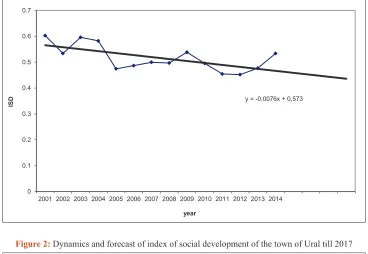
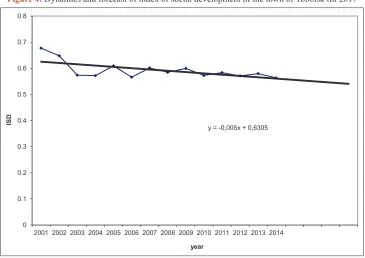
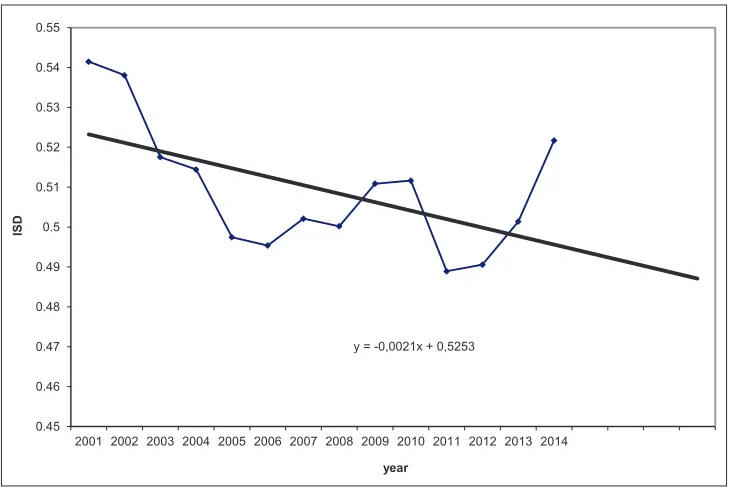
State statistics allowed obtaining the following values, and some forecasts of the ISD in different cities and towns of the Tyumen region (Figures 1-6).
Rough forecast gives even average and ambiguous state statistics data. In general, it is clear that ISD of all the cities and towns
tended to decrease, indicating the problems with the city or town administration in modern Russian conditions.
The results of calculation of the indices are formed in the data base and used in the forecasting step in the selection of alternatives to various city development scenarios.
The selection of patterns of direct target property is automated, i.e., making an administrative decision about forecasting this property with the sought-for objects and bringing them to a certain pattern.
For example, Scenario A (basic) is the continuation of the trends of development of the baseline period without optimization, taking into account the changes in some parameters due to restructuring processes. Investments are made in simple reproduction of fixed
Figure 1: Dynamics and forecast of index of social development of the town of Zavodoukovsk till 2017
capital, in accordance with the depreciation rates. Then in the model it is possible that when the production is reduced, but the investment is spent on the restoration of funds not used in reality.
In the basic scenario, there is no innovation, a priori that allows us considering it as irrational. At the same time, this scenario is extremely necessary for the analysis of the adequacy of the information inherent in the model, as well as for demonstration of the ineffectiveness of urban development.
Scenarios B and C are for the optimization without requiring
active innovation and investments are distributed in a certain
way between the economy and the restoration of the natural and social environment.
Scenarios D, E and F are for optimization too, but with strong innovation activity, which requires investment destination,
distributed between the economy, the restoration of the environment and innovation in certain proportions.
Past forecasts were fully confirmed by the actual situation in the cities and towns of the Tyumen region (Belonozhko and Silin, 2013).
5. CONCLUSION
As a result, within the regional administration system a social experiment in the virtual space is being conducted, in the process of which information - forecasting model is formed, including a set of scenario options to achieve concrete tangible results, i.e., the solution of regional problems. The results are forming the data base at the stage of execution of organizing taking decisions and are used by decision makers at the regional level. In the process of conducting a social experiment in
Figure 3: Dynamics and forecast of index of social development of the town of Surgut till 2017
the virtual space the object’s state changes, the information about this object is studied by the subject of management. If the subject decides that a change in the object is not subject to the adequacy of the defined goals and objectives, the forecasting model adjustment at the stage of execution control is made.
The social experiment in the virtual space makes it possible to generate a set of models in the formulation and decision-making in the regional administration system, to choose the most effective model, and based on this model, the solution of regional problems and to achieve comfort of life of the population of the region, the maximum satisfaction of their needs.
6. ACKNOWLEDGMENT
The authors wish to thank the Russian Humanitarian Science Foundation for their support in the research and preparation of this paper (Project 15-03-00367 “The level of human potential and social situation in the Arctic Region as a factor of development of fuel-energy complex”).
REFERENCES
Babosov, E.M. (2006), Management Sociology. 5th ed. Minsk: Tetrasystems.
Barbakov, O.M., Barbakova, K.G, Gavrin, A.S., Costko, N.A. (2005),
Figure 5: Dynamics and forecast of index of social development of the town of Ishim till 2017
The art of city management: Social experiments in the virtual space. Kurgan: PC “Trans-Ural”.
Bell, D. (1973), The Сoming of Post-industrial Society: A Venture in Social Forecasting. New York: Basic Books, Inc.
Belonozhko, M.L., Silin, A.N. (2013), Russian North: Change of social situation. Middle-East Journal of Scientific Research, 16(2), 150-155. Belonozhko, M.L., Silin, A.N. (2014a), Environmental situation and
conditions for traditional lifestyles of indigenous communities in the West Siberian North. Middle-East Journal of Scientific Research, 21(6), 905-911.
Belonozhko, M.L., Silin, A.N. (2014b), Sociological Research in the Mechanism of Decision-making. Tyumen: TSOGU.
Belonozko, M., Barbakov, O., Siteva, S.S. (2015), Higher education quality management in virtual space of a regional higher educational institution. Mediterranean Journal of Social Sciences, 6(3S5), 249-254.
Bestuzhev-Lada, I.V., editor. (1982), Workbook of Forecasting. Moscow: Thought.
Budyanskiy, Y.A. (1992), Geological Interpretation of Complex Geophysical Data. Moscow: Nedra.
Clark, J. (1926), Social Control of Business. Chicago: The University of Chicago Press.
Dorogov, N. (1997), Regional economy in the system of market relations (methodological aspect). PTPU, 4, 66-71.
Dougherty, G. (2012), Pattern Recognition and Classification. New York: Springer. Available from: http://www.extras.springer.com.html. [Last retrieved on 2016 Feb 03].
Hirsck, F. (1976), Social Limits to Growth. Cambridge, Mass: Harvard University Press.
Kiselev, V.G., Barbakov, O.M., Zobnin, Y.A. (2015), Social engineering in the enterprise management system. Part 1. Theoretical and methodological foundations. Tyumen: TSOGU.
Milgram, S. (2006), The Individual in a Social World. 2nd ed. New York: McGraw-Hill.