Ames Laboratory Publications
Ames Laboratory
6-15-2014
Mixed valency and site-preference chemistry for
cerium and its compounds: A predictive
density-functional theory study
Aftab Alam
Indian Institute of Technology Bombay
Duane D. Johnson
Iowa State University, [email protected]
Follow this and additional works at:
http://lib.dr.iastate.edu/ameslab_pubs
Part of the
Condensed Matter Physics Commons
,
Engineering Physics Commons
, and the
Materials Science and Engineering Commons
The complete bibliographic information for this item can be found at
http://lib.dr.iastate.edu/
ameslab_pubs/271
. For information on how to cite this item, please visit
http://lib.dr.iastate.edu/
howtocite.html
.
Mixed valency and site-preference chemistry for cerium and its
compounds: A predictive density-functional theory study
Abstract
Cerium and its technologically relevant compounds are examples of anomalous mixed valency, originating
from two competing oxidation states—itinerant Ce4+ and localized Ce3+. Under applied stress, anomalous
transitions are observed but not well understood. Here we treat mixed valency as an “alloy” problem involving
two valences with competing and numerous site-occupancy configurations. We use density-functional theory
with Hubbard
U
(i.e., DFT+
U
) to evaluate the effective valence and predict properties, including controlling
the valence by pseudoternary alloying. For Ce and its compounds, such as (Ce,La)2(Fe,Co)14B permanent
magnets, we find a stable mixed-valent α state near the spectroscopic value of νs=3.53. Ce valency in
compounds depends on its steric volume and local chemistry. For La doping, Ce valency shifts towards γ-like
Ce3+, as expected from steric volume; for Co doping, valency depends on local Ce-site chemistry and steric
volume. Our approach captures the key origins of anomalous valency and site-preference chemistry in
complex compounds.
Keywords
Materials Science and Engineering
Disciplines
Condensed Matter Physics | Engineering Physics | Materials Science and Engineering
Comments
This article is from Phys. Rev. B
89
, 235126 (2014), doi:
10.1103/PhysRevB.89.235126
. Posted with
permission.
PHYSICAL REVIEW B89, 235126 (2014)
Mixed valency and site-preference chemistry for cerium and its compounds:
A predictive density-functional theory study
Aftab Alam1,*and D. D. Johnson2,3,†
1Department of Physics, Indian Institute of Technology, Bombay, Powai, Mumbai 400 076, India
2The Ames Laboratory, U.S. Department of Energy, Ames, Iowa 50011-3020, USA
3Materials Science & Engineering, Iowa State University, Ames, Iowa 50011-2300, USA
(Received 15 December 2013; revised manuscript received 3 June 2014; published 23 June 2014)
Cerium and its technologically relevant compounds are examples of anomalous mixed valency, originating from two competing oxidation states—itinerant Ce4+and localized Ce3+. Under applied stress, anomalous transitions are observed but not well understood. Here we treat mixed valency as an “alloy” problem involving two valences with competing and numerous site-occupancy configurations. We use density-functional theory with Hubbard U(i.e., DFT+U) to evaluate the effective valence and predict properties, including controlling the valence by pseudoternary alloying. For Ce and its compounds, such as (Ce,La)2(Fe,Co)14B permanent magnets, we find a stable mixed-valentαstate near the spectroscopic value ofνs =3.53. Ce valency in compounds depends on its
steric volume and local chemistry. For La doping, Ce valency shifts towardsγ-like Ce3+, as expected from steric volume; for Co doping, valency depends on local Ce-site chemistry and steric volume. Our approach captures the key origins of anomalous valency and site-preference chemistry in complex compounds.
DOI:10.1103/PhysRevB.89.235126 PACS number(s): 71.28.+d,71.15.Ap,71.20.Eh,75.30.Mb
Mixed-valence compounds exhibit interesting anomalies when external parameters, such as pressure, are varied. Reliably predicting their properties and determining the origin of mixed-valence effects remains open and dependent upon correlating the properties with the molecular and crystal structure, and with local chemistry. Apart from the field of metallurgy and pigments in artwork and ceramics (e.g., Fe2O3 and Fe3O4) [1], it also serves as an active area of research in complex biophysical problems, such as photosynthesis, and in organic-conjugated materials [2] for artificial electronic devices [3]. What makes these compounds different from other materials is the coexistence of wide s-d bands and very heavy atomiclike f electrons at/near the Fermi energy. Anomalous properties then arise from a competition between the itinerant and localized nature of thefelectrons. Numerous experiments have revealed a growing list of such compounds from the rare-earth (RE) series to late actinides, and some transition-metal compounds.
Cerium is the first RE element that exhibits phases with enormous (15–17%) volume differences [4]. As the most abundant RE, Ce is often considered as a RE replacement in permanent magnets [5]. The low-pressureγ phase of Ce exhibits a local magnetic moment, associated with a trivalent Ce3+configuration. With applied pressure, Ce first transforms into a mixed-valent α state with quenched moments, and eventually transforms into a tetravalent Ce4+ α state at higher pressure. With alloying, a local “chemical” pressure can be exerted, so the Ce valency in its compounds can be more sensitive, e.g., Ce2Fe14B, where it remains in a strongly mixed-valentα-like state, which is incompatible with a local 4f moment. The central problem is to understand the mechanism that controls Ce valency both in pure Ce and its compounds.
*[email protected] †[email protected]
Here, we treat mixed valency by mapping to an “alloy” problem, where the Ce3+ and Ce4+ are considered as two different atoms, and we include the binomial distribution of RE-site occupancy in the lattice. Our approach captures the key electronic and chemical effects, reproducing the observed mixed valency of Ce and its complex compounds, such as (Ce-La)2(Fe-Co)14B magnets. We show that the Ce valency in compounds depends on the steric volume of Ce sites and local chemistry surrounding the RE site. Mixed valency of Ce is then predicted similarly to studies of rare-earth systems using model Hamiltonians [6], and is consistent with a correlated and multielectron picture of Ce with semi-isolated 4f states in contact with a bath of spd valence electrons, as found experimentally [7].
Addressing mixed valency using a density-functional the-ory (DFT) treats magnetism, atomic multiplet effects, and crystal-field splitting on an equal footing, and identifies the electronic mechanisms responsible for the anomalous valence behavior. While a first-principles dynamical mean-field theory (DMFT) may better describe the fluctuating mixed valency, our approach captures the key effects in complex compounds with dramatically less computational intensity. Notably, within DMFT, δ Pu is found to be a superposition of two atomic valences (60%f5and 40%f6) [8]. Yet, experimentally,αand
δ Pu have a superposition of three 5f states [9] (∼20%f4, 40%f5, and 40%f6), i.e., a ternary alloy (two independent fractions).
We use the Vienna ab initio simulation package VASP
[10] with a pseudopotential and projected augmented-wave basis [11] using Perdew-Burke-Ernzhorf (PBE) exchange-correlation and spin-orbit coupling. With different sized Ce3+ and Ce4+ ions, relaxations (ignored in previous studies) are crucial to predict reliable energetics and ground states. Localized Ce3+ f electrons are addressed via a PBE+U approach [12] with a HubbardU(set to 5 eV from previous work [5]) introduced in a screened Hartree-Fock manner. All of the other components (La, Ce4+, Fe, Co, and C) are addressed within PBE only, as the effect of Hubbard Uon
AFTAB ALAM AND D. D. JOHNSON PHYSICAL REVIEW B89, 235126 (2014)
25 30 35 40
Volume (A )
expt
3 3.25 3.5 3.75 4
Ce valence (x) -1.0 -0.8 -0.6 -0.4 -0.2 0 E (eV/cell) -Ce -Ce
`
-CeCe3+ Ce4+
o3
FIG. 1. (Color online) Top: Relaxed volume. Bottom: Formation enthalpy vs Ce valence for pure fcc Ce where trivalent (3+) and tetravalent (4+) Ce are mixed. Square symbols indicate experimental volume (from Ref. [14]). The vertical dashed line is a guide to the eye for the estimated minimum.
them is very small. All potentials are obtained via standard fully self-consistent DFT-based solutions. See [13] for more computational details.
Formation enthalpy (E) is defined as the relative energy of the alloy [(Ce3+,Ce4+) in the present case] with respect to the concentration-weighted sum of the energies of the α -constituent elements in the compound, i.e.,
E=EAlloy(V0)−
s
α=1
cαEα
Vα0, (1)
wherecαis the concentration of theαconstituents.V0andVα0
are the equilibrium volume of the alloy and the constituents in their ground states, respectively.
The formation enthalpy E and volume V versus Ce valence in fcc Ce mixed-valence alloys are shown in Fig.1. Here, Ce3+and Ce4+potentials are occupied over eight sites in a fcc supercell to find the energetically most favorable configuration; hence, we have discrete jumps of 0.125 valence “composition.” From Fig.1, the energetically most favorable mixed-valence state occurs near 3.5 (a fifth-order polynomial fit yieldsνs =3.55), close to the assessed value of 3.67 [4].
We find that the mixed-valenceα state of Ce arises from an energetically favorable distribution of Ce3+ and Ce4+ states. (Using more sites fills in the curve, which is needed in skewed distributions.) Atomic positions and the cell volumes are fully relaxed in each data. The relaxed, DFT+U calculated V’s are compared with known experimental volumes [14] (red squares), and are within 8% and have the correct trend for theγ,
α, andαphases. For pure Ce, the mixed valency corresponds to a volume between those of the purely γ and α phases.
3.0 3.25 3.50 3.75 4.0
Ce valence (x) -0.4 -0.3 -0.2 -0.1 0.0 0.1 0.2 0.3 0.4
E (eV/cell)
Ce filling R(f)
Ce filling R(f) Ce filling R(g)
4+
Ce filling R(g)4+
4+ 4+
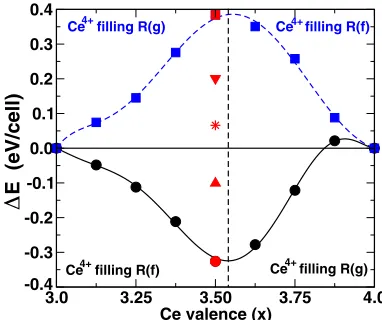
FIG. 2. (Color online) Mixed valency of Ce in Ce2Fe14B. Solid (dashed) curve indicates the formation enthalpies of mixing Ce3+ and Ce4+, with the larger 3+ions distributed over 4g(4f) sites and smaller 4+ ions distributed over 4f (4g) sites. Star and triangles indicate the energies for intermediate sets of distribution where 3+ and 4+ions are mixed over both of the sites.
The inclusion of on-siteUfor Ce3+(with 4felectron) and the spin-orbit coupling is important to get the correct ground state for the intermediate valency.
Next, we investigate the Ce mixed valency in Ce2Fe14B, a challenging 68-atom-per-cell, tetragonal structure with space groupP42/mnm[15]. The mixed valency of Ce significantly affects its magnetic behavior. Due to the complex nature of a 2-14-1 structure [5], the Ce mixed valency is associated with Ce-site preferences. The 2-14-1 structure contains two inequivalent rare-earth (R) sites—R(4f) and R(4g)—each with multiplicity 4 [5]. From the coordination shell around each site, 4gsites acquire a larger volume than 4f sites. As such, Ce3+ (larger ion) prefers to occupy the 4gsites, while Ce4+(smaller ion) prefers to occupy the 4fsites. Energetically favored configurations are found by mixing Ce3+and Ce4+on the eightRsites in all possible ways.
The formation enthalpyE versus Ce valence in (Ce3+ -Ce4+)
2Fe14B for all eight R-site configurations is shown in
Fig. 2. The filled circles indicate energies when Ce3+ is
favorably distributed over 4g sites and Ce4+ on 4f sites; filled squares are the results with the opposite (unfavorable) distribution of Ce ions. Other symbols indicate intermediate sets of distribution where 3+and 4+ions are mixed over both of the sites with a binomial distribution. Notice the asymmetric nature of the energy curves comparing the lower vs upper half of E, which is due to a different filling on the two inequivalent RE sites; that is, the collective effect of filling Ce3+ ions preferentially over 4f sites is very different from that of 4gsites. The favorable mixed valency occurs nearνs =3.5 (3.53 from polynomial fit), close to the
assessed 3.44 [16].
To improve the magnetic properties requires engineering Ce or Fe sites in such a way as to push the Ce valency either towards 3+or 4+. Due to the dependence of the Ce valence on the steric volume [5], one way to manipulate the Ce valency is to vary the unit cell volume by forming pseudoternary compounds. We studied two compounds, i.e., (Ce,La)2Fe14B and Ce2(Fe,Co)14B; the former (latter) should
[image:4.608.85.259.70.321.2] [image:4.608.339.530.71.231.2]MIXED VALENCY AND SITE-PREFERENCE CHEMISTRY . . . PHYSICAL REVIEW B89, 235126 (2014)
3.0 3.25 3.50 3.75 4.0
Ce valence (x) -0.4 -0.3 -0.2 -0.1 0.0 0.1 0.2 0.3 0.4
E (eV/cell)
Ce filling R(f)
Ce filling R(f) Ce filling R(g)
4+
Ce filling R(g)4+
4+ 4+
FIG. 3. (Color online) Similar to Fig. 2 but for (Ce87.5La12.5)2Fe14B. Here La is substituted at its favored 4g site and Ce3+and Ce4+are distributed over the remaining seven RE sites in all possible ways.
increase (reduce) the unit cell volume. First, we dope RE Ce sites by La in Ce2Fe14B. Our calculation shows that out of the two inequivalent RE sites 4f and 4g, La (being larger than Ce) energetically prefers to occupy the 4gsites. This was also observed from x-ray absorption near-edge spectroscopy (XANES) measurement [17].
Figure3 shows theEvs Ce valence with 12.5% of La doping (one out of eight sites) in Ce2Fe14B. From the data in the vicinity of the minimum (x∼3.5), La doping clearly moves the Ce valency towards 3+ relative to the undoped case. This effect is in accord with the steric volume argument: a La ion, being larger than Ce, expands the lattice when doped in Ce2Fe14B, enhancing the steric volume of Ce site(s), and supports a more trivalentlike state. The energetically most favorable mixed-valence state occurs near 3.5 (νs ∼
3.43 from polynomial fit), which compares well with the observed value ofνs ∼3.46 from the XANES experiment [17]
for (Ce90La10)2Fe14B. Steric volume is an important factor controlling the Ce chemical valence, as also evidenced in hydrogenated Ce2Fe14B and Ce2Fe17compounds [16,18].
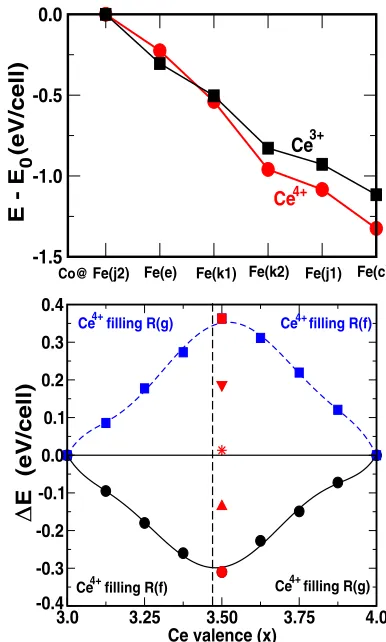
Next, we study the effects of Co doping on Fe sites in Ce2Fe14B, which is known to enhance the Curie temperature and magnetic anisotropy and, hence, is a reason for our choice. Ce2(Fe,Co)14B crystallizes in the sameP42/mnmstructure as Ce2Fe14B, which has six inequivalent Fe sites [5], i.e., Fe(k1), Fe(k2), Fe(j1), Fe(j2), Fe(e), and Fe(c). First we verified the Co-site preference on these symmetry distinct Fe sites. Figure4 (top) shows the site-preference energy for both Ce3+and Ce4+ when one out of 14 Fe sites is doped with a Co atom. The results indicate that the Fe(j2) site has the strongest preference for not occupying Co, as it costs the highest energy.
This finding is supported by two arguments: (1) Co and Fe differ a little in size (RCo < RFe). Out of six Fe sites in 2-14-1, Fe(j2) has the largest coordination volume—a reason for Co to avoidj2 sites. (2)j2 sites in 2-14-1 [andc (dumbbell) sites in a rhombohedral Ce2Fe17 structure [15]] are reported from neutron-diffraction measurement [19] to be crystallographically, as well as magnetically, cognates. In other words, each of these sites has the largest number of near-neighbor Fe ions and the largest moment. Also, these
-1.5 -1.0 -0.5 0.0
E - E (eV/cell)
Co@Fe(j2) Fe(e) Fe(k1) Fe(k2) Fe(j1) Fe(c)
Ce
4+ Ce
3+
0
3.0 3.25 3.50 3.75 4.0
Ce valence (x) -0.4 -0.3 -0.2 -0.1 0.0 0.1 0.2 0.3 0.4
E (eV/cell)
Ce filling R(f)
Ce filling R(f) Ce filling R(g)
4+
Ce filling R(g)4+
4+ 4+
FIG. 4. (Color online) Top: Site-preference energy for Co doping at various Fe sites in Ce2Fe14B.E0is a reference when Co is on the Fe(j2) site. Bottom: Same as Fig.2, but for Ce2(Fe13Co)B with Co occupying Fe(c) sites.
sites are the only transition-metal sites that have a major ligand line—perhaps another reason behind the unfavorability of Co to occupyj2 sites. Fe(c) and Fe(j1) sites have the strongest preference towards Co. This site preference can be justified from the large affinity of Co towards rare earth, i.e., those transition-metal sites that acquire the highest RE coordination will prefer to have Co on them. Fe(c) and Fe(j1), indeed, have the highest coordination of RE around them.
Figure4showsEvs Ce valence for Ce2(Fe13Co)B with Co doped on the energetically most favorable Fe(c) site. Unlike Ce2Fe14B (Fig. 2), 7.14% Co doping (1 out of 14) already favors the mixing of the Ce valence at the Ce4+ end, i.e., no positive (unfavorable)E. Again, compared to the Ce valence in Ce2Fe14B, Co doping pushes the valency of Ce towards 3+ (a similar argument for the polynomial fit to locate minima holds here). This, however, does not jibe with the volume argument used for La doping. Co being smaller than Fe leads to a volume reduction that should move the Co valence towards 4+via steric volume, instead of 3+. In this case, the local chemistry and the associated local steric volume of RE sites play an important role in determining the Ce valency compared to the simple concept based on global volume reduction.
It is well known that Co has a strong affinity to RE elements (Ce in this case), and as such Ce favors a high coordination number of Co. In 2-14-1, Fe(c) sites with 4 Ce and Fe(j1) sites with 3 Ce have the highest number of RE neighbors.
[image:5.608.337.530.69.390.2] [image:5.608.74.271.71.237.2]AFTAB ALAM AND D. D. JOHNSON PHYSICAL REVIEW B89, 235126 (2014)
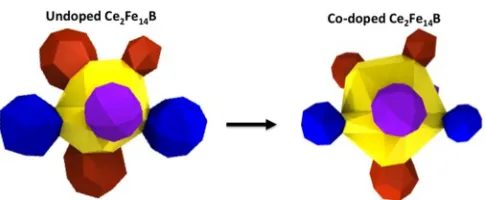
FIG. 5. (Color online) Expansion of the steric (Voronoi) volume of the central Ce site (yellow) after Co doping. Inequivalent Fe sites are denoted by blue, red, and purple. With Co doping, the steric volume of the Ce site is enlarged, at the expense of the Fe sites and associated charge.
These Fe sites are, indeed, the energetically most favorable sites for Co; see Fig.4 (top). Now, becauseRCo< RFe, the accumulation of a large number of Co around the Ce site causes the formation of major ligands, given by lines connecting faces of Voronoi polyhedra, and allowing more room and an expansion of the local Voronoi volume around the Ce site. (These Voronoi polyhedra and volumes were determined by inscribed radii given by saddle points in the electronic density [20].) Note how the central Ce polyhedra expands (Fig.5) due to Co doping on Fe sites. Thus, although Co doping reduces the unit cell volume, the local steric volume around the Ce site is enhanced, which shifts the Ce valency towards 3+. This phenomenon is based on the local chemistry and the nature of hybridization of the Ce ion with its neighboring atoms, instead of the simple volume argument alone. Another argument can be based on the increase in band filling due to one additional electron (arising from Co doping). Now, because of the location of Ce-4f bands in the vicinity of
the Fermi energy, this can also cause a decrease in the Ce valence.
In summary, we have presented an alloy approach to reliably predict the mixed-valency properties in complex compounds, for which DFT+Umethods are essential, and reveal the elec-tronic origin for such behavior. For Ce-based materials, cerium does not have a well-defined valence; rather, itsf electrons fluctuate between two extreme valence states (3+ and 4+) depending upon local atomic configurations (site occupancy). The energy difference between these states/configurations is a few meV atom−1, so associated anomalies are observed, e.g., under pressure. The mechanism for such a transition and the reason for differing valence states is not yet well understood. Doping puts the material under chemical pressure. In Ce2Fe14B, La doping at Ce sites expands the lattice (as expected from steric volume arguments), while a transition-metal dopant such as Co at Fe sites shrinks it. Here we predicted the mixed valency of Ce in pure Ce and Ce2Fe14B, in agreement with experiment. Then, we addressed two different types of doping (La at Ce sites and Co at Fe sites) to reveal how both steric volume and local chemistry influence the Ce valence in compounds. In Co-doped Ce2Fe14B, a simple argument based on steric volume does not hold, rather the nature of hybridization and the electron affinity of Co towards RE elements are crucial to predict the mixed valency of Ce.
Work at Ames Laboratory was supported by the US Depart-ment of Energy (DOE) ARPA-E REACT Program (Contract No. 0472-1526), using capabilities maintained and supported by the Office of Basic Energy Sciences in our Division of Materials Science and Engineering. The Ames Laboratory is operated for the US DOE by Iowa State University under Contract No. DE-AC02-07CH11358.
[1] Peter Day, Noel S. Hush, and Robin J. H. Clark,Philos. Trans.
A366,5(2008).
[2] A. Heckmann and C. Lambert,Angew. Chem. Int. Ed.51,326
(2012).
[3] Oliver S. Wenger,Chem. Soc. Rev.41,3772(2012).
[4] D. C. Koskenmaki and K. A. Gschneidner, Jr., in Handbook on the Physics and Chemistry of Rare Earths, edited by K. A. Gschneidner, Jr. and L. Eyring (North-Holland, Amsterdam, 1978), p. 337.
[5] Aftab Alam, Mahmud Khan, R. W. McCallum, and D. D. Johnson,Appl. Phys. Lett.102,042402(2013).
[6] S. K. Ghatak, M. Avignon, and K. H. Bennemann,J. Phys. F:
Metal Phys. B6,1441(1976).
[7] J. G. Tobin, S. W. Yu, T. Komesu, B. W. Chung, S. A. Morton, and G. D. Waddill,Europhys. Lett.77,17004(2007).
[8] H. J. Shim, K. Haule, and G. Kotliar,Nature (London)446,513
(2007), and references therein.
[9] C. H. Booth, Yu Jianga, D. L. Wang, J. N. Mitchell, P. H. Tobash, E. D. Bauer, M. A. Walle, P. G. Allen, D. Sokaras, D. Nordlund, T.-C. Weng, M. A. Torrez, and J. L. Sarrao,PNAS109,10205
(2012).
[10] G. Kresse and J. Furthm¨uller,Phys. Rev. B54,11169(1996); ,
Comput. Mater. Sci.6,15(1996).
[11] G. Kresse and D. Joubert,Phys. Rev. B59,1758(1999). [12] A. I. Liechtenstein, V. I. Anisimov, and J. Zaanen,Phys. Rev. B
52,R5467(1995).
[13] A Monkhorst-pack Brillouin-zone integration with 24×24× 12 (4×4×4)kmesh is used for 8-atom fcc (68-atom 2-14-1 compound). We usehighprecision with large plane-wave cutoffs (400–450 eV), giving a convergence within 4 meV/cell (8 kBar) for energy (stress tensor). More details are available in Ref. [5], including selection ofU.
[14] B. Johansson, I. A. Abrikosov, M. Ald´en, A. V. Ruban, and H. L. Skriver,Phys. Rev. Lett.74,2335(1995).
[15] J. F. Herbst,Rev. Mod. Phys.63,819(1991), and references therein.
[16] T. W. Capehart, R. K. Mishra, G. P. Meisner, C. D. Fuerst, and J. F. Herbst,Appl. Phys. Lett.63,3642(1993).
[17] T. W. Capehart, R. K. Mishra, C. D. Fuerst, G. P. Meisner, F. E. Pinkerton, and J. F. Herbst,Phys. Rev. B55,11496(1997). [18] D. Fruchart, F. Vaillant, A. Yaouanc, J. M. D. Coey, R. Fruchart,
Ph. L’Heritier, T. Riesterer, J. Osterwalder, and L. Schlapbach,
J. Less-Common Met.130,97(1987).
[19] J. F. Herbst and W. B. Yelon,J. Appl. Phys.60,4224(1986). [20] Aftab Alam, S. N. Khan, Brian G. Wilson, and D. D. Johnson,
Phys. Rev. B84,045105(2011).
[image:6.608.52.295.66.166.2]