www.biogeosciences.net/12/2533/2015/ doi:10.5194/bg-12-2533-2015
© Author(s) 2015. CC Attribution 3.0 License.
Large-eddy simulations of surface roughness parameter
sensitivity to canopy-structure characteristics
K. D. Maurer1, G. Bohrer1, W. T. Kenny1, and V. Y. Ivanov2
1Department of Civil, Environmental & Geodetic Engineering, The Ohio State University, Columbus, OH, USA 2Department of Civil & Environmental Engineering, University of Michigan, Ann Arbor, MI, USA
Correspondence to: G. Bohrer ([email protected])
Received: 15 October 2014 – Published in Biogeosciences Discuss.: 27 November 2014 Revised: 24 March 2015 – Accepted: 27 March 2015 – Published: 30 April 2015
Abstract. Surface roughness parameters, namely the rough-ness length and displacement height, are an integral input used to model surface fluxes. However, most models assume these parameters to be a fixed property of plant functional type and disregard the governing structural heterogeneity and dynamics. In this study, we use large-eddy simulations to ex-plore, in silico, the effects of canopy-structure characteris-tics on surface roughness parameters. We performed a virtual experiment to test the sensitivity of resolved surface rough-ness to four axes of canopy structure: (1) leaf area index, (2) the vertical profile of leaf density, (3) canopy height, and (4) canopy gap fraction. We found roughness parame-ters to be highly variable, but uncovered positive relation-ships between displacement height and maximum canopy height, aerodynamic canopy height and maximum canopy height and leaf area index, and eddy-penetration depth and gap fraction. We also found negative relationships between aerodynamic canopy height and gap fraction, as well as be-tween eddy-penetration depth and maximum canopy height and leaf area index. We generalized our model results into a virtual “biometric” parameterization that relates roughness length and displacement height to canopy height, leaf area index, and gap fraction. Using a decade of wind and canopy-structure observations in a site in Michigan, we tested the ef-fectiveness of our model-driven biometric parameterization approach in predicting the friction velocity over heteroge-neous and disturbed canopies. We compared the accuracy of these predictions with the friction-velocity predictions ob-tained from the common simple approximation related to canopy height, the values calculated with large-eddy simu-lations of the explicit canopy structure as measured by air-borne and ground-based lidar, two other parameterization
ap-proaches that utilize varying canopy-structure inputs, and the annual and decadal means of the surface roughness parame-ters at the site from meteorological observations. We found that the classical representation of constant roughness param-eters (in space and time) as a fraction of canopy height per-formed relatively well. Nonetheless, of the approaches we tested, most of the empirical approaches that incorporate sea-sonal and interannual variation of roughness length and dis-placement height as a function of the dynamics of canopy structure produced more precise and less biased estimates for friction velocity than models with temporally invariable pa-rameters.
1 Introduction
ver-tical distribution of wind speed. These parameters are dis-placement height,d, and roughness length,z0. Though they represent different physical properties of the surface effects on the velocity profile, we will refer to them throughout the manuscript using the combined term “roughness param-eters”. In many land surface, vegetation, ecosystem, and hy-drology models, such as the Community Earth System Model (CESM; Gent et al., 2011), Mapping Evapotranspiration with Internalized Calibration (METRIC; Allen et al., 2007), and Surface Energy Balance Algorithm for Land (SEBAL; Bas-tiaanssen et al., 1998), the surface sensible and latent heat fluxes are functions of the aerodynamic resistance for heat transfer, rah. rah is a function of the turbulence at the sur-face layer, defined through the friction velocity,u∗. In mod-els which cannot directly resolve u∗, rah is parameterized as a function of d andz0. In these models, d andz0 may be derived from different canopy-structure characteristics. In the simplest approach, d and z0 are linear functions of site-level canopy height (h)– typicallyd ≈0.66h(Cowan, 1968) and z0 ≈0.10h (Tanner and Pelton, 1960). The ac-curacy of these estimates may be limited, however, by the dynamic nature (space and time) of canopy-structure char-acteristics. First, the canopy is a complex structure that is hard to describe using simple low-variable-number formula-tions. Second, estimates of the canopy-structure character-istics are limited by the typical absence of data about the vertical distribution of leaf area (Massman and Weil, 1999; Shaw and Pereira, 1982) and tree-top heights, as well as the difference between coarse model grid-cell resolution and the finer scale at which canopy-structure characteristics vary and affect roughness and momentum and flux transfer.
One common approach to incorporate canopy structure in the parameterization of roughness length into models in a more realistic way utilizes satellite imagery products to esti-mate vegetation structure and relate it to canopy–roughness relationships. For example, the SEBAL model (Moran, 1990) utilizes a function based on the normalized difference vege-tation index (NDVI), while the METRIC model employs the Perrier function (Perrier, 1982). These canopy–roughness re-lationships have been shown to improve evapotranspiration estimates (Santos et al., 2012), but they are specific to sparse or short vegetative environments, such as agricultural sys-tems, and are not typically recommended for forest environ-ments (Bastiaanssen et al., 1998).
To incorporate the effects of canopy structure in denser and taller vegetative environments such as forests, empirical functions have been proposed using coarse canopy metrics such as canopy area index (the total, single-sided area of all canopy elements within a 1 m×1 m ground area; Raupach, 1994), stand density (stems per area), or leaf area index (LAI, the total surface area of leaves found within a 1 m×1 m ver-tical column of vegetation; Nakai et al., 2008a). However, the data required to use these functions are typically not available at most sites and, with the exception of LAI, are not yet ob-tainable through large-scale satellite remote sensing. In many
climate models, surface-layer grid cells are prescribed with biome-specific qualities, i.e., sets of parameters describing constant vegetation structure and flux-driving characteristics for all model cells containing a specific biome or plant func-tional type (PFT). For example, the Ecosystem Demography model version 2 (ED2; Medvigy et al., 2009) provides 20 dif-ferent vegetation functional types, 7 of which are representa-tive of forested environments, to describe all land surfaces across the globe. Each such vegetation functional type is characterized by fixed, canopy-height-driven roughness pa-rameters. Similarly, aerodynamic resistance to surface flux in the advanced hydrological model tRIBS+VEGGIE (Ivanov et al., 2008) is only driven by vegetation height, which is ei-ther prescribed or set as a default per PFT.
Roughness parameters have been shown to scale with structural characteristics, such as the influence of area-index (vegetation area per ground area) terms ondandz0, through numerical studies (Shaw and Pereira, 1982; Choudhury and Monteith, 1988) and wind-tunnel experiments (Raupach, 1994). Above-canopy meteorology data have shown esti-mates of roughness parameters to be highly variable both spatially and temporally (Maurer et al., 2013; Harman, 2012; Zhou et al., 2012). As evidence for canopy–roughness re-lationships has risen, various studies have attempted to generalize small-scale interactions between roughness pa-rameters and canopy structure by deriving d and z0 from above-canopy meteorological measurements (Braam et al., 2012; Maurer et al., 2013; Raupach et al., 1996; Nakai et al., 2008a), remote-sensing (Schaudt and Dickinson, 2000; Weligepolage et al., 2012), numerical experiments (Grim-mond and Oke, 1999; Wouters et al., 2012), and large-eddy simulations (LESs; Aumond et al., 2013; Bohrer et al., 2009; Bou-Zeid et al., 2007, 2009). Although the understanding of these small-scale canopy–roughness interactions has grown, accounting for fine-scale canopy-structure effects on rough-ness parameters in larger-scale climate models requires fur-ther development.
tra-ditional roughness parameterization (Aumond et al., 2013). Finally, we use 10 years of direct observations of canopy-structure and roughness parameters (Maurer et al., 2013) to estimate the sensitivity of modeled friction velocity to tem-poral variation in canopy structure and its effects on rough-ness length. We compare these results with other approaches that may be used to represent canopy structure when model-ing roughness parameters.
2 Materials and methods 2.1 Theory
Monin–Obukhov similarity theory (MOST) describes the re-lationships between the mean horizontal wind speed and the friction velocity in the inertial sublayer (Monin and Obukhov, 1954). In brief, MOST describes this relationship using a logarithmic function with parametersd andz0. Fur-ther details on the formulation of MOST used in this work are described in Maurer et al. (2013). The original MOST formu-lation was expanded to include the effects of thermal insta-bility and the flow regime in the roughness sublayer (RSL), as follows:
κuz
u∗ =ln
z−d z0
−ψm
z−d L
+ψm
z0 L
+I ψu
z−d L ,
z−d z∗−d
, (1)
whereuzis the mean horizontal wind speed at heightz, above
the ground. When the data are derived from meteorologi-cal observations, an overbar over a variable represents the 30 min mean of the 10 Hz time series of that variable. Given the mean eastward and northward wind velocities,uandv,
uzis rotated toward the wind direction such that
uz=
u2+v2
1/2
, (2)
whereκis the von Kármán constant,∼0.4, andz∗is the up-per limit of the RSL estimated as 2h (Mölder et al., 1999; Raupach et al., 1996), withhthe canopy height.I is an in-dicator function defined as (I=1 forz≤z∗; orI =0 forz
>z∗).u∗is the friction velocity defined as
u∗=
u0w0+v0w01/2 (3)
where each prime term (e.g., w0) is the perturbation of the specific variable from its mean (e.g., w−w). The atmospheric-stability correction function, ψm(x), was
de-scribed by Paulson (1970) for unstable atmospheric
condi-tions (z/L< 0) as
ψm(x)=2 ln
"
1+(1−16x)1/4
2
#
+ln "
1+(1−16x)1/2
2
#
−2tan−1h(1−16x)1/4i+π 2,
(4) wherexis either(z−d) /Lorz0/L.
Current understanding of aerodynamic properties near forest canopies within the roughness sublayer (RSL) has led to empirical corrections to the MOST model (Harman and Finnigan, 2007; De Ridder, 2010; Cellier and Brunet, 1992; Garratt, 1980; Mölder et al., 1999; Physick and Gar-ratt, 1995; Raupach, 1992). These corrections allow us to utilize MOST with meteorological observation within the RSL, which typically includes the height range where eddy-covariance measurements of forest flux dynamics are con-ducted across the globe. The RSL correction we used,ψu(x1, x2), was described by De Ridder (2010) as
ψu(x1, x2)=(1−16x1)−1/4
1+ υ
µ·x2
x1 1
γ
ln
1+ γ
µx2
exp(−µx2) , (5)
where x1=(z−d) /L; x2=(z−d) / (z∗−d); and υ, µ, andγ are empirical constants provided by De Ridder (2010) as 0.5, 2.59, and 1.5, respectively. The inclusion of the RSL correction (ψu6=0) occurs when the calculation is performed
within the RSL (z≤z∗,I=1). Flux data are typically ob-served within the RSL at one point in space, requiring the implementation of the RSL correction. When boundary layer conditions are near neutral, (z−d) /L andz0/L approach zero, and thusψm(x)becomes negligible (Eq. 4).
Contrary to the classic estimate of z0 (function of h), Thom (1971) suggested a relationship betweenz0and (h− d), as opposed to a relationship between z0 and h alone, where the ratio ofz0/(h−d) was defined as λ, a dimen-sionless, stand-specific parameter. This allowsz0 to be de-pendent on the spacing of the surface roughness elements and not only their height. For example, (h−d)will theoreti-cally be smaller for more densely packed surfaces, providing a smoother surface and smaller roughness length. This rela-tionship can be written as
z0=λ (h−d) . (6)
Nakai et al. (2008b) substituted the aerodynamic height,ha, for the canopy height,h, into this relationship and rearranged the equation to read
ha=d+ z0
λ. (7)
horizontal wind speed and the empirically fitteddandz0. It is determined by identifying the height of the inflection point in the vertical wind-speed profile. This height marks the transi-tion between the sub-canopy and above-canopy flow regimes (Thomas and Foken, 2007b).
We investigated the eddy-penetration depth (δe), which is the length scale describing the vertical range from the top of the canopy that is influenced by turbulent mixing from above. It is defined as the distance betweenhaand the height where the momentum flux value is 10 % of its value atha(Nepf et al., 2007).
2.2 Site description
The data used to test the effectivity of our LES-driven and other modeling approaches originate from a mixed, de-ciduous forest site at the University of Michigan Biolog-ical Station (UMBS) in northern, lower Michigan, USA (45◦3303500N, 84◦4204800W; elevation: 236 m above sea level). The forest is dominated (∼30 % of leaf area index) by early-successional bigtooth aspen (Populus grandiden-tata) and paper birch (Betula papyrifera), with a mean age of 85–90 years (Gough et al., 2013). The remaining leaf area is mostly represented by red oak (Quercus rubra), red maple (Acer rubrum), and white pine (Pinus strobus). Mean canopy height is roughly 20–25 m with an average stem den-sity of≈750 stems ha−1(including only trees with diameter at breast height (DBH) > 8 cm). Eddy-covariance flux mea-surements have been ongoing at the site since 1999 and data are available through AmeriFlux (http://ameriflux.lbl.gov/); site code: US-UMB. Empirical allometric equations, fitted to measurements in this site (Garrity et al., 2012), are used to determine canopy height from a tree census and measure-ments of DBH. Full censuses were conducted in 2001 and 2010, and partial censuses of DBH for 993 trees are mea-sured annually. Leaf area index is meamea-sured weekly using an optical sensor (LAI2000, LI-COR Biosciences, Lincoln, NE, USA). Additional details on the calculation of rough-ness length parameter from wind observations in the site and the determination of canopy structure are described in Mau-rer et al. (2013). Portable canopy lidar measurements (Hardi-man et al., 2013) were used to determine the mean leaf area density profile that was used as the “natural” leaf area den-sity case. Airborne lidar measurements were conducted by the National Center for Airborne Lidar Mapping (NCALM) in summer 2009. The lidar data and processing for our site are described in Garrity et al. (2012). This data set was used to determine the mean and variation of canopy top height and gap fraction, and to prescribe the explicit canopy structure in the “realistic” LES test case (see Sect. 2.4).
2.3 Large-eddy simulations
We used wind fields and heat fluxes from RAFLES simu-lations results to calculate surface roughness parameters of
simplified virtual forests. RAFLES (Bohrer et al., 2009) uses a 3-D heterogeneous canopy domain where leaf and stem ar-eas are prescribed within each voxel. The leaf area density and the instantaneous wind speed within the voxel determine the drag force that is applied to wind flow through that grid cell within each time step. Common to the approach used in most LESs, it assumes the leaf area is composed of flat sur-faces oriented downstream and neglects higher-order effects of leaf and stem shapes and sub-grid-scale wake generation (shown to be a small effect; Shaw and Patton, 2003). It is combined with radiation attenuation (given the leaf densi-ties in the grid cells above) to determine the sensible and la-tent heat fluxes emitted from each grid cell. The model uses the finite volume approach for discretization of the simula-tion domain. It resolves the effects of volume restricsimula-tion due to the volume of the vegetation (stems, branches) by reduc-ing the aperture areas available for flux exchange between each pair of neighboring grid cells and by reducing the vol-ume that is available for flow within each grid cell accord-ing to the volume of the vegetation present (Chatziefstra-tiou et al., 2014). It resolves sub-grid-scale turbulence using the Deardorff (1978) scheme, and includes a parameteriza-tion for sub-grid-scale turbulence dissipaparameteriza-tion due to leaf drag (Shaw and Patton, 2003).
Simulations consisted of 3 h of simulation time at a time step of 0.02 s. RAFLES uses a nested time-stepping scheme with higher frequency calculations for turbulence and even higher frequency calculations for pressure perturbations. Eight pressure and four turbulence time steps were nested in one model time step. Output data snapshots of all grid cells in the simulation domain were recorded every 2 s. The ini-tial 2.5 h of simulation time were used as a “spin-up” period to ensure satisfactory turbulent mixing and semi-stability of the vertical profiles of turbulence and potential temperature. The latter half hour of simulation time was used for analysis, consisting of 300 2 s snapshots.
Synthetic virtual domains covered
constant from 50 m to the height of the capping inversion, and increased with height above that level. Latent and sensible heat fluxes were prescribed based on observed mean noontime observations for August 2011 above the canopy at US-UMB. For each column of the horizontal simulation domain, the sum of the fluxes and Bowen ratio were dis-tributed around the prescribed mean as an empirical function of LAI. Fluxes were further distributed vertically following a leaf-area-dependent empirical exponential profile. More details on the numerical setup of the model and the approach for flux forcing are provided in Bohrer et al. (2009). 2.4 Virtual experiment setup: sensitivity analysis to
quantify the effects of specific canopy-structure characteristics on roughness parameters
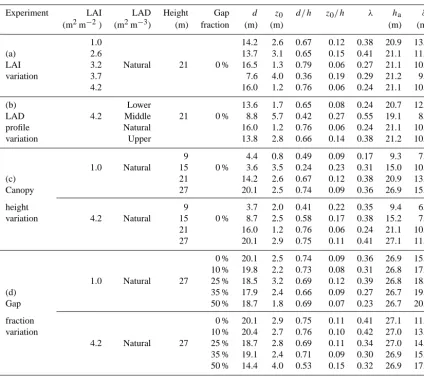
Forest canopies are a complex array of 3-D structures. Many structural characteristics, such as tree height, LAI, vertical leaf area density (LAD) profile, and gap fraction, among others, affect the airflow inside and above the canopy and, consequently, the resulting roughness parameters and aero-dynamic properties of the surface that describe such canopy structure. Using synthetic cases representing different as-pects of canopy structure, we conducted a virtual experiment to test the sensitivity of roughness parameters to four axes of canopy structure: (1) mean site-level LAI, ranging from observed leaf-off conditions (LAI=1.0 m2m−2)to typical, mid-growing season leaf-on conditions (LAI > 1.0 m2m−2); (2) LAD (m2m−3)profile, defined through the vertical bias of the vertical leaf density distribution (See Fig. S1 in the Supplement); (3) canopy height ranging from 9 to 27 m; and (4) canopy patch-level continuity (gap fraction) ranging from 0 to 50 % (see Fig. S2). Based on the available computing re-sources, we selected 20 combinations of the structural char-acteristics listed above. A list of all simulation cases and the canopy-structure characteristics is presented in Table 1.
In the gap fraction cases, canopy gaps were randomly cre-ated across the domain ranging from a single pixel (25 m2, tree-crown scale) to multi-pixel blocks (tens to hundreds of square meters). A gap was described by shorter vegetation (h=9 m) and a non-gap (closed canopy) was described by taller vegetation (h=27 m). It should be noted that we in-troduced gaps in our horizontally homogenous canopy using holes of varying sizes and shapes, which was done to mini-mize the complexity of the prescribed “heterogeneity” treat-ment (Fig. S2). The resulting gap-size distribution was arbi-trary and may not have been well representative of an actual, heterogeneous canopy environment with tree-fall gaps. 2.5 Empirical determination of roughness parameters
from simulations results
To calculate flux and wind statistics, we first calculated the mean value of each model variable at each vertical model level over the entire horizontal domain, and over all 300 time
snapshots. We then rotated the horizontal wind coordinates of each vertical level toward the downstream direction, such that the resulting mean rotated downstream velocity is hurixyt=
hui2
xyt+ hvi2xyt 1/2
, (8)
wherexytmarks an average of the simulation results over all voxels in thex (eastward),y (northward), andt (temporal, 300 snapshots) dimensions. Although the wind forcing aloft is eastward, a rotation develops following the Ekman spiral and is further amplified by randomx–yasymmetrices in the simulation domain. The rotation for the horizontal coordinate system of each horizontal layer is necessary to maintain a consistent downstream axis required for data analysis. After this rotation, we calculated the instantaneous perturbation of the velocity components from thexytaverage for each voxel in space and time along each horizontal layer, such that
u0r=ur− hurixyt, (9)
where the prime indicates an instantaneous perturbation from the mean value in this example of theur (downstream) ve-locity component. Similar formulation applies to the vertical (w)and cross-stream (vr)velocity components. Momentum flux at the downstream direction was calculated as
u0rw0xyt= ur− hurixyt
w− hwixyt
xyt. (10)
See Bohrer et al. (2009) for additional details on the calcula-tion of wind statistics and momentum fluxes from RAFLES output.
We determined the effective aerodynamic canopy height,
Table 1. Description of simulation cases used for sensitivity analysis of roughness parameters derived from an LES over variable canopy layouts, and the resulting roughness parameters for each simulation case. Canopy structure was varied along four axes – (a) LAI, (b) vertical LAD profile, (c) canopy height, and (d) gap fraction – and included an additional (e) realistic simulation case.
Experiment LAI LAD Height Gap d z0 d/ h z0/ h λ ha δe
(m2m−2) (m2m−3) (m) fraction (m) (m) (m) (m)
1.0 14.2 2.6 0.67 0.12 0.38 20.9 13.1
(a) 2.6 13.7 3.1 0.65 0.15 0.41 21.1 11.0
LAI 3.2 Natural 21 0 % 16.5 1.3 0.79 0.06 0.27 21.1 10.7
variation 3.7 7.6 4.0 0.36 0.19 0.29 21.2 9.9
4.2 16.0 1.2 0.76 0.06 0.24 21.1 10.2
(b) Lower 13.6 1.7 0.65 0.08 0.24 20.7 12.6
LAD 4.2 Middle 21 0 % 8.8 5.7 0.42 0.27 0.55 19.1 8.2
profile Natural 16.0 1.2 0.76 0.06 0.24 21.1 10.2
variation Upper 13.8 2.8 0.66 0.14 0.38 21.2 10.2
9 4.4 0.8 0.49 0.09 0.17 9.3 7.1
1.0 Natural 15 0 % 3.6 3.5 0.24 0.23 0.31 15.0 10.1
(c) 21 14.2 2.6 0.67 0.12 0.38 20.9 13.1
Canopy 27 20.1 2.5 0.74 0.09 0.36 26.9 15.8
height 9 3.7 2.0 0.41 0.22 0.35 9.4 6.3
variation 4.2 Natural 15 0 % 8.7 2.5 0.58 0.17 0.38 15.2 7.9
21 16.0 1.2 0.76 0.06 0.24 21.1 10.2
27 20.1 2.9 0.75 0.11 0.41 27.1 11.9
0 % 20.1 2.5 0.74 0.09 0.36 26.9 15.8 10 % 19.8 2.2 0.73 0.08 0.31 26.8 17.5 1.0 Natural 27 25 % 18.5 3.2 0.69 0.12 0.39 26.8 18.2
(d) 35 % 17.9 2.4 0.66 0.09 0.27 26.7 19.2
Gap 50 % 18.7 1.8 0.69 0.07 0.23 26.7 20.2
fraction 0 % 20.1 2.9 0.75 0.11 0.41 27.1 11.9
variation 10 % 20.4 2.7 0.76 0.10 0.42 27.0 13.0
4.2 Natural 27 25 % 18.7 2.8 0.69 0.11 0.34 27.0 14.4 35 % 19.1 2.4 0.71 0.09 0.30 26.9 15.8 50 % 14.4 4.0 0.53 0.15 0.32 26.9 17.3
(e) Realistic 4.2 Natural 27 5 % 18.1 2.5 0.67 0.094 0.43 16.7 10.3
a physically meaningful range by constraining d to be be-tween 0 andha of the simulated forest andz0 to be larger than 0.
3 Results
3.1 Virtual experiment to explore canopy–roughness relationships
We found that d was significantly affected by maximum canopy height (hmax; three-way ANOVA, Table 2). We also found thathaandδewere significantly affected byhmax, LAI, and gap fraction (GF; Table 2).z0was not found to be sig-nificantly affected by any single aspect of canopy structure investigated within this study. As suggested by Thom (1971) and Nakai et al. (2008b), we checked the relationship be-tween z0 and (ha – d)and found a significant relationship
(r2=0.72,P< 0.001). We found a positive relationship be-tweendandhmax(fit forced through [0.0], Fig. 1).
d=0.69hmax (11)
Table 2. Results of a three-way ANOVA to test any significance that maximum canopy height (hmax), leaf area index (LAI), and gap fraction (GF) have on displacement height (d), roughness length (z0), aerodynamic canopy height (ha), or eddy-penetration depth (δe).P values listed in bold font indicate a significant effect.
Variable Three-way ANOVApvalue
hmax LAI GF
D <0.001 0.065 0.370
z0 0.290 0.227 0.918
ha <0.001 <0.001 0.007
δe <0.001 0.001 0.004
We found positive ha−hmax andha−LAI relationships and a negative ha−gap fraction (GF) relationship (Fig. 2). We note that a positive ha−h relationship was previously observed at US-UMB using 12 years of meteorological data and tree-growth censuses (Maurer et al., 2013). By utilizing the suite of RAFLES simulations, we empirically calculated a single canopy−harelationship as
ha_b=hmax+aLAI+bGF+c, (12)
wherea=0.06 m,b=(−)0.69 m, andc=(−)0.11 m. We found a negative δe−LAI relationship and positive δe−hmax andδe−GF relationships (Fig. 3). As expected, we foundδeto be consistently higher during leaf-off periods compared to leaf-on periods at corresponding heights and gap fractions as wind was better able to penetrate the sub-canopy. Increased LAI intensified the effect of gap fraction onδe as the slope of the leaf-on fit line was larger than that of leaf-off periods.
Relationships were empirically determined using rough-ness parameters from each RAFLES simulation, except for those with “unnatural” vertical LAD profiles (i.e., the “up-per”, “middle”, and “lower” LAD cases) as no patterns were observed between any roughness parameters and vertical LAD profile. Maximum canopy height was used instead of mean canopy height because maximum canopy height was more tightly correlated with each roughness parameter than mean canopy height. The resulting roughness parameters for each simulation are listed in Table 1.
We calculated a “biometric”ha_bfor the US-UMB site us-ing the relationship we found in the virtual experiment be-tweenha_band LAI, gap fraction, andhmax(Eq. 12). To sim-ulate the conditions in our site at US-UMB, we assumed a gap fraction of 5 %, which was found by calculating the per-cent area within the NCALM lidar scan domain with vege-tation height less than 2 m. We used the peak growing sea-son site-level mean LAI of 4.2 as measured from 2000–2011 (Maurer et al., 2013). A biometricd was then calculated us-ing Eq. (11). Finally, a biometricz0was calculated as z0=λ ha_b−d
, (13)
Max Canopy Height in m
5 10 15 20 25 30
d
in m
[image:7.612.309.549.341.524.2]5 10 15 20 25
Figure 1. LES domain-averagedd vs. maximum canopy height. Crosses and circles correspond to leaf-off (LAI=1.0 m2m−2)
and leaf-on (LAI > 1.0 m2m−2) conditions, respectively. The best-fit line (forced through [0.0]) is shown as a dashed line (d=0.69hmax).
LAI
1 2 3 4
ha
in m
20.8 21 21.2
(a)
Canopy Height in m
9 15 21 27
9 15 21 27
(b)
Gap Fraction
0 0.25 0.5
26.6 26.8 27 27.2
(c)
Figure 2. LES domain-averaged aerodynamic canopy height (ha) vs. (a) leaf area index (LAI), (b) canopy height (hmax), and (c) gap fraction (GF). For (b) and (c), crosses and circles correspond to leaf-off and peak-LAI conditions, respectively.
whereλ=0.34 was determined from Eq. (7) given the set of
ha,d, andz0values from our simulations through the virtual sensitivity experiment.
3.2 Testing empirical approaches that link roughness parameters to biometric measurements
LAI
1 2 3 4
δe
in m
10 11 12 13 (a)
Canopy Height in m 9 15 21 27 5
10 15 20 (b)
Gap Fraction 0 0.25 0.5 10
[image:8.612.51.286.64.241.2]15 20 25 (c)
Figure 3. LES domain-averaged eddy-penetration depth (δe) vs. (a) leaf area index (LAI), (b) canopy height (hmax), and (c) gap fraction (GF). For (b) and (c), crosses and circles correspond to leaf-off and peak-LAI conditions, respectively. The line in panel (b) represents the 1:1 line.
anddandz0. In order to evaluate the potential improvement to estimates ofu∗using this approach, we compared the ac-curacy and precision of modeledu∗values using the biomet-ric approach with those of five alternative approaches. We evaluate the resulting friction velocities predicted by each of these six (biometric and five alternatives) structure-driven pa-rameterization approaches using 30 min observed values of
u∗, canopy height, and LAI over multiple years at US-UMB (2000–2011, at 34 m a.g.l). The five alternative approaches employed are as follows:
1. “Classical” – fixedd=0.66h andz0=0.10h, where we useh=22 m based on a long-term average over the flux footprint during observation period.
2. “Explicit-LES” – fixedd=0.67h and z0=0.094has determined from the simulation results of the “realistic” LES case.
3. “Yearly observed” – a purely empirical approach, using the values ofd andz0 calculated from meteorological observations during each growing season at US-UMB from 2000–2011 (Maurer et al., 2013). In this approach, the values ofd andz0vary each year according to ob-servations.d andz0were calculated by fitting Eq. 1 to a seasonal set of half-hourly mean observations of wind speed and friction velocity at twice the canopy height (46 m a.g.l.) and only during neutral to slightly unstable atmospheric conditions during daytime. We also tested applicability of shorter-term observations of d andz0 to long-term predictions of friction velocity. This test was motivated by the fact that there are only a few sites around the world with more than a decade of data, while short observation campaigns are more common.
We used the observedd andz0from each year to sim-ulate the entire decadal time series of friction velocity. This resulted in 12 different “yearly” models. Anecdo-tally, the most accurate model was associate with ob-serveddandz0from 2008, and the least accurate model with the yearly values from 2005.
Numerous past studies have attempted to derive re-lationships between roughness parameters and other canopy-structure statistics. We chose two in this study: 4. Raupach (1994) calculated d and z0 as functions of
canopy area index (3), drag coefficient (cd), and canopy height (h):
d= "
1−1
−exp −√2cd3 √
2cd3 #
h (14)
and
z0=
1−d
h
exp
−κu
u∗ −ηh
h, (15)
wherecd=7.5,ηh=0.193, and3=2nbh/A, wheren is the number of stems in a sample plot,bis the mean diameter at breast height,his the mean tree height, and
Ais the total ground area within the canopy sampling area. Full plot censuses provided the data to calculate
3. These were conducted in 2001 and 2010, and3 val-ues were linearly interpolated for the years between the censuses and extrapolated to 2011.
5. Nakai et al. (2008a) calculatedd andz0as functions of stand density (ρs), LAI, andh:
d=
1−
1−exp(−αρs)
αρs
1−exp(−βLAI) βLAI
h (16) and
z0=0.264
1−d
h
h, (17)
whereα andβ are 7.24×10⁻⁴ha stems−1 and 0.273, respectively, and we used the US-UMB mean stand den-sity of 750 stems ha−1.
Table 3. Thirty-minute block-averaged friction velocity (u∗)model evaluation against measuredu∗for displacement height (d), and rough-ness length (z0)calculated from various methods – “classical”, “yearly observed”, “biometric”, “Raupach 94”, and “Nakai 08” – at US-UMB spanning the 2000–2011 growing seasons. We show the slope and intercept of the linear fit, which are measures of the accuracy of the mod-els; the coefficient of determination (r2), which is a measure of precision; and the root-mean-square error (RMSE) between modeled and observedu∗, which is indicative of both precision and accuracy.
Method d(m) z0(m) Slope Intercept r2 RMSE
Classical 14.0 2.10 1.41 −0.05 0.584 0.212
Explicit-LES 18.1 2.54 1.31 −0.06 0.597 0.194
Combined 23.1 1.40 1.11 −0.04 0.564 0.187
(2000–2011) (18.3–26.0) (0.99–1.99)
Yearly obs. 2008 (lowest bias) 26.0 0.99 1.01 −0.06 0.593 0.188 2011 (highestr2) 25.0 1.17 1.19 −0.07 0.607 0.179
2005 (worst) 18.3 1.99 1.38 −0.06 0.588 0.207
Biometric 24.5 3.74 1.41 −0.05 0.585 0.212
(24.0–25.0) (3.67–3.82)
Raupach 94 17.2 0.89 1.24 −0.07 0.604 0.183
(16.6–17.9) (0.88–0.91)
Nakai 08 11.5 2.59 1.43 −0.05 0.582 0.216
(11.1–12.0) (2.40–2.86)
3.3 Improvements to estimates of friction velocity using canopy-structure–roughness relationships Modeled u∗ from all six approaches was regressed against observed u∗. The slope and intercept of the fit line (esti-mates of accuracy), coefficient of determination (r2), and root-mean-square error (estimates of precision) are reported in Table 3. Surprisingly, all parameterization approaches pro-duced similar results, with coefficients of determination be-tween 0.56 and 0.61, near zero, but significantly negative intercepts between (−)0.052 and (−)0.072 (significant mar-gin±0.004). The most significant difference between the ap-proaches was in their bias. All apap-proaches (except the yearly observed one of 2008, which was the only one that was not significantly biased) produced a significant positive bias, but the bias varied from near zero to 43 % (slope of observed vs. modeled fit line between 1.01 and 1.431, significant margin ±0.01). The results of all parameterization approaches are listed in Table 3. We found that the precision of the results obtained by using each of the 12 yearly observed models over the entire 12-year period to be higher than the combined re-sults of using the observation for each specific year during that year only. The bias of the prediction obtained with the observedd andz0, applied to the entire 12-year period, var-ied from no significant bias (using the 2008 parameters) to 1.38 (with the 2005 parameters). The combined (each year with its own parameters) produced an intermediate bias for the friction velocity estimates.
The yearly observed method is dependent on long-term observations of wind, temperature, heat flux, and friction velocity, which are rarely available in forest sites. The
other methods we tested do not require directly observed roughness parameters. Of these methods, the “Raupach 94” approach had the highest precision and lowest bias (slope=1.24,r2=0.604), the explicit-LES approach ranked second and our biometric approach ranked third, although it performed similarly to the very simple classical approach. The “Nakai 08” approach proved to be the least compatible with our site.
4 Discussion
4.1 Response of roughness parameters to canopy-structure change
length and displacement height. We set up a numerical ex-periment that was designed to separate the effects of differ-ent observable characteristics of canopy structure. We also hypothesized that, to some degree, the difficulty in identify-ing a clear effect of canopy structure on each of the rough-ness parameters is because roughrough-ness length and displace-ment height values may trade off, such that similar solutions can be fitted either with lowdor highz0, or vice versa (Nakai et al., 2008a, b; Maurer et al., 2013).
By testing the independent effects of different characteris-tics of canopy structure through a set of controlled virtual ex-periments, we indeed found that different roughness parame-ters where sensitive to different structural characteristics. The aerodynamic canopy height (ha)and eddy-penetration depth (δe)were both sensitive to leaf area, canopy height, and gap fraction (Figs. 2, 3). In contrast,dwas only significantly sen-sitive to canopy height, whilez0did not show any significant relationships with any single canopy-structure characteristic. We found positived−hmaxandha−hmaxrelationships in-dependent of LAI. A strong correlation had previously been reported betweenhaandh(Nakai et al., 2008b; Bohrer et al., 2009; Maurer et al., 2013; Thomas and Foken, 2007b). As canopy height was the only canopy characteristic that var-ied among the “canopy height variation” simulations (Ta-ble 1c), it is reasona(Ta-ble to assume that δe would be rel-atively constant, regardless of canopy height. However, as canopy height increased within our virtual domain, the con-stant mean site-level LAI was stretched further in the verti-cal direction. Therefore, the mean leaf density in the upper canopy was smaller for taller canopies, resulting in an in-creasedδewith canopy height (Fig. 3b). In spite of increased δe, we also observed a positived−hmaxrelationship, indicat-ing that the increasedδe only partially compensated for the increase in canopy height, allowing fordto increase linearly with canopy height, but with a slope smaller than 1.
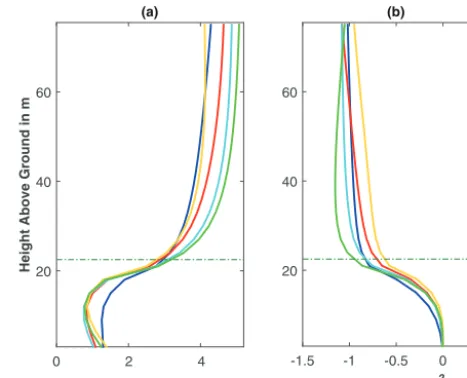
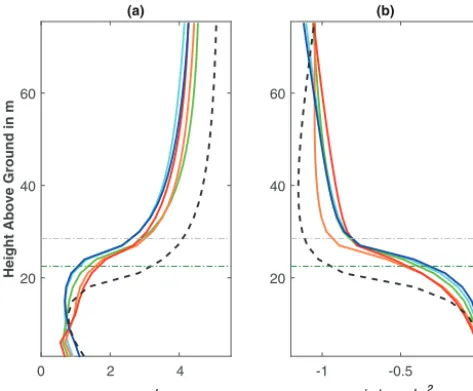
We found a linear relationship betweenhaand gap frac-tion. Eddy-penetration depth scaled with gap fraction as well. It was consistently larger during leaf-off periods compared to leaf-on periods, and the presence of higher LAI during the leaf-on periods resulted in a steeper linear slope of the relationship between δe and gap fraction (Fig. 3c). Intu-itively, increased gap fraction should lead to increased δe, as more canopy openings allow eddies to penetrate deeper into the canopy. These findings are not surprising, as Shaw et al. (1988) found deeperδeat lower LAI. For example, we found that increased LAI and increased gap fraction corre-sponded to increased horizontal wind speed, momentum flux, and turbulence inside the canopy, below 1h(Figs. 4, 5, 6). This was likely due to the extension of turbulent eddy pene-tration deep into canopy gaps, indicated by elevated standard deviation of the vertical velocity,σw(a component of the tur-bulence kinetic energy), in canopy gaps (Fig. 6a). Such loca-tions of increased turbulent eddy penetration are less likely to occur in horizontally homogenous canopies (Fig. 6b). How-ever, the lack of any relationships between roughness length
<ur>x yt /u*
0 2 4
Height Above Ground in m20 40 60
(a)
<ur'w'>x yt /u*2
-1.5 -1 -0.5 0 0.5
20 40 60
[image:10.612.310.544.66.255.2](b)
Figure 4. Vertical profiles of (a) horizontal wind normalized by fric-tion velocity and (b) momentum flux normalized by the square of friction velocity for LAI=1.0 m2m−2(blue), LAI=2.6 m2m−2 (cyan), LAI=3.2 m2m−2 (green), LAI=3.7 m2m−2 (orange), and LAI=4.2 m2m−2 (red). Canopy height shown as horizontal dashed green line.
and gap fraction at all levels below 50 % gap (Table 1) was surprising, as Bohrer et al. (2009) found increases tod,z0, andhain patchier canopies (more gaps) during leaf-on con-ditions. The major difference between these two studies was that the scale of the gaps prescribed here – corresponding to 1–2 crown sizes – was typically smaller than those in the Bohrer et al. (2009) experiments.
We found no consistent correlations between roughness parameters and the mode of the vertical LAD profile, as the variability in roughness parameters over the range of LAD scenarios was extremely high (Table 1). Although the shape of the vertical profile of wind speed is apparently different between the “lower” and the “upper” LAD profiles (Fig. 7) there was no consistent canopy–wind or canopy–turbulence relationships that could be predicted by the bias of the verti-cal LAD curve (Fig. 7). LAD profiles may change in com-plex ways across the landscape and over many timescales (seasons, years, decades) due to disturbance or senescence. As our virtual experiment has shown, the effects of the ver-tical LAD profile are inconsistent with a simple represen-tation of the vertical distribution of LAD using its vertical bias as a single descriptive characteristic. Our results indi-cate that site-level mean LAI and canopy height are easier to obtain and, in general, provide more reliable characteristics of canopy structure than the vertical profile of LAD.
Our simulations did not detect a continuous increase to
relation-<ur>x yt /u*
0 2 4
Height Above Ground in m20 40 60
(a)
<ur'w'>x yz /u*2
-1 -0.5 0
20 40 60
[image:11.612.50.287.67.263.2](b)
Figure 5. Vertical profiles of (a) horizontal wind normalized by fric-tion velocity and (b) momentum flux normalized by the square of friction velocity in a 27 m tall canopy with gap fractions of 0 % (blue), 10 % (cyan), 25 % (green), 35 % (orange), and 50 % (red), as well as in a continuous 21 m tall canopy (dashed back). Canopy height for the tall and short canopies is shown as dashed horizontal gray and green lines, respectively.
ships with any single property of canopy structure, except between displacement height and canopy height. To a lim-ited degree, this was the result of tradeoffs between the two, as indicated by the fact that ha, which combinesd andz0 through the slope of their tradeoff curve, λ, was better con-strained than d or z0 alone. However, this tradeoff cannot fully explain the lack of relationship, as we did not find a significant and consistent relationship betweenz0and differ-ent canopy-structure characteristics even when we assumed a fixed displacement height and fitted only forz0(results not shown). Combined, our results indicate that both of our un-derlying hypotheses were at least partially false, and neither the structural complexity of the canopy nor the tradeoffs be-tweenz0anddcan fully explain the lack of clear relationship between canopy structure anddandz0.
The lack of canopy-structure effects onz0within the vir-tual sensitivity experiment and, in particular, the lack of con-sistent seasonal differences between leaf-on and leaf-off pe-riods may suggest that leaf area is not the primary driver of
z0. To further understand the drivers ofz0, we calculated the sensitivity ofz0to changes in wind speed at a measurement heightzabove the canopy,δz0u. This can be done by solving Eq. (1) forz0 assuming neutral conditions, and calculating the sensitivity as the partial derivative of z0 with respect to uz:
δz0u= ∂z0 ∂uz
=−κ (z−d)
u∗ exp
−κu
z
u∗
. (18)
0 50 100 150
10 20 30 40 (a)
0.2 0.4 0.6 0.8 1 1.2 1.4 1.6 1.8 2
Horizontal Distance in m
0 50 100 150
Height Above Ground in m
10 20 30 40 (b)
[image:11.612.308.545.68.245.2]σw in m/s
Figure 6. Vertical cross section through the simulation results of (a) a 27 m tall canopy with 25 % gap fraction and (b) homogeneous 21 m tall canopy. Thirty-minute mean wind speed and direction are illustrated using black arrows, the standard deviation of vertical ve-locity (an indication of turbulence intensity) is plotted using a color map. Canopy top in each simulation is illustrated by a solid green line.
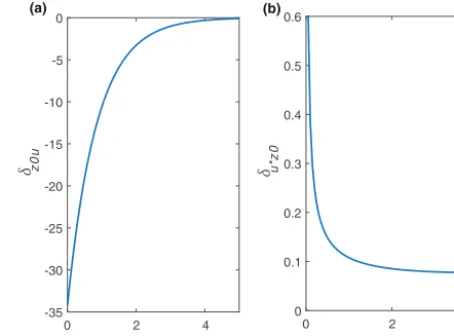
We determine that, at low to intermediate mean wind speeds (below 3 m s−1),z0is extremely sensitive to variation inu, with the derivative being between 5 and 30 (Fig. 8). This indicates that, for an observed variation of 0.1 m s−1 mea-sured at twice the canopy height, the resultingz0will change by 0.5–3 m, which is a full range of the expectedz0values for a 20 m tall canopy. At our site in Michigan, 3 m s−1was approximately the median wind speed and was therefore se-lected to drive the simulations. In reality, variations in half-hourly mean wind speed on the order of 0.1 m s−1 can be a result of local variations in the flow field due to topogra-phy or measurement errors due to instrument placement and calibration. In both reality and LES, such variations in wind speed at a given measurement point could also be the result of effects of local modification to the flow field due to specific heterogeneous canopy-surface structures (which were deter-mined to extend up to 5h; Raupach and Thom, 1981; Bohrer et al., 2009), and could also be driven by random large eddies that may affect the 30 min average at a specific half hour. We hypothesize that this high sensitivity ofz0may be inhibiting the attempts to empirically estimate its relationships with the canopy-structure characteristic.
4.2 Integrating canopy-structure characteristics into models
ve-<ur>x yt /u*
0 2 4
Height Above Ground in m20 40 (a)
<ur'w'>x yt /u*2
-1.5 -1 -0.5 0 0.5
[image:12.612.50.285.65.258.2]20 40 (b)
Figure 7. Vertical profiles of (a) horizontal wind normalized by friction velocity and (b) momentum flux normalized by the square of friction velocity for “lower” (blue), “middle” (cyan), “upper” (green), and ‘natural” (orange) LAD profiles. Canopy height shown as dashed horizontal green line.
locity, Obukhov length, and canopy-structure observations in a forest site in Michigan. We compared six approaches that differ in whether (or not) they incorporate temporal variation into canopy structure, and in the source of data they require to determine z0 and d. Surprisingly, but optimistically for the purpose of accurate modeling, all the surface roughness parameterization approaches we tested resulted in relatively high precision (r2=0.58–0.61) in predicting the half-hourly friction velocity over 12 years. This is surprising because each of the approaches used a different set of values for z0 andd, which in some cases were very far from each other. For example, the biometric and the classical approach per-formed rather similarly, but the biometric approachz0values were about 80 % larger than those of the classical approach. To understand this discrepancy, we calculated the sensitivity of the friction velocity to variation inz0,δu∗z0.
δu∗z0= ∂u∗
∂z0 =κuz
z0
ln
(z−d) z0
2
(19)
For a case similar to the one we simulated, with a canopy at 22 m and mean wind speed of 3 m s−1, we found that the fric-tion velocity is not sensitive to changes in roughness length when roughness length is higher than 0.6 m (Fig. 8). As a general approximation (following the classical approach), for a forest canopy higher than 10 m, roughness length is ex-pected to be larger than 0.1h=1 m. Therefore, while the value of the roughness length parameter is highly sensitive to changes in the half-hourly mean wind speed (Eq. 17, Fig. 8, Table 1), the resulting friction velocity may not be greatly affected by this variation in the parameter’s value.
Mean wind speed in m/s
0 2 4
δ z0 u
-35 -30 -25 -20 -15 -10 -5 0 (a)
z0 in m
0 2 4
δ u*z0
0 0.1 0.2 0.3 0.4 0.5 0.6 (b)
Figure 8. (a) Sensitivity analysis ofz0as a function of variation in the mean wind speed (δzou). We illustrate it here over a particular range of parameters, choosing a canopy height ofh=22 m (roughly the height we used in the simulation and observation site), displace-ment height ofd=0.67h, observation height of 2h (the recom-mended observation height for a flux tower), andu∗of 0.35 m s−1. The results are similar for other canopy heights and u∗ values.
(b) Sensitivity ofu∗to variation inz0(δu∗z0). We plotted the re-sponse curve over the same parametric range and the expected range of values forz0, when mean wind speed is around 3 m s−1.u∗is relatively insensitive (δu∗z0< 0.15) for anyz0above 0.5 m.
The best performing approach for parameterization of roughness length and displacement height was obtained us-ing the annually observed values of these parameters. The yearly observed model demonstrated∼7 % less error than the fixed-in-time classical canopy–roughness relationships. The combined yearly observed approach used thez0andd values for each year to predict friction velocity values in the same years. This method performed better than when apply-ing the data observed durapply-ing a sapply-ingle year to the entire time period. However, the roughness parameters observed during 2011 provided a more accurate and precise model for the entire 12-year time series than the combined approach. The
z0 andd values observed during 2005 provided the worst model, but they still performed better than the classical ap-proach. It is rather intuitive that, when observations ofz0and d exist, they will provide the best approach for modeling of friction velocity (Table 3). Our results indicate that the in-terannual variability in canopy structure that affects rough-ness length has only a very small effect on the resulting fric-tion velocity. Annual growing-season averages ofz0 andd from any single year can provide a suitable approximation to the decadal time series of roughness length parameter values. However, the low spatial coverage by flux networks over the globe limits the use of this method across large spatial do-mains.
[image:12.612.315.542.68.236.2]a surrogate virtual observations from which to evaluate the roughness parameters. However, these types of simulations are limited in their temporal domain (just a few hours as a representative of an entire decade). They are also dependent on high-resolution canopy lidar observations, which, to date, are not common. Parameterization approaches which rely on biometric observations, rather than on wind observations, may be the most reliable and broadly available method to estimate long-term roughness parameters. Our ability to es-timate canopy-structure characteristics such as LAI, canopy height, and gap fraction over a broad range of spatial and temporal scales is continuously improving through the use of on-site biometric measurements as well as airborne and satellite remote sensing observations (Chen et al., 2002; Jon-ckheere et al., 2004; Zheng and Moskal, 2009).
As an indication for the potential of biometric approaches, the approach suggested by Raupach (1994) performed even better than the combined yearly observed approach (Table 3). However, this approach relies on stem census observations. While such records are more common than flux sites, there is still no broad global coverage for this type of observation. We tested two biometric approaches that only required more commonly observable canopy characteristics. LAI, canopy height, and gap fraction or stand density are required by both the Nakai et al. (2008a) approach and the approach derived by the virtual experiments in this study (the biometric ap-proach) in order to determinez0andd. Of the two, our bio-metric approach performed better, and also provided slightly better estimates than the classical approach. Variable success by the three biometric methods may not be surprising – a study by Grimmond and Oke (1999) determined that careful consideration must be given to higher-order structural fea-tures of the surface than the ones represented in this study and include in the biometric approaches. Examples of such higher-order structural characteristics include the complex-ity of organization and the denscomplex-ity of roughness elements. Similar reasoning could provide insight regarding the poor performance of the method of Nakai et al. (2008a) at US-UMB, which is less dense, taller, and has higher LAI than those sites used to parameterize the Nakai 08 method.
The biometric method presented in this study is essentially a variant of the classical method, with the major difference being the use of a variable maximum canopy height as op-posed to mean canopy height, and adding small perturbations to roughness length based on LAI and gap fraction (Eqs. 11– 13). The limited success of this method can be attributed to some degree to the limited effect of interannual variability in canopy structure. However, a decade of observations in a site represents only a very narrow range of potential canopy structures. Our simulation results suggest that this method could potentially improve the prediction of friction velocity when applied to situations where canopy-structure variability is larger, such as after significant disturbance events.
5 Conclusions
In this study we used an LES, long-term meteorological ob-servations, and remote sensing of the canopy to explore the effects of canopy structure on surface roughness parameters in a forest site. We performed a virtual experiment to test the sensitivity of roughness parameters with respect to four axes of variation in canopy structure: (1) leaf area index, (2) the mode of the vertical profile of LAD, (3) canopy height, and (4) gap fraction. We found consistent relationships between the aerodynamic canopy height and LAI, maximum height, and gap fraction, as well as betweend and maximal canopy height. We found that the predicted values of friction velocity are not sensitive to roughness length. As a result, most of the roughness-based approaches we tested for simulating friction velocity performed similarly well. This is despite having very different approaches for determining the values ofz0andd, and having large differences in the range ofz0andd values. This is good news for modelers, because it limits the error from using the current approaches that do not vary in time and do not incorporate canopy structure.
Nonetheless, most of the approaches we tested which used annually variable z0 and d and that incorporated canopy structure provided better approximation for friction velocity than the classical, time-invariable method. Many easily ob-tainable metrics of canopy-structure characteristics are avail-able through a suite of measurements, such as on-site me-teorological and biometric observations or satellite-derived site characteristics. Additionally, many ecosystem models and ecosystem modules within Earth system models resolve the growth of the forest and accurately predict canopy height and LAI. Some models, such as the Ecosystem Demogra-phy model (Medvigy et al., 2009), even resolve the distribu-tion of stem sizes. Such demographic models could readily incorporate the approach by Raupach (1994) for a signifi-cant improvement in surface roughness parameterization. For other models that resolve, or are forced by observed leaf area and vegetation height, our LES-derived biometric approach could offer an easy way to dynamically affect the roughness-length parameterization. This could provide an improvement of surface flux modeling, especially when canopy-structure variations are large. Due to limited spatial coverage by di-rect meteorological measurements, remotely sensed structure statistics, and stand inventories, we suggest utilizing site- and time-specific biometric measurements of canopy structure to estimate site-leveld andz0. The effectivity of these model improvements will, of course, be dependent upon the qual-ity, quantqual-ity, and resolution of the data sets available at the forest of interest.
Acknowledgements. We thank Peter Curtis and Christoph Vogel
for running the AmeriFlux US-UMB and US-UMd sites, and for advice on conducting this study. We thank Ashley Matheny for editing the manuscript. We thank Brady Hardiman for the use of lidar data provided through an NSF-NCALM graduate seed award. This research was supported by the U.S. Department of Energy’s Office of Science, Office of Biological and Envi-ronmental Research, Terrestrial Ecosystem Sciences program, under award nos. DE-SC0006708 and DE-SC0007041 and the AmeriFlux Management project under Flux Core Site agreement no. 7096915 through Lawrence Berkeley National Laboratory, with additional support from the National Science Foundation through grant DEB-0911461. K. D. Maurer was funded in part by an NSF IGERT fellowship (DGE-0504552) awarded through the UMBS Biosphere-Atmosphere Research Training (BART) program. W. T. Kenny was funded by the NASA Earth and Space Science Graduate Training Fellowship program (#NNX11AL45H). Simulations for this projects were run at the Ohio Supercomputer Center as part of resource allocation project PAS0409-4. Any opinions, findings, and conclusions expressed in this material are those of the authors and do not necessarily reflect the views of the National Science Foundation or the Department of Energy.
Edited by: P. Stoy
References
Allen, R., Tasumi, M., Morse, A., Trezza, R., Wright, J., Bastiaanssen, W., Kramber, W., Lorite, I., and Robison, C.: Satellite-based energy balance for mapping eapotranspi-ration with iternalized clibeapotranspi-ration (METRIC) – applications, J. Irrig. Drain. E., 133, 395–406, doi:10.1061/(ASCE)0733-9437(2007)133:4(395), 2007.
Aumond, P., Masson, V., Lac, C., Gauvreau, B., Dupont, S., and Berengier, M.: Including the drag effects of canopies: real case large-eddy simulation studies, Bound. Layer. Meteorol., 146, 65– 80, doi:10.1007/s10546-012-9758-x, 2013.
Bastiaanssen, W. G. M., Menenti, M., Feddes, R. A., and Holtslag, A. A. M.: A remote sensing surface energy balance algorithm for land (SEBAL), 1. Formulation, J. Hydrol., 212–213, 198–212, doi:10.1016/S0022-1694(98)00253-4, 1998.
Bohrer, G., Nathan, R., Katul, G. G., Walko, R. L., and Avissar, R.: Effects of canopy heterogeneity, seed abscission, and inertia on wind-driven dispersal kernels of tree seeds, J. Ecol., 96, 569–580, doi:10.1111/j.1365-2745.2008.01368.x, 2008.
Bohrer, G., Katul, G. G., Walko, R. L., and Avissar, R.: Explor-ing the effects of microscale structural heterogeneity of forest canopies using large-eddy simulations, Bound. Layer. Meteorol., 132, 351–382, doi:10.1007/s10546-009-9404-4, 2009.
Bou-Zeid, E., Parlange, M. B., and Meneveau, C.: On the parame-terization of surface roughness at regional scales, J. Atmos. Sci., 64, 216–227, doi:10.1175/JAS3826.1, 2007.
Bou-Zeid, E., Overney, J., Rogers, B. D., and Parlange, M. B.: The effects of building representation and clustering in large-eddy simulations of flows in urban canopies, Bound. Layer. Meteorol., 132, 415–436, doi:10.1007/s10546-009-9410-6, 2009.
Braam, M., Bosveld, F., and Moene, A.: On Monin-Obukhov scal-ing in and above the atmospheric surface layer: the complexities
of elevated scintillometer measurements, Bound. Layer. Meteo-rol., 144, 157–177, doi:10.1007/s10546-012-9716-7, 2012. Cellier, P. and Brunet, Y.: Flux-gradient relationships above
tall plant canopies, Agric. Forest Meteorol., 58, 93–117, doi:10.1016/0168-1923(92)90113-I, 1992.
Chatziefstratiou, E. K., Velissariou, V., and Bohrer, G.: Resolving the effects of aperture and volume restriction of the flow by semi-porous barriers using large-eddy simulations, Bound. Layer. Me-teorol., 152, 329–348, doi:10.1007/s10546-014-9923-5, 2014. Chen, J. M., Pavlic, G., Brown, L., Cihlar, J., Leblanc, S. G.,
White, H. P., Hall, R. J., Peddle, D. R., King, D. J., Trofy-mow, J. A., Swift, E., Van der Sanden, J., and Pellikka, P. K. E.: Derivation and validation of Canada-wide coarse-resolution leaf area index maps using high-resolution satellite imagery and ground measurements, Remote Sens. Environ., 80, 165–184, doi:10.1016/S0034-4257(01)00300-5, 2002.
Choudhury, B. J. and Monteith, J. L.: A four-layer model for the heat budget of homogeneous land surfaces, Q. J. R. Meteorol. Soc., 114, 373–398, doi:10.1002/qj.49711448006, 1988. Cowan, I. R.: Mass, heat and momentum exchange between stands
of plants and their atmospheric environment, Q. J. R. Meteorol. Soc., 94, 523–544, doi:10.1002/qj.49709440208, 1968. Deardorff, J. W.: Closure of 2nd-moment and 3rd-moment rate
equations for diffusion in homogeneous turbulence, Phys. Fluid., 21, 525–530, 1978.
De Ridder, K.: Bulk transfer relations for the roughness sublayer, Bound. Layer. Meteorol., 134, 257–267, doi:10.1007/s10546-009-9450-y, 2010.
Finnigan, J.: Turbulence in plant canopies, Annu. Rev. Fluid Mech., 32, 519–571, doi:10.1146/annurev.fluid.32.1.519, 2000. Garratt, J. R.: Surface influence upon vertical profiles in the
atmo-spheric near-surface layer, Q. J. R. Meteorol. Soc., 106, 803–819, doi:10.1002/qj.49710645011, 1980.
Garrity, S. R., Meyer, K., Maurer, K. D., Hardiman, B. S., and Bohrer, G.: Estimating plot-level tree structure in a decidu-ous forest by combining allometric equations, spatial wavelet analysis and airborne lidar, Remote Sens. Lett., 3, 443–451, doi:10.1080/01431161.2011.618814, 2012.
Gent, P. R., Danabasoglu, G., Donner, L. J., Holland, M. M., Hunke, E. C., Jayne, S. R., Lawrence, D. M., Neale, R. B., Rasch, P. J., Vertenstein, M., Worley, P. H., Yang, Z.-L., and Zhang, M.: The community climate system model version 4, J. Clim., 24, 4973– 4991, doi:10.1175/2011jcli4083.1, 2011.
Gough, C. M., Hardiman, B. S., Nave, L. E., Bohrer, G., Maurer, K. D., Vogel, C. S., Nadelhoffer, K. J., and Curtis, P. S.: Sustained carbon uptake and storage following moderate disturbance in a Great Lakes forest, Ecol. Appl., 23, 1202–1215, doi:10.1890/12-1554.1, 2013.
Grimmond, C. S. B. and Oke, T. R.: Aerodynamic properties of urban areas derived from analysis of surface form, J. Appl. Meteorol., 38, 1262–1292, doi:10.1175/1520-0450(1999)038< 1262:apouad> 2.0.co;2, 1999.
Hardiman, B. S., Bohrer, G., Gough, C. M., and Cur-tis, P. S.: Canopy structural changes following widespread mortality of canopy dominant trees, Forests, 4, 537–552, doi:10.3390/f4030537, 2013.
Harman, I. N. and Finnigan, J. J.: A simple unified theory for flow in the canopy and roughness sublayer, Bound. Layer. Meteorol., 123, 339–363, doi:10.1007/s10546-006-9145-6, 2007.
Ivanov, V. Y., Bras, R. L., and Vivoni, E. R.: Vegetation-hydrology dynamics in complex terrain of semiarid areas: II. Energy-water controls of vegetation spatio-temporal dynamics and topo-graphic niches of favorability, Water Resour. Res., 44, W03430, doi:10.1029/2006WR005595, 2008.
Jonckheere, I., Fleck, S., Nackaerts, K., Muys, B., Coppin, P., Weiss, M., and Baret, F.: Review of methods for in situ leaf area index determination: Part I. Theories, sensors and hemi-spherical photography, Agric. Forest Meteorol., 121, 19–35, doi:10.1016/j.agrformet.2003.08.027, 2004.
Mahrt, L.: Computing turbulent fluxes near the surface: Needed improvements, Agric. Forest Meteorol., 150, 501–509, doi:10.1016/j.agrformet.2010.01.015, 2010.
Massman, W. J. and Weil, J. C.: An analytical one-dimensional second-order closure model of turbulence statistics and the Lagrangian time scale within and above plant canopies of arbitrary structure, Bound. Layer. Meteorol., 91, 81–107, doi:10.1023/A:1001810204560, 1999.
Maurer, K. D., Hardiman, B. S., Vogel, C. S., and Bohrer, G.: Canopy-structure effects on surface roughness parameters: Ob-servations in a Great Lakes mixed-deciduous forest, Agric. For-est Meteorol., 177, 24–34, doi:10.1016/j.agrformet.2013.04.002, 2013.
Medvigy, D., Wofsy, S. C., Munger, J. W., Hollinger, D. Y., and Moorcroft, P. R.: Mechanistic scaling of ecosystem func-tion and dynamics in space and time: the Ecosystem De-mography model version 2, J. Geophys. Res., 114, G01002, doi:10.1029/2008JG000812, 2009.
Mölder, M., Grelle, A., Lindroth, A., and Halldin, S.: Flux-profile relationships over a boreal forest – roughness sub-layer corrections, Agric. For. Meteorol., 98–99, 645–658, doi:10.1016/S0168-1923(99)00131-8, 1999.
Monin, A. S. and Obukhov, A. M.: Basic laws of turbulent mixing in the surface layer of the atmosphere, Tr. Geofiz. Inst. Akad. Nauk SSSR, 24, 163–187, 1954.
Moran, M. S.: A satellite-based approach for evaluation of the spa-tial distribution of evapotranspiration from agricultural lands, PhD, University of Arizona, Tuscon, Arizona, USA., 223 pp., 1990.
Nakai, T., Sumida, A., Daikoku, K., Matsumoto, K., van der Molen, M. K., Kodama, Y., Kononov, A. V., Maximov, T. C., Dol-man, A. J., Yabuki, H., Hara, T., and Ohta, T.: Parameterisa-tion of aerodynamic roughness over boreal, cool- and warm-temperate forests, Agric. Forest Meteorol., 148, 1916–1925, doi:10.1016/j.agrformet.2008.03.009, 2008a.
Nakai, T., Sumida, A., Matsumoto, K., Daikoku, K., Iida, S., Park, H., Miyahara, M., Kodama, Y., Kononov, A. V., Maximov, T. C., Yabuki, H., Hara, T., and Ohta, T.: Aerodynamic scaling for esti-mating the mean height of dense canopies, Bound. Layer. Mete-orol., 128, 423–443, doi:10.1007/s10546-008-9299-5, 2008b. Nepf, H., Ghisalberti, M., White, B., and Murphy, E.: Retention
time and dispersion associated with submerged aquatic canopies, Water Resour. Res., 43, W04422, doi:10.1029/2006WR005362, 2007.
Paulson, C. A.: The mathematical representation of wind speed and temperature profiles in the unstable atmospheric
sur-face layer, J. Appl. Meteorol., 9, 857–861, doi:10.1175/1520-0450(1970)009< 0857:TMROWS> 2.0.CO;2, 1970.
Perrier, A.: Land surface processes: vegetation, in: Land processes in atmospheric general circulation models, edited by: Eagelson, P., Cambridge University Press, Cambridge, UK, 395–448, 1982. Physick, W. L. and Garratt, J. R.: Incorporation of a high-roughness lower boundary into a mesoscale model for studies of dry depo-sition over complex terrain, Bound. Layer. Meteorol., 74, 55–71, doi:10.1007/bf00715710, 1995.
Raupach, M. R.: Drag and drag partition on rough surfaces, Bound. Layer. Meteorol., 60, 375–395, doi:10.1007/bf00155203, 1992. Raupach, M. R.: Simplified expressions for vegetation
rough-ness length and zero-plane displacement as functions of canopy height and area index, Bound. Layer. Meteorol., 71, 211–216, doi:10.1007/bf00709229, 1994.
Raupach, M. R. and Thom, A. S.: Turbulence in and above plant canopies, Annu. Rev. Fluid Mech., 13, 97–129, doi:10.1146/annurev.fl.13.010181.000525, 1981.
Raupach, M. R., Finnigan, J. J., and Brunet, Y.: Coher-ent eddies and turbulence in vegetation canopies: The mixing-layer analogy, Bound. Layer. Meteorol., 78, 351–382, doi:10.1007/BF00120941, 1996.
Santos, C., Lorite, I. J., Allen, R. G., and Tasumi, M.: Aero-dynamic parameterization of the satellite-based energy balance (METRIC) model for ET estimation in rainfed olive orchards of Andalusia, Spain, Water Resour. Manag., 26, 3267–3283, doi:10.1007/s11269-012-0071-8, 2012.
Schaudt, K. J. and Dickinson, R. E.: An approach to deriving rough-ness length and zero-plane displacement height from satellite data, prototyped with BOREAS data, Agric. For. Meteorol., 104, 143–155, doi:10.1016/S0168-1923(00)00153-2, 2000.
Shaw, R. H. and Pereira, A. R.: Aerodynamic roughness of a plant canopy: A numerical experiment, Agric. Meteorol., 26, 51–65, doi:10.1016/0002-1571(82)90057-7, 1982.
Shaw, R. H. and Patton, E. G.: Canopy element influences on resolved- and subgrid-scale energy within a large-eddy simula-tion, Agric. For. Meteorol., 115, 5–17, 2003.
Shaw, R. H., Denhartog, G., and Neumann, H. H.: Influence of foliar density and thermal-stability on profiles of Reynolds stress and turbulence intensity in a deciduous forest, Bound. Layer. Meteo-rol., 45, 391–409, doi:10.1007/BF00124010, 1988.
Tanner, C. B. and Pelton, W. L.: Potential evapotranspiration esti-mates by the approximate energy balance method of Penman, J. Geophys. Res., 65, 3391–3413, doi:10.1029/JZ065i010p03391, 1960.
Thom, A. S.: Momentum absorption by vegetation, Q. J. R. Meteo-rol. Soc., 97, 414–428, doi:10.1002/qj.49709741404, 1971. Thomas, C. and Foken, T.: Flux contribution of coherent structures
and its implications for the exchange of energy and matter in a tall spruce canopy, Bound. Layer. Meteorol., 123, 317–337, doi:10.1007/s10546-006-9144-7, 2007a.
Thomas, C. and Foken, T.: Organised motion in a tall spruce canopy: temporal scales, structure spacing and terrain effects, Bound. Layer. Meteorol., 122, 123–147, doi:10.1007/s10546-006-9087-z, 2007b.
Wouters, H., De Ridder, K., and van Lipzig, N. P. M.: Comprehen-sive parametrization of surface-layer transfer coefficients for use in atmospheric numerical models, Bound. Layer. Meteorol., 145, 539–550, doi:10.1007/s10546-012-9744-3, 2012.
Zheng, G. and Moskal, L. M.: Retrieving leaf area index (LAI) us-ing remote sensus-ing: theories, methods and sensors, Sensors, 9, 2719–2745, doi:10.3390/s90402719, 2009.