R E S E A R C H
Open Access
Stability and convergence of a new
composite implicit iterative sequence in
Banach spaces
Liping Yang
*and Weiming Kong
*Correspondence:
[email protected] School of Applied Mathematics, Guangdong University of Technology, Guangzhou, 510520, China
Abstract
The purpose of this paper is to study stability and strong convergence of asymptotically pseudocontractive mappings by using a new composite implicit iteration process in an arbitrary real Banach space. The results in this paper improve and extend the corresponding results in the literature.
MSC: 47H09; 47H10; 47J20
Keywords: implicit iteration process; strictly pseudocontractive mappings; asymptotically pseudocontractive mappings; almostT-stability; weakT-stability
1 Introduction
Throughout this paper we assume thatEis an arbitrary real Banach space andE∗denotes the dual space ofE. The normalized duality mapJ:E→E∗is defined by
Jx:=u∗∈E∗:x,u∗=x;u∗=x,
where·,·denotes the generalized duality pairing between elements ofEandE∗. IfE∗is strictly convex, thenJis single-valued.
We first recall some definitions and conclusions.
Definition . LetT:D(T)⊂E→Ebe a mapping.
() Tis said to be asymptotically nonexpansive (see []) if there exists a sequence
{kn} ⊂[,∞),limn→∞kn= such that
Tnx–Tny≤knx–y, ∀x,y∈D(T),n≥;
() Tis said to be asymptotically pseudocontractive (see []) with sequence
{kn} ⊂[,∞), if and only iflimn→∞kn= , for alln≥,x,y∈D(T)and there exists
j(x–y)∈J(x–y)such that
Tnx–Tny,j(x–y)≤knx–y;
() T is said to be strictly asymptotically pseudocontractive with sequence
{kn} ⊂[,∞), if and only iflimn→∞kn=k∈(, ), for alln≥,x,y∈D(T)and there
existsj(x–y)∈J(x–y)such that
Tnx–Tny,j(x–y)≤knx–y;
() T is said to be uniformlyL-Lipschitzian (see []) if there exists a constantL> such that
Tnx–Tny≤Lx–y for allx,y∈D(T),n≥.
It is easy to see that every asymptotically nonexpansive mapping is uniformly L-Lip-schitzian and asymptotically pseudocontractive. In [], Rhoades constructed an example to show that the class of asymptotically pseudocontractive mappings properly contains the class of asymptotically nonexpansive mappings.
The class of asymptotically pseudocontractive mappings has been studied by several au-thors (see [, –] and the references cited therein) by using the modified Mann iteration process (see []) and the modified Ishikawa iteration process (see []). Schu [] proved the following theorem.
Theorem SC Let H be a Hilbert space,K⊂H nonempty bounded closed convex,L> ,
T :K→K completely continuous,uniformly L-Lipschitzian and asymptotically pseudo-contractive with sequence {kn} ⊂[,∞),qn= kn– ,∀n≥,
∞
n=(qn– ) <∞.{αn} ⊂
[, ],<αn≤b,∀n≥,and some b∈(,L–[( +L)/– ]),x∈K,for all n≥,
de-fine
xn+= ( –αn)xn+αnTnxn. (.)
Then{xn}converges to some fixed point of T.
The recursion formula (.) is a modification of the well-known Mann iteration process (see,e.g., []).
Recently, Chang [] extended Theorem SC to real uniformly smooth Banach spaces and proved the following theorem.
Theorem CH Let E be a real uniformly smooth Banach space,K a nonempty bounded closed convex subset of E, T :K→K be an asymptotically pseudocontractive mapping with sequence{kn} ⊂[,∞),limn→∞kn= ,and F(T) ={x∈K:Tx=x} =∅.Let{αn} ⊂
[, ]satisfy the following conditions: (i)limn→∞αn= , (ii)
∞
n=αn=∞.For an arbitrary
x∈K,let{xn}be iteratively defined by(.).If there exists a strictly increasing function φ: [,∞)→[,∞),φ() = such thatTnxn–x∗,j(xn–x∗) ≤knxn–x∗–φ(xn–x∗), ∀n≥,then xn→x∗∈F(T).
LetKbe nonempty closed convex subset ofEand{Ti}ri=be a finite family of nonexpan-sive mappings fromKinto itself (i.e.,Tix–Tiy ≤ x–yforx,y∈Kandi= , , . . . ,r). In
x∈Kand{αn}∞n=⊂[, ), the sequence{xn}∞n=is generated as follows: ⎧
⎪ ⎪ ⎪ ⎪ ⎪ ⎪ ⎪ ⎪ ⎪ ⎪ ⎨ ⎪ ⎪ ⎪ ⎪ ⎪ ⎪ ⎪ ⎪ ⎪ ⎪ ⎩
x= ( –α)x+αTx, x= ( –α)x+αTx, ..
.
xr= ( –αr)xr–+αrTrxr,
xr+= ( –αr+)xr+αr+Txr+, ..
.
The scheme can be expressed in compact form by
xn= ( –αn)xn–+αnTn(modr)xn, n≥. (.)
Using this iteration, they proved that the sequence{xn}converges weakly to a common
fixed point of the finite family of nonexpansive mappings{Ti}ri=in Hilbert spaces under certain conditions. Since then, the construction of fixed points for nonexpansive mappings and strictly pseudocontractive mappings and some other mappings via the implicit iter-ative algorithm has been extensively investigated by many authors (see,e.g., [–] and the references cited therein). An implicit process is generally desirable when no explicit scheme is available. Such a process is generally used as a ‘tool’ to establish the convergence of an explicit scheme.
In , Changet al.[] introduced another implicit iteration process with error. In the sense of [], the implicit iteration process with errors for a finite family of asymptotically nonexpansive mappings{Ti}ri=is generated from an arbitraryx∈Kby
xn=αnxn–+ ( –αn)Tik((nn))xn+un, ∀n≥, (.)
wheren= (k(n) – )r+i(n) withi(n)∈ {, , . . . ,r}andk(n)∈N(the positive integer set) andk(n)→ ∞, asn→ ∞. {αn}∞n= is a suitable sequence in [, ] and{un} ⊂K is such
that∞n=un<∞. They extended the results of [] from Hilbert spaces to more
gen-eral uniformly convex Banach spaces and from nonexpansive mappings to asymptotically nonexpansive mappings.
It is clear that even ifK is a nonempty convex subset ofEand{un} ⊂K is such that
∞
n=un<∞, then the implicit iterative sequence with errors in the sense of [] need
not be well defined,i.e.,{xn}∞n= may fail to be inK. More precisely, the conditions im-posed on the error terms are not compatible with the randomness of the occurrence of errors.
In [], Thakur proposed another modified composite implicit iteration process for a finite family of asymptotically nonexpansive mappings as follows:
xn= ( –αn)xn–+αnTik((nn))yn,
yn= ( –βn)xn–+βnTik(n(n))xn,
{αn},{βn} ⊂[, ],∀n≥,
Inspired and motivated by these facts, we introduce a new modified composite implicit iteration process for an asymptotically pseudocontractive mappings as follows:
⎧ ⎪ ⎨ ⎪ ⎩
x∈K,
xn+= ( –αn)xn+αnTnyn,
yn= ( –βn)xn+βnTnxn+,
{αn},{βn} ⊂[, ],∀n≥. (.)
Unlike iteration methods with errors of [], our iteration process (.) is always well de-fined, that is,{xn}is always inKifKis convex subset ofE.
If{βn}={}for alln≥, (.) becomes the explicit form as follows:
xn+= ( –αn)xn+αnTnxn. (.)
Equation (.) is the modified Mann iterative process (see,e.g., []).
Stability results established in metric space, normed linear space, and Banach space set-tings are available in the literature. There are several authors whose contributions are of colossal value in the study of stability of the fixed point iterative procedures: Imoru and Olatinwo [], Olatinwo and Postolache [], Akewe and Okeke [].
Harder and Hicks [] mentioned that the study of the stability of iterative schemes is useful for both theoretical and numerical investigations. Consequently, several authors have studied the stability of iterative schemes for various types of nonlinear mappings (see, e.g., [–] and the references cited therein).
The purpose of this paper is to study the stability and convergence of the composite implicit iterative sequence for an asymptotically pseudocontractive mapping in arbitrary real Banach spaces.
LetK be a nonempty convex subset ofEandT :K→K be a mapping,x∈K and
{xn} ⊂Kdefined by
xn+=f(T,xn), (.)
wheref is a continuous mapping. Suppose thatF(T)=∅andxn→p∈F(T). Let{sn}be
any bounded sequence inKand{εn}a sequence in [,∞) defined by
εn=sn+–f(T,sn), n≥. (.)
Ifεn→ implies thatsn→p, then the iterative sequence{xn}defined by (.) is said to
beT-stable. If∞n=εn<∞implies thatsn→p, then the sequence{xn}defined by (.) is
said to bealmost T-stable. An example in [] represents an iterative sequence which is almostT-stable but notT-stable.
2 Preliminaries
In the sequel,F(T) ={x∈K:Tx=x} denotes the set of fixed points ofT. We give the stability definition for the sequence{xn}defined by (.).
Definition . Let{xn}be the sequence defined by (.) such thatxn→p∈F(T). Let{sn}
be any bounded sequence inK. Define a sequence{εn}by
εn=sn+– ( –αn)sn–αnTnzn,
zn= ( –βn)sn+βnTnsn+,
Ifεn→ implies thatsn→p, then the sequence{xn}is said to beT-stable. Ifεn/αn→
implies thatsn→p, then the sequence{xn}is said to beweakly T-stable. If
∞
n=εn<∞
implies thatsn→p, then the sequence{xn}is said to bealmost T-stable.
The following lemmas will be needed in proving our main results.
Lemma .(Lemma of []) Let{an},{bn},{cn}be nonnegative real sequences satisfying
the following conditions:
an+≤( –tn)an+bntn+cn, ∀n≥,
where{tn}is a sequence in[, ]such that∞n=tn=∞,limn→∞bn= and∞n=cn<∞.
Then an→ (n→ ∞).
We denote:={φ|φ: [,∞)→[,∞) be a nondecreasing function such thatφ(t) = if and only ift= }.
Lemma .(Lemma . of []) Let{θn}be a sequence of nonnegative real numbers,{λn}
be a real sequence satisfying
≤λn≤,
∞
n=
λn=∞,
and letφ∈.If there exists a positive integer nsuch that
θnq+≤θnq–λnφ(θn+) +λnσn
for some q> ,all n≥nandlimn→∞σn= ,thenlimn→∞θn= .
Lemma .(Lemma . of []) Let E be a real Banach space,T:E→E a mapping,and
λany positive real number.Then for any x,y∈E and k> ,
x–y ≤x–y+λ(I–T–kI)x– (I–T–kI)y
whenever
(I–T–kI)x– (I–T–kI)y,j(x–y)≥, ∀j(x–y)∈J(x–y).
Lemma . Let E be a normed linear space then for all x,y∈E and for all j(x+y)∈J(x+y), the following inequality holds:
x+y≤ x+ y,j(x+y).
First we give two auxiliary lemmas.
If{xn}is the iterative sequence defined by(.)and p∈F(T),then
xn–p ≤( +knαn)
–αn+αn
xn––p+αnbn,
where
bn=Tnxn+–Tnyn+αn(kn+ )xn–Tnyn. (.)
Proof SinceTis an asymptotically pseudocontractive mapping with{kn} ⊂[,∞), there
existsj(xn+–p)∈J(xn+–p) forxn+∈Kandp∈F(T) such that
Tnxn+–p,j(xn+–p)
≤knxn+–p.
Then we have
I–Tn+ (kn– )I
xn+–
I–Tn+ (kn– )I
p,j(xn+–p)
≥.
Thus it follows from Lemma . that
xn+–p ≤
xn+–p+
αn
+αn
I–Tn+ (kn– )I
xn+–
I–Tn+ (kn– )I
p. (.)
It follows from (.) that
xn=xn++αnxn–αnTnyn
= ( +αn)xn++αn
I–Tn+ (kn– )I
xn++αn
Tnxn+–Tnyn
–αnknxn+αn(kn+ )
xn–Tnyn
. (.)
Sincep∈F(T), we have
p= ( +αn)p+αn
I–Tn+ (kn– )I
p–αnknp. (.)
From (.) and (.), we have
xn–p ≥( +αn)
xn+–p+
αn
+αn
I–Tn+ (kn– )I
xn+
–I–Tn+ (kn– )I
p–αnknxn–p
–αnTnxn+–Tnyn–αn(kn+ )xn–Tnyn. (.)
Therefore from (.) we have
xn–p ≥( +αn)xn+–p–αnknxn–p
i.e.,
( +αn)xn+–p ≤( +αnkn)xn–p+αnTnxn+–Tnyn
+αn(kn+ )xn–Tnyn. (.)
Since ( +αn)–≤ and ( +αn)–≤ –αn+αn, from (.), we have
xn+–p ≤( +αnkn)
–αn+αn
xn–p+αnbn, (.)
wherebn=Tnxn+–Tnyn+αn(kn+ )xn–Tnyn. This completes the proof.
3 Main results
Theorem . Let K be a nonempty convex subset of an arbitrary real Banach space E and T :K→K be a uniformly Lipschitzian(with a Lipschitzian constant L> )and strictly asymptotically pseudocontractive mapping with sequence {kn} ⊂[,∞),kn→k∈(, ),
and let F(T)=∅.Assume that{xn},{yn}are the sequences defined by(.),{αn},{βn} ⊂[, ]
satisfy the following conditions:
(i)αn→, βn→ (n→ ∞); (ii)
∞
n=
αn=∞.
If{xn}is bounded in K,then
() {xn}converges strongly to the unique common fixed pointpofT;
() {xn}is both almostT-stable and weaklyT-stable.
Proof Assume thatp,p∈F(T). SinceT is a strictly asymptotically pseudocontractive mapping, there existsj(p–p)∈J(p–p) such that
p–p=Tnp–Tnp,j(p–p)≤knp–p.
Lettingn→ ∞we havep–p≤kp–p,k∈(, ). This implies thatp=p. By the strictly asymptotically pseudocontractive property ofT, similar to (.), we have
xn+–p ≤( +αnkn)
–αn+αn
xn–p+αnbn, (.)
wherebn=Tnxn+–Tnyn+αn(kn+ )xn–Tnyn. Sinceαn→,kn→k∈(, ), and
( +αnkn)
–αn+αn
≤ –αn( –kn–αn)
.
Sincelimn→∞( –kn–αn) = –k≥δ∈(, –k), there exists a natural numbern such
that ( –kn–αn)≥δfor alln≥n. Thus we have
( +αnkn)
–αn+αn
≤ –δαn, ∀n≥n. (.)
Substituting (.) into (.) we have
xn–p ≤( –δαn)xn––p+αnbn, ∀n≥n. (.)
SinceT :K→K is uniformly Lipschitzian with a Lipschitzian constantL> , for all x,y∈K, we have
Tnxn+–p≤Lxn+–p, ∀n≥.
This implies that {Tnx
n+} is bounded inK since {xn}is bounded. Similarly,{Tnxn} is
bounded sequence inK. It follows from (.) that
yn–xn=βnxn–Tnxn+≤βn
xn+Tnxn+→ (n→ ∞). (.)
This implies that{yn}is bounded. Thus by the uniform Lipschitzianness ofT, we have
Tnyn≤Tnyn–Tnxn+Tnxn≤Lyn–xn+Tnxn.
This implies that{Tny
n}is also bounded. From (.) and (.), we have
xn+–yn=(xn–yn) +αn
xn–Tnyn
≤ yn–xn+αn
xn+Tnyn→ (n→ ∞). (.)
Therefore we have
Tnxn+–Tnyn≤Lxn+–yn → (n→ ∞). (.)
Observing (.),{xn},{Tnyn}bounded inKandαn→ (n→ ∞), we know thatbn→
(n→ ∞). By Lemma . and (.), we havexn→p(n→ ∞). The conclusion () is proved.
Next we prove the conclusion (). For any bounded sequence{sn} ⊂Kdefined by (.)
andp∈F(T), we have
sn+–p=sn+– ( –αn)sn–αnTnzn+ ( –αn)sn+αnTnzn–p
≤εn+pn–p, (.)
where
pn= ( –αn)sn+αnTnzn, ∀n≥. (.)
It follows from (.) that
sn=pn+αnsn–αnTnzn
= ( +αn)pn+αn
I–Tn+ (kn– )I
pn+αn
Tnpn–Tnzn
+αnknsn+αn(kn+ )
sn–Tnzn
.
By using a similar method to that given in proving (.)-(.), (.), we can prove that
wherebn=Tnpn–Tnzn+αn(kn+ )sn–Tnzn. SinceTis uniformly Lipschitzian with
Lipschitzian constantL> , we haveTns
n–p ≤Lsn–p. This implies that the sequence {Tns
n}is bounded since{sn}is bounded inK. By the same method as in proving (.)-(.),
we can prove that the sequence{Tnz
n} is bounded andTnpn–Tnzn → (n→ ∞).
Therefore we havebn→ (n→ ∞). Substituting (.) into (.) we have
sn+–p ≤( –αnδ)sn–p+αnbn+εn, ∀n≥n. (.)
If∞n=εn<∞, takingan=sn–p,tn=αnδ,cn=εnin Lemma ., from (.), we have
sn→p(n→ ∞),i.e.,{xn}is almostT-stable.
Ifεn/αn→, takingan=sn–p,tn=αnδ,cn= in Lemma ., from (.), we have
sn→p(n→ ∞),i.e.,{xn}is weaklyT-stable. This completes the proof.
Example . LetE=R= (–∞,∞) with the usual norm. TakeK= [, ] and defineT :
K→Kby
Tx= ⎧ ⎪ ⎪ ⎪ ⎪ ⎪ ⎨ ⎪ ⎪ ⎪ ⎪ ⎪ ⎩
ifx= ,
ifx= ,
x–n+ ifn+ ≤x<(n++n),
n–x if(n++n)≤x<n
for alln≥. ThenF(T) ={}andTis not continuous atx= . We can verify that
Tx≤
x, x∈K.
ThusT is continuous inK andTK⊂[, –n] for alln≥. Then for anyx∈K, there
existsj(x– )∈J(x– ) satisfying
Tnx–Tn,j(x– )=Tnx·x≤ x
for alln≥. That is,Tis a strictly asymptotically pseudocontractive mapping.
Example . LetE= [, ]. DefineT :E→E byTx=x, whereE has the usual norm. ThenF(T) ={}andTis a strictly asymptotically pseudocontractive mapping withkn=.
Consider the following conditions:
αn=
n+ , βn=
n+ , ∀n≥.
Let{xn}be the sequence defined by (.). So
⎧ ⎪ ⎨ ⎪ ⎩
x= .,
xn+= ( –n+)xn+n+Tnyn,
yn= ( –n+ )xn+n+ Tnxn+,
∀n≥.
Table 1 The iteration chart with initial valuex1= 0.25
n xn
1 0.25
2 0.134228 3 0.090397 4 0.067943 5 0.054373
n xn
6 0.045313 7 0.038840 8 0.033985 9 0.030209 10 0.027188
Therefore, the conditions of Theorem . are fulfilled.
Theorem . Let K be a nonempty convex subset of an arbitrary real Banach space E,T: K→K be a uniformly Lipschitzian(with a Lipschitzian constant L> )and asymptotically pseudocontractive mapping with sequence{kn} ⊂[,∞),limn→∞kn= and let F(T)=∅
and p∈F(T).Let{xn},{yn}be the sequences defined by(.).Assume that{αn},{βn} ⊂[, ]
satisfy the following conditions:
(i)αn→, βn→ (n→ ∞); (ii)
∞
n=
αn=∞.
If{xn}is bounded in K and there exists a strictly increasing functionφ: [,∞)→[,∞)
withφ() = such that
lim sup
n→∞
Tnxn+–p,j(xn+–p)
–knxn+–p+φ
xn+–p
≤,
where j(xn+–p)∈J(xn+–p).Then{xn}converges strongly to the fixed point of T.
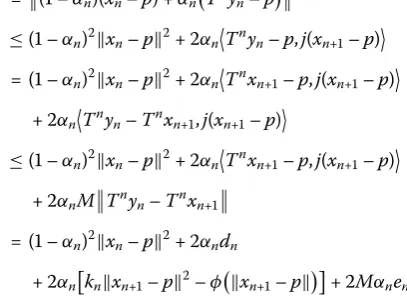
Proof Since{xn}is bounded inK, thenM=supn≥{xn–p}<∞forp∈F(T). It follows
from Lemma . and (.) that there existsj(xn+–p)∈J(xn+–p) such that
xn+–p =( –αn)(xn–p) +αn
Tnyn–p
≤( –αn)xn–p+ αn
Tnyn–p,j(xn+–p)
= ( –αn)xn–p+ αn
Tnxn+–p,j(xn+–p)
+ αn
Tny
n–Tnxn+,j(xn+–p)
≤( –αn)xn–p+ αn
Tnxn+–p,j(xn+–p)
+ αnMTnyn–Tnxn+
= ( –αn)xn–p+ αndn
+ αn
knxn+–p–φ
xn+–p
+ Mαnen, (.)
wheredn=Tnxn+–p,j(xn+–p)–knxn+–p+φ(xn+–p),en=Tnyn–Tnxn+. From (.), we haveen→ asn→ ∞. It follows from (.) that
( – αnkn)xn+–p≤( –αn)xn–p– αnφ
xn+–p
Notice that limn→∞( – αnkn) = > , without loss of generality, we assume that ( –
αnkn) > for alln≥. Therefore, we have
xn+–p≤
( –αn)
– αnkn
xn–p
– αn – αnkn
φxn+–p
+ αndn – αnkn
+ Mαnen – αnkn
=xn–p+
αn[(kn– ) +αn]
– αnkn
xn–p
– αn – αnkn
φxn+–p
+ αndn – αnkn
+ Mαnen – αnkn
≤ xn–p– αnφ
xn+–p
+αn[(kn– ) +αn] – αnkn
M
+ Mαnen – αnkn
+ αndn – αnkn
since – αnkn∈(, )
=xn–p– αnφ
xn+–p
+ αnλ
n
– αnkn
+ αndn – αnkn
, (.)
whereλn= [(kn– ) +αn]M+ enM. Takingq= ,θn=xn–p,λn= αn,σn= λ
n+dn
(–αnkn)
in Lemma ., from (.), we havexn→pasn→ ∞. This completes the proof.
If{βn}={}for alln≥ in (.), it follows from Theorem . that we have the following
result.
Theorem . Let K be a nonempty convex subset of an arbitrary real Banach space E,T: K→K be a uniformly Lipschitzian(with a Lipschitzian constant L> )and asymptotically pseudocontractive mapping with sequence{kn} ⊂[,∞),limn→∞kn= and let F(T)=∅
and p∈F(T),{xn}be the sequence defined by(.).Let{αn} ⊂[, ]satisfy the following
conditions: (i)limn→∞αn= , (ii)
∞
n=αn=∞.If{xn}is bounded in K and there exists a
strictly increasing functionφ: [,∞)→[,∞)withφ() = such that
lim sup
n→∞
Tnxn+–p,j(xn+–p)
–knxn+–p+φ
xn+–p
≤,
where j(xn+–p)∈J(xn+–p),∀n≥,then xn→p as n→ ∞.
Remark . Theorem . extends Theorem CH from real uniformly smooth Banach space to arbitrary real Banach space. The requirement thatKbe bounded closed imposed in Theorem CH is stronger than the requirement that{xn}be bounded imposed in
Theo-rem .. The condition
Tnxn–p,j(xn–p)
≤knxn–p+φ
xn–p
in Theorem CH is replaced by
lim sup
n→∞
Tnxn+–p,j(xn+–p)
–knxn+–p+φ
xn+–p
≤
Remark . We remark that if the error terms are added in (.) and are assumed to be bounded, then the results of this paper still hold. On carefully reading Thakur’s work [], we discovered that there are gaps in the proof of Lemma . in []. In (.) and (.) of Lemma ., one cannot deduce∞n=σn<∞from
∞
n=μn<∞,
∞
n=dn<∞. Thus, his
main results would not hold.
Competing interests
The authors declare that they have no competing interests.
Authors’ contributions
All authors contributed equally to the writing of this paper. All authors read and approved the final manuscript.
Acknowledgements
The authors thank the referees for the comments that helped improve the presentation of this article. This work was supported by the Humanity and Social Science Planning Foundation of Ministry of Education of China (Grant No. 14YJAZH095), the National Natural Science Foundation of China (Grant No. 61374081), the High-level Talents Project in Guangdong Province (Grant No. 2014011), and the Natural Science Foundation of Guangdong Province (Grant Nos. S2013010013034, 2015A030313485).
Received: 3 June 2015 Accepted: 14 September 2015
References
1. Goebel, K, Kirk, WA: A fixed point theorem for asymptotically nonexpansive mappings. Proc. Am. Math. Soc.35, 171-174 (1972)
2. Schu, J: On a theorem of C.E. Chidume concerning the iterative approximation of fixed points. Math. Nachr.153, 313-319 (1991)
3. Goebel, K, Kirk, WA: A fixed point theorem for transformations whose iterates have uniform Lipschitz constant. Stud. Math.47, 135-140 (1973)
4. Rhoades, BE: A comparison of various definition of contractive mappings. Trans. Am. Math. Soc.226, 257-290 (1977) 5. Schu, J: Iterative construction of fixed point of asymptotically nonexpansive mappings. J. Math. Anal. Appl.158,
407-413 (1991)
6. Chang, SS: Some results for asymptotically pseudocontractive mappings and asymptotically nonexpansive mappings. Proc. Am. Math. Soc.129, 845-853 (2000)
7. Ofoedu, EU: Strong convergence theorem for uniformly L-Lipschitzian asymptotically pseudocontractive mapping in real Banach space. J. Math. Anal. Appl.321, 722-728 (2006)
8. Mann, WR: Mean value methods in iteration. Proc. Am. Math. Soc.4, 506-510 (1953)
9. Ishikawa, S: Fixed point and iteration of a nonexpansive mapping in a Banach space. Proc. Am. Math. Soc.59, 65-71 (1976)
10. Xu, HK, Ori, RG: An implicit iteration process for nonexpansive mappings. Numer. Funct. Anal. Optim.22(5), 767-773 (2001)
11. Osilike, MO: Implicit iteration process for common fixed points of a finite family of strictly pseudocontractive maps. J. Math. Anal. Appl.294, 73-81 (2004)
12. Gu, F: The new composite implicit iterative process with errors for common fixed points of a finite family of strictly pseudocontractive mappings. J. Math. Anal. Appl.329, 766-776 (2007)
13. Chang, SS, Tan, KK, Lee, HWJ, Chan, CK: On the convergence of implicit iteration process with errors for a finite family of asymptotically nonexpansive mappings. J. Math. Anal. Appl.313, 273-283 (2006)
14. Yang, LP: Convergence of the new composite implicit iteration process with random errors. Nonlinear Anal. TMA69, 3591-3600 (2008)
15. Su, Y, Li, S: Composite implicit iteration process for common fixed points of a finite family of strictly pseudocontractive maps. J. Math. Anal. Appl.320, 882-891 (2006)
16. Thakur, BS: Weak and strong of composite implicit iteration process. Appl. Math. Comput.190, 965-973 (2007) 17. Imoru, CO, Olatinwo, MO: On the stability of Picard and Mann iteration procedures. Carpath. J. Math.19(2), 155-160
(2003)
18. Olatinwo, MO, Postolache, M: Stability results for Jungck-type iterative processes in convex metric spaces. Appl. Math. Comput.218(12), 6727-6732 (2012)
19. Akewe, H, Okeke, GA: Convergence and stability theorems for the Picard-Mann hybrid iterative scheme for a general class of contractive-like operators. Fixed Point Theory Appl.2015, 66 (2015)
20. Harder, AM, Hicks, TL: Stability results for fixed point iteration procedures. Math. Jpn.33(5), 693-706 (1988) 21. Zhou, HY, Chang, SS, Cho, YJ: Weak stability of Ishikawa iteration procedures forφ-hemicontractive and accretive
operators. Appl. Math. Lett.14, 949-954 (2001)
22. Stevi´c, S: Stability results forφ-strongly pseudocontractive mappings. Yokohama Math. J.50, 71-85 (2003) 23. Huang, Z: Weak stability of Mann and Ishikawa iterations with errors forφ-hemicontractive operators. Appl. Math.
Lett.20, 470-475 (2007)
24. Shahzad, N, Zegeye, H: On stability results forφ-strongly pseudocontractive mappings. Nonlinear Anal. TMA64, 2619-2630 (2006)
26. Liu, LS: Ishikawa and Mann iterative process with errors for nonlinear strongly accretive mappings in Banach spaces. J. Math. Anal. Appl.194, 114-125 (1995)