Journal, 16(2), 127-135.
Reconceptualizing the Linked Courses Model
MARY BAXTER University of Houston
Houston, TX USA [email protected]
To help students meet the demands of society, the University of Houston is using the framework of learning communities and constructivism to create a cross-disciplinary approach to teaching to provide media-rich thematically linked courses to engage a diverse student population. A case study investigat-ed three semesters of thematically linkinvestigat-ed courses, Places in Time and Multicultural America, that used a thematic cross-disciplinary approach to curriculum involving the History and English departments, the Instructional Technology Program, the University Writing Center, and the Museum of Fine Arts, Houston. During this study, the need for a new linked courses model evolved that supports the inclusion of university and community resources.
THE STUDY
Figure 1.Linked Courses component relationships
University resources were needed for successful implementation of the linked courses. The IT Program supported the technology needs of the model. The IT instructor taught the students the skills needed to complete the multimedia projects and supported the American History instructor as needed to generate and support multimedia lecture materials. The allocation, configuration, and support of laptops were vital to ensuring the learning activities ran smoothly.
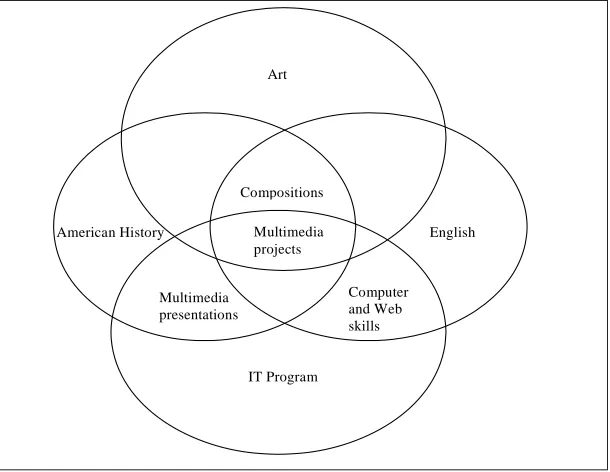
This study at the University of Houston demonstrated the importance of using community resources. Art was added as a component to provide another dimension to student learning. Introducing art within the history course framework provided a visual arts component that expanded student ideas about art and society and to get them to critically think about art. The thematic relationship of the content and sharing of syllabi between the English and American History courses is depicted in Figure 2. The intersec-tion of the Venn diagram shows the interlacing of English composiintersec-tion, American History, technology, and art components.
American History
Multimedia projects
Multimedia presentations
Computer and Web skills Art
Compositions
English
Figure 2. English and American History thematic relationship
Questionnaires and in-person interviews were used to gather data from the American History, English, Art, and IT faculty, as well as the supporting staff to evaluate their perceived outcome covering three semesters of linked course offerings. The analysis of data indicated that both strengths and challenges were identified by all members of the team.
Strengths
One of the greatest strengths of the linked courses concept was the collabo-ration effort in planning and implementing the learning community. There continued to be an environment of communication, testing of ideas, and of obtaining feedback that helped this concept evolve into a rich and meaning-ful experience. This experience energized instructors and provided not only a learning community of support and personal relationships with the instructors, support staff, and freshman students but ultimately became a community of learners. Instructors continued to be creative and innovative;
American History English Gilded Age America
The 1890s as a Turning Point
Depression America
World War II
The Cold War The 1920s
Literature
Composition skills
Conceptualize skills Progressive America
The Meaning of World War I
The Tumultuous 1960s
The Vietnam War
America in Decline? 1973-1989
America in Our Time The West of the Imagination/ The Gilded Age- How the other half lives
Toward the 21st
century The problems and promise of American life
they learned more about teaching and experimenting with how to use technology in the classroom.
Important to the success of this effort, a group of committed and motivated instructors joined together across disciplines to implement the linked courses. Each semester, the students responded positively to the linked courses: they were more motivated, excited, and enthusiastic than students in a standard lecture class. They were also engaged and benefited from a meaningful experience which resulted in higher grades and attendance than the standard lecture classes, and there were no discipline problems. The students benefited from the ownership of their multimedia projects and in writing and performing research.
CHALLENGES
A challenge at first for the faculty was learning to work as a team in an environment that is highly individualistic which resulted is differing visions and opinions; however, over time, all participants learned how to work as a team. Coordinating the syllabus between the English class and the American History class was a challenge. The syllabus required adjustments throughout the semester and as needed to accommodate the technology components. Balance of content between the English and American History courses were a challenge at first. The first two semesters, the English content was diluted due to insufficient class time, the increased number of multimedia projects, and that Fridays were dedicated to learning technology and students working on their projects. Including technology in the English class also reduced writing time and collaboration activities. This problem continued the following semester even though the number of multimedia projects were reduced from five projects to three and help with technology skills was moved to a lab outside of class time. The final semester, in addition to the changes made in the previous semester, an extra hour of class time was added which helped to alleviate the problem of diluted English content. This balance of content and focus on writing and rhetoric were also a concern of administrators.
Registration problems, academic bureaucracy, and the willingness to take risks were challenges identified by some of the participants. Registration problems were a challenge each semester. The open registration system of the university did not enforce the coenrollment requirement; this required the instructors to resolve this problem on the first day of class. Instructors are hopeful that using Peoplesoft software in the future will enable the university to handle the coenrollment requirement of the linked courses. In addition to the registration problems, one instructor commented that they need to overcome the bureaucracy of making changes slowly and be willing to accept risks to effectively meet the challenges of preparing students for a digital society.
After Places in Time and Multicultural America linked courses, the desired goal of scaling the linked courses to at least 100 students did not materialize. Places in Time had 33 students; Multicultural America had 60 students the first semester; 40 for the next semester. Advertising and registration
the linked courses to the desired size requires additional resources such as computers for each student and additional support staff. The primary challenge for the students was that it took several weeks before some students began to understand what was going on and how the linked courses were connected.
EVOLUTION OF A NEW LINKED COURSES MODEL
The linked courses evolved over time to a model that transcends beyond the basic Linked Courses. Linked courses titled Places in Time and Multicul-tural America stressed the importance of active learning and using technol-ogy to help achieve this goal. The American History lecture changed to include the sharing of digital historical artifacts such as movies, music, and photographs. To provide students with an enriching experience, an instruc-tor from MFAH shared the hisinstruc-torical significance of art. The English class changed to include required technology skills that would enable them to produce effective multimedia Websites. These multimedia assignments would weave the history and composition requirements of the linked courses. The interweaving of technology and art extended beyond the basic definition of the Linked Courses mode. Kellogg (1999) explained the Linked Courses Model:
This model links a cohort of students with two common courses. One course is typically content-based (science, math) and the other is an application course (writing, speech). The faculty of each course may teach independently or together and coordinate syllabi and assign-ments so that the classes compliment each other. The Linked Courses Model provides a shared experience for students that focuses on a content-based course that is actively supported by a skills course. (p. 1)
boarders such as the MFAH instructor who taught art concepts to American History students.
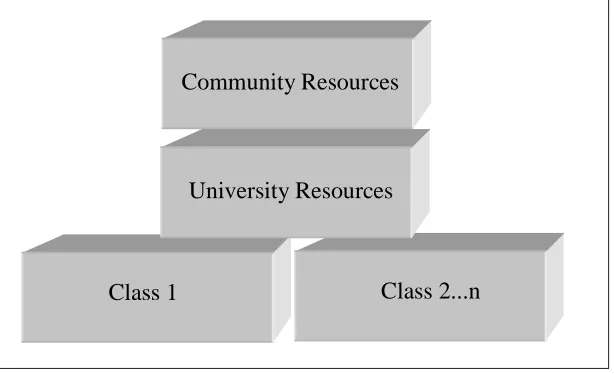
A new model is needed to reflect expanding educational possibilities in providing students with a more powerful 21st century educational experi-ence. This new model I am proposing is the Extensible Linked Courses Model that includes two or more thematically linked courses as well as other university departments and resources that extend beyond the university campus borders. This new Extensible Linked Courses Model is based on the building block approach of using two or more existing courses that are thematically linked, university resources such as the IT Program and the Writing Center, as well as community resources such as the MFAH. This building block approach is depicted in Figure 3.
Figure 3.Building blocks of the Extensible Linked Courses Model
IMPLICATIONS OF THE EXTENSIBLE LINKED COURSES MODEL
As discovered in Places in Time and Multicultural America, using universi-ty resources, such as the IT Program and Writing Center, provides the resources and skills needed to provide a media-rich active learning environ-ment to engage a diverse student population. The implications of using
Class 2...n
Class 1
Community Resources
community resources to enhance student learning are far-reaching. Just as the MFAH instructor introduced art as part of our society; other community resources can be used to help instructors add another dimension to student learning. The Extensible Linked Courses Model draws on the abundance of resources available within the university campus and in the community. The potential for using the Extensible Linked Courses Model for other programs is promising. As discovered in this study, and touched upon in Lenning and Ebbers (1999) study, there was an environment of communica-tion, testing of ideas, creativity, innovacommunica-tion, and in obtaining feedback that helped this concept evolve into a rich and meaningful experience. Instruc-tors designed a supportive learning community, which included the support staff, the University of Houston Writing Center staff, the IT Program, and the MFAH that benefited the freshman students. Each semester was an enlightening experience for the instructors. The instructors commented that they learned more about teaching and experimented with how to use technology in the classroom. The instructors discovered, as did Huba, Epperson and McFadden (2002), that student grades and attendance were higher than the standard lecture classes and that no discipline problems occurred. Participants in the study observed that students had positive attitudes as Huba, Epperson, and McFadden (2001) found in their research. Students in this study were more motivated, excited, and enthusiastic than students in a standard lecture class and they benefited from the ownership of their projects and in writing and performing research.
Planning and implementing Places in Time required instructor time to reinvent the curriculum and to plan and coordinate this experience. This finding corresponded with Rasmussen and Skinnerà’s (1997) discussion of instructor time and flexibility needed to plan and implement a linked courses. For Multicultural America, the instructors were able to reuse existing concepts and some resources which helped reduced the planning time. After Places in Time, a core instructor team evolved to continue the concept. These changes eliminated the need for more formal planning meetings which further reduced instructor time.
meaningful ways by developing creative educationally meaningful projects that demonstrate student understanding of American history and art. Students also benefited from this experience by learning technology skills that will carry forward into their academic and professional careers.
CONCLUDING REMARKS
As a researcher participating in Places in Time and Multicultural America, the opportunity to witness the magical interaction between the students, instructors, and IT support was an illuminating experience. The student motivation and engagement in the classroom was obvious. The student increase in motivation, engagement, attendance, grades, and completion rate over the standard lecture class sends a clear message that this concept is working. Instructors implemented a collaborative environment of support that allowed for the testing of ideas, creativity, innovation, and in obtaining feedback that helped this concept evolve into a rich and meaningful experience.
References
Huba, M., Epperson, D., & McFadden, M. (2001). Final Report ofISU un-dergraduate education survey 2000: A comparison of learning commu-nity participants and non-participants. Retrieved March 23, 2008, from http://www.lc.iastate.edu/finalreport2000.pdf
Huba, M., Epperson, D., & McFadden, M. (2002, May 13-14). Learning
community assessment, report from the learning community assessment subcommittee. Presented at the Learning Communities Institute at Iowa State University. Retrieved March 23, 2008, from http:// www.lc.iastate.edu/Learning%20Community%20Assessment.pdf
Kellogg, K. (1999). Learning communities. (ERIC Document Reproduction
Service No. ED430512) Retrieved March 23, 2008, from http:// www.eric.ed.gov/ERICDocs/data/ericdocs2sql/content_storage_01/ 0000019b/80/17/92/54.pdf
Lenning, O.T., & Ebbers, L.H. (1999). The powerful potential of learning
communities: Improving education for the future. ASHE_ERIC Higher
Education Report, 26(6). Washington, DC: The George Washington University, Graduate School of Education and Human Development. Rasmussen, G., & Skinner, E. (1997). Learning communities: Getting