proficiency. AACE Journal, 15(2), 131-157.
Web Page Design as a Tool for English Proficiency
FRANCESCO CAVALLARO AND LAKSHMY KRISHNAN Nanyang Technological University
Singapore, Singapore [email protected]
Rapid advancements in technology have revolutionized the way languages are taught and learned, so much so that the concepts of Computer Assisted Language Learning (CALL) and the more recent online learning (or elearning) are now familiar to anyone with Internet access. Surfing the Net has become such a popular pursuit among students that the Internet has been incorporated into many courses (Taylor, Jamieson, & Eignor, 2000; Stepp-Greany, 2002).
THE INTERNET IN THE LANGUAGE LEARNING CLASSROOM
Though computers have been used for language teaching since the 1960s, their integration in the classroom has been relatively recent. The benefits of using the computer in a well designed syllabus are now well documented and too numerous to list in this article but some of them include increased self confidence, positive attitude towards studying, and increased motivation (Stepp-Greany, 2002; Beauvois, 1998). In the language learning classroom these benefits have also been described in terms of improved writing skills (Beauvois, 1998; Warschauer, 1996b) and reading skills (Beauvois). More and more, the Internet has become important in the language class-room. Classroom use of the Internet can be classified in four main categories (adapted from Grey, 1999):
1. As a resource: search, browse, and retrieve/download are now terms inseparable from the Internet.
2. As a means of communication: e-mailing, discussing (in forums), chatting, and more recently, video conferencing are everyday activities for many around the world.
3. As a means to ease collaboration: certain software now allows users on different computers to share and work on documents through the World Wide Web.
4. As a publishing medium: with an increasing number of providers offering free or very cheap space on their servers it has never been easier to create your own material and publish it on the Internet. More specific to language learning and teaching, Warschauer (1996a) has identified five main uses of the Internet:
THE INTERNET AS A STIMULUS FOR COMMUNICATION AND AS A PUBLISHING TOOL
Debski (2000) and Toyoda (2001) have shown how the task of designing and publishing web sites in the students’ target language can have a positive impact on learning autonomy. Davey (2001), on the other hand, incorporat-ed a web-design task in an EFL course at a Japanese university. He reportincorporat-ed that the task motivated students and allowed them to use “…a relatively high amount of English in one form or another.” (Conclusion section, ¶ 3). Webpage design may have seemed quite a difficult task some years ago. In those days, to design and post even the simplest web page was left to those trained in this area of expertise. However, nowadays even very young children can design a simple web page and with very little help post it on the World Wide Web. For instance staff and students at Loogootee Elementary West (USA) developed internet projects and activities that integrated the Internet with their classroom curriculum. In these projects (http:// www.loogootee.k12.in.us/west/proj.htm) children aged between 7 and 9 developed and published simple websites with the help of their teachers. Other sites such as http://www.webmonkey.com/ take young learners through steps in designing a simple website in a hassle-free manner. Most website hosts (see http://geocities.yahoo.com/ps/learn2/
HowItWorks4_Free.html) offer user-friendly online web design programs. For the more inexperienced, the programs offer a set of templates with fixed designs where the user simply needs to supply the text and the pictures. The more experienced users can design their sites using relatively easy to use programs such as Microsoft Frontpage or Macromedia Dreamweaver.
RATIONALE FOR A WEB DESIGN PROJECT
z learning how to find information;
z being discerning about the information available on the Net; z becoming proficient in research skills; and
z acquiring web-design and publishing skills not taught in a language course.
Students would also have to develop an awareness of their audience and select the appropriate language and materials when writing and presenting their work. When planning and designing the web page, students would have to make choices in the use of appropriate language, formatting, and organi-zation of information. It is also true that web sites have become common-place and indispensable in the new global economy. This tells us that it is extremely necessary to create awareness in students of the increasing role the Internet is playing in our lives and how to deal with the vast amounts of information that it provides.
Both Grey (1999) and Warschauer (1996a) have identified that the Internet could provide enough stimulus and motivation to improve communication, interaction, and motivation among the students. The authors of this article believed that this would be another strong justification for a web-design task in a language classroom. If the task would indeed motivate the students and improve their communication and interaction skills, then we should see an improvement in their language proficiency as well.
In current day learning, students are no longer passive learners while teachers impart knowledge. Students are playing an increasingly active role in their learning while teachers rather than being the sole possessors of knowledge have become the facilitators in their students’ quest for this knowledge. Bearing in mind the changes that are taking place in the world outside the classroom, it is necessary for English language teachers to explore and experiment with different ways of teaching in the classroom. In this way, they can keep up with the times and also make English language learning more integrative and relevant to this new age.
THE ENGLISH PROFICIENCY COURSE
The English Proficiency (EP) course described in this article is one that is offered to only the first year students or second year direct entry students (they have obtained a diploma from the Polytechnics) who join the universi-ty to study for a Bachelor degree in Engineering. They could be full-time or part-time students. The students who take the EP course are those who do not meet the entry level English language requirement of the university. The EP course is an additional course on top of the core subjects taken by the students. The course does not contribute towards the students’ overall grade and is not counted towards their degree program. The students usually come from different countries such as Malaysia, Vietnam, Indonesia, Thailand, and mainland China, as well as a few from Singapore.
The basis for the English Proficiency course has been that a good foundation in English is necessary for students’ success in their engineering studies at the university. To enable effective learning over a period of time, the course continues for two successive semesters in one year with 13 weeks per semester and one 2-hour tutorial per week. Students are assessed through in-class assignments and end-of semester exams. The requirement is that they pass the course within two years of their study.
focus on the steps that lead to producing meaningful texts, that is, prewrit-ing, writing and rewritprewrit-ing, whereas through the product approach students are taught to focus on the finished text.
In very recent years, the university has been offering more and more online courses through their elearning platform called: edveNTUre. It uses Blackboard 6.1. Every course at this university has an online course site. The course sites are used to post lectures, assignments, quizzes, course information, and any other relevant course material. The students can access the course sites of the subjects they are enrolled in and they can do this at any time and from any computer connected to the Internet. In actual fact students have to log on to their course sites on a daily basis.
Accordingly, the EP course has also been restructured to include a substan-tial amount of online resources. These are mainly self access materials (grammar lessons and exercises) and online quizzes or tests, some of which were automatically assessed through the features of edveNTUre. Black-board grades them and presents the marks in its assessment manager feature for the tutor and student to retrieve. In addition to the existing online tasks, it was suggested in the year 2002/2003 that a web-design group project be introduced as part of the course assessment.
Doing a web-based project in groups would allow students to take over the responsibility and control for their own learning. Such a project would involve cooperative work as group work would help motivate members of the group to help each other, negotiate meaning, and encourage thinking about the task from varying angles (Kinsella, 1996; Thanasoulas, 2002). This will not mean that the teachers’ role will diminish; in fact it will relieve the teachers of being the sole provider of information and allow them to effectively facilitate learning.
CHALLENGES IN THE WEB PROJECT
The main challenge in making the project a success was to engage the students. For a number of years now researchers (Jones, Valdez, Nowa-kowski, & Rasmussen, 1995) have been suggesting that we should adopt new ways of looking at learning. These ways should promote:
z engaged and meaningful learning;
z collaboration among students tackling challenging and real-life tasks; and
z technology as a tool for learning, communication, and collaboration. Research also shows that “achieving engaged learning depends on what students do, what teachers do, learning tasks students perform, and the assessment associated with those tasks.” (Tinzmann, Rasmussen, & Foe-rtsch, 1999, p. 1). Engaged learning takes place when the students, teachers and the tasks display certain characteristics (Jones et al., 1995):
z The students are responsible for their own learning. That is, they are in effect, their own teacher. They are willing to explore different avenues offered to them, and they are producers of knowledge rather than rely on their teachers. They are strategic, energized by learning, and collaborative.
z The teachers are facilitators, guides, and co-learners. They are not the sole givers of knowledge. At the same time they are willing to learn new tasks alongside their students in a supportive and collaborative way. z The learning tasks are authentic, challenging, and multidisciplinary. They should reflect real-life situations and not be bound by the class-room walls. They should be difficult enough to stimulate students to apply their problem-solving skills and they should encourage the integration of different disciplines.
conversation when appropriate; participate in setting goals, standards, benchmarks, and assessments; have work-related conversations with various adults in and outside school; and may engage in entrepreneurial activities” (Jones et al., 1995, p. 11).
The other challenge was to motivate and encourage the tutors to try out something different from the traditional approach. The tutors had to realize that their role had changed somewhat from being the sole proprietor of knowledge to being a facilitator and guide. They also had to be prepared to learn along with the students and be engaged themselves in the task and the learning that was taking place.
In this project, convincing tutors of the value of the task was not easy. One of the main reasons for this was the unfamiliarity with designing a web page and the challenge posed by the computer technology. Rosen (1997) suggest-ed that one of the major steps to look into when embarking on an IT project in the classroom is the instructor’s comfort zone. Rosen proposed that instructors should become familiar with technology before they can help their students in achieving their learning goals. Therefore, bearing in mind the issue of teacher comfort zone, all interested tutors were given a hands-on session on creating a webpage. The session was repeated for those who missed the first session and for those who wished to attend the session again. This was a familiarization session for tutors to know what is expected of the students and to know some basics of web page design. With these sessions, it was hoped that the tutors would not themselves be daunted by the task and inadvertently de-motivate the students. As Thanasoulas (2002, p. 3) pointed out, “…enthusiastic teachers impart a sense of commitment to and interest in the subject matter not only verbally but also nonverbally—cues that students take from them about how to behave.”
Just like the tutors, if students come into class with an emotional barrier against technology, the project will not encourage learning. According to what Toyoda (2001, “Struggling Students with Low Computer Literacy” section, ¶ 7) terms as “technology threshold level,” students need to perceive technology as nonthreatening and as a useful tool. Therefore, anticipating similar apprehension from many students, detailed information on where and how to obtain free web space and how to get online help on designing a web page, was given to them. Announcements were posted on the online course site and printed information was given during class time. In addition, the names and contact details of the technical advisors were made available. Of course, students were encouraged to first try to solve any problems them-selves; in their group in a collaborative way or through discussion with other groups who may have faced the same problem. However, it must be empha-sized that they were never left completely alone, without help.
THE WEB DESIGN PROJECT
The task was very much related to the teaching that went on in the class-room. The input in the classroom concentrated on methods for brainstorm-ing of ideas, organizbrainstorm-ing information, writbrainstorm-ing usbrainstorm-ing various rhetorical patterns such as compare-contrast, cause-effect, and others as well as grammar in the context of the different patterns of writing. The web-design project was introduced in the first session after the students had been taught how to brainstorm for ideas.
The students were then given five broad topics and as a group, they had to decide on one topic to work on. The topics were selected by the coordina-tors of the course prior to the beginning of the course:
z Games kids play z A walk through time z Books, books & more books z Breakfast, Lunch & Dinner z Superstitions
These topics were chosen because they are broad enough to have many interpretations and to allow varied responses. For example, the topic “A Walk through time” could be taken literally and students could investigate the development of time-pieces over the decades or it could be interpreted as historical development of a country. In fact one of the groups interpreted this topic very differently and chose to look at the development of medicine over periods of time. Therefore, the topics were wide-ranging, giving students the opportunity to create niche areas to investigate. Though the task provided much freedom of choice, the students were still bound by specific areas to explore as delimited by the topics. Also the task was meant to encourage students to think deeply about a topic, learn to develop ideas on their own and discuss and collaborate as a group. Having broad topics also allowed the students to explore a wider choice of readings.
complete reference list of the sources from which they obtained their information and the essays had to be written using one of the patterns of writing (Exemplification, Classification, and Compare-Contrast) that they were taught during class. Students also wrote using such patterns during class time, therefore having time to work on organization and language elements.
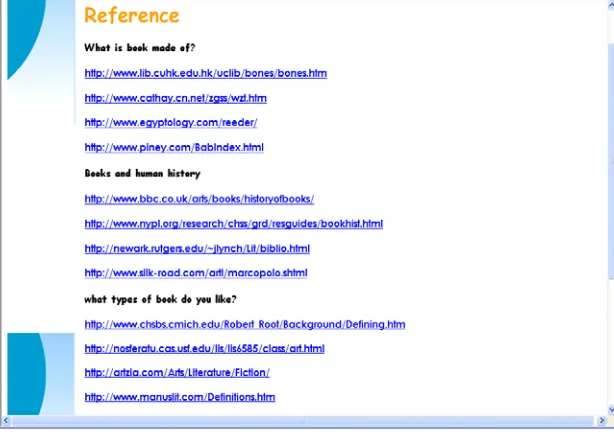
The essays were graded as individual pieces of work. Aspects of writing such as proper introductions, thesis statements, suitable paragraphing and choice of vocabulary as well as grammatical structure were assessed. These aspects were attended to during class time. In order to emphasise the importance of original work and to discourage plagiarism, it was stressed that students would fail the assignment if the essays were cut-and-paste jobs. In fact, the students were asked to publish their reference list on their website (Figure 1). This enabled tutors to randomly check for plagiarized work.
Figure 1. Screen capture of a group’s web page with references
publishing a web site on their chosen topic. The web site had to include a home page, at least three linked web pages that reflected each aspect conveyed in the group members’ essays, and additional information other than those in the essays. The information from the individual essays had to be adapted for the Web and students lost marks if they simply posted their essays on their web sites without adapting them for the Web.
Students had to learn how to use the information they had presented in their essays and reorganize and rewrite them to fulfill a different set of goals. In this case, students were tested on their ability to glean relevant information from their own essays, rephrase them and finally piece the whole topic together in a cohesive manner on a web site. This encouraged drafting and rewriting. It also encouraged group discussions and set up an environment, which prompted communicating and deliberating in English. In addition, other skills such as negotiation and reflection were put to practice in a covert manner. It was thus hoped that the final website design would encourage extra learning, inculcate ingenuity and creativity as a group.
The site had to be built upon slowly over the period of the semester. The first (Home) page was to be uploaded in week 3 (Figure 2). In week 9 the essays were submitted to the tutors and the tutors returned the essays to the students after marking them. The rest of the web pages were uploaded in week 10 when the essays were revised after receiving and taking into account the tutors’ comments.
Figure 2.Screen capture of a group’s Home page designed using templates provided by the web-hosting company. The students merely typed in the text.
Though web design per se was not taught in class, help was given to students (see Appendix A). The tutors were expected to help the students as and when necessary. As stated earlier in the article, the teachers’ role is hardly diminished. In fact, it was very important that the teacher facilitated the task so that the students did not feel at a loss. As suggested by Graus (1999, chap. 5.3.2), “Teachers will also have to invest some time searching the Net, so that they can come up with authentic material for their lessons or recommend certain sites to their students.” The students were, therefore, encouraged to be resourceful in gaining help when designing the web site. This proved to be difficult for many of the students and teachers. However, the great majority was resourceful and sought the help of friends and seniors on campus or even from their friends back home (e.g., Malaysia). None sought help from the technical advisors.
Due to the large number of students (over 500) in the course it was inevita-ble that some groups included students with prior knowledge of web designing. In a few of these groups the members chose to rely on the expertise of their team mates for the technical part and let one or two of their team mates do all the web designing and publishing. In other groups, instead, the more knowledgeable students taught the others in the group how to design and publish a website.
At the end of the semester, an evaluation of the web project was done on students. The tutors were also asked what they thought of the task and whether they would like to continue with the task.
END OF COURSE EVALUATION
The Tutors
The Students
An end of course survey was conducted online, which encouraged students to take their own initiative to complete the survey. Though some may argue that a survey by students need not necessarily reflect the complete truth, by having an online survey, which was not mandatory, it was more likely that the students who took the time to respond felt rather strongly either way about the task and wanted to express their feelings. Out of about 500 students, only 116 took the survey.
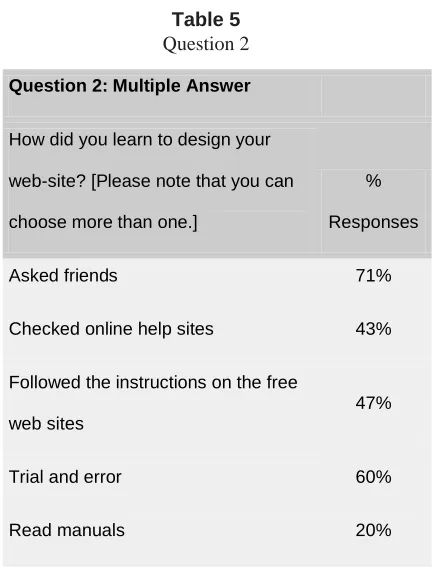
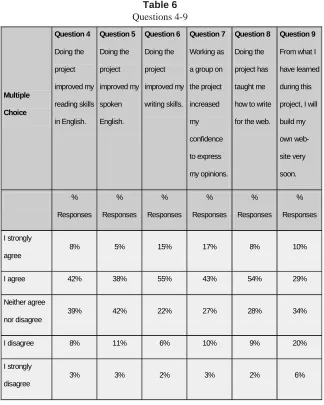
Question one attempted to find out the beginning level of “comfort” zone with regards to the use of IT. Question two hoped to find out whether students found ways to engage in learning and use various resources to help them do the project. Question 3 was a straight-forward one asking for students’ opinion on the task itself. Questions 4,5, 6, 7, and 8 related to the issue of improving proficiency and confidence in using English, while Question 9 was designed to find out whether the students’ had gained confidence in using IT. For Question 4 to 9, the options for answer were the same (I strongly agree, I agree, Neither agree nor disagree, I disagree, I strongly disagree). Question 10 on work load was designed to see whether students truly felt burdened with the task and Question 11 looked at the difficulty level of the task. Question 12 was an open-ended one encouraging a range of responses.
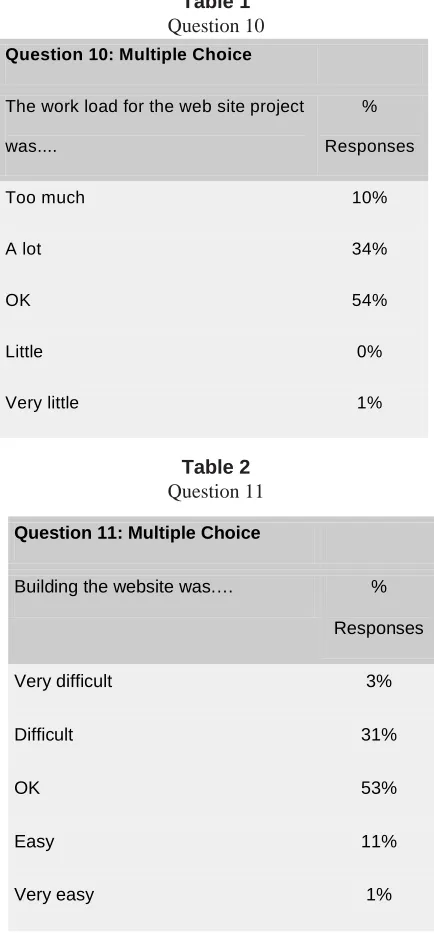
Since tutors’ main concern seemed to be the workload involved, the first point of discussion will focus on this issue. On the issue of work load and the difficulty of the project (Tables 1 and 2), 55% thought that the work load was okay in terms of load and 65% thought it was not difficult. Only 10% thought the workload was too much and 3% thought the work was very difficult. Thirty percent (30%) felt that the load was a lot and 31% that the work was difficult but perhaps not necessarily overly so.
Table 1 Question 10
Table 2 Question 11 Question 10: Multiple Choice
The work load for the web site project
was....
%
Responses
Too much 10%
A lot 34%
OK 54%
Little 0%
Very little 1%
Question 11: Multiple Choice
Building the website was.… %
Responses
Very difficult 3%
Difficult 31%
OK 53%
Easy 11%
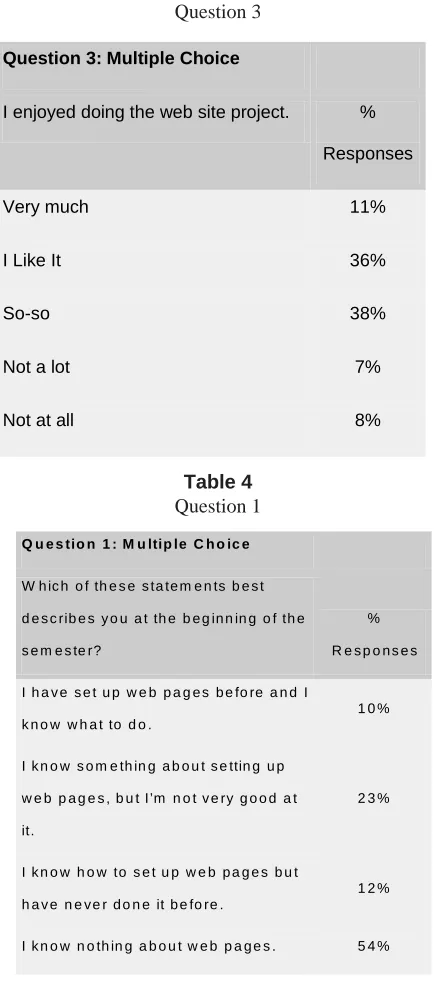
Table 3 Question 3
Table 4 Question 1
Question 3: Multiple Choice
I enjoyed doing the web site project. %
Responses
Very much 11%
I Like It 36%
So-so 38%
Not a lot 7%
Not at all 8%
Q u e s tio n 1 : M u ltip le C h o ic e
W h ic h o f th e s e s ta te m e n ts b e s t
d e s c rib e s y o u a t th e b e g in n in g o f th e
s e m e s te r?
%
R e s p o n s e s
I h a v e s e t u p w e b p a g e s b e fo re a n d I
k n o w w h a t to d o .
1 0 %
I k n o w s o m e th in g a b o u t s e ttin g u p
w e b p a g e s , b u t I’m n o t v e ry g o o d a t
it.
2 3 %
I k n o w h o w to s e t u p w e b p a g e s b u t
h a v e n e v e r d o n e it b e fo re .
1 2 %
The survey findings then suggest that students generally did not find the task overly difficult and that it did not add tremendously to their work load. These findings and their ability to be resourceful (Table 5) reassured us that students did engage themselves in the task.
Table 5 Question 2
The rest of the questions (Table 6) attended to the issue of whether any learning of English and the relevant skills was taking place. Also the questions determined whether the web design project actually encouraged students to use the English language. The results showed that 50% agreed that the entire activity helped them improve their reading, while 43% thought that they had improved their speaking. Seventy percent (70%) stated that their writing ability had also improved. Only a very small percentage (8-14%) believed that they did not improve in their proficiency.
Question 2: Multiple Answer
How did you learn to design your
web-site? [Please note that you can
choose more than one.]
%
Responses
Asked friends 71%
Checked online help sites 43%
Followed the instructions on the free
web sites
47%
Trial and error 60%
Table 6 Questions 4-9
The project also got the student’s approval in other ways. The response to Question 7 (Table 6) shows that 50% of the respondents said they were now more confident in expressing their opinions. Sixty-two percent (62%) said they learned how to write for the Web, and close to 40% said that from what they learned in the course they would go on and design their own personal website. Multiple Choice Question 4 Doing the project improved my reading skills in English. Question 5 Doing the project improved my spoken English. Question 6 Doing the project improved my writing skills. Question 7 Working as
a group on
the project increased my confidence to express my opinions. Question 8 Doing the project has taught me
how to write
for the web.
Question 9
From what I
have learned
during this
project, I will
build my own web-site very soon. % Responses % Responses % Responses % Responses % Responses % Responses I strongly agree
8% 5% 15% 17% 8% 10%
I agree 42% 38% 55% 43% 54% 29%
Neither agree
nor disagree
39% 42% 22% 27% 28% 34%
I disagree 8% 11% 6% 10% 9% 20%
I strongly
disagree
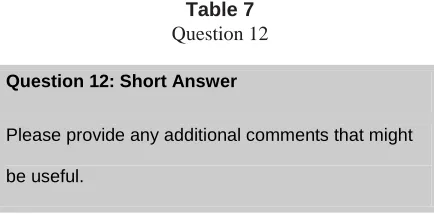
The last question (Table 7) invited additional comments and gave us a better insight into what students truly felt about the task. Not all students answered this question.
Table 7 Question 12
Below is a list of comments from students who truly appreciated the web based project, portraying clearly what the benefits of the project are.
Student 1—Making a website, in my own opinion, is an assessment worthy to assess. With the fact that it would test english communica-tion and writing skills, making a website will also enhance computer abilities that maybe unknown to the others. I hope this would be continued for the next semester’s or perhaps next year’s EP.
Student 12—I think this kind of project will be very useful in the future. But I think, students have to be taught how to write for a formal real web-based essay. From beginning we were taught just to write an essay, I think there are some other rules in writing the formal web-based essay. Besides that, I feel that this project is interesting. I got a lot of new thing about website and so about English itself. And finally, I want to thank to all of you for this project and for all you have given to us.
Student 20—I support the idea of the web-based project in English Proficiency as it will improve our English skill as well as our knowledge about new things, e.g., building our own website.
Question 12: Short Answer
Please provide any additional comments that might
Student 29—Web-page designing is a good assignment, allows us to learn something new that is different from other courses we have
Student 38—Building a website is an unique project espesially for English proficiency course, but i think it’s useful
Student 47—if we have enough time, I think build more webpages which related to our project is better than just one simple webpage
Student 61—website designing is a valuable experience for me
Student 62—the task is very instersting and charllenge.i enjoyed it very much. thanks! thank toutor
Student 88—I have learned a lot from the web-design. Of course, I have improved my English, and I have learned how to make a webpage. In addition, it is quite interesting
Student 89—Setting web-site is one of ways to study English
Student 103—I think the website project is very good, because it can teach us how to build website that is very useful in the future
These comments do show that there was some support for the project among the students. These comments, together with the 47% of students (see Table 3) who liked designing the site, mean that it was a worthwhile experience. Also some of the students valued the task as it taught them something else besides English language skills. Some of the comments also point to the fact that the students clearly saw the benefit of learning how to design their own webpage.
Student18—Maybe the tutor should tell us more about how to rewrite our issue from paper form to webpage form.
Essay writing and web writing do involve different skills and this is one issue that was not discussed explicitly in the classroom. This will need to be given more emphasis next time the project is run.
Others were more concerned about the technical side of web designing:
Student 63—It’s good if we’re taught how to build website by the tutors
Student 77—There should be an instruction for the beginners, likes -> where to get the web tamplates and what exactly is the expectation of the web-site. Thanks
Student 115—If online space has been already supplied to us, it will save us a lot of time to search the space to upload our files
The open-ended question also highlighted all the negative points about the task. Though the short answer questions did not draw attention to the negative points, the open-category highlighted some negative feelings about the project:
Student 6—For the part-time students, doing project like the website is considered quite a time consuming, consider have to work and do project as the same time, though which may seems a normal trend to people. I hope next time whether can organise something which could take this all into account
Student 21—I think you should focus more in english skill like writing, reading, and speaking. According to that the web project is not so important. It is better if you concetrate to increase student ability in using english. Thank you
Student 23—More assignments to help us improve our grammer, spelling and usage of thesaurus. More hand-written assignments. More oral presentation practises to improve our confidence and speaking skills
Student 36—Honestly, overall, this web project i think is useless, cause lot of my friends ask someone to do it for them. include the essay and the web. they only include some mistake inside so it looks like they made it by themselves. Better give assignment to read some books. I found by reading novel, i improve my English
Student 41—The course itself is very helpful for my essay writting. However, building the website is a waste of time. It would be much appreciated if more essay writing or other exercise that could really improve standards of our english be introduced
Student 42—The web project was time consuming
Student 49—Probably a presentation would be sufficient. With the need to build a website, we would need to read up on how to go about building the website. This is especially difficult and time consuming for someone who has no website building experience
Student 50—I think that this website project should not included in this course
Student 82—I feel that practice writing essays will help to improve my writing skill rather than setting up a website. Although this project thought us how to build a website but did not improve my writting skill much
Student 91—TIME WASTED ON WEBSITE SHOULD BE SPEND TO POLISHING GRAMMAR,EXPRESSIONS & OTHERS. THIS IS AN EXTRA SUBJECT FOR US, PROJECT NEEDS MEETING UP WITH TEAMMATES OUTSIDE NORMAL TIME, THIS IS SERIOUSLY TIME WASTING
Student 107—1. Since this is a Engish Project, if we more concern about the English rather than Web-site, it may more helpful to improve English. 2. It spent too much time on research, group discussion and webpage setting up which is not related to english. 3. We need more practice on English essay
Student 114—I don’t think website design is mandatory for the students as it really take up a lot of time especially for the part time student who have the difficulty in juggling the work load from work and school
Many commented on the task being onerous and time-consuming. However, most of these comments seemed to come from the part-time students who were working and studying at the same time, and from polytechnic students who have a higher subject load than other students. Also there were com-ments which pointed out that an English course should focus on “traditional” aspects of the English language teaching such as grammar, essay writing, and oral presentations. These students probably could not relate to a web-based project as being part of an English language learning course and did not engage in the task as well as the other students.
One student interestingly made a comment about motivation:
Student 106—should have some incentives for effort put in. maybe some AU [Academic Units –au] to encourage student to do better
students’ graduating grade, they could not see the need to work too hard for the course.
CONCLUSION AND RECOMMENDATIONS
The project was carried out to encourage authentic use of the English language in an engaging and motivating environment. It was hoped that the tutors could tap into the students’ own interest in the Internet and replace the more traditional writing task with one the students would find more appeal-ing. Our experience in using a web-design project in an English language proficiency classroom, with a multinational composition, was generally a positive one. The completed projects showed much creativity in both design and language use (see examples of web sites). Because of the low numbers who filled in the survey it is difficult to prove while the effectiveness of the project. However, all tutors, even those who voiced concerns over the time and effort the students had to put into the task, felt that the project did have a positive impact on the class dynamics as well as motivating the majority of the students.
The most notable aspect of this study can be seen in the negative comments of the students and the tutors. The survey highlighted to us that the task was both challenging as well as useful to many but at the same time it was seen as an unnecessary load by some. The latter seemed particularly so, but not restricted to, students who were part-timers, and by those who perceived learning in terms of rewards. There were also some comments about the misgivings of whether the course really attended to English language teaching. Those who highlighted this appeared to feel comfortable in learning English the traditional way. To them perhaps language learning and web design are two different areas of study that cannot benefit each other. The issue of time pressure for both students and tutors has been at the forefront of constructivist teaching over the last few years and the question of students’ preferences for more traditional forms of instructions has emerged strongly in language teaching, especially in Asia.
1. A thorough hands-on session in IT and web design might be provided to students and staff in Weeks 1 & 2 of the course. This may help improve the comfort level for both.
2. The EP course itself could focus more on features of writing and differentiate web writing from essay writing of the traditional nature. 3. The tutors need to inform students very clearly about the nature of the
task and how it relates to language learning. It needs to be emphasized at the beginning of the EP course that grammar and other English language features will be attended to during class time and that students will be taught how to use these effectively in various kinds of texts written for different types of audience. This is to ally the fears of those students whose expectations run to the more traditional teaching methods.
4. The course needs to consider how to accommodate the needs of part-time students. It is reasonable to expect part-part-timers to be strapped for time and so it being difficult to meet as a group and discuss the project. One solution would be for the project to be done in pairs and students can work with someone from their workplace or neighborhood to resolve this problem.
5. The underlying issue that seemed to come through from the survey is that the course does not contribute in any way towards the students’ degree or final score. Perhaps it is time to consider the possibility of awarding some points for the course so that students can see some kind of “value” in putting effort into the tasks. Motivation is not only from the point-of-view of challenging tasks but also the tangible benefits that students can reap from the course.
References
Beauvois, M. (1998). Conversation in slow motion: Computer-mediated communication in the foreign language classroom. The Canadian Mod-ern Language Review, 54(2), 198-217.
Davey, I. (2001, June). The use of collaborative web page-design projects for teaching EFL, with a focus on Japanese university students.
CALL-EJ Online, 3(1). Retrieved February 22, 2007 from http://
Debski, R. (2000). Exploring the re-creation of a CALL Innovation. Com-puter Assisted Language Learning, 13(4-5), 307-332.
Frizler, K. (1995, December 6). The internet as an educational tool in
ESOL writing instruction. Unpublished master’s thesis, San Francisco
State University. Retrieved February 22, 2007, from http:// www.geocities.com/[email protected]/frizume/thesis/
Graus, J. (1999). An evaluation of the usefulness of the internet in the EFL
classroom. Unpublished master’s thesis, University of Nijmegen, The
Netherlands.
Grey, D. (1999). The internet in school. London and New York: Cassell. Jones, B.F., Valdez, G., Nowakowski, J., & Rasmussen, C. (1995).
Plug-ging in: Choosing and using educational technology. Retrieved
Febru-ary 22, 2007 from the Learning Point Associates website http:// www.ncrtec.org/capacity/plug/plug.htm
Kahmi-Stein, L.D, Bezdikian, N., Gillis, E., Lee, S., Lemes, B., Michelson, M., et al. (2002). A project-based approach to interactive web site de-sign. TESOL Journal,11(3), 9-14.
Kinsella, K. (1996). Designing group work that supports and enhances di-verse classroom work styles. TESOL Journal, 6(1), 24-30.
Rosen, L. (1997). The world wide web: Taking on the pedagogical chal-lenge. In J. Marnson (Ed.), Technology tools for today’s campuses
[Computer software]. Microsoft Corporation. Also retrieved March 3, 2003 from http://www.horizon.unc.edu/projects/monograph/CD/ Stepp-Greany, J. (2002). Student perceptions on language learning in a
technological environment: Implications for the new millennium. Lan-guage Learning &Technology,6(1), 165-180.
Taylor, C., Jamieson, J., & Eignor, D. (2000). Trends in computer use among international students. TESOL Quarterly, 34, 575-585.
Thanasoulas, D. (2002). Motivation and motivating in the foreign language classroom. The Internet TESL Journal, 8(11).Retrieved March 3, 2003 from http://iteslj.org/Articles/Thanasoulas-Motivation.html
Tinzmann, M.B., Rasmussen, C., & Foertsch, M. (1999). Engaged and
worthwhile learning. Retrieved May 13, 2004 from Oak Brook,
Illi-nois: North Central Regional Educational Laboratory http:// www.ncrtec.org/pd/lwtres/ewl.pdf
Toyoda, E. (2001, January). Exercise of learner autonomy in project-orient-ed CALL. CALL-EJ Online, 2(2). Retrieved March 8, 2003 from http:// www.tell.is.ritsumei.ac.jp/callejonline/journal/2-2/toyoda.html
Warschauer, M. (1996a, March). The world wide web and language
learn-ing: An overview. Paper presented at the TESOL Convention ’96,
Chi-cago, IL. March, 1996.
Warschauer, M. (1996b) Motivational aspects of using computers for writ-ing and communication. In M. Warschauer (Ed.) Telecollaboration in
foreign language learning: Proceedings of the Hawaii Symposium (pp.