The Thirty-Third AAAI Conference on Artificial Intelligence (AAAI-19)
Fair Knapsack
Till Fluschnik,
1Piotr Skowron,
2Mervin Triphaus,
1Kai Wilker
1 1Algorithmics and Computational Complexity, Faculty IV, TU Berlin, Berlin, Germany[email protected],{mervin.triphaus,wilker}@campus.tu-berlin.de
2Faculty of Mathematics, Informatics, and Mechanics, University of Warsaw, Warsaw, Poland
Abstract
We study the following multiagent variant of the knapsack problem. We are given a set of items, a set of voters, and a value of the budget; each item is endowed with a cost and each voter assigns to each item a certain value. The goal is to select a subset of items with the total cost not exceeding the budget, in a way that is consistent with the voters’ pref-erences. Since the preferences of the voters over the items can vary significantly, we need a way of aggregating these preferences, in order to select the socially best valid knap-sack. We study three approaches to aggregating voters’ pref-erences, which are motivated by the literature on multiwin-ner elections and fair allocation. This way we introduce the concepts of individually best, diverse, and fair knapsack. We study the computational complexity (including parameterized complexity, and complexity under restricted domains) of the aforementioned multiagent variants of knapsack.
1
Introduction
In the classic knapsack problem we are given a set ofitems, each having a cost and a value, and a budget. The goal is to find a subset of items with the maximal sum of the val-ues subject to the constraint that the total cost of the selected items must not exceed the budget. In this paper we are study-ing the followstudy-ing variant of the knapsack problem: instead of having a single objective value for each item we assume that there is a set ofagents(also referred to asvoters) who have potentially different valuations (expressed through util-ities) of the items. When choosing a subset of items we want to take into account possibly conflicting preferences of the voters with respect to which items should be selected: in this paper we discuss three different approaches to how the vot-ers’ valuations can be aggregated.
Multiagent knapsack forms an abstract model for a num-ber of real-life scenarios. First, let us note that if the costs of the items are all the same, then the multiagent knapsack model collapses to the model for multiwinner elections (Fal-iszewski et al. 2017) (in the literature on multiwinner elec-tions, items are often called candidates). Multiwinner vot-ing rules are applicable in a broad class of scenarios, rang-ing from selectrang-ing a representative committee of experts,
Copyright c2019, Association for the Advancement of Artificial Intelligence (www.aaai.org). All rights reserved.
through recommendation systems (Lu and Boutilier 2011)1, to resource allocation and facility location problems. In each of these settings it is quite natural to consider that differ-ent items/candidates can incur differdiffer-ent costs. Further, algo-rithms for multiagent knapsack can be viewed as tools for participatory budgeting (Cabannes 2004), where the author-ities aggregate citizens’ preferences to decide which of the potential local projects should obtain funding.
Perhaps the most straightforward way to aggregate voters’ preferences is to select a subset (a knapsack) that maximizes the sum of the utilities of all the voters over all selected items. This approach—which we call selecting an individ-ually best knapsack—subject to differences in methods used for eliciting voters’ preferences has been taken by Benabbou and Perny (2016), and in the context of participatory budget-ing by Goel et al. (2016) and Benade et al. (2017). However, by selecting an individually best knapsack we can disadvan-tage even large minorities of voters, which is illustrated by the following example: assume that the set of items can be divided into two subsetsA1andA2, that all items have the same cost, and that51% of the voters like items fromA1 (assigning the utility of 1 to them, and the utility of 0 to the other items) and the remaining49%of voters like only items fromA2. An individually best knapsack would con-tain only items fromA1, that is49%of the voters would be effectively disregarded.
In this paper we introduce two other approaches to aggre-gating voters’ preferences for selecting a multiagent knap-sack. One such approach—which we call selecting a di-verse knapsack—is inspired by the Chamberlin–Courant rule (Chamberlin and Courant 1983) from the literature on multiwinner voting. Informally speaking, in this approach we aim at maximizing the number of voters who have at least one preferred item in the selected knapsack. For the second approach—which is the main focus of the paper and which we call selecting afair knapsack—we use the concept of Nash welfare (Nash 1950) from the literature on fair allo-cation. Nash welfare is a well-established solution concept that implements a tradeoff between having an objectively
ef-1
ficient resource allocation (knapsack, in our case), and hav-ing an allocation which is acceptable for a large population of agents. Indeed, extensive recent studies in the domain of fair allocation confirm particularly strong fairness guaran-tees of Nash welfare (Caragiannis et al. 2016; Moulin 2003; Darmann and Schauer 2015), and this solution concept has been applied e.g. in the context of public decision mak-ing (Conitzer, Freeman, and Shah 2017), online resource al-location (Freeman, Zahedi, and Conitzer 2017) or transmis-sion congestion control (Kelly 1997) (therein referred to as
proportional fairness). Thus, our work introduces a new ap-plication domain—now the goal is to select a set of shared items—for the concept of Nash welfare. In particular, as a side note, we will explain that our approach leads to a new class of multiwinner rules, which can be viewed as gener-alizations of the Proportional Approval Voting rule beyond the approval setting.
Apart from introducing the new class of multiagent knap-sack problems, our contributions are as follows:
(1) We study the complexity of computing an optimal in-dividually best (IB), diverse, and fair knapsack. This problem is in general NP-hard, except for the case of IB knapsack with unarily encoded utilities of the voters (as the IB knapsack problem is equivalent to the classic knapsack problem).
(2) We study the parameterized complexity of computing a diverse and fair knapsack, focusing on the number of voters.2 We show that for unary-encoded utilities of the
voters computing a diverse knapsack is fixed-parameter tractable when parameterized by the number of voters. On the contrary, computing a fair knapsack isW[1]-hard for the same parameter.
(3) We study the complexity of the considered problems for single-peaked and single-crossing preferences. We show that (under unary encoding of voters’ utilities) a diverse knapsack can be computed in polynomial time when the preferences are single-peaked or single-crossing, while computing a fair knapsack remainsNP-hard.
Our results are summarized in Table 1. Our main mes-sage is that fairness comes with a surprisingly high compu-tational complexity. Indeed, our most unexpected results are that computing a fair knapsack isW[1]-hard when param-eterized by the number of voters, andNP-hard on single-peaked single-crossing domains, with unit-costs, and all util-ities coming from the set{0, . . . ,6}. This was unforeseen since by using a recent result of Peters (2018), one can show that computing a fair knapsack on single-peaked domains (which are not necessarily single-crossing, i.e., when one of the assumptions is weakened), with unit-costs, and all util-ities coming from the set{0,1}(instead of{0, . . . ,6}, i.e., when another assumption is strengthened) is polynomial-time solvable. Our result required a complex reduction from the exact set cover problem. Most of our proofs are omitted
2
Considering this parameter is relevant, e.g., for the case when the set of voters is in fact a relatively small group of experts acting on behalf of a larger population of agents.
Table 1: Overview of our results (for the case of utilities encoded in unary): Herein, SP and SC abbreviate single-peaked and single-crossing preferences, respectively, and “# voters” refers to “when parameterized by the number of vot-ers”.∗(Procaccia, Rosenschein, and Zohar 2008)
Knapsack general SP SC # voters
IB P(equivalent to KNAPSACK) ←
Diverse NP-hard∗ P P FPT
(Thm. 3) (Thm. 3) (Thm. 4) Fair NP-hard NP-hard W[1]-hard
(Thm. 5) (Thm. 9) (Thm. 6)
due to the space constraints.3
Most of the our results are presented for the costs and util-ities of the agents given in the unary-encoding. This makes our results more relevant for practical applications of our framework. E.g., for participatory budgeting (PB) one does not really need more than thousands of values to represent utilities/costs. Further, by assuming efficient encoding of the utilities/costs we would make the hardness results less meaningful—the hardness would simply be an artifact of the fact that we admit the values of the utilities/costs that are exponentially large in the number of voters. By assuming unary encoding we make—on the one hand—the hardness results stronger, and—on the other hand—more applicable to the real scenarios that our model represents.
We also show all three problems to be NP-hard in the non-unary case (Theorems 2 and 5) and proveW-hardness with respect to the budget (Proposition 1 and Corollary 1).
2
The Model
For a pair of natural numbersi, j ∈ N,i ≤ j, by[i, j]we
denote the set{i, i+ 1, . . . , j}. Further, we let[j] = [1, j].
Let V = {v1, . . . , vn} be the set ofnvoters andA =
{a1, . . . , am}be the set ofmitems. The voters have
prefer-ences over the items, which are represented as autility pro-fileu= (ui(a)|i∈[n], a∈A): for eachi∈[n]anda∈A
we useui(a)to denote the utility that vi assigns toa; this
utility quantifies the extent to whichvienjoysa. We assume
that all utilities are nonnegative integers.
Each itema ∈ Acomes with a costc(a) ∈ N, and we
are given a global budget B ∈ N. We call a knapsack a
subsetS of items whose total cost does not exceedB, that isc(S) = P
a∈Sc(a) ≤ B. Our goal is to select a
knap-sack that would be, in some sense, most preferred by the voters. Below, we describe three representative rules which extend the preferences of the individual voters over individ-ual items to their aggregated preferences over all knapsacks. Each such a rule induces a corresponding method for select-ing the best knapsack. Our rules are rooted in concepts from the literature on fair division and on multiwinner elections:
Individually best knapsack: this is the knapsackSwhich
3
maximizes the total utility of the voters from the selected items uIB(S) = Pa∈SPvi∈V ui(a). This defines
per-haps the most straightforward way to select the knapsack: we call it individually best, because the formulauIB(S) treats the items separately and does not take into account fairness-related issues. Indeed, such a knapsack can be very unfair, as discussed in the introduction.
Diverse knapsack: this is the knapsackS that maximizes the utilityuDiv(S) = Pvi∈V maxa∈Sui(a). In words,
in the definition ofuDivwe assume that each voter cares only about his or her most preferred item in the knapsack. This approach is inspired by the Chamberlin–Courant rule (1983) for multiwinner elections and by classic mod-els in facility location (Farahani and Hekmatfar 2009). We call such a knapsack diverse following the convention from the multiwinner literature (Faliszewski et al. 2017). Intuitively, such a knapsack represents the diversity of the opinions among the population of voters; in particular, if the preferences of the voters are very diverse, such a knapsack tries to incorporate the preferences of as many groups of voters as possible at the cost of containing only one representative item for each “similar” group.
Fair knapsack: we use Nash welfare (Nash 1950) as a so-lution concept for fairness. Formally, we call a knap-sack S fair if it maximizes the product uFair(S) =
Q
vi∈V 1 +
P
a∈Sui(a)
.4 Alternatively, by taking the
logarithm ofuFair we can represent fair knapsack as the one maximizingP
vi∈V log(1 +
P
a∈Sui(a)). The
fol-lowing example intuitively explains the type of fairness guaranteed by using the Nash welfare.
Example 1. Consider six groups of voters,V1, . . . , V6, with
|V1| = 300,|V2| = 200,|V3| = 100, and |V4| = |V5| =
|V6| = 1. Assume we have six sufficiently large groups of items,A1. . . , A6. Each voter from groupViassigns utility
1 to all items from group Ai, and zero to all other items.
Finally, assume that the costs of all items are equal to 1, and that the value of the budget is 6. An individually best knapsack would consist only of the items fromA1. A diverse knapsack would contain one item from each setAifori ∈
{1, . . . ,6}. A fair knapsack would contain 3 items fromA1,
2 items fromA2 and 1 item fromA3—this solution can be interpreted as fair since the number of items selected from each group is proportional to the number of voters liking
4
Typically, Nash welfare would be defined as
Q vi∈V
P
a∈Sui(a)
. In our definition, we add one to the sumP
a∈Sui(a) in order to avoid pathological situations when the sum is equal to zero for some voters. This also allows us to represent the expression we optimize as a sum of logarithms, and thus, to expose the close relation between the fair knapsack and the Proportional Approval Voting rule. When the utilities are normalized our definition results in better properties of the outcome pertaining to fairness (Fain, Munagala, and Shah 2018). Further, all our hardness results can be formulated for a weaker (and perhaps the least disputable) notion of fairness in the follow-ing way: it is hard to decide whether an instance of the collective knapsack problem admits a solution where the sum of the utilities of all the agents is the highest (among all valid solutions) and all the agents have the same utility.
items from these groups.
If we assume that the costs of the items from groupsA1,A2, andA3are equal to 3, 2, and 1, respectively, and that our budget is equal to 6, then the fair knapsack will consist of one item from each of the setsA1,A2, andA3— this shows that each group will obtain a share of the cost of the whole knapsack which is proportional to its size.
In Section 1 we referred to the literature supporting the use of Nash welfare in various settings. Let us com-plement these arguments with one additional observation. When the utilities of the voters come from the binary set
{0,1} and the costs of all items are one, then our multia-gent knapsack framework boils down to the standard mul-tiwinner elections model with approval preferences. In this case, a very appealing rule, Proportional Approval Voting (PAV), can be expressed as finding a knapsack maximizing
P
vi∈V H(
P
a∈Sui(a)), where H(i) is thei-th harmonic
number. This is almost equivalent to finding a fair knapsack (maximizing the Nash welfare) since the harmonic function can be viewed as a discrete version of the logarithm. Thus, fair knapsack can be considered an adjustment of PAV to the model with cardinal utilities and costs. In particular (as a side note), observe that the notion of fair knapsack com-bined with positional scoring rules induces rules that can be viewed as adaptations of PAV to the ordinal model.
3
Related Work
Our work extends the literature on the multi-objective (MO) knapsack problem (Kellerer, Pferschy, and Pisinger 2004), i.e., on the variant of the classic knapsack problem with mul-tiple independent functions valuating the items. Typically, in the MO knapsack problem the goal is to find a (the set of) Pareto optimal solution(s) according to multiple objec-tives defined through given functions valuating items. Our approach is different since we consider specific forms of ag-gregating objectives; in particular for each of our concepts— for the individually best, diverse, and fair knapsack—there always exists a Pareto optimal solution; further each solution to the individually best and fair knapsack is Pareto optimal. For an overview of the literature on the MO knapsack prob-lem (with the focus on the analysis of heuristic algorithms) we refer to the survey by Lust and Teghem (2012).
Lu and Boutilier (2011) studied a variant of the Chamberlin–Courant rule that includes knapsack constraints and so being very similar to our diverse knapsack problem. The difference is that (i) they consider utilities which are ex-tracted from the voters’ preference rankings, thus these utili-ties have a specific structure, and (ii) in their model the items are not shared; instead, the selected items can be copied and distributed among the voters. Lu and Boutilier consider a model with additional costs of copying a selected item and sending it to a voter. Consequently, their general model is more complex than our diverse knapsack; they also consid-ered a more specific variant of the model, equivalent to win-ner determination under the Chamberlin–Courant rule.
Byrka et al. (2015) for a discussion on the approximability of the problem.
As we discussed in the introduction, the multiagent variant of the knapsack problem has been often consid-ered in the context of participatory budgeting, yet to the best of our knowledge this literature focuses on the sim-plest aggregation rule corresponding to our individually best knapsack approach (Cabannes 2004; Goel et al. 2016; Benade et al. 2017). Another avenue has been explored by Fain et al. (2016), who studied rules that determine the level of funding provided to different projects (items, in our nomenclature) rather than rules selecting subsets of projects with predefined funding requirements.
4
Computing Multiagent Knapsacks
In this section we investigate the computational complexity of finding individually best, diverse, and fair knapsack. For-mally, we define the computational problem for computing a fair knapsack as:
FAIRKNAPSACK
Input:An instance(V, A, u, c)and a budgetB.
Task: Compute a knapsackS ⊆Asuch thatc(S)≤Band uFair(S)is maximum.
We define the computational problems DIVERSE
KNAPSACK and INDIVIDUALLY BEST KNAPSACK
analogously—the difference is only in the expression to maximize, which for the two problems is uDiv and uIB, respectively. We will use the same names when referring to the decision variants of these problems; in such cases we will assume that one additional integerxis given in the input, and that the decision question is whether there exists S with valueuIB(S)(respectively,uDiv(S)oruFair(S)) at leastx, andc(S)≤B.
We observe that the functionsuIB,uDiv, anduFair(when represented as a sum of logarithms—the use of the logarithm in the objective is only relevant for the approximation ratio) are submodular. Thus, we can use an algorithm of (Sviri-denko 2004) with the following guarantees.
Theorem 1. There is a polynomial-time (1 − 1/e)
-approximation algorithm forINDIVIDUALLYBESTKNAP
-SACK, DIVERSE KNAPSACK, and FAIR KNAPSACK with the objective functionlog(uFair).
In the remainder of the paper we focus on computing ex-act solutions for the three problems. In particular, we study the complexity under the following two restricted domains: Single-peaked preferences. Lettopidenotevi’s most
pre-ferred item, and let/be an order of the items. We say that a utility profileuissingle-peakedwith respect to/if for eacha, b∈Aand eachvi ∈ V such thata / b /topior
topi/ b / awe have thatui(b)≥ui(a).
Single-crossing preferences. Let/be an order of the vot-ers. We say that a utility profileuissingle-crossingwith respect to / if for each two items a, b ∈ A the set
{vi ∈ V | ui(b) ≥ ui(a)} forms a consecutive block
according to/.
We say that a profile uis peaked (resp., single-crossing) if there exists an order/of the items (resp., of the
voters) such thatuis single-peaked (resp., single-crossing) with respect to /. Note that an order witnessing single-peakedness or single-crossingness can be computed in poly-nomial time (see, e.g., (Elkind, Lackner, and Peters 2017; Fitzsimmons 2015)).
We will also study the parameterized complexity of the three problems. For a given parameter p, we say that a problem is fixed-parameter tractable (FPT) when param-eterized by p if there is an algorithm (FPT algorithm) that solves each instance I of the problem in O f(p) · poly(|I|)
time, where f is some computable function. In parameterized algorithmics, FPT algorithms are considered efficient. There is a whole hierarchy of complexity classes, but informally speaking, a problem that isW[1]- or W[2] -hard is assumed not to be FPT and, hence, -hard (or fixed-parameter intractable) from the fixed-parameterized point of view (see (Downey and Fellows 2013) for more details).
Note that if the utilities are not unarily encoded, then FAIR
KNAPSACKisNP-hard even for one voter (see Theorem 5).
Diverse Knapsack
We now turn our attention to the problem of computing a diverse knapsack. Through a straightforward reduction from the standard knapsack problem, we get that DIVERSE
KNAPSACKis computationally hard even for profiles which are both single-peaked and single-crossing, unless the utili-ties are provided in unary encoding.
Theorem 2. DIVERSE KNAPSACK is NP-hard even for single-peaked and single-crossing utility profiles.
Proof. We present a many-one reduction from KNAPSACK.
Let (X = {x1, . . . , xn}, x, y) be an instance of KNAP
-SACK where each xi comes with value ν(xi) ≥ 1 and
weightω(xi); the question is whether there existsS ⊆ X
withP
xi∈Sν(xi) ≥xand
P
xi∈Sω(xi)≤y. We set our
set of itemsA={a1, . . . , an}withc(ai) :=ω(xi)for each
i∈[n]. We addnvotersv1, . . . , vnwith
ui(aj) :=
3n2·ν(a
j), i=j,
j, i > j,
2n−j+ 1, i < j.
It is immediate that for eachSwe have thatP
ai∈Sc(ai) =
P
xi∈Sω(xi). Further,
P
vi∈V maxaj∈Sui(aj) ≥ 3n
2xif
and only if P
xj∈Sν(xj) ≥ x, which proves the
correct-ness. It is immediate to check that the utility profile is single-peaked and single-crossing.
Note that DIVERSE KNAPSACK is NP-hard for utili-ties encoded in unary as it generalizes the Chamberlin– Courant rule, which is computationally hard (Procaccia, Rosenschein, and Zohar 2008). For peaked or single-crossing profiles the Chamberlin-Courant rule is computable in polynomial time (Betzler, Slinko, and Uhlmann 2013; Skowron et al. 2015). These known algorithms can be ex-tended to the case of the diverse knapsack.
(i) single-peaked and encoded in unary; (ii) single-crossing and encoded in unary.
Theorem 3(i) is proven via straight-forward dynamic pro-gramming and omitted due to space constraints. We prove our result for single-crossingness. Let us define a set of use-ful tools. We will also use these tools later on, when analyz-ing the parameterized complexity of the problem.
Given a tuple of voters V~ = (v1, . . . , vn) and a
sub-set S ⊆ A of items, we define an assignment πS, ~V as a surjection[n] → S. An assignment is calledconnected, if for everys ∈ S it holds thatπ−1
S, ~V(s) := {i ∈ [n] | s =
πS, ~V(i)} = [x, y]for somex, y∈[n],y ≥x. For our first tool we introduce the following auxiliary problem.
ORDEREDDIVERSEKNAPSACK
Input:An instance(V , A, u, c~ )whereV~ = (v1, . . . , vn)is
ordered and a budgetB.
Task: Compute a knapsackS ⊆ Asuch thatc(S) ≤ B, anduOrd(S) = maxconnectedπS, ~V
Pn
i=1ui(πS, ~V(i))
is maximum.
IfS ={s1, . . . , s`} ⊆Ais a cost-minimal solution to DI
-VERSE KNAPSACK on(V, A, u, c), then let Vi := {vj ∈
V | si ∈ arg maxa∈Suj(a)}. Consider an orderingV~ =
(V1, . . . , V`), where for eachi∈[`], the voters inViare
ar-bitrarily ordered. Then it is not difficult to see that the assign-mentπS, ~V(i) = arg maxa∈Sui(a)is connected. Hence, we
obtain the following connection between DIVERSEKNAP
-SACKand ORDEREDDIVERSEKNAPSACK.
Observation 1. There is an orderingV~ on the votersV such that there is anS⊆Athat forms a cost-minimal solution for
ORDEREDDIVERSEKNAPSACKand forDIVERSEKNAP
-SACK.
Next, we give a dynamic program for computing knap-sacks that qualitatively lie “between” optimal solutions for ORDERED DIVERSE KNAPSACK and DIVERSE KNAP
-SACK(what “lying in between” means is specified later on). Let us fix an input(V, A, u, c, B)and an orderingV~ =
(v1, . . . , vn)of the voters. We setuˆ:=Pni=1Pa∈Aui(a).
We give a dynamic program with tableT, whereT[i, x] de-notes “some” cost of a knapsack with a value assigned by voters from(v1, . . . , vi)at least equal tox. We setT[1, x] =
min{c(a)| a ∈A, u1(a) ≥x}, if there is ana ∈ Asuch that u1(a) ≥ x, andT[1, x] = ∞otherwise. We define a helper function
f(i, a, x) =
(
c(a), if Pij=1uj(a)≥x,
∞, otherwise.
We set
T[i, x] = (1)
min
a∈A
f(i, a, x),
c(a) + min
j∈[i−1]T[j,max(0, x−
i P
`=j+1
u`(a))]
.
Observation 2. When the utilities are unarily encoded, we can compute all entries ofT in polynomial time.
Lemma 1. Let S be a cost-minimal solution to DI
-VERSE KNAPSACK on (V, A, u, c) and let x = uDiv(S).
ThenT[n, x]≥c(S).
Proof. Suppose that this is not the case, that is,T[n, x] < c(S). Then we construct a knapsackS0 fromT[n, x]as fol-lows. Leta∈ Abe an item that minimizes (1) forT[n, x], then makea ∈S0. IfT[n, x] = f(n, a, x), thenT[n, x] =
c(a) < c(S), contradicting the fact thatS is cost-minimal.
Otherwise,
T[n, x] =c(a) +T[j, x0 := max(0, x−
n X
`=j+1 u`(a))],
for somej ∈ [n−1]. Then we proceed towards a contra-diction as before: Leta0 ∈Abe an item that minimizes (1) forT[j, x0], then makea0 ∈S0, and continue the same rea-soning.
Lemma 2. LetS be a cost-minimal solution toORDERED
DIVERSE KNAPSACK on(V , A, u, c~ ) where V~ is ordered and letx=uOrd(S). ThenT[n, x]≤c(S).
We have all ingredients at hand to prove our main results.
Proof of Theorem 3(ii). IfV~ is an order witnessing single-crossingness, then there is an S ⊆ A that forms a cost-minimal solution for ORDEREDDIVERSEKNAPSACKand for DIVERSE KNAPSACK. Lemmas 1 and 2 guarantee that our algorithm will find it.
Further, we can use our tools to obtain an FPT algorithm (for the number of voters) for unrestricted domains.
Theorem 4. DIVERSE KNAPSACK is FPT when parame-terized by the number of voters and the utilities are unarily encoded.
Proof. By Observation 1, we know that there is an orderV~ on the voters such that there is anS ⊆Athat forms a cost-minimal solution for ORDEREDDIVERSEKNAPSACKand for DIVERSEKNAPSACK. Together with Lemmas 1 and 2 we obtain that forV~ our dynamic program will find suchS. Hence, for each ordering ofV, we computeT[n, x]. Then, we take the minimum over all observed values. Note thatx is the largest value such that T[n, x] ≤ B for some or-dering of the voters. Altogether, this yields a running time of O(n! poly(ˆu+n+m)) ⊆ O(2nlognpoly(ˆu+n+
m)).
Finally, we complement Theorem 4 by proving a lower bound on the running time (via reducing from the
W[2]-complete DOMINATINGSET problem), assuming the
Exponential-Time Hypothesis (ETH).
Proposition 1. DIVERSE KNAPSACK with binary utilities and unary costs is W[2]-hard when parameterized by the budgetBand, unless the ETH breaks, there is no2o(n+m)·
Fair Knapsack
Let us now turn to the problem of computing a fair knap-sack. We first prove that the problem isNP-hard, even for restricted cases, and then we study its parameterized com-plexity.
Theorem 5. FAIRKNAPSACKisNP-hard, even 1. for one voter;
2. for two voters and when all costs are equal to one; 3. if all utilities are in{0,1}and all costs are equal to one.
The proof of Theorem 5 (3) uses the reduction from EX
-ACT REGULAR SET PACKING (ERSP). Since ERSP is
W[1]-hard with respect to the size of the solution (Ausiello, D’Atri, and Protasi 1980), we get the following corollary.
Corollary 1. FAIRKNAPSACKisW[1]-hard when param-eterized by the budget, even if all utilities are in{0,1}and all costs are equal to one.
Using a different construction, we can show that for the combination of the two parameters—the number of voters and the budget—we still get fixed-parameter intractability.
Theorem 6. FAIRKNAPSACKisW[1]-hard when parame-terized by the number of voters and the budget, even if the utilities and the budget are represented in unary encoding and the costs of all items are equal to one.
Proof. We provide a parameterized reduction from the k -MULTICOLORED CLIQUEproblem, which is known to be
W[1]-hard with respect to the number of colors. LetIbe an instance ofk-MULTICOLOREDCLIQUE. InIwe are given a graphGwith the setV(G)of vertices and the setE(G)
of edges, a natural numberk ∈ N, and a coloring function
f:V(G)→[k]that assigns one ofkcolors to each vertex. We ask if Gcontainsk pairwise connected vertices, each having a different color. Without loss of generality we as-sume thatk≥2.
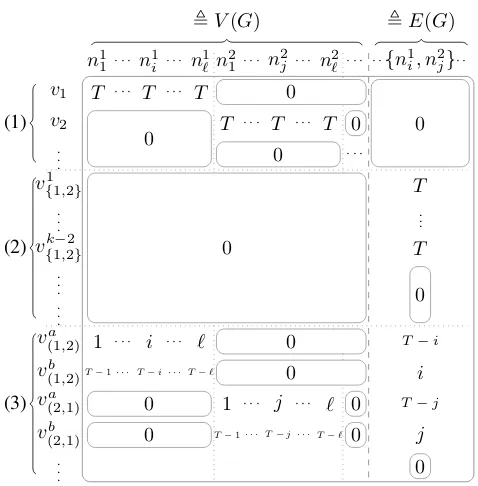
FromIwe construct an instanceIFof FAIRKNAPSACK as follows (we refer to Figure 1 for an illustration). LetT = |V(G)|. We set the set of items toV(G)∪E(G), that is we associate one item with each vertex and with each edge. We construct the set of voters as follows (unless specified otherwise, by default we assume that a voter assigns utility of zero to an item):
1. For each color we introduce one voter who assigns util-ity of T to each vertex with this color. Clearly, there areksuch voters.
2. For each pair of two different colors we introducek− 2 voters, each assigning utility of T to each edge that connects two vertices with these two colors. There are
(k−2) k2
such voters.
3. For each ordered pair of colors,c1andc2, withc16=c2 we introduce two voters, call themaandb, with the fol-lowing utilities. Consider the set of vertices with colorc1 and rename them in an arbitrary way so that they can be put in a sequencen1, n2, . . . , n`. For eachi∈[`]votera
assigns utilityito vertexni and utility(T −i)to each
edge that connectsniwith a vertex with colorc2. Voterb assigns utility (T −i) toni and utilityi to each edge
n1
1· · · n1i · · · n
1
` n21· · · n 2
j · · · n2` · · · ·{n
1
i, n2j}· · ·
v1
v2
. . .
v{11,2}
. . .
v{k1−,22}
. . . . . .
va
(1,2)
vb
(1,2)
va
(2,1)
vb
(2,1)
. . .
T · · · T · · · T
T · · · T · · · T
· · ·
T
.. .
T
1 · · · i · · · ` T−i
T−1· · ·T−i· · · T−` i
1 · · · j · · · ` T−j
T−1· · ·T−j· · ·T−` j
0
0 0
0
0
0
0
0
0
0 0
0 0
0
(1)
(2)
(3)
,V(G) ,E(G)
Figure 1: Illustration of the instance obtained in the proof of Theorem 6. Herein,ncb denotes vertexbin color classc, where each color class contains`vertices. In the presented example, the verticesn1
i andn2j are adjacent. Blocks
con-taining a zero indicate that the corresponding entries are zero.
that connectsni with a vertex with colorc2. There are
2k(k−1)such voters.
We set the cost of each item to one, and the total budget to
B=k+ k2
. By a simple calculation one can check that the total number of voters is equal tok+ (k−2)· k2
+ 2k(k− 1) =kB. This completes our construction.
First, observe that in total each item is assigned utilitykT from all the voters. Indeed, each item corresponding to a vertex gets utility ofT from exactly one voter from the first group, and total utility of(k−1)·T from2(k−1)voters from the third group. Similarly, each item corresponding to an edge gets utility of T fromk−2 voters from the sec-ond group, and total utility of 2·T from four voters from the third group. Thus, independently of how we select B items, the sum of the utilities they are assigned from the voters will always be the same, that isBkT. Thus, clearly the Nash welfare would be maximized if the total utility as-signed to the selected items by each voter is the same, and equal to T. Only in such case the Nash welfare would be equal to(T+ 1)kB. We will show, however, that each voter
assigns to the set ofBitems utilityTif and only ifkout of such items are vertices withkdifferent colors, the remain-ing k2of such items are edges, and each selected edge con-nects two selected vertices.
im-plication. Assume that for the set ofB itemsS each voter assigns total utility ofT. By looking at the first group of vot-ers, we infer thatkitems fromScorrespond to the vertices, and that thesekvertices have different colors. By looking at the second group of voters, we infer that for each pair of two different colors,Scontains exactly one edge connecting ver-tices with such colors. Finally, by looking at the third group of voters we infer that each edge fromSthat connects col-orsc1andc2is adjacent to the vertices fromSwith colorsc1 andc2. This completes the proof.
By Theorem 6 we presumably cannot hope for an FPT algorithm for FAIRKNAPSACK when parameterized by the number n of voters. However, each instance I of FAIR KNAPSACK with unarily encoded utilities is solv-able inO(|I|f(n))time (that is, it is in XPwhen parame-terized by n), where f is some computable function only depending onn.
Theorem 7. For unarily encoded utilities,FAIRKNAPSACK is inXPwhen parameterized by the number of voters.
On the positive side, with stronger requirements on the voters’ utilities, that is, if the number of different values over the utilities is small, we can strengthen Theorem 7 and prove membership inFPT(using integer linear programming).
Theorem 8. FAIRKNAPSACKisFPTwhen parameterized by the combination of the number of voters and the number of different values that a utility function can take.
Proof. We will use the classic result of Lenstra (1983) which says that an integer linear program (ILP) can be solved in FPT time with respect to the number of inte-ger variables. We will also use a recent result of Bred-ereck et al. (2017) who proved that one can apply con-cave/convex transformations of certain variables in an ILP, and that such a modified program can be still solved in an
FPTtime. We construct an ILP as follows. LetU be the set of values that a utility function can take. For each
vec-torz = (z1, . . . , zn)withzi ∈U for eachi, we defineAz
as the set of items a such that for each voter vi we have
ui(a) = zi. Intuitively,Azdescribes a subcollection of the
items with the same “type”: such items are indistinguish-able when we look only at the utilities assigned by the vot-ers; they may vary only with their costs. For each such a setAzwe introduce an integer variablexzwhich intuitively
denotes the number of items from the optimal solution that belong toAz. Further, we construct a functionfz such that
fz(x)is the cost of thexcheapest items fromAz; clearlyfz
is convex. We formulate the following program:
maximize: X
vi∈V
log X
z∈Un
zi·xz
!
subject to: X
z∈Un
fz(xz)≤B
xz∈Z, z∈Un
The above program uses concave transformations (loga-rithms) for the maximized expression, and convex trans-formations (functionsfz) in the left-hand sides of the
con-straints, so we can use the result of Bredereck et al. (2017) and claim that this program can be solved in anFPTtime with respect to the number of integer variables. This com-pletes the proof.
Fair Knapsack under Restricted Domains
In contrast to INDIVIDUALLY BEST KNAPSACK and DI
-VERSEKNAPSACK, both being solvable in polynomial time on restricted domains, FAIR KNAPSACK remainsNP-hard
on utility profiles that are even both, single-peaked and single-crossing.
Theorem 9. FAIR KNAPSACKisNP-hard even on single-peaked single-crossing domains, when the costs of all items are equal to one, and the utilities of each voter come from the set{0, . . . ,6}.
As we discussed in Section 2, if the voters’ utilities come from the binary set{0,1}and if the costs of the items are equal to one, then FAIR KNAPSACK is equivalent to com-puting winners according to Proportional Approval Voting. For this case with single-peaked preferences, Peters (2018) showed that the problem can be formulated as an integer lin-ear program with totally unimodular constraints, and thus it is solvable in polynomial time. This makes our result inter-esting, as it shows that by allowing slightly more general utilities (coming from the set {0, . . . ,6} instead of{0,1}) the problem becomes alreadyNP-hard (even if we addition-ally assume single-crossingness of the preferences).
5
Conclusion
We studied three variants of the knapsack problem in multia-gent settings. One of these variants, selecting an individually best knapsack, has been considered in the literature before, and our work introduces the other two concepts: diverse and fair knapsack. Our paper establishes a relation between the multiagent knapsack model and a broad literature including work on multiwinner voting and on fair allocation. This way, we expose a variety of ways in which the preferences of the voters can be aggregated in different applications that are captured by the abstract model of the multiagent knapsack problem.
Our complexity results are outlined in Table 1. In sum-mary, we showed that computing an individually best or a diverse knapsack can be done efficiently under some con-straints. On the contrary, we give multiple evidences that computing a fair knapsack is computationally hard. This also motivates the study of approximation and heuristic al-gorithms for computing a fair knapsack.
Acknowledgments
the Foundation for Polish Science within the Homing pro-gramme (Project title: ”Normative Comparison of Multiwin-ner Election Rules).
References
Ausiello, G.; D’Atri, A.; and Protasi, M. 1980. Structure preserving reductions among convex optimization problems.
Journal of Computer and System Sciences21:136–153. Benabbou, N., and Perny, P. 2016. Solving multi-agent knapsack problems using incremental approval voting. In
Proceedings of the 22nd European Conference on Artificial Intelligence (ECAI-16), 1318–1326.
Benade, G.; Nath, S.; Procaccia, A.; and Shah, N. 2017. Preference elicitation for participatory budgeting. In Pro-ceedings of the 31st AAAI Conference on Artificial Intelli-gence (AAAI-17), 376–382.
Betzler, N.; Slinko, A.; and Uhlmann, J. 2013. On the com-putation of fully proportional representation. J. of Artificial Intelligence Research47:475–519.
Bredereck, R.; Faliszewski, P.; Niedermeier, R.; Skowron, P.; and Talmon, N. 2017. Mixed integer programming with convex/concave constraints: Fixed-parameter tractabil-ity and applications to multicovering and voting. Technical Report arXiv:1709.02850 [cs.DS], arXiv.org.
Byrka, J.; Pensyl, T.; Rybicki, B.; Spoerhase, J.; Srinivasan, A.; and Trinh, K. 2015. An improved approximation algo-rithm for knapsack median using sparsification. In Proceed-ings of 23rd Annual European Symposium on Algorithms (ESA-2015), 275–287.
Cabannes, Y. 2004. Participatory budgeting: a significant contribution to participatory democracy. Environment and Urbanization16(1):27–46.
Caragiannis, I.; Kurokawa, D.; Moulin, H.; Procaccia, A.; Shah, N.; and Wang, J. 2016. The unreasonable fairness of maximum Nash Welfare. InProceedings of the 2016 ACM Conference on Economics and Computation (EC-16), 305– 322.
Chamberlin, B., and Courant, P. 1983. Representative de-liberations and representative decisions: Proportional repre-sentation and the Borda rule. American Political Science Review77(3):718–733.
Conitzer, V.; Freeman, R.; and Shah, N. 2017. Fair public decision making. InProceedings of the 2017 ACM Confer-ence on Economics and Computation (EC-17), 629–646. Darmann, A., and Schauer, J. 2015. Maximizing Nash prod-uct social welfare in allocating indivisible goods.European Journal of Operational Research247(2):548–559.
Downey, R., and Fellows, M. 2013. Fundamentals of Parameterized Complexity. Texts in Computer Science. Springer.
Elkind, E.; Lackner, M.; and Peters, D. 2017. Structured preferences. In Endriss, U., ed., Trends in Computational Social Choice. AI Access.
Fain, B.; Goel, A.; and Munagala, K. 2016. The core of the participatory budgeting problem. InProceedings of the
12th Conference on Web and Internet Economics (WINE-16), 384–399.
Fain, B.; Munagala, K.; and Shah, N. 2018. Fair public de-cision making. InProceedings of the 2018 ACM Conference on Economics and Computation (EC-18), 575–592. Faliszewski, P.; Skowron, P.; Slinko, A.; and Talmon, N. 2017. Multiwinner voting: A new challenge for social choice theory. In Endriss, U., ed.,Trends in Computational Social Choice. AI Access.
Farahani, F. Z., and Hekmatfar, M., eds. 2009. Facility Lo-cation: Concepts, Models, and Case Studies. Springer. Fitzsimmons, Z. 2015. Single-peaked consistency for weak orders is easy. In Proceedings of the 17th Conference on Theoretical Aspects of Rationality and Knowledge (TARK-15), 127–140.
Freeman, R.; Zahedi, S.; and Conitzer, V. 2017. Fair and efficient social choice in dynamic settings. InProceedings of the 26th International Joint Conference on Artificial In-telligence (IJCAI-17), 4580–4587.
Goel, A.; Krishnaswamy, A.; Sakshuwong, S.; and Aita-murto, T. 2016. Knapsack voting: Voting mechanisms for participatory budgeting. Manuscript.
Kellerer, H.; Pferschy, U.; and Pisinger, D. 2004.Knapsack problems. Springer.
Kelly, F. 1997. Charging and rate control for elastic traffic.
European Transactions on Telecommunications8:33–37. Lenstra, Jr., H. 1983. Integer programming with a fixed number of variables. Mathematics of Operations Research
8(4):538–548.
Lu, T., and Boutilier, C. 2011. Budgeted social choice: From consensus to personalized decision making. InProceedings of the 22nd International Joint Conference on Artificial In-telligence (IJCAI-11), 280–286.
Lust, T., and Teghem, J. 2012. The multiobjective mul-tidimensional knapsack problem: a survey and a new ap-proach.International Transactions in Operational Research
19(4):495–520.
Moulin, H. 2003.Fair Division and Collective Welfare. The MIT Press.
Nash, J. 1950. The bargaining problem. Econometrica
18(2):155–162.
Peters, D. 2018. Single-peakedness and total unimodular-ity: New polynomial-time algorithms for multi-winner elec-tions. InProceedings of the 32nd AAAI Conference on Arti-ficial Intelligence (AAAI-18). To appear.
Procaccia, A.; Rosenschein, J.; and Zohar, A. 2008. On the complexity of achieving proportional representation. Social Choice and Welfare30(3):353–362.
Skowron, P.; Yu, L.; Faliszewski, P.; and Elkind, E. 2015. The complexity of fully proportional representation for single-crossing electorates. Theoretical Computer Science
569:43–57.