The Thirty-Third AAAI Conference on Artificial Intelligence (AAAI-19)
Task Transfer by Preference-Based Cost Learning
Mingxuan Jing,
∗†Xiaojian Ma,
∗†Wenbing Huang,
‡Fuchun Sun,
†Huaping Liu
† †Department of Computer Science and Technology, State Key Lab on Intelligent Technology and Systems, National Lab for Information Science and Technology (TNList), Tsinghua University, Beijing 100084, China‡Tencent AI Lab, Shenzhen, Guangdong, China
{jmx16, maxj14}@mails.tsinghua.edu.cn,{fcsun, hpliu}@tsinghua.edu.cn [email protected]
Abstract
The goal of task transfer in reinforcement learning is migrat-ing the action policy of an agent to the target task from the source task. Given their successes on robotic action planning, current methods mostly rely on two requirements: exactly-relevant expert demonstrations or the explicitly-coded cost function on target task, both of which, however, are inconve-nient to obtain in practice. In this paper, we relax these two strong conditions by developing a novel task transfer frame-work where the expert preference is applied as a guidance. In particular, we alternate the following two steps: Firstly, letting experts apply pre-defined preference rules to select related expert demonstrates for the target task. Secondly, based on the selection result, we learn the target cost function and tra-jectory distribution simultaneously via enhanced Adversarial MaxEnt IRL and generate more trajectories by the learned target distribution for the next preference selection. The theo-retical analysis on the distribution learning and convergence of the proposed algorithm are provided. Extensive simulations on several benchmarks have been conducted for further verifying the effectiveness of the proposed method.
1
Introduction
Imitation Learning has become an incredibly convenient scheme to teach robots skills for specific tasks (Wang et al. 2017; Pathak et al. 2018; Yu et al. 2018; Stadie, Abbeel, and Sutskever 2017; Sermanet et al. 2018; Edmonds et al. 2017). It is often achieved by showing the robot various expert trajectories of state-action pairs. Existing imitation methods like MAML (Finn, Abbeel, and Levine 2017) and One-Shot Imitation Learning (Duan et al. 2017) requires perfect demonstrations in the sense that the experts should perform the same as they expect the robot would do. How-ever, this requirement may not always hold since collecting exactly-relevant demonstrations is resource-consuming.
One possible relaxation is assuming the expert to perform a basic task that is related but not necessary the same as the target task (sharing some common features, parts, etc). This relaxation, at the very least, can reduce the human effort on demonstration collecting and enrich the diversity of the demonstrations for task transfer. For example in Figure 1, the
∗
These two authors contributed equally
Copyright c2019, Association for the Advancement of Artificial Intelligence (www.aaai.org). All rights reserved.
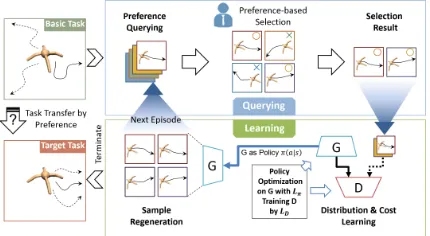
Figure 1: Problem statement and method introduction. As an example, we want to transfer a multi-joint robot from moving towards arbitrary directions (basic task) to moving forward (target task). Our preference-based task transfer framework iterate following two steps. 1. Querying expert for preference-based selection; 2. Learning distribution and cost simultane-ously from selected samples, doing policy optimization and re-generating more samples, which would have the same distribution as the selected ones.
expert demonstrations contain the agent movements along an arbitrary direction, while the desired target is to move along only one specified direction.
Clearly, it does not come for free to learn target action pol-icy from the relaxed expert demonstrations. More advanced strategies are required to transfer the action policy from the demonstrations to the target task. The work by (De Gemmis et al. 2009) suggests that using experts’ preference as a super-vised signal can achieve nearly optimal learning result. Here, the preference refers to the highly-abstract evaluation rules or choice tendency of a human for making comparison and selec-tion among data samples. Indeed, the preference mechanism has been applied in many other scenarios, such as complex tasks learning (Wirth et al. 2017), policy updating (Christiano et al. 2017), and policy optimization combing with Inverse Reinforcement Learning (IRL) (Wirth and F¨urnkranz 2013) to name a few.
impor-tance of modeling distribution comes from two aspects: 1. Learning the trajectory distribution takes a critical role in preference-based selection, which will be discussed lately; 2. With the distribution, it is more convenient to provide a theoretical analysis of the efficiency and stability of the task transfer algorithm (See Section 3.4).
In this work, we approach the task transfer by utilizing the expert preference in a principled way. We first model the preference selection as a rejection sampling where a hid-den cost is proposed to compute the acceptance probability. After selection, we then learn the distribution of the target trajectories based on the preferred demonstrations. Since the candidate demonstrations would usually be insufficient after selection, we augment the demonstrations with the samples of the current learned trajectory distribution and perform the preference selection and distribution learning iteratively. The distribution here acts as the knowledge which we make the transfer on. The theoretical derivations prove that it can improve the preference after each iteration and the target distribution will eventually converge.
As the core of our framework, the trajectory distribution and cost learning are based on but has advanced the Max-imum Entropy Inverse Reinforcement Learning (MaxEnt IRL) (Ziebart et al. 2008) and its adversary version (Finn et al. 2016). The MaxEnt IRL framework models the trajec-tory distribution as the exponential of the explicitly-coded cost function. Nevertheless in MaxEnt IRL, computing the partition function requires MCMC or iterative optimization, which is time-consuming and numerically unstable. Hence in adversary MaxEnt IRL, it avoids the computation of the partition function by casting the whole IRL problem into optimization of a generator and a discriminator. Although the adversary MaxEnt IRL is more flexible, it never delivers any form of the cost function, which is crucial for down-stream applications and policy learning. Our method enhances the original adversary MaxEnt IRL by redefining the samples from the trajectory level to the state-action level and devise the cost function using the outputs of the discriminator and generator. With the cost function, we can optimize the gener-ator by any off-the-shelf reinforcement learning method and then the optimal generator could be used as a policy on the target task.
To summarize, our key contributions are as follow. 1. We propose to perform imitation learning from related but
not exactly-relevant demonstrations by making use of the expert preference-based selection.
2. We enhance the Adversarial MaxEnt IRL framework for learning the trajectory distribution and cost function simul-taneously.
3. Theoretical analyses have been provided to guarantee the convergence of the proposed task transfer frameworks. Considerable experimental evaluations demonstrate that our method obtains comparable results with other algo-rithms that require accurate demonstrations or costs.
2
Preliminaries
This section reviews fundamental conceptions and introduces related works to our method. Before further introduction, we
first provide key notations used in this paper.
Notations.For modeling the action decision procedure of an agent, The Markov Decision Processes (MDP) without reward (S,A,T, γ, µ) is used, where S denotes a set of states which can be acquired from environment;Adenotes a set of actions controlled by the agent; T = p(s0|s, a)
denotes the transition probability from statestos0 by ac-tion a; γ ∈ [0,1) is a discount factor; µ is the distribu-tion of the initial state s0; π(a|s) defines the policy. A
trajectory is given by the sequence of state-action pairs
τi={(s(0i), a(0i)),(s(1i), a(1i)),· · · }. We define the cost func-tion parameterized byθover a s-a pair ascθ(a, s), and de-fine the cost over a trajectory asCθ(τi) =Ptcθ(a
(i)
t , s
(i)
t )
wheretis time step. A trajectory set is formulated bynexpert demonstrations,i.e.Bi={τi}ni=1.
2.1
MaxEnt IRL
Given a demonstration set B, the Inverse Reinforcement Learning (IRL) method (Ng, Russell, and others 2000) seeks to learn optimal parameters θ of the cost function
Cθ(τi). The solution could be multiple when using
insuf-ficient demonstrations. The MaxEnt IRL (Ziebart 2010; Boularias, Kober, and Peters 2011) handles this ambiguity by training the parameters to maximize the entropy over trajectories, leading to the optimization problem as:
max
θ −
X
τ
p(τ) logp(τ)
s.t. Ep(τ)[Cθ(τi)] =EpE(τ)[Cθ(τi)], τi∈B,
X
i
p(τi) = 1, p(τi)≥0.
(1)
Herep(τ)is the distribution of trajectories;pE(τ)is the prob-ability of the expert trajectory;E[·]computes the expectation.
The optimalp(τ)is derived to be the Boltzmann distribution associated with the cost−Cθ(τ), namely,
p(τ) = 1
Z exp(−Cθ(τ)). (2)
Here Z is the partition function given by the integral of
exp(−Cθ(τ))over all trajectories.
2.2
Generative Adversarial Networks
Generative Adversarial Networks (GANs) provides a frame-work to model a generatorGand a discriminatorD simultane-ously.Ggenerates samplex∼G(z)from noisez∼N(0, I)
, whileDtakesxas input, and outputs the likelihood value
D(x) ∈ [0,1]indicates whetherxis sampled from under-lying data distribution or from generator (Goodfellow et al. 2014)
min
D LD=Ex∼pdata[logD(x)]
+Ez∼N(0,I)[log(1−D(G(z))]
min
G LG =Ez∼N(0,I)[−logD(G(z))] +Ez∼N(0,I)[log(1−D(G(z))].
Generator lossLG, discriminator lossLD and
optimiza-tion goals are defined as (3). HereLG is modified as the
sum among logarithm confusion and opposite loss ofDfor keeping training signal in case generated sample is easily classified by the discriminator.
3
Methodology
Our preference-based task transfer framework consists of 2 iterative sub-procedures: 1) querying expert preference and construct a selected trajectory samples set; 2) learning the trajectory distribution and cost function from this samples set for re-generating more samples for next episode. Start-ing from the demonstrations of the basic task, the trajectory distribution and cost function we learned are improved con-tinuously. Finally, with the learned cost function, we can derive a policy of the target task.
The following sections will cover the modeling and anal-ysis for all the two steps mentioned above. In Section 3.1, we will introduce the hidden-cost model for modeling the expert preference-based selection. Then in Section 3.2, our enhanced Adversarial MaxEnt IRL for distribution and cost learning will be presented. We will combine the above two components to develop a preference-based task trans-fer framework and provide the theoretical analysis on it.
3.1
Preference-based Sampling and Hidden Cost
Model
The main idea of our task transfer framework is transfer-ring trajectory distribution with sample selection. Different from other transfer learning algorithms, the selection in our method only depends on preference provided by experts in-stead of any quantities. The preference of expert here could be abstract conceptions or rules on the performance of agents in target task, which are hard to directly be formalized as cost functions or provided numerically by the expert. In our preference-based cost learning framework, however, we only require experts to choose their most preferred samples among the given set generated on the last step, and try to use the selection result as the guidance on migrating the distribution from current policy to the target task policy.
We migrate the distribution by preference-based selection of samples in current set, the agent should be able to generate feasible trajectories on target task, which requires the proba-bility of a trajectory on current task to be non-zero whenever the probability of that trajectory on target task is non-zero, and there should exist one finite valueM (which indicates the expected rejections made before a sample is accepted) that
∀τ,∃M ∈(0,∞)s.t.M p(τ∈Bi)> p(τ∈Btar), (4)
whereBiandBtarare feasible trajectory sets of current task and target task respectively. In previous section, we have shown that under MaxEnt IRL, the expert trajectories are assumed to be sampled from a Boltzmann distribution with negative cost function as energy. For an arbitrary trajectory
τ, there will be
p(τ∈Bi) =p(τ) =
exp(−Ci(τ))
Zi
∝exp(−Ci(τ))
p(τ∈Btar) =ptar(τ) =
exp(−Ctar(τ))
Ztar
∝exp(−Ctar(τ)), (5)
whereCiandCtarare ground truth costs over a trajectory of current and target task, whileciandctarare corresponding cost functions. During selection, we suppose that the expert intends to keep the trajectoryτwhich have lower cost value on target task, which means the preference selection proce-dure could be seen as a rejection sampling over setBiwith acceptance probability
psel(τ) =
ptar(τ) M pi(τ) =
Zi
M Ztarexp (Ci(τ)−Ctar(τ))
∝exp (−Ctar(τ) +Ci(τ)).
(6)
We define the gap between target cost and current cost as
hidden costch(s, a) =ctar(s, a)−ci(s, a)and for trajectory
Ch(τ) =Ctar(τ)−Ci(τ). Thus we can viewChas a latent
factor, or formally, a negative utility function (Wirth et al. 2016) that indicates the preference and at the same while indicates the gap between target distribution and current dis-tribution. Lower expectation ofChover the set of samples indicates greater acceptance possibilities and indicated cur-rent distribution to be more similar as target one. After each step, by reintroducing the accept rate, the probability of a sample presenting in the set afterithselection should be
pi+1(τ) =p(selected(τ)|τ)pi(τ)
= Zi
M Ztarexp(Ci(τ)−Ctar(τ)) 1
Ziexp(−Ci(τ))
∝exp(−Ctar(τ)).
(7)
With preference-based sample selection, the trajectory dis-tribution is expected to approach to the one under the target task finally. The convergence analysis will be provided in Section 3.4.
3.2
Enhanced Adversarial MaxEnt IRL for
Distribution and Cost Learning
In the previous section, we introduce how the preference-based sample selection works in our task transfer framework. However, since the task transfer is an iterative process, we need to generate more samples with the same distribution as the selected samples set to keep it selectable by experts. Additionally, a cost function needs to be extracted from the selected demonstrations to optimize policies. With our en-hanced Adversarial MaxEnt IRL, we can tackle these prob-lems by learning the trajectory distribution and unbiased cost function simultaneously.
• Redefining the GAN from trajectory level to state-action pair level to extract a cost function that can be directly used for policy optimization.
• Although the GAN does not directly work on trajectory anymore, we prove that the generator can still be a sampler to the trajectory distribution of demonstrations.
We first briefly review the main ideas of Adversarial Max-Ent IRL. In this algorithm, demonstrations are supposed to be drawn from a Boltzmann distribution (2), and the op-timizing target can be regarded as Maximum Likelihood Estimation(MLE) over trajectory setB
min
θ Lcost=Eτ∼B[−logpθ(τ)]. (8)
The optimization in (8) can be cast into an optimization problem of a GAN (Goodfellow et al. 2014; Finn et al. 2016), where the discriminator takes the form as followed
D(τ) = p(τ) p(τ) +G(τ) =
1
Z exp(−C(τ))
1
Z exp(−C(τ)) +G(τ)
. (9)
Finn et al. showed that, when the model is trained to opti-mal, the generatorGwill be an optimal sampler of the trajec-tory distributionp(τ) = exp(−C(τ))/Z. However, we still cannot extract a closed-form cost function from the model. As a result, we enhanced it to meet our requirements.
Since the cost function should be defined on each state-action pair, we first modified the input of the model in (9) from a trajectory to a state-action pair
D(s, a) =
1
Z exp(−c(s, a))
1
Zexp(−c(s, a)) +G(s, a)
. (10)
The connection between the accurate costc(s, a)and outputs
D(s, a),G(s, a)of GANs can be established
˜
c(s, a) :=c(s, a) + logZ
= log(1−D(s, a))−logD(s, a)−logG(s, a). (11) Here we define˜c(s, a) = c(s, a) + logZ as a cost esti-mator, whilec(s, a)is the accurate cost function. Since the partition functionZis a constant while cost function is fixed, it will not affect the policy optimization, which means that
˜
ccan be directly integrated in common policy optimization algorithms as a unbiased cost function.
Notice that, after this modification, there will be several issues we need to address. Firstly, since the GAN is not de-fined on trajectory anymore, the equivalence between Guided Cost Learning and GAN training need to be re-verified. We will discuss it in Section 3.4. Moreover, it is not straight-forward whetherG(s, a)is a sampler to the distribution of demonstrations.
We now show that whenGis trained to optimal, the distri-bution of trajectories sampled from it is exactly the distribu-tionp(τ)of demonstrations:
Assumption 1. The environment is stationary.
Lemma 1. Suppose that we have an expert policy πE(a|s) to produce demonstrationsB, a trajectory τ =
{(s0, a0),(s1, a1),· · · } is sampled from πE. Then τ will have the same probability as drawn fromp(τ)if Assump-tion 1 holds (p(τ)is the trajectory distribution ofB).
Proof. We first introduce the environment modelpe(s0|s, a)
and the state distributionps(s). In Reinforcement Learning, environment is basically a condition distribution over state transitions(s0, s, a). Thus the probability of a given trajectory
τ ={(s0, a0),(s1, a1)· · · }will be
p(τ) =ps(s0)
Y
t=0
πE(at|st)pe(st+1|st, at). (12)
Now we sample a trajectoryτwithπEby executing roll-outs. Under Assumption 1, the environment modelpefor samplingτfromπEwill be the same as sampling the
demon-strationsB, whileps(s) =RR
pe(s0|s, a)ds dais also iden-tical. Therefore, the probability of samplingτcan be derived as
q(τ) =ps(s0)
Y
t=0
πE(at|st)pe(st+1|st, at). (13)
It’s obvious thatp(τ) =q(τ).
Lemma 2. (Goodfellow et al. 2014) The global minimum of the discriminator objective(3)is achieved whenpG=pdata.
For a GAN defined on state-action level, with Lemma 2,
pG = pdata = πE,πE is the expert policy for producing demonstrations. Then with Lemma 1, it’s obviously that the trajectory sampled withG(s, a)will have the same density asp(τ), which means thatG(s, a)can still be a sampler to the trajectory distribution of demonstrations.
We formulate the minimization of generator loss as a policy optimization problem. We regard the unbiased cost estimator
˜
c(s, a)as the cost function instead ofLGin (3), andGas a
policyπ. Thus the policy objective will be
Lπ=E(s,a)∈B[log(1−D(s, a))−logD(s, a)] +H(π)
whereH(π) =E(s,a)∈B[−logπ(a|s)].
(14) This is quite similar to the generator objective used by GAIL (Ho and Ermon 2016) but with an extra entropy penalty. We’ll compare the performances of cost learning between our method and GAIL in Section 4.
3.3
Preference-based Task Transfer
The entire task transfer framework is demonstrated in Al-gorithm 1, which combines the hidden cost model for preference-based selection and enhanced Adversarial Max-Ent IRL for distribution and cost learning. With this frame-work, a well-trained policy on the basic task can be trans-ferred to target task without accurate demonstrations or cost. Comparing to Section 3.2, we adopt a stop condition with
andDωi−1wheni >1. Compare to initialize from scratch, this will converge faster in each iteration, while the results remain the same.
Algorithm 1Preference-based task transfer via Adversarial MaxEnt IRL
Input:
Demonstrations setB0on basic task.
Stop indicator, maximum episodeM. Preference rules, or emulators which provides selection results.
Output:
Transferred policyπt.
i= 0
Initialize generatorGφ0, discriminatorDω0; 1: repeat
2: i←i+ 1
3: forstepsin{1,· · ·, N}do
4: Sample trajectoryτfromGφi;
5: UpdateDωi with binary classification error in (3) to tell demonstrationτE∈B
i−1from sampleτ;
6: UpdateGφi using any policy optimization method with respect toLπin (14);
7: end for
8: Sampling withGφi, and collectBi˜;
9: Query for preference to select trajectory inBi˜ to ob-tain reob-tained samplesBi, dropped samplesBi, and guarantee|Bi|is no more than half of|B˜i|;
10: Random sampleβ|Bi|trajectories fromBi and put them back intoBi;
11: until |Bi|/|Bi˜ |< ori=M
12: return πt←Gφi
3.4
Theoretical Analysis
In this section, we will discuss how can our framework learn the distribution from trajectories in each episode and finally transfer the cost function to target task. Remember the core part in our framework: Transferring the trajectory distribution fromp0toptar. There is a finite loop in this process, during
which we query for preference aspsel(τ)∝exp{−Ch(τ)}
and improve the distribution pi for each episodei. If the
distribution improves monotonically and the improvement can be maintained, we can guarantee the convergence of our method, which means thatptarcan be learned. Then the cost functionciwe learned together withpiwill also approach
to the cost for target taskctar. This intuition is shown as following:
Proposition 1. Given a finite set of trajectoriesBsampled from distributionp(τ)and an expert with select probabil-ity(6), the hidden cost over a trajectoryEτ∼p[−Ch(τ)]is improved monotonically after each selection.
This proposition can be proved with some elementary derivations. Here we only provide the proof sketch. Since all the trajectories inBare sampled from corresponding distribu-tionp(τ), the expect cost can be estimated. Notice that we use a normalized select probabilitypsel(τ) = exp(−Ch(τ))/Z.
Thus the estimations of expectation before and after the se-lection will be
Eτ∼p[−Ch(τ)]≈ 1
|B| |B|
X
i=0
(−Ch(τi))
Eτ∼p0[−Ch(τ)]≈
|B|
X
i=0
psel(τi)(−Ch(τi))/
|B|
X
i=0
psel(τi).
(15) Obviously, trajectories after selection can not be seen as samples drawn from p, here we use p0, which can be re-garded as animproved p. Under linear expansion of cost,
Eτ∼p0[−Ch(τ)]≥Eτ∼p[−Ch(τ)]can be proved. Thus the
expect cost over a trajectory is improved monotonically. Then we need to re-verify that whether the proposed state-action level GAN in our enhanced Adversarial MaxEnt IRL is still equivalent to Guided Cost Learning (Finn, Levine, and Abbeel 2016):
Theorem 1. Suppose we have demonstrations B =
{τ0, τ1,· · · }, a GAN with generatorGφ(s, a), discriminator Dω(s, a). Then when the generator lossLG=Eτ∼p[log(1− Dω(s, a))−log(Dω(s, a))]is minimized, the sampler loss in Guided Cost Learning (Finn, Levine, and Abbeel 2016)
Lsampler = DKL(q(τ) || exp(−C(τ))/Z) is also mini-mized.q(τ)is the learned trajectory distribution, andGφis corresponding sampler.
Since theLsampleris minimized along withLG, when the
adversarial training ends, an optimal sampler ofq(τ)can be obtained. Now we need to proveBis drawn fromq(τ):
Theorem 2. Under the same settings in Theorem 1, when the discriminator loss is minimized, the cost loss in Guided Cost Learning Lcost = Eτ∼B[Cθ(τ)] +
Eτ∼G[exp(−Cθ(τ))/q(τ)] is also minimized. Thus the learned cost Cθ(τ)is optimal forB. Refer to Theorem 1, Bis drawn fromq(τ).
In Theorem 2, MaxEnt IRL is regarded as a MLE of (2), while the unknown partition functionZneeds to be estimated. Therefore, training a state-action level GAN is still equivalent to maximizing the likelihood of trajectory distribution. Thus we can learn the optimal cost function and distribution under the current trajectory setBat the same time.
With Proposition 1, we can start from an arbitrary tra-jectory distribution p0 and trajectory set B0 drawn from
it. Then we can define atrajectory distribution iterationas
pi+1(τ)∝pi(τ) exp{−Ch(τ)}(Haarnoja et al. 2017). Then
expected hidden cost over a trajectoryEτ∼pi[−Ch(τ)] im-proves monotonically in each episode. With Theorem 1, 2, by strictly recovering theimproveddistribution aspi+1from
trajectory set (after selection), our algorithm can guarantee to maintain the improvement of expect cost over a trajectory to next episode.
Under certain regularity conditions (Haarnoja et al. 2017),
piconverges top∞. For trajectories that sampled from the target distributionptar(τ), their corresponding select
Figure 2: Results of distribution learning under four MuJoCo environments. Here the demonstrations are provided by an expert policy (PPO) under a known cost function. We compare the average cost value among trajectories generated by anoracle(an ideal policy that always obtains maximum return), PPO (sample generator, acts as the expert), GAIL (a state-of-the-art IRL algorithm) and our distribution learning method. The results show that our method can finally achieve nearly the same performance as the expert. As we discussed in Section 4.1, we can verify that our method can learn the distribution from demonstrations.
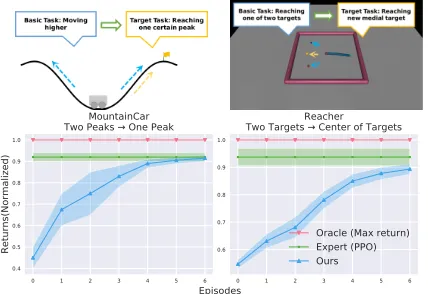
Figure 3: Results of cost learning and task transfer. We com-pare the average returns among anoracle(an ideal policy that always obtains maximum return), an expert policy trained with the cost of target task, and our method. The results show that our algorithm can adapt to new task efficiently within
4∼6episodes, and achieves nearly the same performance as the expert.
Cb(τ))/Zcan be a fixed point of this iteration when the
itera-tion starts frompb(τ) = exp(−Cb(τ))/Z. Since all the non-optimal distribution can be improved this way, the learned distribution will converge toptar(τ)at infinity. As we have showed before, with a limited demonstrated trajectoriesB
sampled from arbitrary trajectory distributionp(τ), an op-timal costc(a, s) can be extracted through our enhanced Adversarial MaxEnt IRL proposed in Section 3.2. There-fore, the target costctarcan also be learned from transferred distributionptar.
4
Experiments
We evaluate our algorithm on several control tasks in Mu-JoCo (Todorov, Erez, and Tassa 2012) physical simulator with pre-defined ground-truth cost functioncb(s, a)on ba-sic tasks andctar(s, a)on target tasks in each experiments, Cb(τ)andCtar(τ)are accumulated costs over trajectoryτ
for basic and target task respectively. All the initial demon-strations are generated by a well-trained PPO usingcb, and
during the transfer process, preference is given by emulator with negative utility function (or hidden cost over a trajectory)
Ch=Ctar−Cb. The select probability follows the definition in (6). For performance evaluation, we use averaged return with respect toctar(s, a)as the criterion.
4.1
Overview
In experiments, we mainly want to answer three questions: 1. During the task transfer procedure, can our method recover
the trajectory distribution from demonstrations in each episode?
2. Starting from a basic task, can our method finally transfer to the target task and learn the cost function of it? 3. Under the same task transfer problem, can our method
(based on preference only) obtain a policy with compa-rable performance, compared to other task transfer algo-rithms (based on accurate cost or demonstrations)? To answer the first question, we need to verify the distri-bution learning part in our method functionally. Since our enhanced Adversarial MaxEnt IRL is built upon MaxEnt IRL, the recovered trajectory distribution can be reflected as a cost function, and the trajectories we learn from being generated by the optimal policy under that cost. Intuitively, given the ex-pert trajectoriesτPPOgenerated by PPO and its corresponding
costCtar(τPPO), if we can train a policy which can generate
τwith similar averageCtar(τ), we believe that the trajectory distribution can be recovered.
To answer the second question, we evaluate the complete preference-based task transfer algorithm under some cus-tomized environments and tasks. In each environment, we transfer current policy under basic task to the target one. During the transfer process, expert preference (emulated by computer) is given as a selection result only, while any infor-mation of cost or selecting rule is unknown to the agent. We also train an expert policy with PPO andctar(s, a)for com-parison. In each episode, we generateτiusing our learned policy and recordCtar(τi). If the averageCtar(τi)finally
approaches toCtar(τPPO), we can verify that our method can
learn the cost function of target task.
target task in each episode (we consider gradient stepin MAML the same asepisodein our method) for evaluation, to see whether the result of our method is comparable.
4.2
Environments and Tasks
Here we outline some specifications of the environments and tasks in our experiments:
• Hopper, Walker2d, Humanoid and Reacher:These en-vironments and tasks are directly picked from OpenAI Gym (Brockman et al. 2016) without customization. Since they are only used for functionally verifying our distribu-tion learning part and comparing with the original GAIL algorithm, there are no transfer settings.
• MountainCar, Two Peaks→One Peak:In this environ-ment, there are two peaks for the agent to climb. The basic task is to make the vehicle higher, while the target task is climbing to a specified one.
• Reacher, Two Targets→Center of Targets:In this envi-ronment, the agent needs to control a 2-DOF manipulator to reach some specified targets. For the basic task, there will be two targets, and the agent can reach any of them, while in target task the agent is expected to reach the cen-tral position between the two targets.
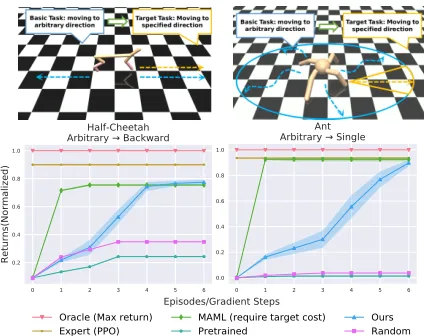
• Half-Cheetah, Arbitrary→Backward:In this environ-ment, the agent needs to control a multi-joint (6) robot to move forward or backward. The two directions are all acceptable in the basic task, while only moving backward is expected in the target task.
• Ant, Arbitrary→Single:This environment enhances the Half-Cheetah environment in two aspects: First, there will be more joints (8) to control; Second, the robot can move to arbitrary directions. In the basic task, any directions are allowed, while only one specified direction is expected in the target task.
4.3
Distribution and Cost Learning
We first concern the question whether our method can recover the trajectory distribution from demonstrations during the task transfer procedure. Experiment results are shown in Figure 2. All the selected control tasks are equipped with high-dimensional continuous state and action spaces, which can be challenging to common IRL algorithms. We find that our method achieves nearly the same final performance as the expert (PPO) that provides the demonstrations, indicating that our method can recover the trajectory distribution. Also, comparing with other state-of-the-art IRL methods like GAIL, our method can learn a better trajectory distribution and a cost function more efficiently.
4.4
Preference-based Task Transfer
In Figure 3, we demonstrate the transfer results on two envi-ronments. The transfer in Reacher environment is more diffi-cult than MountainCar toy environment. The reason would be that the later one can be clustered easily since there are only two actual goals that a trajectory may reach, and the target goal (to reach one specified peak) is exactly one of
Figure 4: Results of comparison with other methods. We evaluate our algorithm under the transfer environments intro-duced by (Finn, Abbeel, and Levine 2017). For the baselines,
MAMLrequires accuratectarwhen transferring,Pretrained
means pre-training one policy from a basic task using Be-havior Cloning (Ross, Gordon, and Bagnell 2011) then fine-tuning.Randommeans optimizing a policy from randomly initialized weights. The results show that our method can obtain a policy with comparable performance with MAML and other baselines.
them. In Reacher environment, although the demonstrations in the basic task still seem to be easily clustered, the target task cannot be directly derived from any of the clusters. In both two transfer experiments, the adapted policies produced by our algorithm show nearly the same performances as the experts that directly trained on these two target tasks. As the transferred policy is trained with the learned cost function, we can conclude that our algorithm can transfer to target task by learning the target cost function. In our experiments, we find that within less than 10 episodes and less than 100 query-ing number at each episode can sufficiently derive desired performance. Another potential improvement of our method is to apply some commutable rules to simulate the human selection and reduce the querying time.
4.5
Comparison with Other Methods
and impressive.
5
Conclusion
In this paper, we present an algorithm that can transfer poli-cies through learning the cost function on the target task with expert-provided preference selection results only. By mod-eling the preference-based selection as rejection sampling and utilizing enhanced Adversarial MaxEnt IRL for directly recovering the trajectory distribution and cost function from selection results, our algorithm can efficiently transfer poli-cies from a related but not exactly-relevant basic task to the target one, while theoretical analysis on convergence can be provided at the same time. Comparing to other task transfer methods, our algorithm can handle the scenario in which acquiring the accurate demonstrations or cost functions from experts is inconvenient. Our results achieve comparable task transfer performances to other methods which depend on accurate costs or demonstrations. Future work could focus on the quantitative evaluation of the improvement on the trans-ferred cost function. Also, the upper bound on the sum of total operating episodes could be analyzed.
Acknowledgment
This research work was jointly supported by the Natural Science Foundation great international cooperation project (Grant No:61621136008) and the National Natural Science Foundation of China (Grant No:61327809). Professor
Fuchun Sun([email protected])is the corresponding author of this paper and we would like to thank Tao Kong, Chao Yang and Professor Chongjie Zhang for their generous help and insightful advice.
References
Boularias, A.; Kober, J.; and Peters, J. 2011. Relative entropy inverse reinforcement learning. InInternational Conference on Artificial Intelligence and Statistics (AISTATS).
Brockman, G.; Cheung, V.; Pettersson, L.; Schneider, J.; Schulman, J.; Tang, J.; and Zaremba, W. 2016. Openai gym.
Christiano, P. F.; Leike, J.; Brown, T.; Martic, M.; Legg, S.; and Amodei, D. 2017. Deep reinforcement learning from human pref-erences. InAdvances in Neural Information Processing Systems (NIPS).
De Gemmis, M.; Iaquinta, L.; Lops, P.; Musto, C.; Narducci, F.; and Semeraro, G. 2009. Preference learning in recommender systems. Preference Learning.
Duan, Y.; Andrychowicz, M.; Stadie, B.; Jonathan Ho, O.; Schneider, J.; Sutskever, I.; Abbeel, P.; and Zaremba, W. 2017. One-shot imitation learning. InAdvances in Neural Information Processing Systems (NIPS).
Edmonds, M.; Gao, F.; Xie, X.; Liu, H.; Qi, S.; Zhu, Y.; Rothrock, B.; and Zhu, S.-C. 2017. Feeling the force: Integrating force and pose for fluent discovery through imitation learning to open medicine bottles. InIEEE/RSJ International Conference on Intelligent Robots and Systems (IROS).
Finn, C.; Abbeel, P.; and Levine, S. 2017. Model-agnostic meta-learning for fast adaptation of deep networks. InInternational Conference on Machine Learning (ICML).
Finn, C.; Christiano, P.; Abbeel, P.; and Levine, S. 2016. A connection between generative adversarial networks, inverse re-inforcement learning, and energy-based models. arXiv preprint arXiv:1611.03852.
Finn, C.; Levine, S.; and Abbeel, P. 2016. Guided cost learning: Deep inverse optimal control via policy optimization. In Interna-tional Conference on Machine Learning (ICML).
Goodfellow, I.; Pouget-Abadie, J.; Mirza, M.; Xu, B.; Warde-Farley, D.; Ozair, S.; Courville, A.; and Bengio, Y. 2014. Generative adversarial nets. InAdvances in neural information processing systems (NIPS).
Haarnoja, T.; Tang, H.; Abbeel, P.; and Levine, S. 2017. Reinforce-ment learning with deep energy-based policies. InInternational Conference on Machine Learning (ICML).
Ho, J., and Ermon, S. 2016. Generative adversarial imitation learning. InAdvances in Neural Information Processing Systems (NIPS).
Ng, A. Y.; Russell, S. J.; et al. 2000. Algorithms for inverse reinforcement learning. InInternational conference on Machine learning (ICML).
Pathak, D.; Mahmoudieh, P.; Luo, M.; Agrawal, P.; Chen, D.; Shentu, F.; Shelhamer, E.; Malik, J.; Efros, A. A.; and Darrell, T. 2018. Zero-shot visual imitation. InInternational Conference on Learning Representations (ICLR).
Ross, S.; Gordon, G.; and Bagnell, D. 2011. A reduction of imita-tion learning and structured predicimita-tion to no-regret online learning. InInternational conference on artificial intelligence and statistics (AISTATS).
Sermanet, P.; Lynch, C.; Chebotar, Y.; Hsu, J.; Jang, E.; Schaal, S.; Levine, S.; and Brain, G. 2018. Time-contrastive networks: Self-supervised learning from video. InIEEE International Conference on Robotics and Automation (ICRA).
Stadie, B. C.; Abbeel, P.; and Sutskever, I. 2017. Third-person imitation learning. InInternational Conference on Learning Repre-sentations (ICLR).
Todorov, E.; Erez, T.; and Tassa, Y. 2012. Mujoco: A physics engine for model-based control. InIEEE/RSJ International Conference on Intelligent Robots and Systems (IROS). IEEE.
Wang, Z.; Merel, J. S.; Reed, S. E.; de Freitas, N.; Wayne, G.; and Heess, N. 2017. Robust imitation of diverse behaviors. InAdvances in Neural Information Processing Systems (NIPS).
Wirth, C., and F¨urnkranz, J. 2013. A policy iteration algorithm for learning from preference-based feedback. InInternational Sympo-sium on Intelligent Data Analysis. Springer.
Wirth, C.; Furnkranz, J.; Neumann, G.; et al. 2016. Model-free preference-based reinforcement learning. InAAAI Conference on Artificial Intelligence (AAAI).
Wirth, C.; Akrour, R.; Neumann, G.; and F¨urnkranz, J. 2017. A survey of preference-based reinforcement learning methods.Journal of Machine Learning Research (JMLR).
Yu, T.; Finn, C.; Dasari, S.; Xie, A.; Zhang, T.; Abbeel, P.; and Levine, S. 2018. One-shot imitation from observing humans via domain-adaptive meta-learning. InRobotics: Science and Systems (RSS).
Ziebart, B. D.; Maas, A. L.; Bagnell, J. A.; and Dey, A. K. 2008. Maximum entropy inverse reinforcement learning. InAAAI Confer-ence on Artificial IntelligConfer-ence (AAAI).