The Thirty-Third AAAI Conference on Artificial Intelligence (AAAI-19)
On Limited Conjunctions and Partial
Features in Parameter-Tractable Feature Logics
Stephanie McIntyre,
1Alexander Borgida,
2David Toman,
1Grant Weddell
1 1Cheriton School of Computer Science, University of Waterloo, Canada2Department of Computer Science, Rutgers University, NJ, U.S.A.
{srmcinty,david,gweddell}@uwaterloo.ca, [email protected]
Abstract
Standard reasoning problems are complete for EXPTIME in common feature-based description logics—ones in which all roles are restricted to being functions. We show how to con-trol conjunctions on left-hand-sides of subsumptions and use this restriction to develop a parameter-tractable algorithm for reasoning about knowledge base consistency. We then show how the resulting logic can simulate partial features, and present algorithms for efficient query answering in that set-ting.
1
Introduction
Ontology-based data access(OBDA) emphasizes the use of ontologies, usually expressed in adescription logic (DL), as a preferred front end for interacting with (multiple) databases, containing facts about a domain (Calvanese et al. 2007; Kontchakov et al. 2010; Lutz et al. 2013). A de-sirable DL for OBDA supports (i) more expressive con-ceptual modelling of the domain, (ii) capturing domain se-mantics embedded in relational schema, and (iii) effective query answering. The CF D family of feature-based DLs has been designed primarily to support PTIME reasoning in accessing relational data sources. A distinguishing property of this family is support for expressing complex functional dependencies, which are the most widely used way to cap-ture domain semantics in relational databases, in addition to foreign keys. One dialect, calledCF DI∀−nc (St. Jacques, Toman, and Weddell 2016), supported OBDA to relational databases, and was able to do so without “loading” the rela-tional database into an ABox. In addition, it was capable of emulating DL-LiteFcore.
Our main contribution is a new parameterized member of this family called CF DI∀−kc , which adds the ability to use conjunctions on the left-hand side of subsumptions in aCF DI∀−nc TBox, where the parameterkis a positive in-teger that constitutes a limit on the number of conjunctions that need to be considered in reasoning services. (Indeed, any CF DI∀−nc TBox can be easily mapped to a CF DI∀−2c TBox.) This enhances the modelling capacity ofCF DI∀−kc : in a university context, we can now not only specify that a
StudentWorkeris both aStudentand anEmployee,
Copyright c2019, Association for the Advancement of Artificial Intelligence (www.aaai.org). All rights reserved.
but actually define StudentWorker as anyone who is both, by adding the axiom
(StudentuEmployee)vStudentWorker.
This distinction between “primitive concepts” (“phones, which happen to all be black”) and “defined concepts” (“black phones”) was one of the key insights that drove Brachman (Brachman 1977) to the development of KL-ONE, the progenitor of DLs, and was an important missing ingredient in semantic data models (Hull and King 1987), such as Taxis (Mylopoulos, Bernstein, and Wong 1980) and GEM (Zaniolo 1983), as well as UML.
A frequently remarked limitation of theCF Dfamily, in-cluding CF DI∀−nc , is that features connecting objects are total functions. An interesting and important benefit of al-lowing limited conjunctions on the left-hand side of sub-sumption will be the ability to encode and support reasoning with features that are insteadpartialfunctions. This means that we can now explicitly require that aBuildingnever has asalary. In relational database terms, this means that CF DI∀−kc can indirectly represent “null inapplicable”, in ad-dition to the usual “null unknown”, which comes from the open world assumption of DLs. In particular, we also in-troducepartial-CF DI∀−kc variants ofCF DI∀−kc DLs, which add an ability to capture partial features, and show how any partial-CF DI∀−kc terminology can always be mapped to a CF DI∀−(k+1)c terminology. The remaining technical contri-butions of this paper are to show that each of the following problems are parameter-tractable ink:
1. (parameter diagnosis) given an arbitraryCF DI∀ TBox T and integerk, determining ifT is aCF DI∀−kc TBox;
2. (concept satisfiability) given aCF DI∀−kc TBox and con-ceptC, determining ifCis satisfiable;
3. (knowledge base consistency) determining if a given CF DI∀−kc knowledge base is consistent; and
4. (query answering in OBDA) computing the certain an-swers for conjunctive queries over a given CF DI∀−kc knowledge base.
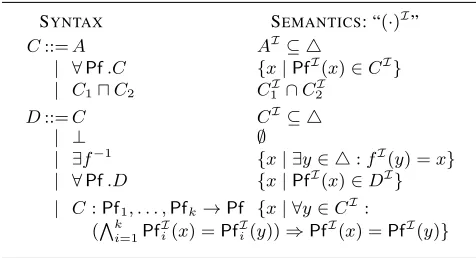
SYNTAX SEMANTICS: “(·)I”
C::=A AI⊆ 4
| ∀Pf.C {x|PfI(x)∈CI}
| C1uC2 C1I∩C2I
D::=C CI⊆ 4
| ⊥ ∅
| ∃f−1 {x| ∃y∈ 4:fI(y) =x} | ∀Pf.D {x|PfI(x)∈DI} | C:Pf1, . . . ,Pfk→Pf {x| ∀y∈CI :
(Vk i=1Pf
I
i(x) =Pf I
i(y))⇒Pf I
(x) =PfI(y)}
Figure 1:CF DI∀Concepts.
Cal`ı, Gottlob, and Pieris 2012), CF DI∀ TBoxes need to be globally analyzed to determine whether they satisfy the CF DI∀−kc restrictions (see Theorem 6 in Section 3).
2
Background and Definitions
All members of theCF Dfamily are fragments of FOL with underlying signatures based on disjoint sets of unary pred-icate symbolsPC, calledprimitive concepts, constant sym-bolsIN, calledindividuals, and unary function symbols F, calledfeatures. Apath function Pfis a word inF∗, with the
empty word denoted byid, and concatenation by “.”. Con-cept descriptionsof two kinds,CandD, are defined by the grammar rules on the left-hand-side of Fig. 1. An instance of the final production is called apath functional dependency (PFD). (Note that PFD-like constructs have also been con-sidered in versions of DL-Lite (Calvanese et al. 2008).)
Semantics is defined in the standard way with respect to an interpretation I = (4,(·)I) that fixes the meaning of symbols inPC,IN,F. Here, features are interpreted as total functions. The interpretation functionI is extended to path expressions by interpretingid as the identity functionλx.x, concatenation as function composition, and to complex con-cept descriptions C or D as per Fig. 1. An interpretation I satisfies asubsumptionC v D ifCI ⊆ DI, aconcept assertionA(a)ifaI ∈ AI, and a path function assertion Pf1(a) =Pf2(b)ifPfI1(aI) =PfI2(bI). Aknowledge base (KB)K = (T,A)consists of a TBoxT of subsumptions, and an ABoxAof assertions.IsatisfiesKif it satisfies each subsumption and assertion inK.
Example 1 Consider the relational schema for a univer-sity database in Fig. 2 where key attributes are underlined for brevity, and SQL keywords are in boldface. In con-structing a CF DI∀ conceptual model for this, we start with primitive concepts for each table (e.g., Building,
Room, Employee, Student, and StudentWorker). So called “concrete” features are used to record columns of tables (e.g.,bname,roomNr,inBldg, andsalary). Functional relationships between instances of concepts are captured using “abstract” features, whose identifiers come from the name of the foreign key constraints (e.g.,
caretakerRef, office, hasMgrRef). Domain con-straints on table columns are captured by value restrictions
Building( bname, campus );
Room( roomNr, inBldg, caretaker,
constraint caretakerRef foreign key
( caretaker )referencesEmployee,
constraint inBldgRef foreign key
( inBldg )referencesBuilding );
Employee( name, salary, roomNr, inBldg,
constraintoffice foreign key
( roomNr, inBldg )referencesRoom )
Prof( name, level,
constraint nameRef foreign key
( name )referencesEmployee );
Student( snum, name, hasMgr, gpa,
constraint hasMgrRef foreign key
( hasMgr )referencesEmployee );
materialized viewStudentWorkeras
select * fromStudent natural joinEmployee
Figure 2: A University Database Schema.
on concrete features, as inRoom v ∀roomNr.Integer. Ordinary key constraints are captured by PFDs, as in the following one for buildings: Building v Building :
bname→id.
The identification of Rooms presents a more interesting case, since they are so-called “weak entities” in the Entity Relationship model: they require a local part for the key (roomNr), and the key of some other entity, Building
in this case. This is captured by the more complex PFD
Room v Room : roomNr,inBldgRef.bname → id. Single-attribute foreign keys are captured by value restric-tions on abstract features naming the foreign key constraint, as inRoom v ∀caretakerRef.Employee.1The com-plex foreign keyofficeforEmployeerequires the value restriction Employee v ∀office.Room and an addi-tional more complex PFD:
EmployeevEmployee:roomNr,inBldg→office. Note that binary relationships that are not functional in ei-ther direction (called “N-M relationships” in database cir-cles), as well as n-ary relationships, can be represented using reification: if employees could have multiple offices, and, conversely, an office could house multiple people, then this would be modelled as the conceptOccupancy, with fea-tures ofandby, restrictions Occupancy v ∀of.Room
andOccupancyv ∀by.Employee, and a crucial PFD
OccupancyvOccupancy:of, by→id,
ensuring that every (room,employee)-pair is represented by at most one instance ofOccupancy.
1
Explicit naming of foreign key constraints, e.g., “constraint
The situation where the primary key of a table is also a foreign key is the usual representation of subclass hierar-chies, so we add the axiomProfvEmployee.
The following are examples of domain semantics not cap-tured by traditional conceptual models, such as UML, but attainable using PFDs:
• (StudentWorkers managed by the same person must work in the same office) StudentWorker v
StudentWorker:hasMgr→office
• (where professors are another subclass of Employee,
Profs must have their own individual offices)Prof v
Employee:office→id
• (all rooms in a building must have the same caretaker)
RoomvRoom:inBldg→caretaker
Once we add to the language conjunctions on the left-hand side of subsumptions, we will also be able todefine
StudentWorker, as discussed in the Introduction, cap-turing the view definition. Note that since the view is ma-terialized, it should be modelled, since accessing it is faster than performing the join that defines it.
Since features are total functions, at this point each
Buildinghas asalary, etc., which is an unpleasant as-pect. Once we introduce partial features and limited con-junctions on the lhs, we will be able to restrict the do-main of features in the ontology, by stating, for example,
(Buildingu ∃salary)v ⊥.
It is easy to see that for everyCF DI∀KB(T,A), there is a simplifiednormal form: a conservative extension(T0,A0)
in which subsumptions inT0 adhere to the form C v D
where the structure of conceptsCandDare now given by the following:
C ::= A| ∀f.A|A1uA2
D ::= A| ⊥ | ∀f.A| ∃f−1|A:Pf
1, . . . ,Pfk →Pf
Hereon, we also assume w.l.o.g. that at least one of the con-cept descriptionsC andD is a primitive concept, and that the ABoxA0 contains only assertions of the form “A(a)”,
“a.f =b”, and “a=b”. Note that such a normalization of ABoxes leads to the introduction of additional constant sym-bols that, from the point of query answering, should behave the same way anonymous objects do (and thus be excluded from query answers by appeal to straightforward housekeep-ing checks).
Unfortunately, unrestricted use of the concept construc-tors in Fig. 1 leads to intractability of checking KB consis-tency and logical implication (Toman and Weddell 2005). As usual, to ensure PTIME complexity, one looks for additional restrictions on concept constructors. One restriction, which has been investigated (e.g., (Khizder, Toman, and Weddell 2000)), is to limit the PFD constructor to one of the follow-ing two forms:
1. C:Pf1, . . . ,Pf.Pfi, . . . ,Pfk→Pf or
2. C:Pf1, . . . ,Pf.f, . . . ,Pfk →Pf.g
Note that this form continues to allow all the examples of PFD concepts introduced above, including keys and ordi-nary functional dependencies. The second restriction, intro-duced in this paper, limits the use of conjunctionuwith a parameterkas follows:
Definition 2 (Restricted Conjunction) Let k > 0 be a constant. We say that TBoxT is aCF DI∀−kc TBox if, when-ever T |= (A1u · · · uAn) v B for some set of
prim-itive concepts {A1, . . . , An} ∪ {B}, with n > k, then
T |= (Ai1 u · · · uAik) v B for some k-sized subset
{Ai1, . . . , Aik}of the primitive concepts{A1, . . . , An}. 2
Note that this condition is not syntactic, and we will return to the issue of checking it later, showing that this can be done in time exponential ink, but linear in|T |. Adding these restrictions leads to the logicCF DI∀−kc .
Relation to CF DI∀−nc . It is relatively easy to see that CF DI∀−nc (Toman and Weddell 2014), a logic that disal-lows conjunctions on the left-hand sides of subsumptions altogether but allows for primitive negation on the right-hand sides can be embedded into CF DI∀−2c by mapping
A v ¬B to AuB v ⊥and keeping the remainder of a CF DI∀−nc TBox unchanged. It is then easy to verify that the above transformation always yields aCF DI∀−2c TBox since the only subsumptions with a conjunction on their left-hand sides are of the form AuB v ⊥. This embedding also shows that the expressive power ofCF DI∀−nc falls strictly betweenCF DI∀−1c (which is unable to capture disjointness) andCF DI∀−2c (which can in addition define certain binary intersections of concepts).
3
Reasoning in
CF DI
∀−kcWe now present our main result: showing that the complex-ity of reasoning inCF DI∀−kc is in PTIME for a fixedk. The presentation proceeds in two steps. The first shows how con-cept consistency w.r.t. aCF DI∀−kc TBox can be decided, and the second extends this to full KB consistency.
3.1
TBox and Concept Satisfiability
It is easy to see that every CF DI∀−kc TBox T is consis-tent (by setting all primitive concepts to be interpreted as the empty set). To test forprimitive concept satisfiabilitywe use the following construction for the closure of relevant in-ferred subsumptions:
Definition 3 (TBox Closure) LetEˆ,Fˆ,GˆandHˆ be sets of primitive concepts (including⊥) of size at mostk, or sets of value restrictions involving a common featuref over such a set of concepts (written as∀f.Eˆ, etc.; all the sets represent-ingconjunctionsof their elements); andT aCF DI∀−kc TBox in normal form. Then defineClos(T)to be a set of “small” subsumptions entailed byT. In particular, let it be the least set such that
1. EˆvEˆ and⊥ vEˆare inClos(T)for every setEˆ; 2. IfEˆvFˆandFˆvGˆ are inClos(T)then so isEˆ vGˆ; 3. IfEˆ vFˆandEˆ vGˆ are inClos(T)then so isEˆ vHˆ
for allHˆ ⊆Fˆ∪Gˆof size between 1 and k;
4. IfCvD∈ T, forDnot of the form∃f−1, andC⊆Eˆ, thenEˆ vD ∈Clos(T);
6. IfEˆ vFˆis inClos(T)then so is∀f.Eˆ v ∀f.Fˆ; 7. IfAv ∃f−1∈ T andEˆ vA,∀f.Eˆ v ∀f.Fˆ ∈Clos(T)
thenEˆvFˆ ∈Clos(T).
Note thatClos(T)is polynomial in|T |and exponential in
k. And clearly each subsumption added toClos(T)by rules (1-7) in Definition 3 is logically implied byT. We also note that while the above construction will be sufficient to pro-vide the desired complexity bounds, the resultingClos(T)is by no means the smallest such set. For example, one could complicate the rules in order to make all right-hand sides singletons, or by not explicitly representing all weakenings.
Theorem 4 (Primitive Concept Satisfiability) LetT be a CF DI∀−kc TBox in normal form andAa primitive concept. ThenAis satisfiable with respect toT if and only ifA v ⊥ 6∈Clos(T).
Proof (sketch): One direction is immediate: wereAv ⊥in Clos(T)it would be logically implied byT and hence there couldn’t be a model ofT in whichAis nonempty. For the other direction, givenClos(T), an objecto, and a primitive conceptA, define the following family of subsets ofPC in-dexed by paths of features and their inverses, starting from
o, in the following recursive manner:
1. So={B|AvB∈Clos(T)};
2. Sf(x)={B |Eˆv ∀f.B∈Clos(T)andEˆ ⊆Sx}, when f ∈Fandxnot of the form “f−(y)”; and
3. Sf−(x) = {B | ∀f.Eˆ v B ∈ Clos(T)andEˆ ⊆ Sx}, whenA0 v ∃f−1 ∈ T,A0 ∈Sx, andxnot of the form
“f(y)”.
We say thatSxisdefinedif it conforms to one of the three
cases above, and that it is consistentif ⊥ 6∈ Sx. Observe
that all defined sets Sx are consistent. Otherwise, A must
be inconsistent, implying in turn thatA v ⊥ ∈ Clos(T), a contradiction. Hence the defined sets Sx induce a (tree)
model ofT, in whicho∈AI. 2
Note that the above model witnessing the satisfiability ofA
does not contain any identical path agreements, and hence vacuously satisfies all PFDs inT.
Observation 5 LetT be aCF DI∀−kc TBox in normal form andA1, . . . , Anprimitive concepts. ThenA1u. . .uAn is
satisfiable with respect toT if and only ifA is satisfiable with respect toT ∪ {A v A1, . . . , A v An}, for a fresh
primitive conceptA, sinceT ∪ {AvA1, . . . , AvAn}is
aCF DI∀−kc TBox wheneverT is aCF DI∀−kc TBox. 2 This observation allows consistency checks for arbitrary conjunctions, including cases that may not appear in CF DI∀−kc TBoxes (for a particular fixedk).
On determiningk: a pay as you go approach. The above development assumes a fixedkknown in advance. However, the TBox closure procedure also allows for testing whether a given value ofkis sufficient for aCF DI∀TBoxT:
Theorem 6 (Testing fork) LetT be aCF DI∀TBox. Then T isnotaCF DI∀−kc TBox if and only if there areE,ˆ F ,ˆ G, Dˆ
such that (1)Eˆ vFˆ∈Clos(T), (2)GˆvD∈Clos(T), (3)
ˆ
F ⊆Gˆ, (4)|Eˆ∪( ˆG−Fˆ)|> k, and (5) for allHˆ vD ∈ Clos(T)we haveHˆ 6⊂Eˆ∪( ˆG−Fˆ).
Proof (sketch): We have remarked already that all sub-sumptions inClos(T)are entailed byT. HenceEˆ ∪( ˆG−
ˆ
F) v D is also logically implied byT. Since there is no
ˆ
H 6⊂ Eˆ ∪( ˆG−Fˆ) such that Hˆ v D ∈ Clos(T) ei-ther Eˆ ∪( ˆG−Fˆ) v D violates the conditions in Defini-tion 2, or we failed to derive one of theHˆ v D logically implied byT. However, wereT aCF DI∀−kc TBox such that
ˆ
H vD6∈Clos(T), one could then construct a model, sim-ilar to the construction in the proof of Theorem 4, in which
ˆ
H v D doesn’t hold, a contradiction with the assumption
thatT aCF DI∀−kc TBox. 2
Note that this Theorem leads to an algorithm based on it-eratively increasingkand testing whetherT is aCF DI∀−kc TBox using the above Theorem. The algorithm terminates whenT is aCF DI∀−kc TBox.2 Note also that successive it-erations easily reuse subsumptions from the previous level, and in this way can avoid unnecessary recomputation of all such subsumptions.
3.2
Knowledge Base Consistency
Inverse featuresaffect how PFDs interact with an ABox. In particular, PFDs in which all path functions have a common prefix, i.e., of the form
AvB :f.Pf1, . . . , f.Pfk→f.Pf
may apply to (pairs of) anonymous individuals mandated by the existence of inverse features (f in this case). In general, to enforce PFDs with respect to an ABoxwhile avoiding any need to explicitly create anonymous predecessor objects, we add additional logically implied PFDs to a given TBox as follows:
Definition 7 (PFD Enrichment for Inverses) Let T be a CF DI∀−kc TBox in normal form,
AvB:f.Pf1, . . . , f.Pfk →f.Pf∈ T
(A v B : f.Pf1, . . . , f.Pfk → id ∈ T) with Pfi 6= id
for 1 ≤ i ≤ k. Then we require that A v ∀f.A0, B v ∀f.B0, and A0 v B0 : Pf1, . . . ,Pfk → Pf (A0 v B0 :
Pf1, . . . ,Pfk → id), whereA0 andB0 are fresh primitive
concepts, also be inT. 2
For further details on this, see (St. Jacques, Toman, and Weddell 2016). The first step of deciding KB consistency, ABox completion, is defined by the rules in Fig. 3. In partic-ular, the rules extend a given ABox with all implied concept memberships and feature agreements.
Definition 8 Let (T,A)be aCF DI∀−kc KB. We define an ABoxCompletionT(A)to be the least ABoxA0closed under
the rules in Fig. 3 such thatA ⊆ A0. 2
2Note that the algorithm terminates for an arbitraryT since
Ifaappears inAthen adda=atoA Ifa=b∈ A then addb=atoA
Ifa=b, ϕ∈ A then addϕ[b/a]toA Ifa.f =b, a.f =c∈ Athen addb=c toA (a) ABox Equality Interactions
IfA1(a), . . . , Ak(a)∈ AandT |=A1u. . .uAk vBthen addB(a)toA
If{A(a), a.f =b} ⊆ A andT |=Av ∀f.B then addB(b)toA If{A(a), b.f=a} ⊆ A andT |=∀f.AvB then addB(b)toA
(b) ABox–TBox Interactions
If (i)A vB : Pf1, . . . ,Pfk →Pf ∈ T, (ii)A(a), B(b) ∈ A, and (iii) for1 ≤ i ≤k, there exists a prefixPf0i ofPfi s.t. a.Pf0i=ci, b.Pfi0 =di, ci=di∈ Athen:
1. Ifa.Pf=c, b.Pf =d∈ Aandc=d6∈ Athen addc=dtoA; or
2. IfPfis of the formPf00.f anda.Pf00=c, b.Pf00=d∈ A, andc=d6∈ Athen (i) ifa.Pf =c0∈ Athen addd.f =c0toA, else (ii) ifb.Pf=d0∈ Athen addc.f=d0toA, otherwise (iii) addc.f =e, d.f =etoA, whereeis a new individual.
(c) ABox–PFD Interactions
Figure 3: ABox Completion Rules forCompletionT(A)
Observe that individuals can only be declared to be mem-bers of primitive concepts sinceAis in normal form. It is also easy to see that completion terminates since it can add at most|T ||A|2 new objects, one for every pair of existing objects and a feature name.
What remains to verify is that for every ABox objectathe set of primitive concepts{A|A(a)∈CompletionT(A)}is satisfiable with respect toT. We use Corollary 5 to test this condition for each objectaappearing inCompletionT(A). Theorem 9 (CF DI∀−kc KB Consistency) LetK = (T,A)
be aCF DI∀−kc KB. ThenKis consistent if and only if{A | A(a) ∈ CompletionT(A)} is satisfiable with respect toT for every “a” appearing inCompletionT(A). 2 It is easy to see that the above construction can be imple-mented to run inO(|T |k+|T ||A|2). Other reasoning prob-lems forCF DI∀−kc , such aslogical implication,T |=C v D, are reduced to KB consistency in the standard way.
4
Partial Features
In this section we utilize our newfound ability to accommo-date limited conjunctions on the left-hand sides of subsump-tions to introducepartial featuresinCF DI∀−kc. We start with modifying the syntax and semantics for this purpose.
Definition 10 (Partial Features)
1. Featuresf ∈ Fare now interpreted aspartialfunctions on4(i.e., the result can beundefinedfor some elements of4);
2. The semantics of path functionPfdenotes a partial func-tion resulting from the composifunc-tion of partial funcfunc-tions. 3. The syntax ofCin feature-based DLs is extended with an
additional concept constructor of the form “∃f”, called an existential restriction that can then appear on both sides of subsumptions.
4. The∃f concept constructor is interpreted as{x | ∃y ∈ 4.fI(x) =y}.
5. We adopt astrict interpretation of set membership and equality. This means that set membership holds only when the value exists; and equality holds only when both sides are defined and denote the same object. 2 There are several observations worth making at this point. First, as a consequence of 2 and 5, the semantics of value restrictions and PFDs coincide with the original semantics when features were interpreted as total functions. Note also that our PFDs agree with the definition of identity con-straints in (Calvanese et al. 2008), wherePf0 = id, which also require path values to exist. To further clarify the im-pact of this observation note that aPFD subsumptionof the form “C1 vC2 :Pf1, . . . ,Pfk →Pf0” is violated when
(a) all path functionsPf0, . . . ,Pfk are defined for aC1 ob-jecte1and aC2objecte2, and (b)PfiI(e1) =PfIi(e2)holds only for1≤i≤k. Formally, and more explicitly, this leads to the following interpretation of PFDs in the presence of partial features:
(C:Pf1, . . . ,Pfk→Pf0)I =
{x| ∀y.y∈CI∧x∈(∃Pf0)I∧y∈(∃Pf0)I∧ Vk
i=1(x∈(∃Pfi)I∧y∈(∃Pfi)I∧PfIi(x) =Pf
I
i(y))
→PfI0(x) =PfI0(y)}.
Second, as a consequence of item 5, we have the tautology ∀f.E v ∃f for arbitraryf andE(in other words,∃f is a top-free notation for∀f.>).
Finally, since features are stillfunctional, so-called “qual-ified existential restrictions” of the form “∃f.C”, with se-mantics given as follows:
(∃f.C)I ={x| ∃y∈ 4.fI(x) =y∧y∈CI},
are the same as “∀f.C”. Hence we will write “(∃Pf)” as shorthand for “(∃f1u ∀f1.(∃f2u ∀f2.(. . .(∃fk). . .)))”.
do-main and range of features:
(Buildingu ∃salary)v ⊥
(Buildingu ∃inBldg)v ⊥ . . .
Buildingv ∃nameu ∃campusu. . .
The new constructor∃f naturally extends ournormal form topartial-CF DI∀−kc TBoxes by allowing ∃f to appear on both sides of subsumptions.
The following definition now shows howCF DI∀−kc is able to simulate its extension with partial functions and existen-tial restrictions in a straightforward manner. The idea is to introduce a new atomic conceptGthat intuitively stands for “objects in the total model that exist in the partial model”.
Definition 12 LetT be a partial-CF DI∀−kc TBox in normal form. We then derive aCF DI∀−(k+1)c TBoxT0 fromT by
applying the following rules:
1. Av ⊥ 7→ AuGv ⊥
2. AvB 7→ AuGvB
3. AuBvC 7→ AuBuGvC
4. Av ∀f.B 7→ AuGv ∀f.Bu ∀f.G
5. ∀f.AvB 7→ ∀f.Au ∀f.GvB
6. Av ∃f 7→ AuGv ∀f.G
7. ∃f vA 7→ ∀f.GvA
and then by adding the subsumption∀f.GvGtoT0. 2
It is easy to verify thatT0, defined above, is aCF DI∀−
(k+1)c
TBox and that:
Theorem 13 LetK = (T,A)be a partial-CF DI∀−kc KB, and let T0 be defined as above. Then K is consistent
if and only if the CF DI∀−(k+1)c KB (T0,A ∪ {G(a) |
aappears inA})is consistent. 2 Note that PFDs do not interact with TBox completion and areappliedonly in the process of ABox closure. Hence the only extension necessary is to verify that, in ABox-PFD in-teractions, the objectenecessarily exists (all the other ob-jects involved are explicitly in the ABox already). This is achieved by modifying the precondition on the objectsaand
btoAu ∃Pf(a)andBu ∃Pf(b), respectively.
Hereon, we assume that logical consequence with respect topartial-CF DI∀−kc TBoxes is reduced to KB unsatisfiabil-ity in the standard way.
4.1
On Value Restrictions
Inpartial-CF DI∀−kc, the value restriction∀f.A inherits its definition from CF DI∀−kc , i.e., it is the set of all objectso
thathavea featurefand such thatf(o)∈AI. Note that this does not impact the fact that features inpartial-CF DI∀−kc are partial. For example, to express thatAobjects donot have featuref, one can sayAu ∃f v ⊥. Similarly, to restrict the range of a partial featurewithout making it total for allA
objects, we can sayAu ∃f v ∀f.B.
On the other hand, value restrictions in more traditional role-based description logics, such asALC, also cover the vacuous cases, containing objects for whichf is undefined
(in addition to the above). This definition unfortunately leads to computational difficulties: thedisjunctivenature of such value restriction, when used on left-hand sides of subsump-tions, destroys the canonical model property of the logic. This leads to intractability of query answering as shown by Calvaneseet al.(Calvanese et al. 2013).
To regain tractability of our logic we would have to re-strict the use of value rere-strictions on the left-hand side of subsumptions. In our normal form, we would have to re-place∀f.A with∀f.Au ∃f in the grammar for left-hand side concepts. This would then lead to alternative rules when simulating the partial-feature logic in the total-feature coun-terpart in Definition 12:
40. Av ∀f.B 7→ AuGv ∀f.B
50. (∀f.Au ∃f)vB 7→ (∀f.Au ∀f.G)vB
5
OBDA for
partial-
CF DI
∀−kcConjunctive queries are, as usual, formed from atomic queries (oratoms) of the formC(x)andx.Pf1 = y.Pf2, where xand y are variables, using conjunction and exis-tential quantification. To simplify notation, we conflate con-junctive queries with the set of its constituent atoms and a set ofanswer variables:
Definition 14 (Conjunctive Query)
Letϕbe a set of atoms (representing a conjunction)C(xi)
andxi1.Pf1=xi2.Pf2(whereCis a concept description),
Pfi path functions, and x¯a tuple of variables. We call the
expression{¯x|ϕ}aconjunctive query(CQ). 2 A conjunctive query{x¯|ϕ}is therefore a notational variant of the formula∃y.¯ V
ψ∈ϕψin whichy¯contains all variables
appearing inϕbut not inx¯. The usual definition of certain answers is given by the following:
Definition 15 (Certain Answer)
LetKbe a partial-CF DI∀−kc KB andQ ={x¯ | ϕ}a CQ. Acertain answertoQoverK is a substitution of constant symbols¯a,[¯x7→a¯], such thatK |=Q[¯x7→¯a]. 2 As is the case with TBoxes and ABoxes, a CQ can be rep-resented in anormal form, a form in which all atoms in the CQ are of the form “A(x)” or “x.f =y”, whereAis a prim-itive concept andfa feature. This can be easily achieved by introducing additional non-answer (existentially quantified) variables and primitive concepts equivalent to the complex ones in the query. For the remainder of the paper, we also as-sume CQs are alwaysconnected. (Evaluating disconnected CQs is easily achieved by considering each component sep-arately.)
Example 16 A query asking for all students whose man-agers are professors is
{(x)| {Student(x), x.hasMgrRef=w,Prof(w)}}
1. If{A1(x), . . . , An(x)} ⊆ψandT |=A1u. . .uAnv ⊥thenFold(Q) :=Fold(Q)− {{y¯|ψ}}.
2. If{x.f =y, x.f=z} ⊆ψthenFold(Q) :=Fold(Q)− {{y¯|ψ}} ∪ {{y¯|ψ}[z/y]}. 3. If{x.f =z, y.f=z} ⊆ψthenFold(Q) :=Fold(Q)∪ {{y¯|ψ}[x/y]}.
4. If{A1(x), . . . , An(x), B(x)} ⊆ψandT |=A1u. . .uAnvBthenFold(Q) :=Fold(Q)−{{y¯|ψ}}∪{{y¯|ψ−{B(x)}}}.
5. If{x.f =y, A1(y), . . . , An(y)} ⊆ψandydoes not appear elsewhere inψnor iny¯thenFold(Q) :=Fold(Q)∪ {{y¯|ψ0}}
for allψ0 =ψ− {x.f =y, A
1(y), . . . , An(y)} ∪ {B0,i0(x), . . . , Bn,in(x)}for whichT |=B0,i0 v ∃f andT |=Bi,ij v
∀f.Aifori >0and whereBi,ij are all such maximal primitive concepts w.r.t.v.
6. If{y.f =x, A1(y), . . . , An(y)} ⊆ψandydoes not appear elsewhere inψnor iny¯thenFold(Q) :=Fold(Q)∪ {{y¯|ψ0}},
for allψ0 = ψ− {y.f = x, A1(y), . . . , An(y)} ∪ {B0,i0(x), . . . , Bn,in(x)} for whichT |= B0,i0 v ∃f
−1 andT |= ∀f.Bi,ij vAifori >0and whereBi,ij are all such maximal primitive concepts w.r.t.v.
Figure 4: Query Rewriting Rules for{y¯|ψ} ∈FoldT(Q).
(St. Jacques, Toman, and Weddell 2016). While, in principle we could create a representative for each such possibility along the lines of thecombined approach(Lutz, Toman, and Wolter 2009; Kontchakov et al. 2010), the resulting com-pleted ABox would no longer be polynomial in the size of the original knowledge base. To avoid the need for such an “expensive” ABox completion, our approach treats matches to anonymous individuals byquery reformulation—an idea first suggested in (Calvanese et al. 2007). Note however that our rewriting differs from “perfect rewriting”: since we per-form ABox completion for all objects in a given ABox (see Fig. 3) we can greatly simplify the query rewriting and make the result smaller since we no longer need to expand the query, e.g., w.r.t. concept hierarchies.
Definition 17 Let Q = {y¯ | ϕ} be a CQ. We write FoldT(Q)to denote the set of CQs (implicitly denoting the
union of their results) that is obtained by applying exhaus-tively the rewrite rules in Fig. 4 to the initial set{{y¯|ϕ}}.
2
The key idea underlying this definition is that, to find query answers, it is now sufficient tomatchqueries inFoldT(Q)
explicitly against the (completed) ABoxCompletionT(A); matches outside the ABox are captured by query reformula-tion (rules 5 and 6); removed parts of the query (rules 1,2,4) are implied byT; rule 3 makes possible the application of rules 5 and 6.
Lemma 18 LetQbe a CQ with at least one answer vari-able. Then¯ais a certain answer toQoverK = (T,A)if and only if¯ais an answer for some{x¯ | ψ} ∈ FoldT(Q)
overCompletionT(A).
Proof (sketch): By observing that the extended ABox CompletionT(A)is essentially a part of the minimal model ofK(sinceKis Horn) and that every element ofFoldT(Q)
implies Q, it is easy to see that whenever (1-6) are satis-fied, there is a match ofQin the minimal model and thus
¯
ais an answer. Conversely, if a match of Q in a minimal model exists yieldinga¯as an answer, then part of the match will be realized in the ABox (since at least the answer vari-ables must be bound to ABox individuals) and the remain-der of the match must be forest-like. Hence, an element in
FoldT(Q) matches in the ABox since the remaining
con-juncts must be implied byT. 2
Example 19 Suppose we have an additional axiom in our TBox which specializes the range of hasMgrRef for
StudentWorkers to be professors:StudentWorkerv ∀hasMgrRef.Prof. To find FoldT(Q) for the query in
Example 16, we consider the subset {x.hasMgrRef =
w,Prof(w)} is replaced by {StudentWorker(x)} by applying rule 5: using the above axiom and axioms in our original ontology,StudentWorkerv ∃hasMgrRefcan be derived from StudentWorker v Student (from the definition of StudentWorker), and Student v ∀hasMgrRef.Employeeu ∃hasMgrRef, which is ob-tained from the foreign keyhasMgr, once features become partial, as in Example 11. Then, the query becomes the set {Student(x),StudentWorker(x)}, which in turn is reduced to {StudentWorker(x)}, since the ontology hasStudentWorkervStudent.
For CQ without answer variables, we need an additional step that checks whether the query, when it can be folded to a concept (calledC below) matches in the tree part of every model ofK. We use the KB consistency check to determine whether a concept isforcedin a model of a KB. Thus, given apartial-CF DI∀−kc TBoxT we check for every combination of primitive conceptsA1, . . . , Ak(that could potentially
la-bel an object in an ABox):
• (T,{A1(a), . . . , Ak(a)})is consistent, and
• (T ∪ {Cv ⊥},{A1(a), . . . , Ak(a)})is not consistent.
If so we say thatA1, . . . , Ak forceC inT. To account for
forcing we extend the query rewriting in Definition 17 as follows:
7. Ifx¯=hiinQ={x¯|ϕ}andϕis equivalent to a concept
C. ThenFold(Q) :=Fold(Q)∪{hi |A1(x)∧. . .∧Ak(x)}
for every combination of primitive conceptsA1, . . . , Ak
that forceCinT.
This construction accounts for matches in the anonymous part of the minimal model of K, and yields the following Lemma:
at least one {hi | ψ} ∈ FoldT(Q)evaluates to true over
CompletionT(A).
Proof (sketch): The first condition is similar to Lemma 18, the second allows for queries that can be folded into a con-cept to be realized completely outside of the (extended) ABox. Non-emptiness of the models of C indeed corre-sponds to finding an object that makes the query true in the
minimal model. 2
Combining the results in Lemmata 18 and 20 yields the needed query reformulation for all CQ (and in turn for all UCQ and other syntactically positive queries).
6
Summary and Future Work
The contributions in this paper are twofold. First, we intro-duce CF DI∀−kc , a new dialect of theCF D family of DLs admitting a limited use of concept conjunction in left-hand sides of TBox subsumption while maintaining parameter-ized tractability of reasoning. We show how this makes it possible to simulate partial functions, and also how con-junctive queries can be reformulated to enable OBDA over a CF DI∀−kc KB. We have also combined our results with refer-ring expressions to provide a richer framework in which to accomplish OBDA over relational data sources, and, in par-ticular, to avoidobject id inventionneeded, e.g., to capture PFD-generated equalities in Fig. 3 (these results are beyond the limits of this paper). Hence the techniques presented here are expected to perform as well or better than the experi-mental results reported in (St. Jacques, Toman, and Weddell 2016). For future work, we plan to explore how referring ex-pressions can be used to account for other equalities outside of an ABox that more powerful DLs might induce, e.g, by limited use of the “same-as” concept constructor (Borgida and Patel-Schneider 1994).
Acknowledgments
We thank the anonymous reviewers for their suggestions, which helped considerably to improve the paper. The re-search was supported by NSERC Discovery Grants from the government of Canada.
References
Bienvenu, M.; Kikot, S.; Kontchakov, R.; Podolskii, V. V.; Ryzhikov, V.; and Zakharyaschev, M. 2017. The com-plexity of ontology-based data access with OWL 2 QL and bounded treewidth queries. In Proceedings of the 36th ACM SIGMOD-SIGACT-SIGAI Symposium on Principles of Database Systems, PODS 2017, 201–216.
Borgida, A., and Patel-Schneider, P. F. 1994. A Semantics and Complete Algorithm for Subsumption in the CLASSIC Description Logic.J. of AI Research1:277–308.
Brachman, R. J. 1977. What’s in a concept: structural foundations for semantic networks. International journal of man-machine studies9(2):127–152.
Cal`ı, A.; Gottlob, G.; and Pieris, A. 2012. Towards more ex-pressive ontology languages: The query answering problem. Artif. Intell.193:87–128.
Calvanese, D.; De Giacomo, G.; Lembo, D.; Lenzerini, M.; and Rosati, R. 2007. Tractable reasoning and efficient query answering in description logics: The DL-Lite family. J. Au-tom. Reasoning39(3):385–429.
Calvanese, D.; De Giacomo, G.; Lembo, D.; Lenzerini, M.; and Rosati, R. 2008. Path-Based Identification Constraints in Description Logics. InKR, 231–241.
Calvanese, D.; De Giacomo, G.; Lembo, D.; Lenzerini, M.; and Rosati, R. 2013. Data complexity of query answering in description logics. Artif. Intell.195:335–360.
Hull, R., and King, R. 1987. Semantic database model-ing: Survey, applications, and research issues. ACM Com-put. Surv.19(3):201–260.
International Organization for Standardization. 2016. SQL – Part 2: Foundation (SQL/Foundation). ISO/IEC 9075-2:2016.
Khizder, V. L.; Toman, D.; and Weddell, G. 2000. Reason-ing about Duplicate Elimination with Description Logic. In DOOD, 1017–1032.
Kontchakov, R.; Lutz, C.; Toman, D.; Wolter, F.; and Za-kharyaschev, M. 2010. The combined approach to query answering in DL-Lite. InProc. KR, 247–257.
Lutz, C.; Seylan, I.; Toman, D.; and Wolter, F. 2013. The combined approach to OBDA: Taming role hierarchies using filters. InISWC (1), 314–330.
Lutz, C.; Toman, D.; and Wolter, F. 2009. Conjunctive query answering in the description logic EL using a rela-tional database system. InProc. IJCAI, 2070–2075. Mylopoulos, J.; Bernstein, P. A.; and Wong, H. K. T. 1980. A language facility for designing database-intensive appli-cations. ACM Trans. Database Syst.5(2):185–207.
Simancik, F.; Motik, B.; and Horrocks, I. 2014. Consequence-based and fixed-parameter tractable reasoning in description logics. Artif. Intell.209:29–77.
St. Jacques, J.; Toman, D.; and Weddell, G. E. 2016. Object-relational queries over CF DInc knowledge bases: OBDA for the SQL-Literate. InProc. IJCAI, 1258–1264.
Toman, D., and Weddell, G. 2005. On Reasoning about Structural Equality in XML: A Description Logic Approach. Theoretical Computer Science336(1):181–203.
Toman, D., and Weddell, G. E. 2014. On adding inverse features to the description logicCF D∀nc. InPRICAI 2014, 587–599.