44
A Serve on Slicing: Method of Data Publishing While Maintaining Privacy
Devpal Yadav, Prof. Kailas Patidar, Prof. Manoj Yadav
Sri Satya Sai Institute of Science and Technology,
Sehore, Madhya Pradesh, India
Abstract — Latest work shows that abstraction
loses amount of information for high spatial data.
There are several anonymization techniques like
Abstraction, Containerization for privacy
preserving small data publishing. Bucketization
does not avoid enrollment acknowledgment and
does not give clear separation between aspects.
We are presenting a technique called slicing for
multiple columns multiple attributes which
partitions the data both horizontally and
vertically. We also show that slicing conserves
better data service than generalization and
Bucketization and can be used for enrollment
acknowledgment conservation. Slicing can be
used for aspect acknowledgment conservation
and establishing an efficient algorithm for
computing the sliced data that obey the l-diversity
requirement Our workload confirm that this
technique is used to prevent membership
disclosure and it also used to increase the data
utility and privacy of a sliced dataset by allowing
multiple columns multiple attributes slicing while
maintaining the prevention.
Keyword: - Data security, Data publishing,
Privacy preservation, Data anonymization.
I.
INTRODUCTION
Micro data has been studied extensively in recent
years for privacy preserving. Records of micro data,
each of which contains information about an
individual entity, such as a person, a household, or
an organization there are many micro data
anonymization techniques have been proposed. The
most popular ones are generalization [9], [11] for
k-anonymity [11] and Bucketization [12], [7], [3] for
‘l-diversity [6]. In both approaches, attributes are
partitioned into three categories:
1.Some attributes are identifiers that can uniquely
identify an individual, such as Name or Social
Security Number;
2.Some attributes are Quasi Identifiers (QI), which
the adversary may already know (possibly from
other publicly available databases) and which,
when taken together, can potentially identify an
individual, e.g., Birthdate, Sex, and Zip code;
3.Some attributes are Sensitive Attributes (SAs),
which are unknown to the adversary and are
considered sensitive, such as Disease and Salary.
In both generalization and Bucketization, first we
remove identifiers from the data and then partitions
tuples into buckets. The two techniques differ in the
next step. Generalization transforms the QI-values in
each bucket into “less specific but semantically
consistent” values so that tuples in the same bucket
cannot be distinguished by their QI values. In
Bucketization, one separates the SAs from the QIs
by randomly permuting the SA values in each
bucket. The anonymized data consist of a set of
buckets with permuted sensitive attribute values.
II.
LITERATURE REVIEW
In [9], [11], [10], generalization has been proposed.
45 but semantically consistent” value. Three types of
encoding schemes have been proposed for
generalization: global recoding, regional recoding,
and local recoding. In Global recoding [4] the
property that multiple occurrences of the same value
are always replaced by the same generalized value.
In Regional record [5] also called multidimensional
recoding (the Mondrian algorithm) which partitions
the domain space into non-intersect regions and data
points in the same region are represented by the
region they are in. Local recoding [13] does not have
the above constraints and allows different
occurrences of the same value to be generalized
differently. The main problems with generalization
are:
1.It fails on high-dimensional data due to the
curse of dimensionality [1]
2.It causes too much information loss due to the
uniform-distribution assumption [12].
In [12], [7], [3], Bucketization has been proposed. In
Bucketization first partitions tuples in the table into
buckets and then separates the quasi identifiers with
the sensitive attribute by randomly permuting the
sensitive attribute values in each bucket. The
anonymized data consist of a set of buckets with
permuted sensitive attribute values. In particular,
Bucketization has been used for anonym zing
high-dimensional data [2]. However, their approach
assumes a clear separation between QIs and SAs. In
addition, because the exact values of all QIs are
released, membership information is disclosed.
III.
EXISTING SYSTEM PROBLEM
Generalization for k-anonymity suffers from
following three reasons because of which it losses
considerable amount of information, especially for
high-dimensional data. First, generalization for
k-anonymity suffers from the curse of dimensionality.
In order for generalization to be effective, records in
the same bucket must be close to each other so that
generalizing the records would not lose too much
information. However, in high dimensional data,
most data points have similar distances with each
other, forcing a great amount of generalization to
satisfy k-anonymity even for relatively small ks.
Second, in order to perform data analysis or data
mining tasks on the generalized table, the data
analyst has to make the uniform distribution
assumption that every value in a generalized
interval/set is equally possible, as no other
distribution assumption can be justified. This
significantly reduces the data utility of the
generalized data. Third, because each attribute is
generalized separately, correlations between
different attributes are lost. In order to study attribute
correlations on the generalized table, the data analyst
has to assume that every possible combination of
attribute values is equally possible. This is an
inherent problem of generalization that prevents
effective analysis of attribute correlations.
Bucketization has better data utility than
generalization, but has some limitations as follows:
First, Bucketization does not prevent
membership disclosure [8]. Because Bucketization
publishes the QI values in their original forms, an
adversary can find out whether an individual has a
record in the published data or not. As shown in
[11], 87 percent of the individuals in the United
States can be uniquely identified using only three
attributes (Birthdate, Sex, and Zip code). A micro
data (e.g., census data) usually contains many other
46 that the membership information of most individuals
can be inferred from the packetized table.
Second, Bucketization requires a clear
separation between QIs and SAs. However, in many
data sets, it is unclear which attributes are QIs and
which are SAs. Third, by separating the sensitive
attribute from the QI attributes, Bucketization breaks
the attribute correlations between the QIs and the
SAs.
IV.
SOLUTION FOR THE EXISTING
SYSTEM PROBLEM
We introduce a novel data anonymization technique
called slicing to improve the current state of the art.
Slicing partitions the data set both vertically and
horizontally. Vertical partitioning is done by
grouping attributes into columns based on the
correlations among the attributes. Each column
contains a subset of attributes that are highly
correlated. Horizontal partitioning is done by
grouping tuples into buckets. Finally, within each
bucket, values in each column are randomly
permutated (or sorted) to break the linking between
different columns.
The basic idea of slicing is to break the
association cross columns, but to preserve the
association within each column. This reduces the
dimensionality of the data and preserves better utility
than generalization and Bucketization. Slicing
preserves utility because it groups highly correlated
attributes together, and preserves the correlations
between such attributes. Slicing protects privacy
because it breaks the associations between
uncorrelated attributes, which are infrequent and thus
identifying. Note that when the data set contains QIs
and one SA, Bucketization has to break their
correlation; slicing, on the other hand, can group
some QI attributes with the SA, preserving attribute
correlations with the sensitive attribute.
The key intuition that slicing provides privacy
protection is that the slicing process ensures that for
any tuple, there are generally multiple matching
buckets.
V.
PROPOSED SYSTEM
We first give an example to illustrate slicing. We
then formalize slicing, compare it with
generalization and Bucketization, and discuss
privacy threats that slicing can address.
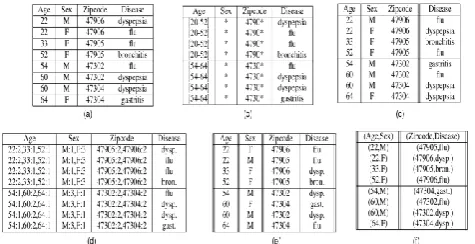
Table 1 An Micro data Table and its Anonymized
versions using various Anonyms zing Technique.
Table 1 shows an example micro data table and its
anonymized versions using various anonymization
techniques. The original table is shown in Table 1a.
The three QI attributes are {Age: Sex; Zip code},
and the sensitive attribute SA is Disease. A
generalized table that satisfies 4- anonymity is
shown in Table 1b, a packetized table that satisfies
2-diversity is shown in Table 1c, a generalized table
where each attribute value is replaced with the
multistep of values in the bucket is shown in Table
1d, and two sliced tables are shown in Tables 1e and
1f. Slicing first partitions attributes into columns.
Each column contains a subset of attributes. This
vertically partitions the table. For example, the sliced
47 column contains {Age; Sex} and the second column
contains {Zip code; Disease}. The sliced table
shown in Table 1e contains four columns, where
each column contains exactly one attribute slicing
also partition tuples into buckets. Each bucket
contains a subset of tuples. This horizontally
partitions the table. For example, both sliced tables
in Tables 1e and 1f contain two buckets, each
containing four tuples. Within each bucket, values in
each column are randomly permutated to break the
linking between different columns.
5.1 Formalization of Slicing
Let T be the micro data table to be published. T
contains d attributes: A = {A1; A2…Ad} and their
attribute domains are {D [A1]; D [A2]; . . .; D [Ad]}.
A tuple t ϵ T can be represented as t = (t [A1]; t [A2];
. . . ; t [Ad]) where t [Ai] (1 ≤ i ≤ d) is the Ai value of
t.
5.2 Attribute Partition and Columns
An attribute partition consists of several subsets of
A, such that each attribute belongs to exactly one
subset. Each subset of attributes is called a column.
5.3 Tuple Partition and Buckets
A tuple partition consists of several subsets of T,
such that each tuple belongs to exactly one subset.
Each subset of tuples is called a bucket.
5.4 Slicing
Given a micro data table T, a slicing of T is given by
an attribute partition and a tuple partition.
For example, Tables 1e and 1f are two sliced tables.
In Table 1e, the attribute partition is {{Age}, {Sex},
{Zip code}, {Disease}} and the tuple partition is
{{t1; t2; t3; t4}, {t5; t6; t7; t8}}. In Table 1f, the
attribute partition is {{Age, Sex}, {Zip code,
Disease}} and the tuple partition is {{t1; t2; t3; t4},
{t5; t6; t7; t8}}.
5.6 Column Generalization
Column generalization ensures that one column
satisfies the k-anonymity requirement. It is a
multidimensional encoding [5] and can be used as an
additional step in slicing. Specifically, a general
slicing algorithm consists of the following three
phases: attribute partition, column generalization,
and tuple partition. Because each column contains
much fewer attributes than the whole table, attribute
partition enables slicing to handle high-dimensional
data.
5.7 Matching Buckets
For example, consider the sliced table shown in
Table 1f, and consider t1 = (22; M; 47906;
dyspepsia). Then, the set of matching buckets for t1
is {B1}.
5.8 Comparison with Generalization
We now show that slicing preserves more
information than such a local recoding approach,
assuming that the same tuple partition is used. We
achieve this by showing that slicing is better than the
following enhancement of the local recoding
approach. Rather than using a generalized value to
replace more specific attribute values, one uses the
multiset of exact values in each bucket. For example,
Table 1b is a generalized table, and Table 1d is the
result of using multisets of exact values rather than
generalized values. For the Age attribute of the first
bucket, we use the multiset of exact values {22, 22,
33, 52} rather than the generalized interval [22-52].
The multiset of exact values provides more
information about the distribution of values in each
48 using multisets of exact values preserves more
information than generalization. However, we
observe that this multiset-based generalization is
equivalent to a trivial slicing scheme where each
column contains exactly one attribute, because both
approaches preserve the exact values in each
attribute but break the association between them
within one bucket. For example, Table 1e is
equivalent to Table 1d. Now comparing Table 1e
with the sliced table shown in Table 1f, we observe
that while one-attribute-per-column slicing preserves
attribute distributional information, it does not
preserve attribute correlation, because each attribute
is in its own column. In slicing, one groups
correlated attributes together in one column and
preserves their correlation. For example, in the sliced
table shown in Table 1f, correlations between Age
and Sex and correlations between Zip code and
Disease are preserved. In fact, the sliced table
encodes the same amount of information as the
original data with regard to correlations between
attributes in the same column.
5.9 Comparison with Bucketization
To compare slicing with Bucketization, we first note
that Bucketization can be viewed as a special case of
slicing, where there are exactly two columns: one
column contains only the SA, and the other contains
all the QIs. The advantages of slicing over
Bucketization can be understood as follows:
First, by partitioning attributes into more than two
columns, slicing can be used to prevent membership
disclosure. Our empirical evaluation on a real data
set shows that Bucketization does not prevent
membership disclosure.
Second, unlike Bucketization, which requires a clear
separation of QI attributes and the sensitive attribute,
slicing can be used without such a separation. For
data set such as the census data, one often cannot
clearly separate QIs from SAs because there is no
single external public database that one can use to
determine which attributes the adversary already
knows. Slicing can be useful for such data.
Finally, by allowing a column to contain both some
QI attributes and the sensitive attribute, attribute
correlations between the sensitive attribute and the
QI attributes are preserved. For example, in Table 1f,
Zip code and Disease form one column, enabling
inferences about their correlations. Attribute
correlations are important utility in data publishing.
For workloads that consider attributes in isolation,
one can simply publish two tables, one containing all
QI attributes and one containing the sensitive
attribute
5.10 Privacy Threats
For slicing, we consider protection against
membership disclosure and attribute disclosure. It is
a little unclear how identity disclosure should be
defined for sliced data (or for data anonymized by
Bucketization), since each tuple resides within a
bucket and within the bucket the association across
different columns are hidden. In any case, because
identity disclosure leads to attribute disclosure,
protection against attribute disclosure is also
sufficient protection against identity disclosure.
We would like to point out a nice property of slicing
that is important for privacy protection. In slicing, a
tuple can potentially match multiple buckets, i.e.,
each tuple can have more than one matching buckets.
This is different from previous work on
generalization (global recoding specifically) and
Bucketization, where each tuple can belong to a
49
V.
CONCLUSION
Here we conduct a serve on slicing by using a
method of data publishing while maintaining the
privacy. Slicing overcomes the limitations of
generalization and Bucketization and preserves
better utility while protecting against privacy threats.
We illustrate how to use slicing to prevent attribute
disclosure and membership disclosure. Our
experiments show that slicing preserves better data
utility than generalization and is more effective than
Bucketization in workloads involving the sensitive
attribute. The general methodology proposed by this
work is that: before anonymizing the data, one can
analyze the data characteristics and use these
characteristics in data anonymization.
ACKNOWLEDGMENT
We would like to take this opportunity to express our
profound gratitude and deep regard to my Guide
Prof. Kailas Patidar, for his exemplary guidance,
valuable feedback and constant encouragement
throughout the duration of the project. I would like
to thanks our principal and the entire staff member
who directly and indirectly guide me. Never the less
I also like to thanks my parents and friends to help
me during the completion of this task.
REFERENCE
[1] C. Aggarwal, “On k-Anonymity and the Curse
of Dimensionality,” Proc. Int’l Conf. Very
Large Data Bases (VLDB), pp. 901-909, 2005.
[2] G. Ghinita, Y. Tao, and P. Kalnis, “On the
Anonymization of Sparse High-Dimensional
Data,” Proc. IEEE 24th International
Conference Data Engineering (ICDE), pp.
715-724, 2008.
[3] N. Koudas, D. Srivastava, T. Yu, and Q.
Zhang, “Aggregate Query Answering on
Anonymized Tables,” Proceedings IEEE 23rd
International Conference Data Engineering.
(ICDE), pp. 116-125, 2007.
[4] K. LeFevre, D. DeWitt, and R. Ramakrishnan,
“Incognito: Efficient Full-Domain
k-Anonymity,” Proceedings ACM SIGMOD
International Conference Management of Data
(SIGMOD), pp. 49-60, 2005.
[5] K. LeFevre, D. DeWitt, and R. Ramakrishnan,
“Mondrian Multidimensional k-Anonymity,”
Proceedings International Conference Data
Engineering (ICDE), p. 25, 2006.
[6] A. Machanavajjhala, J. Gehrke, D. Kifer, and
M. Venkitasubramaniam, “‘-Diversity: Privacy
Beyond k-Anonymity,” Proceedings
International Conference Data Engineering
(ICDE), p. 24, 2006.
[7] D.J. Martin, D. Kifer, A. Machanavajjhala, J.
Gehrke, and J.Y. Halpern, “Worst-Case
Background Knowledge for
Privacy-Preserving Data Publishing,” Proceedings
IEEE 23rd International Conference Data
Engineering (ICDE), pp. 126-135, 2007.
[8] M.E. Nergiz, M. Atzori, and C. Clifton,
“Hiding the Presence of Individuals from
Shared Databases,” Proceedings ACM
SIGMOD International Conference
Management of Data (SIGMOD), pp. 665-676,
2007.
[9] P. Samarati, “Protecting Respondent’s Privacy
in Micro data Release,” IEEE Transaction
Knowledge and Data Engineering, vol. 13, no.
6, pp. 1010-1027, Nov./Dec. 2001.
[10]L. Sweeney, “Achieving k-Anonymity Privacy
Protection Using Generalization and
50 Fuzziness and Knowledge-Based Systems, vol.
10, no. 6, pp. 571-588, 2002.
[11]L. Sweeney, “k-Anonymity: A Model for
Protecting Privacy,” international journal
Uncertainty Fuzziness and Knowledge-Based
Systems, vol. 10, no. 5, pp. 557-570, 2002.
[12]X. Xiao and Y. Tao, “Anatomy: Simple and
Effective Privacy Preservation,” Proceedings
international conference Very Large Data
Bases (VLDB), pp. 139-150, 2006.
[13]J. Xu, W. Wang, J. Pei, X. Wang, B. Shi, and
A.W.-C. Fu, “Utility-Based Anonymization
Using Local recoding,” Proceedings 12th
ACMSIGKDD international conference
Knowledge Discovery and Data Mining
(KDD), pp. 785-790, 2006.