Copyright © 2016 www.ijctet.org, All right reserved
Comparison of the Calculation Methods of Heating and Cooling
Degree-Days in Three Different Cities in Morocco
Boujnah Mohamed1, Jraida Kaoutar2, Farchi Abdelmajid3, Mounir Ilham4 1, 2, 3LIMM Laboratory, Faculty of Science and Technology of Settat, Morocco
4 High School of Technology of Safi University cadi Ayyad Safi, Morocco
Abstract—Reduction of energy consumption has become one of the main subjects of interest for most developed and developing countries. Degree-days method is a widely used method that can be utilized to estimate the heating and cooling energy requirement for a building. Several methods can be used to determine the degree-day values according to the availability of the climatic data. In the present work, heating degree-days and cooling degree-days are estimated and examined using hourly method, Ashrae method, UKMO method and Shoenau-Kehrig method. The comparison was conducted taking the hourly method as reference. Typical meteorological year of Casablanca, Marrakech and Ifrane have been used for this study.
Keyword —Heating days, Cooling degree-days, Morocco, building.
I. INTRODUCTION
The increase of energy consumption with each
passing day places a burden on the country’s
economy, besides causing environmental pollution (Özkan and Onan, 2011). It has been observed that global carbon dioxide (CO2) emissions from fossil fuel combustion increased in 2013 to the new record of 35.3 billion tones (Gt) CO2, which is 0.7 Gt higher than
last year’s record. This moderate increase of 2% in 2013 compared to 2012 is a continuation of last year’s
trend and of the slowdown in the annual emissions growth (Olivier, 2014). This percentage is going to rise in the coming years as the global population continues to increase, emerging economies continue to develop, and climate changes lead to a greater demand for space heating and cooling. Buildings are intensive energy-users, their global contribution towards energy consumption has steadily increased recent years (Prakash, 2014; lin and Liu, 2015, Jraida, et al, 2016) and current predictions show that this increase is expected to triple by 2030 (Pérez-Lombard, et al, 2008). Degree-days are a tool that can be used in the assessment and analysis of weather related energy consumption in building and consequently carbon emissions due to space heating
and 10°C as base temperature respectively for HDD and CDD. OrtizBeviá et al (2012) estimated trends and interannual variability in the evolution of degree-days in Spain from observations at 31 stations for the period of 1952-2005.Shin and Lok Do (2016) proposed a new CDD method using specific enthalpy values instead of dry-bulb temperature in order to predict cooling energy consumption. As a result, the comparison utilizing the enthalpy-based CDD method resulted in a percent error of approximately less than that of the temperature-based CDD method. However in Morocco, data from 37 weather stations during 10 years were used by Idchabani et al (2015) to evaluate and analyze the heating and cooling degree-days and the effect of geographical conditions using the regression approach. In the present work, heating degree-day and cooling degree-day are estimated and examined using hourly method, Ashrae method, UKMO method and Shoenau-Kehrig method. The comparison was conducted taking the hourly method as reference. Typical meteorological year of Ifrane, Casablanca and Marrakech have been used for this study.
II. METHODOLOGY
The concept of the degree-days is one of the well known and well established tools for predicting heating and cooling energy consumption in buildings (Sarak and Satman, 2003; Kaynakli, 2012; Al-Hadhrami, 2013). The predicted results can be used to make decision regarding how to minimize building energy consumption and improve overall building energy performance (Shin and Do, 2016). Several methods are used for estimating the heating and cooling degree-days depending on the availability of data.
2.1. Hourly method
The most rigorous definition of degree-time is given by equations (1) and (2). In these equations the mean daily degree hours are calculated by summing the differences between the base temperature and the hourly temperature measurements. Then the cumulative degree-hours of a day are divided by 24. The daily degree-days are then summed over the desired period t (i.e. a month, a year, etc). The hourly method presents the limitation of the hourly temperature data that cannot always be available.
Where n is the cumulative difference between specified temperatures in degrees over a specified time period, Ti is the outside air temperature at the i-th hour of i-the day and T is i-the base temperature. The superscript indicates that only positive values of the bracketed quantity are taken into account in the sum
2.2. ASHRAE method
In Ashrae method (ASHRAE, 2013), degree-days are calculated as the sum of the difference between mean daily temperature and base temperature. Therefore, heating degree-days (HDD) are estimated using equation (3).
nj
md b
t
T
T
HDD
1(3)
Similarly, cooling degree-days (CDD) are calculated as:
nj
b md
t
T
T
CDD
1(4)
Where n is the number of days, Tb the base temperature to which the degree-days are calculated, and Tmd is the mean daily temperature defined as the arithmetic mean of the maximum and minimum temperatures in a given day, as shown in equation (5).
2
min max
T
T
T
md
(5)2.3. UKMO method
The UKMO method (CIBSE, 2006) was developed in 1928 by the UK Meteorological office for the calculation of degree-days.
b b b
b md
b
d
T
T
T
T
and
T
T
T
T
and
T
T
T
T
T
T
T
T
T
HDD
min
min max max
min max min
max
min max min
0
4
1
4
1
2
1
(7)Copyright © 2016 www.ijctet.org, All right reserved introduced. Depending on these, daily heating
degree-days and daily cooling degree-degree-days are calculated using equation (6) and equation (7) respectively.
b b b b b md d
T
T
T
T
and
T
T
T
T
and
T
T
T
T
T
T
T
T
T
CDD
max min max min min max max min max min max0
4
1
4
1
2
1
Where ∆Tmax and ∆Tmin are calculated using
equation (8) and equation (9).
b
T
T
T
max max (8)min
min
T
T
T
b
(9)2.4. Schoenau and Kehrig
Schoenau and Kehrig developed one of the simple and accurate method of estimating heating and cooling degree-days to any base temperature, The only assumption made is that for every month the daily mean temperatures, T, are scattered around the monthly mean temperature with a normal distribution. The formula for calculating monthly heating degree-days is expressed as follows:
b b b
d m
m
N
S
Z
F
Z
f
Z
HDD
(10) The monthly cooling degree-days CDDm to base Tb is calculated by the same equation:
b b b
d m
m
N
S
Z
F
Z
f
Z
CDD
(11)Where Nm is the number of days in the month and Zb is the difference between monthly average temperature Tm and base temperature Tb, normalized by the standard deviation of the daily average temperature Sd:
ns
calculatio
CDD
for
S
T
T
ns
calculatio
HDD
for
S
T
T
Z
d b m d m b b,
,
Function f is the normal (Gaussian) probability density function with mean 0 and standard deviation 1, and function F is the equivalent cumulative normal probability function:
2
exp
2
1
2Z
Z
f
(13)
b ZdZ
Z
f
Z
F
(14)III. RESULTS AND DISCUSSIONS
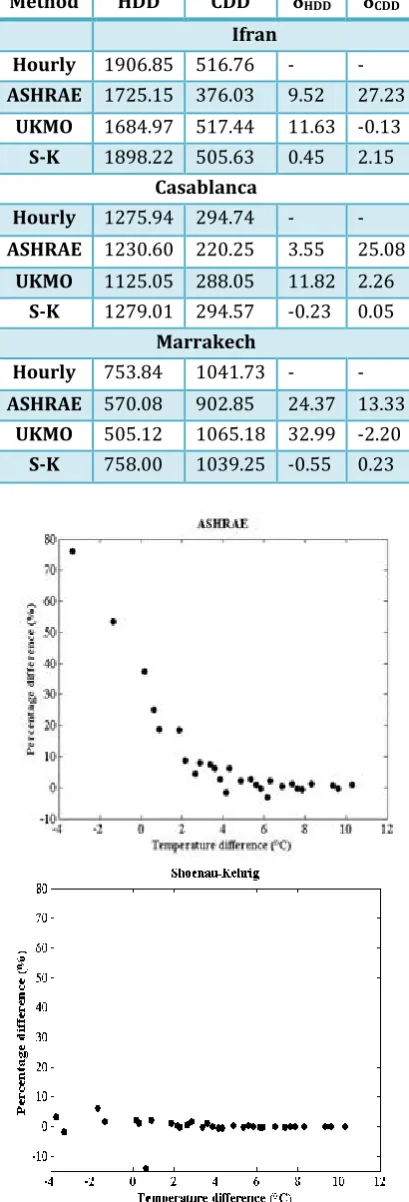
Heating and cooling degree-days were calculated and examined using traditional formulae and other approximate methods. Comparisons were based on calculations using hourly values from Typical Meteorological Year (TMY) data of three cities namely Ifrane (cold climate), Casablanca (mild climate) and Marrakech (hot climate). Table 1 summarizes the results of heating degree-days at 18°C base temperature and cooling degree-days at 21°C base temperature using the four methods described above. Ashare, UKMO and Shoenau-Kehrig were compared to the hourly method in order to give a percentage
difference δ defined as:
100
Hm Am HmDD
DD
DD
(15)Where DDHm is the degree-days values obtained by the hourly method and DDAm the result of each of the approximate methods.
By analyzing the calculated data from the previously reported relationships, we notice that the values of degree-days vary considerably from city to city for the
same base temperature. It’s found that the annual
heating degree-days values for Ifrane and Casablanca are higher than the annual cooling degree-days values, which means that the predominant period of the year is the heating period, subsequently, the annual heating energy consumption will be higher in these cities. However, it’s seen that the annual cooling
degree-days values in Marrakech are higher than those of heating degree-days; therefore, the energy consumption for cooling will be higher in this city.
Besides, it’s seen that Shoenau-Kehrrig method has the good performance; the heating and cooling degree-days calculated by this method agreed very closely with those calculated by the hourly method and return the lower percentage difference which is equal to 0.45% in heating degree-days and 2.15% in cooling degree-days for Ifrane, -0.23% in heating degree-days and 0.05% in cooling degree-days for Casablanca and -0.55% in heating degree-days and 0.23% in cooling degree-days for Marrakech.
(12)
Table 1- Annual HDD and CDD calculated using the models in Ifran Casablanca and Marrakech
Method HDD CDD δHDD δCDD
Ifran
Hourly 1906.85 516.76 - -
ASHRAE 1725.15 376.03 9.52 27.23
UKMO 1684.97 517.44 11.63 -0.13
S-K 1898.22 505.63 0.45 2.15
Casablanca
Hourly 1275.94 294.74 - -
ASHRAE 1230.60 220.25 3.55 25.08
UKMO 1125.05 288.05 11.82 2.26
S-K 1279.01 294.57 -0.23 0.05
Marrakech
Hourly 753.84 1041.73 - -
ASHRAE 570.08 902.85 24.37 13.33
UKMO 505.12 1065.18 32.99 -2.20
S-K 758.00 1039.25 -0.55 0.23
So as to allow general comparisons to be made the
percentage difference δ against ∆Tm, which represents the difference between the base temperature and the mean monthly temperature, were plotted for heating
months in Casablanca. According to Figure 1, it was demonstrated that for all methods the percentage
difference increases when ∆Tm is low, in other words when the base temperature is close to the external temperature. But this increase is more apparent in the case of Ashrae and UKMO methods. However when the range of mean monthly and base temperatures become significant the methods return smaller values of percentage difference.
Figure 1- Percentage difference against ∆Tm for
heating months in Casablanca
Table 2- Annual heating degree-days for different base temperatures in the three cities
Method HDD
Base temperature
14 16 18 20 Ifran
Hourly 1078.90 1465.2 1906.85 2400.5
ASHRAE 914.87 1294.8 1725.15 2209.9
UKMO 855.60 1245.5 1684.97 2125.5
S-K 1077.70 1460.7 1898.22 2389.7
Casablanca
Hourly 554.90 876.5 1275.94 1753.3
ASHRAE 491.10 820.5 1230.60 1708.0
UKMO 423.20 751.6 1090.77 1611.0
S-K 552.94 876.8 1279.01 1754.5
Marrakech
Hourly 292.96 490.4 753.84 1088.9
ASHRAE 140.78 311.4 570.08 897.31
UKMO 175.42 286.5 505.12 741.83
S-K 296.63 493.3 758.00 1090.4
Copyright © 2016 www.ijctet.org, All right reserved be discerned from the results that the selection of the
base temperature is crucial as it affects significantly the annual heating and cooling degree-days. It has been found that the annual HDD increases as the base temperature increases from 14°C to 20°C, however the annual CDD decreases with the increase in base temperatures from 21°C to 27°C.This is true for all the
approximate methods. Moreover, it’s seen that a
decrease in base temperature from 20 to 18°C lowers the heating degree-days by approximately 20.56% in Ifrane, 27.22% in Casablanca and 30.77% in Marrakech. However an increase in the base temperature from 21 to 23°C results in a reduction of approximately 32.43%, 40.01% and 27.84% in Ifrane, Casablanca and Marrakech, respectively.
Table 3 - Annual cooling degree-days for different base temperatures in the three cities
Method CDD
Base temperature
21 23 25 27 Ifran
Hourly 516.76 349.16 222.39 131.60
ASHRAE 376.03 216.04 105.84 40.5
UKMO 517.44 349.41 221.82 131.16
S-K 505.63 338.01 214.52 127.67
Casablanca
Hourly 294.74 149.8 62.79 18.28
ASHRAE 220.25 82.75 12.20 0
UKMO 288.05 185.45 60.17 20.90
S-K 294.57 145.67 58.57 18.40
Marrakech
Hourly 1041.73 751.61 521.72 344.51
ASHRAE 902.85 587.41 342.95 183.73
UKMO 1065.18 760.89 522.73 347.10
S-K 1039.25 741.11 506.48 329.33
IV. CONCLUSION
The calculation of degree-days has always been a topic of focus by researchers. This paper gives an idea about the thermal needs in three different climates of Morocco and presents comparison of the traditional method (the hourly method) and the approximate methods: Ashrae method, UKMO method and Shoenau-Kehrig method using typical meteorological
year of Ifrane, Casablanca and Marrakech. It’s seen
that the highest energy demand for heating appears in Ifran with much HDD amounts, while the highest energy demand for cooling appears in Marrakech with much CDD amounts. The results obtained show also that Shoenau-Kehrrig method has the good
performance, furthermore it was observed that for all methods the percentage difference start increasing
when ∆Tm is low. It has also been demonstrated that an increase of the base temperature resulted in an increase of HDD and a decrease of CDD values.
REFERENCES
[1]. Al-Hadhrami, L. M. (2013). Comprehensive review of cooling and heating degree day’s
characteristics over Kingdom of Saudi Arabia. Renewable and sustainable energy reviews, 27, 305-314.
[2]. Büyükalaca, O., Bulut, H., & Yılmaz, T. (2001).
Analysis of variable-base heating and cooling degree-days for Turkey. Applied Energy, 69(4), 269-283.
[3]. CIBSE. 2006. Degree-days: Theory and Application. TM41.
[4]. Handbook, A. S. H. R. A. E. (2013). Fundamentals 2013. Atlanta, USA: ASHRAE.
[5]. Hitchin, E. R. (1983). Estimating monthly degree-days. Building Services Engineering Research and Technology, 4(4), 159-162.
[6]. Idchabani, R., Garoum, M., & Khaldoun, A. (2015). Analysis and mapping of the heating and cooling degree-days for Morocco at variable base temperatures. International Journal of Ambient Energy, 36(4), 190-198.
[7]. Jiang, F., Li, X., Wei, B., Hu, R., & Li, Z. (2009). Observed trends of heating and cooling degree-days in Xinjiang Province, China. Theoretical and applied climatology, 97(3-4), 349-360.
[8]. Jraida, K., Farchi, A., Mounir, B., & Mounir, I. (2016). A study on the optimum insulation thicknesses of building walls with respect to different zones in Morocco. International Journal of Ambient Energy, 1-6.
[9]. Kaynakli, O. (2012). A review of the economical and optimum thermal insulation thickness for building applications. Renewable and Sustainable Energy Reviews, 16(1), 415-425. [10].Lin, B., & Liu, H. (2015). China's building energy
efficiency and urbanization. Energy and Buildings, 86, 356-365.
[11].Moreci, E., Ciulla, G., & Brano, V. L. (2016). Annual heating energy requirements of office buildings in a European climate. Sustainable Cities and Society, 20, 81-95.
[13].OrtizBeviá, M. J., Sánchez-López, G., Alvarez-Garcìa, F. J., & RuizdeElvira, A. (2012). Evolution of heating and cooling degree-days in Spain: Trends and interannual variability. Global and Planetary Change, 92, 236-247.
[14].Olivier, J. G. (2014). Trends in global CO2 emissions: 2014 Report.
[15].Özkan, D. B., & Onan, C. (2011). Optimization of insulation thickness for different glazing areas in buildings for various climatic regions in Turkey.Applied Energy, 88(4), 1331-1342. [16].Papakostas, K., Mavromatis, T., & Kyriakis, N.
(2010). Impact of the ambient temperature rise on the energy consumption for heating and cooling in residential buildings of Greece. Renewable Energy, 35(7), 1376-1379. [17].Pérez-Lombard, L., Ortiz, J., & Pout, C. (2008). A
review on buildings energy consumption information. Energy and buildings, 40(3), 394-398.
[18].Prakash, D. (2015). Transient analysis and improvement of indoor thermal comfort for an air-conditioned room with thermal insulations. Ain Shams Engineering Journal, 6(3), 947-956.
[19].Sarak, H., & Satman, A. (2003). The degree-day method to estimate the residential heating natural gas consumption in Turkey: a case study. Energy, 28(9), 929-939.
[20].Schoenau, G. J., & Kehrig, R. A. (1990). Method for calculating degree-days to any base temperature. Energy and Buildings, 14(4), 299-302.