35(2), Summer 2016, ISSN: 2008-8191 pp. 123-160
On Anthropomorphism in Technology-Enhanced
Language Learning: Does Modality Matter in
Agent-Based Multimedia Instruction on L2 Idioms?
Rahman Sahragard Professor Shiraz University [email protected]
Alireza Ahmadi Associate Professor
Shiraz University [email protected] Hamed Babaie Shalmani
PhD Student Shiraz University [email protected]
Abstract
The present study aimed to satisfy a twofold purpose: On the one hand, it sought to verify the postulation that agent-based instruction could offer a compromise approach to teaching L2 idioms where form and meaning would be equally emphasized during instruction. Given that anthropomorphism has not been much under scrutiny, this research, on the other hand, sought to ascertain whether learning and retention of English idioms would be differentially impacted when two different modalities of virtual tutors —anthropomorphic and non-anthropomorphic— were present in the tutorial. To this aim, the participants of the study received instruction on 128 English idioms from human teachers, a multimedia application featuring a humanoid virtual teacher, or a piece of multimedia courseware with a non-anthropomorphic virtual tutor. Analysis of the post-intervention measures of L2 idiom knowledge revealed that agent-based instruction had proved more effective in improving both learning and retention of the target idioms among the participants. A further finding was that despite the greater motivational benefits of the humanoid virtual tutor, it had not privileged the participants, performance-wise.
Keywords:
anthropomorphism, cognitive load, modality effect, pedagogical
agents, redundancy effect
Received: 02/04/2016 Accepted: 11/07/2016
The non-compositionality of a great many idioms in English has always
presented a serious challenge to L2 learners as they strive desperately to come
to grip with the problem of mapping forms to meanings (Grant, 2003). The
lack of appropriate teaching materials and the paucity of a clear methodology
to help remove this stumbling block are among the major factors that have
further aggravated the difficulty associated with the learning and retention of
L2 idioms (Cameron & Low, 1999). Despite the fact that myriad strategies
for efficient teaching of English idioms have been employed by ELT
practitioners worldwide, none has fared better in ensuring optimal learning on
the part of language learners largely owing to their excessive obsession with
meaning-making and contextualization (Chen & Lai, 2013).
As one famous pedagogic strategy that places a strong emphasis on the
role of context in L2 idiom acquisition,
associative fluency
(Johnson &
Rosano, 1993) requires that students should find as many interpretations as
possible for a single metaphor or an idiom by analyzing possible relationships
or associations between a particular concept and the other concepts in the
target language. As one example, in the idiomatic expression
he looks at the
world through rose-tinted spectacles
, one hypothesis is that by analyzing the
relationship between the color of a rose, a pair of spectacles, and the
personality of the individual to whom the idiom applies, one can help make
the idiomatic meaning transparent and hence fix it in the learner’s memory;
however, the central issue is that the mere transparency of meaning as
revealed through the analysis of relationships would not necessary guarantee
internalization of form as well (Abel, 2003).
In a similar vein,
etymological elaboration
has been cited in the literature
as one panacea for the problem of teaching L2 idioms. The rationale behind
the use of this strategy comes from the idea that the meanings of idiomatic
expressions are usually not arbitrary but motivated (Boers, Demecheleer, &
Eyckmans, 2004). Students are presented with the history of origin or source
domains of figurative expressions that are assumed to promote
comprehension of idioms via the provision of elaborate verbal descriptions.
Notwithstanding, while verbal elaborations provide an extra pathway for
expediting the process of comprehension and enhancing recall, the strategy is
not without its shortcomings and has often been reported not to have liven up
to its claim to help decipher the meanings of culture-specific idioms and also
to aid encode the L2 forms efficiently in the learner’s memory (Vasiljevic,
2015).
Given the preoccupation of the aforementioned strategies with meaning,
contextualization, and semantic analysis, and the familiar complaint ELT
teachers receive from their students about their finding it challenging to make
persistent form-meaning connections when it comes to the learning of
figurative expressions, a concerted attempt needs to be made to develop a
compromise approach that targets both profound comprehension and
prolonged retention of L2 idioms on the part of students.
Over the past decade, advancements in computer technology have gained
tremendous momentum such that they have inspired ELT enthusiasts to
deliberate on what affordances technology could offer language pedagogy and
hence to lay the foundation for the development of more innovative
approaches such as Technology-Enhanced Language Learning (TELL),
Multimedia Computer-Assisted Language Learning (MCALL),
Mobile-Assisted Language Learning (MALL), and Podcasting (Babaie, 2008;
Laborda, 2010).
(Reeves & Nass, 1996) suggesting that emulation of human-to-human
interaction in virtual learning environments, which is made possible via the
incorporation of pedagogical agents into multimedia courseware, provides the
necessary conditions for enhanced learning, as the learner finds himself
immersed in a naturalistic environment that gives him the impression that the
communication is actually taking place between two real humans (Heidig &
Clarebout, 2011).
In addition to improving the naturalness of computer-human interaction
through simulation of human daily communication, unique characteristics of
virtual tutors likewise correlate with the effect they produce on student
learning. It is contented that
lifelikeness
(i.e., looking like human beings
and/or behaving like them) as one of these distinct qualities empowers
pedagogical agents to coordinate speech with non-verbal forms of
communication such that they appear as realistic, believable, and hence
engaging teachers, which in turn further improves their effectiveness as
attention grabbers in tutorial situations (Cassell & Thorisson, 1999).
AutoTutor, Baldi, COSMO, Herman the Bug, and STEVE (Graesser, Person,
& Harter, 2001; Massaro & Cohen, 1994) are but a few examples of
pedagogical agents shown to have served learners by arousing their curiosity,
garnering and directing their attention to the learning task being introduced,
and generally, by generating strong motivation in them through performing a
blend of roles such as “supplanting”, “scaffolding”, “demonstrating”,
“modelling”, “coaching”, and “testing” at the time of instruction (Clarebout,
Elen, Johnson, & Shaw, 2002, pp. 270-271).
thanks to the participants’ increased ability to differentiate between relevant
and redundant information presented at the time of instruction.
In yet another experiment by Dai, Raine, Roscoe, Cai, and McNamara
(2011), the efficacy of an intelligent tutoring system called Writing-Pal was
assessed concerning the development of essay writing skills among the
participants of the study. The tutoring system comprised a number of strategy
training modules that would provide witting strategy instruction on the three
distinct phases of writing ability development, namely prewriting, drafting,
and revising. Instruction was delivered in a virtual classroom where a virtual
teacher called Dr. Julie established dialogues with other cartoon characters as
they asked about the principles and mechanics of writing in each phase of
development. Analysis of the students’ essays as well as examination of their
attitudes clearly suggested that the participants had found the pedagogical
agent effective enough in engaging their attention throughout instruction and
hence the whole learning experience enjoyable and memorable.
Carlotto and Jaques (2016) likewise explored how varying degrees of
agent embodiment in tutorial settings would affect Brazilian students’
learning of English in a CALL environment with embedded pedagogical
gents. Attributes such as the image effect (i.e., the visual presence of a tutor
can lead to more efficient learning); the modality effect (i.e., auditory
information coupled with visual texts can facilitate information processing);
and the embodiment effect (i.e., a fully embodied agent capable of gesturing
and showing emotions and delivering the content aurally) were the object of
investigation. The participants received treatment on the present perfect verb
tense under a no-agent, a voice-only, a static-agent, or an embodied-agent
condition. Analysis of the posttest scores as well as the students’ responses to
the questionnaire items revealed that the presence of a fully embodied agent
had greatly privileged the participants, albeit the agent’s voice was believed
to have better contributed to the students’ learning than its gestures and
movements.
anthropomorphic
and
non-anthropomorphic
,
can be identified.
Anthropomorphic agents are those that resemble human beings and are able
to gesticulate, wear various facial expressions, and generally display a vast
array of human non-verbal forms of communication that are in synchrony
with speech (Gulz & Haake, 2006). By comparison, non-anthropomorphic
tutors are not humanoid in appearance and are able to show only a small subset
of human non-verbal behaviors. An animated pointing finger, an arrow
symbol with transition effects, a blinking rectangle, or flashing texts coupled
with stunning visual effects are all characteristic examples of
non-anthropomorphic agents (Murano, Gee, & O’Brian Holt, 2011).
Objectives of the Study
On the one hand, the present study aims to compare the effects of
agent-based instruction with those of a conventional method (i.e., teacher-fronted
instruction) on the learning and retention of English idioms among Iranian
EFL learners. Given that studies (Allen, Crossley, Snow, & McNamara, 2014;
Corbeil, 2007; Duffy & Azevedo, 2015; Ergül & Koç, 2013; Johnson, Rickel,
& Lester, 2000; Noma & Badler, 1997) have shown that virtual tutors offer
the potential to serve as powerful attention-getting devices that garner and
focus the learners’ attention on salient aspects of the learning task, it can be
hypothesized that agent-based instruction may represent a compromise
approach to language pedagogy such that while meaning is emphasized
through the provision of contextual cues, definitions, and examples of use in
the tutorial, equal importance is accorded to form by the virtual tutors
increasing the saliency of L2 structures at the time of instruction. This can
possibly be accomplished through increased noticing of L2 forms via
promoting students’ engagement with the subject matter being introduced and
combining this with visual effects such as keeping an eye gaze on L2 forms,
pointing to L2 structures, and so on. The present study, then, seeks to measure
the efficiency of this balanced approach in comparison to that of a mainstream
method of teaching L2 idioms as well as to test the tenability of the
assumptions upon which it is premised.
utility of pedagogical agents for language learning as well as the issue of agent
modality in MCALL settings.
Research Questions
Given the above-mentioned objectives, the present study aims to address
the following questions:
Q
1: Is there a statistically significant difference between the performance
level of EFL learners who receive treatment through teacher-fronted
instruction and that of those who receive treatment via agent-based instruction
in regard to their learning and retention of English idioms?
Q
2: Is there a statistically significant difference between the performance
level of EFL learners who receive instruction from an anthropomorphic
pedagogical agent and that of those who receive instruction from a
non-anthropomorphic virtual tutor in regard to their learning and retention of
English idioms?
Q
3: In the views of the participants, what are seen as the pros and cons
of learning from virtual tutors? Specifically, what is the promise, if any, of
agent-based instruction and how it might be different from conventional
methods as told by the participants?
Method
Participants
The participants were 150 students who were studying EFL at the Islamic
Azad University of Rasht in the north of Iran. To homogenize the participants,
care was exercised to recruit BA students who had already passed a course on
English idioms. Student participation was voluntary and the participants
would receive remuneration as their reward.
An IELTS proficiency test of receptive skills was administered to an
initial pool of 287 EFL learners from whom students who had obtained an
overall band score of 4.5 or 5 on the test were identified as intermediate-level
learners and were hence entitled to take part in the study.
A digital randomizer called SuperCool Random Number Generator
1was
then employed to randomly select only 150 participants from the population
of qualified candidates. The program came with an option to generate a set of
random numbers from within a specified range. The prospective participants
were first assigned a number from unity to a number representing the last
individual identified as a qualified candidate. Next, the application randomly
selected 150 numbers in such a way that all the qualified participants whose
corresponding numbers were in the list of chosen numbers could be included
in the final pool. The same randomizer was also utilized to randomly assign
the final pool of the candidates to five equivalent groups of participants, with
two serving as the pilot groups, two as the experimental groups, and one as
the control group.
Materials
Out of 18 textbooks reviewed, five idiomatic texts were ultimately
chosen as the base materials of the study. These involved (a)
All Clear! Idioms
in Context Book 2
(Fragiadakis, 1992), (b)
Basic Idioms in American English
Book 2
(Setzler, 1981), (c)
Practicing Idioms
(Watson, 1991), (d)
Speak
English Like an American
(Gillett, 2004), and (e)
Street Talk 3
(Burke, 1995).
Authors’ strong assertions about their books featuring high frequency
English idioms and finding the selected idioms in the category of common
idioms in idiom dictionaries such
American Heritage Dictionary of Idioms
(1997),
Cambridge International Dictionary of Idioms
(1998),
Collins
COBUILD Dictionary of Idioms
(1995), and so on were two main standards
used for the selection of the idiom texts as well as high frequency idioms.
Units with a limited number of exercises as well as units with recurring
themes were excluded from selection. The final sample contained 128 idioms
in 12 units of instruction chosen based on the suitability of the topic, neutrality
of the content, as well as the diversity of the range of exercises offered.
Instruments
sample copy of an IELTS test taken from
Cambridge IELTS 9
(2013)
examination papers was administered to the learners at the beginning of the
experiment. The test comprised 80 items, half of which measured the
students’ listening ability, and the other half, their reading ability. The raw
scores obtained on individual modules were calculated by computing the
aggregates of the points the participants received on individual test items.
These were then converted to band scores using an online IELTS band score
calculator and logged by the researchers for later access.
The test of English idioms.
In order to ascertain the participants’ prior
familiarity with the idiomatic expressions introduced over the course of the
experiment and also to gauge their degree of learning from the course, two
parallel versions of an English idiom test were developed, with one serving as
a pretest and the other as immediate and delayed posttests of L2 idiom
knowledge. Each version of the test also would measure receptive and
productive knowledge of L2 idioms through recognition and production
modules that initially contained 128 items in fill-in-the-blank, matching, and
cloze formats.
The focus group interviews.
At the end of the study, a total of 15
participants were randomly chosen from each experimental group and were
interviewed in an attempt to share their feelings and also their hands-on
experience with the researchers. Specifically, the probes aimed to poll the
participants’ opinions as to their overall impression of working with the
multimedia applications, the efficacy of agent-based instruction, what they
liked most about the virtual tutors, the amount of control they could exercise
over the multimedia units, the adequacy of explanations and examples
presented, the utility of feedback given on their responses by the pedagogical
agents, and so on.
waving, etc.), making eye contact with students, giving a nod, fixing a steady
gaze on L2 forms, and so on. It also featured the caliber to wear various facial
expressions and communicate emotions. By comparison, the other type of
courseware featured a non-anthropomorphic virtual tutor in the form of an
animated hand with a pointing finger. The non-humanoid tutor, however, was
capable of demonstrating only a small subset of human non-verbal behaviors
that is, pointing to the idiomatic forms at the time of instruction. Both types
of applications, however, comprised 12 units of instruction that were
computerized versions of the units chosen based on the aforementioned
selection criteria. They also introduced 128 English idioms to the
experimental groups through several transitional modules.
Procedures
At the beginning of the experiment, each pilot group received one of the
two versions of the test of L2 idioms that underwent standardization through
several rounds of analysis. The participants took the production test first and
sat the test of recognition after a short break. Their responses to individual
items were scored and then entered as binary data into a digital item statistics
analyzer called Test Analysis Program
2featuring the capability to mark
defective items with the number (hash) sign.
It was decided that items with item facility values close to zero be kept
and easy items be removed from the final drafts of the tests, as easy items
would indicate that the participants already knew the idioms. The exclusion
of easy items, however, made the scores non-comparable across the tests, as
some modules were left with more items and some with fewer ones. Likewise,
some items were of different types, measuring the students’ knowledge of
different idioms. To remedy the problem, then, a digital file and directory
comparison tool called ExamDiff Pro
3was employed. The comparator
allowed for the cross-comparison of the tests drafts by highlighting extra
items and those not shared by all four modules in different colors.
Following the exclusion of extra and mismatched items, too, the
participants’ exam papers were rescored and the reliability coefficients of the
tests were computed through the use of a Cronbach’s alpha. With 84 items
(out of 128) left on the tests modules, the indices of reliability reported for the
pretest of production was 0.91; for the pretest of recognition, it was reported
as 0.8; for the posttest of production, it turned out to be 0.86; and for the
posttest of recognition, it was reported as 0.84.
As for the content validity of the tests, the remaining test items were
checked by the researchers to ensure that they would still measure the
knowledge of a representative sample of the idioms that appeared in the
selected units. Next, a Monte Carlo simulation was conducted to demonstrate
the tests construct validity. The simulation could help provide a dependable
estimate of the probability of recovering a specified number of factors when
the number of iterations was set to 1000. It worked by comparing the
eigenvalues derived from the real dataset (i.e., by analyzing the participants’
test performance scores) with those obtained for a randomly generated set of
data (Pallant, 2013).
The simulation results revealed that three factors could be recovered for
all four modules, suggesting that the three sections of the tests (i.e.,
fill-in-the-blank, matching, and cloze) might have measured three logical aspects of the
L2 idiom knowledge and hence the high chance of recovery for three factors.
The small number of participants in the pilot groups could be another
explanation for the possibility of test items correlating with more than one
single factor (Bryant & Yarnold, 1995).
Following the standardization of the idiom tests, one test was
administered to the experimental and control groups as a pretest so as to
demonstrate the participants’ prior familiarity, if any, with the target idioms
to be taught as well as the homogeneity of the study groups at the beginning
of the experiment.
The analysis of the pretest results revealed that the participants
demonstrated a lackluster performance on both pretests of receptive and
productive knowledge (M
R anthropomorphic= 16.16, SD = 4.14; M
P anthropomorphic=
7.26, SD = 3.54; M
R non-anthropomorphic= 14.90, SD = 3.65; M
P non-anthropomorphic=
6.10, SD = 3.25; M
R control= 15.03, SD = 4.53; M
P control= 7.46, SD = 2.95),
suggesting that they would need to learn a great number of the target idioms.
A further finding was that the three groups belonged to the same population
prior to the delivery of instruction (p > 0.05).
Having taken the pretest, the participants in the experimental groups
began receiving treatment on 128 English idioms through 12 agent-based
multimedia units. They sat at computer terminals, wore headsets, and
launched the applications at the researchers’ signal. Next, the participants
watched an intro movie and were redirected to the Login Page a while later to
enter their personal information. Entering all details was essential for
successful logging into the multimedia courseware.
Once the participants specified their names, e-mail addresses, and other
required data, they were taken to the Orientation Module where a humanoid
agent or a background voice zeroed in on the importance of learning idioms,
the themes under which the idioms of the unit would be presented, what
different buttons would do when interacted by the participants, and so on.
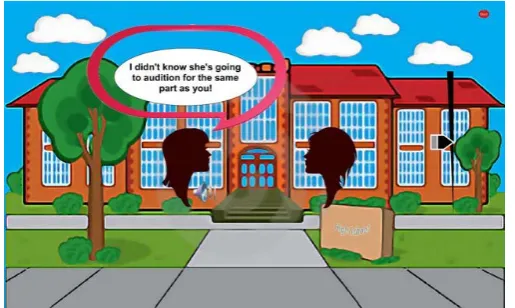
Figure 1. The virtual characters under the anthropomorphic condition. Dialogues were established and the target idioms were introduced under a relevant theme to allow for the contextualized learning of L2 idioms.
Figure 2
. The virtual characters under the non-anthropomorphic condition.
While the anthropomorphic group watched animated virtual characters
conversing, the non-anthropomorphic group viewed static images of talking
silhouettes that were used to signal turn-taking only.
Having watched the animations of virtual characters and ventured a wild
guess at the idiomatic meanings, the participants moved on to have their
conjectures checked by the applications. Here the anthropomorphic tutor or
the background voice started posing questions to the participants and
responding in an appropriate manner depending on their choices. The
questions were of the multiple-choice type and appeared on a virtual
blackboard in the background. The options were selectable from a list of
choices that came with radio buttons.
The humanoid teacher would praise the participants by giving them a
round of rapturous applause in case they responded correctly to the
comprehension checks, or express his regret when the selected option was
wrong. As for the non-anthropomorphic group, only verbal feedback was
given to inform the participants of the correctness of their choices.
the same way as a human teacher: He coordinated body movements with
speech and demonstrated a wide range of non-verbal behaviors at the time of
instruction. He spoke slowly and eloquently, allowing the participants to
deliberate on the content delivered.
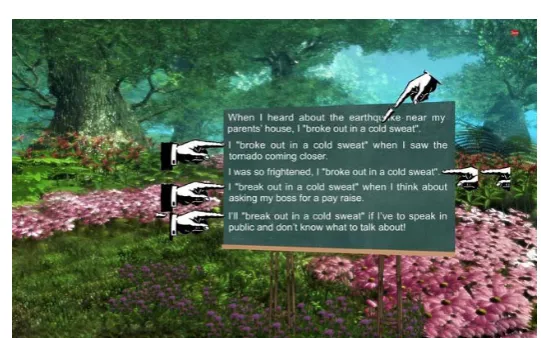
As for the non-anthropomorphic condition, an animated hand with a
pointing finger would pop up at the time of instruction. The pointing finger
appeared at different positions (sometimes blinking and sometimes moving in
different directions) when pointing to and highlighting the idiomatic forms
displayed by on-screen texts; however, it was not capable of wearing facial
expressions or communicating emotions. Figures 3 and 4 below show the
difference between the two multimedia conditions under which instruction
was delivered by the two agent modalities.
Figure 4
. Pointing finger in the Instruction Module. To highlight the idiomatic
expressions being introduced, the pointing finger was animated with visual
effects such as blinking and moving effects. Only a small subset of human
paralinguistic behaviors (i.e., pointing) could be displayed, however.
At the end of instruction, the participants were given three options to
choose from: They could opt for rewinding the whole movie clip; they could
listen to individual segments of instruction in the Individual-Parts Scene by
interacting with the corresponding multimedia buttons; or they could move
on to work with the exercises in the Exercise Module.
The Exercise Module aimed to provide the learners with further practice
in manipulating the newly learnt target idioms in different contexts of use.
One characteristic feature of the module was that it would supply the
participants with feedback by item response, that is, they would receive
feedback as soon as they answered every single question.
In antithesis to the experimental groups who worked with multimedia
courseware with embedded pedagogical agents, the control group received
treatment on the target idioms the conventional way: At the beginning, the
dialogues included in the print copies of the selected units were read aloud to
the participants to allow them to formulate conjectures about idiomatic
meanings. Next, they were presented with 10 to 12 comprehension check
questions to confirm their hunches on a voluntary basis. Having their surmises
confirmed, the participants listened to the same dialogues again as they were
being read by the researchers, this time paying heed to the definitions,
explanations, and examples provided.
The participants then practiced using the recently introduced idioms in
new contexts of use by trying the exercises and listening to the researchers’
feedback. The round-up session was much akin to its counterpart under the
experimental conditions: The idiomatic expressions were reintroduced
through new example sentences that were followed by a brief explanation of
idiomatic meanings. Finally, the participants took a paper quiz to demonstrate
their overall learning from instruction.
The experiment lasted for six weeks during which treatment was offered
for one session per week and for 90 to 100 minutes per session. Each session
was divided into two cycles, and in each cycle, one unit of instruction
available in either a print or a digital copy was taught. At the end of the
experiment, the participants took a different version of the standardized test
of idioms as an immediate posttest and again as a delayed posttest two weeks
after the study. Focus group interviews were also conducted with half of the
participants in the experimental groups.
Results
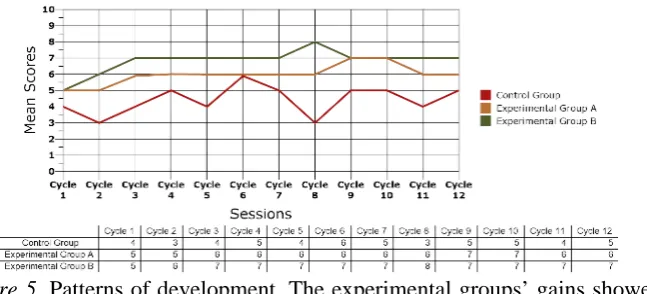
shows the plot of mean scores recorded for individual cycles in each treatment
session.
Figure 5
. Patterns of development. The experimental groups’ gains showed
no long-term, unsystematic fluctuation in their level of performance over the
course of the study, implying that learning had proceeded more smoothly for
these groups of participants than for the control group students.
The total possible score that could have been obtained by the participants
in each cycle was seven on average, given that the command of 84 idioms in
total should have been measured over 12 cycles of continuous instruction. As
can be seen in the figure, the mean score logged for the experimental groups
in each cycle was higher than that obtained by the control group learners. This
clearly suggests that instruction as delivered by the pedagogical agents had
proved comparatively more efficient in expanding the participants’ repertoire
of the target idioms. Further evidence supporting this claim comes from the
fact that the mean scores of the experimental groups displayed small
fluctuations and almost remained fixed across the cycles, whereas long-term
variation in the scores was observed for the participants of the control group
across the treatment sessions.
through 4 below summarize the results of the immediate posttests of receptive
and productive knowledge.
Table 1
Means on the Immediate Posttest of Recognition
Descriptive
Statistics Target Groups Mean Std.
Deviation N
Mean Scores
Experimental Group A 74.2000 8.71938 30 Experimental Group B 80.6000 8.37319 30
Control Group 64.0333 11.03125 30
Total 72.9444 11.58977 90
Table 2
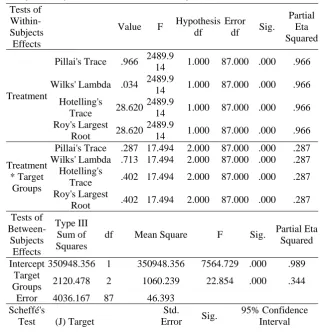
Results of Tests of Within- and Between-subjects Contrasts
Tests of Within- Subjects
Effects
Value F Hypothesis df
Error df Sig.
Partial Eta Squared
Treatment
Pillai's Trace .966 2489.9
14 1.000 87.000 .000 .966
Wilks' Lambda .034 2489.9
14 1.000 87.000 .000 .966
Hotelling's
Trace 28.620
2489.9
14 1.000 87.000 .000 .966
Roy's Largest
Root 28.620
2489.9
14 1.000 87.000 .000 .966
Treatment * Target
Groups
Pillai's Trace .287 17.494 2.000 87.000 .000 .287 Wilks' Lambda .713 17.494 2.000 87.000 .000 .287
Hotelling's
Trace .402 17.494 2.000 87.000 .000 .287 Roy's Largest
Root .402 17.494 2.000 87.000 .000 .287
Tests of Between-Subjects Effects Type III Sum of Squares
df Mean Square F Sig. Partial Eta
Squared
Intercept 350948.356 1 350948.356 7564.729 .000 .989 Target
Groups 2120.478 2 1060.239 22.854 .000 .344
Error 4036.167 87 46.393
Scheffé's
Test (J) Target
Std.
Error Sig.
(I) Target Groups
Groups Mean
Difference (I-J)
Lower Bound
Upper Bound
A B -6.4000
* 2.43961 .036 -12.4759 -.3241
C 10.1667* 2.43961 .000 4.0908 16.2425
B A 6.4000
* 2.43961 .036 .3241 12.4759
C 16.5667* 2.43961 .000 10.4908 22.6425
C A -10.1667
* 2.43961 .000 -16.2425 -4.0908
B -16.5667* 2.43961 .000 -22.6425 -10.4908
Note
. Experimental Group A = Anthropomorphic Group, Experimental Group
B = Non-Anthropomorphic Group, & Control Group = Teacher-Fronted
Instruction. The within- and between-subjects contrasts are both statistically
significant (p < 0.05) and meaningful as suggested by large Eta Squared
values. In addition, the claim that the treatment produced differential impacts
on student learning under all the three conditions is substantiated by the
Scheffé’s test result (p < 0.05).
Table 3
Means on the Immediate Posttest of Production
Descriptive
Statistics Target Groups Mean Std. Deviation N
Total 6.9444 3.27867 90
Mean Scores
Experimental Group A 72.1000 7.97561 30
Experimental Group B 77.2000 5.40370 30
Control Group 60.5667 8.83443 30
Total 69.9556 10.22874 90
Table 4
Results of Tests of Within- and Between-Subjects Contrasts
Tests of Within- Subjects
Effects
Value F Hypothesis
df Error df Sig.
Partial Eta Squared
Treatment
Pillai's Trace .983 4990.433 1.000 87.000 .000 .983 Wilks'
Lambda .017 4990.433 1.000 87.000 .000 .983
Hotelling's
Trace 57.361 4990.433 1.000 87.000 .000 .983
Roy's
Treatment * Target Groups
Wilks'
Lambda .554 34.980 2.000 87.000 .000 .446
Hotelling's
Trace .804 34.980 2.000 87.000 .000 .446
Roy's
Largest Root .804 34.980 2.000 87.000 .000 .446
Tests of Between-
Subjects Effects
Type III Sum of
Squares df Mean Square F Sig.
Partial Eta Squared
Intercept 266112.450 1 266112.450 8375.834 .000 .990
Target
Groups 1884.933 2 942.467 29.664 .000 .405
Error 2764.117 87 31.771
Scheffé's Test (I) Target Groups (J) Target Groups Mean Difference (I-J)
Std. Error Sig.
95% Confidence Interval
Lower Bound
Upper Bound
A B -5.1000
* 1.94855 .037 -9.9529 -.2471
C 11.5333* 1.94855 .000 6.6805 16.3862
B A 5.1000
* 1.94855 .037 .2471 9.9529
C 16.6333* 1.94855 .000 11.7805 21.4862
C A -11.5333
* 1.94855 .000 -16.3862 -6.6805
B -16.6333* 1.94855 .000 -21.4862 -1.7805
Note
. Both within- and between-subjects contrasts are statistically significant
at the preset alpha level (p < 0.05) and are also meaningful as indicated by
large Eta Squared values. In addition, the treatment effects produced under all
the three conditions are not equivalent in size as suggested by the Scheffé’s
test result (p < 0.05).
< 0.05). Large Eta Squared values (
provide further corroborative
evidence for this assumption. A further finding is that the interaction effect
(Treatment * Target Groups) suggests that there was no similar change in the
participants’ test scores across the pre- and posttests. In other words, the
treatment effects were not similar for the learners of different groups.
A glimpse at the statistics for the between-subjects contrasts as well as
the Scheffé’s test result reveals that the group effect is also statistically
significant (p < 0.05). This suggests that knowledge of the target idioms did
not improve equally well for the participants in the three study groups. In other
words, it can be contended that the treatments had produced differential
effects on student learning, resulting in varying degrees of learning success.
Furthermore, as can be seen, the mean difference is significant in favor of both
the experimental groups and the experimental group who had received
treatment under the non-anthropomorphic condition. This strongly suggests
the greater efficiency of agent-based instruction relative to that of
teacher-fronted instruction as well as the superiority of the non-anthropomorphic
condition when it comes to the learning of L2 idioms.
Likewise, in an attempt to measure the effect, if any, of the treatment on
the participants’ retention of L2 idioms, the mean scores obtained by the three
study groups on the delayed posttests of recognition and production were
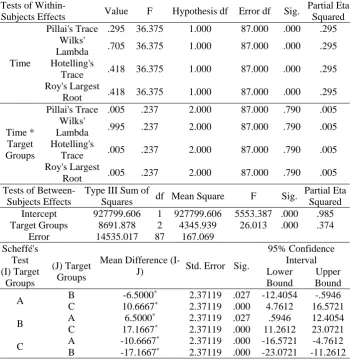
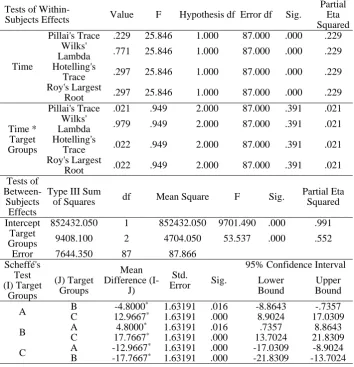
retrieved and analyzed. Tables 5 through 8 below summarize the results of the
delayed posttests of receptive and productive knowledge.
Table 5
Means on the Delayed Posttest of Recognition
Descriptive
Statistics Target Groups Mean Std. Deviation N
Mean Scores
Experimental Group A 72.0333 8.51969 30
Experimental Group B 78.5333 8.62927 30
Control Group 61.3667 10.29390 30
Table 6
Results of Tests of Within- and Between-Subjects Effects
Tests of Within-
Subjects Effects Value F Hypothesis df Error df Sig.
Partial Eta Squared
Time
Pillai's Trace .295 36.375 1.000 87.000 .000 .295
Wilks'
Lambda .705 36.375 1.000 87.000 .000 .295
Hotelling's
Trace .418 36.375 1.000 87.000 .000 .295
Roy's Largest
Root .418 36.375 1.000 87.000 .000 .295
Time * Target Groups
Pillai's Trace .005 .237 2.000 87.000 .790 .005
Wilks'
Lambda .995 .237 2.000 87.000 .790 .005
Hotelling's
Trace .005 .237 2.000 87.000 .790 .005
Roy's Largest
Root .005 .237 2.000 87.000 .790 .005
Tests of Between- Subjects Effects
Type III Sum of
Squares df Mean Square F Sig.
Partial Eta Squared
Intercept 927799.606 1 927799.606 5553.387 .000 .985
Target Groups 8691.878 2 4345.939 26.013 .000 .374
Error 14535.017 87 167.069
Scheffé's Test (I) Target Groups (J) Target Groups
Mean Difference
(I-J) Std. Error Sig.
95% Confidence Interval Lower Bound Upper Bound
A B -6.5000
* 2.37119 .027 -12.4054 -.5946
C 10.6667* 2.37119 .000 4.7612 16.5721
B A 6.5000
* 2.37119 .027 .5946 12.4054
C 17.1667* 2.37119 .000 11.2612 23.0721
C A -10.6667
* 2.37119 .000 -16.5721 -4.7612
B -17.1667* 2.37119 .000 -23.0721 -11.2612
Table 7
Means on the Delayed Posttest of Production
Descriptive
Statistics Target Groups Mean Std.
Deviation N
Mean Scores
Experimental Group A 70.4000 6.34415 30
Experimental Group B 75.2000 5.99080 30
Control Group 57.4333 6.61077 30
Total 67.6778 9.79776 90
Table 8
Results of Tests of Within- and Between-Subjects Effects
Tests of Within-
Subjects Effects Value F Hypothesis df Error df Sig.
Partial Eta Squared
Time
Pillai's Trace .229 25.846 1.000 87.000 .000 .229
Wilks'
Lambda .771 25.846 1.000 87.000 .000 .229
Hotelling's
Trace .297 25.846 1.000 87.000 .000 .229
Roy's Largest
Root .297 25.846 1.000 87.000 .000 .229
Time * Target Groups
Pillai's Trace .021 .949 2.000 87.000 .391 .021
Wilks'
Lambda .979 .949 2.000 87.000 .391 .021
Hotelling's
Trace .022 .949 2.000 87.000 .391 .021
Roy's Largest
Root .022 .949 2.000 87.000 .391 .021
Tests of Between-Subjects Effects
Type III Sum
of Squares df Mean Square F Sig.
Partial Eta Squared
Intercept 852432.050 1 852432.050 9701.490 .000 .991
Target
Groups 9408.100 2 4704.050 53.537 .000 .552
Error 7644.350 87 87.866
Scheffé's Test (I) Target Groups (J) Target Groups Mean Difference (I-J) Std.
Error Sig.
95% Confidence Interval Lower
Bound
Upper Bound
A B -4.8000
* 1.63191 .016 -8.8643 -.7357
C 12.9667* 1.63191 .000 8.9024 17.0309
B A 4.8000
* 1.63191 .016 .7357 8.8643
C 17.7667* 1.63191 .000 13.7024 21.8309
C A -12.9667
* 1.63191 .000 -17.0309 -8.9024
Note
. The main effect for “Time” suggests that the change in test performance
scores over time was noticeable for the participants in each study group (p <
0.05). Yet the interaction effect (Time * Target Groups) is not significant (p
> 0.05), suggesting that the effect of time was similar across the study groups.
In addition, the tests of between-subjects contrasts clearly show that the
treatments had produced differential effects on the participants’ retention (p
< 0.05).
As can be seen, the statistics reported for the tests of within-subjects
effects clearly shows that the main effect for “Time” is statistically
significant (p < 0.05) and meaningful at the same time as indicated by large
Eta Squared values (
The implication is that there was a
noticeable change in the test scores over time for the participants in
individual groups. Notwithstanding, the interaction effect (Time * Target
Groups) is not significant (p > 0.05) and at the same time is too small to
be meaningful (
This suggests that the decline in performance
and hence the drop in test scores was similar for the three groups, or there
was the same change in test performance scores over time for all
participants.
Analysis of the between-subjects effects likewise suggests that the
group effect is statistically significant (p < 0.05). This shows that the
amount of retention varied for the participants of different groups—an
assumption that receives further support from the Scheffé’s test result (p <
0.05). In other words, it can be argued that the treatments had kept their
effects over time and hence the groups’ differential performance on the
delayed posttests, too. A further glimpse at the tables also reveals that here
again the mean difference is significant in favor of the experimental
treatments and that the non-anthropomorphic condition is still superior to
the anthropomorphic condition in terms of instructional efficiency.
Discussion
by Strauss and Corbin (1998) suggesting that qualitative data analysis
involves codification of data fragments in three distinct phases, namely
“open”, “axial”, and “selective” coding (pp. 101-103). A specialized
qualitative data analysis tool called MAXQDA
4was also employed to
expedite the arduous process of data analysis.
A brief review of the results presented in the previous section suggests
that agent-based instruction had proved comparatively more effective in
developing both receptive and productive knowledge of the learners, which
lends support to the assumption that this modality of instruction represents a
compromise approach to teaching English idioms such that both form and
meaning are emphasized equally well during instruction. This finding
provides an empirically justified answer to the first research question asking
about the comparability of the effects of agent-based instruction with those of
a conventional method of teaching English idioms on student learning and
retention. There are two explanations for the present finding:
One justification is that learning from pedagogical agents offered the
participants a new, enjoyable experience where “persona effect” (Ryu &
Baylor, 2005, p. 291), produced as a result of virtual tutors mimicking human
behaviors, increased their lifelikeness and hence their believability such that
it created the impression that the participants were actually communicating
with real human teachers (van der Meij, van der Meij, & Harmsen, 2015;
Veletsianos & Miller, 2008). Accordingly, enhanced naturalness of
computer-human interaction can be a possible explanation for the students’ sustained
motivation throughout instruction and hence their augmented learning from
virtual tutors.
The persona effect, lifelikeness, and believability of pedagogical agents,
which make them powerful attention gabbers such that student motivation is
likely to sustain longer at the time of instruction, in turn seem to stem from
their caliber to draw on social cues to establish rapport and maintain
interpersonal relationships with learners through, for example, making eye
contact, flashing a smile, giving a nod, or offering praise, and visual cues
where, for instance, pointing to or keeping a steady gaze on L2 structures,
using a special hand gesture, or displaying a flashing effect is used to capture
and direct learners’ attention to the learning task (Johnson, Ozogul, &
Reisslein, 2014). The pedagogical agents in the present study were capable of
using one or both types of cues and hence were able to directly (via visual
signaling) or indirectly (via social cues) capture and sustain the participants’
attention throughout instruction.
When asked about the overall utility of agent-based instruction, what
they liked most about the applications, and which features they found the most
useful, a large percentage of the participants in both experimental groups
(92% in the anthropomorphic and 86% in the non-anthropomorphic group)
reported that they had greatly enjoyed working with the multimedia units and
that they had found the whole experience engaging and fruitful in improving
their knowledge of L2 idioms. One participant, for example, described his
hands-on experience in the following way:
Vignette 1
: What I found truly interesting in the applications was the way the
agent greeted me and introduced himself like a human. He then explained
everything in detail: He talked about the goals of the unit, the functions of the
buttons… His teaching was perfect, the clarifications were great, and there
were a lot of exercises to do…
In addition to improved quality of computer-human interaction adding to
the overall novelty of experience, increased levels of motivation, as well as
enhanced noticing of L2 forms being a possible explanation for the greater
sufficiency of agent-based instruction, another justification is that instruction
as delivered via pedagogical agents is more or less learner-centered where
learners feel to be in control of aspects of the environment and hence their
learning. Such a claim receives support from a number of studies (e.g.,
Collentine, 2011; Heift, 2007; Toyoda, 2001) that have explored issues of
learner autonomy
,
learner-controlled interaction
, and
individualized
instruction
or
adaptive CALL
in CALL environments. It has been argued that
some degree of control is implicit in most tutorial situations such that
parameters like the amount of tutor’s talk, the number of clarification
requests, the provision of feedback on responses, the amount of time to be
spent on doing various learning tasks, what to do next and how to do it, and
so on can be controlled, allowing learners to explore the environment and
exploit the available resources within a heuristic-learning framework
(Chapelle & Mizuno, 1989).
to receive feedback based on their unique responses to questions. This
contrasts with the control condition where the learning environment was more
under the rein of the human teachers, and the clarifications and feedback were
typically given based on group performance or on voluntary requests by some
participants. When asked about the extent to which they felt to be in control
of their learning, again a sizable percentage of the participants (72% in the
anthropomorphic and 74% in the non-anthropomorphic group) reported that
they could partially control the pace of learning and that they had found the
whole experience to be partly learner-directed and individualized. The
following vignette represents one participant’s view on her being in control
of aspects of instruction:
Vignette
2
: I believe I could somehow proceed at my own speed when
working with the units. For instance, I could watch the virtual teacher several
times to listen to the explanations if I felt I forgot the meanings of some
idioms; or I could choose to get feedback…
A further review of the findings under the results section reveals that the
non-anthropomorphic group delivered a superior performance relative to even
the anthropomorphic group, suggesting that the two modalities of pedagogical
agents had produced differential effects on the students’ learning and retention
of the target idioms. This finding provides an empirically justified answer to
the second research question exploring whether anthropomorphism would be
a covariate, moderating the effects of virtual tutors. Mayer and Moreno’s
(1998) Generative/Cognitive Theory of Multimedia Learning and Sweller’s
(2005) Cognitive Load Theory are time-honored, viable theories of
multimedia learning that bear strong relevance for the interpretation of this
second finding.
Out of 10 instructional design principles proposed by Moreno (2006) and
her associates as underpinnings of the Generative Theory of Multimedia
Learning, two principles—the
modality
and
redundancy
principles—are key
to an understanding of whether and how anthropomorphism affects learning
from virtual tutors. The modality principle suggests that when learners are
presented with relevant materials that are available in multiple modalities
(e.g., text, picture, audio, etc.), processing is facilitated, as different memory
channels are engaged. A strong modality effect, then, is produced that in turn
maximizes the learning efficiency.
redundancy effect to compensate for the limited capacity of the working
memory when engaged in information processing. This hinges on the amount
of extra information that is available in one modality such that the greater the
amount of redundant information, the weaker the modality effect appears in
the tutorial setting. For example, it has been suggested that learners can
acquire knowledge better from graphics and narration (spoken texts) than
from graphics and visual texts (Mayer, 2009). The rationale is that graphics
and visual texts are both processed in the visual memory, resulting in a high
cognitive load.
The redundancy principle lends support to Sweller’s (2005) Cognitive
Load Theory suggesting that instruction should be delivered in such a way as
to reduce the
extrinsic cognitive load
that results from an inefficient
instructional design where redundant materials overload the working memory
capacity at the time of information processing. Convictions are strong that a
heightened level of extrinsic load produces what is technically referred to as
the
split-attention effect
(Ayres & Sweller, 2005) where the overloaded
memory module (i.e., verbal or visual memory) compensates for its limited
capacity by forcing learners to divide their attention between different bits of
information that are to be processed simultaneously than sequentially for
active construction of knowledge to take place. In other words, different
visual or verbal stimuli jostle for students’ attention, resulting in them
devoting their attention to one bit of visual/verbal information at one time and
to another bit at a later time. Student learning, then, is affected owing to the
inability to seamlessly integrate information in dual modalities or different
bits of information in a single modality.
In the present study, modality effect might have been produced as a result
of presenting information via pedagogical agents, visual, and spoken texts.
Yet redundancy effect could have come about in the learning environment as
well, as the agents’ non-verbal behaviors were processed in the participants’
visual memory in addition to visual texts. Consequently, split-attention effect
could have been produced as a result of the learners’ attention being divided
between the agents showing these behaviors and the on-screen and spoken
texts. Seamless integration of information, then, is affected due to visual
memory overload.
differential effects of the two modalities of virtual tutors on student learning
and retention is that as for the anthropomorphic condition, greater redundant
information might have been present in the visual modality than in the
auditory modality, as the anthropomorphic agent was able to display a wide
range of human non-verbal behaviors. Accordingly, a stronger redundancy
effect might have been produced leading the participants to struggle for
processing both visual texts and the agent’s non-verbal behaviors
concurrently in their visual memory. The learners, then, should have divided
their attention between the on-screen texts and the tutor’s behaviors to allow
for the visual memory to free up space for information processing. Contiguous
or parallel processing of information could have been affected, however.
As for the non-anthropomorphic pointing finger, the tutor was capable
of mimicking only a small subset of human non-verbal behaviors.
Accordingly, little redundant information could have existed in the visual
modality and hence there was a strong possibility for greater modality effect
to be present in the tutorial. Thanks to a smaller extrinsic cognitive load, the
visual memory might not have been occupied to the extent that the
participants’ attention would have to become split, allowing for seamless,
uninterruptable integration of information. Further evidence corroborating
such a view comes from the participants’ responses to qualitative probes that
could help shed light on potential cognitive and affective benefits of the two
agent modalities.
When asked to share their opinions about the emotional or affective
impact, if any, of the virtual tutors on their curiosity, motivation, and
engagement with the learning task, a vast majority of the participants in the
anthropomorphic group (around 97%) reported that they had found the
agent’s behaviors motivating and that they had been greatly influenced by the
charisma, persona, and appeal of the anthropomorphic virtual tutor. One
participant, for example, shared his impression in this way:
Vignette 3
: I really enjoyed the appeal of the virtual teacher: He was
attractive and looked quite charming; the tone of voice was strong but also
calm and friendly; the facial expressions, body movements, and reactions
looked very real… Overall, seeing the teacher behaving like a human and
coordinating movements was highly interesting to me…
agent’s behavior highly attractive and exciting. Even those who liked the
agent’s behavior complained that they had found it a bit difficult to identify
themselves with the tutor as a real teacher, largely owing to the fact that they
could see no face or person on the stage posing or reacting to their responses
like a human being. Below is one participant’s view on the degree to which
she found the agent’s behavior motivating and lovable:
Vignette 4
: There’s nothing special about the virtual teacher. Though the
effects and directional movements looked interesting, I could only hear a
voice in the background talking about the idioms and their uses in different
situations. I could see no one on the stage I could identify with…
Yet when asked about their opinions as to the visual or cognitive impact,
if any, of the virtual tutors on their attention, learning, and memory, only a
small number of the participants in the anthropomorphic group (around 43%)
reported that the humanoid tutor could efficiently sustain their attention
throughout instruction, while a fairly large percentage (around 84%) of the
learners in the non-anthropomorphic group asserted that they had found the
pointing finger effective enough in directing and holding their attention for an
extended period of time. The following vignettes represent the participants’
ideas about this characteristic feature (i.e., the ability to effectively sustain
students’ attention throughout instruction) of the anthropomorphic and
non-anthropomorphic agents, respectively:
Vignette 5
: I believe both the teacher’s behavior and the texts were useful in
helping me concentrate on the expressions being taught in that I felt they
highly persisted in my memory; but, watching the teacher gesturing somehow
kept me from holding my attention all the time…
Vignette 6
: I never thought highlighting effects like pointing in e-learning
environments could’ve had such a positive effect on memory. Also, I don’t
think following the visual effects and graphic texts was that distracting; to the
contrary, I found it rather useful in helping me concentrate all the time…
processing the agent’s behavior, as the visual texts and the non-verbal
behavior of pointing could have been processed as essentially one unified
visual element along with the spoken texts in the verbal memory.
Accordingly, the bits of information available in dual modalities could have
been more or less balanced, resulting in a strong modality effect to come about
in the tutorial setting.
Conclusions, Implications, and Future Studies
The present study has found that agent-based instruction can hold great
promise for the teaching of L2 idioms by emphasizing a balanced approach
where both form and meaning are equally emphasized during instruction. It
has also revealed that anthropomorphism is one dimension of agent modality
that may correlate with the effects of virtual tutors on students’ learning and
retention in tutorial situations. Among the suggested explanations was the
idea that the epitome of a non-anthropomorphic tutor would produce a
stronger modality effect thanks to the presence of little redundant visual
information, fewer occurrences of split-attention effect, facilitated processing,
and hence seamless integration of information in dual modalities.
Considering that bundles of multimedia courseware and tutorials with
embedded pedagogical agents have not been used extensively in language
pedagogy, it is advisable that ELT teachers, especially in EFL contexts, show
wider recognition for the delivery of agent-based instruction in educational
settings, appreciating the fact that this type of instruction can benefit language
learners in much the same way as it privileges and continues to privilege the
learners of other disciplines.
Finally, as for courseware designers, the findings of the present study
suggest that it is essential that multimedia applications should deliver
instruction in such a way as to reduce the extrinsic cognitive load to allow for
the working memory to allocate more processing power to
germane load
(Sweller, 2010) or that portion of mental load required for the formation of
schemata. In the present study, efficient learning of L2 idioms required that
the participants should integrate three interrelated sub-schemas or aspects of
idiom knowledge (i.e., knowledge of form, meaning, and appropriate use) into
higher-order schemata. For this to happen, a heightened level of germane load
should serve as a precondition for effective knowledge construction. One way
to accomplish this is by incorporating into multimedia courseware
pedagogical agents that are assumed to deliver the course content in optimal
ways. Non-anthropomorphic virtual tutors, as the study suggests, can serve as
one good candidate vying for incorporation into tutorials, thanks to the
likelihood of their delivering instruction in ways that maximize the germane
load by reducing the extrinsic load. The possibility for a stronger modality
effect produced as a result of the balanced processing of information in dual
modalities provides further support for their inclusion in educational
applications.
Jayothisa, 2013, p. 275), or even with respect to their gender so that they can
be attracted by different genders (Ozogul, Johnson, Atkinson , & Reisslein,
2013). Finally, future studies may examine what implications agent-based
instruction carries for the teaching of other components or skills of the L2
such as its vocabulary and grammar, and whether or not level of proficiency
can also interact or correlate with other variables to affect learning from
pedagogical agents.
References
Abel, B. (2003). English idioms in the first language and second language
lexicon: A dual representation approach.
Second Language
Research
,
19(
4), 329-358.
Allen, L. K., Crossley, S. A., Snow, E. L., & McNamara, D. S. (2014). L2
writing practice: Game enjoyment as a key to engagement.
Language Learning & Technology
,
14
(2), 124-150. Retrieved from
http://llt.msu.edu/issues/june2014/allenetal.pdf
Ayres, P., & Sweller, J. (2005). The split-attention principle in multimedia
learning. In R. E. Mayer (Ed.),
Cambridge handbook of multimedia
learning
(pp. 135–147). UK: Cambridge University Press.
Babaie, H. (2008). On the effects of help options in MCALL programs on
the listening comprehension of EFL learners.
TELL Journal
,
2
(6),
27-47.
Boers, F., Demecheleer, M., & Eyckmans, J. (2004). Cross
‐
cultural
variation as a variable in comprehending and remembering
figurative idioms.
European Journal of English Studies
,
8
(3), 375
‐
388.
Bryant, F. B., & Yarnold, P. R. (1995). Principal components analysis and
exploratory and confirmatory factor analysis. In L. G. Grimm & R.
R. Yarnold (Eds.),
Reading and understanding multivariate
statistics
(pp. 99-136). Washington, DC: American Psychological
Association.
Cambridge University Press. (2013).
Cambridge IELTS 9: Authentic
examination papers from Cambridge ESOL
. New York: Cambridge.
Carlotto, T., & Jaques, P. A. (2016). The effects of animated pedagogical
agents in an English-as-a-Foreign-Language learning environment.
Journal of Human Computer Studies
,
90
,
1-32.
Cassell, J., & Thorisson, K. (1999). The power of a nod and a glance:
envelope vs. emotional feedback in animated conversational agents.
Applied Artificial Intelligence
,
13
(4), 519- 538.
Chapelle, C., & Mizuno, S. (1989). Student’s strategies with
learner-controlled CALL.
CALICO Journal
,
7
(2), 25-47.
Chen, Y., C., & Lai, H., L. (2013). Teaching English idioms as metaphors
through cognitive-oriented methods: A case in an EFL writing class.
English Language Teaching, 6
(6), 13-20.
Clarebout, G., Elen, J., Johnson, W. L., & Shaw, E. (2002). Animated
pedagogical agents: An opportunity to be grasped?
Journal of
Educational Multimedia and Hypermedia
,
77
(3), 267-286.
Collentine, K. (2001). Learner autonomy in a task-based 3d world and
production.
Language
Learning & Technology
,
15
(3), 50-67.
Corbeil, G. (2007). Using the French tutor multimedia package or a
textbook to teach two French past tense verbs: Which approach is
more effective?
CALICO Journal
,
24
(2), 313-330. Retrieved from
https://calico.org/html/article_647.pdf
Dai, J., Raine, B. R., Roscoe, R., Cai, Z., & McNamara, D. S. (2011). The
Writing-Pal tutoring system: Development and design.
Journal of
Engineering and Computer Innovations
,
2
(1), 1-11.
Duffy, M. C., & Azevedo, R. (2015). Motivation matters: Interactions
between achievement goals and agent scaffolding for self-regulated
learning within an intelligent tutoring system.
Computers in Human
Behavior
,
52
, 338-348. http://dx.doi.org/10.1016/j.chb.2015.05.041
Dunsworth, Q., & Atkinson, R. K. (2007). Fostering multimedia learning
of science: Exploring the role of an animated agent’s image.
Computers and Education
,
49
(3), 677-690.
Graesser, A. C., Person, N., Harter, D. (2001). Teaching tactics and dialog
in AutoTutor.
International Journal of Artificial Intelligence in
Education
,
12
, 257-279.
Grant, L. E. (2003).
A corpus-based investigation of idiomatic multiword
units
. (Doctoral dissertation). Available from ProQuest Dissertations
and Theses database.
Gulz, A., & Haake, M. (2006). Design of animated pedagogical agents - A
look at their look.
International Journal of Human-Computer
Studies
,
64
(4), 322-339.
Heidig, S., & Clarebout, G. (2011). Do pedagogical agents make a
difference to student motivation and learning? A Review of
Empirical Research.
Educational Research Review
,
6
, 27-54.
Heift, T. (2007). Learner personas in CALL.
CALICO Journal
,
25
(1),
1-10. http://dx.doi.org/1-10.1558/cj.v25i1.1-10
Hongpaisanwiwat, C., & Lewis M. (2003) Attentional effect of animated
character. In M. Rauterberg, M. Menozzi, & J. Wesson (Eds.),
Human-computer interaction-INTERACT '03
(pp. 423-430). Nieuwe
Hemweg, Amsterdam: IOS Press.
Johnson, A. M., Ozogul, G., & Reisslein, M. (2014). Supporting
multimedia learning with visual signalling and animated
pedagogical agent: moderating effects of prior knowledge.
Journal
of Computer Assisted Learning
,
31
(2), 97-115.
Johnson, J., & Rosano, T. (1993). Relation of cognitive style to metaphor
interpretation and second language proficiency.
Applied
Psycholinguistics 14
, 159-175.
Johnson, W. L., Rickel, J. W., & Lester, J. C. (2000). Animated
pedagogical agents: Face-to-face interaction in interactive learning
environments.
International Journal of Artificial Intelligence in
Education
,
41
, 41-78.
Laborda, J. G. (2010). Contextual clues in Semi-direct interviews for
computer assisted language testing.
Procedia Social and Behavioral
Sciences
,
2
, 3591-3595.
task-related attitudes, and learning achievement.
Educational
Technology & Society
,
16
(4), 275–286.
Massaro, D. W., & Cohen, M. M. (1994). Visual, orthographic,
phonological, and lexical influences in reading.
Journal of
Experimental Psychology: Human Perception and Performance
,
20
,
1107-1128.
Mayer, R. E. (2009).
Multimedia learning
(2
ndEd.). NY: Cambridge
University Press.
Mayer, R. E., & Moreno, R. (1998). A split-attention effect in multimedia
learning: Evidence for dual processing systems in working memory.
Journal of Educational Psychology
,
90
, 312-320.
Moreno, R. (2006). Learning in high-tech and multimedia environments.
Current Directions in Psychological Science
,
15
, 63-67.
Nippold, M. A., & Duthie, J. K. (2003). Mental imagery and idiom
comprehension: A comparison of school-age children and adults.
Journal of Speech
,
Language
,
and Hearing Research
,
46
, 788-799.
Noma, T., & Badler, N. I. (1997). A virtual human presenter.
Proceedings
of the IJCAI Workshop on Animated Interface Agents: Making Them
Intelligent
. San Francisco: Morgan Kaufmann.
Ozogul, G., Johnson, A. M., Atkinson, R. K., & Reisslein, M. (2013).
Investigating the impact of pedagogical agent gender matching and
learner choice on learning outcomes and perceptions.
Computers &
Education
,
67
, 36-50.
Paivio, A., & Walsh, M. (1993). Psychological processes in metaphor
comprehension and memory. In A. Ortony. (Ed.),
Metaphor and
thought
(pp. 307-328). Cambridge: Cambridge University Press.
Pallant, J. (2013).
SPSS survival manual
(5
thEd.). NY: Open University
Press.
Reeves, B., & Nass, C. (1996).
The media equation: How people treat