ARTICLE
Effect of straw incorporation on methane
emission in rice paddy: conversion factor
and smart straw management
Hyeon Ji Song
1, Jin Ho Lee
1, Hyun‑Cheol Jeong
2, Eun‑Jung Choi
2, Taek‑Keun Oh
3, Chang‑Oh Hong
4and Pil Joo Kim
1,5*Abstract
Straw incorporation is strongly recommended in rice paddy to improve soil quality and mitigate atmospheric carbon dioxide (CO2), via increasing soil organic carbon (SOC) stock. However, straw application significantly increased methane (CH4) emission during rice cultivation, and then its incorporation area was not expanded effectively. To find the reasonable straw management practice which can reduce CH4 emission without productivity damage, the effect of straw incorporation season and method on CH4 emission was investigated at six different textured paddy fields in South Korea for 2 years. A straw was applied right after rice harvesting in autumn, and the other right before rice transplanting in spring. In the autumn application, straw was applied with two different methods: spreading over soil surface or mixing with soil. Straw application significantly increased seasonal CH4 flux by average 28–122% over 197– 590 kg CH4 ha−1 of the no‑straw, but its flux showed big difference among straw applications. Fresh straw application before transplanting increased seasonal CH4 flux by approximately 120% over the no‑straw, but the autumn applica‑ tion reduced its CH4 flux by 24–43% over 509–1407 kg CH4 ha−1 of the spring application. In particular, the seasonal CH4 flux was approximately 24% lower in straw mixing with soil after autumn harvesting than 423–855 kg CH4 ha−1 in straw spreading over surface. However, CH4 fluxes were not significantly discriminated by soil and meteorological properties in the selected condition. Straw application slightly increased rice grain yield by approximately 4% over the no‑straw, but rice productivity was not statistically different among straw applications. Spring straw application increased CH4 intensity which means seasonal CH4 flux per grain yield by the maximum 220% over the no‑straw. Autumn straw application significantly decreased CH4 intensity by average 24–65% over the spring straw application. In particular, CH4 intensity in straw mixing with soil treatment was not statistically different with the no‑straw. There‑ fore, autumn straw application with mixing inner soil could be a reasonable straw management practice to decrease CH4 emission impact with improving soil productivity.
Keywords: Greenhouse gas, Methane intensity, Straw application, Low land
© The Author(s) 2019. This article is distributed under the terms of the Creative Commons Attribution 4.0 International License (http://creat iveco mmons .org/licen ses/by/4.0/), which permits unrestricted use, distribution, and reproduction in any medium, provided you give appropriate credit to the original author(s) and the source, provide a link to the Creative Commons license, and indicate if changes were made.
Introduction
Soil organic carbon (SOC) stock is accepted as the most key parameter to decide soil health condition and sustainability [1]. With global warming, soil C seques-tration, which means transferring a greenhouse gas carbon dioxide (CO2) into long-lived pools and storing
CO2 securely inner soil layers [2], is getting a big atten-tion. Consequently, increasing SOC stock is recog-nized as the most promised soil management strategy to achieve sustainable soil quality and mitigate global warming [3, 4].
Several soil management practices such as tillage, fer-tilizer, water, organic matter, winter cover crop, and crop rotation managements were recommended to increase SOC stock in arable lands [5]. In particular, straw recy-cling is accepted as the most reasonable agricultural practice to increase SOC stock in mono-rice paddy [6].
Open Access
*Correspondence: [email protected]
1 Division of Applied Life Science (BK 21+ Program), Gyeongsang
National University, Jinju 52828, South Korea
The Korean government has strongly recommended straw recycling to increase SOC stock. However, its recy-cling area was not expanded rapidly in the fields. Most of rice straw was removed for cattle feeding in rice cropping area. This removal significantly decreased SOC stock with the lapse of year, and then deteriorated soil quality [7, 8].
In the negative side, straw addition as organic mat-ter source markedly increased the emission of methane (CH4), which is an important greenhouse gas (GHG) and has 28 times higher global warming potential (GWP) than CO2 over a 100-year time horizon [9], during the flooded rice cultivation [10]. Methane is biologically produced by methanogenic archaea during anaerobic decomposition of organic matter [11]. Flooded rice cropping is assumed to cover approximately 10% of anthropogenic CH4 emis-sion [12]. Therefore, sustainable straw management prac-tices which can increase SOC stock and decrease CH4 emission during rice cultivation should be developed.
In the several field studies [13, 14], the application of rice straw aerobically digested during the fallow sea-son was very effective to decrease CH4 flux during the flooded rice cropping season, comparing with CH4 emission in fresh straw application. However, rice straw is generally applied in farmer’s fields with two different methodologies. For example, rice straw is mechanically chopped at harvesting stage and immediately applied as organic amendment. The chopped straw is spread over the soil surface and digested under upland condition dur-ing the cold follow season. On the other hand, the straw is mixed with soil via plowing and then digested. How-ever, the effect of two different straw managements on CH4 emission was not clear.
In order to evaluate the effect of rice straw manage-ments on CH4 emission in Korean rice paddies, rice straw was applied with three different methodologies. The chopped fresh straw was incorporated in spring before transplanting. In the other treatments, straw was applied with two different methodologies in autumn right after harvesting and aerobically digested during the fallow sea-son. The one chopped straw was spread over the surface layer, and the other straw was mixed with soil right after rice harvesting.
Materials and methods Experimental site selection
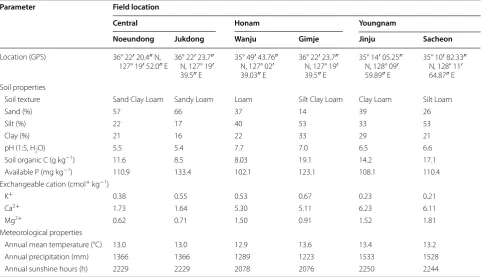
To evaluate the effect of straw managements on seasonal CH4 flux in Korean rice fields, six typical rice paddies having different soil texture were selected in three dif-ferent locations (Central, Honam, and Youngnam area) of south Korean Peninsula (Table 1). As the central part of Korea, two different textured experiment plots (sand clay loam and sandy loam) were installed in Noeun-dong
and Juk-dong, Daejeon, South Korea, respectively. In the Honam area, loam and silt clay loam having rice paddies were selected as the experimental sites in Wanju-gun and Gimje-si, respectively. In Youngnam area, two rice pad-dies having clay loam and silt loam textures were selected in Jinju-si and Sacheon-si, respectively.
Two paddy soils of the central part (Daejeon) of Korea had slightly acidic pH (5.4–5.5) and low fertility with 8–12 g kg−1 of SOC concentration before the experi-ment. In comparison, two soils of Honam area had rela-tively high pH (7.0–7.7). Silt clay loam in Gimje-si had high SOC content (19.1 g kg−1), but loam soil in Wanju -gun had low fertility with 8.0 g kg−1 of SOC. However, two rice paddies in Youngnam area had general chemi-cal properties of Korean paddy soils with pH 6.1–6.2 and 14–17 g kg−1 of SOC content.
However, any apparent difference on meteorologi-cal properties of three different locations was not found for the last 30 years. Mean annual temperatures of the selected locations were ranged within 12.9–13.6 °C with-out big difference. Annual precipitation was slightly higher in Youngnam area with average 1528 mm, and comparatively lower in Honam area with 1223–1289 mm. Sunshine hours were approximately 200 h per year higher in Youngnam and Central areas than Honam area [15].
Experimental plot installation and rice cultivation
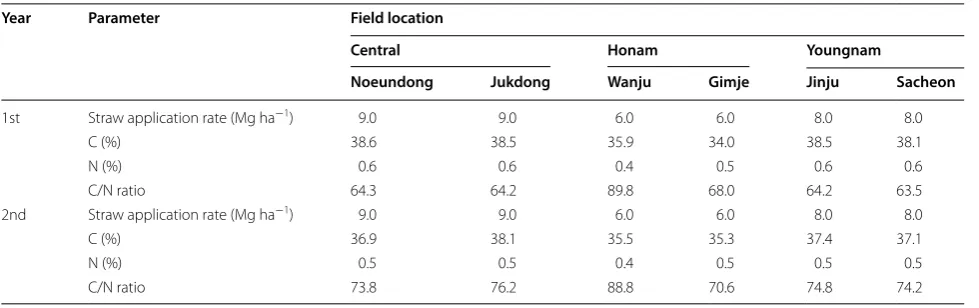
To evaluate the effect of straw application on seasonal CH4 flux, straw recycling and removal plots were selected as the main treatments (Table 2). In the straw recycling treatment, straw was applied with three different meth-ods surface spreading after rice harvesting in autumn, mixing with soil in autumn, and recycling right before rice transplanting in spring. In the selected experiment fields, all plots were designed with 100 m2 size, and total 12 plots (4 treatments and 3 replicates) were arranged with randomized complete block design.
In the selected experimental fields, rice was cultivated under the same condition, except for straw application. Shindongjin cultivar (Japonica) was selected as the target rice cultivar. The same levels (N–P2O5–K2O = 90–45– 57 kg ha−1) of chemical fertilizers were applied in all treat-ments, according to the guidelines of rice cultivation of RDA, Korea [16]. The fields were constantly flooded with 5–7 cm depth from soil surface by 1 month before har-vesting. Three-week old rice seedlings were manually transplanted with 15 cm × 30 cm space interval in the late May-the early June. Rice was harvested at maturing stage in the mid-October. Rice growth and yield properties were investigated at harvesting stage, based on the Korean standard [17].
Methane gas sampling and analysis
During rice cultivation period, CH4 emission rates were determined using a closed chamber method [18]. Three pairs of six hexahedra transparent acrylic chamber (W. 60 cm × L. 60 cm × H. 120 cm) were installed in each plot after rice transplanting. Total eight hills of rice seedling were transplanted inner the chamber with the same space interval out of the chamber. A fan and a thermometer were placed inner the chambers to circulate gas and monitor the temperature of inside chambers, respectively. The lips of the chambers were only closed during the sampling period and kept open during the whole experimental period to mini-mize chamber effects. Gas was sampled every week interval
Table 1 Characteristics of the selected soils before plot installation, and meteorological properties for the last 30 years
Parameter Field location
Central Honam Youngnam
Noeundong Jukdong Wanju Gimje Jinju Sacheon
Location (GPS) 36° 22′ 20.4″ N,
127° 19′ 52.0″ E 36° 22
′ 23.7″
N, 127° 19′
39.5″ E
35° 49′ 43.76″
N, 127° 02′
39.03″ E
36° 22′ 23.7″
N, 127° 19′
39.5″ E
35° 14′ 05.25″
N, 128° 09′
59.89″ E
35° 10′ 82.33″
N, 128° 11′
64.87″ E
Soil properties
Soil texture Sand Clay Loam Sandy Loam Loam Silt Clay Loam Clay Loam Silt Loam
Sand (%) 57 66 37 14 39 26
Silt (%) 22 17 40 53 33 53
Clay (%) 21 16 22 33 29 21
pH (1:5, H2O) 5.5 5.4 7.7 7.0 6.5 6.6
Soil organic C (g kg−1) 11.6 8.5 8.03 19.1 14.2 17.1
Available P (mg kg−1) 110.9 133.4 102.1 123.1 108.1 110.4
Exchangeable cation (cmol+ kg−1)
K+ 0.38 0.55 0.53 0.67 0.23 0.21
Ca2+ 1.73 1.64 5.30 5.11 6.23 6.11
Mg2+ 0.62 0.71 1.50 0.91 1.52 1.81
Meteorological properties
Annual mean temperature (°C) 13.0 13.0 12.9 13.6 13.4 13.2
Annual precipitation (mm) 1366 1366 1289 1223 1533 1528
Annual sunshine hours (h) 2229 2229 2078 2076 2250 2244
Table 2 Field managements and rice cultivation
Season No-straw treatment Straw recycling treatment
Spring recycling Autumn recycling
Spreading Mixing
After harvesting (Autumn) Straw removed Straw removed Straw spread over soil
surface Straw mixed with soil
Before transplanting (Following spring) – Straw application – –
Plowing and irrigation
at 10:00–10:30. Gas samples were collected using 60 ml gas-tight syringes at 0 and 30 min after chamber closing.
The gas samples were transferred into 30 ml air-evacu-ated glass vials closed by a butyl rubber septum. The CH4 concentrations in the collected gas samples were analyzed by gas chromatography (Shimadzu, GC-2010, Japan) with a Porapak NQ column (Q 80–100 mesh). A flame ionization detector (FID) were utilized for quantifying the CH4 con-centrations in samples. The temperatures of column, injec-tor, and detector were controlled at 35, 200 and 250 °C, respectively. Hydrogen and helium gases were used as the burning and carrier gases, respectively.
The CH4 emission rates were calculated using the increased CH4 concentration in the headspace of closed chambers [18, 19].
where ΔC (m3 m−3) is the increased CH
4 concentrations in the headspace of closed chamber during the sampling period, Δt is the chamber closing hour for gas sampling, V (m3) and A (m2) are the headspace volume and the surface area of closed chamber, respectively, ρ is the gas density of CH4 at a standardized state (mg cm−3), and T (K) is the absolute temperature of closed chamber at gas sampling.
The seasonal CH4 fluxes which means the cumulative CH4 emission rates during the entire experiment period were calculated [20].
where Ri is the rate of CH4 flux per day (g m−2 day−1) in the ith sampling, Di is the interval days between the
CH4emission rate
mg m−2h−1
=Ct×VA×ρ×273T
Seasonal CH4flux
kg ha−1 =
n
i
(Ri×Di)
(i− 1)th and ith sampling, and n is the number of sam-pling time.
To figure out the impact of straw application practices on CH4 emission during rice production, CH4 intensity which means CH4 seasonal fluxes per rice grain produc-tivity were evaluated.
To compare the effect of straw recycling method-ologies on CH4 emission rate, conversion factor which implies the relative CH4 emission weight to the control (straw application right before transplanting in spring) was calculated by 2006 IPCC Guideline [21]. Methane emission factor means average daily CH4 emission rate (kg CH4 ha−1 day−1) during rice cropping period. Based on CH4 emission factor at the straw incorporated shortly (< 30 days) before cultivation, the conversion factor was comparatively calculated using CH4 emission factor under different straw recycling condition.
where EFT and EFC mean the CH4 emission factor (kg CH4 ha−1 day−1) of straw treatments and the control (straw incorporated shortly (< 30 days) before cultiva-tion), respectively.
Soil, straw and statistical analysis
Air temperature, precipitation and sunshine hour data during rice cultivation were collected from the database of Korea Meteorological Administration [15]. In addi-tion, soil redox potential (Eh value) was determined at 5–10 cm soil depth during rice cropping season with Eh
CH4intensity
kg CH4kg−1grain
=Seasonal CH4flux
Grain yeild
Conversion factor=EFT
EFC
Table 3 Straw application rate and chemical properties of straw in each location
Year Parameter Field location
Central Honam Youngnam
Noeundong Jukdong Wanju Gimje Jinju Sacheon
1st Straw application rate (Mg ha−1) 9.0 9.0 6.0 6.0 8.0 8.0
C (%) 38.6 38.5 35.9 34.0 38.5 38.1
N (%) 0.6 0.6 0.4 0.5 0.6 0.6
C/N ratio 64.3 64.2 89.8 68.0 64.2 63.5
2nd Straw application rate (Mg ha−1) 9.0 9.0 6.0 6.0 8.0 8.0
C (%) 36.9 38.1 35.5 35.3 37.4 37.1
N (%) 0.5 0.5 0.4 0.5 0.5 0.5
electrode and Eh meter (PRN-41, DKK-TOA Corpora-tion, Japan).
Total C and N contents of the used soil and straw were determined using CHNS Analyzer (CHNS-932, Leco, Saint Joseph, MI, USA). Soil properties were deter-mined following as the Korean standard [22]; soil texture (pipette method), pH (1:5 with H2O), available P (Lan-caster method), and exchangeable cation content (1 M NH4-acetate extraction at pH 7).
All statistical analyses were performed using IBM SPSS statistics 25.0 (IBM Corp., Armonk, NY, USA). The impact of parameters (treatments and year) was deter-mined through one- and two-way analysis of variance (ANOVA), and Tukey’s test.
Results
Methane emission during rice cultivation
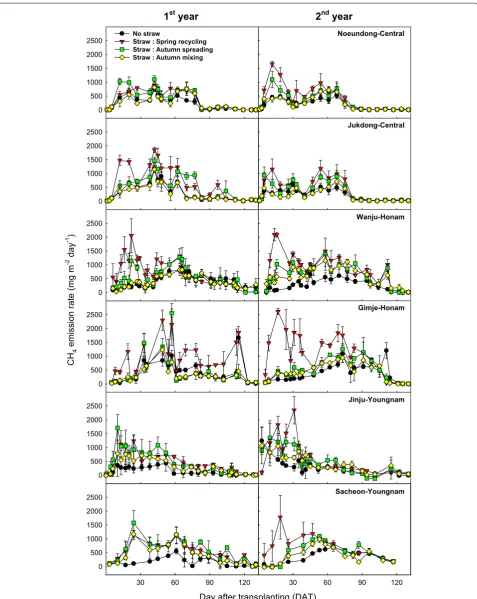
Irrespective with soil amendments, similar CH4 emission patterns were observed in each field during rice cropping seasons (Fig. 1). Methane emission rates were sharply increased with flooding and rice transplanting. This high CH4 emission rates were maintained to rice flowering stage at approximately 80–90 days after transplanting, and thereafter, slowly decreased to the background level.
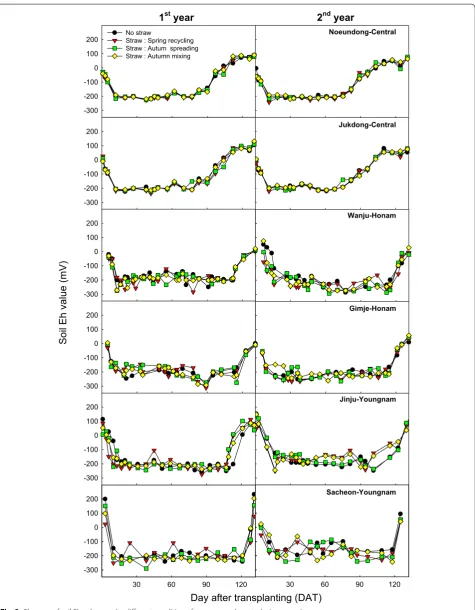
Methane emission patterns were reversely changed with changes of soil Eh values (Fig. 2). Irrespective with soil amendments, soil Eh values were sharply decreased to less than minus 200 mV within 1–2 week after trans-planting. This low Eh values were continued to rice flowering stage, and thereafter steadily increased up to 200 mV at harvesting stage. However, soil Eh value changes were not clearly discriminated among soil amendments.
Methane factor and conversion factor
Under the same soil amendments, CH4 emission factor which means the average daily CH4 emission rate dur-ing croppdur-ing season [21] showed big differences among soil textures and experimental field locations. However, this emission factor was not correlated with clay or organic matter contents of soils. The average CH4 emis-sion factor was ranged within 2.67 ± 0.91 kg ha−1 day−1 in the no-straw treatment, and straw applications sig-nificantly increased this emission factor by 1.3–2.2 times over that in the no-straw (Table 4, and Fig. 3).
Among straw application treatments, CH4 emission factor was the highest with 5.94 ± 1.90 kg ha−1 day−1 in the straw application right before rice transplanting in spring (control). However, straw application in autumn and its aerobic digestion during the off-cropping sea-son significantly decreased CH4 emission factor by
average 20–40% over that in the control. In particular, CH4 emission factor was much lower in the straw mix-ing with soil right after rice harvestmix-ing in autumn with 3.42 ± 1.04 kg ha−1 day−1, which was not comparable with 4.51 ± 1.10 kg ha−1 day−1 in the straw spreading over soil surface in autumn.
In the 2006 Revised IPCC Guideline [21], the CH4 emission rate in straw incorporated shortly (< 30 days) before rice cultivation was proposed as the control with conversion factor 1.0 (error range 0.97–1.04). Comparing with CH4 emission factor (5.94 ± 1.90 kg ha−1 day−1) at the control treatment, straw application over the surface right after rice har-vesting decreased average 20% of CH4 emission and then had 0.8 of conversion factor (Fig. 4). In compari-son, straw mixing with soil right after rice harvesting reduced average 40% of CH4 emission and then had 0.6 of conversion factor.
Rice productivity and methane intensity
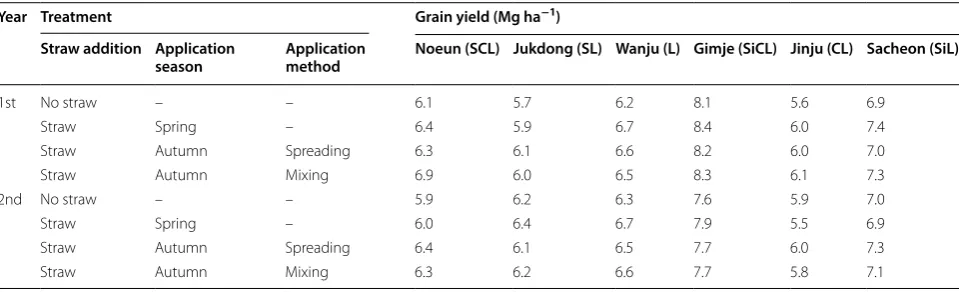
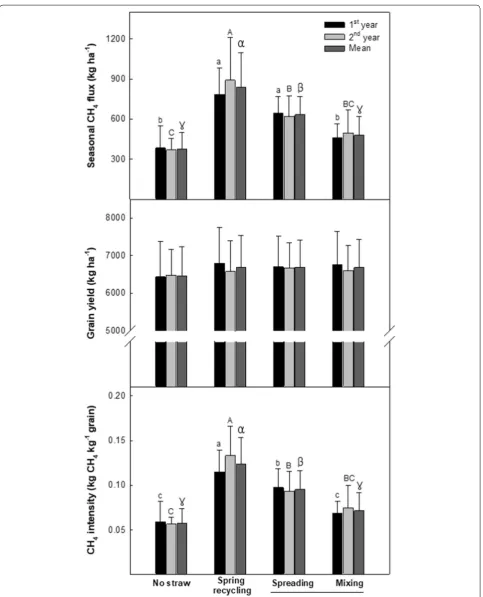
The same rice cultivar was cultivated in the whole inves-tigation sites. However, under the same soil amendments, rice yield properties showed differences among rice fields and cropping years (Table 5). We could not find any correlation between grain yields and soil and meteoro-logical properties in this study. In six different soils, the mean grain yield was 6.5 ± 0.8 Mg ha−1 in the no-straw treatment (NPK) for 2 years. Straw application slightly increased rice grain productivity by average 4% over the no-straw application. However, the average grain produc-tivities were not significantly different among straw man-agements. Its productivity was the highest with average 6.7 Mg ha−1 in the straw spreading over soil surface at harvesting stage, and then followed by the straw mixing with soils with 6.6 Mg ha−1.
0 500 1000 1500 2000 2500 0 500 1000 1500 2000 2500
0 500 1000 1500 2000 2500 0 500 1000 1500 2000 2500 0 500 1000 1500 2000 2500 0 500 1000 1500 2000
2500 No strawStraw : Spring recycling Straw : Autumn spreading Straw : Autumn mixing
Day after transplanting (DAT)
Noeundong-Central
CH
4
emission rate (mg
m
-2 da
y
-1 )
1st year 2nd year
Jukdong-Central
Wanju-Honam
Gimje-Honam
30 60 90 120
30 60 90 120
Jinju-Youngnam
Sacheon-Youngnam
2D Graph 13
Y Data
-300 -200 -100 0 100 200
1st year
Jukdong-Central
Sand Clay Loam
Sand Loam Noeundong-Central
-300 -200 -100 0 100
200 No strawStraw : Spring recycling Straw : Autum spreading Straw : Autumn mixing
-300 -200 -100 0 100 200
-300 -200 -100 0 100 200
-300 -200 -100 0 100 200
2nd year
Gimje-Honam Wanju-Honam
Sacheon-Youngnam Jinju-Youngnam
30 60 90 120
Soil Eh value (mV)
-300 -200 -100 0 100 200
-300 -200 -100 0 100 200
Day after transplanting (DAT)
30 60 90 120
Table
4
CH
4
emission fac
tors of each lo
ca tion under diff er en t metho ds of str aw applic ation A ll tr ea tmen ts w er e plo w ed bef or
e flooding in spr
ing
Diff
er
en
t lett
ers on same c
olumn indica te sig nifican t diff er enc e a t lev el of p <
0.05 within the tr
ea tmen ts Year Tr ea tmen t CH 4 emission fac tor (k g ha − 1 da y − 1) Str aw addition A pplica tion season A pplica tion method Noeun (SCL) Juk dong (SL) W anju (L) G imje (SiCL) Jinju ( CL) Sacheon (SiL) M ean 1st No stra w – – 2.21b 2.87c 3.71b 3.99b 1.40b 1.58c 2.63b Stra w Spr ing – 3.46a 5.87a 5.92a 7.26a 4.42a 5.39a 5.39a Stra w A utumn Spr eading 3.66a 4.47b 4.56b 3.47b 4.54a 6.11a 4.47a Stra w A utumn M ixing 2.50b 2.57c 3.62b 2.92b 2.96ab 4.55ab 3.19b 2nd No stra w – – 1.88c 2.23c 2.59c 3.57c 2.64c 3.38c 2.71c Stra w Spr ing – 4.49a 4.34a 8.10a 10.13a 5.79a 6.83a 6.61a Stra w A utumn Spr eading 2.99b 3.50b 6.15ab 5.08b 4.35ab 4.88ab 4.49b Stra w A utumn M ixing 2.36bc 2.15c 5.64b 4.16bc 3.87bc 3.78bc 3.66bc M ean No stra w – – 2.05b 2.55b 3.15c 3.78b 2.02c 2.48c 2.67c Stra w Spr ing – 3.98a 5.10a 7.01a 8.70a 5.11a 6.11a 5.94a Stra w A utumn Spr eading 3.32a 3.98a 5.36ab 4.28b 4.44a 5.50a 4.51b Stra w A utumn M ixing 2.43b 2.36b 4.63bc 3.54b 3.41b 4.16b 3.42c
Statistical analysis Year
Discussion
In this field experiments which were studied in six dif-ferent soils for 2 years, the effect of straw application on CH4 emission was highly different depending on straw application timing and methods (Fig. 1). Straw applica-tion right before flooding in spring significantly increased
seasonal CH4 flux by average 122% over no-straw appli-cation [23]. Methane emission is basically decided by the difference between CH4 production and oxidation [24]. Methanogens produce CH4 under extremely reduced soil condition, and organic C availability can impor-tantly affect CH4 production. In the flooded rice fields, Fig. 3 Methane emission factors under different condition of straw amendments during cropping seasons. (Different letters on the same column
indicate significant difference at level of p < 0.05 among treatments)
Fig. 4 Conversion factor of CH4 flux under different condition of straw amendments during cropping seasons. (Different letters on same column
indicate significant difference at level of p < 0.05 among treatments)
Table 5 Grain yields under different methods of straw application in different location
Year Treatment Grain yield (Mg ha−1) Straw addition Application
season Application method Noeun (SCL) Jukdong (SL) Wanju (L) Gimje (SiCL) Jinju (CL) Sacheon (SiL)
1st No straw – – 6.1 5.7 6.2 8.1 5.6 6.9
Straw Spring – 6.4 5.9 6.7 8.4 6.0 7.4
Straw Autumn Spreading 6.3 6.1 6.6 8.2 6.0 7.0
Straw Autumn Mixing 6.9 6.0 6.5 8.3 6.1 7.3
2nd No straw – – 5.9 6.2 6.3 7.6 5.9 7.0
Straw Spring – 6.0 6.4 6.7 7.9 5.5 6.9
Straw Autumn Spreading 6.4 6.1 6.5 7.7 6.0 7.3
Fig. 5 Total CH4 flux, grain yield, and CH4 intensity under different condition of straw amendments during cropping seasons. (Different letters on
applied straw provides a C source for methanogenesis and develops strictly anaerobic soil conditions [25, 26]. This changed soil condition stimulates CH4 production, inhibits CH4 oxidation, and then increases CH4 emission [27, 28].
Aerobic digestion of amended straw during off-crop-ping season significantly decreased CH4 emission during rice cropping season. However, straw mixing with soil at rice harvesting stage was more effective to reduce CH4 emission than straw spreading over surface during fallow season. In the several field studies [13, 14], the applica-tion of rice straw digested during the off-cropping sea-son was very effective to decrease CH4 emission during rice cropping season, comparing with CH4 emission in straw applied shortly (< 30 days) before cultivation. The changes of organic constituent composition in rice straw during the off-cropping season might be related to this decrease of CH4 emission rates. Rice straw contained approximately 25–35% of cellulose, 32–37% of hemicel-lulose, and 6–10% of lignin [29]. Aerobic decomposition of straw during the off-cropping upland season decreases the concentration of readily available C substrates like cellulose and hemicellulose for methanogenesis, and then decreases CH4 emissions in the following rice cropping season [26, 30]. This decomposition effect might be much higher under the condition of straw mixing with soil than straw spreading over surface layer.
In the 2006 Revised IPCC guidelines [21], a daily CH4 emission factor (EFi) is calculated by multiplying baseline CH4 emission factor (EFc) and scaling factors (SF) (Eq. 1). Scaling factors mean the conversion factor of CH4 emis-sion factor against that in the control treatment [21], and are specified with several SF for water regime during the cultivation period (SFw), water regime in the pre-season (SFp), organic amendment applied (SFo), soil type (SFs), and rice cultivar (SFR).
where EFi and EFc are a daily emission factor for i con-dition (kg CH4 ha−1 day−1) and baseline emission factor (kg CH4 ha−1 day−1), respectively. SFW, SFP, SFO and SFS,r mean scaling factors for water regime during the culti-vation period, water regime in the pre-season, organic amendment applied and soil type and rice cultivar, respectively.
Scaling factor for organic amendment applied (SFo) is estimated with application rate of organic amendment in fresh weight (Mg ha−1) and conversion factor for organic amendment [21]. For example, in Tier 1 level, IPCC pro-posed 1.0 (error range 0.97–1.04) as the conversion factor for straw incorporated shortly (< 30 days) before cultiva-tion. In comparison, straw incorporated long (> 30 days) before cultivation had 0.29 (error range 0.20–0.40) of
(1)
EFi=EFc×SFw×SFp×SFo×SFS×SFS,r
conversion factor. However, in this studies, the conver-sion factor for straw applied in autumn was approxi-mately 0.6 and 0.8 in the straw mixing with soil and the straw spreading over surface layer, respectively (Fig. 4). They were much bigger than the IPCC default value (0.29) to straw incorporated long (> 30 days) before cul-tivation [21].
Besides the effect of straw incorporation on increas-ing CH4 emission, straw application makes a number of other effects. The effect of straw amendments on rice growth and productivity might be positive or negative, depending on incorporation methodology and timing, chemical and physical properties of straw, and fertiliza-tion backgrounds [31, 32]. In this field studies, rice straw recycling slightly increased rice grain productivity by approximately 4% over that of the no-straw treatment, but there was no statistic difference among straw appli-cation seasons and methods (Fig. 5). However, long-term straw application can increase SOC stock, which might further offset the negative effect of straw application, due to increased CH4 emission [33]. For example, straw appli-cation increased SOC content by 20–30% in the long-term straw application field [34].
With developing intensive farming structure, rice pro-ductivity increase is limited largely by the deterioration of soil quality, due to decrease of soil organic matter (SOM) stock [35, 36]. Straw recycling as organic matter source is accepted as the most reasonable management practice to improve SOM stock and increase crop productivity [33]. Rice straw application can improve soil fertility [37]. This improved soil quality might reduce the dependence of chemical fertilizers [38] and increases rice productivity [39]. The positive effect of rice cropping industry that is not related to GHG emission should be also considered. For example, comparing with straw burning in the open field, straw recycling leads to favorable effects on envi-ronment quality and human health [40]. Straw applica-tion can boost soil biota activity, which will improve soil biodiversity and health condition [41]. Therefore, agri-cultural policy decisions including straw management should consider a number of trade-offs between positive and negative effects of straw application on rice produc-tivity and environment impact.
Acknowledgements
This work was supported by Cooperative Research Program for Agriculture Science & Technology Development (Project title: Study on ammonia emission inventory establishment in paddy rice, Project No. PJ014205032019), National Academy of Agricultural Science, Rural Development Administration and Basis Science Program (NRF‑2015R1A6A1A03031413), the National Research Foundation, the Ministry of Education, Republic of Korea.
Authors’ contributions
PJK developed the concepts, led the research, contributed to data analyses and wrote the paper. All authors read and approved the final manuscript.
Funding Not applicable.
Availability of data and materials
All data generated or analyzed during this study are included in this published article.
Competing interests
The authors declare that they have no competing interests.
Author details
1 Division of Applied Life Science (BK 21+ Program), Gyeongsang National
University, Jinju 52828, South Korea. 2 National Academy of Agricultural Sci‑
ence, RDA, Wanju 55365, South Korea. 3 Department of Bio‑Environmental
Chemistry, Chungnam National University, Daejeon 34134, South Korea.
4 Department of Life Science and Environmental Biochemistry, Pusan National
University, Miryang 50463, South Korea. 5 Institute of Agriculture and Life Sci‑
ences, Gyeongsang National University, Jinju 52828, South Korea.
Received: 7 August 2019 Accepted: 8 November 2019
References
1. Havlin JL, Kissel DE, Maddux LD, Claassen MM, Long JH (1990) Crop rota‑ tion and tillage effects on soil organic carbon and nitrogen. Soil Sci Soc
Am J 54(2):448–452. https ://doi.org/10.2136/sssaj 1990.03615 99500 54000
20026 x
2. Lal R, Negassa W, Lorenz K (2015) Carbon sequestration in soil. Curr Opin
Environ Sustain 15:79–86. https ://doi.org/10.1016/j.cosus t.2015.09.002
3. Reeves DW (1997) The role of soil organic matter in maintaining soil qual‑
ity in continuous cropping systems. Soil Till Res 43:131–167. https ://doi.
org/10.1016/S0167 ‑1987(97)00038 ‑X
4. Crowther TW, Todd‑Brown KEO, Rowe CW, Wieder WR, Carey JC, Mach‑ muller MB, Snoek BL, Fang S, Zhou G, Allison SD, Blair JM, Bridgham SD, Burton AJ, Carrillo Y, Reich PB, Clark JS, Classen AT, Dijkstra FA, Elberling B, Emmett BA, Estiarte M, Frey SD, Guo J, Harte J, Jiang L, Johnson BR, Kröel‑Dulay G, Larsen KS, Laudon H, Lavallee JM, Luo Y, Lupascu M, Ma LN, Marhan S, Michelsen A, Mohan J, Niu S, Pendall E, Peñuelas J, Pfeifer‑ Meister L, Poll C, Reinsch S, Reynolds LL, Schmidt IK, Sistla S, Sokol NW, Templer PH, Treseder KK, Welker JM, Bradford MA (2016) Quantifying global soil carbon losses in response to warming. Nature 540:104–108. https ://doi.org/10.1038/natur e2015 0
5. Lal R (2004) Soil carbon sequestration impacts on global climate change
and food security. Science 304(6):1623–1627. https ://doi.org/10.1126/
scien ce.10973 96
6. Lu F, Wang X, Han B, Ouyang Z, Duan X, Zheng H, Miao H (2009) Soil carbon sequestrations by nitrogen fertilizer application, straw return and
no‑tillage in China’s cropland. Glob Change Biol 15:281–305. https ://doi.
org/10.1111/j.1365‑2486.2008.01743 .x
7. Lee SB, Lee CH, Jung KY, Park KD, Lee DK, Kim PJ (2009) Changes of soil organic carbon and its fractions in relation to soil physical properties
in a long‑term fertilized paddy. Soil Till Res 104:227–232. https ://doi.
org/10.1016/j.still .2009.02.007
8. Wang W, Lai DYF, Wang C, Pan T, Zeng C (2015) Effects of rice straw incor‑ poration on active soil organic carbon pools in a subtropical paddy soil.
Soil Till Res 152:8–16. https ://doi.org/10.1016/j.still .2015.03.011
9. Myhre G, Shindell D, Breon FM, Collins W, Fuglestvedt J, Huang J, Koch D, Lamarque JF, Lee D, Mendoza B, Nakajima T, Robock A, Stephens G, Takemura T, Zhang H (2013) Anthropogenic and natural radiative forcing. In: Stocker TF, Qin D, Plattner GK, Tignor M, Allen SK, Boschung J, Nauels A, Xia Y, Bex V, Midgley PM (eds) Climate change 2013: the physical science basis. Contribution of Working Group I to the Fifth Assessment Report of the Intergovernmental Panel on Climate Change. Cambridge University Press, Cambridge, pp 661–740
10. Liu W, Hussain S, Wu L, Qin Z, Li X, Lu J, Khan F, Cao W, Geng M (2016) Greenhouse gas emissions, soil quality, and crop productivity from
a mono‑rice cultivation system as influenced by fallow season straw
management. Environ Sci Pollut Res 23:315–328. https ://doi.org/10.1007/
s1135 6‑015‑5227‑7
11. Garcia JL, Patel BKC, Ollivier B (2000) Taxonomic, phylogenetic and eco‑
logical diversity of methanogenic Archaea. Anaerobe 6(4):205–226. https
://doi.org/10.1006/anae.2000.0345
12. Conrad R (2009) The global methane cycle: recent advances in understanding the microbial processes involved. Environ Microbial Rep
1(5):285–292. https ://doi.org/10.1111/j.1758‑2229.2009.00038 .x
13. Watanabe A, Katoh K, Kimura M (1993) Effect of Rice straw application on CH4 emission from paddy fields. II. Contribution of organic constituents in
rice straw. Soil Sci Plant Nutr 39:707–712. https ://doi.org/10.1080/00380
768.1993.10419 187
14. Lu WF, Chen W, Duan BW, Guo WM, Lu Y, Lantin RS, Wassmann R, Neue HU (2000) Methane emissions and mitigation options in irrigated rice
fields in southeast China. Nutr Cycl Agroecosys 58:65–73. https ://doi.
org/10.1023/A:10098 30232 650
15. Korea Meteorological Administration (KMA). Dongjak‑Gu, Seoul, Republic
of Korea. 1949. http://www.weath er.go.kr/weath er/clima te/past_cal.jsp.
Accessed Nov 2018
16. Rural Development Administration (RDA) (2017) Fertilization standard of crop plants. National Institute of Agricultural Science and Technology,
Jeonju, p 17 (In Korean)
17. Rural Development Administration (RDA) (1995) Standard investigation methods for agriculture experiment. National Institute of Agricultural
Science and Technology, Suwon, p 601 (In Korean)
18. Rolston DE. Gas flux. In Klute A (Ed.), Methods of Soil Analysis, Part 1, Physical and Mineralogical Methods. 2nd ed. Am Soc Agronomy and Soil Sci Soc Am, Madison, WI, USA; 1986. pp. 1103–1119 (Agronomy Mono‑ graphs 9)
19. Lou Y, Li Z, Zhang T, Liang Y (2004) CO2 emissions from subtropical arable
soils of China. Soil Biol Biochem 36:1835–1842. https ://doi.org/10.1016/j.
soilb io.2004.05.006
20. Singh S, Singh J, Kashyap AK (1999) Methane flux from irrigated rice fields in relation to crop growth and N fertilization. Soil Biol Biochem
31:1219–1228. https ://doi.org/10.1016/S0038 ‑0717(99)00027 ‑9
21. Lasco RD, Ogle S, Raison J, Verchot L, Wassmann R, Yagi K, Bhattacharya S, Brenner JS, Daka JP, González SP, Krug T, Li Y, Martino DL, McConkey BG, Smith P, Tyler SC, Zhakata W, Sass RL, Yan X (2006) Cropland. In: Eggleston HS, Buendia L, Miwa K, Ngara T, Tanabe K (eds) 2006 IPCC guidelines for National Greenhouse Gas Inventories. Agriculture, forestry and other land use, prepared by the National Greenhouse Gas Inventories Programme, vol 4. Institute for Global Environmental Strategies (IGES), Japan, pp 5.6–5.66
22. Rural Development Administration (RDA) (1998) Methods of soil chemi‑ cal analysis. National Institute of Agricultural Science and Technology, Suwon, p (In Korean)
23. Wang J, Zhang X, Xiong Z, Khalil MAK, Zhao X, Xie Y, Xing G (2012) Meth‑ ane emissions from a rice agroecosystem in South China: effects of water regime, straw incorporation and nitrogen fertilizer. Nutr Cycl Agroecosyst
93:103–112. https ://doi.org/10.1007/s1070 5‑012‑9503‑3
24. Conrad R (2007) Microbial ecology of methanogens and methanotrophs.
Adv Agron. 96:1–63. https ://doi.org/10.1016/S0065 ‑2113(07)96005 ‑8
25. Mitra S, Majumdar D, Wassmann R (2012) Methane production and emis‑ sion in surface and subsurface rice soils and their blends. Agric Ecosyst
Environ 158:94–102. https ://doi.org/10.1016/j.agee.2012.05.021
26. Malyan SK, Bhatia A, Kumar A, Gupta DK, Singh R, Kumar SS, Tomer R, Kumar O, Jain N (2012) Methane production, oxidation and mitigation: a mechanistic understanding and comprehensive evaluation of influenc‑
ing factors. Sci Total Environ 572:874–896. https ://doi.org/10.1016/j.scito
tenv.2016.07.182
27. Sander BO, Samson M, Buresh RJ (2014) Methane and nitrous oxide emis‑ sions from flooded rice fields as affected by water and straw manage‑
ment between rice crops. Geoderma 253–236:355–362. https ://doi.
org/10.1016/j.geode rma.2014.07.020
28. Oo AZ, Win KT, Bellingrath‑Kimura SD (2015) Within field spatial variation in methane emissions from lowland rice in Myanmar. SpringerPlus 4:145. https ://doi.org/10.1186/s4006 4‑015‑0901‑2
29. Jin S, Chen H (2006) Structural properties and enzymatic hydrolysis of rice
straw. Process Biochem 41:1261–1264. https ://doi.org/10.1016/j.procb
30. Yan X, Yagi K, Akiyama H, Akimoto H (2005) Statistical analysis of the major variables controlling methane emission from rice
fields. Glob Change Biol 11(7):1131–1141. https ://doi.org/10.111
1/j.1365‑2486.2005.00976 .x
31. Ma ED, Zhang GB, Ma J, Xu H, Cai ZC, Yagi K (2010) Effects of rice straw
returning methods on N2O emission during wheat‑growing season. Nutr
Cycl Agroecosyst 88:463–469. https ://doi.org/10.1007/s1070 5‑010‑9369‑1
32. Xia LL, Wang SW, Yan XY (2014) Effects of long‑term straw incorporation on the net global warming potential and the net economic benefit in a rice‑wheat cropping system in China. Agric Ecosyst Environ 197:118–127. https ://doi.org/10.1016/j.agee.2014.08.001
33. Liu C, Lu M, Cui J, Li B, Fang C (2014) Effects of straw carbon input on carbon dynamics in agricultural soils: a meta‑analysis. Glob Change Biol
20:1366–1381. https ://doi.org/10.1111/gcb.12517
34. Jiang Y, Qian H, Huang S, Zhang X, Wang L, Zhang L, Shen M, Xiao X, Chen F, Zhang H, Lu C, Li C, Zhang J, Deng A, Groenigen KJV, Zhang W (2019) Acclimation of methane emissions from rice paddy fields to straw addi‑
tion. Sci Adv 5:eaau9038. https ://doi.org/10.1126/sciad v.aau90 38
35. Ray DK, Ramankutty N, Mueller ND, West PC, Foley JA (2012) Recent pat‑
terns of crop yield growth and stagnation. Nat Commun 3:1293. https ://
doi.org/10.1038/ncomm s2296
36. Mueller ND, Gerber JS, Johnston M, Ray DK, Ramankutty N, Foley JA (2012) Closing yield gaps through nutrient and water management.
Nature 490:254–257. https ://doi.org/10.1038/natur e1142 0
37. Huang S, Zeng Y, Wu J, Shi Q, Pan X (2013) Effect of crop residue retention
on rice yield in China: a meta‑analysis. Field Crop Res 154:188–194. https
://doi.org/10.1016/j.fcr.2013.08.013
38. Lal R (2010) Beyond Copenhagen: mitigating climate change and achieving food security through soil carbon sequestration. Food Secur
2(2):169–177. https ://doi.org/10.1007/s1257 1‑010‑0060‑9
39. Liao YL, Zheng SX, Nie J, Lu YH, Xie J, Yang ZP (2009) Effects of long‑term application of fertilizer and rice straw on soil fertility and sustainability of a reddish paddy soil productivity. Sci Agric Sin 42(10):3541–3550 40. Huang X, Li M, Li J, Song Y (2012) A high‑resolution emission inventory
of crop burning in fields in China based on MODIS thermal anomalies/
fire products. Atmos Environ 50:9–15. https ://doi.org/10.1016/j.atmos
env.2012.01.017
41. Zhang Z, Zhang X, Xu M, Zhang S, Huang S, Liang W (2016) Responses of soil micro‑food web to long‑term fertilization in a wheat–maize
rotation system. Appl Soil Ecol 98:56–64. https ://doi.org/10.1016/j.apsoi
l.2015.09.008
Publisher’s Note