October 31, 2019
Impact of Sodium Chloride and Ascorbic Acid on Pasting and Textural Parameters of
Corn Starch-Water and Milk Systems
Author’s Details: Şenol KOSE1*
Yagmur ERIM KOSE1 Mehmet Murat CEYLAN2
1
Department of Food Engineering, Faculty of Engineering, Van Yuzuncu Yil University, Van, Turkey 2
Department of Food Engineering, Faculty of Engineering, Igdır University, Igdır, Turkey *Corresponding Author Phone: 0(432) 225 1024, Fax: 0(432) 225 1730
*E-mail: [email protected]
Received Date: 3-Sep-2019 Accepted Date: 17-Sep-2019 Published Date: 14-Oct-2019
_______________________________________________________________________________________ Abstract
The effect of NaCI and ascorbic acid addition at the different concentrations on the pasting and textural parameters of corn starch in water and skimmed milk were determined using Texture and Rapid Visco Analyser. Rapid Visco analysis exhibited that addition of NaCI and ascorbic acid significantly affected (p<0.05) the pasting parameters such as peak time, pasting temperature, peak, breakdown, final, trough and setback viscosities. Also addition of NaCI and ascorbic acid significantly influenced (p<0.05) textural properties such as hardness, adhesiveness, springiness, cohesiveness, chewiness, gumminess, and resilience values of starch gels. This study indicated that the concentration ratio was found to be quite significant in the addition of salt and ascorbic acid to the corn starch. These results will be used as a guideline in the development of starch-based food products containing NaCI and ascorbic acid. Keywords: Corn starch, Salt, Ascorbic acid, Texture profile analysis (TPA), Rapid Visco Analyser (RVA) _______________________________________________________________________________________
INTRODUCTION
Starch, the main carbohydrate storage form in green plants, is mainly found in seeds, tubers, roots, leaves, stems and fruits (Ai & Jane, 2015). The reason for common use of starch is related to the gelling and thickening agent in food industry. Starch is extensively used as a thickening agent in dairy-based jellies, sauces, sweets, custards and desserts (Abu-Jdayıl et al., 2004).
In various food systems, the starch/polysaccharides mixtures of co-existing with salt, ascorbic acid and other ingredients (Feng et al., 2016). Among these food ingredients, ascorbic acid is naturally present in vegetables and fruits or added to regulate pH, inhibition of microbial growth (Majzoobi et al., 2014). On the other hand, salts are generally used in starch products as a condiment. In yellow alkaline noodles and sauce, both salt and starch are essential components of the formula (Wang et al., 2016). Also, it is known that the addition of salt and ascorbic acid significantly effect the rheological and pasting characteristics of various starch gels (Katsuta, 1998; Ahmad & Williams, 1999; Chiotelli et al., 2002; Hirashima et al., 2005; Samutsri
& Suphantharika, 2012). Although there has been some information on the addition of salt and ascorbic acid
of different starch types, no literature was found associated with the effect of NaCI and ascorbic acid concentration on pasting and textural characteristics of corn starch-water and milk gel. Therefore, the main aim of this research was to elucidate the impact of NaCI and ascorbic acid concentration on pasting and textural parameters of corn starch-water and milk systems. It will provide the information for preparation of starch-based products with NaCI and ascorbic acid.
MATERIALS AND METHODS Materials
Corn starch (Selva Food Industry Inc., Turkey), UHT skimmed milk (Pınar Dairy Products Inc., Turkey), L(+) ascorbic acid (Merck, Darmstadt, Germany), NaCI (Merck, Darmstadt, Germany) and distilled water were used in the current study.
Methods
In this study, the impact of NaCI and ascorbic acid at different concentrations on the pasting properties of corn starch-water and milk systems were investigated using Rapid Visco Analyser (RVA) (Perten RVA 4500; Perten Instruments, Warriewood, NSW, Australia). Approximately, 3 g NaCI and corn starch or ascorbic acid and corn starch mixture were put into RVA canister. Subsequently, 25 ml water or skimmed milk was added, the mixture was heated 50 °C and stirring at 50 °C at 160 rpm for 10 s. The samples were held at 50 °C for 1 min., heated to 95 °C at 13.16 °C/min, kept at 95 °C for 5 min and were cooled to 50 °C at 7.28 °C/min. Thermocline windows software (Perten) was used to calculate pasting parameters (pasting temperature, peak time, peak, breakdown, trough, final and setback viscosities).
Textural parameters
According to the method described by Yildiz et al (2013) the impact of NaCI and ascorbic acid concentration on texture profile analysis (TPA) of corn starch gels in water and skimmed milk was carried out by using texture analyser (TAXT2i; Stable Micro Systems Ltd., Godalming, UK) equipped with a P/25 cylindrical probe and load cell of 5 kg was used. Deformation distance, test speed and trigger force were adjusted to 5 mm, 1 mm/s and 5 g, respectively.
Hardness, springiness, adhesiveness, cohesiveness, gumminess, chewiness and resilience were supplied from TPA by using texture instrument software (version 2.0.7.0; Stable Microsystems, Godalming, UK). For each sample, all measurements were carried out three times.
Statistical analysis
Concentrations of corn starch samples were recorded as a mean±standard deviation of triplicate measurements. ANOVA was conducted using SPSS (SPSS Statistics V.20; Armonk, NY, USA) to determine the effect of NaCI and ascorbic acid concentration on the pasting and textural parameters of corn starch was significant or not. Also, for comparison of corn starch-ascorbic acid-water and corn starch- ascorbic acid-skimmed milk or corn starch-NaCI-water and corn starch-NaCI-skimmed milk groups, t test were used.
RESULTS AND DISCUSSIONS
Impact of NaCI and ascorbic acid concentrations on pasting parameters of corn starch- water and skimmed milk mixture
October 31, 2019
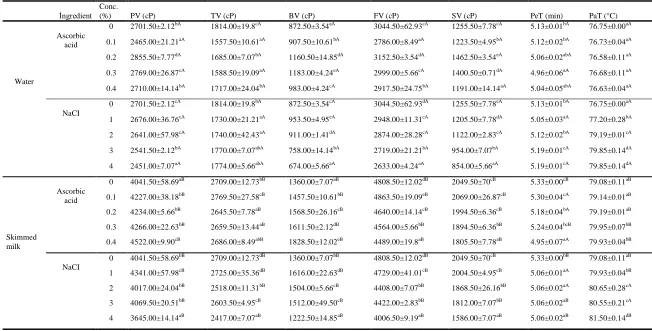
BV than salt added starches. In general, it has been found that the addition of ascorbic acid to corn starch samples increased the BV value. But, the addition of 0.4% ascorbic acid resulted in a greater reduction in BV content of corn starch in water. Our results were similar to Trithavisup and Charoenrein (2016), who found that the addition of ascorbic acid increased the BV viscosity. Also, FV and SV of corn starch samples generally significantly decreased (P<0.05). The reduction in the SV (retrogradation) can be due to interactions between starch chains and some amino acids. Therefore, the reduction in the content of amylose may contribute to the reduction of retrogradation (Ziegler et al., 2018).
In the present study, PaT for corn starches changed between 76.58 and 81.50 °C, the lowest shown by ascobic acid added corn starch in water and the highest by NaCI added corn starch in skimmed milk. Similarly, Seetharaman et al. (2001) determined PaT in the range of 74.9–84.7°C for corn landraces of Argentinian. The addition of NaCI and ascorbic acid increased the pasting temperature (PaT) of corn starch with an increase in concentration. The higher PaT has shown the potential for resistance to swelling in the content (Kumar et al., 2018). The ability of the salts to change the gelatinisation temperature of the starch is linked to the effect on the structures of water. Powerful hydrated ions increase the structural sequence of water with reduced ability of gelatinized starch. Conversely, weakly hydrated ions disrupt the water structure and assist gelatinization. The chloride ion is placed in the middle of the lyotropic series and therefore has little effect on the structure of water (Jyothi et al., 2005).
Table 1. Impact of NaCI and ascorbic acid addition at the different concentration on the pasting parameters of corn starch in water and skimmed milk (mean±standart deviations) For ascorbic acid and NaCI, Mean values shown by different letters (a-d) show differences between the concentrations (P<0.05),
For the same ingredient, Mean values in the same column shown different letters (A-B) between the water and skimmed milk (P <0.05),
PV: Peak viscosity, TV: Trough viscosity, BV: Breakdown viscosity, FV: Final viscosity, SV:Setback viscosity, PeT:Peak time, PaT: Pasting temperature
İngredient Conc.
(%) PV (cP) TV (cP) BV (cP) FV (cP) SV (cP) PeT (min) PaT (°C)
Water
Ascorbic acid
0 2701.50±2.12bA 1814.00±19.8cA 872.50±3.54aA 3044.50±62.93cA 1255.50±7.78cA 5.13±0.01bA 76.75±0.00aA
0.1 2465.00±21.21aA 1557.50±10.61aA 907.50±10.61bA 2786.00±8.49aA 1223.50±4.95bA 5.12±0.02bA 76.73±0.04aA
0.2 2855.50±7.77dA 1685.00±7.07bA 1160.50±14.85dA 3152.50±3.54dA 1462.50±3.54eA 5.06±0.02abA 76.58±0.11aA
0.3 2769.00±26.87cA 1588.50±19.09aA 1183.00±4.24eA 2999.00±5.66cA 1400.50±0.71dA 4.96±0.06aA 76.68±0.11aA
0.4 2710.00±14.14bA 1717.00±24.04bA 983.00±4.24cA 2917.50±24.75bA 1191.00±14.14aA 5.04±0.05abA 76.63±0.04aA
NaCI
0 2701.50±2.12cA 1814.00±19.8bA 872.50±3.54cA 3044.50±62.93dA 1255.50±7.78eA 5.13±0.01bA 76.75±0.00aA
1 2676.00±36.76cA 1730.00±21.21aA 953.50±4.95eA 2948.00±11.31cA 1205.50±7.78dA 5.05±0.03aA 77.20±0.28bA
2 2641.00±57.98cA 1740.00±42.43aA 911.00±1.41dA 2874.00±28.28cA 1122.00±2.83cA 5.12±0.02bA 79.19±0.01cA
3 2541.50±2.12bA 1770.00±7.07abA 758.00±14.14bA 2719.00±21.21bA 954.00±7.07bA 5.19±0.01cA 79.85±0.14dA
4 2451.00±7.07aA 1774.00±5.66abA 674.00±5.66aA 2633.00±4.24aA 854.00±5.66aA 5.19±0.01cA 79.85±0.14dA
Skimmed milk
Ascorbic acid
0 4041.50±58.69aB 2709.00±12.73bB 1360.00±7.07aB 4808.50±12.02dB 2049.50±70cB 5.33±0.00cB 79.08±0.11aB
0.1 4227.00±38.18bB 2769.50±27.58cB 1457.50±10.61bB 4863.50±19.09eB 2069.00±26.87cB 5.30±0.04cA 79.14±0.01aB
0.2 4234.00±5.66bB 2645.50±7.78aB 1568.50±26.16cB 4640.00±14.14cB 1994.50±6.36cB 5.18±0.04bA 79.19±0.01aB
0.3 4266.00±22.63bB 2659.50±13.44aB 1611.50±2.12dB 4564.00±5.66bB 1894.50±6.36bB 5.24±0.04bcB 79.95±0.07bB
October 31, 2019
Impact of NaCI and ascorbic acid concentrations on textural parameters of corn starch- water and skimmed milk mixture
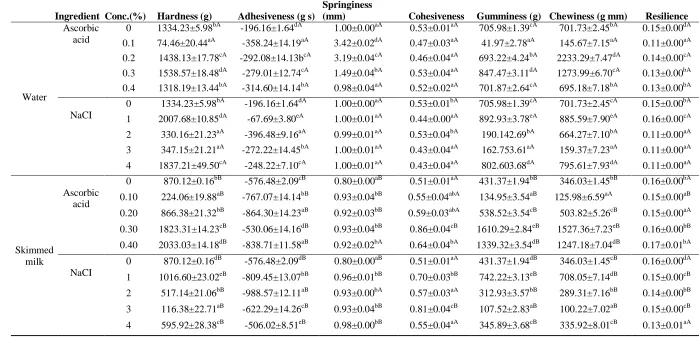
The effect of NaCI and ascorbic acid addition at different concentrations on the textural parameters of corn starch in water and skimmed milk are shown in Table 2. Hardness values of corn starch-water and milk system changed irregular with the addition of NaCI and ascorbic acid at different concentrations. However, the addition of NaCI and ascorbic acid affected the hardness value of corn starch gels significantly (P<0.05). It seemed that there were critical levels of NaCl concentration for hardness of the mixed gels. Feng et al. (2016) determined that when NaCl concentration is below the critical value, the hardness value increases. In contrast, when NaCl concentration is above the critical value, the hardness value decreases. Therefore, the addition of NaCI at appropriate concentration can improve the hardness of the corn starch-water and milk gels. In our study, similar results were determined with the addition of ascorbic acid at different concentrations.
The addition of NaCI and ascorbic acid significantly affected (P<0.05) the adhesiveness values of gel samples. Adhesiveness (g.s) values of corn starchwater and milk gels were changed between 67.69 and -396.48, -506.02 and -988.57, respectively. The adhesiveness of the starch-milk mixture is higher values than the adhesiveness of that same concentration in water. Our results were higher than the value determined by Sandhu and Singh (2007) for corn starch gels.
Springiness values of corn starch-water and skimmed milk systems changed between 0.98 to 3.42 mm, 0.80 to 0.98 mm, respectively. The springiness of corn starch-milk mixture is lower values than the springiness of corn starch-water mixture. It is thought to be this situation is related to the viscosity of a certain concentration of starch-milk mixture is higher than the viscosity of that same concentration in water.
Cohesiveness is related to the internal structure of the sample, which represents the degree of difficulty that occurred while breaking down the internal structure of the sample. In addition to elasticity and viscosity of the sample, it contains both the cohesive and adhesive forces (Yildiz et al., 2015). The cohesiveness value of the samples ranged between 0.43 and 0.86.
Another textural parameter of corn starch samples determined from TPA analysis is gumminess characterizes semi-solid foods with high degree of cohesiveness and a low degree of hardness. Gumminess is defined as the product of cohesiveness and hardness (Erim Köse et al., 2018). Gumminess value of the corn starch-water and skimmed milk samples changed between 41.97 and 1610.29.
The chewiness is calculated by multiplying hardness with springiness and cohesiveness and it is known as the energy required to masticate a solid food to a state ready for swallowing (Yildiz et al., 2015). As seen Table 2, the addition of NaCI and ascorbic acid affected the chewiness value of corn starch gels significantly (P<0.05). In general, the chewiness of starch-milk mixture is lower values than the chewiness of that same concentration in water. As above mention, chewiness values of corn starch-water and milk system changed irregular with the addition of NaCI and ascorbic acid at different concentrations. The increase or decrease in chewiness as NaCI and ascorbic acid content increased could be due to the increase or decrease in hardness as NaCI and ascorbic acid concentration increased since the formula used to calculate chewiness is known as the multiplication of hardness with springiness and cohesiveness.
The other textural parameter determined in this study for corn starch-water and milk mixture is resilience.
Table 2. Impact of NaCI and ascorbic acid addition at the different concentration on the textural parameters of corn starch in water and skimmed milk (mean±standart deviations) For ascorbic acid and NaCI, Mean values shown by different letters (a-d) show differences between the concentrations (P<0.05),
For the same ingredient, Mean values in the same column shown different letters (A-B) between the water and skimmed milk (P <0.05),
PV: Peak viscosity, TV: Trough viscosity, BV: Breakdown viscosity, FV: Final viscosity, SV:Setback viscosity, PeT:Peak time, PaT: Pasting temperature
Ingredient Conc.(%) Hardness (g) Adhesiveness (g s)
Springiness
(mm) Cohesiveness Gumminess (g) Chewiness (g mm) Resilience
Water
Ascorbic acid
0 1334.23±5.98bA -196.16±1.64dA 1.00±0.00aA 0.53±0.01aA 705.98±1.39cA 701.73±2.45bA 0.15±0.00dA 0.1 74.46±20.44aA -358.24±14.19aA 3.42±0.02dA 0.47±0.03aA 41.97±2.78aA 145.67±7.15aA 0.11±0.00aA 0.2 1438.13±17.78cA -292.08±14.13bcA 3.19±0.04cA 0.46±0.04aA 693.22±4.24bA 2233.29±7.47dA 0.14±0.00cA 0.3 1538.57±18.48dA -279.01±12.74cA 1.49±0.04bA 0.53±0.04aA 847.47±3.11dA 1273.99±6.70cA 0.13±0.00bA 0.4 1318.19±13.44bA -314.60±14.14bA 0.98±0.04aA 0.52±0.02aA 701.87±2.64cA 695.18±7.18bA 0.13±0.00bA
NaCI
0 1334.23±5.98bA -196.16±1.64dA 1.00±0.00aA 0.53±0.01bA 705.98±1.39cA 701.73±2.45cA 0.15±0.00bA 1 2007.68±10.85dA -67.69±3.80eA 1.00±0.01aA 0.44±0.00aA 892.93±3.78eA 885.59±7.90eA 0.16±0.00cA 2 330.16±21.23aA -396.48±9.16aA 0.99±0.01aA 0.53±0.04bA 190.142.69bA 664.27±7.10bA 0.11±0.00aA 3 347.15±21.21aA -272.22±14.45bA 1.00±0.01aA 0.43±0.04aA 162.753.61aA 159.37±7.23aA 0.11±0.00aA
4 1837.21±49.50cA -248.22±7.10cA 1.00±0.01aA 0.43±0.04aA 802.603.68dA 795.61±7.93dA 0.11±0.00aA
Skimmed
Ascorbic acid
0 870.12±0.16bB -576.48±2.09cB 0.80±0.00aB 0.51±0.01aA 431.37±1.94bB 346.03±1.45bB 0.16±0.00bA
0.10 224.06±19.88aB -767.07±14.14bB 0.93±0.04bB 0.55±0.04abA 134.95±3.54aB 125.98±6.59aA 0.15±0.00aB
0.20 866.38±21.32bB -864.30±14.23aB 0.92±0.03bB 0.59±0.03abA 538.52±3.54cB 503.82±5.26cB 0.15±0.00aA
0.30 1823.31±14.23cB -530.06±14.16dB 0.93±0.04bB 0.86±0.04cB 1610.29±2.84eB 1527.36±7.23eB 0.16±0.00bB
October 31, 2019 CONCLUSION
This investigation showed that the addition of NaCI and ascorbic acid have a significant effect on the pasting and textural properties of corn starch/water or corn starch/skimmed milk combined systems and addition of NaCI and ascorbic acid at different concentrations giving rise to irregular change. The studied corn starch-water or corn starch-skimmed milk with ascorbic acid and NaCI could be used in many different food products and process optimisation to change its pasting and textural parameters. The concentration of NaCI and ascorbic acid could be selected depending on the quality characteristics of the product and production processes. For these reasons, further studies are needed to demonstrate the relationship between corn starch and different starches with water, milk and milk components.
References
i. Abu-Jdayil B, Mohameed HA, Eassa A (2004) Rheology of wheat starch-milk-sugar systems: effect of starch concentration, sugar type and concentration and milk fat content. Journal of Food Engineering 64: 207-212.
ii. Ahmad FB, Williams PA (1999) Effect of salts on the gelatinization and rheological properties of sago starch. Journal of Agricultural and Food Chemistry 47(8): 3359-3366.
iii. Ahmad Mir S, Bosco SJD, Bashir M, Shah MA, Magbool Mir M (2017). Physicochemical and structural properties of starches isolated from corn cultivars grown in Indian temperate climate. International Journal of Food Properties 20:4, 821-832.
iv. Ai Y, Jane J (2015) Gelatinization and rheological properties of starch. Starch 67: 213 224.
v. Chiotelli E, Pilosio G, Le Meste M (2002) Effect of sodium chloride on the gelatinization of starch: A multimeasurement study. Biopolymers 63(1): 41-58.
vi. Coronato R, Biasutti EAR, Carvalho CWP, Grossmann MVE (2012). Gellan gum/cassava starch mixtures in water systems and in milk systems. Starch/Starke 64: 359-366.
vii.Erim Köse Y, Altun İ, Köse Ş (2018) Determination of texture profile analysis of yogurt produced by industrial and traditional method. International Journal of Scientific and Technological Research 4(8): 66-70.
viii. Feng T, Gao L, Zhuang H, Ye R, Xu Z, Liu Y, Bing F (2016) Effects of NaCI and CaCI2 on Physical
Properties of Mesona Blumes Gum/Rice Starch Mixed Gel.
Advance Journal of Food Science and Technology 12(3): 138-144.
ix. Gani A, Nazia S, Rather SS, Wani SM, Shah A, Bashir M (2014) Effect of g-irradiation on granule structure and physicochemical properties of starch extracted from two types of potatoes grown in Jammu & Kashmir, India. LWT-Food Science and Technology 58: 239-246.
x. Hirashima M, Takahashi R, Nishinary K. (2005) Effects of adding acids before and after gelatinization on the viscoelasticity of corn starch pastes. Food Hydrocolloids 19: 909-914.
xi. . Jyothi AN, Sasikiran K, Sajeev MS, Revamma R, Moorthy SN (2005) Gelatinization properties of cassava starch in the presence of salts, acids and oxidising agents. Starch/Starke 57:547-555.
xii.Katsuta K (1998). Effects of salts and saccharides on rheological properties and pulsed NMR of rice starch during gelatinization and retrogradation processes. In P. A. Williams, & G. O. Phillips (Eds.), Gums and stabilisers for the food industry (pp. 59–68). Cambridge, UK: The Royal Society of Chemistry.
xiii. Majzoobi M, Radi M, Farahnaky A, Tongdang Karrila T (2012) Effects of ascorbic acid on physicochemical properties of wheat starch. Journal of Food Science 77: 314-318.
xiv.Majzoobi M, Beparva P, Farahnaky A, Badii F (2014) Physicochemical properties of cross-linked wheat starch affected by L-ascorbic acid. Journal of Agricultural Science and Technology 16: 355-364.
xv. Matser AM, Steeneken PAM (1997) Rheological properties of highly cross-linked waxy maize starch in aqueous suspensions of skim milk components. Effects of the concentration of starch and skim milk components. Carbohydrate Polymers 32: 297-305.
xvii. Samutsri W, Suphantharika M (2012) Effect of salts on pasting, thermal, and rheological properties of rice starch in the presence of non-ionic and ionic hydrocolloids. Carbohydrate Polymers 87(2):1559- 1568.
xviii. Sandhu KS, Singh N (2007) Some properties of corn starches II: Physicochemical, gelatinization, retrogradation, pasting and gel textural properties. Food Chemistry 101:1499-1507.
xix.Seetharaman K, Tziotis A, Borras F, White PJ, Ferrer M, Robutti J (2001) Thermal and functional characterization of starch from Argentinean corn. Cereal Chemistry 78: 379–386.
xx. Trithavisup K, Charoenrein S (2016) Influence of acid treatment on physicochemical properties of aged rice flour. International Journal of Food Properties 19:9, 2074-2086.
xxi.Yildiz O, Yurt B, Basturk A, Toker OS, Yilmaz MT, Karaman S, Dağlıoğlu O (2013) Pasting properties, texture profile and stress-relaxation behavior of wheat starch/dietary fiber systems. Food Research International 53: 278-290.
xxii. Yildiz O, Yurt B, Toker OS, Ceylan MM, Yilmaz MT, Baştürk A (2015) Pasting, textural and sensory characteristics of the Kofter, A fruit-based dessert: Effect of molasses and water concentration. International Journal of Food Engineering 11(3):349-358.
xxiii. Wang W, Zhou H, Yang H, Cui M (2016) Effects of salts on the freze-thaw stability, gel strength and rheological properties of potato starch. Journal of Food Science and Technology 53(9):3624–3631. xxiv. Ziegler V, Ferreira CD, da Silva J, Zavareze EDR, Dias ARGD, Oliveira MD, Elias MC (2018) Heat
moisture treatment of oat grains and its effects on lipase activity and starch properties. Starch/Starke, 70, DOI 10.1002/star.201700010.