Comparative Evaluation of Some Peeling Parameters of a Rotary Cassava Peeling
Machine with Manual Knife Peeling
Author’s Details: 1
Oladipo, N.O, 2Opadotun, O.O, 2Adamade, C.A and 1Bello, M.K
1
Engineering and Scientific Services Department; 2Agro Industrial Development and Extension Department, National Centre for Agricultural Mechanization (NCAM), Ilorin, Kwara State.
Abstract:
Cassava is grown and consumed in all agro-ecological zones of Nigeria; it is a draught resistant crop rich in carbohydrates and other nutrients. Nigeria is the world’s highest producer. With its potentials, if well mechanized, cassava can improve food and nutritional security. The root is highly perishable with a span of 48 to 72hours after harvest. The more need for it to be processed timely to prevent wastage. It provides food for human and livestock; the edible starch is also useful for manufacturing and pharmaceutical industries as raw materials. Virtually all aspect of its propagation and processing have been successfully mechanized, but the peeling part is largely research in progress which has led to the design and fabrication of simple peeling tools to motorized peeling machines to ease the operation.
The traditional method of peeling is laborious and time consuming; the reason why NCAM has been working on ways of mechanizing this aspect of cassava processing. The design and fabrication of rotary cassava peeling machine was a huge success; the comparative performance evaluation of the machine and the conventional manual knife peeling was carried out using the following parameters: peeling time, peeling rate, peeling efficiency, and peeling capacity to ascertain the usefulness of the machine. It was concluded that the machine performed well.
Key Words: Comparative, Evaluation, Rotary, Peeling and Machine.
1. INTRODUCTION
Figure 1: Cassava growing regions in Nigeria (Source: Ezedinma, 2006).
Cassava is very rich in edible starch and other nutrients. It is a draught resistant crop that can boost food and nutritional security. Aside from being a source of carbohydrate for both human and livestock, it is useful in the production of starch and ethanol for manufacturing and pharmaceutical industries. Post harvest handling of cassava is essential to reduce losses. Processing of cassava into finished or semi-finished products often involves all or some of the following operations, depending on the desired end-product: peeling, washing, grating/chipping, dewatering, fermentation, pulverizing, sieving, pelletizing, and drying/frying (Oriola and Raji, 2013).
Peeling, which is the removal of periderm and cortex from the root is still largely done manually. This is laborious and time consuming; also the quality of the end product is low due to contaminations. Hence, the effectiveness is low and not suitable for commercial purposes.
Research efforts have been devoted to the development of peeling machines by many research institutes and individual researchers since when the search for effective peeling mechanisms really started; the peeling tools of the National Centre for Agricultural Mechanization (NCAM) were invented to substitute for primitive knives, and it proved effective but still manually operated. Currently, some peeling machines have been developed, and these include continuous process cassava-peeling machine, horizontal cassava peeler, rotary cassava peeler, etc.
A most recent effort by the Centre to improve mechanical peeling is the design and fabrication of a motorized rotary cassava peeler. The machine was tested and some peeling parameters such as peeling rate, tuber loss, peeling time and peeling capacity were evaluated in comparison with the conventional manual knife peeling to ascertain its efficiency. 2.0. MATERIALS AND METHODS
2.1. Machine Description
The rotary peeling machine is cylindrical in shape; made of mild steel. The surface diameter is about 100Cm. The inner part is made of galvanized mild steel perforated to give abrasion. It has a rigid vertical wall and a rotary circular base. It has three discharge outlets: the peeled cassava discharge outlet and the other two for peel discharge. The machine is powered by a 6hp diesel engine connected to a speed reduction gear of ratio 1:40 through the shaft at the base of the machine.
2.2. Working Principle
The machine works by abrasion; the perforated inner surface gives the needed abrasion for peeling through the rotary base which spins the loaded tubers. Washing is done concurrently by intermittent flushing during operation to remove peels.
Plate 1: Pictorial view of the motorized Rotary Cassava peeling machine.
2.3. Materials
i. Cassava: The cassava used for this evaluation was sourced from NCAM cassava farm. ii. Analog weighing scale
iii. Tachometer iv. Stopwatches
vii. Bowls and pales viii. Kitchen knives
2.4. Experimental Procedures
Tubers of irregular shapes were used for the testing; 30kg of Cassava was weighed out in three replicates each for both mechanical and manual peeling operations. The speeds of both the unloaded and loaded motorized peeling machine were read and recorded.
Three individuals were used for the manual knife peeling; the operations (manual and mechanical peeling) were started concurrently and timed. The weight of peels gotten was taken and recorded from the outlet chute of the machine. The procedure was repeated for the three replicates for the machine. The weight of peel from the manual knife peeling was taken and recorded for each of the replicates as well.
Plate 2: Machine Peeled cassava Plate 3: Manual knife peeling.
2.5. Evaluated Parameters
The evaluation was carried out using formulae (modified) by Olukunle and Jimoh, 2012 as follow:
1. Peeling Rate (Pr):
P
W
P
t C r
Where,
Pr is the peeling rate in kg/s;
WC is the weight of tuber fed into the machine (kg);
Pt is the time of operation in (s).
2. Determination of tuber losses (TL): 100
W
W
T
C TP L
Where,
TL is the tuber loss (%);
WC is a weight of tuber before peeling, kg;
3. Peeling Efficiency (PE): 100
W
W
P
C TC E Where,PE is peeling efficiency (%);
WTC is the weight of peeled tuber collected, kg;
WC is a weight of tuber before peeling, kg.
4. Machine Output Capacity (MTC):
M
TC
P
r
3600
5. Peeling Time: was determined directly using the stopwatch and record.
3.0. RESULTS AND DISCUSSIONS
3.1. Results
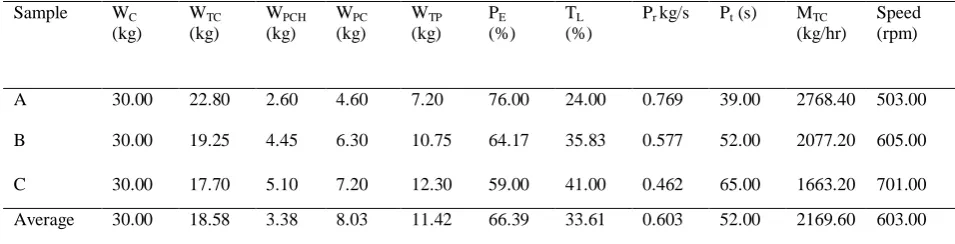
Some parameters Evaluated from the Machine and manual knife peeling operations are presented in tables 1 and 2 respectively.
Table 1: Some Parameters Evaluated from the Rotary Peeling Machine.
Sample WC
(kg) WTC (kg) WPCH (kg) WPC (kg) WTP (kg) PE (%) TL (%)
Pr kg/s Pt (s) MTC (kg/hr)
Speed (rpm)
A 30.00 22.80 2.60 4.60 7.20 76.00 24.00 0.769 39.00 2768.40 503.00
B 30.00 19.25 4.45 6.30 10.75 64.17 35.83 0.577 52.00 2077.20 605.00
C 30.00 17.70 5.10 7.20 12.30 59.00 41.00 0.462 65.00 1663.20 701.00
Average 30.00 18.58 3.38 8.03 11.42 66.39 33.61 0.603 52.00 2169.60 603.00
Table 2: Some Parameters Evaluated from Manual Knife Peeling Operation.
Sample WC (kg) WTP (kg) TL
(%)
PE (%)
Pt Pr kg/s PC
(kg/hr)
A 30.00 23.80 20.67 79.33 54min50s 0.009 32.40
B 30.00 23.60 21.33 78.67 101min31s 0.005 18.00
C 30.00 22.60 26.00 75.33 47min5s 0.011 39.60
Average 30.00 23.33 22.67 77.78 67min49s 0.025 30.00
Notations:
WC – Weight of fresh cassava (kg); WTC – Weight of peeled tuber collected from the machine (kg); WPCH – Weight of
peel collected from the machine by hand (kg); WPC – Weight of peel flushed out of the machine during operation (kg);
WTP – Total weight of peel collected from the machine (kg); PE – Performance efficiency of the machine (%); TL –
Tuber Loss (kg); Pr – Peeling Rate (kg/s); Pt – Peeling Time (s) and MTC – Machine Throughput Capacity (kg/hr).
3.2. Discussions
2. Peeling Efficiency: an average peeling efficiency of 66.39% was recorded for the machine and 77.78% for manual knife peeling. There is a clear mark in the efficiency of the two operations; the efficiency of peeling machines among other parameters depends on the optimum operational speed as reported by Olukunle and Jimoh (2012), that the higher the operational speed, the lower the peeling efficiency. This was observed as the efficiency of the machine decreased with an increase in speed (table 1) for each replicate with the best result gotten at the 503rpm speed of operation.
3. Tuber Loss: The tuber loss was estimated by the weight of peel collected from each operation. Manual knife peeling had an average tuber loss of 22.67% compared to 33.61% for the rotary peeling machine. This also is distinct; the tuber loss in peelers is influenced by the speed of operation as reported by Olukunle and Jimoh (2012) that the higher the speed, the higher the tuber loss. It was observed that tuber loss increased with increase in speed of operation (table 1).
4. Machine Output Capacity: The output capacity which represents the output per hour of the two operations showed that the rotary peeling machine had an average output of 2169.60kg/hr (table 1) compared to 30kg/hr (table 2) for manual knife peeling. This is due to the speed of operation for the machine.
RECOMMENDATION
From the observations during this evaluation and testing, it is recommended that an optimum peeling speed is determined for the machine to help operators get the best output.
CONCLUSIONS
It was concluded that the machine average overall performance was good with peeling efficiency of 66.39%, tuber loss of 33.61%, throughput capacity of 2169.60kg/hr and average peeling time of 52s at an average speed of 603rpm.
Acknowledgments
We thank NCAM management for sponsoring the design and fabrication of the machine; staff and head of the department of engineering and scientific services (ESS) for supporting this research work.
REFERENCES
i. Ezedinma, C. (2006). Structure and Profitability of Cassava Enterprises in Nigeria, paper presented at the Root and Tuber Expansion Programme (RTEP) Training Workshop on Rural Enterprise Management and Community-Driven Development at ARMTI, Ilorin.
ii. FAO. (2019). FAO in Nigeria: Nigeria at a glance. Retrieved 15th January, 2019 from: www.fao.org/nigeria-at-a-glance.
iii. NBS, (2007). Filling the Data Gaps, National Bureau of Statistics.
iv. Olukunle, O.J and M.O. Jimoh. 2012. Comparative analysis and performance evaluation of three cassava peeling machines. International Research Journal of Engineering Science, Technology and Innovation (IRJESTI) Vol. 1(4) pp. 94-102, July 2012. Available online: http://www.interesjournals.org/IRJESTI.