Please cite this article as: A. N. Patel, B. N. Suthar, Design Optimization of Axial Flux Surface Mounted Permanent Magnet Brushless DC Motor For Electrical Vehicle Based on Genetic Algorithm, International Journal of Engineering (IJE), IJE TRANSACTIONS A: Basics Vol. 31, No. 7, (July 2018) 1050-1056
International Journal of Engineering
J o u r n a l H o m e p a g e : w w w . i j e . i rDesign Optimization of Axial Flux Surface Mounted Permanent Magnet Brushless
DC Motor For Electrical Vehicle Based on Genetic Algorithm
A. N. Patel*a, B. N. Sutharb
a Electrical Engineering Department, Institute of Technology, Nirma University, Ahmedabad, India b Electrical Engineering Department, Government Engineering College, Bhuj, India
P A P E R I N F O
Paper history:
Received 28 November 2017
Received in revised form 16 February 2018 Accepted 23 February 2018
Keywords:
Axial Flux Permanent Magnet Brushless DC
Motor
Computer Aided Design
Finite ElementAnalysis Optimization Genetic Algorithm
A B S T R A C T
This paper presents the design optimization of axial flux surface mounted Permanent Magnet Brushless DC motor based on genetic algorithm for an electrical vehicle application. The rating of the motor calculated form vehicle dynamics is 250 W, 150 rpm. The axial flux surface mounted Permanent Magnet Brushless DC (PMBLDC) motor was designed to fit in the rim of the wheel. There are several design variables e.g. air gap flux density, slot loading, magnet spacer width, ratio of outer to inner diameter, air gap length, current density and space factor. The main contribution in the present work is to propose the best combination of design variables obtained using genetic algorithm (GA) optimization technique and design of motor based on optimized design variables. Final validation is carried out with the help of 3-D finite element analysis (FEA) for GA based constraint and unconstraint design. The entire procedure based on GA is explained with the help of block diagram. Efficiency of the axial flux surface mounted PMBLDC motor is enhanced from 88.15 to 91.5 % using GA based design optimization. Proposed optimization technique and methodology will be useful for performance improvement of any nonlinear engineering design involving various design variables for specific application.
doi: 10.5829/ije.2018.31.07a.07
1. INTRODUCTION1
In order to reduce dependence on fossil fuel and air pollution produced by automobiles, one better option is to use electric vehicle powered by batteries and using electrical motor as a prime mover. Significant attention is paid to electric mobility by major automoile payers in recent years to provide environmental friendly option for transportaion. Electrical motors used in electric vehicle should possess high operational efficiency and high power density. High power density and high operational efficiency resulted in to less electric vehicle weight and more range of driving. The Permanent Magnet (PM) motors are becoming paramount machines due to many advantages over conventional machines. PM motors are inherently efficient and compact compared to conventional motors due to application of
*Corresponding Author Email: [email protected] (A. N. Patel)
paper focuses on design optimization of dual rotor single stator axial flux PM motor. The requirements of vehicle are: laden weight of 150 kg, maximum speed is 25 kmph and acceleration requirement is 25 kmph in 9 second. The rating of axial flux PMBLDC motor is calculated for this application using vehicle dynamic equations [5-7]. Motor rating of 250 W, 150 rpm calculated as per application requirements and vehicle dynamics. Sandwiched stator double rotor PM motor of 250 W and 150 rpm is designed assuming proper design variables. Computer Aided Design (CAD) algorithm is finalized. Design optimization is done using Genetic Algorithm (GA) technique. Thus, the main objective in the present work is to propose the best combination of design variables obtained using genetic algorithm (GA) optimization technique and design of motor based on optimized design variables. Finite Element Analysis (FEA) is carried out to validate CAD based design and GA based optimized design. Following sections of paper explain this work carried out and analyzed the obtained results.
2. VEHICLE DYNAMICS
Tractive force required for propelling the vehicle mainly consists three forces [5]:
(i) Frictional force (Fr)
cos sin
r r
F m g f m g (1)
(ii) Aerodynamic drag (Fw)
2
1 2
w a f d
F A C v (2)
(iii) Accelerating force (Fa)
a
dv
F m a m
dt
(3)
The above parameters are described in Table 1. Torque required is calculated by following equations.
t
TFr (4)
where, Ft is tractive force and r is radius of wheel. Calculated rating of motor based on the parameters of Table 1 and vehicle dynamics are represented in Table 2.
3. COMPUTER AIDED DESIGN OF AXIAL FLUX PMBLDC MOTOR
There are four main stages of electrical motor design: (i) Calculation of main dimensions (ii) Design of stator (iii) Design of rotor (iv) Performance analysis [8]. The
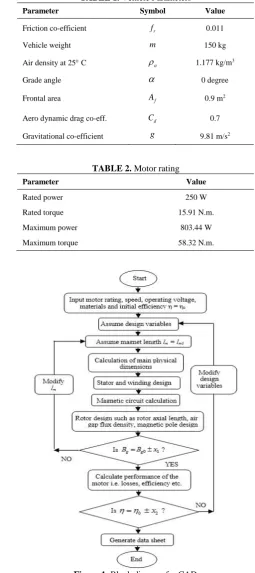
block diagram of computer aided design (CAD) program for Axial Flux surface mounted PMBLDC motor is shown in Figure 1.
TABLE 1. Vehicle Parameters
Parameter Symbol Value
Friction co-efficient fr 0.011
Vehicle weight m 150 kg Air density at 25 C a 1.177 kg/m3
Grade angle 0 degree Frontal area Af 0.9 m2
Aero dynamic drag co-eff. Cd 0.7
Gravitational co-efficient g 9.81 m/s2
TABLE 2. Motor rating
Parameter Value
Rated power 250 W Rated torque 15.91 N.m. Maximum power 803.44 W Maximum torque 58.32 N.m.
Input data for CAD includes motor power rating, speed, operating voltage, initially assumed efficiency and material availability. Based on input data design and performance estimation is done [9]. The flowchart contains two loops. If error between obtained air gap flux density and assumed air gap flux density is not within acceptable error band (±x2 %) then inner loop will change the length of magnet (lm) and if error between calculated efficiency and assumed efficiency is not within acceptable error band (±x2 %) then outer loop will modify initially assumed design variables. The volume of the applied materials which depend on the motor geometry have significant impacts on the motor cost [4].
Losses in axial flux surface mounted PMBLDC motor is classified as copper loss, iron loss and friction-windage loss. Copper loss (Pcu) due to winding resistance can be obtained form following equations.
2
2* *
cu ph ph
P I R (5)
2
* *
*
s o i s
cp s
n R R
R
K A
(6)
2
* * * 2 4* *
s bi s
e
cp s
n w d
R
K A
(7)
* s
ph
h e s
p
N R R
R
N
(8)
where, Rs slot resistance, Re end turn resistance, Iph current per phase, Rph phase resistance, ns numer of conductors per slot, Ro outer diameter, Ri inner diameter, kcp packing factor and As slot area.
Iron loss (Pi) depends on two major components called hysteresis loss and eddy current loss. Iron loss can be otained form following equation.
1.6 2 2
i h m e m
PK B fK B f (9)
where, Kh hysteresis coefficiecnt, Bm maximum flux density in core, f frequency of flux reversal and Ke coefficiecnt of eddy current loss.
3 5 5
&
1
( n )(D D ) 2
f w f r o i
P C (10)
Friction and windage loss (Pf&w) depends on many factors like friction coefficienct, air density and speed. It is usually assumed 20% of iron loss in low speed machine. Motor efficiecny is expressed as follows:
&
Pout Pout
Efficiency P Losses P P P P
cu
out out i f w
(11)
The above equation is selected as an objective function for optimization.
4. DESIGN OPTIMIZATION BASED ON GENETIC ALGORITHM
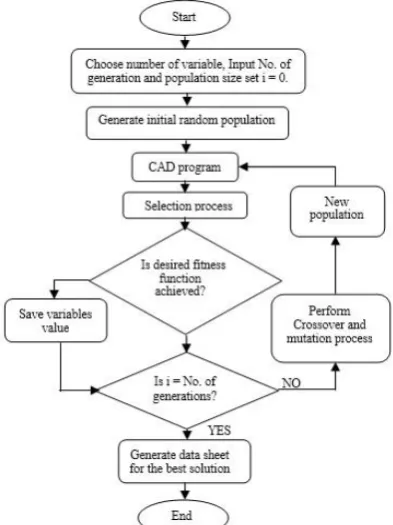
Genetic Algorithm (GA) is considered the most appropriate optimization technique for electrical motor design because it is nonlinear process involving many design variables having specified upper band and lower band [10]. Usually design variables affect each other and vary simultaneously. The nonlinear nature of the GA makes it the most suitable for motor design optimization. GA starts with number of design variables used for optimal design, the function which is to be optimized (fitness function), number of populations and generations, upper and lower limits of design variables. Figure 2 illustrates block diagram of GA based optimization technique. To optimize motor design there are mainly four operators: (i) Generate population (ii) Selection (iii) Crossover (iv) Mutation. Here motor efficiency is taken as a fitness function.
5. DETAILS OF SIMULATION
Influential design variables are identified based on parametric analysis carried out in CAD of Axial Flux surface mounted PMBLDC motor. Table 3 shows five influential design variables with appropriate range for optimization. Range of design variables is selected based on availability of materials, manufacturability and performance requirement.
TABLE3.Range of design variables
Variable Range
Minimum Maximum
)
g
B
(
Air gap flux density 0.4 T 0.9 T
)
s
I
(
Slot electrical loading 100 A 400 A
)
r
K
(
Stator diametric ratio 1.3 2.5
)
max I
(
Max. current density 4A/mm2 10A/mm2
)
g
l
(
Air gap length 0.25 mm 1.0 mm
Application of rere earth magnets allow air gap flux density between 0.4 to 0.9 T. Current density between 4-10 mm2, air gap length between 0.25 to 1.0 mm and slot loading between 100 to 400 A is recommended for permanent magnet motor [9].
Table 4 illustrates each chromosome’s 1x5 array for proposed optimization. The population is arbitrarily produced from the given ranges of various design variables. Population is a set of different chromosomes which have different genes and different values for the objective function. Each of the chromosomes are arbitrarily generated and only one of the chromosomes from the whole population is considered.
In selection procedure, whole population is initially sorted according to the fitness value. The selection process retains the chromosome with high efficiency and discards the chromosomes with lowest efficiency.
The process of crossover ensures that sufficient diversity is maintained during the entire process of genesis. The mating pool has that population which is selected based on its fitness. Genes of the two different chromosomes are exchanged arbitrarily and it produces to two completely new and different chromosomes.
The mutation process presents abrupt and random changes in the original chromosomes. The mutation is done by either increasing or decreasing the original genes by percentage indicated by the randomly generated number.
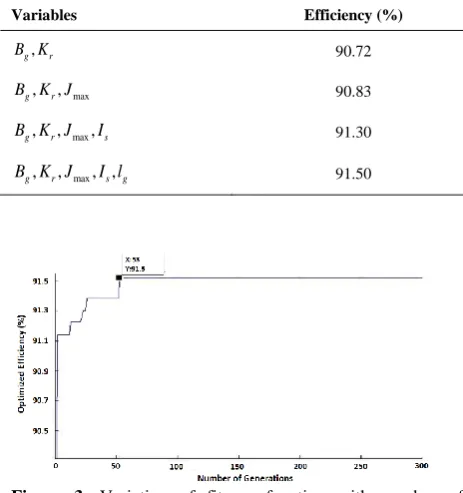
Efficiency is optimized using GA technique and effect of number of design variables on efficiency is shown in Table 5. It is observed that as the number of design variables are increased the fitness function (efficiency) is improved.
Note that in the present study the population size selected was 100 with cross over probability as 75 and 1% mutation rate. The simulations were always carried out for 300 generations, however in few cases it is observed that the optimized result is achived within 53 generations as shown in Figure 3. The execution time for the simulation was found to be 12.34 s for 300 generations.
TABLE 4. Chromosome representation
g
B Is Kr Imax lg
TABLE5.Effect of number of variables on optimal efficiency
Variables Efficiency (%)
,
g r
B K 90.72
max
, ,
g r
B K J 90.83
max
, , ,
g r s
B K J I 91.30
max
, , , ,
g r s g
B K J I l 91.50
Figure 3. Variation of fitness function with number of generations in unconstraint design
The simulations were carried out on Intel CPU core 3, I3-4150 @ 3.50 GHz with 4 G RAM. Figure 3 illustrates that as number of generations are increased the fitness function (efficiency) is improved. Optimum efficiency of 91.5 % converged after 53 generations. Figure 4 shows per unit relative performance of the motor with CAD based design, GA based unconstraint and constraint design by taking CAD based design as a base. Design constraint represents limitation imposed of machine design. Constraints restrict the range of design variables due to space, manufacturability and economic considerations. Axial length of motor is considered as dimensional constraint in constraint based optimization in this work. Initial efficiency of 88.15% obtained with CAD ased design. It is observed that GA based unconstraint design with 5 variables gives the highest efficiency of 91.5% but with higher penalty of more weight of the motor 12.57 kg and hence more cost.
Figure 4. Relative performance of CAD and GA based optimized design
TABLE6. Comparison of CAD and GA based design
Parameters
CAD based design
GA based optimized design
Unconstraint Constraint
Efficiency (%) 88.15 91.50 90.85 Outer diameter (mm) 178 206.8 196.8 Inner diameter (mm) 102.8 114.8 89.8 Number of turns/slot 26 18 20 Axial length (mm) 71.2 80.9 74 Weight (kg) 7.81 12.57 12.01
6. FINITE ELEMENT ANALYSIS (FEA)
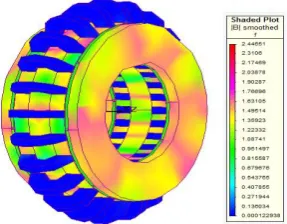
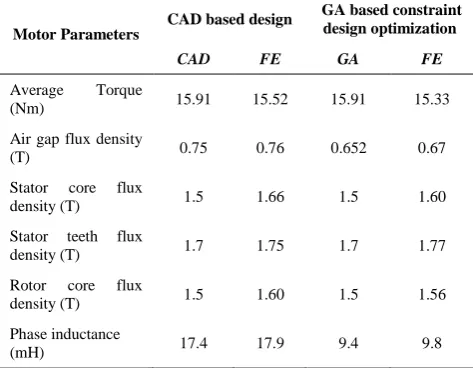
Three dimensional finite element analysis (FEA) is carried out to validate CAD and GA based constraint design. Data obtained from CAD and GA based design is used as input for FEA. FEA is used to obtain torque profile and magnetic circuit analysis of motor. Results obtained from the FEA validate CAD and GA based designs and comparative analysis is shown in Table 7. Flux density distribution of CAD based designed motor and GA based constraint designed motor is obtained from FEA and shown in Figures 5 and 7. Flux densities obtained in various sections of magnetic circuit are in line with the assumed flux densities, respectively. Torque profile of CAD based designed motor and GA based optimized (constraint) motor design are shown in Figures 6 and 8, respectively. Average torque obtained from FEA is fairly matching with CAD based designed motor and GA based optimized motor. Torque developed in FEA is marginally less by 2.45 and 3.64 % with reference to CAD and GA based optimization, respectively. This marginal difference is ascribed due to empirical formulas and nonlinear characteristic of magnetic materials.
Figure 5. 3-D flux density distribution of the CAD based AFPMBLDC motor
Figure 6. Torque profile for CAD based motor design
Figure 7. 3-D flux density distribution of the GA based optimized AFPMBLDC motor
TABLE 7. Validation of Designed Axial flux PMBLDC motor
Motor Parameters CAD based design
GA based constraint design optimization
CAD FE GA FE
Average Torque
(Nm) 15.91 15.52 15.91 15.33 Air gap flux density
(T) 0.75 0.76 0.652 0.67 Stator core flux
density (T) 1.5 1.66 1.5 1.60 Stator teeth flux
density (T) 1.7 1.75 1.7 1.77 Rotor core flux
density (T) 1.5 1.60 1.5 1.56 Phase inductance
(mH) 17.4 17.9 9.4 9.8
7. CONCLUSION
Axial flux surface mounted PMBLDC motor with sandwiched stator topology offers many advantages in direct drive application. Unconstraint as well as constraint design optimization using GA technique enhances the performance of axial flux PMBLDC motor. Design optimization is carried out for 250 W, 150 rpm motor. Efficiency of same motor is increased from 88.15 to 91.50 % using unconstraint design optimization and to 90.85 % using constraint design optimization. Increment in efficiency and reduction in phase resistance is significant enhancement in performance of motor with the use of GA based optimization technique. Finite element analysis (FEA) is carried out to validate the design. Results obtained from GA based constraint as well as unconstraint design are fairly matching with the results obtained from FEA. Correctness of GA based design optimization is established.
7. REFERENCES
1. Afjei, E., Hashemipour, O., Saati, M. and Nezamabadi, M., "A new hybrid brushless dc motor/generator without permanent magnet", International Journal of Engineering Transactions B Applications, Vol. 20, No. 1, (2007), 77-86.
2. Upadhyay, P., Rajagopal, K. and Singh, B., "Computer aided design of an axial-field permanent magnet brushless dc motor for an electric vehicle", Journal of applied physics, Vol. 93, No. 10, (2003), 8689-8691.
3. Ilka, R., Tilaki, A.R., Alamdari, H. and Baghipour, R., "Design optimization of permanent magnet-brushless dc motor using elitist genetic algorithm with minimum loss and maximum power density", Int. J. Mecha. Elecr. Comput. Technol, Vol. 4, No. 10, (2014), 1169-1185.
4. Azari, M.N., Samami, M. and Pahnehkolaei, S.A., "Optimal design of a brushless dc motor, by cuckoo optimization algorithm (research note)", International Journal of Engineering-Transactions B: Applications, Vol. 30, No. 5, (2017), 668-677.
5. Nair, A. and Rajagopal, K., "Generic model of an electric vehicle for dynamic simulation and performance prediction", in Electrical Machines and Systems (ICEMS), 2010 International Conference on, IEEE., (2010), 753-757.
6. Sockeel, N., Shi, J., Shahverdi, M. and Mazzola, M., "Sensitivity analysis of the battery model for model predictive control implemented into a plug-in hybrid electric vehicle", in Transportation Electrification Conference and Expo (ITEC), 2017 IEEE, (2017), 493-500.
7. Bing, L., Huiyong, C., Hongwen, H. and Jiankun, P., "The dynamic matching calculation and simulation for dual-motor driven electric vehicle", in Transportation Electrification Asia-Pacific (ITEC Asia-Asia-Pacific), 2014 IEEE Conference and Expo, IEEE., (2014), 1-5.
8. Hanselman, D.C., "Brushless permanent magnet motor design, New York: McGraw- Hill, (1994) in place of The Writers' Collective, (2003).
9. Hendershot, J.R. and Miller, T.J.E., "Design of brushless permanent-magnet machines, Oxford Univ. Press, UK, (1994) in place of Motor Design Books, (2010).
Design Optimization of Axial Flux Surface Mounted Permanent Magnet Brushless
DC Motor For Electrical Vehicle Based on Genetic Algorithm
A. N. Patela, B. N. Sutharb
a Electrical Engineering Department, Institute of Technology, Nirma University, Ahmedabad, India b Electrical Engineering Department, Government Engineering College, Bhuj, India
P A P E R I N F O
Paper history:
Received 28 November 2017
Received in revised form 16 February 2018 Accepted 23 February 2018
Keywords:
Axial Flux Permanent Magnet Brushless DC
Motor
Computer Aided Design
Finite ElementAnalysis
Optimization Genetic Algorithm
هديكچ
یحارط یزاس هنیهب هلاقم نیا رد روحم راش حطس
ی وم روت مئاد سیطانغم کبوراج نودب میقتسم نایرج رب
ا یتنژ ساس ک
.تسا هدش هئارا یکیرتکلا یوردوخ کی دربراک یارب متیروگلا تعرس
هدش هبساحم روتوم قیرط زا د یمانی ک ردوخ و 250 تاو ، 150
قد رد رود هقی .تسا روحم راش حطس ی
روتوم مئاد سیطانغم کبوراج نودب میقتسم نایرج
(PMBLDC)
ارط دش یح راب ،ییاوه فاکش راش هتیسناد دننام یفلتخم یحارط یاهریغتم .دنک تقباطم خرچ هبل اب ات یراذگ
ش ،فاک
سیطانغم هلصاف ضرع اضف روتکاف و نایرج هتیسناد ،اوه فاکش لوط ،ینورد هب ینوریب رطق تبسن ،
دوجو د دنرا . مهس یملع ارط یاهریغتم بیکرت نیرتهب داهنشیپ رضاح راک رد یلصا نیهب شور زا هدافتسا اب هدمآ تسدب یح
ه یزاس کیتنژ
متیروگلا
(GA)
.تسا هدش هنیهب یحارط یاهریغتم ساسا رب روتوم یحارط و رابتعا جنس ی اهن یی کمک اب آ زیلان رصنع دودحم D -3 ( FEA ) یارب تیدودحم اب یحارط
GA
تیدودحم نودب و ماجنا
.تسا هدش ساسا رب شور لک
GA
ب ا
لاب کمک رگاید ک ما ضوت حی هداد تسا هدش . اراک یی روحم راش حطس ی روتوم PMBLDC اب هدافتسا زا هنیهب س زا ی حارط ی رب یانبم GA زا 88.15 ات 91.5 ٪ ازفا شی هتفای .تسا یروحم راش حطس ییاراک پ شور یداهنشی هب ی هن زاس ی و نآ لوصا ارب ی سدنهم حرط ره درکلمع دوبهب ی غ یطخری غتم لماش یاهری حارط فلتخم ی ارب ی م صاخ دربراک ف
دی وخ دها
.دوب
doi: 10.5829/ije.2018.31.07a.07