Please cite this article as: V. Morenov, E. Leusheva, Influence of the Solid Phase's Fractional Composition on the Filtration Characteristics of the Drilling Mud, International Journal of Engineering (IJE), IJE TRANSACTIONS B: Applications Vol. 32, No. 5, (May 2019) 794-798
International Journal of Engineering
J o u r n a l H o m e p a g e : w w w . i j e . i rInfluence of the Solid Phase's Fractional Composition on the Filtration
Characteristics of the Drilling Mud
V. Morenov*, E. Leusheva
Saint-Petersburg Mining University, Oil and Gas Department, Saint Petersburg, Russia
P A P E R I N F O
Paper history: Received 16 January 2019
Received in revised form 19 April 2019 Accepted 02 May 2019
Keywords:
Filtration Rate Weighting Agent Drilling Mud Bridging Agent
A B S T R A C T
Filtration of the drilling mud is one of it's most important parameters, especially when drilling-in producing formation. Decrease of filtration characteristics allows reducing both solid and liquid phases's penetration zone into the formation. The study of the effect of the weighting-bridging agent's fractional composition on the filtration rate allows selecting of optimal composition of the solid phase in the the drilling mud. This paper presents studies of the static filtration rate of drilling mud with addition of various weighting-bridging agents. The obtained result indicates that an intensive decrease in the filtration rate is observed at calcium carbonate's introduction into the solution with an average particle size of up to 50 µm. Further studies should be directed to investigate the dynamic filtration rate, the possibility of "mixing" of various fractions in the composition of one solution and the evaluation of their influence on the filtration rate.
doi: 10.5829/ije.2019.32.05b.22
1. INTRODUCTION1
Drilling mud is an integral element of drilling technology. The concept of drilling mud incorporates all the working agents used to destruct rocks and remove its cuttings from the wellbore.
The hydrostatic pressure of the mud column in the wellbore during drilling, mostly, exceeds the pressure of the formation fluids. For this reason, the drilling mud penetrates permeable formations. Strong absorption does not occur here, since the solid phase of the drilling mud, presipitating in the pores and cracks in the walls of the wellbore, forms a filter cake of relatively low permeability through which only the filtrate can pass. The phenomenon of the small-particled suspension penetration into the formation during forming of a filter cake is called instant filtration, and the fluid, which flows into the formation after that, is called the mud filtrate.
Abrams [1], Kaeuffer [2] and Vickers [3] studied the properties of bridging agents and how they affect the drilling-in process of the formation. In their
*Corresponding Author Email: [email protected] (V. Morenov)
investigations, they have found fractional composition of various bridging agents and how particles of these fluids interact with the pore space of the reservoir. Ishbaev [4] studied the methods of reduction in contamination of the producing formation with mud filtrate and solid particles of drilling fluid. Dick and Heinz [5] calculated bridging agents’ optimum share in the drilling fluid in order to seal the permeable areas of the reservoir [6]. In drilling muds, it is feasible to use bridging agents, which are at the same time weighting agents (bridging-weighting agents) [7-10].
At well drilling there are two types of filtration: static and dynamic filtrations. The static filration occurring in the absence of circulation, whereas the drilling mud does not interfere with the growth of the filter cake; while dynamic filtration occurring when the drilling mud is circulating, and the growth of the filter cake is limited due to the erosion effect of the mud flow. The filtration properties of the drilling mud are usually evaluated and adjusted on the basis of tests for filtration losses according to American Petroleum Institute standard (ISO 10414-1:2008 Petroleum and natural gas industries) [11-13].
The study of filtration processes and the assessment of the effect on this process by various polymers, acids and salts are given in the works of many authors [14-16]. These works show the technological and economic efficiency of cellulose substances, acrylamide-based reagents, methyl propane sulfonic acid and sodium p-styrene sulfonate, as well as p-styrene methyl methacrylate-acrylic acid. In addition, an important aspect of the filtering process is its dynamic component, as shown in [17, 18].
The filtration rate is influenced by structuring reagents, such as clay or various polymers, as well as the solid phase of the drilling mud, which are weighting and bridging additives.
Aim of this article is to assess the effect of the fractional composition of the solution's solid phase (weighting-bridging agent) on the static filtration rate. Presented studies are a continuation of previously published work [19].
The main research focus of this work was to assess the effect of the fractional composition of the carbonate weighting agent on the rheological parameters of the drilling fluid. Based on the experimental studies, conclusions were drawn, the main of which is that calcium carbonate particles with an average particle size of 10 to 50 µm lead to an overall increase in rheology and an increase in resistance to flow of the solution. With an increase in the degree of weighting agent's dispersion, the total surface area of the material increases and the adsorption of the weighting agent particles by water and polymers rises, which contributes to the process of structure formation.
2. EXPERIMENTAL RESEARCH
Laboratory studies were aimed at determining the relationship between the size of the weighting particles and their effect on the filtration properties of drilling muds.
Carbonate samples of weighting agents of the brands Baracarb-5 (5 µm), Mex-Carb Fine (10 µm), MK-40 (40 µm), Baracarb-50 (50 µm), MK-60 (60 µm), MK-100 (100 µm), Baracarb-150 (150 µm) and barite sample of the BARITE brand weighting agent were chosen for the research objects. Sampling was carried out according to the indicator "average fraction size" (D50) [19].
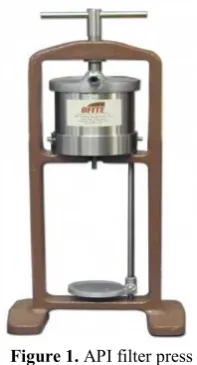
In order to measure static filtration rate, an API filter press is used (Figure 1). This value reflects the amount of liquid, filtered from the drilling mud under the pressure drop of 100 psi in 30 minutes (F30).
Methods for assessing the quality of reagents and drilling mud materials are described in ISO 13500: 2008 “Petroleum and natural gas industries. Drilling fluid materials. Specifications and tests”. The ISO standard corresponds to the Russian GOST R 56946-2016 “Oil
and gas industry. Drilling mud materials. Specifications and tests" [12].
This standard contains the technical characteristics of drilling mud materials and the rules for the application of laboratory testing methods for physical-chemical and technological characteristics of the drilling mud components for oil and gas wells.
Standard also regulates the technical conditions and tests for barite, hematite, clay powder, polymers based on cellulose ethers, starch-based reagents, biopolymers of microbiological origin and lubricant additives.
Specifications for the barite weighting agent are shown in Table 1.
Technical characteristics of carbonate weighting agents are regulated according to GOST 19219-73 and TC 5743-001-00288283-2011.
These weighting agents have become more widespread due to appearance of non-clay drilling solutions. Various international enterprises, such as “Halluburton” or “Akros”, manufacture carbonate weighting agents. Whereas production costs are more or less the same, geographic location of the drilling site determines economic feasibility [20-22].
Figure 1. API filter press
TABLE 1. Specifications for the barite weighting agent
Name of the indicator Value
Density, g/cm3, not less than 4.0-4.2
pH of aqueous extract at 10% solids content (alkaline
earth metals) 6-8
Mass part of water-soluble salts, %, incl. water-soluble
calcium, not more than 0.05
Mass part of residue, the particle diameter of which
exceeds 75 µm, %, not more than 3
Mass part of residue, the particle diameter of which
exceeds 6 µm, %, not more than 30
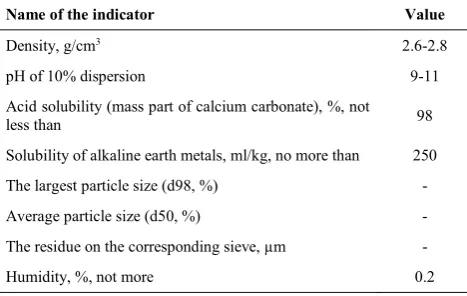
Technical characteristics of carbonate weighting agents are presented in Table 2.
Samples of weighting agents used in the presented study have been tested and meet the requirements of mentioned standards.
3. SELECTION OF DRILLING MUD FOR RESEARCH
As in the previous work [19], a non-clay biopolymer drilling mud was chosen as the basis of the drilling fluid. This drilling fluid was supposed to be used in the wellbore with depth of 1900 m, diameter of 8 ½’’ (215.9 mm). Productive part of the formation was comprised by limestone. The advantage of biopolymer solutions is that they increase the effective viscosity at low shear rates with a slight increase in plastic viscosity, which contributes to enhancing the carrying and suspending characteristics of the drilling mud and reducing the equivalent density during circulation [23, 24]. Strengthening the viscoelastic properties of drilling agents significantly improves the cleaning of the wellbore from rock cuttings, and also reduces the filtration rate of the liquid phase into the formation.
In addition, the biopolymer solution contains a smaller amount of insoluble solid phase in the composition. Therefore, there is less chance of reservoir contamination during drilling.
4. EVALUATION OF WEIGHTING AGENTS' FRACTIONAL COMPOSITION INFLUENCE ON DRILLING MUD FILTRATION INDEX
For each experiment, a solution sample was prepared; the density of the initial suspension was 1050 kg/m3.
The required amount of reagents for the preparation of the solution is shown in Table 3. Then the density of each solution sample was increased to 1160 kg/m3 with
corresponding weighting agent.
TABLE 2. Specifications for the carbonate weighting agent
Name of the indicator Value
Density, g/cm3 2.6-2.8
pH of 10% dispersion 9-11
Acid solubility (mass part of calcium carbonate), %, not
less than 98
Solubility of alkaline earth metals, ml/kg, no more than 250 The largest particle size (d98, %) -
Average particle size (d50, %) -
The residue on the corresponding sieve, µm -
Humidity, %, not more 0.2
TABLE 3. Required amount of reagents for the preparation of
the solution
Drilling mud
Component Yield, kg/m3
BARAZAN 4
KCl 50
PAC HV 3
PAC LV 3
NaOH 1.1
Na2CO3 0.5
In this work, studies were conducted to determine the static filtration rate of a biopolymer clayless drilling mud with additives of weighting agents of different fractional composition (carbonate weighting agents ranging in size from 5 to 150 µm, also the effect of barite on the filtration rate was studied) on the API filter press. The obtained data on the change in filtration rate for carbonate weighting agents are graphically illustrated in Figure 2.
The static filtration rate of the solution is inversely related to the size of the calcium carbonate particles. The larger the particle size of the weighting agent, the faster they sediment on the filter, colmataging the pores. Therefore, with an increase in the fractional composition, a decrease in the static filtration rate is observed (Figure 2). Decrease in the static filtration of the solution is observed when calcium carbonate is introduced into its composition with particle size of up to 50-60 µm inclusively (from 12 ml of the initial solution without addition of the weighing agent to 8 ml of the weighted solution with addition of 50-60 µm fraction). With a further increase in particle size, the graph flattens out, but a decrease in filtration to the minimum of 0-1 ml in 30 minutes is not achieved due to the large particle sizes and their nondense packaging. To achieve minimum filtration, it is necessary to use weighting agents of different fractions in one drilling mud.
Figure 2. Dependence of static filtration rate (F30) on
fractional composition of calcium carbonate in solution
6 7 8 9 10 11 12 13
0 10 20 30 40 50 60 70 80 90 100110120130140 150 160
Average size of weighting agent’s particles, (D50), μm Static
filtration rate,
30
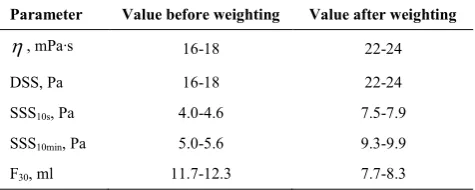
Plastic viscosity (η), as well as the main rheological parameters, such as static shear stress (SSS) calculated after 10 seconds (SSS10s) and 10 minutes (SSS10min) of
rest, dynamic shear stress (DSS) and static filtration rate in 30 minutes (F30) were also examined and analyzed
before and after its weighting with barite. Obtained data are presented in Table 4 [19].
TABLE 4. Parameters of drilling mud weighted with barite
Parameter Value before weighting Value after weighting
η, mPa·s 16-18 22-24
DSS, Pa 16-18 22-24
SSS10s, Pa 4.0-4.6 7.5-7.9
SSS10min, Pa 5.0-5.6 9.3-9.9
F30, ml 11.7-12.3 7.7-8.3
Based on the values from Table 4, which were obtained in the course of the experiments, it can be concluded that the introduction of barite into the drilling fluid changes the filtration rate. The decrease in filtration rate is associated with the process of sedimentation of weighting agent's particles and blockage of the filter's pores. However, standard barite (d50 = 75 µm) is not recommended for use when drilling-in productive reservoirs, since the process of irreversible contamination of the formation and reduction of its permeability occurs. For drilling of the oil-containing formations, it is recommended to use carbonate agents as weighting-bridging additive, which can be later removed with hydrochloric acid treatment.
5. CONCLUSION
For drilling-in productive reservoir, under otherwise equal conditions, it is more efficient to use non-clay biopolymer drilling mud. The biopolymer solution contains less solid phase, and thus reduces the likelihood of reservoir contamination.
The static filtration rate of the solution is inversely related to the size of the calcium carbonate particles. Filtration of the solution decreases with increasing size of the weighting agent fraction. However, an intensive decrease in the filtration rate is observed only when calcium carbonate is introduced into the solution with an average particle size of up to 50 µm inclusive. Further fractions' size reduces the filtration of drilling mud to a small extent. This may be explained by the fact that fast building permeable filter cake does not contribute to minimal filtration. Due to Kaeuffer and Vickers theory, it is advisable to use weighting agents of both fine and coarse fractions in one drilling solution.
The rate of filtration with the introduction of barite into the solution decreases, but standard barite (d50 = 75 µm), as was shown before, should not be used at producing reservoirs’ drilling-in, as this may lead to formation deteriorating.
Further studies should be directed to studying the dynamic filtration index, the possibility of “mixing” different fractions (due to considered theories of bridging agents’ selection) in the composition of one solution and evaluating their influence on the filtration rate.
6. ACKNOWLEDGMENT
Project is conducted within the frame of Stated scholarship for the support of young scientists grant no. SP-4606.2018.1 and SP-3147.2018.1.
7. REFERENCES
1. Abrams, A., "Mud design to minimize rock impairment due to particle invasion", Journal of Petroleum Technology, Vol. 29, No. 05, (1977), 586-592.
2. Kaeuffer, M., "Determination de l’optimum de remplissage granulometrique et quelques proprietes s’y rattachant", in Congres de I’AFTPV, Rouen., (1973).
3. Vickers, S., Cowie, M., Jones, T. and Twynam, A.J., "A new methodology that surpasses current bridging theories to efficiently seal a varied pore throat distribution as found in natural reservoir formations", Wiertnictwo, Nafta, Gaz, Vol. 23, No. 1, (2006), 501-515.
4. Ishbaev, G., Dilmiev, М., Khristenko, А. and Mileyko, А., "Bridging theories of particle size distribution", Бурение и нефть, No. 6, (2011), 16-18.
5. Dick, M., Heinz, T., Svoboda, C. and Aston, M., "Optimizing the selection of bridging particles for reservoir drilling fluids", in SPE international symposium on formation damage control, Society of Petroleum Engineers., (2000).
6. Lamb, K.F., Harper, B.F., Ali, S.A., Darring, M.T., Marine, H.C. and Foxenberg, W.E., "Fluid-loss pills control losses through sand-control screens without damage or cleanup treatment", in Asia Pacific Oil and Gas Conference and Exhibition, Society of Petroleum Engineers., (2007).
7. Ya., M., S., G., A., I., I., E., A., L. and A., K., "Marcs engineer software predicting tight packing of lost circulation materials for drilling fluids", in Drilling and Oil., (2014), 35-37
8. I.R., R. and A.M., S., "The results of the complex rheological studies of the cross-linked polymer composition for the limitation of water inflow to carbonate reservoir conditions",
International Journal of Civil Engineering and Technology, No. 2, (2019), 493-509.
9. Moradi, S.T. and Nikolaev, N.I., "Considerations of well cementing materials in high-pressure, high-temperature conditions", International Journal of Engineering, Transactions C: Aspects, Vol. 29, No. 9, (2016), 1214-1218. 10. Morenov, V. and Leusheva, E., "Energy delivery at oil and gas
11. Moradi, S.T. and Nikolaev, N., "Optimization of cement spacer rheology model using genetic algorithm", International Journal of Engineering Trans. A Basics, Vol. 29, No. 1, (2016), 127-131.
12. Standardization, I.O.f., "Petroleum and natural gas industries--drilling fluid materials: Specifications and tests, ISO, (2008). 13. Beloglazov, I., "Automation experimental studies of grinding
process in jaw crusher using dem simulation", in Journal of Physics: Conference Series, IOP Publishing. Vol. 1118, (2018), 012007.
14. Okoro, E.E., Igwilo, K.C., Ifeka, K., Okafor, I.S. and Sangotade, I., "Cellulosic cyperus esculentus l. As a filtrate loss modifier in field applicable aqueous and non-aqueous drilling fluids",
Journal of Petroleum Exploration and Production Technology, (2018), 1-7.
15. Huo, J.-h., Peng, Z.-g., Ye, Z.-b., Feng, Q., Zheng, Y., Zhang, J. and Liu, X., "Investigation of synthesized polymer on the rheological and filtration performance of water-based drilling fluid system", Journal of Petroleum Science and Engineering, Vol. 165, (2018), 655-663.
16. Mohamadian, N., Ghorbani, H., Wood, D.A. and Khoshmardan, M.A., "A hybrid nanocomposite of poly (styrene-methyl methacrylate-acrylic acid)/clay as a novel rheology-improvement additive for drilling fluids", Journal of Polymer Research, Vol. 26, No. 2, (2019), doi.org/10.1007/s10965-019-1696-6.
17. Balavi, H. and Boluk, Y., "Dynamic filtration of drilling fluids and fluid loss under axially rotating crossflow filtration",
Journal of Petroleum Science and Engineering, Vol. 163, (2018), 611-615.
18. Alshubbar, G., Nygaard, R. and Jeennakorn, M., "The effect of wellbore circulation on building an lcm bridge at the fracture aperture", Journal of Petroleum Science and Engineering, Vol. 165, (2018), 550-556.
19. Morenov, V., Leusheva, E. and Martel, A., "Investigation of the fractional composition effect of the carbonate weighting agents on the rheology of the clayless drilling mud", International Journal of Engineering, Vol. 31, No. 7, (2018), 1152-1158. 20. Moradi, S.T. and Nikolaev, N.I., "Sedimentation stability of oil
well cements in directional wells", International Journal of Engineering-Transactions A: Basics, Vol. 30, No. 7, (2017), 1105-1109.
21. Morenov, V. and Leusheva, E., "Development of drilling mud solution for drilling in hard rocks", International Journal of Engineering, Transactions A: Basics, Vol. 30, No. 4, (2017) 620-626.
22. Nikolaev, N. and Leusheva, E., "Development of drilling fluids composition for efficiency increase of hard rocks drilling",
Journal of Mining Institute, Vol. 219, (2016), 412-420. 23. Moradi, S.T., Nikolaev, N. and Leusheva, E., "Improvement of
cement properties using a single multi-functional polymer",
International Journal of Engineering, Vol. 31, No. 1, (2018), 181-187.
24. Nikolaev, N.I. and Haoya, L., "Results of cement-to-rock contact study", Записки Горного института, Vol. 226, No., (2017), 428-434. DOI: 10.25515/PMI.2017.4.428
Influence of the Solid Phase's Fractional Composition on the Filtration
Characteristics of the Drilling Mud
V. Morenov, E. Leusheva
Saint-Petersburg Mining University, Oil and Gas Department, Saint Petersburg, Russia
P A P E R I N F O
Paper history: Received 16 January 2019
Received in revised form 19 April 2019 Accepted 02 May 2019
Keywords:
Filtration Rate Weighting Agent Drilling Mud Bridging Agent
! " # $% & ' ' ( )
#* + ( ) , - . / . . 1 & ' 2 3 " ) 4 5 67$ . / 83 9'
& ' 8 / 3 " ) $ ! 8 / : 5 # + ' ( ) ;- < 5" = % >: 8 / ? @ 7 (/ / ) A / $ 1 9' B 5 . ) C 4 D5 E ' C $ /
50 ;- < @ 7 9!3 @ . . 1 ' ( ) ;- < < . / H$ # ;- < ? " & ' I J( : .: 8 / # @ 7 + ' ( ) I $
$< ' ( ) .