Modern Journal of Language Teaching Methods ISSN: 2251-6204
Vol. 6, Issue 7, October 2016
Page 1
Modern Journal of Language Teaching Methods (MJLTM)
ISSN: 2251 - 6204
www.mjltm.com
Editor – in – Chief
Hamed Ghaemi, Assistant Professor in TEFL, Islamic Azad University (IAU)
Editorial Board:
1.
Abednia Arman, PhD in TEFL, Allameh Tabataba’i University, Tehran, Iran
2.
Afraz Shahram, PhD in TEFL, Islamic Azad University, Qeshm Branch, Iran
3.
Amiri Mehrdad, PhD in TEFL, Islamic Azad University, Science and research
Branch, Iran
4.
Azizi Masoud, PhD in Applied Linguistics, University of Tehran, Iran
5.
Basiroo Reza, PhD in TEFL, Islamic Azad University, Bushehr Branch, Iran
6.
Dlayedwa Ntombizodwa, Lecturer, University of the Western Cape, South Africa
7.
Doro Katalin, PhD in Applied Linguistics, Department of English Language
Teacher Education and Applied Linguistics, University of Szeged, Hungary
8.
Dutta Hemanga, Assistant Professor of Linguistics, The English and Foreign
Languages University (EFLU), India
9.
Elahi Shirvan Majid, PhD in TEFL, Ferdowsi University of Mashhad, Iran
10.
Fernández Miguel, PhD, Chicago State University, USA
11.
Ghaemi Hamide, PhD in Speech and Language Pathology, Mashhad University
of Medical Sciences, Iran
12.
Ghafournia Narjes, PhD in TEFL, Islamic Azad University, Neyshabur Branch,
Iran
13.
Grim Frédérique M. A., Associate Professor of French, Colorado State University,
USA
14.
Izadi Dariush, PhD in Applied Linguistics, Macquarie University, Sydney,
Australia
15.
Kargozari Hamid Reza, PhD in TEFL, Payame Noor University of Tehran, Iran
16.
Kaviani Amir, Assistant Professor at Zayed University, UAE
Modern Journal of Language Teaching Methods ISSN: 2251-6204
Vol. 6, Issue 7, October 2016
Page 2
17.
Kirkpatrick Robert, Assistant Professor of Applied Linguistics, Shinawatra
International University, Thailand
18.
Mehrani Mehdi, PhD in TEFL, University of Neyshabur, Neyshabur, Iran
19.
Morady Moghaddam Mostafa, PhD in TEFL, University of Tabriz, Iran
20.
Mouton Nelda, PhD in Education Management, North-West University
(NWU), South Africa
21.
Najafi Sarem Saeid, PhD Candidate in TEFL, Islamic Azad University, Science
and Research Branch, Tehran, Iran
22.
Naicker Suren, Department of Linguistics and Translation, University of South
Africa
23.
Ndhlovu Finex, PhD, Linguistics Programme, University of New England,
Australia
24.
Raddaoui Ali Hechemi, PhD, Associate Professor of Applied Linguistics,
University of Wyoming in Laramie, USA
25.
Rezaei Saeed, PhD in TEFL, Sharif University of Technology, Tehran, Iran
26.
Rolstad Kellie, PhD, Associate Professor of Education, University of Maryland,
USA
27.
Roohbakhshfar Hamid, PhD in TESOL, Islamic Azad University, Neyshabur
Branch, Iran
28.
Sanatifar Mohammad Saleh, PhD in Translation Studies, Tabaran Institute of
Higher Education, Mashhad, Iran.
29.
Shafiee Sajad, Department of English, Shahrekord Branch, Islamic Azad
University, Shahrekord, Iran
30.
Stobart Simon, PhD, Dean of Computing, Teesside University, UK
31.
Suszczynska Malgorzata, Senior Assistant Professor, University of Szeged,
Hungary
32.
Tabeifard Sayed Javad, PhD in ELT, University of Tehran, Kish International
Campus, Iran
33.
Weir George R. S., PhD in Philosophy of Psychology, University of Strathclyde,
Glasgow, UK
34.
Zabihi Reza, PhD in TEFL, University of Neyshabur, Neyshabur, Iran
35.
Zegarac Vladimir, PhD, University of Bedfordshire, UK
Modern Journal of Language Teaching Methods ISSN: 2251-6204
Vol. 6, Issue 7, October 2016
Page 3
Abstracting/Indexing
Index
Copernicus 2011
Modern Journal of Language Teaching Methods ISSN: 2251-6204
Vol. 6, Issue 7, October 2016
Page 4
Linguistics Abstract
EBSCO Publication
Lulu Publication
Modern Journal of Language Teaching Methods ISSN: 2251-6204
Vol. 6, Issue 7, October 2016
Page 5
Directory of Open Access Journals
ProQuest
Modern Language Association
Cabell's Directories
Modern Journal of Language Teaching Methods ISSN: 2251-6204
Vol. 6, Issue 7, October 2016
Page 6
COPE
Directory of Research Journal Indexing (DRJI)
Modern Journal of Language Teaching Methods ISSN: 2251-6204
Vol. 6, Issue 7, October 2016
Page 7
Indian Citation Index
International Society of Universal Research in Sciences
Ulrich's
Modern Journal of Language Teaching Methods ISSN: 2251-6204
Vol. 6, Issue 7, October 2016
Page 8
THE IMPACT OF TASK-BASED LANGUAGE TEACHING
(TBLT) ON IRANIAN FEMALE INTERMEDIATE EFL
LEARNERS' WRITING PERFORMANCE
aMina Tasouji Azari , 1bAlireza Bonyadi
a English Department Islamic Azad University, Urmia Branch, Urmia, Iran b English Department Islamic Azad University, Urmia Branch, Urmia, Iran
ABSTRACT
THIS ARTICLE INVESTIGATED THE IMPACT OF TASK-BASED LANGUAGE TEACHING (TBLT) ON WRITING PERFORMANCE OF THE IRANIAN INTERMEDIATE EFL LEARNERS. THERE WERE TWO GROUPS OF FORTY STUDENTS OF THE INTERMEDIATE FEMALE LEARNERS STUDYING ENGLISH IN JAHAD-E-DANESHGHAHI LANGUAGE INSTITUTE, RANGING IN AGE FROM THIRTEEN TO NINETEEN. THEY PARTICIPATED IN THEIR REGULAR CLASSES IN THE INSTITUTE AND WERE ASSIGNED TO TWO GROUPS INCLUDING AN EXPERIMENTAL GROUP OF TASK-BASED LANGUAGE TEACHING (TBLT) AND A CONTROL GROUP. FOR THE PURPOSE OF HOMOGENEITY, ALL STUDENTS IN TWO GROUPS TOOK AN ACHIEVEMENT TEST BEFORE THE TREATMENT. AS A PRE-TEST; STUDENTS WERE ASSIGNED TO WRITE A TASK AT THE BEGINNING OF THE COURSE. ONE OF THE CLASSES WAS CONDUCTED THROUGH TAKING A TBLT APPROACH ON THEIR WRITING, WHILE THE OTHER CLASS FOLLOWED REGULAR PATTERNS OF TEACHING, NAMELY TRADITIONAL APPROACH FOR TBLT GROUP THERE WERE SOME TASKS CHOSEN FROM LEARNERS' TEXT BOOK. THE TASK SELECTION WAS IN ACCORDANCE WITH LEARNING STANDARDS FOR ESL AND TOFEL WRITING SECTIONS. AT THE END OF THE TREATMENT, A POST –TEST WAS ADMINISTERED TO BOTH EXPERIMENTAL GROUP AND THE CONTROL GROUP. SCORING WAS DONE ON THE BASIS OF SCORING SCALE OF "EXPOSITORY WRITING QUALITY SCALE". THE RESEARCHER USED PAIRED SAMPLES T-TEST TO ANALYZE THE EFFECT OF TBLT TEACHING APPROACH ON THE WRITING PERFORMANCE OF THE LEARNERS. THE DATA ANALYSIS REVEALED THAT THE SUBJECTS IN TBLT GROUP PERFORMED BETTER ON THE WRITING PERFORMANCE POST-TEST THAN THE SUBJECTS IN CONTROL GROUP. THE FINDINGS OF THE STUDY ALSO DEMONSTRATED THAT TBLT WOULD ENHANCE WRITING PERFORMANCE IN THE GROUP OF LEARNERS. MOREOVER, IT WAS INDICATED THAT TBLT HAS BEEN EFFECTIVE IN TEACHING WRITING PERFORMANCE TO IRANIAN EFL LEARNERS.
KEY WORDS: TASK-BASED LANGUAGE TEACHING, TASK, LANGUAGE TEACHING APPROACH,
WRITING PROFICIENCY, EFL LEARNERS.
1. Introduction
Tasks have a central role in modern SLA research and especially in language pedagogy. It is in the natural setting where the word "task" entered language teaching through work with adults who needed
[email protected]
author. Corresponding
1
Modern Journal of Language Teaching Methods ISSN: 2251-6204
Vol. 6, Issue 7, October 2016
Page 9
to use the second language outside the classes (Allwrights, 1979; Breen, 1984; Nunan, 1989; 1993 as cited in Rosa , 2004).
The advent of “task” can be traced back from 1980s, responding to dissatisfaction with dominate principles of traditional methods which had resulted in disappointing outcomes and unsuccessful learners. At that time, tasks were considered as mechanisms for production phase of teaching a language (Norris).
Scholars have defined tasks in several different ways. Long (1985) has defined task as a piece of work undertaken freely or for the some rewards: painting a fence, filling out a form…. For Crooks (1986) task is a piece of work or activity with some specified objectives, as a part of educational course, or at work. While according to Bygate (2001), task is an activity which requires learners to use language with emphasis on meaning to attain an objective.
Considering the importance and implementation of task, Task-based language teaching approach has been proposed the notion of “task” in modern pedagogy followed communicative approaches of language teaching as the main pedagogical tool.
TBLT can be defined as a process-oriented approach to language teaching that focuses on communication (Little wood, 2004; Nunan, 2004; Richards, 2005 as cited in Lai & Li, 2011). The basic point in Task-based language teaching is communicative tasks that serve as major units of curriculum while the primacy is on meaning (Lai & Li, 2011). Recently, Task-based language teaching has gained great popularity among researchers, teachers and syllabus designers in a variety of educational settings due to its signs of crystallizing in to a robust domain of inquiry, with an international conference series (www.tblt.org) , a book series (Task-based language teaching: issues, research and practice), and a healthy literature (Norris, 2009).
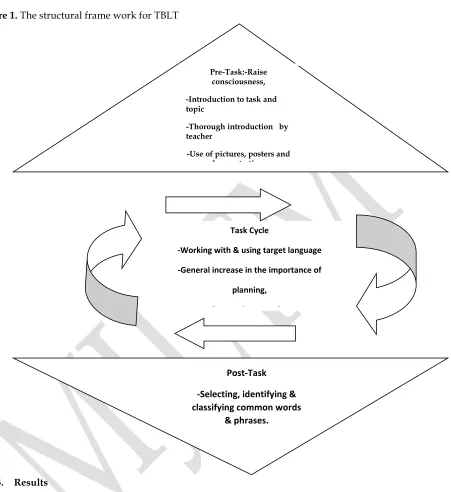
Rod Ellis (2003) was the pioneer researcher who proposed and elaborated “Task-based” instructional approach, which encompasses tasks of various kinds to develop learners’ communicative language ability. Harmer (2002 as cited in Rosa, 2004, p.208) summarized very clearly the stages of the TBL framework:
In the pre-task, the teacher discusses the topic with the class and may highlight useful words and phrases, helping the students to understand the task instructions. The students may hear a recording of people doing the same task. During the task cycle, the students perform the task in pairs or small groups while the teacher monitors from a distance. The students then plan what they will tell the rest of the class, what they did and how it went, and they then report on the task either orally or in writing. In the language focus stage the students examine and discuss specific features of any listening or reading text which they have looked up for the task and the teacher may conduct some form of practice of specific language features which the task has provoked.
Wray (2011) believes the main feature of Task-based Language Teaching is that it emphasizes on the complexity of tasks and primacy of communication. Basically, according to Ellis (2003), TBLT involves taking task as the basic for the whole language curriculum, which is a unit of syllabus in language pedagogy by applying a procedural syllabus consisting graded set of tasks to be accomplished by students. He states that “tasks are seen not a means by which learners acquire new knowledge of restructuring their inter-language, but simply as a means by which learners can activate their existing knowledge of the L2 by developing fluency” (Ellis, 2003, p. 30).
Prabhu (1987) was the first researcher to consider task as the central notion of learning and teaching a language. Later, Foley (1991) described the psychological framework of TBLT. Moreover, in an attempt to operationalize Task-based theory, Brenda Dyer (1996) investigated L1 and L2 writing theories according to
Modern Journal of Language Teaching Methods ISSN: 2251-6204
Vol. 6, Issue 7, October 2016
Page 10
Hillock's environmental mode and based language teaching. Hillock (1986) concluded that a Task-based, process / product combination was the most effective mode of teaching composition.
Consecutively, Swain and Lapkin (2000) examined the use of first language in Task-based language learning. They concluded that there was more use of L1 than was expected, so judicious use of L1 can
support L2 learning. Focusing more on the details, Carless (2003) conducted a case study, implemented
Task-based language teaching in Hong Kong to observe determining factors in the implementation of Task-based teaching in primary schools. Besides distinguishing the factors, he found out that examination would have some impact on what is going on in class, as well as the point that lack of teacher's proficiency will inhibit implementation of communicative approach.
More recently, Sánchez (2004) examined the role of Task-based approach in language teaching. Sánchez tried to bring positive results of using Task-based approach such as: more refined and complete foreign language syllabus, motivating students and focusing the attention of teachers and students on meaning and communicative language use. Meanwhile, Rosa (2004) investigated the effect of TBLT on young learners. He believed translation is a compulsory step, especially in reporting phase. One year later, in an attempt to reconsider Task-based language learning, Slimani-Rolls (2005) claimed that one-way and decision-making tasks are preferred regarding language development.
During a case study for Korean Secondary School classroom practice, focusing on EFL teachers' perceptions of Task-based language teaching, Jeon and Jung – Won Hahn (2005) stated that majority of teachers have a higher level of understanding about TBLT, although there are some negative views on using TBLT in class practices. Moreover, Kuteeva (2006) focused on students' collaboration on Task-based communication in on-line forums. Additionally, Carless (2007) examined the suitability of TBLT for secondary schools in Hong Kong, resulting in more flexible version of TBLT; namely, Task-supported Language Teaching. As a comprehensive attempt, Adams (2009) collected and speculated all books and articles on the topic of TBLT, while Norris (2009) considered key principles of TBLT. Later, Zhao (2011) questioned the role of Task-based theories in combination with communicative and form-focused approaches. He approved superiority of Task-based language teaching over traditional methods. At the same time in Asia, Butler (2011) investigated implementation of communicative and Task-based language teaching in Asia-Pacific region. The researcher found TBLT being adopted and used in many countries, while facing some challenges like: conceptual constraints, classroom-level constraints and societal-institutional level constraints.
Concerning local studies, TBLT implementation was examined by Rahimpoor (2006) proposing three kinds of TB syllabi, concluding that TBLT will lead to greater fluency and complexity among language learners.
Sadeghi and Fazelijou (2011) from Urmia University conducted a research focusing on the role of Task-supported language teaching and Task-based language teaching in EFL learner’s writing performance and grammar gains. They concluded students using revised PPP approach (TSL) learning did significantly better in grammar recognition section of the post-test, but students in Task-based language teaching did better on writings.
Considering tasks in TBLT, Maftoon and Haratmeh (2012) focused on the effectiveness of in-put _ out-put_ oriented tasks for vocabulary knowledge.
Moreover, Shabani and Ghasemi (2014), examined the effect of TBLT and CBLT (Context-based Language Teaching) on Iranian ESP learners’ Reading Comprehension, preferring TBLT as more effective approach as the result.
Modern Journal of Language Teaching Methods ISSN: 2251-6204
Vol. 6, Issue 7, October 2016
Page 11
Najjari (2014) conducted a research on the implementation of TBLT in Iran, concerning the barriers of TBLT. He resulted in a more flexible and more innovative version of TBLT to be implemented in Iran's context.
As its clear; many studies have conducted on TBLT and its efficiency and importance so far, but to the researcher’s best knowledge, few studies have focused on determining beneficial approach in teaching language, especially in the Iranian context and among intermediate EFL learners. Therefore, a research question has been formulated dealing with exploring the efficiency of Task-based Language Teaching on the development of writing proficiency. The study has addressed the following question:
RQ: Does teaching writing through Task-based Language Teaching (TBLT) have any significant effect on Iranian intermediate EFL learners' writing proficiency?
2. Research methodology
Participants
As the research question entails, the required participants need to be of the same intermediate level of second language proficiency. Since the purpose of this study is to examine potential and practical ideas for how Task-based Language Teaching can be applied to Iranian language learners, this study employed a quasi-experimental design including an experimental group and a control group of intermediate level of second language proficiency participants.
Forty intermediate female learners studying English in Jahad-e-Daneshghahi Language Institute were selected to take part in this research, ranging in age from thirteen to nineteen. They were researcher's students that participated in their regular classes in the institute who were assigned to three classes. Three students of each class were omitted due to age limitation or unmatched proficiency level after the homogeneity test. Random selection of participants in a class was impossible because they had already been assigned to their existing classes by the institute.
Instruments
To accomplish the purpose of the research, three instruments were determined as required for the study:
Homogeneity Test
In order to provide homogeneity, all students in both groups have taken an achievement test before conducting the treatment. The "General English Proficiency Test", Nelson (400B) was administered before the treatment. It consisted of four sections, i.e. vocabulary, structure, reading comprehension items. This was conducted to evaluate and ensure the proficiency level of students which was supposed to be the intermediate level. Among learners, based on their scores on Nelson proficiency test, those placed in intermediate level (within one standard deviation below and above the mean), were considered as main participants.
Pre/Post-Test
It is worth noticing that since the pre-test and post-test utilized in this study were researcher-made ones, they were piloted prior to use. Reliability indices for the pre- and post-test (0.70) revealed that the researcher-made tests were accepted for the purpose of the study. Besides, the test content was validated with regard to test instructions, the relevance of questions to content, its suitability to the research goals and objectives, and the suitability of the time allocated to the tests. The remarks of the validating team, their notes and suggestions were taken in to account, and the researcher made the necessary modifications before applying the test.
Scale for Assessing Writing
Modern Journal of Language Teaching Methods ISSN: 2251-6204
Vol. 6, Issue 7, October 2016
Page 12
The scale for Evaluating Expository Writing developed by Quellmalz (1982) was used as the framework in rating students’ writing. This is a holistic analytic instrument that has six- point scales for assessing four dimensions of writing competence, focus/organization, support and mechanics. Inter-reliability test (using Cronbach alpha) indicates that the total reliability is 0.918 from the rators' perspectives and the reliability of each of them is obtained as 0.848.
Material
The specifically regular text books of the institute are Top Notch Books series written by Saslow and Ascher (2005), which were chosen to be the base of the treatments of this study as they were the text book of the institute.
Procedure
This study has a quasi-experimental design including an experimental group and a control group. The participants needed to be of intermediate level of second language proficiency. In order to provide homogeneity, students in both groups took an achievement test before conducting the treatment.
Additionally, as a pre-test, students were assigned to write a task at the beginning. The treatments were about 20-30 minutes during each session. One of the classes received TBLT approach on their writing as the experimental group. For the experimental class, the teacher taught according to pre-task, task and post-task phases. The focus was on communication and meaning, but for the main focus was on tasks. Following the process of teaching tasks, students were asked to write about the topic in groups of two or three.
The task selection was in accordance with learning standards for ESL and TOFEL writing sections. Consequently, their writings were collected and scored by the teacher. For the end of the treatment, a post –test was administered to both experimental group and the control group. The writings were examined in terms of subject clearness, main idea clearness, beginning and end relevance, logical planning and the number of digressions. Scoring was done on the basis of scoring scale of "Expository Writing Quality Scale"
Modern Journal of Language Teaching Methods ISSN: 2251-6204
Vol. 6, Issue 7, October 2016
Page 13
Figure 1. The structural frame work for TBLT
3. Results
Null hypothesis: Teaching writing through Task-based Language Teaching (TBLT) does not have significant effect on Iranian intermediate EFL learners' writing proficiency.
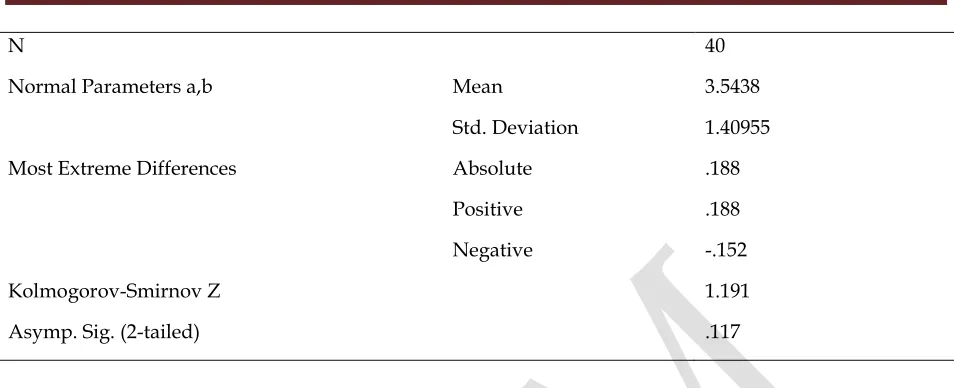
In order to determine the kind of test running, the researcher uses Kolmogorov –Smirnov test to analyze the normal status of the related data.
Table 2. One-Sample Kolmogorov-Smirnov test for Tasked Based Language Teaching
task-based
Task Cycle
-Working with & using target language
-General increase in the importance of
planning,
Report, Presentation
--
Pre-Task:-Raise consciousness,
-Introduction to task and topic
-Thorough introduction by teacher
-Use of pictures, posters and demonstrations
Post-Task -Selecting, identifying & classifying common words
& phrases. -Practice of language in
Modern Journal of Language Teaching Methods ISSN: 2251-6204
Vol. 6, Issue 7, October 2016
Page 14
N 40
Normal Parameters a,b Mean 3.5438
Std. Deviation 1.40955
Most Extreme Differences Absolute .188
Positive .188
Negative -.152
Kolmogorov-Smirnov Z 1.191
Asymp. Sig. (2-tailed) .117
One can conclude from the obtained results, where the level of significance for Kolmogorov-Smirnov test is reported as 0.117(P value >0.05), that obtained results of this method confirm the normal status of the relevant data. Based on the results of Kolmogorov-Smirnov test, the researcher uses Paired- samples t-test to study this hypothesis. Prior to statistical analyses of the hypotheses, it is necessary to change the hypotheses to statistical hypotheses.
{𝐻𝐻0: 𝜇1= 𝜇2 1: 𝜇1≠ 𝜇2
Table 3. Paired- samples t-test regarding the effect of Tasked-based Language Teaching
Since significance level (p value) is less than 0.05 (0.000), null hypothesis is rejected and alternative hypothesis is accepted i.e. teaching writing through task-based language teaching has significant effect on Iranian intermediate EFL learners' writing proficiency. In addition, 95% confidence interval (1.20608, 46892) is a positive value and this indicates that teaching writing through task based language teaching has a positive effect on writing proficiency.
As seen in the above table, the level of significance pertinent to variables is less than 0.05. It reveals that Task- based variable mean is significantly greater than that of control group. This implies that Task-based Language Teaching is more effective when compared to common traditional Language Teaching. Moreover, Task-based condition mean is significantly greater than that of control condition that proves the efficiency of TBLT on the learners' writing proficiency.
Paired Differences T df Sig.
(2-tailed) Mean Std.
Deviation
Std. Error Mean
95% Confidence
Interval of the
Difference
Lower Upper
Post-test – pre-test .83750 .78755 .17610 .46892 1.20608 4.756 19 .000
Modern Journal of Language Teaching Methods ISSN: 2251-6204
Vol. 6, Issue 7, October 2016
Page 15
4. Conclusion
Based on the findings of the study, the researcher drew the conclusion that Task -based Language Teaching had significant effect on Iranian intermediate EFL learners' writing proficiency in isolation. Also, it is clear from the study findings that this approach had significant effect on Iranian intermediate EFL learners’ writing proficiency when compared simultaneously with traditional common approach of language teaching (control group).
Being in line with most current studies and researches on the issue of teaching methods; Task-based language teaching revealed to have great benefits in learning a language. Hismanoglu and Hismanoglu (2011) cited Ellis’s (2009) list of the benefits such as:
TBLT provides opportunity for ‘natural’ learning in class.
It emphasizes on meaning, while stressing over learning form.
It brings a fertile input of target language.
It is motivating intrinsically.
It is consistent with learner-focused educational psychology, but considers teacher input and guidance important.
It encompasses improvement of communicative fluency but not ignoring accuracy.
It can be deployed together with traditional approaches"(Hismanoglu & Hismanoglu, 2011, p. 49).
It can be concluded that TBLT provides opportunities to set clear goals for the instructional courses; additionally, it ensures student-centered and authentic approaches to learning as well as providing multiple opportunities for input, production and feedback
The findings of this study can be employed in classroom teaching and instruction. By considering the limitations of TBLT and adapting this method in Iranian context. The results of the study can be useful and helpful for instructors, researchers, syllabus designers and teachers in presenting efficient and effective writing tasks. Also text-book developers for junior and senior high schools may benefit from the findings of this study in designing new materials and possibly in changing the current grammar-based textbooks used in Iran.The experiences and concerns described in the paper may be shared by teachers to move from a teacher-centered approach which is the traditional approach of teaching in Iran, to one in which the learners play a more active, independent role to teach more and better namely Task-based Language Teaching.
REFERENCES
Ahmadvand, M. &Nejadansari, D. (2014): Attention to meaning and form vs. attention to
meaning alone: The effect of focus on form on vocabulary retention of an EFL context. Procedia –Social & Behavioral Sciences.:98,2014,116-121.DOI:10.1016/j.sbspro.2014.03.396
Allen, P. (1984). Functional-analytic course design and the variable focus curriculum in Brumfit C. (ed.) ELT Documents 124: The Practice of Communicative Teaching. Oxford: Pergamon.
Allwright, R. (1979). Language learning through communication practice in Broomfit C. & K. Johnson (eds.). The communicative approach to language teaching.Oxford University Press. Batstone, R. (1994). Grammar. Oxford: Oxford University Press.
Blake, R. &Zyzik, E. El,(2003) Española y la lingüísticaaplicada. Georgetown University Press (forthcoming(
Modern Journal of Language Teaching Methods ISSN: 2251-6204
Vol. 6, Issue 7, October 2016
Page 16
Breen, M. (1987).Learner contribution to task design.In C. Candlin and D. Murphy (eds.), Language learning
Brumfit, C. (1979). Communicative language teaching: An educational perspective in C. Brumfit and K. Johnson (eds) .
Butler, Y.G. (2011). The implementation of communicative and task-based language teaching in the Asia-pacific region.Annual Review of Applied Linguistics, 31, 36-57. Cambridge University Press.
Bygate, M. (2001).Effects of task repetition on the structure and control of oral language. In M. Bygate, P. Skehan, & M. Swain (Eds.), Researching pedagogic tasks: Second language learning, teaching and
Testing(pp. 23-48). Harlow/ New York: Longman.
Cameron, L. (2001) Teaching languages to young learners. Cambridge University Press.
Carless, D, R, (2003).Factors in implementation of task-based teaching in primary schools. System, 31,485-500.
Ciubancan, L, M, (2012).From task-supported teaching to task-based learning: the case of Japanese language teaching in Romania, academia.edu, Christian University.
Crookes, G. (1989) Planning and interlanguage variation, Studies in Second Language Acquisition, 11, 367-383
Crookers, G. &Choudron, C. (2001)."Guidelines for language classroom instruction"inM.Celce-Murica(ed), Teaching English as a second or foreign language. Heinle&Heinle Thomson Learning.
Dyer, B. (1996). L1 and L2 composition theories: Hillocks’ environmental mode and task-based language Teaching.ELT journal, 50/4.
Ellis, R. (2003). Task-based language learning and teaching. Oxford: Oxford University Press.
Ellis, R. (2010).Task-based language learning and teaching with technology. In M.Thomas &H, Reinders (eds).New York/London :Continuum
Foster, P. &skehan, P. (1996). The influence of planning and task type on second language performance. Studies in second language acquition, 18, 299-323.
Goto Butler, Y. (2011). The implementation of communicative and task-based language teaching in the Asia- Pacific Region.Annual Review of Applied Linguistics. 31, 36-57.
Gowner, R. and S.Walters. (1983). Teaching Practice Handbook. England: Oxford.
Hashemi, M., Aziznezhad, M. &Darvishi,S(2012).Using task-based language teaching, learning practically in English classes. Procedia-Social&Behavioral Sciences,31,526-529.
Jacobson,N,D,(2012).Applying cognitive linguistics and task-supported language teaching to instruction of English conditional phrases.GeorgetownUniversity.Washington,DC.
Jeon,I.& Hahn,J. (2005). Exploring EFL teachers’ perceptions of task-based language teaching: A case study of Korean secondary school classroom. Asian EFL Journal .8(1) 123-143.
Kazerooni, A.(1995). Task-based language teaching.Asp[E linge],7-10.
Klapper,J.(2003).Taking communication to task. A critical review of recent trends in language teaching.Language learning journal,27,33-42.
Kotaka,M .(2013).Task-based language teaching and the Japanese English classroom. University of Hong Kong: Hong Kong.
Lia, C.& Li, G. (2011). Technology and task-based language teaching: a critical review. CALICO Journal, 28 (2), 498-521
Littlewood, W. (2004). The task-based approach: some questions and suggestions. ELT journal, 58, 319- 26.
Long, M. H. (1991). Focus on form: a design feature in language teaching methodology. In K. de Bot, R. B. Ginsberg, & C. Karmsch (eds.), foreign language research in cross-cultural perspective (pp. 39-52). Amsterdam: John Benjamins.
Maftoon, P. & Haratmeh. M.S.(2012). The relative effectiveness of input and output-oriented tasks with different involvement loads on the receptive and productive vocabulary knowledge of Iranian
EFL learners. The Journal of Teaching Language Skills.4 (2),67. 29-52.
Modern Journal of Language Teaching Methods ISSN: 2251-6204
Vol. 6, Issue 7, October 2016
Page 17
Müller, A.,Schocker,M.&Ditfurth, V.(2013). Teaching English: Task-supported language learning .Verlag Ferdinand Schoningh G mbH& co. KG.Paderborn.
Najjari,R.(2014).Implementation of task-based language teaching in Iran: Theoretical and practical considerations. Science Direct ,1307-1315.
Norris, J. M. (2009). Task based teaching and testing. The handbook of Language Teaching.Blackwell Publishing Ltd.
Nunan, D. (1989). Designing tasks for the communicative classroom.Cambridge University Press.
Nunan, D. (1993). Task-based syllabus design: selecting, grading, and sequencing tasks in Gass. S,& G. Crookers (eds.), Tasks in a pedagogical context, Multilingual Matters.
Quellmalz,E(1982): Scale for evaluating expository writing. Journal of educational measurement, 6(4), 28- 40. Rahimpour,M.(2008).Implementation of task-based approaches to language teaching,Pazhuhesh-e Zabanha-ye Khareji,41,45-61.
Revesz, A., & Han, Z. (2006).Task content familiarity, task type and efficacy of recasts. Language Awareness, 15(3), 160-179. Retrieved from ERIC database.
Richards, J. C. (2005). Communicative language teaching today (RELC portfolio series 13). Singapore: SEAMEO regional language center.
Robinson, P. (2001). Task complexity, task difficulty, and task production: Exploring interactions in a componential framework. Applied linguistics, 22, 27-57
Rosa, M. M. (2004). TBLT and young learners. Glosas Didacticas,11, 207-214
Sadeghi,K.&Fazelijou,E(2011). The role of task-supported language teaching in EFL learner's writing performance and grammar gains. The southeast Asian Journal of English language studies, 18(1), 117-127.
Samuda,V.,&Bygate,M,(2008).Tasks in second language learning,Basingstoke:Palgrave Macmillan. Sanchez,A,(2004).The task-based approach in language teaching.Intrnational Journal of English Studies.4(1),39-71.
Saslow,J. &Ascher, A.(2005). Top Notch.Pearson Education, Inc.
Shabani,M. B.,&Gasemi,A,(2014).The effect of task-based language teaching (TBLT) and content based language teaching(CBLT) on the Iranian intermediate ESP learners' reading comprehension.
Procedia - Social & Behavioral Sciences.:98,2014,1713-1721.DOI:10.1016/j.sbspro.2014.03.598. Skehan, P,(1996 b) .Second language acquisition research and task-based instruction in J. Willis and Willis and D. Willis (ed(.
Silva, C.(2006 ).Task-supported language teaching with real beginners. Center for advancement of higher education, Tokyo University.203-208
Silmani-Rolls, A. (2005). Rethinking task-based language learning: what we can learn from learners.Language Teaching Research 9,2. pp. 195-218
Song, M.-J., &Suh, B.-R. (2008).The effect of output task types on noticing and learning of the English past counterfactual conditional.System, 36(2), 295-312.
Swain, M, &Lapkin, S. (2001). ‘Focus on form through collaborative dialogue: Exploring task effects’ in Bygate, M., Skehan, P., and Swain, M (eds). Researching Pedagogic tasks: Second Language Learning, Teaching, and Testing. New York: Longman. pp 99-118
Thomas, M., &Reinders, H. (Eds.). (2010). Task-based language learning and teaching with technology.
London: Continuum.
Van den Branden, K., bygate, M., & Norris, J. M. (2009). Task-based language teaching: A reader. Amsterdam/Philadelphia: John Benjamins Publishing Company.
Willis, J. (1996). A Framework for Task-based Learning.Harlow, UK: Longman. Willis, D., & Willis, J. (2011).Doing task-based teaching. Oxford: OUP.
Wray, A. (2011). Interim evaluation of Welsh for adults teaching materials in the light of current research. (Draft Consultative Report), Cardiff University
Zheng,X.,&Borg,S.(2014).Task-based learning and teaching in China: secondary school teachers beliefs and practice: Language Teaching Research,18(2),205-221.
Modern Journal of Language Teaching Methods ISSN: 2251-6204
Vol. 6, Issue 7, October 2016
Page 18
AN INVESTIGATION OF EFL TEACHERS’ VIEWS
TOWARDS ‘PROSPECT 1’
Faraneh Rahpeimay Soumehsaraei M.A. in TEFL
Department of English, District 1, Organisation of Education, Rasht, Guilan, Iran E-mail: [email protected]
ABSTRACT
TEXTBOOKS ARE ALWAYS IMPORTANT FOR EDUCATIONAL PURPOSES. AS SUCH, TEXTBOOK EVALUATION CAN PAVE THE WAY FOR THE FULFILLMENT OF EDUCATIONAL OBJECTIVES. THIS STUDY EXAMINED THE SEVENTH-GRADE ENGLISH TEXTBOOK ‘PROSPECT 1’ WHICH IS CURRENTLY USED IN IRANIAN HIGH SCHOOLS TO DETERMINE THE EXTENT TO WHICH IT FULFILS THE EXPECTATIONS OF ENGLISH TEACHERS. TWENTY EFL TEACHERS WERE SELECTED BASED ON AVAILABILITY SAMPLING TO TAKE PART IN THIS STUDY. THE DATA WERE GATHERED THROUGH A QUESTIONNAIRE WITH LIKERT-SCALE ITEMS. THE FINDINGS REVEALED THAT ONLY 63.36% OF THE PARTICIPANTS WERE SATISFIED WITH THE TEXTBOOK. THE RESULTS IMPLY THAT THIS TEXTBOOK IS NOT QUITE AN APPROPRIATE ONE FOR THE SEVENTH-GRADE EFL LEARNERS AND MORE CARE SHOULD BE TAKEN BY THOSE WHO ARE INVOLVED IN THE PREPARATION OF TEXTBOOKS.
KEY WORDS: EVALUATION, SURVEY, TEACHERS, TEXTBOOK, PROSPECT 1
1. Introduction
According to Oxford Advanced Learners’ Dictionary, textbooks are the most familiar educational materials which are the books that teach a particular subject and are used especially in schools and colleges. Because of the importance of English language as an international language and its implementation at school levels, the English school textbooks are one of the issues worthy of further investigation. As Hutchinson and Torres (1994) stated, textbooks always play a very important role in the process of language teaching and learning, no matter how the methodologies of language teaching and learning change.
Evaluation requires due attention to the details and enumerating the strong and weak points. In evaluating a textbook, we should explore how suitable it is for the specific goals we are willing to achieve, and the students’ needs in their particular situation.
According to Sheldon (1988), textbooks are to be evaluated for two reasons. First, the evaluation will assist the teachers or program developers to make decisions on choosing the proper textbook. Furthermore, evaluation of a textbook will make the teachers familiar with its probable weaknesses and strengths. This will enable teachers to make appropriate adaptations to enhance the quality of the materials in their future instruction.
Although the significance of the textbook as a universal component of English language teaching is undeniable (Hutchinson & Torres, 1994), it is difficult to define the role of textbook in the language classroom thoroughly. Textbook is a common framework for both teachers and students. However, they should not be used from cover to cover, for meeting students' needs. Instructors need to strike a balance
Modern Journal of Language Teaching Methods ISSN: 2251-6204
Vol. 6, Issue 7, October 2016
Page 19
between being a slave to the texts and providing organized, objective-based instruction (Garinger, 2002). To do so, instructors need updated criteria for evaluation system to use as evaluation, as an underlying element in the introduction of innovations and modifications within an educational context. This is a dynamic process which examines the suitability and appropriateness of an existing practice (Rea-Dickens & Germaine 1992) and can be used as a useful device for both teachers and material writers. However, despite its undeniable role in improving different aspects of instructional programs, evaluation is not still well-accepted part of a project (Hargreaves, 1989).
One of the recent changes in the educational system in Iran is the new division in the grades. Accordingly, after the sixth grade in the primary school level, the students start junior high school, which is initiated with the 7th grade. The English textbook for the 7th grade students is “Prospect 1”, which is not
quite known to some teachers and students in high schools. That is why this textbook is chosen for a brief evaluation from both external and internal aspects. Questionnaire has become one of the most popular research instruments applied in the social sciences (Dörnyei, 2003). This study tries to investigate the degree of appropriateness of the book ‘Prospect 1’ for the students of the 7th grade in high schools in
Rasht.
2. Literature Review
Classroom teachers spend much time using textbooks in class, so choosing an appropriate one is important. Hutchinson and Torres (1994) claim that “no teaching-learning situation, it seems, is complete until it has its relevant textbook” (p. 315). Sharing the same opinion, Riazi (2003) believes that textbooks are the second most important factor, surpassed only by the teacher in language education and maintains that the teacher must know how to use their materials and how useful they can be.
Several studies have been done in the area of textbook evaluation. In what follows, some of the most important ones will be reviewed.
Ansary and Babaii (2002) believed that “teachers, students, and administers are all consumers of textbooks. All these groups, of course, may have conflicting views about what a good/standard textbook is. However, the question is where they can turn to for reliable advice on how to make an informed decision and select a suitable textbook” (Checklist Approach to Textbook Evaluation section, para. 3). Accordingly, the fundamental problem with the checklists used in their study was their dependence on the swings of the theoretical pendulum (Sheldon, 1988, cited in Ansary & Babaii, 2002). They argued that no clear formula can present a conclusive way to judge a textbook. They, therefore, compiled a list of what they deem to be a set of theory-neutral and universal features of EFL/ESL textbooks.
Jahangard (2007) evaluated four EFL textbooks which were prescribed for use in the Iranian high schools by the Ministry of Education. In his paper, the merits and demerits of the textbooks were explained in detail with reference to 13 common critical features extracted from different materials evaluation checklists. His study gave some suggestions as to how to evaluate some of the shortcomings encountered in the textbooks.
According to Riazi and Mosalanejad (2010), the textbook evaluation studies in Iran have focused on developing textbook evaluation criteria. They used most of those criteria to examine the shortcomings of the English textbook (English 1).
Ghorbani (2011) examined the first-grade English textbook used in Iran’s senior high schools based on the research findings in syllabus design, English language teaching, and the specific language teaching situation in Iran to determine the extent to which it conforms to the common universal characteristics of EFL/ESL textbooks. Detailed analysis focused specifically on the use of a checklist extracted from different EFL textbook evaluation checklists in line with the local needs. The findings showed that only 63 percent of the textbook conforms to the universal characteristics of textbooks.
Modern Journal of Language Teaching Methods ISSN: 2251-6204
Vol. 6, Issue 7, October 2016
Page 20
3. Method
3.1. Participants
A sample of 20 English teachers of 7th grade in some schools in Rasht was selected based on availability
sampling for the study. Their experience of teaching English ranged from 8 to 34 years. Some of these teachers had a B.A. and some of the others had an M.A. and their age ranged from 31 to 52.
3.2. Instrument
A questionnaire was used in this study which includes some selected items based on McDonough and Shaw (2003). This Likert-scale questionnaire consists of thirty items and is enclosed in the Appendix.
3.3. Procedures
Each participant was given the questionnaire to report her teaching experience, age and their ideas about ‘Prospect 1’. Then the questionnaires were considered to find the degree of their agreement with this textbook based on the of items including practical consideration, skills, activities and practices, and of course pedagogical purposes and methods.
Descriptive statistics (frequency and percentage) were reported for each item. To this end, the SPSS software was used to analyze the data.
4. Results
The first five items of the questionnaire (from one to five) are related to the practical consideration of the book ‘Prospect 1’ which is being taught in 7th grade at schools. The following table displays the results of
SPSS analysis (Table 1). The scores are counted out of 25.
Table 1. Practical Consideration (Items 1-5)
Frequency Percent Valid Percent
Cumulative
Percent
Valid 13 1 5 5 5
15 1 5 5 10
16 5 25 25 35
17 2 10 10 45
18 3 15 15 60
19 2 10 10 70
20 1 5 5 75
21 4 20 20 95
24 1 5 5 100
Total 20 100 100
Modern Journal of Language Teaching Methods ISSN: 2251-6204
Vol. 6, Issue 7, October 2016
Page 21
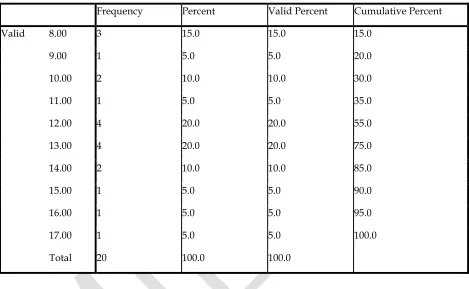
The second table in this study is related to the items six to nine in the questionnaire (See Table 2). This table reports the effectiveness of the usage of skills in the book ‘Prospect 1’ at schools. The scores are out of 20.
Table 2. Skills (Items 6-9)
Frequency Percent Valid Percent Cumulative Percent
Valid 8.00 3 15.0 15.0 15.0
9.00 1 5.0 5.0 20.0
10.00 2 10.0 10.0 30.0
11.00 1 5.0 5.0 35.0
12.00 4 20.0 20.0 55.0
13.00 4 20.0 20.0 75.0
14.00 2 10.0 10.0 85.0
15.00 1 5.0 5.0 90.0
16.00 1 5.0 5.0 95.0
17.00 1 5.0 5.0 100.0
Total 20 100.0 100.0
Following the first two tables about practical consideration and skills, the third table in the following shows the amount of agreement about the influence of activities and practices used in the book ‘Prospect 1’ for the 7th grade students (See Table 3). The third table talks about the items ten to twenty-three and
describes the percentages of the amount of teachers’ agreement by paying attention to the activities and practices used in the book. The scores mentioned in the third table are out of 70.
This table is the most important table in this study that shows the number of items in the questionnaire which are related to the activities and practices is higher than the other ones. It portrays the importance of activities and practices in the mentioned book and the English classes at schools.
Table 3. Activities and Practices (Items 10-23)
Frequency Percent Valid Percent Cumulative Percent
Valid 26.00 1 5.0 5.0 5.0
33.00 1 5.0 5.0 10.0
34.00 1 5.0 5.0 15.0
Modern Journal of Language Teaching Methods ISSN: 2251-6204
Vol. 6, Issue 7, October 2016
Page 22
35.00 1 5.0 5.0 20.0
38.00 3 15.0 15.0 35.0
39.00 1 5.0 5.0 40.0
43.00 1 5.0 5.0 45.0
44.00 2 10.0 10.0 55.0
45.00 3 15.0 15.0 70.0
47.00 3 15.0 15.0 85.0
48.00 1 5.0 5.0 90.0
53.00 1 5.0 5.0 95.0
62.00 1 5.0 5.0 100.0
Total 20 100.0 100.0
The following table is the forth one and explains the pedagogical purposes and the use of methods according to the ideas mentioned by the experienced teachers who answered the questionnaire. The scores in this table are out of 35.
Table 4. Pedagogical Purposes and Methods (Items 24-30)
Frequency Percent Valid Percent Cumulative Percent
Valid 16.00 1 5.0 5.0 5.0
17.00 1 5.0 5.0 10.0
18.00 1 5.0 5.0 15.0
19.00 1 5.0 5.0 20.0
20.00 2 10.0 10.0 30.0
21.00 4 20.0 20.0 50.0
22.00 1 5.0 5.0 55.0
23.00 4 20.0 20.0 75.0
25.00 1 5.0 5.0 80.0
26.00 1 5.0 5.0 85.0
28.00 2 10.0 10.0 95.0
Modern Journal of Language Teaching Methods ISSN: 2251-6204
Vol. 6, Issue 7, October 2016
Page 23
31.00 1 5.0 5.0 100.0
Total 20 100.0 100.0
5. Discussion and Conclusion
Based on the information presented in the tables in the previous section (Tables 1-4), the book ’Prospect 1’ is not found to be a satisfactory textbook for the students of 7th grade in high schools. The teachers who
answered the questionnaire items were not so much satisfied with this book and showed their disagreement in this way.
The following table (Table 5) shows the conclusion in percentages. As mentioned in the table, just 72.4% agreement is gained about the practical consideration of the book which is the highest amount of satisfaction, and the others are all less than this percentage.
Next, pedagogical purposes and exercises used in this way got 63.7% of satisfaction and different activities used in the book reached only 60.92% of agreement. The last one, which is the lowest, is related to skills and reveals about just 60% of satisfaction.
Total satisfaction of the teachers about the book ‘Prospect 1’ in 7th grade of high schools is just 63.36%
which does not seem to be high enough.
Table 5. Total Evaluation of the Book ‘Prospect 1’
Section Score Perfect Percentage
Practical consideration 362 500 72.4%
Skills 240 400 60%
Activities and practices 853 1400 60.92%
Pedagogical purposes and methods 446 700 63.7%
Total 1901 3000 63.36%
Thus, it is necessary for teachers to be well-qualified to evaluate materials and be sure that students are using the suitable ones for their language learning experience and textbooks should effectively match the identified needs of the learners. It should be also possible for curriculum developers, administrators and teachers to try to focus more on how to maximize intake rather than concentrating on language item coverage (Ghorbani, 2011).
Implications suggest that all material developers need to use the appropriate checklists with more acceptable characteristics which are adapted to meet the the needs of the EFL learners. Some of the textbooks lack many of the criteria of a really valuable book. Therefore, it is necessary to carefully check all aspects of the materials, especially textbooks. To sum up, modifications need to be made in the existing textbooks to make sure that the educational goals are achieved as expected. To this end, textbook evaluation in various contexts recruiting different EFl instructors can shed light on the potential weaknesses and drawbacks.
Modern Journal of Language Teaching Methods ISSN: 2251-6204
Vol. 6, Issue 7, October 2016
Page 24
REFERENCES
Ansary, H. & Babaii, E. (2002). Universal characteristics of EFL/ESL textbooks: A step
towards systematic textbook evaluation. The Internet TESL Journal, 8(2). Retrieved from http:/iteslj.org/Ansary-textbooks/
Dörnyei, Z. (2003). Questionnaires in second language research: Construction, administration, processing. London, LEA.
Garinger, D. (2002). Textbook selection for the ESL classroom. Center for Applied Linguistics Digest. Retrieved from http://www.cal.org/resources/Digest/0210
Ghorbani, M. (2011). Quantification and graphic representation of EFL textbook evaluation results. Theory and Practice in Language Studies, 1(5),511-520.
Hargreaves, A. (1989). Curriculum and assessmentreform. Toronto: OISE Press.
Hutchinson, T. & Torres, E. (1994). The textbook as agent of change. ELT Journal,48, 315-328. Jahangard, A. (2007). The evaluation of the EFL materials taught at Iranian public high schools. Karen’s Linguistics Issues. Retrieved fromhttp://www3.telus.net/linguisticsissues McDonough, J. & Shaw, C. (2003). Materials and methods in ELT: A teacher’s guide (2nd ed.)
Publishing. Oxford: Blackwell Publishers.
Mukundan, J., Hajimohammadi, R. & Nimehchisalem, V. (2011). Developing an English language textbook evaluation checklist.Contemporary Issues In Education Research, 4(6), 21-27. Rea-Dickens, P. & Germaine, K. (1992). Evaluation. Oxford: Oxford University Press.
Riazi, A. M. (2003). What do textbook evaluation schemes tell us? A study of the textbook evaluation schemes of three decades. In Methodology and materials design in
language teaching (pp, 52-69). Current perceptions and practices and their implications. SEAMEO Regional Language Centre.
Riazi, M., & Mosalanejad, N. (2010). Evaluation of learning objectives in Iranian high-school
and pre-university English textbooks using Bloom’s Taxonomy. The Electronic Journal for English as a Second Language, 3(4), 1-16.
Sheldon, L. E. (1988) Evaluating ELT textbooks and materials. ELT Journal, 42(4), 237-246.
APPENDIX
:دنمجرا راکمه
اب "افطل .دهد رارق یسررب دروم یفیک و یمک رظنم را ار متفه یسیلگنا نابز باتک ات تسا نآرب همانشسرپ نیا ﭙ
سا نیا رد ار ام ،دراوم هب نداد خ
.دییامرف ملاعا اردوخ تقفاوم مدع ای تقفاوم نازیم دوخ رظن دروم عبرم رد ناشن کی ندادرارق اب "افطل .دییامرف یرای رما
رکشت اب س
... :سیردت هبرجت نازیم ...:تلایصحت ...:ن
"لاماک مقفاوم
مقفاوم یرظن مرادن
مفلاخم "لاماک مفلاخم
یسررب یارب رظن دروم دراوم
1
هارمه هب باتک نیا . هدرشف حول
-.دشابیم سرتسدرد ملعم باتکو نیرمت باتک
2
.تسا هدش ماجنا یفاک تقد اب باتکدلج یحارط .
3
.تسارادروخرب یبوخ یگنهامهزا باتک نیاردریوصتو نتم .
4
اب باتک . .تسا گنهامه روشک یگنهرف یاضف
5
یریگدای یور باتک نیارد هتفرراکب سورد نیوانع . .دنراذگریثات
Modern Journal of Language Teaching Methods ISSN: 2251-6204
Vol. 6, Issue 7, October 2016
Page 25
6
.دوش یم هیارا نداد شوگ تراهم یارب یفاک تانیرمت باتک نیا رد.
7
.دوش یم هیارا ندرک تبحص تراهم یارب یفاک تانیرمت باتک نیا رد.
8
.دوش یم هیارا ندناوخ تراهم یارب یفاک تانیرمت باتک نیا رد .
9
اهم یارب یفاک تانیرمت باتک نیارد. هدش هیارا نتشون تر
10
.تسا هدش هیارا ابفلا شزومآ یارب یبسانم شور باتک نیارد .
11
.دنا هدش یدنب هجرد تخس هب ناسآزا باتک تانیرمت .
12
.تسا دنمدوس اه گنهرف یریگدای یارب باتک نیا تانیرمت .
13
طت لباق یعقاو یاهتیعقوم اب هدش هیارا یاهتیلاعف . .تسا قیب
14
شیازفا یجیردت تروص هب باتک رد هدش هیارا یروتسد تانیرمت تیفیک . .دبای یم
15
.دنوش یم هیارا یتوافتم تانیرمت رد یشخرچ تروصب تاغل .
16
.تسا یگنهامه یاراد اهنآ کرد تیلباقو سردرهدیدج تاغل دادعت .
17
آدای هب رداهتیلاعفو تانیرمت . .دنراذگریثات یلبق یروتسد تاکن یدرو
18
.دراد دوجو یفاک تاحیضوت اهتیلاعفو تانیرمت درومرد .
19
.دنوش یم یروتسد تاکن یریگراک هب ندش ناسآ ثعاب اهتیلاعف .
20
.دنراد یفاک هزیگنا دوجوم یاهتیلاعفو تانیرمت زا هدافتسارد نازومآ شناد .
21
انیرمت . .تسا بسانم متفه سلاک ینس هورگ نیا یارب باتک نیا یاهتیلاعفو ت
22
.دنراد یگنهامه سورد فادها اب تانیرمت .
23
.دنوش یم رارکت تانیرمت رد یفاک نازیم هب اه سرد تاملک .
24
.دراد یگنهامه یشزومآ همانرب فادها اب باتک نیا .
25
ب هسیاقمرد باتک نیا . .دراد زاین سیردت یارب یرتمک نامز یلبق باتک ا
26
.دنک یم کمک نآ سیردت شور و باتک فادها رتهب کرد هب ملعم یامنهار باتک .
27
.دریگیم رارق نیملعم رایتخارد یدایز یاه لاثم ملعم یامنهار باتکرد .
28
ره سیردت یارب ار یحضاوو قیقد یاه شور امنهار باتک . .دنک یم هیارا سرد
29
باتک نیا. ﭙ .تسا نابز یریگدای یارب یبوخ هیا
30
.تسا نابز شزومآ یاه شور نیرتدیدج زا هتفرگرب باتک نیا شزومآ شور.
Modern Journal of Language Teaching Methods ISSN: 2251-6204
Vol. 6, Issue 7, October 2016
Page 26
THE EFFECT OF SUMMARIZING VS. TRADITIONAL
FOLLOW-UP COMPREHENSION ACTIVITIES ON THE
LANGUAGE LEARNERS’ RETENTION OF DIFFERENT
GENRES
Fereshteh Tadayon, [email protected]
Dr Gholamreza Rohani Vali-e-asr university of Rafsanjan
ABSTRACT
A VARIETY OF FOLLOW-UP EXERCISES HAVE BEEN SUGGESTED TO ENHANCE THE COMPREHENSION AND RETENTION OF FOREIGN LANGUAGE TEXTS. THE USE OF QUESTIONS HAS BEEN REGARDED AS AN INTEGRAL TYPE OF SUCH EXERCISES THOUGH OF COURSE NOT NECESSARILY THE MOST EFFECTIVE ONE. THE PRESENT STUDY WAS AN ATTEMPT TO EXPLORE THE EFFECT OF ENGLISH AND PERSIAN SUMMARIZING OF TEXTS IN DIFFERENT GENRES (LITERARY AND SCIENTIFIC) VERSUS THE USE OF MULTIPLE CHOICE QUESTIONS AS THE FOLLOW-UP COMPREHENSION ACTIVITIES ON THE LANGUAGE LEARNERS’ LONG-TERM RETENTION. TO DO SO, SIXTY NON-ENGLISH LANGUAGE GRADUATE STUDENTS WERE ASSIGNED INTO 3 GROUPS OF 20. ALL SUBJECTS WERE EXPOSED TO TWO SCIENTIFIC AND TWO LITERARY TEXTS. THE TEXTS WERE THE SAME FOR THE MENTIONED GROUPS WHILE THE FOLLOW-UP COMPREHENSION ACTIVITIES INCLUDED MULTIPLE CHOICE QUESTIONS, PERSIAN SUMMARIZING AND ENGLISH SUMMARIZING FOR THE THREE GROUPS RESPECTIVELY. AFTER TWO WEEKS OF TREATMENT, THE SUBJECTS, GIVEN THE FIRST LINE OF THE ALREADY MENTIONED TEXTS, WERE ASKED TO WRITE FREE-RECALL PROTOCOLS IN FARSI OR ENGLISH. TWO PROFESSIONAL RATERS THEN SCORED THE PROTOCOLS, AND THE STATISTICAL ANALYSIS OF THE DATA THUS GATHERED INDICATED THE SIGNIFICANCE OF BOTH ENGLISH AND PERSIAN SUMMARIZING IN ENHANCING THE LANGUAGE LEARNERS’ LONG-TERM RETENTION OF THE TEXTS DISREGARDING THE TYPE OF GENRE.
KEY WORDS: SUMMARIZING, MULTIPLE CHOICE QUESTIONS, FOLLOW-UP EXERCISES,
RETENTION, GENRE
Introduction
The importance of genre analysis in the realm of ESP (Swale, 1990) has led recent research studies to regard rhetorical ‘move’ structures and linguistic features of all types of texts. Swale goes on to describe genre as follows:
A genre comprises a class of communicative events, the members of which share some set of communicative purposes. These purposes are recognized by the expert members of the parent discourse community, and thereby constitute the rationale for the genre. This rationale shapes the schematic structure of the discourse and influences and constraints choice of content and style. Communicative purpose is both a privileged criterion and one that operates to keep the scope of a genre as here conceived narrowly focused on comparable rhetorical action. In addition to purpose, exemplars of a genre exhibit various patterns of similarity in terms of structure, style, content and intended audience.
Modern Journal of Language Teaching Methods ISSN: 2251-6204
Vol. 6, Issue 7, October 2016
Page 27
O’Sullivan, Hartley, and Saunders (1994) argued that 'genres are agents of ideological closure- they limit the meaning-potential of a given text' (p. 128). Chandler (1997) claimed that genre provides a comprehensive framework within which readers interpret texts and make inferences. The specific genre of a text guides readers towards a preferred reading and does not hinder readers to prevent from 'reading against the grain' which restricts the interpretation of texts (Feuer, 1992; Fiske, 2002). Knight (1994) referred to texts including a specific genre as an active process contributing the students to infer the meaning. Moreover, according to Seidenberg (1989) one of the genres helping readers to identify important information and make logical connections between ideas is the literary genre. Therefore, the cognitive process involved in the story comprehension as a literary genre helps learners to remember and recall the text more effectively. Measuring retention of different genres based on text processing led to a movement from multiple-choice question (MC) toward summarization (Alidib, 2004). Bernhardt (1993) reported that MC questions neglect interaction occurring between the readers and text. Hence, the use of summarization as one way of measuring reading comprehension has been manifested "more carefully at the authenticity of the assessment tasks and their alignment with current research, theory, and instructional practices" (Valencia, 1990: 60). Such a practice enables us to gain insight into students’ comprehension abilities, whether they are able to get the main focus and viewpoint of texts (Johnston, 1981; Kintsch & Van Dijk, 1978). Moreover, summarization promotes students’ quality of their overall comprehension and long-term retention of information affecting their learning (Pearson & Duke, 2002). Although there have been a number of studies examining the summarizing skill of learners (Brown, Campione, & Day, 1981; Day, 1980; Susar & Akkaya, 2009; Winograd, 1984; Zafarani & Kabgani, 2014a);
the effect of text genres on summarizing (Li, 2014) and the effect of genre-based instruction on reading comprehension (Hyon, 2001a), few if any studies have investigated Persian and English summarization in comparison to multiple choice questions as follow-up comprehension activities to come to the most effective means of enhancing learners’ long-term recall of literary and scientific genres. The result of this study can be regarded as a practical contribution to both teaching and learning effective reading comprehension by providing guidelines resulting in the language learners’ enhanced retention of the texts they read.
Literature review
In the realm of foreign language teaching in general and reading comprehension skill in specific, the area of genre remains to be controversial. According to Paltridge (2001), the difference among genres has been established concerning discourse structuring. He says that belonging of texts to particular genre types is based on pragmatic and perceptual criteria:
‘’. . . What typifies a genre at the discourse level is not dependent on the presence of any one particular aspect of discourse structure in isolation, but on the interaction and co-occurrence of a number of aspects of discourse structure: that is, those of macrostructure, discourse elements and discourse relations, components of discourse elements and semantic relations’’.
A genre theorist (Chandler, 1997) supported that conventional definitions of genres based on the notion that they constitute particular conventions of content such as themes or settings and forms or include structures and styles shared by the texts. In addition, the students’ cognitive process is improved through identifying and linking the themes in one specific genre to comprehend the written texts better.
Keller-Cohen (1986) investigated the effect of various aspects that may influence the comprehension of two specific genre types – bank accounts and periodical bills. The results indicated that prior knowledge, familiarity with content and language, and reading purpose affected the comprehension of these genres. Accordingly, prior knowledge contributed learners to determine the textual structure leading them to predict the information included in the texts. Similarly, Bernhardt (1991) conducted a study to examine textual and conceptual factors affecting the reading comprehension of a business letter as a genre in
Modern Journal of Language Teaching Methods ISSN: 2251-6204
Vol. 6, Issue 7, October 2016
Page 28
English adult learners of German as a foreign language. The findings demonstrated the influence of all factors, particularly, formal prior knowledge and cross-cultural differences.
Most of the works on foreign language comprehension of different genres consist of recall protocols analysis. This allows readers to recall ideas at both micro and macrostructure levels.
Hyon (2001b) examined the effects of an EAP genre-based reading comprising four different genres (hard news story, feature article, textbook, and research article) course on eight adult non-native speakers. In other words, this study attempted to find whether the corresponding of class genres to students’ interest and reading requirements; their retention of about what taught in the course; and the effect of genre-based instruction on how their L2 reading. The four genres were genre-based on the following features: (1) content; (2) structure; (3) language style; and (4) purpose.
It was found that the class genres were linked with to some of the students’ academic and non-academic reading materials. In terms of non-academic reading, they argued that newspapers or magazines as texts they read outside their courses, some of which were similar to ones covered in the reading class. Regarding their academic work, they mentioned reading textbooks and journal articles. Furthermore, students’ impression of the class and texts helped them to remember class genre features and employed the material to their L2 reading and writing. This findings included the definition of genre as a category of texts in which share ‘‘some set of communicative purposes’’ as well as ‘‘various patterns of similarity in terms of structure, style, content and intended audience’’ Swale (1990, p. 58).
Later on, Alidib (2004) examined the effects of text genre on French language reading comprehension at two levels of college French instruction. All the 48students were exposed the same two passages from twentieth century French literature. Having read excerpts from novel and play, they were asked to compose an L1 free-recall protocol. The recall protocols were analyzed using prepositional analysis system proposed by Johnson (1970) and the scores were analyzed with the Analysis of variance (ANOVA) procedure. The results demonstrated significant effect for text genre and level of class performance but no significant effect for the level of instruction.
In the realm of EFL teaching in Iran, Marzban and Seifi (2013) determined the effect of text structure instruction on reading comprehension of narrative and expository texts. The participants consisted of 80 students assigned to four groups. The first experimental group received instruction of narrative structures and the first control group received samples of narrative text without instruction. They were exposed to posttest after five sessions. The second experimental and control group were given an expository pretest. The first experimental group received the instruction of expository structure in five sessions but control group did not receive any instruction. Then expository posttests were given. The results illustrated the positive effect of narrative instruction on reading comprehension ability of learners. Nevertheless, the effect of expository text structure on reading comprehension ability of the students was not significant.
Measuring retention of different genres is feasible through summarization requiring readers to think critically both during and after reading. They must analyze the text information for important concepts, and also for information that can be deleted in order to summarize. Students must take time to process and reflect on what has been read. Summarization as an effective way to identify the main ideas in the text and then rephrase in one's own words (Dole, Duffy, Roehler, & Pearson, 1991). Dole et al. (1991) argued that summarizing forces to sift through large units of text, differentiate important from unimportant ideas, and then synthesize those ideas and create a new coherent text that stands for, by substantive criteria, the original.
Cumming, Rebuffot, and Ledwell (1989) investigated the difference between first and second language summarizing. In this study, the 23 participants were asked to write summaries in English and 14 students were asked to write summaries both in English and French. They found out that first language (L1) was a
Modern Journal of Language Teaching Methods ISSN: 2251-6204
Vol. 6, Issue 7, October 2016
Page 29
main factor affecting their summarization. Less proficient L1 students applied both languages in their summaries whereas the experts focused on one language and wrote the gist of the texts. Therefore, the difference between them was attributed to the difference in their knowledge and literacy.
Chin (2010) conducted a study on the effect of summary writing in Taiwan. Forty-six students participated in his study. They were given two English texts and were then asked to summarize the two