Vol. 4, No. 1, 2014, 1-11
1
Jou
rn
al o
f Mat
h
emat
ic
al
Nano
S
cie
n
ce
On the spectrum of Cayley graphs via character table
FARZANEH NOWROOZI AND MODJTABA GHORBANI
Department of Mathematics, Faculty of Science, Shahid Rajaee
Teacher Training University, Tehran, 16785 – 136, I R. Iran
ABSTRACT.A Cayley graph can be consider as an interpretation of group representation.
This means that one can construct the Cayley graph Г = Cay(G, S) by having the vertex set to be the elements of G with g~h if and only if hg1S. In this paper, we focus our attention on Cayley graphs with a normal symmetric subset. We also determine all eigenvalues of Buckminster fullerene by constructing Cay(G,S) where G is the alternating group A5.
Keywords: eigenvalue, Cayley graph, characteristic polynomial.
1. INTRODUCTION
An important connection between graph eigenvalues and other branches of mathematics is spectral graph theory. The concepts and methods of spectral graph theory and group theory, bring useful tools to the study of spectrum of Cayley graph. The aim of this paper is to study eigenvalues of Cayley graphs via their character tables. We also apply our method to compute the eigenvalues of fullerenes. Fullerenes are 3-connected cubic graphs composed of 12 pentagons and n = 0,2,3,4, ... hexagons. The investigation of the mathematical properties of fullerenes are done by mathematicians, see [5,7,8,11,12, 16-19]. This paper is the first attempt to compute the eigenvalues of fullerene graphs by means of representation theory.
2
Jou
rn
al o
f Mat
h
emat
ic
al
Nano
S
ci
en
ce
2. DEFINITIONS AND PRELIMINARIES
In this section, we introduce some definitions which will be kept throughout the paper. A simple graph Г = (V, E) is a graph with vertex and edge sets V and E, respectively without loops and multiple edges. When two vertices u and v are endpoints of an edge, we say that they are adjacent and write u~v to indicate this. The adjacency matrix A is an n × n matrix where n = |V| with rows and columns indexed by the elements of the vertex set and the xy-th entry is the number of edges connecting x
and y. The characteristic polynomial PГ(x) of graph Г with adjacency matrix A is
defined as
PГ(x) = det(xI-A).
One can prove that PГ(x) is a monic polynomial of degree n. The roots of the
characteristic polynomial are the eigenvalues of Г and form the spectrum of Г. The Cayley-Hamilton theorem says that any linear operator is a zero of its characteristic polynomial.
Theorem 1(Cayley-Hamilton). Let PA(x) be the characteristic polynomial of A. Then
PA(A) = 0.
Since our graphs are undirected, the adjacency matrix A is symmetric. Consequently, all eigenvalues are real. If Г is a graph on n vertices and λ1, λ2, …, λn are
the eigenvalues of its adjacency matrix, then the energy and the Estrada index of Г are defined as [9,10]:
n i i=1E Г
λ and
in
λ
i
EE Г e
1
.
Let now G is a finite group and S is a generating symmetric subset of G (e.g., S-1 = S and G=<S>) where 1GS . The Cayley graph Г=Cay(G,S) is a connected regular graph whose vertex set is the elements of G and two vertices g h, S are adjacent if and only if 1
hg S.
3. MAIN RESULTS AND DISCUSSIONS
The aim of this section is to compute the spectrum of Cayley graphs on finite groups via their character tables. First of all, we recall the concept of character table. For some vector space V, let GL(V) = {A End V
| A is invertible}. A representation of group G is a homomorphism ρ:G → GL(V). The dimension of V is called the degree of ρ. A simple example of a representation is the trivial representation ρ: G → C* given byρ(g) = 1, for all g in G. Let φ: G → GL(V) be a representation. The character χφ: G → C
afforded by φ is χφ(g) = tr(φg). An irreducible character is a character associated with
3
Jou
rn
al o
f Mat
h
emat
ic
al
Nano
S
cie
n
ce
correspond to the conjugacy classes of G. If G is abelian, the eigenvalues of a Cayley graph can easily be determined as follows.
Theorem 2 [6]. Let G be a finite abelian group and S be a symmetric subset of G of size
k. Then the eigenvalues of the adjacency matrix of Cay(G,S) are given by
( ),
χ s S λ
χ s(1) as χ ranges over all irreducible characters of G.
By using Theorem 2, one can easily see that for the cyclic group G = <x> by choosing S={x,x-1}, S is symmetric subset of G and
n
Cay G S C
Γ ( , ) . This implies that
spec(Cay(< x >,{x,x-1})=spec(Cn),
where Cn denotes a cycle graph on n vertices. Let pi (1≤ i ≤n) be prime numbers and
i
α . According to the fundamental abelian theorem, every abelian group G can be presented as follows:
1 2
1 2
,
α α αk
k
p p p
G Z Z Z (2) where Zn denotes a cyclic group of order n.
For given graphs Г1 and Г2 their Cartesian product Г1□Г2 is defined as the graphon the vertex set V(Г1)×V(Г2) with vertices u = (u1, u2) and v = (v1, v2) connected by an edge if and only if either u1 = v1 and u2v2 is an edge of E(Г2) or u2 = v2 and u1v1 in
E(Г1).
Proposition 1[1]. Let Г1 = Cay(G,R) and Г2 = Cay(H,T) be two Cayley graphs on groups
G and H, respectively. Then Г1□Г2=Cay(G×H,S) is a Cayley graph if and only if
S { , , ,x 1 1 y x G y H| , } ( ,1) (1, ). R T
Proposition 2[15]. Let χ1, χ2, …, χm and Ψ1, Ψ2, …, Ψn be distinct irreducible characters
of G and H, respectively. Then the direct product group G×H has exactly mn irreducible characters χi Ψjwhere 1≤i≤m and 1≤j≤n.
By using Propositions 1,2 and Eq. 2, one can compute all eigenvalues of Cay(G,S) where G is an abelian group. In the following example, we find the spectrum of abelian group Z2×Z2.
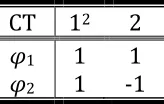
Example 1. The cyclic group Z2 has two conjugacy classes. Consequently, it has two
irreducible characters and so its character table is as reported in Table 1.
CT 12 2
φ1 1 1
φ2 1 -1
4
Jou
rn
al o
f Mat
h
emat
ic
al
Nano
S
ci
en
ce
Now by using Proposition 2, one can conclude that the group Z2×Z2 has 2×2=4 conjugacy classes and so four irreducible characters. Consider two distinct presentation for Z2 in which Z2={(),(12)} acts on set {1,2} and Z2={(),(34)} acts on set {3,4}. Let [()], [(12)] and [()], [(34)] be their conjugacy classes, respectively. Then [()], [(12)], [(34)] and [(12)(34)] are conjugacy classes of Z2×Z2. It follows that the character table of Z2×Z2 is as reported in Table 2.
CT 14 212 122 22
φ1 1 1 1 1
φ2 1 -1 1 -1
φ3 1 1 -1 -1
φ4 1 -1 -1 1
Table 2. The character table Z2×Z2.
It is clear that the character table of group Z2×Z2 is the Tensor product of character table of group Z2 with itself, e.g.
2
2CT Z2 Z =CT Z2 CT Z
1 1 1 1
1 1 1 1 .
In general, we have the following proposition.
Proposition 3[15]. Let G and H be two finite groups with character tables CT(G) and
CT(H), respectively. Then the character table of direct product group G×H is
CT G H =CT G CT H .
In continuing, let G be an arbitrary finite group with a symmetric subset S where G = <S>. We recall that S is normal subset if and only if Sg=g-1Sg=S, for all g G .
Theorem 3 [6]. Let G be a finite group with a normal symmetric subset S and A be the
adjacency matrix of the graph Г =Cay(G,S). Then the eigenvalues of A are given by
( )/ (1),
χ s S
λ
χ s χas χ ranges over all irreducible characters of G. Moreover, the multiplicity of λχ is
χ(1)2. Note that in above theorem the
χ
λ 's are not distinct.
As an application of above theorem, consider the symmetric group Sym(n) on n
letters. LetS
i j i,j, | {1,2,..., },n i j
, then Sym(n)=<S> and for every
g Sym(n), Sg=S. This implies that S is a normal symmetric subset of Sym(n) and by
using Theorem 3, all eigenvalues of Cay(Sym(n),S) are as follows:
| | ((1,2))/ (1).
χ
5
Jou
rn
al o
f Mat
h
emat
ic
al
Nano
S
cie
n
ce
Since| |S n n( 1)/2, the Eq. 3 can be simplified as follows:
( 1) ((1,2))/2 (1).
χ
λ n n χ χ
Thus, we proved the following result:
Corollary 1. Consider the symmetric group Sym(n) on n letters with a normal
symmetric subset S
i j i,j, | {1,2,..., },n i j
. Then an eigenvalue ofCay(Sym(n),S) associated with irreducible character χ is:
( 1) ((1,2))/2 (1).
χ
λ n n χ χ
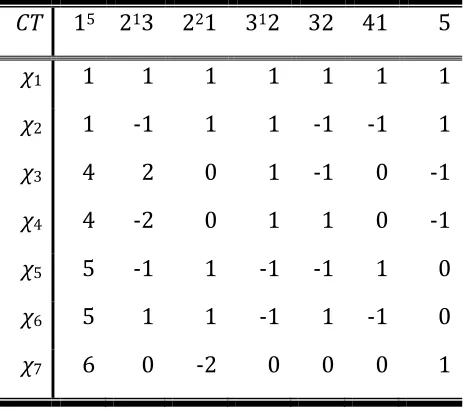
Example 2. Consider the symmetric group Sym(5) on five letters with a normal
symmetric subset S={(1,2), (1,3), (1,4), (1,5), (2,3), (2,4), (2,5), (3,4), (3,5), (4,5)}. The character table of this group is reported in Table 3. Hence, by using Corollary 1, the spectrum of Sym(5) is as follows:
1 16 25 36
[ 10] ,[ 5] ,[ 2] ,[0] .
The problem of characterizing integral graphs seems to be very difficult and so it is wise to restrict ourselves to certain conditions. Here we are interested to study the symmetric group Sym(n).
CT 15 213 221 312 32 41 5
χ1 1 1 1 1 1 1 1
χ2 1 -1 1 1 -1 -1 1
χ3 4 2 0 1 -1 0 -1
χ4 4 -2 0 1 1 0 -1
χ5 5 -1 1 -1 -1 1 0
χ6 5 1 1 -1 1 -1 0
χ7 6 0 -2 0 0 0 1
Table 3. The character table of Sym(5).
Theorem 4[15]. Let g be an element of order n in G. Suppose that g is conjugate to gi
6
Jou
rn
al o
f Mat
h
emat
ic
al
Nano
S
ci
en
ce
Corollary 2. The Cayley graph Cay(Sym(n),S) is an integral graph.
Proof. Let g Sym n ( ) and (i,o(g))=1, then the permutations g and gi have the same
cycle type, and hence are conjugate. According to Theorem 4, χ(g) is an integer for all characters χ of G. Since a rational algebraic integer must be integer, the proof is completed.
4. ENERGY AND ESTRADA OF CAYLEY GRAPHS
The aim of this section is to propose some new results on the energy and Estrada index of Cayley graphs. In [19,20] the authors computed the spectrum of unitary Cayley graphs. Our method for computing the eigenvalues is completely different with their methods. In continuing this paper, the following theorem is crucial.
Theorem 5. Let G and H be two finite groups with normal symmetric subset T1 and T2,
respectively. Let Г1 =Cay(G,T1) and Г2 =Cay(H, T2) and S ( ,1) (1, ).T1 T2 Then the eigenvalues of Γ Γ1 2Cay G H S
,
are given by λχ λφ with multiplicity2(1) (1)2
χ φ as χ, φ range over all irreducible characters of G and H, respectively.
Proof. Let Г1 and Г2 be two graphs with eigenvalues λ1, …, λn and µ1, …, µm,
respectively. It is well known fact that λi + µj (1≤ i ≤ n, 1≤ j ≤ m) are eigenvalues
ofΓ Γ1 2. Hence, by using Theorem 3, the proof is completed.
Corollary 3. Let S be as defined in Theorem 5 and Irr(G) denotes the set of irreducible
characters of G, then
( ( , )) | ( )| ( ) | ( )| ( ), ( ( , )) ( ) ( ).
E Cay G H S Irr H E G Irr G E H
EE Cay G H S EE G EE H
Proof.
( ), ( ) ( ), ( )
( ), ( ) ( ), ( ) ( ), ( )
( ), ( )
( ( , )) | | | |
| | | | | | | | | ( )| ( ) | ( )| ( ),
( ( , )) χφ
χφ χ φ
χ Irr G φ Irr H χ Irr G φ Irr H
χ φ χ φ
χ Irr G φ Irr H χ Irr G φ Irr H χ Irr G φ Irr H
λ χ Irr G φ Irr H
E Cay G H S λ λ λ
λ λ λ λ
Irr H E G Irr G E H
EE Cay G H S e
( ), ( ) ( ) ( ).
χ φ
λ λ
χ Irr G φ Irr H e EE G EE H
7
Jou
rn
al o
f Mat
h
emat
ic
al
Nano
S
cie
n
ce
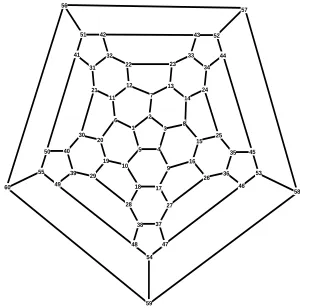
(1,2,3,4,5) and b = (2,3)(4,5). By using definition of a Cayley graph, it is easy to see that two elements x y, Г Cay A S
5,
are adjacent if and only if y x1 S. This means that Г is a cubic graph. Let S = {a,a-1,b}, then the Cayley graph Г = Cay(A5,S) is as depicted in Figure 1.This Cayley graph is isomorphic with the graph of most stable fullerene namely buckyball fullerene [16,17]. It is well-known fact that among fullerenes just buckyball
C60 and dodecahedron are Cayley graphs. Further, C60 is the only vertex-transitive IPR (none of its pentagons make contact with each other) fullerene graph. Recently, the study of graph spectra of such molecules are considered by mathematicians, see for details [2,5,7]. By a direct computation, the spectrum of fullerene C60 is determined as follows:
31, 2.73, 2.35, 1.83, 1. 64, 19, 0.65, -0.13, -0.44, -1.34, -1.43, -1.65, -24, -2.574, -2.63.
1 2
3
4 5 6
7
8
9 10
11
12 13
14
15
16
17 18 19 20 21
22 23
24
25
26
27 28
29 30
31
32 33
35
36
37 38 39
40 41
42 43
44
45
46
47 48 49
50
51 52
53
54 55
56
57
58
59 60
34
Figure 1. Cayley graph Г = Cay(A5,S) where S = {)1,2,3,4,5), (1,5,4,3,2), (2,3)(4,5)}.
8
Jou
rn
al o
f Mat
h
emat
ic
al
Nano
S
ci
en
ce
other words, for computing the eigenvalues of Cayley graphs by this method, we need the character table of associated group. Hence, in continuing of this section, we compute the eigenvalues of Cayley graphs on groups I = A5 and Ih = Z2×A5, respectively. At first consider the alternating group A5. The conjugacy classes of this group are:
()G, (1,2)(3,4)G, (1,2,3)G, (1,2,3,4,5)G, (1,2,3,5,4)G.
Let S = (1,2,3,4,5)G (2,3)(4,5)G. It is easy to check that |(1,2,34,5)G| = 12, |(2,3)(4,5)G|
= 15 and so |S| = 27. By using Theorem 3, it follows that for each character of I, we have:
1 )
(1)
G -1 G G
χ
λ (|a |χ(a )+|(a |+|b |χ(b )). χ
Since |aG| = |(a-1)G| = 12 and |bG| = 15, then
1 15 (1)
χ
λ (24χ(a )+ χ(b )). χ
The character table of A5 is as follows:
CT 1 b C a a-1
χ1 1 1 1 1 1
χ2 3 -1 0 A *A
χ3 3 -1 0 *A A
χ4 4 0 1 -1 -1
χ5 5 1 -1 0
Table 4. Character table of group A5.
where c=(1,2,3), A e2π 5/ e8π 5/ (1 5)/2 and *A e4π 5/ e6π 5/ (1 5)/2. The second and fourth columns of Table 4 are corresponded to b and a are [1,A,*A ,-1,0] and [1,-1,-1,0,1], respectively. This implies that the spectrum of Cay(A5,S) is as follows:
4 5 1 6 4 5 1 3 39 ( ( ), )
9 16 9 25 1
spec Cay I S
.
Thus, the energy and Estrada index of Cay(A5,S) are approximately 371 and 0.87×10¹⁷.
Consider now group Ih = Z2×A5, one can prove easily that the generators of this group are {(1,2,3,4,5),(3,4,5),(6,7)}. By using GAP software [20] we deduce that Ih has
ten conjugacy classes as follows:
1 = ()G, g2 = (6,7)G, g3 = (3,4,5)G, g4 = (3,4,5)(6,7)G, g5 = (2,3)(4,5)G, g6 = (2,3)(4,5)(6,7)G,
9
Jou
rn
al o
f Mat
h
emat
ic
al
Nano
S
cie
n
ce
= (1,5,3) and b = (2,3)(4,5)(6,7). It is easy to see that T = {a,a-1,b} is a generating set of
Ih and so S = {aG,bG} is a normal symmetric subset in which Ih = <S>. By using Theorem
3, it follows that for each character of Ih, the related eigenvalue is:
1
) (1)
G -1 G G
χ
λ (|a |χ(a )+|(a |+|b |χ(b )). χ
Since |aG|= 20 and |bG| = 15, then
1
20 (1)
χ
λ (40χ(a )+ χ(b )). χ
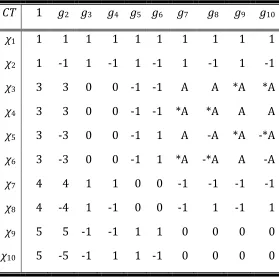
Further, the character table of Ih is as follows:
CT 1 g2 g3 g4 g5 g6 g7 g8 g9 g10
χ1 1 1 1 1 1 1 1 1 1 1
χ2 1 -1 1 -1 1 -1 1 -1 1 -1
χ3 3 3 0 0 -1 -1 A A *A *A
χ4 3 3 0 0 -1 -1 *A *A A A
χ5 3 -3 0 0 -1 1 A -A *A -*A
χ6 3 -3 0 0 -1 1 *A -*A A -A
χ7 4 4 1 1 0 0 -1 -1 -1 -1
χ8 4 -4 1 -1 0 0 -1 1 -1 1
χ9 5 5 -1 -1 1 1 0 0 0 0
χ10 5 -5 -1 1 1 -1 0 0 0 0
Table 5. Character table of group Z2×A5.
10
Jou
rn
al o
f Mat
h
emat
ic
al
Nano
S
ci
en
ce
11 5 5 10 25 55 25 43 18 32 1 1 ( )h
spec I
.
Hence, for Г =Cay(Ih, S), we have E Г
980 and EE Г
0.77 10 24.REFERENCES
[1] A. R. Abdollahi, A. Loghman, Cayley graphs isomorphic to the product of two Cayley graphs, Ars Combin., in press.
[2] A. R. Ashrafi, M. Hamadanian, The full non-rigid group theory for tetra ammine platinum(II), Croatica Chemica Acta, 76 (2003) 299-303.
[3] N. Biggs, Algebraic Graph Theory, Cambridge Univ. Press, Cambridge, 1974.
[4] D. Cvetković, M. Doob, H. Sachs, Spectra of Graphs-Theory and Application, Deutscher Verlag der Wissenschaften, Berlin, Academic Press, third edition, Johann Ambrosius Barth Verlag, 1995.
[5] M. DeVos, L. Goddyn, B. Mohar, R. Šámal, Cayley sum graphs and eigenvalues of (3,6)-fullerenes, J. Comb. Theory Series B, 99 (2009) 358-369.
[6] P. Diaconis, M. Shahshahani, Generating a random permutation with random transposition, Zeit. für Wahrscheinlichkeitstheorie verw. Gebiete, 57 (1981) 159-179.
[7] M. Deza, P. W Fowler, A. Rassat, K. M Rogers, Fullerenes as tilings of surfaces, J. Chem. Inf. Comp. Sci., 40 (2000) 550–558.
[8] C. Domb, On the theory of cooperative phenomena in crystals, Adv. in Phys., 9 (1960) 149–361.
[9] E. Estrada, Characterization of 3D molecular structure, Chem. Phys. Lett., 319 (2000) 713-718.
[10] I. Gutman, The energy of a graph, Ber. Math.Statist. Sekt. Forschungsz. Graz, 103 (1978) 1-22.
[11] M. Ghorbani, E. Bani-Asadi, Remarks on characteristic coefficients of fullerene graphs, Appl. Math.Comput., 230 (2014) 428–435.
11
Jou
rn
al o
f Mat
h
emat
ic
al
Nano
S
cie
n
ce
[13] A. Ilić, The energy of unitary cayley graphs, Linear Algebra and its Applications, 431 (2009) 1881–1889.
[14] H. N. Ramaswamy, C. R. Veena, On the energy of unitary Cayley graphs, Electron. J. Combin. 16 (2009) #N24.
[15] G. James, M. Liebeck, Representation and characters of groups, Cambridge University Press, Cambridge, 1993.
[16] H. W. Kroto, J. E. Fichier, D. E Cox, The Fulerene, Pergamon Press, New York, 1993.
[17] H. W. Kroto, J. R. Heath, S. C. O’Brien, R. F. Curl, R.E. Smalley, Nature, 318 (1985) 162.
[18] X. Meng, Q. Huang, Z. Zhang, Fullerenes which are Cayley Graphs, MATCH Commun. Math. Comput. Chem., 56 (2006) 493-500.
[19] D. E Manolopoulos, D. R Woodall, P.W. Fowler, Electronic stability of fullerenes eigenvalue theorems for leapfrog carbon clusters, J. Chem. Soc. Faraday Trans., 88 (1992) 2427–2435.