11
REFLECTION OF THE CONCEPT OF SUSTAINABILITY IN TERMS
OF ACCOUNTING
Andrei – Mihai Cristea, PhD candidate
University "1 December 1918" Alba Iulia,
Hyperion University of Bucharest
Abstract:
Accounting for achieving sustainability (which also includes managerial
accounting of the environment) is promoted by the followers of the theory of effective protection
of the environment, for which sustainability means maintaining a balance between the activity
Economic and ecological system, a fair distribution of resources and opportunities, not only
between current generations, but also between present and future generations, as well as an
efficient allocation of resources in time to take into account limitations of natural resources¹.
The development of a managerial accounting that incorporates the concept of sustainability is
not an easy approach, as it requires the determination of constraints on economic activities, as
well as the subordination of economic criteria traditional criteria based on social and
ecological values².
Key words: sustainability, sustainable development, environmental managerial
accounting, environmental management system, accounting of sustainability
JEL classification: M41, Q01, Q56
1. Introduction
The two notions of sustainability and sustainable development received a number of definitions from experts, organisations and groups involved in the implementation of governmental concepts or departments and agencies. Thus, according to experts, sustainable development is a journey and not a destination¹, development without destroying² or increasing in harmony with the environment, preserving the resource base for economic well-being and planning for the future of children³.
According to specialized organisations, sustainable development requires a healthy environment, economic prosperity and social¹ fairness, and is the accumulation of continuous economic and social development that does not affect the environment and natural² resources, Improving the quality of life in terms of limiting the existing capacity of eco-systems³.
At governmental level, sustainable development is the implementation of a process that integrates the decisions of environmental, economic and social¹ considerations or the existence on the basis of the income offered by nature, not the erosion of natural capital, consumption of renewable resources within the limit of their ability to regenerate².
The need for a sustainable development has been shaped as a target policy both in the world economy and for nations and Companies (UNCED 1987).
Sustainability (sustainability) refers to the use of natural resources within the limit of their regenerative¹ power, and the qualitative (sustainable) growth refers to the sustainable growth of the welfare of the population and society as a whole, increasing by decreasing or maintaining constant use of natural resources at the same time as the constant decline or maintenance of pollution.
12 development contains two key notions: the concept of need or necessity and the notion of limitations imposed by the level of technology and the ability of the environment to meet the present and future needs.
2. Systemic approach to sustainable development
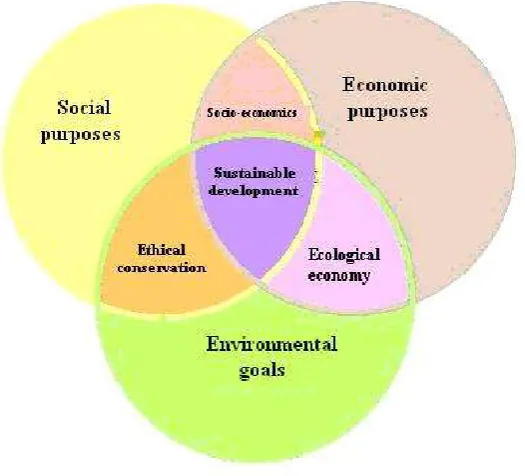
Sustainable society is that society that is structured and behaves in such a way that it exists for an infinite number of generations¹. From the perspective of Karr² ' a sustainable society is regarded as a system characterized by stability, the achievement of an inherent potential, capacity of self-regeneration and a minimum need for external support. Thus, both production and consumption must be sustainable. Figure 1 presents a systemic perspective of sustainable development, which is at the intersection of social, economic and environmental components.
Figure 1. A systemic approach to sustainable development Source: Sadler1 (1988)
In the context of sustainable development, the ecological economy strategy must follow several main directions:
1. Resizing economic growth, taking into account a more balanced distribution of resources and the emphasis on qualitative quality of production;
2. Eliminating poverty in terms of satisfying essential needs for jobs, food, energy, water, housing and health;
3. Preserving and enhancing natural resources, maintaining the diversity of ecosystems, overseeing the environmental impact of the economy.
4. The reorientation of the technologies and the control of their risks.
1 Sadler, B., Natural Capital and Borrowed Time: The Global Context of Sustainable Development,
13 5. Ensuring the quality of economic growth;
6. Decentralisation of forms of governance, increasing participation in decision-making and linking environmental and economy decisions.
Sustainable development strategies must be permanently altered in order to adapt to continuous changes arising from the increase in understanding of the link between natural activities and ecosystems, must contain three main components : identifying priority issues, defining actions to remedy or mitigate the identified problems and ensuring effective implementation and defining the strategic objectives to be made in accordance with the political interests, economic and social.
Sustainable development implies both economic development and integration of environmental protection in national strategies, and it is necessary to define each government's own strategy on ways to ensure sustainable development. This is possible through the development of an effective legislative system, by integrating environmental protection at national policy level, by establishing integrated national accounting systems to take account of the ecological component as well.
3. Accounting for sustainability
Outlining the concepts of sustainability and sustainable development has naturally raised the question of whether businesses can provide a basis for promoting the principles related to them, the answers focusing primarily on eco-efficiency analysis.
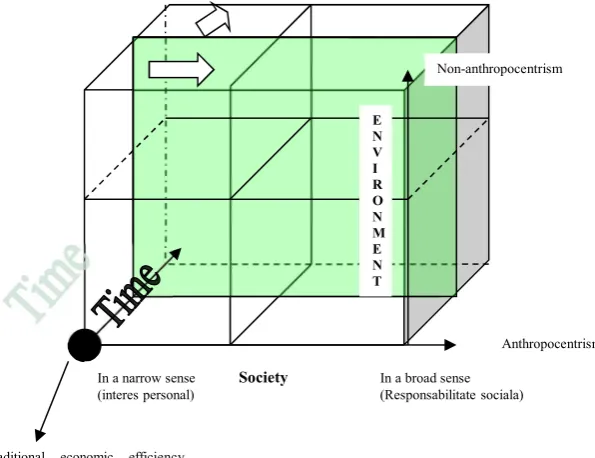
The sustainable approach brings a new vision on the elaboration of decisions, which must integrate three dimensions: environment, society and the time horizon.(Fig. 1.3.)
Figure 2. Socio-ecological dimensions of decision making Source: Milne2, 1996
The traditional approach to drafting decisions focuses on short-term decisions in relation to the social area (shorter than a generation) and reported to a limited number of individuals. Sustainable
2 Milne, M., On sustainability; the environment and management accounting, Management Accounting
Research, 1996, No 7, pag. 140
E N V I R O N M E N T
In a narrow sense Society In a broad sense (interes personal) (Responsabilitate sociala)
Anthropocentrism Non-anthropocentrism
14 development requires a long-term approach aimed at future generations, and individual values extend to the broad social approach (community, social groups), which generates social responsibility, just as the environment no longer needs Only viewed from the perspective of immediate usefulness but by its intrinsic value.
According to these dimensions, four main approaches (typologies) of environmental decisions have been developed: exploitation (environmental elements are not taken into account), conservation (taking into account environmental externalities), effective protection (naturalistic preservation) and extensive conservation.
The first and last of these approaches are at opposite poles: the exploitation approach completely ignores the environmental problems in relation to economic activity, while the extensive conservation-type approach rejects the idea that decisions about the environment should only be taken on the basis of individuals ' preferences, with rules of decision to protect the intrinsic value of nature³.
Although totally opposite, both approaches are reflected in identical accounting treatments, i.e. not taking into account environmental elements in calculating costs. The extensive conservation approach does not allow the accounting of environmental elements, which would lead to their³,4 trivialization, and the exploitation approach focuses only on maximizing the usefulness of activities.
The "conservation" approach uses accounting tools from a prospective perspective, such as environmental impact analysis and extensive cost-benefit analysis, which use environmental information as externalities, without integrating them into accounting.
Analyzing accounting literature on how sustainability can be reflected with the help of accounting, you can identify four completely different directions or camps³.
So:
The accounts must be separate from nature, ecology and sustainability because it could only provide a contamination of the precious life(Maunders and Burritt, 1991; Cooper, 1992); Reflecting sustainability in accounting must be done by means of environmental quotas and
provisions(Canadian Institute of Authorized Accountants,1993; Federation of European Accountants ' Experts, 1993) ;
The integration of sustainability must be done using environmental management and environmental accounting;
Accounting and accountancy professionals must support the purpose of sustainability, but the practical way of achieving this is problematic, with new tools, methods and techniques, specially constructed to achieve this thing.
A first approach to the latter attitude was the emergence of the term of sustainable cost calculation, which encompasses the economic, social and environmental aspects of sustainable development. Also, it was proposed to divide the capital into various components with different functionalities: critical natural capital (ozone layer), Renewable natural capital (air, water, soil), and generated capital (machinery, technology and know-how)³. Thus, the main aspects of sustainability – the environment, social and economic components could be allocated to specific categories of capital. The development of the concept of sustainable cost calculation led to the development of a parallel accounting system that was intended to quantify in monetary terms and for a given period, the costs incurred by an organisation to bring the natural environment to the stage At the beginning of the accounting period. Such a system, however, cannot reflect the full spectrum of sustainability, but only an estimate of the variation of the environmental component of sustainability, and the reactions of organizations towards such a system were reserved and pessimistic, mainly due to additional costs to be generated.
15 sustainability report, published in the year 2000. This first attempt at the accounting of sustainability was considered by its authors a failure, primarily because of the results obtained which actually accounted for the measure of non-sustainability (in the absence of quantifiable benchmarks of Sustainability). The attempts of the accounting professionals to develop support tools for the development of decisions led to new methods such as the method of accounting of the costs generated by the material flows, the method of life cycle analysis, or Multi-criteria elaboration techniques, which join the expansion of classical methods such as cost-benefit analysis, or the total cost accounting method. An analysis of how society looks at sustainable development compared to companies, shows that the multitude of activities considered sustainable by society is much lower than the multitude of activities considered sustainable by Companies, the latter must move towards a reorientation of global business strategies for the purpose of granting greater importance to environmental and social areas. This begins to be done in particular in the major corporations of the world, which are increasingly more visible to the social and environmental policies practiced and the results of their implementation.
4. Conclusions
The effective ways that can contribute to the implementation of the environmental aspects of sustainable development are: environmental management accounting, environmental impact studies and environmental management systems, regulated by the standards International in the field. Recent approaches in the area of quantification and assessment of sustainability have generated multi-dimensional models, which try to explain the links between decision-making processes and political dynamics specific to different contexts Social. Multidimensional models appear to be widely accepted with regard to the accounting approach of sustainability due to the complexity of the notion both in terms of scientific uncertainty and due to ideological diversity.3
Accounting for achieving sustainability (which also includes managerial accounting of the environment) is promoted by the followers of the theory of effective protection of the environment, for which sustainability means maintaining a balance between the activity Economic and ecological system, a fair distribution of resources and opportunities, not only between current generations, but also between present and future generations, as well as an efficient allocation of resources in time to take into account limitations of natural resources4.
The development of a managerial accounting that incorporates the concept of sustainability is not an easy approach, as it requires the determination of constraints on economic activities, as well as the subordination of economic criteria Traditional criteria based on social and ecological values5.
5. Bibliography
[1]Bebbington J, Graz R., An account of sustainability: failure, success and a reconceptualization, Critical Perspectives on Accounting (2001), 557-587, pag. 5
[2]Cooper, C., The non and nom of accounting for (M)other nature, Accounting, Auditing and Accountability Journal, No. 5,1992, pag. 16-39
[3]Daly, H.E., Allocation, distribution and scale: towards an economics that is efficient, just, ans sustainable, Ecological Economics, 6, 1992, pag. 185-194
3 Bebbington J., Brown J, Frame B., Accounting technologies and sustainabilitz assessment models,
Ecological Economics 61 (2007), 224-236
4Daly, H.E., Allocation, distribution and scale: towards an economics that is efficient, just, ans
sustainable, Ecological Economics, 6, 1992, pag. 185-194
5 Milne, M., On sustainability; the environment and management accounting, Management Accounting
16 [4]Gray, R., Accounting for the environment, Sage Publications, London, 2001
[5]Hines, R., On valuing nature, Accounting, Auditing and Accountabilitz Journal, 4(3),1991, pag. 27-29
[6]Karr, J, Protecting Ecological Integrity: an urgent soceital goal, Yale Journal Int. 297, 1993, pag. 299
[7]Meadows, D., Meadows, D., Randers, J, Beyond the limitits to grow, in Dancing Toward the future, summer 1992
[8]Milne, M., On sustainability; the environment and management accounting, Management Accounting Research, 1996, No 7, pag. 135-161
[9]Norton, B.G., Intergenerational equitz and environmental decisions: A model using Rawls’ veil of ignorance, Ecological Economics, No.1, 1989, pag. 147
[10]Sadler, B., Natural Capital and Borrowed Time: The Global Context of Sustainable Development, Victoria, B.C., Canada, Institute of the North American west