Iran J Health Sci 2018; 6(3): 53 Paternal Adaptation and Affecting Factors in Men: A Meta-Synthesis
Narges Eskandari1 Masoumeh Simbar2* Abu Ali Vadadhir3 Azam Bagheri4
1. Assistant Professor of midwifery, Department of midwifery, School of Nursing and Midwifery, Qom University of Medical Sciences, Qom, Iran
2. Professor, Department of Midwifery and Reproductive Health, School of Nursing and Midwifery, Reproductive Endocrinology Research Center, Research Institute for Endocrine Sciences, Shahid Beheshti University of Medical Science, Tehran, Iran
3. Associate professor of anthropology, Department of anthropology, School of social sciences, Tehran University, Tehran, Iran
4. Assistant Professor of midwifery, Department of midwifery, School of Nursing and Midwifery, Kashan University of Medical Sciences, Kashan, Iran
*Correspondence to: Masoumeh Simbar [email protected]
(Received: 5 Apr. 2018; Revised: 29 May. 2018; Accepted: 18 Jul. 2018)
Copyright © 2018, Published by Mazandaran University of Medical Sciences on behalf of Iranian Journal of Health Sciences and Health Sciences Research Center. This is an open-access article distributed under the terms of the Creative Commons Attribution-Non Commercial 4.0 International License https://creativecommons.org/licenses/by-nc/4.0/which permits copy and redistribute the material just in noncommercial usages, provided the original work is properly cited.
Abstract
Background and purpose: Few studies have been carried out on paternal adaptation and there is no comprehensive definition and theory about paternal adaptation in men. This study aimed to extract the concept of paternal adaptation in men and factors affecting it based on qualitative research conducted on paternal experiences.
Materials and Methods: This research was a systematic review and meta-synthesis, including 10 articles, that combined the findings of qualitative research related to men`s experiences of transition to fatherhood, using meta-ethnographic method.
Results: Findings of this study were categorized into three themes including representations and signs of paternal adaptation, paternal adaptation facilitators and paternal adaptation obstacles. Parental satisfaction, understanding paternal transition and development, being capable of fulfilling paternal responsibilities, and being capable of handling the current situation were found to be the representations and signs of paternal adaptation. Adaptation facilitators included attempt to manage present situation, cooperation in the child rearing, time lapse, use of educational resources, readiness to become a parent, utilization of support resources, and parental leave. On the other hand, adaptation obstacles were found to be as follows: damaged parental relationship, paternal role ambiguity, expectations above the father's abilities, lack of time for oneself, damaged marital relationship, occupational concerns, insufficient social support, false myths and misbeliefs, and financial problems.
Conclusion: Enhancing fathers' parenting knowledge and skills, creating educational opportunities, supplying support resources, preparing the setting for father`s continued presence and participation in the family, and offering paternal models to the society may facilitate fathers' paternal adaptation.
Key words: Adaptation; Fathers; Review Article; Meta-Synthesis
Citation: Eskandari N, Simbar M*, Vadadhir AA, Bageri A. Paternal Adaptation and Affecting Factors in Men: A Meta-Synthesis. Iran J Health Sci. 2018; 6 (3): 53-62.
Original Article
Iran J Health Sci 2018; 6(3): 54
1.
IntroductionBirth of children are the most intensely emotional moments and the postnatal period is strongly influenced by environmental factors and is experienced as being the most interpersonal and interpersonally challenging in terms of coping with the new reality of being a father (1). Parenting and the changes following it force men to reconsider their life, responsibilities, and the relationship with their child (2). These changes are perceived as a positive experience for many fathers and a negative one for some others (3). Unfortunately, few studies have investigated the parenthood experiences, norms, values, beliefs, and behaviors which men display during transfer to fatherhood. However, adequate sciences can help specialists support men via providing knowledge, skills, and appropriate interventions in order to assist men in becoming more active and supportive fathers (4). These issues compelled experts to stress the importance of further research to theorize and conceptualize fatherhood (5). As a consequence, there was a continuous increase in studies conducted in this field These studies examined men's experiences during pregnancy, childbirth and the first months after it (1). Some reviews have been written due to an increase in the number of qualitative studies conducted on the fatherhood experiences. For example, the findings of Chin's study, combining the research carried out from 1989 to 2009, showed that males' experiences in transition to fatherhood can be categorized into three themes: emotional reactions to phases of transition (detached, surprise, and confusion), identifying their role as father (the approachable provider), and
redefining self and relationship with partner (the more united tag team) (3). According to Genesoni and Tallandini's review, based on the research carried out during 2002-2008, fatherhood contains three stages of prenatal, labor and birth, and postnatal periods. In pregnancy stage, men mostly need to psychologically reorganize themselves.
To the best of the knowledge of researchers, no review is available about the concept of paternal adaptation, and just one systematic review was found about the effective factors in father’s adaptation (6), whereas, qualitative meta‐synthesis has been used to consolidate the reported findings of qualitative studies (7) in a related area, and has enabled the researchers, through taken-for-granted assumptions, describe and explain in ways that bring fresh insights (8). The present study was designed to define the concept of paternal adaptation and the factors affecting it based on the present qualitative studies.
2.
Materials and Methods2.1. Design and Data Collection
The current study was a meta-synthesis which aimed to combine the findings of available qualitative research on the men`s experiences of transition to fatherhood. Studies were collected through systematic review by relevant key words including fatherhood, fathering, father, paternal, parenting, adaptation, adjustment, coping, transition, role, experience and qualitative, using electronic resources including EBSCO, Ovid, Scopus, MEDLINE, PubMed and Google Scholar.
The collected studies were assessed based on inclusion and exclusion criteria. The inclusion criteria included the following:
Iran J Health Sci 2018; 6(3): 55
qualitative study, preliminary study based on direct questions from the participants, availability of English version of the study, focusing on fathers' experiences after the childbirth, having marital life with the infant's mother, and the article being published during 2004-2015. The exclusion criteria were as follows: lack of inclusion criteria, including teenage fathers, gay fathers and fathers with sick children, and unavailability of full-text of the study. In this regard, 1409 titles were assessed, and 10 qualitative studies were finalized for this meta-synthesis (4 dissertations and 6 articles published in peer-reviewed journals).
2.2. Data analysis
The present meta-synthesis was performed with a meta-ethnographic approach described by Noblit and Hare (1988) in 7 steps:
1. Getting started and deciding on a phenomenon of study: a research enquiry which could be informed by qualitative research was identified: ‘What is the concept of paternal adaptation and factors affecting it based on the father`s experiences?’
2. Deciding what qualitative studies are relevant to the initial interest: Dissertations and articles published in peer-reviewed journals were used in this review study., (9, 10).
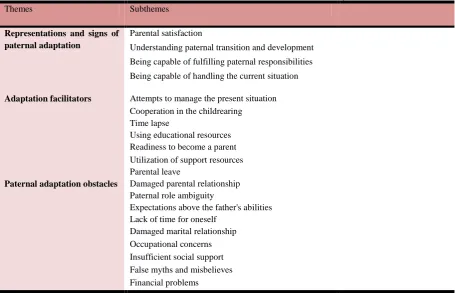
3. Reading the studies, paying careful attention to the details: The texts of articles and dissertations were studied. Each study was assessed to identify its findings including basic concepts, subthemes and themes. A summary of extracted concepts and themes is presented in Table 1.
Table 1.Themes extracted from studies included in the meta-synthesis
Themes Subthemes
Representations and signs of paternal adaptation
Parental satisfaction
Understanding paternal transition and development
Being capable of fulfilling paternal responsibilities
Being capable of handling the current situation
Adaptation facilitators Attempts to manage the present situation Cooperation in the childrearing
Time lapse
Using educational resources Readiness to become a parent Utilization of support resources Parental leave
Paternal adaptation obstacles Damaged parental relationship Paternal role ambiguity
Expectations above the father's abilities Lack of time for oneself
Damaged marital relationship Occupational concerns Insufficient social support False myths and misbelieves Financial problems
Iran J Health Sci 2018; 6(3): 56
4. Determining how the studies are related to each other: The tables of themes and concepts from each study were compared to determine the relationship between them. Similar themes were then merged.
5. Translating the studies into one another: The reciprocal translation was performed based on the interpretation and comparison of the main themes and concepts (9).
6. Synthesizing translations: The authors tried to formulate overarching themes from initial concepts in primary studies and offered a new interpretation (10). 7. Expressing the synthesis: The findings
are shown in written form (Table 1).
2.3. Critical appraisal
Since the quality of the studies is determined according to their compatibility to our research question and reports with poor quality may also contain valuable data (1), the authors decided not to exclude any study with regard to its quality. In this regard, no criteria specifying the quality of the studies were reported.
2.4. Validation
Research team members separately tried to formulate overarching themes from initial concepts in primary studies and offered an interpretation. We also expressed statements, dependent on the original study participants, to verify each theme (11).
3. Results
The findings of the present meta-synthesis were classified into three themes: Representations and signs of paternal adaptation, paternal adaptation facilitators, and paternal adaptation obstacles (Table 1), which are described below.
3.1. Representations and signs of paternal adaptation
Regarding the findings of the present study, parental satisfaction, understanding paternal transition and development, being capable of fulfilling paternal responsibilities, and being capable of handling the current situation were found to be the representations and signs of paternal adaptation.
Parental satisfaction. An adapted father is satisfied with his fathering. This means that he enjoys fatherhood and is proud to have a child in his life. In the available studies, the fathers had described their child as a source of love and happiness, and believed that their child brought them respect and is a sign of maturity and manhood (12), with the capability to create life and the power of fertility for men (13).
"I'm so glad to have a child, I can say that I am worthy of respect among young people who do not have a child " (12).
Understanding paternal transition and development. Due to the presence of the child, fathers have to accept that some changes will occur in their life, new responsibilities are added to their duties, and they have become more mature in comparison to the past. There is evidence that fatherhood is a revolution in men's lives, and most parents experience transition to a new stage of life after the birth of a child (12). For example, one father said:
" your life is really going to change … you’re going to have no time for each other, your sex life will disappear, uh, social time—it’s going to totally change. " (14). Fatherhood also means maturity (2) and development (12) for men. Because following the fathering, personality,
Iran J Health Sci 2018; 6(3): 57
knowledge, sensitivity, patience, and tolerance develop in men. This development brings new responsibilities for fathers (15).
Being capable of fulfilling paternal responsibilities. A man as a father must provide the family welfare, support his family emotionally and physically, provide financial support for his family, (13) and participate in household chores and child rearing with his wife (16).
"So when she is cleaning the baby and there is something to do like cooking, I continue with that because she can’t do two things at the same time" (17).
Being capable of handling the current situation. An adopted father confides and believes in his own ability in handling new conditions and difficulties related to it (18).
3.2. Adaptation facilitators
According to the findings of this study, attempts to manage the present situation, cooperation in childrearing, time lapse, use of educational resources, readiness to become a parent, utilization of support resources, and parental leave are facilitators in paternal adaptation.
Attempt to manage the present situation. Interring in paternal role associated with new experiences requires finding new ways for fathers to adapt (19), and fathering, as a revolution, requires great adjustment to the new situation (15). Along with paternal adaptation, it is necessary to allocate the time to oneself (18), performing favorite activities (15), and maintaining one's personal attributes (19) and integrity (15). Maintaining one's personal attributes help fathers enjoy the new situation and cope with it more easily (19). Job occupation is one of the factors that causes a gap between fathers and their children. Fathers speak about lack of enough time to spend with
their children (17), so they need to manage time for the present to spend with their children (19).
"Well, you should try to manage the situation ... as much as possible, I tried to put my life together; I tried to take control of my life, I won’t let it be disrupted" (18) Cooperation in the childrearing. Fathers' tendency to participate and gain experience affects their performances (20). In addition, cooperation in the childcare in defined and obvious methods enhances intimacy and the relationship between fathers and their children (19).
Time lapse. As a child grows, the relationship between father and child will become stronger and fathers will discover new ways to communicate with their children (19). As a result, parents can enjoy their parental roles more and receive the required rewards. These experiences suggest that receiving positive rewards and feedback from communicating with a child brings about satisfaction and joy to the parents (18).
" the more you do, the more you learn, and as time goes on, you remember how you’ve dealt with things in the past" (20) .
Using educational resources. Fathers perceive different roles for themselves, such as model, supporter, teacher, and supplier, and believe that they need more training in this regard (20). Fathers emphasize their need to acquire knowledge and information about child rearing, as well as incoming problems and changes. They believe that acquiring knowledge will prepare them for new conditions, and will enable them to cope more easily with fatherhood roles and responsibilities (18) "It’s made me want to learn more, to read more to study more because I know I’ve got to pass that on" (20).
Iran J Health Sci 2018; 6(3): 58
Readiness to parenting. There is a relationship between gradual transition to fatherhood and the amount of fathers' readiness for parenthood (14). For example, taking care of children in a big family enhances men' parenting skills (19). Also, laying in a proper position of life and appropriate situation of communication and employment, prior to the birth of child, facilitates men's transition to fatherhood (20). Men believe that fathers should ensure the presence of favorable conditions before decision-making and attempting to have a child (18).
"Each family should have a child after 1 to 2 years of their marital life, depending on their condition or their performance" (12). Utilization of support resources. The use of support resources plays an important role in facilitating adaptation to fatherhood (19). Medical caregivers, family, friends, and community can provide the needed support to fathers in this regard (18). Fathers stated that they need an opportunity to talk about their fears and concerns and to ask questions about tasks that they are not able to accomplish. Also, to participate in certain activities such as obstetric care and prenatal classes, fathers needed the support and cooperation of their employers (19). “We have a couple of friends up the road who have older children, and that just gave us support and some reassurance that we were doing things in the right way" (4). Parental leave. Use of parental leave and reduced work hours can enhance father's presence at home and provide opportunities for active participation in childrearing and interaction with their children (12). Parental leave is an opportunity for men to be involved in their children's affairs. During this period, men experience the support of their wives and child at home, and are taken
away from job duties which enhance the distance between them and their families (4).
"Now, I think that a leave is approved for fathers… If this plan is implemented, it somehow contributes to being with family" (12).
3.3. Paternal adaptation obstacles
Obstacles in paternal adaptation include damaged parental relationship, paternal role ambiguity, expectations above the father's abilities, lack of time for oneself, damaged marital relationship, occupational concerns, insufficient social support, false myths and misbeliefs, and financial problems.
Damaged parental relationship. The presence of infant in the men`s life and communication with him/her is one of the challenges that fathers encounter (20). Fathers do not know how to communicate with their children and how to play with them (19). Some fathers say that they do not enjoy spending time with their baby, and it is difficult to make contact with baby, since it is associated with no reward for fathers (20). Young age of an infant and his inability to react to his father's attempts would cause a lack of motivation for the father with regard to their involvement in childrearing (12).
“You don’t get much feedback from them, they cry, poo and eat and cry and that’s about it" (20).
Paternal role ambiguity. Rather than accepting an equal parenting role, fathers have identified their own roles as a secondary parent in child rearing (4). Fathers feel that they are eliminated from their infants’ life during the first days after childbirth, because their wife does not involve them in activities related to the neonate (20). Non-defined paternal tasks
Iran J Health Sci 2018; 6(3): 59
and contribution in childrearing compels fathers to be randomly involved in childcare and in the cases when they are in a good mood or based on their wives' demand (18).
“I think my priority is to do my job. … the work conditions are such that the men are so busy and have no time to take care of the baby" (18).
Expectations above the father's abilities. Society`s expectations of fathers (14), fathers’ expectations of themselves, the parental role they want to play, and fathers’ definition of their identity are effective on paternal experiences and their attempts to enter various aspects of fatherhood (20). The fathers believed that a father should meet his child's needs by any means. They even stated that if a father is unable to perform this task, he can no longer be considered as a father (13).
"He's a good father who meets his child's needs. He is a child and a child sometimes wants something. The father should not be ashamed to provide it. " (12).
Lack of time for oneself. Another experience during the first years of fathering is putting child at the center of a father’s life and forgetting oneself. The needs of a child determine the direction of the family, parents' life and their priorities. This means that all parent’s activities should be planned based on the baby's eating and sleeping schedule (15). Flexibility is reduced and fathers have less time to spend for personal activities. This causes fathers' anger in some cases. Because fathers have to postpone their hobbies and entertainment to accompany and care for their child (12, 15).
“A new little person who is in the center all the time, you have to think of him/her first. You get a little more bound, a little more stuck" (15).
Damaged marital relationship. By interring neonate to the home, some fathers feel that they have no control over the circumstances. It is difficult for fathers to accept the fact that the house is no longer a private residence for them and their wife. In fact, the presence of child brings fathers a feeling of anxiety and loss of control. They can no longer continue their routine life and have to share their privacy and marital boundary with another person (20). Following the childbirth, the position of father in the family changes and he is put aside (17). The intimate relationship with his wife is decreased (15), and he feels no attention and love (12).
"To be honest, it hurts me, it hurts me a lot, I am deeply sad in my heart regarding that issue (living separate). I am used to staying with her" (17).
Occupational concerns. For all fathers, their job serves as a communication barrier so that they are away from their child during long working hours and cannot participate in child-related activities (4). Men's commitments to their jobs prevent them from spending their time, as they like, with their child (16).
Insufficient social support. Available support cannot meet the needs of men as fathers. They feel a supportive family that they can rely on does not exist, doctors cannot accurately diagnose and treat the child`s diseases, the government does not provide adequate services to support fathers, and there are no sufficient educational resources to respond to fathers questions (12). The presence of fathers in maternal child health clinics is not welcomed and health providers provide general and ambiguous information to fathers. Some caregivers have an
unfriendly behavior and poor
communication, and do not pay attention to
Iran J Health Sci 2018; 6(3): 60
the fathers' needs (17). "We did not find any classes (parental education). I do not think such a class exists" (16).
False myths and misbeliefs. Conflicting messages and information causes a dilemma for fathers, and disturbs their decision-making. Sometimes, the fathers are confused as to whether to select modern medicine or traditional medicine. They cannot decide which path to take (12). " When I am facing a problem, I get into a dilemma as to where to start, at the hospital or with my elders " (17).
Financial problems. A father commits himself to providing financial resources for his wife and baby (17), and all fathers are common in this belief that a father should serve his child to provide a better life for them. This is despite the fact that economic constraints are obstacles in this regard (12). " You can’t tell him that there is no food today. Telling him that today daddy could not get money! Eee, he can’t hear you. That is first; secondly their mother should eat well, better than she used to eat" (17).
4. Discussion
According to the results of this meta-synthesis, paternal adaptation is represented as parental satisfaction, understanding paternal transition and development, and being capable of fulfilling paternal responsibilities and handling the current situation. On the available studies the birth and presence of a child causes a revolution and fundamental changes in the men's world (21), that includes various aspects of their life (19). To adapt with this situation, fathers need to adjust to the paternal roles, and related responsibilities and challenges (22). In this regard, an adapted father is satisfied with fathering and this satisfaction is obtained
from his ability to handle new conditions and pressures resulting from it (18). In response to changes resulting from parenting, fathers should modify and redefine their responsibilities, roles, and relations (23), and make a balance between the roles of fatherhood and new emotional and communicational demands, economic pressures, and social expectations (1). The novelty of parental experiences and lack of knowledge and skills in this regard brings concerns and causes fear in men (4). Studies have shown that learning skills relevant to childcare strengthens positive attitudes to paternity in men (1).
Readiness for fathering means men are prepared for dealing with changes and responsibilities that emerge after childbirth. This is made possible by providing parents with information about how to establish a healthy parental relationship. For many fathers, the first years of parenthood are accompanied with problems, such as mental stress, social isolation, and disorder in interacting with wife and child (24), and fathers’ feelings of loneliness, lack of support, not being understood , and worthlessness during and following the pregnancy period (3, 25, 26). Richman (1982) believes that men are traditionally separated from the process of pregnancy, birth and childrearing, and their duties in these stages are indeterminate (27). In consequence, fathers speak about cooperation in parental responsibilities; but their definition of it is ambiguous (18). Social and cultural messages about paternal cooperation are ambiguous, and do not include the importance and manner of this cooperation (28). In general, the evidence suggests that although fathers are expected to actively participate in the family affairs, their roles, except for being breadwinner,
Iran J Health Sci 2018; 6(3): 61
are not clearly defined (18). Lack of time to rest and following personal works (14, 29), and conflicts between parents to have time away from their child are discussed by fathers in different studies (14). Following the birth, life flexibility is reduced, and fathers have to postpone their hobbies and entertainments for the caring of their child and to be with him/her. This makes the father angry and upset in some situations (29). Transition to fatherhood is also accompanied with reduced marital satisfaction in parents (30), and fathers describe emotional separation from their wives as a stressful experience caused by the birth of a child (12).
Although fathers expect themselves to become a good and complete father (19), a majority of them find the fact that job pressures impose additional commitments on fathers and create the impression that they do not have enough time in addition to having many paternal responsibilities (31).
5. Conclusion
According to the findings of this study, Paternal adaptation may be defined as parental satisfaction, understanding paternal transition and development, and being capable of fulfilling paternal responsibilities, and handling the current situation. Enhancing fathers' parenting knowledge and skills, creating educational opportunities, supplying support resources, preparing the environment for a greater paternal presence for the father, and involvement in family affairs, and offering paternal models to the society may facilitate fathers' paternal adaptation.
Limitations
Limitations of the present study were the exclusion of studies in which the English and full text versions were not available.
Conflicts of interest
No Conflicts of interest.
Acknowledgements
The authors express their gratitude to the research deputy of Shahid Beheshti University of Medical Sciences. It must be noted that this article is an excerpt from a reproductive health Ph.D. thesis (sbmuz.rec.1394.76).
References
1. Genesoni L, Tallandini MA. Men's psychological transition to fatherhood: An analysis of the literature, 1989-2008. Birth. 2009;36(4):305-17. PMID: 20002423.
2. Carneiro LMR, Silva KLD, Pinto ACS, Silva ADA, Pinheiro PNDC, Vieira NFC. Fatherhood: discourses of men who experience a closer and participative relationship in the children care. Journal of Nursing UFPE on line. 2012;6(9):2177-82. Doi: 10.5205/reuol.2570-20440-1-LE.0609201223.
3. Chin R, Hall P, Daiches A. Fathers' experiences of their transition to fatherhood: A metasynthesis. Journal of reproductive and infant psychology. 2011;29(1):4-18. https://doi.org/10.1080/02646838.2010.51304 4.
4. Barenski S. Transition to Fatherhood: A Puerto Rican Perspective. Doctoral dissertation: University of Massachusetts; 2010.
5.Ozgun O, Erden S, Ciftci MA. Examining different perspectives on fatherhood: a socio-cultural approach. Procedia-Social and Behavioral Sciences. 2011;15:364-8. doi:10.1016/j.sbspro.2011.03.103.
6. Jazayerinezhad N, Bostani Khalesi Z, Niknami M. A Systematic Review of the Effective Factors in Father’s Adaptation. Shiraz E-Med J. 2018;19(4):e64378. Doi: 10.5812/semj.64378 [In Press].
7. Watson J, FosseyE, Harvey C. A home but how to connect with others? A qualitative meta‐ synthesis of experiences of people with mental illness living in supported housing. Health &
social care in the community. 19 Jul 2018;1-19. PMID: 30027684
Health & social care in the community. 2018. 8. Walsh D, Downe S. Meta‐synthesis method for qualitative research: a literature review. Journal of advanced nursing. 2005;50(2):204-11. PMID: 15788085.
Iran J Health Sci 2018; 6(3): 62
9. Noblit GW, Hare RD. Meta-Ethnography: Synthesizing Qualitative Studies. London, UK: Sage Publications; 1988.
10. Sandelowski M, Black BP, Mercer RT, Bergum V, Stainton MC. The epistemology of expectant parenthood. Western Journal of Nursing Research. 1994;16(6):601-22. URL: https://doi.org/10.1177/019394599401600602. 11. Lincoln YS, Guba EG. Establishing trustworthiness. In Naturalistic Inquiry Beverly Hills: Sage; 1985.
12. Eskandari N, Simbar M, Vedadhir A, Baghestani A. Paternal experiences in Iranian men: a phenomenological study. Iranian Journal of Nursing Research. 2016;10(4):105-16. URL: http://ijnr.ir/article-1-1633-en.html. 13. Eskandari N, Simbar M, Vadadhir AA, Baghestani AR. Exploring the Lived Experience, Meaning and Imperatives of
Fatherhood: An Interpretative
Phenomenological Analysis. Global Journal of Health Science. 2016;8(9). PMID: 27157163. 14. Bradley E, Boath E, Mackenzie M. The experience of first-time fatherhood: a brief report. Journal of reproductive and infant psychology. 2004;22(1):45-7. URL: https://doi.org/10.1080/026468303100016430 49.
15. Premberg Å, Hellström AL, Berg M. Experiences of the first year as father. Scandinavian Journal of Caring Sciences. 2008;22(1):56-63. PMID: 18269423.
16. Eskandari N, Simbar M, Vadadhir A, Baghestani A. Fatherhood Adaptation: Designing, Assessing the Psychometric Properties ,and Applying of Questionnaire. Tehran: shahid beheshti university of medical sciences; 2016.
17. Mbekenga CK, Lugina HI, Christensson K, Olsson P. Postpartum experiences of first-time fathers in a Tanzanian suburb: A qualitative interview study. Midwifery. 2011;27(2):174-80. PMID: 20385433.
18. Eskandari N, Simbar M, Vedadhir A, Baghestani AR. Paternal adaptation in first-time fathers: a phenomenological study. Journal of Reproductive and Infant Psychology.2016;35(1):1-12. PMID 29517289 [in process].
19. Graham K. A phenomenological approach to understanding the early experience of becoming a father for the first time. Doctoral dissertation: Bournemouth University; 2007.
20. Kowlessar O. A Qualitative Exploration of Men's Transition to Fatherhood and Experiences of Early Parenting. Doctoral dissertation: University of Manchester; 2012. 21. Cabrera NJ, Hofferth SL, Chae S. Patterns and predictors of father-infant engagement across race/ethnic groups. Early Child Res Q 2011;26(3):365-75. PMID: 22110258.
22. Ricci SS, Kyle T. Maternity and pediatric nursing. Philadelphia: Lippincott Williams & Wilkins; 2009.
23. Lu H, Zhu X, Hou R, Wang D-h, Zhang H-j, While A. Chinese family adaptation during the postpartum period and its influencing factors: A questionnaire survey. Midwifery. 2012;28(2):222-7. PMID: 21419534.
24. May C, Fletcher R. Preparing fathers for the transition to parenthood: Recommendations for the content of antenatale ducation. Midwifery. 2013;29(5):474-8. PMID: 23159162.
25. Brennan A, Marshall‐Lucette S, Ayers S, Ahmed H. A qualitative exploration of the Couvade syndrome in expectant fathers. Journal of reproductive and infant psychology. 2007;25(1):18-39. URL:https:// doi.org/10.1080/02646830601117142.
26. Deave T, Johnson D. The transition to parenthood: What does it mean for fathers? Journal of Advanced Nursing. 2008;63(6):626-33. PMID: 18808584.
27. Richman J. Men's Experience of Pregnancy and Childbirth. In: McKee L, O'Brien M, editors. The Father Figure. London: Tavistock Publishers; 1982.
28. Wilson C, Beaton J, Brophy K. Understanding the Roots of Mothers’ Expectations for Fathers: ProQuest; 2009. 29. Premberg Å, Taft C, Hellström A-L, Berg M. Father for the first time-development and validation of a questionnaire to assess fathers’ experiences of first childbirth (FTFQ). BMC Pregnancy and Childbirth. 2012;12(1):35. PMID: 22594834.
30. Alessia K, Roufeil L. ‘It's Quite a Journey’: Australian Parents’ Experience of Adopting Older Children from Overseas Orphanages. Children Australia. 2012;37(04):161-9.URL: https://doi.org/10.1017/cha.2012.37.
31. Goodman WB, Crouter AC, Lanza ST, Cox MJ. Paternal Work Characteristics and Father-Infant Interactions in Low-Income, Rural Families. J Marriage Fam. 2008;70(3):640-53. PMID: 20011453.