Please cite this article as: M. Khajiyan Sheini Pour, M. Abdideh, Investigation of the Effect of L-Ascorbic Acid on Class G Oil Well Cement, International Journal of Engineering (IJE), IJE TRANSACTIONS C: Aspects Vol. 32, No. 3, (March 2019) 360-365
International Journal of Engineering
J o u r n a l H o m e p a g e : w w w . i j e . i rInvestigation of the Effect of L-Ascorbic Acid on Class G Oil Well Cement
M. Khajiyan Sheini Pour*, M. Abdideh
Department of Inorganic Chemical Industry, Iranian Institute of Research & Development in Chemical Industries, Karaj, Iran
P A P E R I N F O
Paper history:
Received 23 November 2018
Received in revised form 29 January 2019 Accepted 07 March 2019
Keywords: L-Ascorbic Acid Oil Well Cement Free Fluid Thickening Time Compressive Strength
A B S T R A C T
Various chemicals can have different effects on the properties of the cement slurry. In this paper, the different effects of L-ascorbic acid have been investigated on the important parameters of cement slurry made from class G oil well cement. These parameters included the amount of free fluid, rheological properties, T hickening T ime, and compressive strength. Several cement slurries were made with different dosages of L-ascorbic acid. By increasing the amount of L-ascorbic acid, free fluids were decreased and rheological properties of the slurries were improved. This improvement in the amount of free fluid and rheological properties continued with an increase of L-ascorbic acid. Increasing the dosage of L-ascorbic acid to 0.03% by weight of cement, decreased the thickening time and increased the compressive strength. In other words, L-ascorbic acid acted as an accelerator up to 0.03% by weight of cement and would have the role of a retarder in higher value.
doi: 10.5829/ije.2019.32.03c.02
NOMENCLATURE
φ percent of free fluid (%) cp centipoise
VFF free fluid value (milliliters) lb pound
ρ specific gravity of slurry ft foot
ms initially recorded (starting) mass of the slurry (grams) psi pound-force per square inch
T .T T hickening T ime ppg pounds per gallon
C.S Compressive Strength
1. INTRODUCTION1
Well cementing is one of the important steps in oil well drilling. A primary cementing job is the cement placement between the casing and the formation [1]. In the design of an oil well cement slurry, various additives are used with different applications [2]. Properties of an oil well cement slurry are usually investigated and improved according to the well conditions. Low quality cementing job results fluids migration from one layer to another which destroys the well integrity and further repair operations, which need cost and time [3]. Therefore, one of the basic tasks of the cementing operation is zonal isolation [4].
Cement compositions are designed based on the geological conditions of that area, materials which are
*Corresponding Author Email: [email protected] (M. Khajiyan Sheini Pour)
available and technical difficulties of the well [5]. Different chemicals can have significant effects on the parameters of a cement slurry. Understanding the application and impact of the chemicals can help designing of the cement slurry. Carbohydrates show different effects on cement [6]. In different doses, carbohydrates exhibit dual behavior against cement, it can act as a retarder or as an accelerator. Among the carbohydrates, sugar is the most well-known compound, whose effects on various types of cement and specifically as a retarder have been investigated [7,8]. Khan and Baradan [9] have pointed to two different effects of sugar on portland cement. According to their results, increasing sugar more than 0.3% by weight of cement (BWOC) causes reducing thickening time of the cement slurry and in fewer quantities it causes a delay in the thickening
time. However, due to the negative effects of sugar on cement slurries, it is not typically used in oil and gas well cementing [10]. Sugar in all quantities leads to a reduction in strength.
Retarders reduce the hydration rate of the cement slurry. In other words, they increase the cement slurry setting time. Accelerators are additives that reduce cement slurry setting time by speeding up the reaction between cement and water. This category of additives increases the initial strength of the cement. L-ascorbic acid (L-AA), more commonly known as vitamin C, is used as a highly effective vitamin for the human body. Vitamin C which is a small carbohydrate molecule was first identified by Albert Szent-Györgyi in early 20th century, who discovered its role in the scurvy prevention and cure [11]. L-AA was selected as an available carbohydrate. So far, the effect of L-AA on cement slurries has not been investigated. The chemical structure of the L-AA is shown in Figure 1.
Most researches on oil well cement slurry, basic types of the cement are used as a selection for experiment and evaluation. Class G oil well cement is one of the basic cement types. Properties of the slurry made with class G oil well cement can be modified using different additives in accordance with well conditions. In this research, the effect of L-AA on class G oil well cement and its results were presented. The studied parameters included free fluid, rheological properties, thickening time and compressive strength.
2. MATERIALS METHOD
2. 1. Materials Class G high sulfate resistant (HSR)
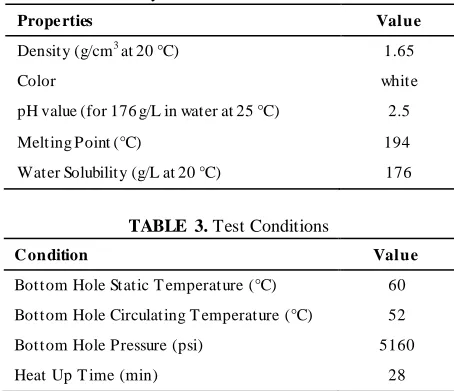
cement was selected from Dyckerhoff Cement Factory. The specific gravity of the cement was 3.14 g/cm3. It is an oil well cement in accordance with the standard 10A API (American Petroleum Institute) [12]. Table 1 contains the chemical composition of this class G oil well cement. SIGMA-ALDRICH L-AA was used and its code was A92902. The physicochemical information of L-AA used in this study is presented in Table 2. Distilled water was used for making cement slurries.
Figure 1. Chemical structure of the L-AA
TABLE 1. Chemical composition of class G oil well cement
C aO % SiO2 % Fe2O3 % Al2O3 % SO3 % MgO %
63.4 21.1 3.5 3.3 2.3 4.1
2. 2. Cement Slurry Compositions Totally, 8 types
of cement slurry were studied. One of these slurries has no L-AA and was used as a base slurry to compare its results with the results of the other slurries. This cement slurry and specimen preparation were carried out by closely following API Specification 10A [12]. Other slurries contained L-AA with varying amounts from 0.01 to 0.07% BWOC. The weight of all slurries was 15.9 pounds per gallon (PPG). Test conditions and slurry compositions are presented in Tables 3 and 4, respectively. To make all slurries, first of all, we mixe d L-AA with distilled water in a cement mixer for one minute, then the cement was added to the solution. To improve the validity of data, each test was performed three times and its final result was derived from the average of three sets of data. All of the data points have an error bar according to the standard deviation.
2. 3. Free Fluid One of the important parameters of
cement slurry is the amount of free fluid (free water). Free fluid test is performed to determine the amount of the free fluid that is carried out at the top of the cement mixture between the time it is placed and the time it gels and sets up [13]. In order to do this, we first stirred the slurry in the atmospheric consistometer for 30 minutes and transferred the slurry directly into the clean and dry 500 ml conical flask. The flask was placed in without any movement for 2 hours. At the end of the test, the amount of separated water was measured [12]. The percent of free fluid was calculated by the following formula (Equation (1)):
𝜑 =VFF. ρ
ms × 100 (1)
where VFF is the free fluid value, expressed in milliliters ; ρ is the specific gravity of slurry and ms is the initially recorded (starting) mass of the slurry, expressed in grams.
TABLE 2. Physicochemical Information of L-AA
Prope rties Value
) °C at 20 3 g/cm
Density ( 1.65
Color white
pH value (for 176 g/L in water at 25 °C) 2.5
Melting Point (°C) 194
Water Solubility (g/L at 20 °C) 176
TABLE 3. Test Conditions
C ondition Value
Bottom Hole Static T emperature (°C) 60
Bottom Hole Circulating T emperature (°C) 52
Bottom Hole Pressure (psi) 5160
TABLE 4. Slurry compositions
|Slurry Name W ate r Type Wate r Re quire me nt
(%BWO C )
C e me nt We ight (%BW O C )
L-AA Amount (%BWO C )
Slurry W e ight, (PPG)
Base Slurry Distilled 44 100 0.0 15.9
Slurry 1 Distilled 44 100 0.01 15.9
Slurry 2 Distilled 44 100 0.02 15.9
Slurry 3 Distilled 44 100 0.03 15.9
Slurry 4 Distilled 44 100 0.04 15.9
Slurry 5 Distilled 44 100 0.05 15.9
Slurry 6 Distilled 44 100 0.06 15.9
Slurry 7 Distilled 44 100 0.07 15.9
2. 4. Rheology Rheological properties of cement
slurry play a considerable role in the efficiency of slurry [14]. Knowledge about the rheology of oil well cement slurry is necessary to evaluate the ability of mixing and pumping of the slurry, optimize mud removal and slurry placement, and to estimate the effect of oil well temperature on slurry placement [15]. Chandler Viscometer Model 3530 (Chandler Engineering Company) was used to measure the rheological properties of the cement slurry. Plastic Viscosity (PV) and Yield Point (YP) are two main parameters that have been calculated.
2. 5. Thickening Time Thickening Time (TT) test
is a accepted method for measuring how long cement slurry should remain pump-able under simulated down-hole temperature and pressure conditions [16]. We used
the High-Pressure High-Temperature (HPHT)
consistometer (Chandler Engineering Company) to perform the TT test. The measuring of TT is related to the torque being applied on a stationary paddle within the rotating slurry cell [17]. The pump-ability or consistency of the slurry is measured in Bearden unit of consistency (BC). The end of a TT tes t is defined when the cement slurry reaches a consistency of 100 Bc [18]. To determine whether a chemical acts as a retarder or as an accelerator, the thickening time of the cement slurry should be investigated using the consistometer.
2. 6. Compressive Strength The importance of the
compressive strength (CS) of cement is so high that it can't be ignored at any time. Applying of a destructive effect on the strength of concrete by a material is a negative rating for that material. For better and more accurate comparison of the CS of the samples, an Ultrasonic Cement Analyzer (UCA) was used to measure the CS. The performance of the UCA device is based on the relationship between ultrasonic pulse velocity in a cement slurry sample and its CS. Compressive strength
is obtained by measuring the change in velocity of an ultrasonic signal transmitted through the cement sample as it cures. UCA is a recommended practice for determining sonic strength in API RP 10B-2 [19]. In this study, the Model 4265 UCA (Chandler Engineering Company) was used. The compressive strength can be seen instantaneously and accurately by UCA.
3. RESULTS AND DISCUSSION
3. 1. Free Fluid Test Results Obviously, a lower
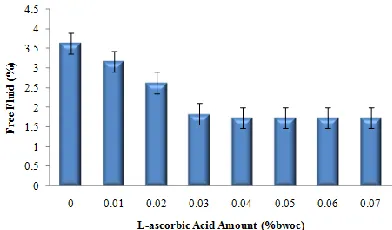
amount of free fluid is better for a cement slurry. A large amount of free fluid can cause cement operations to deal with a lot of problems. One of the major problems is increasing the setting time due to the increase in free fluids at the top of the hole, which may ultimately cause gas flow or unwanted flow in the well. The results of the free fluid test with the error bars for all slurries were presented in Figure 2. A significant reduction in the free fluid content was found in certain amounts of L-AA. The lowering trend is visible until slurry 3. In other slurries (including slurry 4 to 7), no significant changes in free water content were observed.
It was found that L-AA helped to improve the amount of free fluid by affecting on the hydration of the cement slurry and contributing to this process .
3. 2. Rheology Test Results Regarding the readings
from the viscometer device, some of the important parameters of rheological properties of the slurry were calculated. Figure 3, shows the results of plastic viscosity and yield point for all slurries. These results show that the amount of plastic viscosity is constant when the amount of L-AA is higher than 0.03, and there is no change. The lubricating effect of L-AA is well seen. By evaluating Figure 3, which shows the results of the slurry yield point, we can find that the amount of yield point decreases with increasing the amount of L-AA in the cement slurry. As can be seen, the severity of th e decrease in the amount of yield point from slurry 1 to 3 is very evident.
3. 3. Thickening Time Test Results Figure 4 shows
the variation of the TT of cement slurries by increasing the amount of L-AA. These changes indicate that, with an increase in the amount of L-AA to 0.04% BWOC, the TT of the slurries is lower than the base slurry. The greatest reduction in TT belongs to the slurry 3, where 0.03% BWOC L-AA has been used. The other result is the retarding effect of L-AA on cement setting in amounts higher than 0.05% BWOC L-AA. This test was carried out at a temperature of 52°C and a pressure of 5160 psi.
Unlike other carbohydrates, L-AA showed a dual effect at very low doses (less than 0.1% BWOC). Sugars at high doses act as an accelerator and act as a retarder in low doses, as opposed to L-AA.
3. 4. Compressive Strength Test Results The
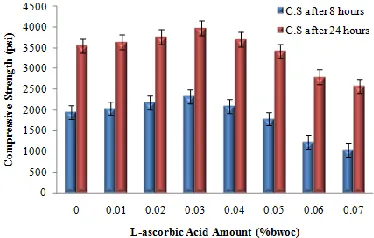
cement compressive strength after a cementing operation is very important. Generally, high compressive strength indicates low porosity and increased durability of hardened cement. The compressive strength results at 60°C for all slurries are shown in Figure 5. These results were obtained in 8 and 24 hours. In both cases, the
Figure 3. Effect of L-AA in different amounts on the rheology properties of cement slurry at 52⁰ C
Figure 4. Thickening Time vs. amount of L-AA used in slurries at 52⁰C & 5160 psi
increase and decrease of strength are proportional to each other. As can be seen, the highest compressive strength is obtained when the amount of L-AA in the slurry is 0.03% BWOC, which is related to slurry 3. The presence of more than 0.04% BWOC L-AA in slurry reduces the compressive strength of cured cement.
In general, increasing the amount of carbohydrates in the cement slurry decreases the compressive strength. Even though sugar in excess of 0.3% BWOC can act as an accelerator, but it becomes problematic in the final set of the slurry. It might be preventing cement slurry from being completely cured. Whereas, L-AA gives a satisfactory result of compressive strength in both cases of retarder and accelerator. When L-AA acted as an accelerator, in addition of reducing TT of the cement slurry, the compressive strength increased.
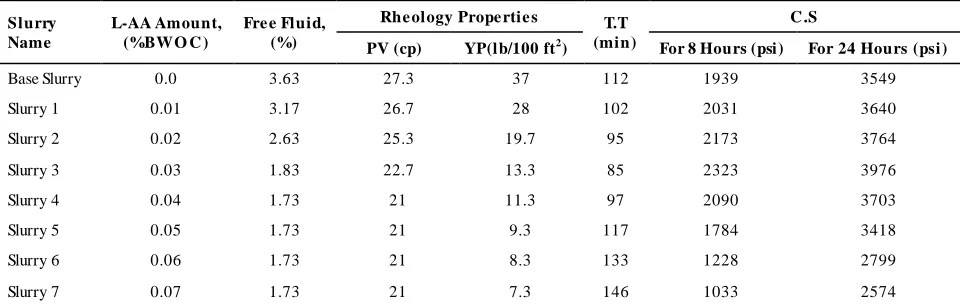
The total results from the free fluid test, rheology, thickening time and compressive strength for all cement slurries are presented in Table 5. The results were obtained at 52⁰C for free fluid, rheology and thickening time. In the test of compressive strength, the applied temperature was 60⁰C and the applied pressure in the thickening Time test was 5160 psi.
According to the results of the experiments, the effect of L-AA on the hydration of the class G oil well cement is deduced. Tricalcium aluminate and tricalcium silicate are two important silicates in the class G oil well cement and are very effective in cement hydration. Hence, L-AA affects tricalcium aluminate and tricalcium silicate.
TABLE 5. All results for all cement slurries
Slurry Name
L-AA Amount, (%BW O C )
Fre e Fluid, (%)
Rhe ology Prope rtie s T.T
(min)
C .S
PV (cp) YP(lb/100 ft2) For 8 Hours (psi) For 24 Hours (psi)
Base Slurry 0.0 3.63 27.3 37 112 1939 3549
Slurry 1 0.01 3.17 26.7 28 102 2031 3640
Slurry 2 0.02 2.63 25.3 19.7 95 2173 3764
Slurry 3 0.03 1.83 22.7 13.3 85 2323 3976
Slurry 4 0.04 1.73 21 11.3 97 2090 3703
Slurry 5 0.05 1.73 21 9.3 117 1784 3418
Slurry 6 0.06 1.73 21 8.3 133 1228 2799
Slurry 7 0.07 1.73 21 7.3 146 1033 2574
4. CONCLUSIONS
In this research, it has been observed that different amounts of L-AA have a definite effect on the various properties of the class G oil well cement. The common point obtained from the results of all tests is that all properties of slurries in the presence of 0.03% BWOC AA have the best possible conditions. In addition to, L-AA at all doses improves the free fluid content and rheological properties of the cement slurry. In amounts below 0.03% BWOC can act as an accelerator and also increase compressive strength. Generally, 0.03% BWOC can be considered as the highest optimal amount for use of L-AA in cement slurries that have been made with class G oil well cement. In the values above 0.05% BWOC, it was introduced as a retarder. The use of L-AA at these low values can be justifiable in terms of cost.
5. REFERENCES
1. T abatabaee Moradi, S.S. and Ivanovich Nikolaev, N., "Considerations of well cementing materials in high -pressure, high-temperature conditions", International Journal of Engineering, Transactions C: Aspects, Vol. 29, No . 9, (2016), 1214-1218.
2. Xiao, Q., Rao, P., Xiao, W., Liu, X., and Zhang, W., " Preparation of a novel forpolymer as fluid loss additive for high temperature oil well cementing", Russian Journal of Applied Chemistry, Vol. 87, No. 9, (2014), 1377–1381.
3. T abatabaee Moradi, S.S., Nikolaev, N.I. and Leusheva, E.L., "Improvement of Cement Properties Using a Single Multi-functional Polymer", International Journal of Engineering, Transactions A: Basics, Vol. 31, No. 1, (2018), 181-187. 4. T abatabaee Moradi, S.S., Nikolaev, N.I., " Optimization o f Cement
Spacer Rheology Model Using Genetic Algorithm",
International Journal of Engineering, Transactions A: Basics, Vol. 29, No. 1, (2016), 127-131.
5. T abatabaee Moradi, S.S., Ivanovich Nikolaev, N., "Sedimentation Stability of Oil Well Cements in Directional Wells", International Journal of Engineering, Transactions A: Basics, Vol. 30, No. 7, (2017), 1105-1109.
6. Zhang, L., Catalan, L.J., Balec, R.J., Larsen, A.C., Esmaeili, H.H., and Kinrade, S.D., "Effects of saccharide set retarders on the hydration of ordinary Portland cement and pure tricalcium silicate", Journal of the American Ceramic Society, Vol. 93, No. 1, (2010), 279- 287.
7. Bruere, G.M., "Set -retarding Effects of Sugars in Portland Cement Pastes", Nature, Vol. 212, (1966), 502–503. 8. Bermudez, M., "Effect of sugar on the thickening time of cement
slurries", in SPE Annual T echnical Conference and Exhibition,Society of Petroleum Engineers., (2007). 9. Khan, B. and Baradan, B.," T he effect of sugar on setting-time of
various types of cements", Quarterly Science Vision, Vol. 8, No. 1, (2002), 71–78.
10. Broni-bediako, E., Ofori-sarpong, G., Broni-bediako, E. and Joel, O.F., " Oil well cement additives: a review of the common types", Oil and Gas Research, Vol. 2, No. 1, (2016), 1 -7.
11. De T ullio, M.C.," The Mystery of Vitamin C", Nature Education, Vol. 3, No. 9, (2010), 48-51.
12. American Petroleum Institute (API), "Specification for Cements and Materials for Well Cementing", 24th, Washington, DC, USA, (2010).
13. Joel, O.F.," T he secondary effects of lignosulfonate cement retarder on cement slurry properties", Journal of Engineering and Applied Sciences, Vol. 4, No. 9, (2009), 1–7.
14. Shahriar, A., and Nehdi, M.L.," Optimization of rheological properties of oil well cement slurries using experimental design",
Materials and Structures, Vol. 45, No. 9, (2012), 1403–1423. 15. Shahriar, A., "Investigation on rheology of oil well cement slurries", PhD Thesis, The University of Western Ontario, (2011). 16. Salam, K.K., Arinkoola, A.O., Ajagbe, B., and Sanni, O.," Evaluation of thickening time of oil field class G cement slurry at high temperature and pressure using experimental design",
International Journal of Engineering Sciences, Vol. 2, No. 8, (2013), 361–367.
17. Pattinasarany, A. and Irawan, S., "T he novel method to estimate effect of cement slurry consistency toward friction pressure in oil/gas well cementing", Research Journal of Applied Sciences,
Engineering and Technology, Vol. 4, No. 22, (2012), 4596– 4606.
18. Sah, S.L., "Encyclopaedia of petroleum science and engineering", Delhi, Gyan Publishing House, (2010).
Investigation of the Effect of L-Ascorbic Acid on Class G Oil Well
Cement
RESEARCH NOTE
M. Khajiyan Sheini Pour, M. Abdideh
Department of Inorganic Chemical Industry, Iranian Institute of Research & Development in Chemical Industries, Karaj, Iran
P A P E R I N F O
Paper history:
Received 23 November 2018
Received in revised form 29 January 2019 Accepted 07 March 2019
Keywords: L-Ascorbic Acid Oil Well Cement Free Fluid Thickening Time Compressive Strength
هدیکچ ش داوم ی م ی ا یی م فلتخم ی
ثات دنناوت ی ر توافتم ی یور باغود صاوخ س ی نام شاا ت شاد ن
ا رد .د ی
ن ثات لاقم ی تار لا توافتم -اروو سا ی ک س ا ی د را یور س باغود مهم صاوخ ی
نام س زا هدش تخاس ی نام تفن هاچ سلاک G سررا ی ا .ت سا هد ش ی
ن صاوخ ما ش م ی ناز س ی لا صاوخ ،دازآ ر ئ ژولو یوی ، ن نامز ی م
مکارت ااو ت سا و شدنا
ی دنچ .دوا ی ن باغود س ی نام داقم اا ی ر توافتم زا لا -اروو سا ی
ک سا ی د اا .د ش تخا س
ازفا ی ش لا -اروو سا ی ک سا ی د م ی ناز س ی لا دازآ ی شهاک تفا صاوخ و ژولوئر یوی باغود اه دوبها ی تفا ا . ی ن م رد دوبها ی ناز س ی لا و دازآ ژولوئر صاوخ ی و ی ازفا اا ی ش لا -اروو سا ی ک سا ی د مادا ی تفا اا . ازفا ی ش م ی ناز لا -ارووس ا ی ک س ا ی د رادقم ات 03 / 0 نزو دص رد ی س ی ،نام ن نامز ی م
مکارت ااو ت سا و شهاک شدنا
ی ازفا ی ش ی تفا ا . ترابع د ی رگ لا -اروو سا ی ک سا ی د ات 03 / 0 نزو دص رد ی س ی نام ناونعا باتش هدنهد داقم رد و ی ر ا ی رتش ناونعا هدننکدنک
شدنا مین نامز درک مع
.
doi: 10.5829/ije.2019.32.03c.02