Please cite this article as: M. Pirzadeh, A. R. Toloei, Design of Generalized Predictive Control for the Stabilizing Loop from a two-axis Gimbal Seeker, Considering Cross-Coupling in Between two Channels, International Journal of Engineering (IJE), IJE A: Basics Vol. 32, No. 4, (April 2019) 555-561
International Journal of Engineering
J o u r n a l H o m e p a g e : w w w . i j e . i rDesign of Generalized Predictive Control for the Stabilizing Loop from a two -axis
Gimbal Seeker, Considering Cross-Coupling in Between two Channels
M. Pirzadeh*a, A. R. Toloeib
a Department of Electrical Engineering, Damavand Branch, Islamic Azad University, Damavand, Iran b Department of Aerospace, Shahid Beheshti University, Tehran, Iran
P A P E R I N F O
Paper history:
Received 06 October 2018
Received in revised form 30 December 2018 Accepted 03 Januray 2019
Keywords:
Generalized Predictive Control Gimbal Seeker
Cross Coupling Control Effort
A B S T R A C T
In this research, Generalized Predictive control (GPC) is proposed for the control of a stabilizing loop from a two axis gimbal seeker. In fact, there are some views about using GPC type controller which are two folds. First, it drives the stabilization loops that are made by a DC moto r, Rate Gyro, inertia and cross coupling unit in between two channels using the predictive model type controller. Second, the theory is to excavate the results of flight simulation on the efficiency of two-axis gimbal seeker. The simulations, based on different scenarios, are valuated for the proficiency of the designed system considering the dynamic mass imbalance and the cross-coupling in between two channels and the flight simulation. The flight simulation results are explained the accuracy of the design ed system with predictive control in opposite of conventional PI controller. For example, the simulation results in altitude of 2km show the suggested system in comparison with conventional PI controller improves miss-distance and flight time 11.98% and 1.5% respectively. Moreover, the suggested system in maximum control signal is 72.61%, minimum control signal is 1.55% and final time is 80.43% (control effort parameter), which is better than PI type controller.
doi: 10.5829/ije.2019.32.04a.13
NOMENCLATURE , ,
X Y Z
F F F Aerodynamic forces a, e, r Angle of effective control-surface deflection
, ,
X Y Z
C C C Aerodynamic forces coefficients TTETE T otal External T orque in Elevation channel
ref
S Reference area TED Elevation channel Disturbances
ref
I Reference length of body TECC Elevation Cross-Coupling
0
q Dynamic pressure i j k, , Missile body frame axes
V Air speed r e d, , Pitch frame axes
Density of the atmosphere n e k, , Yaw frame axes, ,
p q r Angular velocity about the body (x,y,z) axes Bn, Be, Bk
Yaw gimbal angular velocity in relation to inertial space about n, e, k
, ,
X Y Z
M M M Aerodynamic moments Ar, Ae, Ad
Pitch gimbal angular velocity in relation to inertial space about r, e, d
, ,
l m n
C C C Aerodynamic moment coefficients
1. INTRODUCTION1
One of the first steps in evaluating the function of a flying object is to investigate the flight mechanics and identify
*Corresponding Author Email: m [email protected] (M. Pirzadeh)
missile is seeker which plays a very important role in identifying and tracking the target. Therefore, for a precise consideration, it is the best to evaluate first the performance of the seeker stabilization loop system under the software simulation in the loop.
Regarding the today’s wide application of the predictive control systems to control industrial and complex systems due to its robustness, optimality and ability to face uncertainty. The use of this method in controlling and reinstating the stabilizing loop of a two axis seeker is proposed. Now We shall examine this proposed seeker model a missile along with motion and flight dynamics equations. Such a consideration, a two axis seeker model with this control method has not been introduced in any article or publication up to now. We shall continue to provide some research in this field.
Fuzzy control is used to control the two axis stabilizer loop, and the performance of the proposed system is compared to the fixed and hypothetical line of sight rate conditions with proportional control [1]. Moreover, in this paper, various flight and engagement scenarios were accurately examined by the proposed model without simulation and flight dynamics to be performed. The predictive control method was used in the tracking loop and the guidance system. But the torque disturbances and cross coupling between two channels of unmodelled seekers and system performance under flight conditions have not been taken into consideration [2]. Gimb a l motion equations and the modelled system performance were taken without regard to the dynamics of missile flight and dynamic mass instability [3-5]. For more simplicity, the equations of products of inertia were neglected, meaning gimbals mass distribution is taken symmetrically [5]. A cascade control in order to control the system of the stabilization loop of a two axis Seeker was used [6]. However, in studying the performance of the modelled system, the flight dynamics are not considered, and only simulation for the fixed and hypothetical values along with torque dis turbances is considered. Fuzzy PID controller was used to control the stabilization loop of the dual axis -gimbal system [7]. But, in this research, the conditions were applied offline and simulation was performed regardless of the flight dynamics and the consideration of the subsystems of a missile. Also, during the online simulation of this system, the Fuzzy PID controller was not able to control the entire flight path due to the complexity of applying the online conditions, and after a limited distance, the system was diverted and is not directed to the target [7]. A dynamical model of the gimballed system regarding the cross coupling unit, the angular motion platform and the input of torque disturbances for both the azimuth and elevation channel was submitted and the designer by using feedback Linearization has stabilized stability and attenuate the chaos [8]. In this paper, the dynamics of flight and simulation was not studied during various
flight and engagement scenarios. State Dependent Riccati Equation (SDRE) was first introduced, then the Finite-Horizon tracking technique with SDRE was investigated [9]. In this paper, the system is modelled nonlinearly, but torque disturbances, cross -coupling and non-linear flight dynamics are not considered. The two degree of freedom, Internal Model Controller (2-DOF IMC) was used which is a kind of resisting controller [10]. In this paper, Dynamic Tracking loop Model is the first order and the dynamics of the flying object and simulation were ignored during the flight path. Also, angular rate inputs are fixed values that are applied to the system. In addition, as reported in literature [11-13], resistant control methods, variable structure control (VSC) and H∞ control methods were used for stabilizing and controlling the system of stabilizer loops, respectively.
In this study, by simulating a double-axis gimbal seeker along with mass imbalance of the gimbals and cross-coupling between the azimuth and elevation channels and placing it within a missile, the effects of 6 degrees of freedom equations, flight conditions on a missile along with an introduced seeker was considered. Therefore, by using the generalized predictive control method, the stabilizer loop or servo-mechanism was stable. Finally, the performance of the modeled double axis seeker system with predictive control was compared to conventional PI control.
2. METHODOLOGY
In order to appraise the efficiency of the gimbal control system, conducting analysis at the flight path is very necessary. Therefore, nonlinear flight dynamic model is used in this study, including dynamics, aerodynamics and control unit.
2. 1. Aerodynamics Models The 6DOF model
needs information about the position and magnitude of all forces acting on a body as well as the magnitude of all moments on the body. Aerodynamic forces and moments are forces and moments that act on a Rocket due to their motion among the atmosphere. Therefore, they can be described on the body coordinate system. Aerodynamic coefficient can be derived from the shape (using MD). In this research, we are supposed that the missile is symmetrical.
0
0 0 0
, ( )
,
,
r r
q e
X ref X X X
Y ref Y Y Y Y r Y
Z ref Z Z Z Z e Z
F q S C C C
F q S C C C C C rM
F q S C C C C C qN
(1)
Note that for the assumed symmetric missile, 𝐶𝑍𝛼= 𝐶𝑌𝛽,
𝐶𝑍𝑞= 𝐶𝑌𝑟, 𝐶𝑚𝛼= 𝐶𝑛𝛽, 𝐶𝑚𝑞= 𝐶𝑛𝑟 , 𝐼𝑟𝑒𝑓𝑥= 𝐼𝑟𝑒𝑓𝑦 , 𝑀 =
moment is measured on the body coordinate system as follows:
0
0
0
,
,
,
p a
q e
r r X l ref refy l l a l l Y m ref refx m m m e m
Z n ref refy n n n r n
M C q S I C C C pM C
M C q S I C C C C qN
M C q S I C C C C rN
(2)
3. EQUATIONS OF A TWO-AXIS GIMBAL MOTION
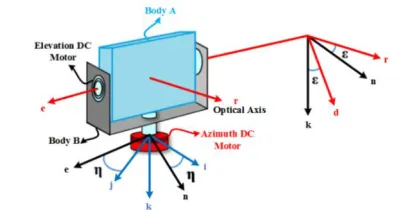
The dual-axis gimbal system is shown in Figure 1. Generally, the stabilizer loop in the dual-axis seeker system on the two channels with the least differences are similar to each other. The control and stabilization of each channel is dependent on the cross -coupling between two dynamical mass instability channels, generated by the asymmetric mass distribution, external and internal factors which is affecting the system that subsequently influences its operation. It should be noted that if mass distribution is considered as symmetrically in relation to the frame or body axis, then there is no longer asymmetric mass distribution and the inertial matrix will be in a diagonal way. In this research, a dynamic imbalance and cross-coupling between the two channels were considered.
Thus, the total external torque in the elevation channel is given by following expression [1]:
TETE ED ECC
T T T (3)
Furthermore, the total external torque in azimuth channel is given by following expression [1]:
TETA AD ACC
T T T (4)
4. PROPOSED CONTROLLER DESIGN FOR GIMBAL SEEKER
We used a predictive control in order to choose the best control action by optimizing a cost function for the dynamical model of the modelled system. In the other control methods, feedback was used to calculate the system's previous error, and then to the system's current error.
Figure 1. Two-axis gimbal system
This led to a decrease in the system's functionality rate and in some cases the system's instability. Since the two -axis seeker system has a very complex dynamic, which is a multi-variable, unstable, and noisy process; a generalized predictive control model based on a state-space is used. In this research, we used the predictive control model based on the state-space in order to control the two-axis seeker stabilizing loop and to evaluate its performance in flight simulation by taking into account the flight dynamics of a flying object stated as follows [14-15]:
1
1 -1
k xx k x k
k k k
X P x H u
Y Px Hu
(5)
And the following cost function, where P is the predictive horizon rate and H is the control horizon rate [14-15]:
2
1
1
ˆ
( ) - ( 1 )
( -1) ( )
P i d i
M
i i
J q y t i y t t
u t i r t
(6)With reference to Figure 2, it can be seen that how the proposed controller is applied to each channel of the stabilizer loop system: The general block diagram for the closed loop flight simulation is shown in Figure 3.
5. SIMULATION AND RESULTS
The initial values are summarized in Table 1. In order to accurately evaluate the performance of the model system, we simulate and evaluate once for unchanged
Figure 2. Two-axis gimbal seeker with GPC controller
inputs and fixed angular rate commands and also for different heights. In the next scenario, the modelled system was simulated under flight conditions regarding the introduced seeker into a simulated missile which all the commands were online and during the engagement for the target of maneuverability. The target without maneuverability taken into account for different heights and 15 km approached target. Finally, we compared the performance of each mode with each other. The following Table 2 shows the conditions for each of the scenarios applied:
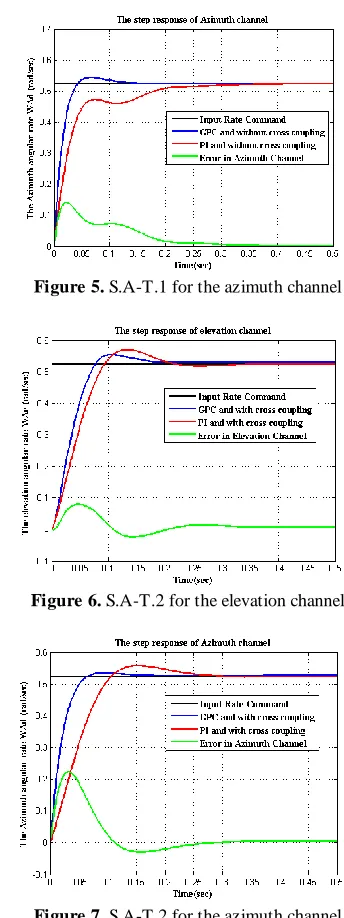
Figures 4 and 5 show the first scenario assuming the offline mode, without cross -coupling and the input rate command is equal to 30º/s for the elevation and azimuth channels (S.A-T.1).
Also, Figures 6 and 7 show the first scenario assuming the offline mode, with cross -coupling and the input rate command is equal to 30º/s for two channels (S.A-T.2).
TABLE 1. Initial Data used for Simulations
Parame te r Initial Value
Missile velocity(𝑉𝑚) 50 m/s
T arget velocity(𝑉𝑡) 50-100 m/s
𝑃𝐸𝑙𝑒𝑣𝑎𝑡 𝑖𝑜 𝑛 63
𝑃𝐴𝑧𝑖𝑚𝑢𝑡ℎ 45
𝐻𝐸𝑙𝑒𝑣 𝑎𝑡𝑖𝑜𝑛 , 𝐴𝑧𝑖𝑚𝑢𝑡ℎ 1
TABLE 2. Parameter Data Used for Analysis Scenarios
S.A S.B
T .1 T .2 T .3 T .4
A
n
g
u
la
r
R
a
te
0.61
0
0.25 Pj Pi Pk
0.61
0
0.25 Pj Pi Pk
From Airframe
Data
From Airframe
Data
In
p
u
t
R
a
te 30 º/s
Without Cross-Coupling
30 º/s With
Cross-Coupling
Online Without
Cross-Coupling
Online With
Cross-Coupling
Figure 4. S.A-T.1 for the elevation channel
Figure 5. S.A-T.1 for the azimuth channel
Figure 6. S.A-T.2 for the elevation channel
Figure 7. S.A-T.2 for the azimuth channel
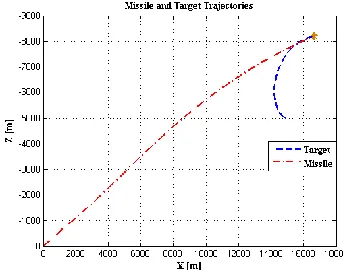
Figures 8 and 9 show the scenario "B" assuming the online mode, without cross -coupling in 0.5 seconds from simulation for azimuth and elevation channels (S.B- T.3). Figures 10 and 11 shows the scenario "B" assuming the online mode, with cross -coupling in 0.5 seconds from simulation for azimuth and elevation channels (S.B-T.4). Figures 12 and 13 also represent respectively how the missile and target are involved when the target is accelerated and non-accelerated.
Figure 8. S.B-T.3 in 0.5sec for the elevation channel
Figure 9. S.B-T.3 in 0.5sec for the azimuth channel
Figure 10. S.B-T.4 in 0.5sec for the elevation channel
Figure 11. S.B-T.4 in 0.5sec for the azimuth channel
Figure 12. M issile and target trajectories when the target is non-accelerated
Figure 13. M issile and target trajectories when the target is accelerated
TABLE 3. Transient response analysis results
T
e
st
N
u
m
b
e
r Ele vation C hanne l Az imuth C hanne l
C onve rtional PI controlle r GPC type controlle r C onve rtional PI controlle r GPC type controlle r O v
(%) ts
(se c) td
(se c) tr (sec) O v (%)
ts
(se c) td
(se c) tr
(se c) O v (%)
ts
(se c) td
(se c) tr
(se c) O v (%)
ts
(se c) td
(se c) tr
(se c)
1 7.63 0.46 0.04 0.1 3.88 0.3 0.03 0.081 - 0.5 0.02 0.35 3.81 0.34 0.01 0.04
TABLE 4. Effective range with cross coupling
Altitude (km) C onve rtional PI C ontrolle r GPC Type C ontrolle r
Flight Time (s) Inte rce pt point(m) Miss Distance(m) Flight Time (s) Inte rce pt point(m) Miss Distance(m)
1 14.61 8408.6 14.62 14.53 8448.9 14.33
2 14.82 8319.2 13.29 14.6 8416.1 14.88
3 14.94 8262.7 14.53 14.92 8273.3 14.69
4 15.25 8123.7 14.81 15.21 8141.9 14.13
5 15.75 7900 14.08 15.65 7941.3 14.94
6 16.4 7608 13.36 16.19 7700 14.38
TABLE 5. Control Effort
Te st C ase PI C ontrolle r GPC Type C ontrolle r
max min TF(ms) max min TF(ms) W ithout Cross-Coupling 7.5768 -1.7416 368 2.0751 1.7145 72
W ith C ross-Coupling 24.5452 7.5398 374 2.0751 1.7158 72
6. CONCLUSION
In this research, we took into account the equations of motion of the two axis gimbal seeker in order to better understand the concepts and complexities of the two -axis seeker stabilizer loop and its control. Then, the predictive control theory is expressed and utilize it for controlling a two-axis seeker compared to the traditional PI control method. We also tested it under flight conditions and six-degree freedom equations to check out the uncertainties, conditions and precise examination of the operation of the gimballed sys tem.
In this research, Generalized Predictive Control (GPC) performance on the state of space was successful in order to stabilize the system, and the results are: the predictive control compared to the conventional method is more efficient and fast, optimization of The traveled trajectory by the missile toward the target during flight conditions, improving the Miss Distance at the moment of collision with the target, resistant to the uncertainty of the parameter and torque disturbances, mass imbalance and cross-couplings. For example, the simulation results in altitude=2km show the suggested system in comparison with conventional PI controller improves miss-distance and flight time by 11.98 and 1.5%, respectively. Moreover, the suggested system in maximu m control signal=72.61%, minimum control signal=1.55% and final time=80.43% (control effort parameters), were much better than PI type controller.
7. REFERENCES
1. Abdo, M., Vali, A. R., T oloei, A. R. and Arvan, M. R., “Stabilization loop of a two axes gimbal system using self-tuning PID type fuzzy controller”, ISA Transactions, Vol. 53, (2014), 591-602.
2. Anderson, D., McGookin, M., “Fast Model Predictive Control of the Nadir Singularity in Electro-Optic Systems”, Journal of Guidance Control and Dynamics, Vol. 32, (2009), 626-632. 3. Özgür, H., Aydan, E., İsmet , E., “ Proxy-based sliding mode stabilization of a twoaxis gimballed platform”, Proceedings of
the world congress on engineering and computer science, San Francisco, USA (WCECS), Vol. I, (2011).
4. Abdo, M., Vali, A. R., T oloei, A. R. and Arvan, M. R., “Research on the Cross-Coupling of a two axis gimbal system with dynamic unbalance”, International Journal of Advanced Robotic Systems, Vol. 10, (2013). https://doi.org/10.5772/56963 5. Khodadadi, H., “Robust control and modeling a 2-DOF inertial
stabilized platform”, International conference on electrical, control and computer engineering, Pahang, Malaysia, (2011) 223–228.
6. Abdo, M., Vali, A. R., T oloei, A. R. and Arvan, M. R., “Improving two axes gimbal seeker performance using cascade control approach”, Proceedings IMeche Part G: Journal of Aerospace Engineering, (2014), 1-18.
7. Abdo, M., Vali, A. R., T oloei, A. R. and Arvan, M. R., “Modeling Control and simulation of two axes gimbal seeker using fuzzy PID controller”, 22nd Iranian Conference on Electrical Engineering (ICEE), (2014), 1342-1347.
8. Zhan, S. T ., Yan, W. X., Fu, Z., Pan, G and Zhao, Y. Z., “Robust control of a yaw-pitch gimbaled seeker”, Aircraft Engineering and Aerospace Technology, Vol. 87, (2015), 83-91. 9. Khamis, A., Kamel, A. M and Naidu, D. S., “ Nonlinear Optimal
T racking For Missile Gimbaled Seeker Using Finite-Horizon State Dependent Riccati Equation”, T he 14th Annual IEEE International Conference on Cyber T echnology in Automation, Control and Intelligent Systems, (2014), 88-93.
10. Mondal, S., Sadhu, S and Banerjee, A., “ Platform Motion Disturbances Attenuation in a Missile Seeker Subsystem Using Internal Model Control”, International Conference on Control, Automation, Robotics and Embedded Systems (CARE), (2013), 1-4.
11. Lin, CM., Hsu, CF and Mon. YJ., “Self-organizing fuzzy learning CLOS guidance law design”, IEEE Transactions, Vol. 39, (2003), 1144–1151.
12. T am, KK., Lee, T H., Mamum, A., Lee, MW and Khoh, CJ., “Composite control of a gyro mirror line of sight stabilization platform design and auto tuning”, ISA Transactions, Vol. 40, (2001), 155–171.
13. Krishna Moorty, JAR., Marathe, R and Sule, VR., “ H∞ control law for line-of sight stabilization for mobile land vehicles”, Optical Engineering, Vol. 41, (2002), 2935–2944.
14. Salahshoor, K., Khaki-Sedigh, A., Sarhadi, P., “ An indirect adaptive predictive control for the pitch channel autopilot of a flight system”, Aerospace Science and Technology, Vol. 45, (2015), 78-87.
Design of Generalized Predictive Control for the Stabilizing Loop from a two-axis
Gimbal Seeker, Considering Cross-Coupling in Between two Channels
M. Pirzadeha, A. R. Toloeib
a Department of Electrical Engineering, Damavand Branch, Islamic Azad University, Damavand, Iran b Department of Aerospace, Shahid Beheshti University, Tehran, Iran
P A P E R I N F O
Paper history:
Received 06 October 2018
Received in revised form 30 December 2018 Accepted 03 Januray 2019
Keywords:
Generalized Predictive Control Gimbal Seeker
Cross Coupling Control Effort هدیکچ ا رد نی قحت ،قی گ رگوجتسج لرتنک روظنم هب لابمی
هروحمود کی پ هدننک لرتنک شی نیب معت می هتفای م هئارا ی ددرگ قح رد . تقی
ور ود درکی ا زا هدافتسا رد مهم نی
دراد دوجو رلرتنک عون
;
س لرتنک ،لوا متسی
قلح ۀ اپ زاسرادی اس هارمهب رگوجتسج ی ر ز متسیسری یاه کشت لی دنهد ۀ رگ رظنرد اب نآ نتف
ب عطاقتم لاصتا نی
سررب ،مود و لاناکود ی
س درکلمع متسی ش تحت هدش هئارا ار
طی
زاورپ ی د نتفرگرظنرد اب کیمانی
بش .هدنرپ ئش هی اهیزاس ازا هب ی رانس یاهوی اپان نتفرگ رظنرد اب و فلتخم ی
یراد مرج ی و
ارش و عطاقتم لاصتا طی
زاورپ ،ی س درکلمع متسی وم ار هدش هئارا زرا در
یبای م رارق ی دنهد اتن . جی بش هی اهیزاس تقد س متسی حارط ی رلرتنک اب هدش
GPC
رلرتنک ربارب رد ار
PI م ناشن ی دهد دب . نی اتن هک تروص جی بش هی یزاس عافترا رد 2 یرتمولیک م ناشن ی دهد اطخ هک ی M iss-distance
زاورپ نامز و ی ترتب بی دودح 98 / 11 و 5 / 1 % دوبهب هتفای س ،هولاعب .تسا لانگی لرتنک ی ز و نام اهن یی اهرتماراپ( ی لرتنک شلات ی ترتب ) بی دودح 55 / 1 و 43 / 80 % دوبهب موسرم شور هب تبسن هتفای
تسا
.