PhD Dissertation
International Doctorate School in Information and Communication Technologies
DIT - University of Trento
Corrective Evolution of Adaptable
Process Models
Adina Sirbu
Advisor:
Prof. Marco Pistore
Fondazione Bruno Kessler
“We shall not cease from exploration And the end of all our exploring Will be to arrive where we started And know the place for the first time.”
T. S. Eliot
Acknowledgements
First of all, I would like to thank my advisor Marco Pistore for giving me the opportunity to work under his guidance. Marco’s invaluable insights from his broad knowledge and experience, as well as his problem-oriented view (what is the message?) have always kept me focused on achieving concrete results. This thesis would not have been possible without his support, and I am deeply grateful for having had the experience to work together.
Many thanks to Luciano Baresi and Annapaola Marconi for our numer-ous discussions which helped to shape the research problem presented in this thesis. This work has greatly improved over time due to their many fruitful suggestions and comments. I would like to thank Luciano Baresi, Paolo Giorgini, and Barbara Weber for accepting to act as my doctoral ex-amination committee, for taking the time to read this thesis and to prepare many interesting questions and comments.
giorgio Bertoli, who over the years have become close friends. Many thanks go to all my friends, and especially to Nathalie Steinmetz, for their many encouragements during these last years. I know how fortunate I am to have them in my life, and I apologize for not listing them all here.
Abstract
Modeling business processes is a complex and time-consuming task, which
can be simplified by allowing process instances to be structurally adapted at
runtime, based on context (e.g., by adding or deleting activities). The
pro-cess model then no longer needs to include a handling procedure for every
exception that can occur. Instead, it only needs to include the assumptions
under which a successful execution is guaranteed. If a design-time
assump-tion is violated, the excepassump-tion handling procedure matching the context is
selected at runtime. However, if runtime structural adaptation is allowed,
the process model may later need to be updated based on the logs of adapted
process instances. Evolving the process model is necessary if adapting at
run-time is too costly, or if certain adaptations fail and should be avoided.
An issue that is insufficiently addressed in the previous work on process
evolution is how to evolve a process model and also ensure that the evolved
process model continues to achieve the goal of the original model. We refer
to the problem of evolving a process model based on selected instance
adap-tations, such that the evolved model satisfies the goal of the original model,
as corrective evolution. Automated techniques for solving the corrective evolution problem are necessary for two reasons. First, the more complex
a process model is, the more difficult it is to be changed manually. Second,
there is a need to verify that the evolved model satisfies the original goal.
To develop automated techniques, we first formalize the problem of
an instance adaptation at a particular point in the process model, there can
be multiple paths in the model for reaching this point. Each of these paths
is uniquely identified by a trace, i.e., a recording of the activities executed
up to that point. Depending on traces, an instance adaptation can be used
to correct the process model in three different ways. A correction is strict
if the adaptation should be plugged in on a precise trace, relaxed if on all
traces, and relaxed with conditions if on a subset of all traces. The choice
is driven by competing concerns: the evolved model should not introduce
untested behavior, but it should also remain understandable.
Using our formal model, we develop automated techniques for solving
the corrective evolution problem in two cases. The first case is also the
most restrictive, when all corrections are strict. This case does not require
verification, since the process model and adaptations are assumed to satisfy
the goal, as long as the adaptations are applied on the corresponding traces.
The second case is when corrections are either strict or relaxed. This second
case requires verification, and for this reason we develop an automated
technique based on planning.
We implemented the two automated techniques as tools, which are
inte-grated into a common toolkit. We used this toolkit to evaluate the tradeoffs
between applying strict and relaxed corrections on a scenario built on a real
event log.
Keywords
Contents
1 Introduction 1
1.1 Contributions . . . 7
1.1.1 Formal Model . . . 7
1.1.2 Automated Process Evolution Approach . . . 8
1.1.3 Experimental Results . . . 10
1.2 Thesis Outline . . . 11
2 State of the Art 13 2.1 Adaptable Process Models . . . 13
2.1.1 Design-time Adaptation Approaches . . . 15
2.1.2 Runtime Adaptation Approaches . . . 19
2.2 Ensuring Process Compliance to Goals and Constraints . . 25
2.2.1 Design-time Compliance . . . 26
2.2.2 Runtime Compliance . . . 30
2.3 Related Work . . . 32
2.3.1 Analyzing Execution and Adaptation Logs . . . 32
2.3.2 Managing Process Variants . . . 34
2.3.3 Refactoring Process Models . . . 36
2.4 Discussion . . . 38
3.1.1 Execution Phase . . . 41
3.1.2 Analysis Phase . . . 43
3.1.3 Evolution Phase . . . 44
3.2 Process-Based Application Representation . . . 47
3.2.1 Domain Objects . . . 48
3.2.2 Goals . . . 50
3.2.3 Process Models . . . 52
3.3 Execution Concepts . . . 57
3.3.1 Traces . . . 57
3.3.2 Configurations . . . 58
3.3.3 Executions . . . 59
3.3.4 Goal Satisfaction . . . 61
3.4 Adaptation Concepts . . . 62
3.4.1 Adaptation Operation . . . 63
3.4.2 Adapted Traces and Executions . . . 65
3.5 Discussion . . . 68
4 Corrective Evolution 71 4.1 Corrections . . . 71
4.1.1 Adaptation Plug-in Point and Condition . . . 72
4.1.2 Correction Applicability . . . 76
4.1.3 Correction Effects . . . 78
4.2 Corrective Evolution Problem . . . 80
4.2.1 Ordering Corrections . . . 81
4.2.2 Problem Definition . . . 82
4.2.3 Solution Properties . . . 83
4.2.4 Multiple Corrections at Once vs. One at a Time . . 85
CONTENTS
5 Encoding into State Transition Systems 89
5.1 Basic STS Notions . . . 90
5.2 Encoding the Process Models . . . 92
5.3 Encoding the Adaptations . . . 95
5.4 Encoding the Partial Traces . . . 97
5.5 Encoding the Conditions . . . 99
5.6 Encoding the Domain Objects . . . 102
5.7 Encoding the Goals . . . 103
6 Strict Corrective Evolution 107 6.1 Description of the Approach . . . 107
6.2 Correctness of the Approach . . . 110
6.2.1 Correspondence Between Executions of a Corrected Model and Runs of the Parallel Product STS . . . . 112
6.2.2 Correctness . . . 122
6.2.3 Completeness . . . 123
6.3 Discussion . . . 124
7 Relaxed Corrective Evolution 127 7.1 Description of the Approach . . . 128
7.2 Correctness of the Approach . . . 133
7.2.1 Correspondence Between Executions of a Corrected Model and Runs of the Parallel Product STS . . . . 134
7.2.2 Correspondence Between Complete Executions of a Corrected Model and Complete Runs of the Controller139 7.2.3 Correctness . . . 142
7.2.4 Completeness . . . 144
8 Evaluation 147
8.1 Overview of the Event Log . . . 148
8.2 Experimental Setup . . . 150
8.2.1 Designing the Domain Objects . . . 150
8.2.2 Annotating the Activities . . . 153
8.2.3 Obtaining the Original Process Model . . . 154
8.2.4 Generating Corrections . . . 156
8.3 Evaluating Tradeoffs Between Strict and Relaxed Corrections159 8.3.1 Fitness . . . 159
8.3.2 Behavior . . . 161
8.3.3 Structure . . . 162
8.4 Discussion . . . 164
9 Conclusion 167 9.1 Achieved Results . . . 167
9.2 Future Directions . . . 170
List of Tables
3.1 Configurations along one execution in the car logistics scenario 61
List of Figures
3.1 Evolution framework . . . 40
3.2 Process-based application representation . . . 48
3.3 Modeling elements in the process lifecycle . . . 49
3.4 Domain objects in the car logistics scenario . . . 51
3.5 Car process model . . . 56
3.6 Adaptation operations . . . 67
5.1 STS encoding of the process model and adaptations . . . . 98
5.2 STS encoding of traces: (a) π1; (b) π2 . . . 100
5.3 STS encoding of conditions: (a) ϕ1; (b) ϕ2 . . . 101
5.4 STS encoding of the Car Health domain object . . . 104
5.5 STS encoding of a goal statement . . . 105
6.1 Strict corrective evolution: solution overview . . . 108
6.2 Corrected process model: both corrections are strict . . . . 110
6.3 Example of a correspondence between an execution and a run111 7.1 Relaxed corrective evolution: solution overview . . . 129
7.2 Corrected process model: correction C1 is relaxed, C2 is strict132 7.3 Corrected process model: correction C1 is strict, C2 is relaxed132 7.4 Corrected process model: both corrections are relaxed . . . 133
8.1 Mining result on the raw event log . . . 149
8.3 A rough process model . . . 157 8.4 Fitness: corrections applied (1) individually; (2) incrementally160 8.5 Behavioral precision: corrections applied (1) individually;
(2) incrementally . . . 162 8.6 Corrected process models for the 4th correction . . . 163 8.7 Structural precision: corrections applied (1) individually;
Chapter 1
Introduction
The success of an enterprise depends on its ability to adapt frequently and rapidly in reponse to changes in the business environment [20]. Since busi-ness activities are increasingly integrated with information technologies, this flexibility must also be present in the information system of the enter-prise. In response to this challenge, service-oriented computing emerged as a major trend in business engineering and software technology [71, 121]. With service-oriented computing, the main idea is to capture business rel-evant functionality into independent modular units called services, which expose only the information which is necessary to be used by customers. Services therefore allow to abstract away from implementation details and focus on business requirements and functionalities. Technologies and stan-dards have been developed for building service-based applications as com-positions of individual services, possibly offered by different third-party organizations. The flexibility offered by service-based applications comes from the fact that software services can be discovered, selected and com-posed dynamically, while the application is running.
work-flow management technologies were designed to support business processes requiring the coordination of human participants and IT tools and appli-cations. This mainly involved providing support for designing and man-aging the execution of these business processes, which were seen as static and repetitive. In contrast, in BPM business processes do not necessarily involve human participants, and often span different organisations [118]. Moreover, the support provided with workflow management is enhanced in BPM to include also business process monitoring, diagnosis, and redesign [110].
By using business processes to represent compositions of services, and BPM to manage these business processes, an enterprise can more easily react to changes in the business environment. The support provided by BPM in terms of monitoring and diagnosis can be used to observe the changes in the environment. Then, the ability to implement the runtime adaptation of business processes and the redesign of these processes with relatively little effort, by re-composing existing services, allows to rapidly respond to the observed changes.
From process modeling to adaptation
needs to include a handling procedure for every exceptional situation that can occur. Instead, it only needs to include the assumptions under which a successful execution is guaranteed. If a design-time assumption is violated, an exception is triggered and the exception handling procedure matching the context is selected or constructed at runtime (e.g., [12, 21, 28]).
Being able to adapt process instances at runtime is especially useful if the exceptional situation is unlikely, but must nevertheless be considered in the process model (e.g., due to legal concerns), and including the ex-ception handling procedure would significantly increase the complexity of the process model. Another case where runtime adaptation is useful is if the appropriate exception handling procedure is not known at the time of designing the process model. If process knowledge can be discovered also at runtime, we may want to postpone the decision of how to handle an exceptional situation until it is actually needed, in order to use all the available process or fragment models. Finally, there may be different han-dling procedures which are suitable for a particular exceptional situation, and the process designer may not know upfront which handling procedure would be successful for the application. Also in this case, we may want to choose an appropriate exception handling procedure at runtime.
From adaptation to evolution
If runtime structural adaptation is allowed, the process model may later need to be updated based on the logs of adapted process instances. If an instance adaptation fails when applied in a certain situation, the process model can be updated to ensure that the failing adaptation is no longer used for that situation. Updating the process model is necessary also when it is too costly to deal at execution time with an exceptional situation, for example because the situation occurs frequently.
process variants is not new, and different aspects of this research problem been addressed in, e.g., [15, 37, 53, 77, 87, 95, 117]. Many approaches deal with the question of how to recommend process model changes based on frequent and successful process instance adaptations, e.g., [77, 87, 117]. There are also approaches, e.g., [53, 87], which generate the evolved pro-cess model automatically. Once a propro-cess model is evolved, an important problem that arises is how to migrate the running process instances to the new process model. This problem is investigated in, e.g., [15, 86, 95].
Although many approaches have been proposed to tackle the problem of process evolution, an issue that is insufficiently addressed in these ap-proaches is how to evolve a process model and also ensure that the evolved process model continues to comply with the goal and constraints of the orig-inal process model. Process models often have to comply with internally defined directives, such as business strategies, as well as externally imposed directives, such as legal regulations and contracts. Enforcing compliance with external directives is particularly challenging, since such directives cannot simply be incorporated in the design of the process models [93]. This issue is also relevant for process evolution, especially since instance adaptations can be used to update a process model in multiple ways, but it can be the case that only some of the evolved process models which result comply with the goal and constraints of the original process model. We refer to the problem of evolving a process model based on selected process instance adaptations such that the evolved model satisfies the goal of the original model as corrective evolution.
are three options, depending on which traces the adaptation should be plugged in. To the best of our knowledge, this distinction based on traces is not present in the literature.
• The first option is to plug in the adaptation at a particular point in the process model, only for the trace corresponding to the process instance where the adaptation was used. We call this option a strict
correction. The advantage of strict corrections is that the resulting
process model will not contain any unknown behavior.
• The second option, or relaxed correction, is to plug in the adapta-tion again at a particular point in the process model, but on all the traces that lead to the specified point. Although more behavior is introduced, the resulting process model should be smaller than the model obtained with strict corrections. The reason is that applying strict corrections requires unfolding the process model, such that the adaptation is plugged in only for the right trace, and this unfolding may require duplicating process steps.
• Plugging in adaptations as relaxed corrections is not always possible, since we also need to ensure that the resulting process model satisfies the goal. The option in this case, relaxed correction with conditions, is to plug in the adaptation only for some of the traces leading to the specified point. This option covers the cases in between the first two options.
Motivating scenario
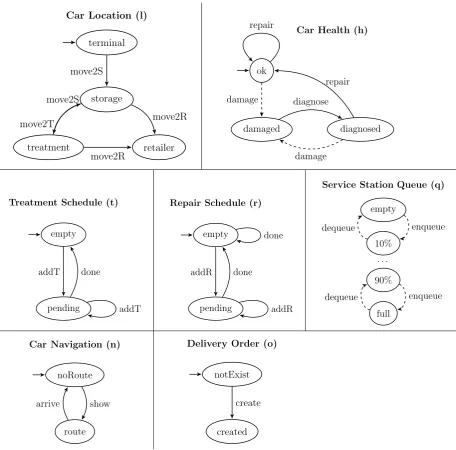
at the sea port, must be unloaded and eventually delivered to a retailer. We focus on the process model for handling the car from the moment it arrives at the terminal, and until it is delivered. First, the car is stored, and remains in the storage area until a delivery order is issued. Then, it undergoes the treatments specified in the delivery order (e.g., painting, installation of electronic equipment, washing). When the treatments are completed, the car is loaded on a truck and delivered to the retailer. The goal of the process is to deliver the car to the retailer in perfect condition. Cars may be damaged at any point while at the sea port. They may be scratched, may have dents on the surface, flat tires, or low oil levels. The damage can be handled by repairing the car immediately or postponing the repair to a more convenient time. How to handle the damage depends on the context of the car. For example, it may depend on the availability of the resources necessary to repair the car, such as treatment stations or skilled workers. It may also depend on how urgent it is to repair the car, as well as on the urgency of the other cars waiting to be repaired.
To consider at every step in the process that the car can be damaged, as well as all the possible contexts in which the damage can occur, would complicate the process model significantly and obscure the original purpose of the process model. Instead, we specify a constraint on every process step, that the car should not be damaged. If this constraint is violated, the execution of the process instance will be interrupted, and the appropriate handling procedure will be selected based on the context.
1.1. CONTRIBUTIONS
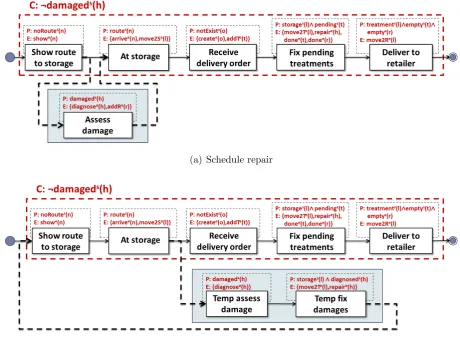
anymore. Although the repairs are not urgent, they should be resolved such that the car is delivered on time. We therefore need to evolve the process model, such that the repair is postponed in the first situation, and performed immediately in the second. Moreover, we need to ensure that the evolved process model satisfies the goal to deliver the car in perfect condition.
Depending on the type of the two corrections, we will obtain different process models. If both corrections are strict, the second adaptation is applied only for the trace when the car is damaged a second time, after having postponed the repair for the first damage. If, however, the second adaptation is plugged in as a relaxed correction, it will be applied also for the traces where the car is damaged for the first time.
1.1
Contributions
In this dissertation, we extend the existing work on process evolution by investigating the problem of updating a process model based on process instance adaptations, such that the evolved model continues to achieve the goal of the original process model. We propose a formal model for representing processes and their goals, and use this formal model to develop two automated approaches for process evolution. Finally, we evaluate these two approaches on a scenario built on a real-life event log.
1.1.1 Formal Model
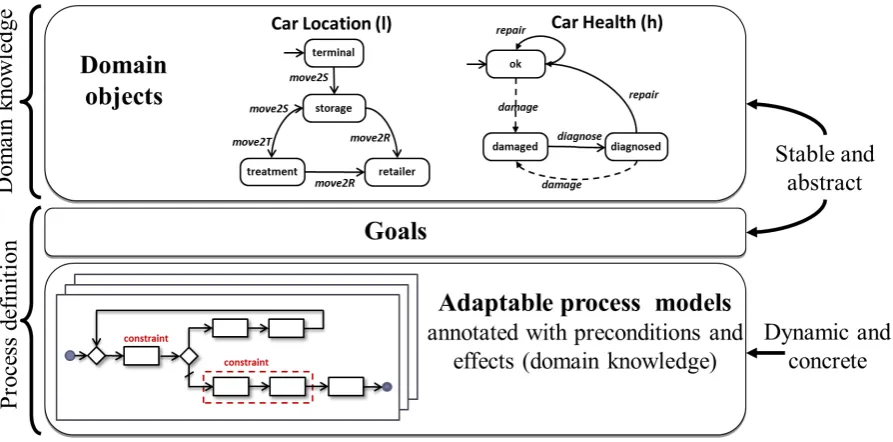
independent of context.
We consider the domain knowledge to be stable and abstract, and model this knowledge using domain objects. Each domain object corresponds to a property of a physical or computational entity in the domain, and consists of a set of possible values and a set of events representing value changes. The stable part of the process knowledge is represented using goals, defined based on the domain objects. Finally, the dynamic and concrete part of process knowledge is represented using adaptable process models. Process models are directed graphs in which the nodes are either steps in the process (i.e., activities) or control connectors. We relate the process models to the domain by defining annotations on process steps based on domain objects. We use this formal model to investigate the problem of corrective evo-lution, that is, the problem of updating a process model based on process instance adaptations, such that the evolved model satisfies the goal of the original model. To formally specify that process models satisfy goals, we introduce process execution concepts, and define goal satisfaction criteria based on these concepts. We then introduce process instance adaptation concepts. Based on these concepts, we define evolutionary correction as the operation of changing a process model to include an instance adapta-tion at a certain point in the model and for a certain condiadapta-tion. Finally, we define the corrective evolution problem as the problem of applying a sequence of corrections, such that the resulting process model satisfies the original goal.
1.1.2 Automated Process Evolution Approach
1.1. CONTRIBUTIONS
is depends not only on the size of the model, but also on features such as level of concurrency and modularity of the model [18, 64]. Second, unless all corrections are strict, there is a need to verify that the resulting process model satisfies the original goal.
In this dissertation, we develop automated techniques for solving two cases of the corrective evolution problem: when all the corrections are strict, and when the corrections are either strict or relaxed. Unlike the general case, these two cases do not require searching for the right traces where to plug in the adaptations. In the first case, the traces are given as input. In the second case, if a trace is not given, i.e., a correction is relaxed, the adaptation should be plugged in on all traces leading to the plug-in point. The difference between these two cases is that strict corrective evolution also does not require verification, since we assume that both process model and adaptations satisfy the goal, as long as adaptations are applied only on the corresponding traces.
If all corrections are strict, the challenge is not to find a solution to the problem, since a solution to the problem can be constructed naively. However, a naively constructed solution will be unnecessarily large, due to the duplication of many process steps. Therefore, the challenge in this case is to automatically find a solution which contains as few duplicated process steps as possible.
1.1.3 Experimental Results
The two automated techniques for solving corrective evolution problems have been implemented into a prototype tool. We used this prototype tool to conduct a series of experiments, in order to show the tradeoffs between applying strict and relaxed corrections.
To conduct our experiments, we set up a scenario based on a real event log. The traces in this log correspond to instances of a single process, an application process for a personal loan or overdraft. To set up our scenario, we recreated all the elements required by our approach: the domain objects, the original process model and its goal, as well as the corrections to the process model. This task was particularly challenging, since the event log we used is an overwhelmingly complex mass of data. The complexity of the log stems from a great variation in how the loan applications are processed, in terms of the order of executing activities, as well as the number of times that certain sequences are re-executed.
We first designed our domain objects based on the event log and the textual descriptions given as input, and used these domain objects to an-notate all the activities that appear in the log. We filtered and mined the event log to obtain a rough process model and created the goal for this process model based on the domain objects. Finally, we computed the differences between the model and the traces in the log, and used the most frequent differences to generate strict and relaxed corrections.
1.2. THESIS OUTLINE
by applying relaxed corrections should require less future adaptations than the corresponding process models obtained with strict corrections.
1.2
Thesis Outline
The rest of this thesis is organized as follows. In Chapter 2 we give an overview of the state of the art in two fields related to our research prob-lem. The first field is that of adaptable process models. Here, we present techniques ranging from design-time to runtime, and from manual to fully automatic, which are meant to increase the flexibility of process models to changes in the execution environment. The second field is that of ensur-ing the compliance of process models to goals and constraints. Here, we present techniques from the research area of business process management, as well as techniques from the related area of Web service composition. We then focus on approaches which are closely related to the problem of pro-cess evolution, and conclude with a discussion about the limitations of the approaches which are closest to the work presented in this thesis.
In Chapter 3, we introduce a framework supporting the evolution of process models based on execution and adaptation histories, and discuss each phase in the lifecycle of a process-based application using this frame-work. We also introduce the basic elements for modeling an application, as well as concepts related to process execution and adaptation. These concepts are then used in Chapter 4, where we formally define corrections and corrective evolution problems. This chapter also includes a discussion of the challenges involved in automating corrective evolution.
mechanism, and is used in the following two chapters for solving two cases of corrective evolution. In Chapter 6, we solve the special case when all corrections are strict. In Chapter 7, we continue with a second and more general case, when corrections are either strict or relaxed.
Chapter 2
State of the Art
The research problem addressed in this thesis, that of ensuring goal compli-ance of evolving process models, has its roots into two related fields. First, there is the field of adaptable process models, which deals with increasing the flexibility of process models to changes in the execution environment. The second field is that of ensuring the compliance of business process models to goals and constraints. In this chapter, we give an overview of each of these two related fields in Section 2.1, and respectively Section 2.2. Approaches which are closely related to our research problem are presented in detail in Section 2.3.
2.1
Adaptable Process Models
of the process affected by the change, while maintaining the unaffected parts unchanged [97].
Different types of flexibility are required during the lifecycle of a process (see also [83, 118]):
• ability to deal with uncertainty by deferring certain decisions to exe-cution time;
• ability to react to foreseen or un-foreseen exceptions by deviating from the predefined process model;
• ability to evolve process models over time.
To address these flexibility requirements, several competing paradigms have emerged, such as adaptable processes [82, 12], declarative processes [75], and data-driven processes [111, 68]. In the following, we give an overview of approaches designed to achieve process flexibility. Although we will choose examples for each of the competing paradigms, we will focus more on approaches which model processes using an imperative language, since this is also the direction taken in this thesis.
Process adaptation can be performed either at design-time or at run-time. Among design-time adaptation approaches, we distinguish between approaches which provide a set of specialized constructs for embedding the adaptation logic in the process model, and approaches which support the modeling of a reference process model from which different process variants can be configured.
2.1. ADAPTABLE PROCESS MODELS
model is changed as well. Here, we consider also the problem of propagat-ing the process model changes to the runnpropagat-ing process instances.
2.1.1 Design-time Adaptation Approaches
Special Modeling Constructs
We first consider the case when the process modeling language contains constructs which provide the ability to incorporate alternative execution paths within the process model at design-time. Here, an important contri-bution is the work on workflow patterns [109], which provide a means to assess the expressiveness of process modeling languages [124, 92].
The approach in [60] proposes a set of modeling constructs, which allow to route the execution of the process based on contextual information. The built-in adaptation constructs include:
• theconditional if, which is used to specify conditional branches guarded
by context conditions;
• the context handler, which allows to react automatically to the
viola-tion of context condiviola-tions during the execuviola-tion of the process;
• the conditional one-of, which is used to specify a set of alternative
paths, each handling a specific execution context, and which allows to react to context changes by jumping at runtime from one path to another;
• the cross-context link, which allows such jumps also when it is not
possible or desirable to undo the work done.
Another complex form of design-time adaptation is proposed by Modaf-feri et al. in [67]. The authors introduce the notion of context-sensitive region as a part of the business process which can have different behaviors depending on context. Regions are associated to several configurations, each configuration having an entry condition over the user context. At execution time, the process instance can be migrated from one configura-tion to another (possibly compensating completed activities), depending on context. To prevent excessive loss of work due to compensation, the notion of migration arcs is introduced, these allowing to switch between configurations.
Wieland et al. [123] extend BPEL in order to explicitly model the influ-ence of the execution context on the workflow. The context-aware work-flows are modeled using context events, context queries, and context deci-sions. With context events, the workflow waits asynchronously for a special environment state. The context queries are used to filter or select objects based on spatial predicates. Lastly, context decisions are used to route the process flow based on internal/external context data.
Process Configuration
For a particular business process, several process variants may exist. There are many situations when process variants are necessary. For example, if the process model should be used in different countries or regions, these countries may have different regulations. Another example is if there are different policies for different seasons, different groups of customers, etc. What is specific to process variants is that for each particular context the steps to be followed are known and well understood.
2.1. ADAPTABLE PROCESS MODELS
process model, using conditional branching. In both cases, the maintenance efforts are high. Separate, very similar process models are difficult to maintain due to the high redundancy. On the other hand, a process model which includes all the variants will be difficult to maintain and understand due to its size and complexity.
Several directions have been proposed to reduce the efforts necessary for maintaining process variants. One such direction is to use process config-uration. With process configuration, the idea is to capture all the process variants into a reference process model, such that at configuration-time (an intermediary phase between design-time and runtime) this reference model can be configured into one of the process variants.
The main characteristic of such reference process models is that they include variation points, in order to distinguish between parts which are common to all variants and parts which are variant-specific. For example, such variation points are represented as configurable nodes in [88, 33, 107], node labels in [85], and adjustment points in Provop [37].
by Aalst et al. [107] allows to configure processes incrementally, ensuring at every step that the configured variants are correct with respect to both syntactic and behavioral semantics.
Another means to support the configuration of process variants from a reference process model is by annotating the nodes of the reference model. With aggregated EPCs [85], the EPCs are connected to a product hierarchy by annotating the functions and events with simple labels. The labels are then used for extracting from the aggregated EPC the process model corresponding to a given product or product group. A similar approach has been developed in the project PESOA [79, 96], where process models are extended with stereotype annotations to obtain variant-rich process
models. Through process configuration, each variation point is realized
with one or more variants, depending on its type. The approach also makes use of the feature diagrams proposed in [45]. Although feature diagrams were introduced to facilitate configuration in software product lines, they can also be used to configure process models. In particular, the variants can be linked to features from a feature diagram. This way, variants are included or excluded from the process model depending on the selection of features in the feature configuration.
In Provop [37], process variants can be configured from a base pro-cess model, by applying groups of change operations, called options. The regions to which changes can be applied are restricted using adjustment points. Similar to [88] and [33], Provop allows to define constraints on the application of different adjustments (e.g., two options can be mutually exclusive). However, different from the process configuration approaches presented so far, for which the reference model needs to contain all the possible behavior, Provop allows also to move or add process elements.
is-2.1. ADAPTABLE PROCESS MODELS
sue is addressed in [50], where the configuration process is guided through questionnaires. Each question refers to a set of domain facts, which can be set to true or false. It is possible to define domain constraints as proposi-tional logic formulas over facts, as well as ordering dependencies between questions and facts. The questions are then posed in an order consistent with these dependencies. For each question, the space of allowed choices is pruned, in order to prevent the violation of domain constraints.
2.1.2 Runtime Adaptation Approaches
Loosely Specified Process Models
While specifying a process model, we may foresee at design-time that more execution paths will be necessary at runtime, which are not present in the model. Also, it may be the case that the process model cannot be completely specified, and that the activities to be performed at certain points in the process model will become clear only during the execution of a process instance. In both cases, a possible solution is to have loosely specified process models. Such models are incomplete, in the sense that they do not contain enough information to allow them to be executed to completion, but they can be completed at runtime by providing a concrete realization for the underspecified parts.
The approach in [3] supports late binding through small, self-contained processes called ’worklets’. The process model contains enabled workitems, which have associated sets of rules. Worklets are selected and bound at runtime using these rules and the relevant context. Both rules and worklets can be manually added at any time, even during process execution. Also supporting late binding, Burmeister et al. [14] model a business process by defining a goal hierarchy, a list of context variables, and a set of business plans linked to subgoals. Business plans are then selected and executed depending on goals and context. Late binding can also be achieved us-ing an aspect-oriented approach, by annotatus-ing process parts with aspects (e.g., [19, 42]). If the aspect matches the context information, the normal execution of a workflow can be interrupted and interweaved with additional business logic.
An approach which supports late modeling is presented by Sadiq et al. in [94], based on the notion of ’pockets of flexibility’. During execution, process instances are progressively built based on constraints which specify how and when the fragments can be composed. Validation is used to ensure that the constraint set does not carry conflicts or redundancy, and also that the dynamically modeled fragment conforms to the constraints.
Late composition of process fragments can be achieved using a
2.1. ADAPTABLE PROCESS MODELS
Dynamic Adaptation of Process Instances
When executing a process instance, it may be necessary to deviate from the execution paths defined in the process model in response to changes in the execution environment. Examples of such deviations are adding, skip-ping, re-executing, or compensating activities. Such adaptations only alter the precise process instance, without affecting the process model or other process instances. In the following, we discuss representative approaches supporting the dynamic adaptation of process models and Web service compositions. We start with approaches which consider adaptable process models. However, we also consider an approach where this dynamicity is built in the representation of processes. All these approaches are reactive, in the sense that the instance is locally adapted to react to changes in the execution environment. We therefore present also an approach which goes in the direction of proactive adaptation.
Many process management systems have been proposed which sup-port the user in defining process instance changes, e.g., ADEPT2 [82, 83], WASA2 [120], eFlow [16], CAKE II [66]. In [116], Weber et al. provide
Several approaches have been proposed for automating the structural adaptation of process instances. Such approaches are often based on plan-ning, as is the case of the works presented in [99], [12], and [28]. In [99], Schuschel and Weske present an integrated planning and enactment sys-tem, where alternating phases of planning and coordination are repeatedly traversed whenever an unanticipated effect occurs. This approach is ex-tended in [100], where the replanning is triggered automatically.
Bucchiarone et al. [12] propose a framework supporting the runtime adaptation of service-based applications to unexpected or improbable con-text changes. Adaptation is achieved through a set of mechanisms which are meant to bring the process instance to a state where the execution can be correctly resumed. The adaptation mechanisms can be combined through adaptation strategies, thus allowing to address complex adaptation needs, which cannot be solved by applying isolated mechanisms. The adap-tation mechanisms are realized by extending planning techniques originally designed for the automated composition of services [61]. The framework has been implemented and demonstrated on a complex car logistic scenario in [80].
Friedrich et al. [28] propose a self-healing approach to handle exceptions in service-based processes, such as faulty service invocations. At design-time, the approach can be used to evaluate the repairability of process definitions. At runtime, when an exception arises, the approach generates alternative repair plans by taking into account constraints posed by the process structure, the execution state of the process instance, and the available repair actions.
2.1. ADAPTABLE PROCESS MODELS
by the control-flow status, but by the presence of data objects. An exam-ple of a case handling tool is FLOWer, which supports several deviation operations: open/skip work items not yet enabled, skip or execute enabled work items, and redo executed or skipped items.
A shortcoming of current approaches supporting runtime automated adaptation is that the adaptation occurs only in a reactive fashion [71]. In other words, the adaptation is performed only after a deviation from the re-quirements or a change in context is observed. This has several drawbacks. First, if a failure occurs, the user may have to wait until the application becomes available again. Secondly, a failure can lead to undesirable con-sequences such as loss of money. The alternative, also called short-term proactive adaptation, is to automatically detect that a constraint will be violated before the conflict actually occurs.
An approach going in the direction of short-term proactive adaptation is AgentWork [69]. The adaptation offered by this workflow management system consists in adding, dropping or replacing individual tasks based on Event Condition Action (ECA) rules. These rules specify the events which constitute logical failures and the corresponding workflow adapta-tions. The adaptation mechanism uses temporal estimates in order to predict the workflow part which would be affected by the failure and adapt it in advance. The limitations of this approach are that adaptation changes can only affect individual tasks, and that manual intervention is required in case conflicting rules generate incompatible actions.
Evolution of Process Models
sense of deriving process model changes based on previous process instance adaptations will be considered in detail in Section 2.3.
Handling the already running process instances after a process model change is a challenging issue. Letting the instances finish on the old pro-cess model may be impossible, e.g., if the change is the enforcement of a new law. Aborting their execution entirely may also be undesirable if it means losing a great amount of work. The alternative is to migrate the currently executing process instances to the new process model. This is not a straightforward task, as shown with the dynamic-change bug originally described in [26]. The dynamic-change bug shows that it may be impos-sible to put the old instance in a state of the new process model without skipping or re-executing tasks.
In response to these challenges, many approaches have been been de-vised, e.g., [15, 95]. In [15], Casati et al. introduce a taxonomy of policies which describe how to manage running workflow instances when the corre-sponding workflow schema is modified. The authors introduce also a formal condition, instance compliance, to determine which running instances can be migrated to the new schema version: an instance is compliant with a new schema if it can be produced also on the new schema. Sadiq et al. [95] address also the problem of migrating the non-compliant instances to the new schema. If an instance is non-compliant, a compliance graph is con-structed which serves to partially roll-back the instance into a compliant state, from which it can execute according to the changed schema.
The problem of migrating process instances can be further complicated by the fact that the instances themselves may have been adapted. This issue is addressed in [86], where Rinderle et al. describe different migration policies based on the degree of overlap between concurrent process model and process instance changes.
mi-2.2. ENSURING PROCESS COMPLIANCE TO GOALS AND CONSTRAINTS
gration is that of version control. Without version control, a process model must either be copied manually before it is changed, or it must be over-written. In the first case, this leads to increased maintenance efforts, as the number of different versions increases. In the second case, problems will arise if there are currently running process instances which cannot be migrated.
With version control, process instances belonging to different versions can coexist, and, if possible, can be migrated to new versions. Examples of approaches which address the problem of versioning for process models are [44] and [125]. In [44], Kradolfer and Geppert present a framework for workflow schema evolution based on workflow type versioning and work-flow migration. To keep track of the evolution of a workwork-flow schema, the versions are stored in a version tree, which encodes derived-from relations. The instances can then be migrated to versions in the same version tree. They can also be migrated to previous versions, by performing a series of inverse modification operations. Zhao and Liu [125] present a different method, in which all the versions of a process model are stored in a single directed graph by annotating the nodes and edges with version numbers. Once the graph is built, any version of the process model can be obtained from the graph by following a set of derivation rules.
2.2
Ensuring Process Compliance to Goals and
Con-straints
financial services, gaming, or healthcare. Therefore, there is a need to design compliance rules and develop compliance checking and enforcing mechanisms. This is a challenging task, especially in the case of exter-nal directives, which cannot simply be incorporated in the design of the process models [93]. The main reason is the difference in terms of own-ership, governance, and timeline, between the business strategy and the regulations.
In this section, we give an overview of approaches which focus on ensur-ing the compliance of process models to goals and constraints. We consider approaches belonging to the research area of business process management, but also approaches from the related area of Web service composition. These approaches differ in the time when they are applied (design-time vs. runtime), but also in purpose (e.g., verification vs. self-healing) and in the techniques used (e.g., model checking, automated reasoning).
2.2.1 Design-time Compliance
Essentially, there are two ways to ensure at design-time that a process model complies with the specifications of goals and constraints. First, one can automatically generate the process model according to the specifica-tions, starting from process fragments or from Web services. Alternatively, one can verify that the manually created or mined process model complies with the specifications. We give an overview of automatic composition ap-proaches in Section 2.2.1, and of verification apap-proaches in Section 2.2.1.
Automated Composition
2.2. ENSURING PROCESS COMPLIANCE TO GOALS AND CONSTRAINTS
They can therefore be used, together with business rules or goals defined based on the business objects, to automatically compose compliant process models. This is the case of the approach by Kuster et al. [48], which can be used to generate business process models based on object lifecycle confor-mance and coverage requirements. The object lifecycles are synchronized manually, while the rest of the technique is automatic.
Automatic composition approaches which follow this idea have also been proposed in the artifact-centric community. The artifact-centric paradigm has the following dimensions [40]: (i) business artifacts (data), (ii) artifact lifecycles, which describe stages in the evolution of artifacts, (iii) services or tasks in business processes which make transactional changes to artifacts, and (iv) the associations or constraints on the manner in which the busi-ness processes can make changes to the artifacts. The work presented in this thesis can also be seen as artifact-centric, with domain objects, effects, and preconditions corresponding to (ii)-(iv). In [29], Fritz et al. devise an technique for automatically composing declarative artifact-centric work-flows starting from a goal to be achieved and service descriptions. The authors consider only the restricted setting when artifacts are key-value pairs, without explicitly considering the artifact lifecycle.
automated composition of Web service functionalities described in terms of background ontologies. We used the most general notion of matching, partial matches, where several Web services can cooperate, each covering only a part of a requirement. Due to the background ontologies and to partial matches, finding a composition which satisfies the goal involves searching in a huge search space. To overcome the size of the search space, we developed heuristic techniques for guiding the search.
In the following, we focus on one particular Web service composition approach, ASTRO (see [76, 10, 11, 43]), which is also the starting point for the work presented in this thesis. ASTRO is a composition framework based on planning as model checking, which covers both cases of extended goals and cases of partial observability. Given an abstract BPEL descrip-tion of the component services and a formal representadescrip-tion of composidescrip-tion requirements, the approach automatically synthesizes an executable BPEL process. The synthesized process orchestrates the components in such a way as to satisfy the given requirements.
The composition requirements used in ASTRO include both control flow and data flow requirements. Traditional composition requirements refer to reaching a state or outcome. However, in many scenarios it is necessary to align the behavior of the composed services. Also, it may be necessary to ensure that the composed service reacts to certain events in a prede-fined way. The approach in [10, 43] shows how to express such control-flow requirements in terms of object diagrams and their lifecycles. The require-ment language in [10] allows to define not only reachability goals, but also recovery conditions and preferences. This approach is further enhanced in [43] to deal with problems specific to user-centric service compositions.
2.2. ENSURING PROCESS COMPLIANCE TO GOALS AND CONSTRAINTS
our work on corrective evolution. In particular, we have exploited the goal language and object diagrams introduced in [10] to model our application, and used the powerful planning techniques in ASTRO to implement our solution.
Verifying Compliance
Another way to ensure at design-time that the process model achieves the goal and/or complies to the constraints is to apply a verification technique. Many approaches in this category annotate the tasks in the process models with semantic information, and use these annotations to evaluate formally specified constraints. Ghose and Koliadis [31] annotate the tasks in BPMN process models with effects, and devise a technique to accumulate the ef-fects of ordered tasks. The focus in [31] is however not on verifying that the process is compliant to the constraints, but rather on how to resolve non-compliance. Non-compliance is resolved by identifying process mod-els which are minimally different from the original, and which satisfy the constraints. The authors present also a set of process compliance patterns, which capture commonly occurring constraint violations and the actions required to resolve the non-compliance.
Hoffmann et al. [39] annotate the tasks in a process model with precon-ditions and effects. These are conjunctions of logical literals, formulated in terms of an ontology which axiomatizes the business domain. Using these annotations, the authors develop low-order polynomial time methods for verifying the compliance of process models with a constraint base. The methods perform exact compliance checking for restricted cases, and ap-proximate compliance checking for more general cases, guaranteeing either only soundness or only correctness of the results.
rela-tionships between activities. This is the case of the approach by Awad et al. [5], which checks the compliance of process models with activity ordering compliance rules. The compliance rules are expressed as queries formulated in BPMN-Q, a visual language based on BPMN. A query processor matches BPMN process graphs to the query graph. The resulting sub-graphs are reduced and eventually translated into finite state machines. The query is transformed into formulas in temporal logic, and a model checker is used to verify if the finite state machines satisfy the temporal logic formu-las. A similar approach is proposed by Liu et al. in [54], which uses model checking to verify the compliance of BPEL processes with compliance rules specified in the graphical Business Property Specification Language.
The work presented by Governatori et al. in [34] addresses also the normative aspect of compliance, that is, whether the constraint refers to an obligation, a permission, or a prohibition. This is achieved by specifying business contracts in a Formal Contract Language (FCL). The compliance of a BPMN process with a contract is verified by comparing events along the process execution paths with the contract conditions.
2.2.2 Runtime Compliance
When ensuring the compliance of process models at runtime, there are essentially two possibilities. The first possibility is to monitor the execution and record any constraint violation. The second possibility is to also react to constraint violations by triggering healing procedures.
Monitoring the runtime compliance has been addressed in, e.g., [4, 57, 58]. Agrawal et al. [4] present a workflow solution for addressing the internal control requirements of the Sarbanes-Oxley Act. The architecture of this solution consists of four components: workflow modeling, active enforcement, workflow auditing, and anomaly detection.
2.2. ENSURING PROCESS COMPLIANCE TO GOALS AND CONSTRAINTS
thesis, as it concerns the monitoring of compliance for adaptable process models. Ly et al. formally define two types of semantic constraints which impose conditions on how certain activities can be used in the process: mutual exclusion and dependency. Based on exploring execution traces, the approach verifies that the process is semantically correct, i.e., it com-plies with the annotations. The authors then extend the approach to deal with adaptations of process instances and evolution of process models, as well as propagation of changes from process models to (possibly adapted) process instances. Here, optimization techniques are used, which restrict the set of relevant constraints based on the semantics of the change opera-tions applied. The limitation of this work is that compliance is limited to constraints on relationships between activities in a process.
An approach which addresses not only the monitoring of process in-stances, but also their self-healing, is presented in [7, 6]. Baresi et al. propose a framework (Dynamo) for self-healing BPEL compositions. More precisely, supervision rules are added to the BPEL process, specifying a location where the property should be verified, the monitoring parameters (priority, validity, trusted providers), a monitoring expression specified in WSCoL (Web Service Constraint Language) and a recovery strategy spec-ified in WSReL (Web Service Recovery Language). There can be different recovery strategies for the same violated constraint, and the selection is done based on context.
2.3
Related Work
Evolving a process model may be necessary in various situations, e.g., to accommodate legal or policy changes, to implement optimizations, or to improve the design of the process model. A variety of approaches exist which use the structural adaptations of process instances to evolve process models or to support evolution. We distinguish between approaches which consider the logs of the instance adaptations, also referred to as change logs (e.g.,[87, 105]), and approaches which consider the process variants that result by structural adaptation (e.g.,[37, 53]). We also provide an overview of process model refactoring techniques, which focus on improving the quality of the process models.
2.3.1 Analyzing Execution and Adaptation Logs
Process management systems typically offer the possibility to record in-formation about the execution of process instances. This inin-formation is represented as events, where each event refers to a precise task in the process model and to a process instance, and events are totally ordered. Some process management systems also allow process instances to devi-ate from the prescribed process model or be adapted structurally while they are running (e.g., [83, 12]). In such systems, the instance adaptations can be recorded into adaptation logs, also referred to as change logs. The execution and adaptation logs can then be analyzed to support process diagnosis (e.g., [35, 89]), facilitate change reuse (e.g., [105, 98]), and evolve the model (e.g., [87, 117]). Also the work presented in this thesis belongs to this category, since our corrections are generated based on adaptation logs.
2.3. RELATED WORK
consisting of change operations and causal relations between them. These change processes can be used as an analysis tool to understand when and why changes were necessary. Rozinat and van der Aalst [89] analyze how data attributes influence the choices made in the process based on past process executions. They convert each decision point into a classification problem, where classes are the different decisions to be made, and then solve the problem using decision trees.
The approach by Soffer et al. [105] is designed to facilitate change
reuse, but also to support process diagnosis. This is a learning approach
for grouping the process instances based on similar contextual properties, paths, and outcomes. The groups can be used to provide criteria for path selection in a given situation, to address specific questions (e.g., ”hunches” about the cause of poor performance), and to identify successful deviations from the existing process model. In the context of declarative processes, Schoenenberg et al. [98] present an approach which facilitates change reuse by generating recommendations based on similar past executions and con-sidering optimization goals.
about the context.
A different approach also employing case-based reasoning to reuse pre-vious changes is presented by Minor et al. in [65]. The authors propose a suspension mechanism, which allows the designer to modify suspended parts of the workflow while the remainder of the workflow can continue to be executed.
A recent approach from the process mining community which is very close to our work is presented in [27]. Fahland and van der Aalst investigate the problem of repairing a process model with respect to a log, such that the repaired model can replay the log and is as similar as possible to the original model. The non-fitting subtraces are grouped into sublogs, which are then mined for perfectly fitting subprocesses. These subprocesses can then be added to the original model at the appropriate location.
2.3.2 Managing Process Variants
Instead of logs of adapted instances, the result of structural adaptation can be represented as variants of a process model coexisting in the same process collection. As observed also in [23, 37], the techniques for managing process variants fall into two categories: techniques which keep the variants separate and provide a way to keep track of commonalities (e.g., [24, 25, 46, 55]), and techniques which use a reference model to represent the variants (e.g., [37, 85, 88, 53]). To obtain a reference model, the process variants may have to be merged or aggregated (e.g., [53, 49, 47]). In the following, we present several available techniques for managing and merging process variants, focusing in particular on approaches that can be used for process evolution.
2.3. RELATED WORK
place. Most notably, since process models are created by copying or merg-ing fragments from other models, the process model repositories tend to accumulate clones over time [24]. Besides eliminating clones, other rea-sons are to ensure consistency between variants when updating them, or to identify reusable fragments. Many approaches for querying a process model repository have been proposed, which return either exact matches [24], or inexact matches together with a similarity measure [46, 56]. Other approaches focus on version control, e.g., [25].
Managing process variants using a reference process model can be achieved through process configuration, which we have discussed in Section 2.1.1. Among the approaches supporting process configuration, Provop [37] is particularly relevant to our work, since it allows for structural configura-tion [84]. In other words, Provop allows process variants to be configured from a base process model by applying structural adaptations (e.g., in-serting, deleting, and moving fragments). The structural adaptations can be selected automatically based on context [36]. This idea that process models can be structurally adapted to their execution context is also one of the main assumptions in this thesis.
Another relevant approach which supports the management of process variants using a reference model is presented by Li et al. in [53]. The idea here is to learn from past changes by merging the process variants into a process model which covers the variants best. Considering that the distance between two process models is the minimal number of high-level change operations necessary for transforming one process model into the other, [53] employs a heuristic search to find a new process model such that the weighted average distance between the new model and variants is minimal.
process model from a pair of variant models, such that the behavior of the resulting process model subsumes that of the input variants. This is different from the approach in [53], where the new process model covers the variants only partially. The algorithm presented in [49] works by creating a copy for the common parts of the variants, and appending the differences using configurable connectors.
The technique described by Kuster et al. in [47] can be used for comput-ing and resolvcomput-ing differences between variants in the absence of a change log. Differently from [49], the aim here is not to merge the variants auto-matically, but to assist the modelers in manually resolving the differences.
2.3.3 Refactoring Process Models
Refactoring is a term originating from software engineering, where it
usu-ally refers to techniques used for restructuring a body of code, without changing its external behavior. Refactoring is performed to improve the quality of the software in terms of readability, maintainability, reduced complexity. Similar to code refactoring, the refactoring of process models refers to improving the internal quality of process models without affecting their external behavior.
Several refactoring opportunities for the control flow of process models, also known as process model smells, have been presented in [115]. To address these smells, Weber et al. propose 11 behavior-preserving process refactoring techniques. Close to the work presented in this dissertation is the refactoring technique RF11, Pull Up Instance Change. In particular, our work can be used to automate this refactoring technique.
2.3. RELATED WORK
process models have been shown empirically to have less errors and to be easier to understand [51]. There are many approaches which propose automated techniques for structuring process models. For example, the technique introduced by Vanhatalo et al. [114] uses the refined process structure tree (RPST) decomposition previously developed in [113]. Also using the RPST decomposition, Polyvyanyy et al. [78] provide a full char-acterization of the acyclic process models which are inherently unstruc-tured, i.e., which cannot be transformed into structured models. Deriving structured models from unstructured ones is also discussed in the context of transforming graph-based process models [73], respectively BPMN models [74] to BPEL.
Golani and Gal [32] propose another approach for restructuring process models. The authors start from on the observation that exception handling design is typically performed only after the normal process of execution has been designed. They therefore propose to restructure the process model by re-ordering the activities based on exception efficiency considerations.
2.4
Discussion
The approaches in [87], [117], and [53] are closest to our work, since they generate new process models based on adaptation logs, respectively process variants. All three approaches derive process model changes from frequent instance changes. The context of the adaptations is considered in [87] and [117], but not considered in [53]. In [87], the context is represented as natural language annotations which are entered and processed manually. Structured information about the context is considered only in [117]. Fur-ther, the process trace for which changes should be applied is considered implicitly in [53], and not considered in [87] and [117].
However, a process instance adaptation is tightly coupled to the context
and trace for which it is used, and may even be harmful if used for different contexts or traces. When deciding to evolve the process model based on instance adaptations, the contexts and traces must be considered as well. If traces are ignored, then we need to consider the overall goal of the process model, to make sure that the adaptations that we introduce in the process model are not harmful. The process goal in not considered in either of the three mentioned approaches.
Chapter 3
Evolution Framework
In this Chapter, we introduce a framework designed to support the evo-lution of business processes based on execution and adaptation histories. We first present an overview of the evolution framework from an architec-tural perspective. We describe in detail each phase in the lifecycle of a process-based application which uses the framework, with the aim to po-sition corrective evolution in this lifecycle. We then introduce the basic elements for modeling the process-based application. Finally, we present in detail concepts related to process execution and adaptation. These con-cepts will be used in Chapter 4 to define the corrective evolution problem.
3.1
Process-Based Application Lifecycle
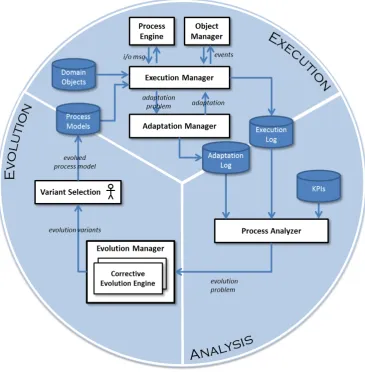
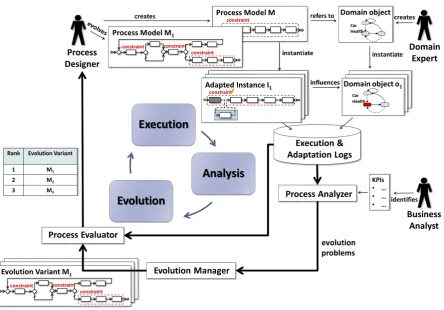
tem-Figure 3.1: Evolution framework
poral ordering between the three phases. For example, both analysis and evolution tasks can be performed while the application is executing.
3.1. PROCESS-BASED APPLICATION LIFECYCLE
monitored, and analyzed. While a feedback loop from the evaluation phase to the design phase exists, the changes are supposed to be minimal. This is why process evolution is typically included in the design and analysis phase, and is assumed to be a manual task.
However, the ability to cope with frequent process changes has been recognized as one of the critical success factors for achieving effective pro-cess support [70]. Therefore, in our evolution lifecycle, we focus less on the initial setup of the application, corresponding in the traditional lifecy-cle to the design and analysis phase, as well as the system configuration phase. Instead, we consider that the process-based application is already set up and running, and focus on the application’s ability to change in response to short and long-term changes in the execution environment. In our evolution lifecycle, we therefore consider explicitly both short-term process instance changes (included in the execution phase as adaptation), and long-term process model changes (the evolution phase).
In the following, we present in detail each phase in the evolution lifecycle.
3.1.1 Execution Phase
We model a process-based application using domain objects and process
models. The domain objects are used for representing the domain
knowl-edge, while the process models represent the business logic. In the execu-tion phase, the process models and domain objects are instantiated. The resulting process instances are executed on the process engine. The
exe-cution manager is responsible for keeping the system configuration up to
date and for consistently aligning the status of domain objects with the execution of process instances and the context events received by theobject
manager.
excep-tions in case of constraint violation. Such excepexcep-tions can be considered at design-time, by including in the process model appropriate exception han-dlers, for example as in [60, 91]. If, however, the exceptions are not handled at design-time, they will require runtime structural process adaptations.
In our framework, structural process adaptations are handled by an
adaptation manager, which can be realized using existing state of the art
techniques such as [12, 21, 28]. The adaptation manager receives as in-put an adaptation problem, which contains information about the process instance to be adapted, the system configuration, and the constraint vi-olation. The adaptation manager is then responsible for computing an adaptation for the process instance, which addresses the constraint viola-tion.
There can be several adaptations which are applicable to the same ex-ceptional situation. For example, for one constraint violation, possible adaptations can be to bring the process instance to a stable state which does not violate the constraint, to skip or replace some activities in the original process model which are no longer applicable in the current con-text, or to compensate and terminate the process instance. Preferences between adaptation strategies can be specified in advance, for example, we can specify that compensating and terminating the process instance should be performed only in case there is no other means to address the constraint violation.
All the information regarding execution and adaptation which may be useful in the other phases is recorded into execution and adaptation logs.
The execution log contains events which record information such as the
3.1. PROCESS-BASED APPLICATION LIFECYCLE
the actual adaptations performed.
3.1.2 Analysis Phase
In the analysis phase, the execution and adaptation logs are continuously monitored by a process analyzer, in order to determine performance prob-lems. The process analyzer can be realized using existing approaches such as [17, 122]. An example of a performance problem is failing to meet the target of a Key Performance Indicator (KPI). State of the art approaches supporting the analysis of process instance executions use data mining tech-niques on the values measured for different metrics (e.g., execution time), in order to uncover patterns in the metric behavior. Such patterns show the main factors which influence the behavior of the metric. This analysis then enables system users to react to existing performance problems, and can also be used to proactively avoid such problems by predicting metric values for the currently running process instances [17, 122].
simply to prevent that the problematic adaptation is used. However, the use of the problematic adaptation can also be restricted without modifying the process model, for example by notifying the adaptation mana