UNIVERSITY OF TRENTO - ITALY
ICT DOCTORAL SCHOOL
DEPARMENT OF INFORMATION ENGINEERING AND COMPUTER SCIENCE
Security of Publish/Subscribe
Systems
A dissertation submitted by Mihaela Ion
for the degree of Doctor of Sciences
accepted on the recommendation of
Dr. Bruno Crispo, co-advisor, University of Trento, Italy
Dr. Giovanni Russello, co-advisor, University of Auckland, New Zealand Prof. Dr. Ernesto Damiani, examiner, University of Milan, Italy Dr. Brian LaMacchia, examiner, Microsoft Research, Redmond and
University of Washington, US
c
Security of Publish/Subscribe Systems
This work is licensed under a
Creative Commons Attribution–NonCommercial–ShareAlike 3.0 Italy License. To view a copy of this license, visit the website:
MIHAELA ION University of Trento
Abstract:
The increasing demand for content-centric applications has motivated researchers to rethink and redesign the way information is stored and delivered on the Internet. In-creasingly, network traffic consists of content dissemination to multiple recipients. However, the host-centric architecture of the Internet was designed for point-to-point communication between two fixed endpoint-to-points. As a result, there is a mismatch between the current Internet architecture and current data or content-centric ap-plications, where users demand data, regardless of the source of the information, which in many cases is unknown to them.
Content-based networking has been proposed to address such demands with the advantage of increased efficiency, network load reduction, low latency, and energy efficiency. The publish/subscribe (pub/sub) communication paradigm is the most complex and mature example of such a network. Another example is Information Centric Networking (ICN), a global-scale version of pub/sub systems that aims at evolving the Internet from its host-based packet delivery to directly retrieving infor-mation by name. Both approaches completely decouple senders (or publishers) and receivers (or subscribers) being very suitable for content-distribution applications or event-driven applications such as instant news delivery, stock quote dissemination, and pervasive computing. To enable this capability, at the core of pub/sub systems are distributed routers or brokers that forward information based on its content. The basic operation that brokers need to perform is to match incoming messages or publications against registered interests or subscriptions.
Though a lot of research has focused on increasing the networking efficiency, security has been only marginally addressed. We believe there are several reasons for this. First of all, security solutions designed for point-to-point communication such as symmetric-key encryption do not scale up to pub/sub systems or ICN applications, mainly because publishers and subscribers are decoupled and it is infeasible for them to establish or to maintain contact and therefore to exchange keying material. In this thesis we analyse several such emerging applications like Smart Energy Systems, Smart Cities and eHealth applications that require greater decoupling of publishers and subscribers, and possible full decoupling.
v
Another challenge for publish/subscribe systems is enforcing fine-grained access control policies on the content of publications. Access control policies are usually enforced by a trusted third party or by the owner holding the data. However, such solutions are not possible for pub/sub systems. When brokers are not trusted, even the policies themselves should remain private as they can reveal sensitive information about the data.
In this thesis we address these challenges and design a novel security solution for pub/sub systems when brokers are not trusted such that: (i) it provides confi-dentiality of publications and subscriptions, (ii) it does not require publishers and subscribers to share keys, (iii) it allows subscribers to express complex subscription filters in the form of general Boolean expressions of predicates, and (iv) it allows enforcing fine-grained access control policies on the data. We provide a security analysis of the scheme.
Furthermore, to secure data caching and replication in the network, a key re-quirement for ICN systems and recently also of pub/sub systems that extended brokers with database functionality, we show how our solution can be transformed in an encrypted search solution able to index publications at the broker side and allow subscribers to make encrypted queries. This is the first full-fledged multi-user encrypted search scheme that allows complex queries. We analyse the inference exposure of our index using different threat models.
To allow our encrypted routing solution to scale up to large applications or performance constrained applications that require real-time delivery of messages, we also discuss subscription indexing and the inference exposure of the index.
Finally, we implement our solution as a set of middleware-agnostic libraries and deploy them on two popular content-based networking implementations: a pub/sub system called PADRES, and an ICN called CCNx. Performance analysis shows that our solution is scalable.
Contents
1 Introduction 1
1.1 Content-based networking . . . 1
1.1.1 Publish/Subscribe vs. Information Centric Networking. . . . 2
1.2 Security challenges . . . 3
1.3 Thesis contributions . . . 4
1.4 Thesis outline . . . 5
2 Publish/Subscribe Systems 7 2.1 The publish/subscribe communication paradigm . . . 7
2.2 Topic vs. content-based publish/subscribe . . . 8
2.3 Application scenarios . . . 9
2.3.1 Smart Energy Systems . . . 10
2.3.1.1 The EV Scheduling Use Case . . . 11
2.3.2 Smart Cities . . . 14
2.3.2.1 Sensing the Smart City . . . 14
2.3.2.2 Mobility in the Smart City . . . 15
2.3.3 Healthcare . . . 15
2.4 Security requirements . . . 18
3 A Basic Confidentiality Scheme 21 3.1 Threat model . . . 21
3.2 Required security properties . . . 22
3.3 Related work . . . 22
3.4 Background on security mechanisms . . . 25
3.4.1 Proxy encryption . . . 25
3.4.2 Multi-user encrypted search . . . 27
3.5 Proposed solution. . . 31
3.5.1 Assumptions . . . 31
3.5.2 Solution overview. . . 31
3.5.3 Initialization . . . 32
3.5.4 Event encryption . . . 32
3.5.5 Filter encryption . . . 34
3.5.6 Encrypted matching . . . 34
3.5.7 Event decryption . . . 35
3.6 Security analysis . . . 36
3.6.1 Preliminaries . . . 36
3.6.2 Scheme overview . . . 38
3.6.3 Security of filter encryption . . . 38
3.6.4 Security of event encryption . . . 40
4 Enforcing Fine-Grained Access Control Policies 49
4.1 Threat model . . . 49
4.2 Security properties . . . 50
4.3 Related work . . . 50
4.4 Background on security mechanisms . . . 51
4.4.1 Key-Policy Attribute-based Encryption . . . 51
4.4.2 Ciphertext-Policy Attribute-based Encryption. . . 54
4.5 Solution details . . . 59
4.5.1 Initialization . . . 60
4.5.2 Event encryption . . . 61
4.5.3 Filter encryption . . . 62
4.5.4 Encrypted matching . . . 63
4.5.5 Event decryption . . . 63
4.6 User revocation and subscription expiration . . . 63
4.6.1 Initialization . . . 63
4.6.2 Event encryption . . . 64
4.6.3 Filter encryption . . . 64
4.6.4 Encrypted matching . . . 64
4.6.5 Event decryption . . . 64
4.7 Enforcing publisher-defined access control policies. . . 65
4.8 The e-health application revisited. . . 67
4.9 Security analysis . . . 68
4.10 Implementation and performance analysis . . . 70
5 Querying In-Network Cached Publications 75 5.1 Encrypted search approaches and their shortcomings . . . 76
5.1.1 Single-user schemes. . . 77
5.1.2 Semi-fledged multi-user schemes . . . 79
5.1.3 Full-fledged multi-user schemes . . . 81
5.2 Solution description . . . 82
5.2.1 Event encryption and indexing . . . 82
5.2.2 Query encryption. . . 83
5.2.3 Event matching . . . 84
5.3 Inference exposure . . . 85
5.3.1 Background . . . 86
5.3.2 Threat model 1: Freq+DBK . . . 87
5.3.2.1 Inference of the 2-dimensional index . . . 88
5.3.2.2 Inference of the 1-dimensional index . . . 90
5.3.2.3 Inference comparison on synthetic datasets . . . 90
Contents ix
6 Efficient Encrypted Routing 95
6.1 Introduction. . . 95
6.2 Background . . . 96
6.2.1 Event filtering algorithms . . . 97
6.2.2 Event routing optimizations . . . 100
6.3 Related work . . . 101
6.3.1 Confidential event filtering . . . 101
6.3.2 Encrypted routing optimizations . . . 101
6.4 Solution details . . . 102
6.4.1 A simple solution indexing predicates . . . 103
6.4.2 Indexing Boolean expressions . . . 105
6.5 Performance comparison of the schemes . . . 106
6.6 Inference exposure . . . 109
6.6.1 Exposure of the non-indexed scheme . . . 109
6.6.2 Exposure of the indexed scheme . . . 114
7 Implementation and Integration with Different Middlewares 117 7.1 Implementation overview . . . 117
7.2 Libraries . . . 119
7.2.1 Basic encryption schemes implementation . . . 119
7.2.2 Secure pub/sub implementation. . . 121
7.3 Integration with CCNx. . . 124
7.4 Integration with PADRES . . . 127
7.4.1 PADRES . . . 127
7.4.2 Confidential PADRES . . . 128
7.4.3 Using advertisements with PADRES . . . 129
8 Conclusions 133 A Appendix 137 A.1 Appendix Publications . . . 137
List of Figures
2.1 The pub/sub infrastructure connects publishers and subscribers via
a network of interconnected brokers. . . 8
2.2 Topic-based subscriptions. . . 8
2.3 A Smart Energy System and data flows between main entities. . . . 11
2.4 Subscriptions and message types for the EV charging use case. . . . 13
2.5 Subscription routing tables in a distributed scenario. . . 14
2.6 Publishing and subscribing to sensor information. . . 15
2.7 Mobility examples. . . 16
2.8 An e-health application scenario for monitoring chronic diseases. . . 16
3.1 Proxy encryption, transformation and decryption. . . 26
3.2 Encrypted keyword match by an untrusted server. . . 29
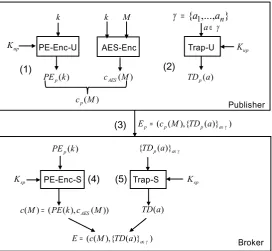
3.3 Event encryption with Proxy Encryption. . . 33
3.4 Filter generation and encryption. . . 34
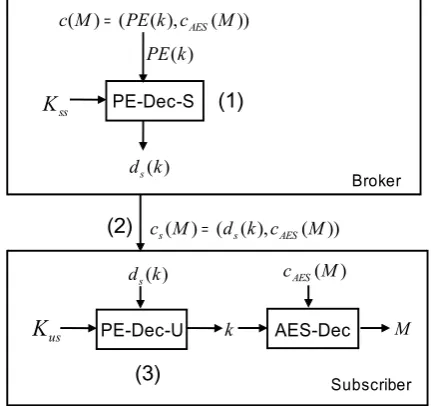
3.5 Event decryption.. . . 36
3.6 Event and filter encryption. . . 37
3.7 Event matching against two filters. T D(a1) matchesli1 and lj2. . . . 41
3.8 SDE basic operations performance time. . . 45
3.9 Event encryption and decryption times. . . 46
3.10 Filter encryption and re-encryption times. . . 46
3.11 Encrypted matching times. . . 47
4.1 A simple access policy tree. . . 53
4.2 Tree representation for a <7 on 4 bits.. . . 56
4.3 Event encryption with KP-ABE. . . 61
4.4 Filter generation and encryption. . . 62
4.5 Example of a policy for expiration date 15/12/2012. . . 64
4.6 Decryption key generation and attribute encryption. . . 65
4.7 Policy encryption. . . 66
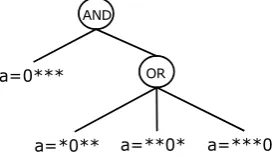
4.8 Access tree implementing heart rate>120 . . . 67
4.9 Event and filter encryption with access control. . . 69
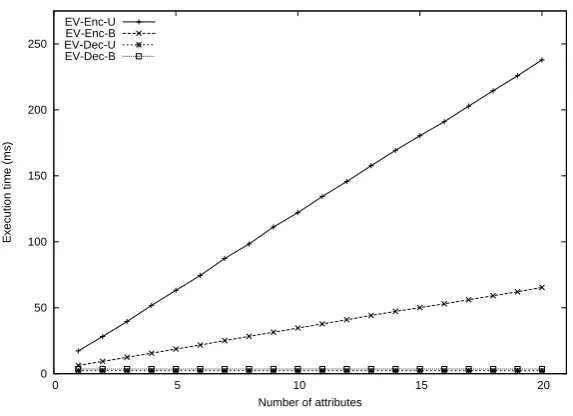
4.10 Event encryption times - comparison of the basic and enhanced schemes. . . 71
4.11 Event decryption times - comparison of the basic and enhanced schemes. . . 71
4.12 Decryption key generation times. . . 72
4.13 CP-ABE encryption time. . . 73
5.1 Query encryption as an access tree using the trapdoor algorithm. . . 83
5.3 Plaintext data and indexed data using direct encryption.. . . 86
5.4 Quotient and IC tables. . . 88
5.5 Inference exposure of the type 1 event. . . 91
5.6 Inference exposure of the type 2 event. . . 92
5.7 Encrypted table (a) and the corresponding RCV graph (b) from [Ceselli 2005]. . . 92
6.1 Filter generation and encryption. . . 103
6.2 Indexing time of 20,000 filters for different depths. . . 107
6.3 Query execution time on 20,000 filters. . . 107
6.4 Indexing time for different numbers of filters. . . 108
6.5 Event matching time for different numbers of filters. . . 108
6.6 Filter index and corresponding associations graph. . . 114
6.7 Filter index and corresponding associations graph. . . 115
6.8 Filter index and corresponding associations graph. . . 116
7.1 Components stack. . . 118
7.2 Libraries stack. . . 119
7.3 Diagram showing the main classes for event and filter encryption. . . 119
7.4 Diagram showing the main broker classes. . . 123
7.5 Encrypted routing over CCNx. . . 127
7.6 A simple PADRES network. . . 128
7.7 PADRES router extended with encryption functionality. . . 129
7.8 EV Charging Scenario. . . 130
7.9 Routing tables without advertisements. . . 130
List of Tables
2.1 Topic-based vs. content-based filters. . . 9
3.1 Properties achieved by current confidentiality schemes. . . 25
5.1 Comparison of search on encrypted data schemes.. . . 77
5.2 Events index. . . 82
5.3 Trapdoor index.. . . 82
5.4 Indexed data using a hash function with collision.. . . 87
5.5 Plaintext database with “bag of bits” representation of numeric values. 89 5.6 Quotient table - 2D index. . . 89
5.7 IC table - 2D index. . . 89
5.8 Quotient table - 1D index. . . 90
5.9 IC table - 1D index. . . 90
6.1 Event Filtering Algorithms . . . 97
6.2 Example of a predicate index. . . 103
6.3 Example of a filter ID map. . . 104
6.4 Example of a predicate index. . . 105
6.5 Filter structures 1. . . 110
6.6 Filter structures 2. . . 111
6.7 Filters having the same tree structure. . . 112
6.8 Exposure coefficient for filters representing a single numeric inequal-ities. . . 113
7.1 Summary of AesKPClient class. . . 120
7.2 Summary of AesCPClient class. . . 121
7.3 Summary of AesKPEvent class. . . 121
7.4 Summary of KeEncFilter class. . . 122
7.5 Summary of KeTreePolicy class. . . 122
7.6 Summary of SecPubSubClient class. . . 123
7.7 Summary of EncBroker class. . . 124
7.8 Summary of CCNPublisher class. . . 125
7.9 Summary of CCNSubscriber class. . . 125
List of Algorithms
1 PE-Init . . . 26
2 PE-KeyGen: Key generation for a new user. . . 26
3 PE-Enc-U: The user side proxy encryption. . . 27
4 PE-Enc-S: Server re-encryption. . . 27
5 PE-Dec-S: Server pre-decryption. . . 27
6 PE-Dec-U: User decryption. . . 27
7 SDE-Init . . . 28
8 SDE-KeyGen: Key generation for each new user. . . 29
9 KE-Enc-U: The user side keyword encryption . . . 29
10 KE-Enc-S: Server side keyword re-encryption. . . 30
11 Trap-U: The user side trapdoor encryption. . . 30
12 Trap-S: The server side trapdoor re-encryption. . . 30
13 Match: Single keyword match. . . 30
14 TreeEval: Access Tree Evaluation . . . 35
15 KP-ABE Init . . . 52
16 KP-ABE-Enc . . . 53
17 KP-ABE KeyGen . . . 54
18 KP-ABE DecryptNode . . . 55
19 CP-ABE Init . . . 55
20 CP-ABE KeyGen . . . 56
21 Inequality Policy Generation . . . 57
22 CP-ABE-Enc . . . 58
23 CP-ABE: DecryptNode . . . 59
24 Encrypted Event Filtering. . . 84
25 iTreeEval: Access Tree Evaluation with Index . . . 85
26 The Label algorithm. . . 99
27 The Match Algorithm. . . 100
28 Encrypted Event Filtering. . . 104
Chapter 1
Introduction
Contents
1.1 Content-based networking . . . 1
1.1.1 Publish/Subscribe vs. Information Centric Networking. . . . 2
1.2 Security challenges. . . 3
1.3 Thesis contributions . . . 4
1.4 Thesis outline. . . 5
1.1
Content-based networking
The increasing demand for content-distribution applications is motivating re-searchers to rethink and redesign the way information is stored and delivered on the Internet. The IP model no longer matches the way users and applications request and share information today. Users are more interested in sharing and retrieving information, and care less about which specific end point is holding the informa-tion. Furthermore, network traffic increasingly consists of content dissemination to multiple recipients. Content producers are both large organizations such as news agencies, movie studios, but also users who share photos or videos with friends on social networks. Thus, the host-centric architecture of the Internet designed for point-to-point communication between two fixed endpoints is not scalable or relevant for the current data-centric applications.
Content-based networking has been proposed to address such demands, mo-tivated by both application-level and network-level considerations. At the application-level, consumers are more interested in expressing what content they are interested in retrieving, and less about where that content can be found. At the network level, identifying content rather than location allows more efficient net-working by duplicating and caching content in the network. The shift from host-centric to content-host-centric networking has several advantages, such as network load reduction, low dissemination latency, and energy efficiency. Van Jacobson described content-based networking as the third revolution in telecommunication networks, as we move from connecting wires (public switched telephone network [PSTN]) to connecting nodes (all-IP networks) to connecting information [Pentikousis 2012].
Networking [Jacobson 2007]. The publish/subscribe (pub/sub) paradigm has been around for over 25 years and is now used in many applications such as instant news delivery, stock quotes dissemination, and pervasive computing. Information-Centric Networking (ICN) is a relatively new research field, described as a global-scale version of the publish/subscribe paradigm [Ghodsi 2011]. ICN aims at evolving the Internet from its host-based packet delivery to directly retrieving information by name [Ahlgren 2012]. Both pub/sub and ICN focus on finding and delivering information to users instead of connecting end hosts that exchange information. Implementations of these two paradigms are generally designed to run alongside or independent of TCP/IP, and do not disrupt existing networks. However, more ambitious designs aim at replacing TCP/IP [Fotiou 2012].
Apart from current dissemination applications, the shift to content-based networking is also motivated by new emerging applications such as Smart Grids and Smart Cities, mobile and pervasive applications. Moreover, as the number of mobile devices and sensors connected to the Internet is increasing, content-centric networks are becoming even more important. First of all, they allow asynchronous communication between devices which do not need to be online at the same time to communicate. This is especially important for mobile devices which are turned off or in sleep mode to save energy when not used or may not be online all the time due to mobility. Second, ICNs are build around the idea of in-network content storage, thus making data available a greater percentage of the time and allowing mobile devices the freedom to be turned off more often to save power. This feature is also provided by more recent publish/subscribe systems (e.g., PADRES [Jacobsen 2010]) which cache publications in the network and allow users to query them later.
1.1.1 Publish/Subscribe vs. Information Centric Networking
1.2. Security challenges 3
example is the PADRES pub/sub system [Jacobsen 2010] which enhanced brokers with databases in order to enable historic data queries.
Last but not least, another important difference between the two models is the expressiveness of the subscription or interest. Pub/sub systems use more expres-sive subscription filters that range from names to general Boolean expressions of predicates, while ICN use only names to request data.
In this thesis we target a security solution that can work with any content-based networking solution and implement our libraries to be middleware-agnostic. We design our solution to meet all the needs of the more complex pub/sub systems and show that it can also be applied to ICN with a concrete implementation. In fact, we can even integrate our encrypted filtering algorithm with ICN, thus enabling more expressive interests on top of the naming provided by ICN.
1.2
Security challenges
Content-based networking requires new security mechanisms to address its specific communication model. Traditionally, security mechanisms and access control poli-cies are enforced point-to-point or through the use of trusted third parties. Such mechanisms were designed for the host-centric point-to-point Internet and are not suitable in content-based networks where data creators and consumers are decou-pled and not aware of each other. Moreover, because the network can be public, it cannot be trusted to enforce access control mechanisms. Once the data is published on the network, publishers lose all control over who gets access to their data. What content-based networking needs is to explicitly secure the content itself, as opposed to securing the end-to-end communication channel or end-points. Because the data is sometimes cached or stored in the network, we cannot rely on trusted end-points to control access to the data and enforce access control policies.
To enable content-based networking, at the core of pub/sub systems are dis-tributed routers or brokers that forward information based on its content. If the brokers are trusted, for example if they are under the direct control of the organi-zation using the pub/sub system, the confidentiality of the events and filters can be ensured by securing the communication between brokers, between publishers and brokers, and between brokers and subscribers. However, in many scenarios brokers cannot be considered trusted, either because a malicious employee could get access to the data and misuse it, or because the pub/sub system has been outsourced to another company. Outsourcing the IT infrastructure is a business model adopted more and more by companies because it reduces costs and improves the quality of services and operations. In fact, even sectors such as healthcare, initially reluc-tant to adopt this model, are slowly employing it [Ondo 2006]. Because of that, there is a need for confidentiality and access control solutions that can be applied when brokers are untrusted and therefore could compromise the confidentiality of publications and subscriptions.
Another issue to consider is the privacy of the data transmitted over the pub/sub network, because it could contain sensitive information about individuals or organi-zations (e.g., personal and medical data). When such sensitive information is being sent, it should be possible to control how the data is disclosed and to whom. The disclosure of sensitive data is usually protected through the enforcement of access control policies. A policy specifies who can access the data and under which condi-tions. In pub/sub systems, publications or events contain multiple attributes and different access control policies could apply to each. For example, in an e-health application, the names of the patients should be disclosed to their doctors, but not to researchers that aggregate and analyse data from various patients. Access control solutions for pub/sub systems [Miklos 2002, Bacon 2008] require brokers to have access both to the policies and the content of events in order to enforce fine-grained policies on the attributes of the event (e.g., name, address). However, these solutions are not suitable for outsourced environments because they reveal the content of events to the untrusted brokers. On the other hand, encrypting only the content of events and leaving the access control policies unencrypted so that they can be enforced by brokers may not be sufficient because the policies could reveal sensitive information about the data. For example, if an event sent by the Gateway installed at a patient’s home has attached a policy granting access to the data to a cardiologist, an attacker could infer that the patient suffers from a heart condition even if the actual event is encrypted.
1.3
Thesis contributions
This thesis makes the following contributions:
1.4. Thesis outline 5
system for communication. In these applications, a point-to-point communi-cation model would not scale up.
2. We propose a novel solution for confidentiality and access control in pub/sub systems. Compared to existing solutions, our scheme is able to provide at the same time confidentiality of publications (or events) and subscriptions (or filters), fine-grained access control policies, and complex encrypted filtering of events, while not requiring publishers and subscribers to share keys.
3. We provide a novel solution for indexing and querying in-network cached encrypted publications. Most encrypted search solutions for databases provide keyword search or conjunctions of keywords. We provide a survey of existing schemes and show that none of them is able to support both multi-users that can read and write to the database with their own unique key, and complex queries. Our solution is the first one to have such features.
4. We provide a novel solution for efficient encrypted routing. Though effi-cient filtering algorithms have been researched intensively for non-encrypted pub/sub systems, confidentiality preserving filtering algorithms do not scale well when the number of subscriptions increases. Moreover, they have other limitations such as less expressive filters (e.g., only keyword match) and key sharing. We propose a solution for an efficient and scalable filtering algo-rithm, while maintaining the properties of our confidentiality and access con-trol scheme.
5. We implement our solutions as middleware-agnostic libraries and integrate and test them with popular versions of both a pub/sub and an ICN system.
1.4
Thesis outline
The organization of the thesis chapter by chapter is as follows:
Chapter 2 describes the properties of publish/subscribe systems and several research applications such as Smart Energy Systems, Smart Cities, and remote patient monitoring in healthcare applications where a classic point-to-point model would not scale up. We then illustrate the need for security requirements in such systems with a possible attack over an unsecured system.
Chapter4enhances the proposed solution to allow enforcing fine-grained access control policies on the data without relying on a trusted third party. This solution addresses a more powerful threat model and extends the previous solution to defend against it.
Chapter5provides a novel solution that allows indexing and querying in-network cached publications. Current encrypted search solutions cannot support at the same time multi-users with read and write capabilities and complex encrypted queries. Our solution allows performing encrypted complex queries on the data, and multi-users, each user having a unique key that can be revoked without affecting the other users.
Chapter6 enhances the scheme with an efficient encrypted matching algorithm that increases the performance of the scheme while still providing the same security properties.
Chapter 7 discusses the implementation of our middleware-agnostic libraries both with a classic pub/sub system enhanced with databases for publication caching, and with a popular information-centric network. We provide an exten-sive performance evaluation and comparison of the various schemes.
Chapter 2
Publish/Subscribe Systems
Contents
2.1 The publish/subscribe communication paradigm . . . 7
2.2 Topic vs. content-based publish/subscribe . . . 8
2.3 Application scenarios . . . 9
2.3.1 Smart Energy Systems . . . 10
2.3.2 Smart Cities . . . 14
2.3.3 Healthcare . . . 15
2.4 Security requirements . . . 18
2.1
The publish/subscribe communication paradigm
The publish/subscribe model is an asynchronous communication paradigm where senders, known as publishers, and receivers, known as subscribers, exchange mes-sages in a loosely coupled manner, i.e., without establishing direct contact. The messages that publishers generate are calledevents orpublications. Publishers do not send events directly to subscribers, instead a network of interconnected brokers is responsible for delivering the events to the interested subscribers. In fact, pub-lishers do not know who receives their events and subscribers are not aware of the source of information. In order to receive events, subscribers need to register inter-est with a broker through a filter or subscription. When a new event is published, brokers forward it to all subscribers that expressed a filter matched by the event. Figure2.1shows a simple pub/sub network that forwards messages from publishers to interested subscribers.
The pub/sub communication paradigm has the advantage of allowing the full decoupling of the communicating entities [Eugster 2003] which enables dynamic and flexible information exchange between a large number of entities. The communicat-ing parties do not need to know each other or establish contact in order to exchange content. Moreover, if durable subscription is enabled, publishers and subscribers do not need to actively participate in the interaction at the same time. If a subscriber is offline when a publisher creates an event, the broker will store the event until the subscriber becomes online and the event can be delivered.
Publisher
Subscriber B
B
B
B B
Publisher
Publisher
Publisher
Subscriber
Subscriber
Subscriber Subscriber
Publishing events
Figure 2.1: The pub/sub infrastructure connects publishers and subscribers via a network of interconnected brokers.
such as instant news delivery, stock market quotes distribution, auction bids [Bornhovd 2002], and air traffic control. Other applications of pub/sub are mobile systems [Cugola 2002b], ubiquitous computing [Langheinrich 2000], dis-tributed workflow management systems [Cugola 2002a], and peer-to-peer systems [Heimbigner 2001].
2.2
Topic vs. content-based publish/subscribe
Several pub/sub implementations that differ in the granularity used in the defi-nition of the filters have been proposed in the literature. The most simple one is topic-based, in which subscribers subscribe to a topic identified by a keyword
[Zhuang 2001]. A topic-based scheme is similar to the notion of group communica-tion. When subscribing to a topic T, a subscriber becomes a member of group T. When an event for topic T is published, the event is broadcasted to all the mem-bers of that group. Organizing topics in hierarchies allows a better management of subscriptions [Singhera 2008]. For example, by registering to a topic, a subscriber is also registered to all its subtopics. Figure 2.2 shows an example of hierarchical topics for an application that monitors ambient conditions such as temperatures, humidity and air quality in different towns.
Ambient Data
Temperature Humidity Air Quality
Trento Trento Trento
T4
Verona
T1 T2 T3
T5 T6 T7
2.3. Application scenarios 9
Topic-based schemes are easy to implement but they offer limited expressiveness.
Content-based schemes are more flexible and allow specifying subscriptions based on the actual content of the event. To express a filter on the content of an event, subscribers need a query language and understanding of the data formats. For example, in Gryphon [Banavar 1999] and Siena [Carzaniga 2001] events consist of sets of (attribute name = attribute value) pairs and filters are specified as SQL WHERE clauses. Java Message Service (JMS) [Hapner 2002] does not allow filtering on the content of the event, but instead events carry properties in their headers and subscribers can define filters on them. Filters that apply to the composition of simple events have also been proposed (such as in [Bacon 2000]). When expressing such a filter, subscribers are notified upon the occurrence of the composite event.
Content-based schemes are more expressive and fit more naturally the way users search for information on the Internet. Table 2.1 compares the expressiveness of topic and content-based subscriptions for the scenario in Figure 2.2. For the first subscription, a user would need to subscribe to several topics to get all the events related to Trento. In the other examples, subscribing to a topic returns a super-set of the data, requiring the user to filter out undesired results. This causes overhead for the network and the users, and could be a real problem for users with limited resources using mobile devices.
Table 2.1: Topic-based vs. content-based filters.
Subscription Topic-based Content-based
All Trento data T4, T6, T7 Trento
All Trento temperature since 2008
T4 (super-set) temperature and Trento
and year>2008 All Trento air quality with
Air Quality Index>50
T7 (super-set) airquality and Trento and
aqi>50
Because of its generality and expressiveness, we will focus on content-based fil-tering. Topic-based filtering can be considered a sub-case of content-based where filters contain only one attribute (or keyword). We assume that filters define con-straints in the form ofattr name-op-attr value whereop can be one of the compar-ison operators such as =,≤, <,≥, and >. Constraints can be logically combined using AND,OR and NOT to form complex subscription patterns.
In the following we describe several applications that use a publish/subscribe system to enable many-to-many communication between a large number of loosely-coupled entities. For such applications, the classic point-to-point communication model, or even group communication would not scale up.
2.3
Application scenarios
subscription fee. Brokers deliver to them content matching their subscription every time new content is published. In the following we propose more complex scenarios inspired from emerging applications such as Smart Energy Systems, Smart Cities and eHealth. We use these scenarios to illustrate how information is published and routed in a pub/sub system. The entities, message types and scenarios we describe emerged from various research projects and represent our vision on how such novel systems could run using a pub/sub system. We will further use these examples to explain our different threat models and requirements for a secure pub/sub scheme.
2.3.1 Smart Energy Systems
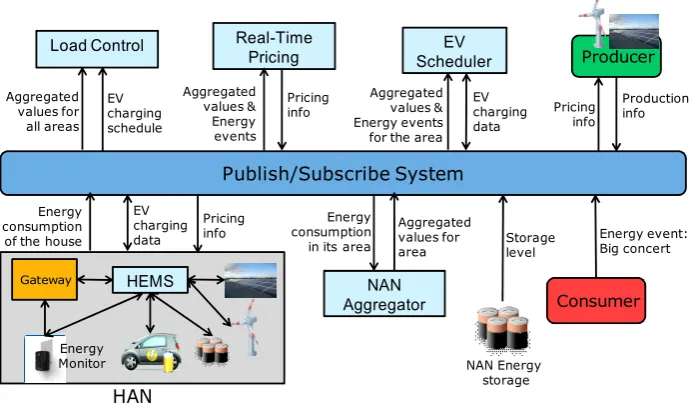
Smart Energy Systems are large distributed systems that connect energy suppliers, consumers and their devices, and provide dedicated services that monitor and con-trol energy consumption with the goal of reducing costs, optimizing energy usage and increasing the reliability of the Energy Grid. The classic point-to-point com-munication model does not scale up to a large Smart Energy System because data generated by one entity, e.g., a Smart Meter, is likely of interest to many entities such as an Energy Management and Control System (EMCS), a neighbourhood ag-gregator, a Utility Company, a Real-Time Pricing System, a Load Control System, many of which are unknown to the data publishing device. The pub/sub commu-nication model was designed to deliver data asynchronously and reliably between a large number of loosely coupled entities in a many-to-many manner and fits well the communication requirements of a Smart Energy System, as shown in Figure 2.3.
A Smart Energy System provides dedicated services such as scheduling, actua-tors and real-time pricing to reduce energy consumption, lower peak time demand, reduce costs, and increase the reliability of the Energy Grid through the smoothing out or reduction of peak loads. A Smart Energy System could have the following entities:
• Energy Monitor: measures the real-time energy consumption of each device inside a house.
• Energy Management & Control System (EMCS): installed in each house, a local EMCS schedules and turns on/off different devices in the house such as dish washer, Electric Vehicle (EV) charging, and air conditioning.
• Customer Gateway: acts as an interface between the Home Area Network (HAN) and neighborhood or city area network. All messages between the HAN and the external network are sent and received through the Gateway.
2.3. Application scenarios 11
• Real-Time Pricing (RTP): calculates energy prices based on current de-mand and offer. The pricing is calculated in such a way that it incentivizes consumers to reduce peek consumption and overall fluctuations in demand.
• EV Scheduler: a service that receives status information and energy needs of the EVs in a neighborhood, and pricing information, and schedules how the EVs should be charged such that the network in not overloaded.
• Neighborhood Area Network (NAN) Aggregator: aggregates the in-formation about the energy consumption in a neighborhood.
• Energy Storage: either inside a house or in a neighborhood, it is used to store energy in low demand periods and use it during high demand. If medical devices are in use, such storages become very important.
• Load Control: controls that the network is not overloaded, analyses peak/low demand periods, predicts future demand, detects problems and risks of blackouts.
A robust pub/sub system connects all these entities and reliably delivers mes-sages between them as shown in Figure2.3.
Energy consumption of the house Aggregated values for all areas Publish/Subscribe System HAN Real-Time Pricing Gateway HEMS Load Control NAN Aggregator EV Scheduler Energy consumption in its area
Aggregated values for area Aggregated values & Energy events Aggregated values & Energy events
for the area Pricing info Pricing info EV charging data EV charging schedule EV charging data Consumer Energy Monitor Energy event: Big concert HAN Producer NAN Energy storage Storage level Production info Pricing info
Figure 2.3: A Smart Energy System and data flows between main entities.
2.3.1.1 The EV Scheduling Use Case
at Intel Labs, Santa Clara, US. Before charging their cars, users send a scheduling request to a neighbourhood EV scheduler that sends back the times and power at which the car should be charged such that it does not overload the network and lowers the cost for the consumer. In particular, the main goal of the scheduler is not to overload the local transformer which was not provisioned to support an EV for every household. In the future, when more people will own EVs, this could become a real problem. A study [pec a] conducted by the Pecan Street Project [pec b] in a test bed of 10 households owning EVs in the Mueller neighbourhood in Austin, Texas, in the US, over a period of two months, showed that people turn everything on at the same time, even during weekends. When people come home at the end of a day they turn on television, computer, air conditioning, other appliances, along with plugging in their EV for recharging. An EV charging at maximum power can use as much energy as an entire household, thus doubling the overload on the neighbourhood transformer. In this particular installation, a transformer can serve up to 12 houses and is very expensive to replace. Using an EV scheduling service would reduce the risk of overloading and damaging the transformer by coordinating across homes.
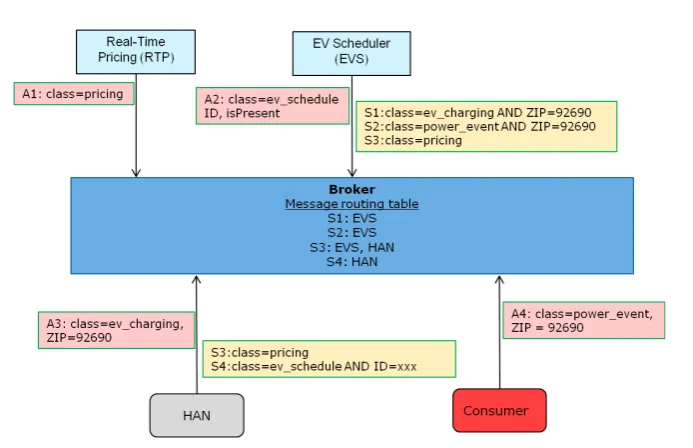
In Figure2.4, we show potential subscriptions and messages for an EV schedul-ing use case. There are four publishers and four types of messages or publications. The message types are advertised by each publisher in the form of anadvertisement
which is sent before publishing any messages.
• A pricing message, published by the RTP, contains information about prices per time period and consumption class. The EVS and the HAN both regis-tered subscriptions to receive such messages, i.e., S3: class=pricing.
• An ev charging message is a charging request sent by a HAN. The EVS of a neighborhood subscribes to this type of messages, i.e., S1:class=ev charging AND ZIP=92000.
• An ev schedule message sent by the EV Scheduler in response to a charging request. The HAN subscribes to it with S4: class=ev schedule AND ID=xxx.
2.3. Application scenarios 13
Figure 2.4: Subscriptions and message types for the EV charging use case.
Figure 2.4 shows a simple case in which only one broker is used to deliver messages from publishers to interested subscribers. The broker maintains a message routing table that has entries of the form: subscription: destinations. A message that matches the subscription will be forwarded to all the destinations paired with the subscription. Figure2.4 shows the routing table for this example.
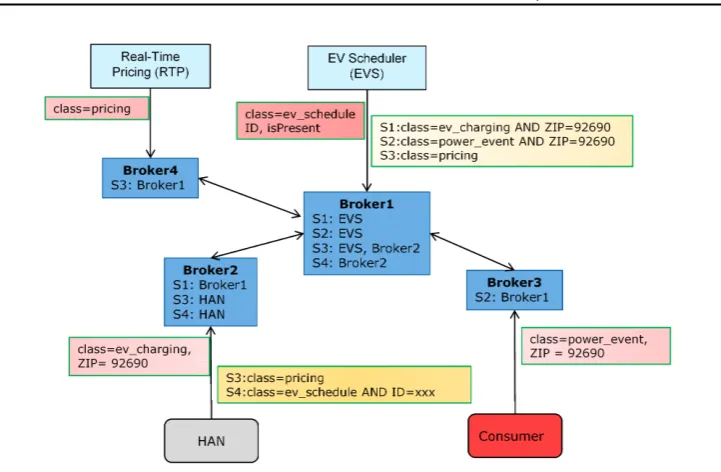
To increase the scalability and reliability of the system, pub/sub systems are usually distributed and messages are forwarded through multiple hops. Figure 2.5 shows the same example, but with several distributed brokers. We note that in this case each broker becomes either a publisher or a subscriber or both to its neighbouring brokers. Brokers only know their immediate neighbours and are unaware of the source of publications or subscriptions.
Figure 2.5: Subscription routing tables in a distributed scenario.
2.3.2 Smart Cities
A similar application is a Smart City in which large amounts of data are gener-ated for example by sensors that monitor the ambient environment (e.g., pollution level, air quality, noise levels, flooding), the traffic (e.g., traffic congestion, acci-dents, closed roads, closed subway stations), and by people that report events etc. A pub/sub system would deliver messages from publishers only to interested sub-scribers without requiring publishers to know the addresses or identities of the subscribers. In the following we describe two applications that we developed to-gether with the Energy and Sustainability Lab (ESL) at Intel Labs, Santa Clara, US.
2.3.2.1 Sensing the Smart City
2.3. Application scenarios 15 Humidity readings Publish/Subscribe System Temperature Sensor Humidity Sensor Air Quality Control Pollution Sensor Aggregated values from all NANs in a city
Warnings and recommendations Temperature readings User Warnings and Recommendations for its area Neighborhood Area Network Aggregator Chemical Substances Sensor Readings for
its area Aggregated values Pollution level Levels for various substances Temperature data for its area
Figure 2.6: Publishing and subscribing to sensor information.
2.3.2.2 Mobility in the Smart City
Figure 2.7 shows a scenario in which subscriptions are location dependent. Let us consider the case of an electric car driving on a road that needs to charge its battery. The car may subscribe to messages about EV charging stations near its location or trajectory that have a specific time, power, availability and price. EV charging stations publish their location, availability and price on the network. It is the job of the pub/sub system to match the message published by different charging stations to the subscription conditions and then to deliver to subscribers only desired information. If the car driver sees an incident on the road, it may report it to the police and the message will be delivered to the closest police officer that subscribed to traffic incidents in the area.
2.3.3 Healthcare
Figure 2.7: Mobility examples.
Message Bus
Body sensors
Monitoring sensors
Patient
in-Home Monitoring System
PDA
Medical Console
Gateway
Medical Repository
Outsourced IT Domain
Research Center
• epidemiological data • quantitative clinical indicators • quantitative expenditure data
Healthcare Authority
Audit appropriateness of therapies & get data for
reimbursement
Drug Delivery Service
Deliver drug personalized kit to patient
Drug Stock Management
Prepare drug personalized kit
2.3. Application scenarios 17
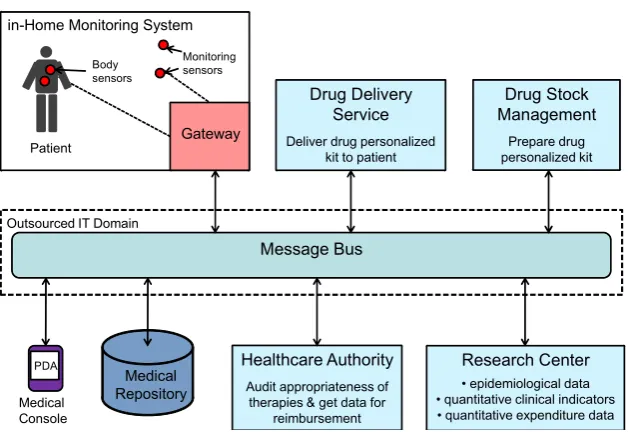
The e-health application is composed of several distributed components that are shown in Figure 2.8. Each component is described in details as follows.
Thein-Home Monitoring System(iHMS) is a component that performs the gathering of patient’s data through the use of electronic devices self-managed by the patient. These devices have wireless means to connect to a central gateway where the data is gathered. Regarding the physiological parameters it could be useful to monitor the blood pressure, the heart rate and the ECG at regular time intervals. Regarding the life style, the relevant data to be monitored is the weight and the amount of physical exercises (e.g., walking and/or running). In our application, we employ the following devices:
• a wrist integrated device able to measure the blood pressure and the blood oxygen levels;
• a portable device for ECG and heart rate monitoring;
• a smart scale that automatically sends periodic weight measures;
• a device to be worn during physical exercises that can monitor some relevant parameters, such as the number of steps during a walking activity, the total energy consumption (kcal), the duration of the physical activity, etc.
In the hospital, the Medical Console (MC) retrieves the data collected by the iHMS. The patient’s doctor can use the MC for accessing the vital signs and lifestyle data stored in theMedical Repository(MR). The MC can also alert the doctor if the values exceed some personalised thresholds. The doctor can inform the patient that a visit is required and some more specific medical tests have to be performed. The doctor can also decide to prescribe a therapy, composed of a list of drugs to be regularly assumed by the patient, and to give advice in order to improve the patient’s lifestyle.
The drug therapy, depending on the specific disease, can include drugs that can be directly provided by the hospital and/or drugs to be purchased through the territorial pharmacies. In the former case, the drugs provided by the hospital are reimbursed by the Healthcare Authority(HA). In order to assure the appropri-ateness of the therapy and the exact amount of costs to be reimbursed, the hospital has to provide to the HA data related to the patient’s conditions and drug costs.
TheDrug Stock Management(DSM) is in charge of preparing a personalised drug kit, composed of the drugs prescribed by the doctor for a specific patient. To prepare the therapy kit, the doctor has to provide to the DSM personnel the therapeutic data. The drugs can be delivered at home thanks to aDrug Delivery Service(DDS) that performs the transportation directly to the patient’s home.
of quantitative clinical and expenditure indicators (e.g., number of patients with repeated outpatient visits or total average cost for each patient).
2.4
Security requirements
We motivate the need for security mechanisms with an example of a possible attack that could be carried out on an unprotected pub/sub system. We use as reference the last application we introduced.
Let us assume that the San Raffaele hospital has decided to outsource the pub/sub system to an IT company such as a cloud provider that provides and maintains the servers where the service is deployed, and that no security mecha-nisms are in place. The pub/sub system connects all publishers and subscribers and allows them to send and receive events asynchronously through a shared set of interfaces. Subscribers can specify their interest in particular messages through filters. Filters are strings which express constraints on the attributes of the events. If messages are sent in the clear, a malicious employee of the company managing the pub/sub system can easily get access to the events that are exchanged through the brokers. The attacker could also be another user of the same cloud provider that can mount a collocation attack [Ristenpart 2009] and capture the memory of the pub/sub broker application. Therefore, in this setting the patients’ privacy is at risk. We illustrate the risk of violating the patients’ privacy through an example. Let us suppose that a patient named “John Smith” suffering from a heart condi-tion is monitored remotely by a doctor. The medical devices carried by the patient monitor the blood pressure, heart rate and ECG. At regular time intervals, these values are published by the gateway.
The doctor monitoring the patient registered the following subscription filter with a broker to be notified immediately of any significant change in the patient’s condition. The doctor expressed the following filter:
name=“John Smith” AND (heart rate>120 OR systolic pressure>150 OR di-astolic pressure>100).
The doctor will be notified when values exceed the specified thresholds. When values are normal, they are logged in the patient’s history and the doctor can retrieve them when necessary. If an employee is able to capture the filter, he will be able to infer that John Smith is suffering from a heart condition.
Now let us suppose that the doctor received an event which indicates a change in the patient’s condition and needs to write the following prescription:
name=“John Smith”, age=70, address=“via Tartini 12, Padova”, symptom =“high blood pressure”, disease=“primary hypertension”, medication=“Catapres”.
2.4. Security requirements 19
The employee could also access the filter registered by the doctor and infer that the patient John Smith has a heart problem. That is why, in order to protect sensitive data contained by events and filters transmitted over an untrusted out-sourced pub/sub system, cryptographic mechanisms are needed to provide event and filter confidentiality. Moreover, because different policies apply to different at-tributes of the event, without a proper access control mechanism that can enforce
fine-grained access control policies, legitimate subscribers would learn information that they are not supposed to. For example, if no access control mechanisms are in place, researchers would learn the names and addresses of patients, though only anonymized data should be available to them.
Chapter 3
A Basic Confidentiality Scheme
Contents
3.1 Threat model . . . 21
3.2 Required security properties. . . 22
3.3 Related work . . . 22
3.4 Background on security mechanisms . . . 25
3.4.1 Proxy encryption . . . 25
3.4.2 Multi-user encrypted search . . . 27
3.5 Proposed solution . . . 31
3.5.1 Assumptions . . . 31
3.5.2 Solution overview. . . 31
3.5.3 Initialization . . . 32
3.5.4 Event encryption . . . 32
3.5.5 Filter encryption . . . 34
3.5.6 Encrypted matching . . . 34
3.5.7 Event decryption . . . 35
3.6 Security analysis . . . 36
3.6.1 Preliminaries . . . 36
3.6.2 Scheme overview . . . 38
3.6.3 Security of filter encryption . . . 38
3.6.4 Security of event encryption . . . 40
3.7 Implementation and performance analysis . . . 44
3.1
Threat model
We assume there is at least one Trusted Authority which generates encryption and decryption keys used to protect data from unauthorised access. The authority does not misbehave and is trusted by all the entities of the system.
3.2
Required security properties
In the following we enumerate the properties that a confidentiality scheme for pub/sub systems should provide, assuming an honest-but-curious threat model. As previously discussed, because publishers and subscribers are decoupled and can-not always share secret keys, a crucial property that needs to be ensured by any encryption scheme for pub/sub systems is scalable key management that does not require establishing and maintaining shared (group) keys. We define this property as follows and we require it for our scheme:
Definition 1 (P1: Scalable key management). A simplified and scalable key man-agement eliminates the need for publishers and subscribers to share keys and sup-ports the loosely-coupled model of the pub/sub paradigm. Key sharing would require redistribution of new keys to all participants and re-encryption of all filters when a filter is unsubscribed, thus affecting the scalability of the system.
Moreover, we require that the content of publications and subscriptions is pro-tected and that the broker does not learn anything about them during the matching process. this leads to the following properties.
Definition 2 (P2: Publication confidentiality). The publication confidentiality property ensures that the content of the event is hidden from the brokers and only intended subscribers are able to decrypt the event. By intended subscribers we mean subscribers that registered a filter matched by the event. In some cases, subscribers might need to obtain an authorization from the Trusted Authority in order to register a filter.
Definition 3 (P3: Subscription confidentiality). The subscription confidentiality property ensures that the details of the filters are hidden from the brokers. The broker should be able only to tell if an event matches a filter but gain no other information about the event or the filter.
Definition 4 (P4: Complex encrypted matching). Brokers should be able to match complex encrypted filters against encrypted events without learning anything about the content of events or filters. By complex encrypted filters, we mean filters that can express conjunctions and disjunctions of equalities, inequalities and negations in an encrypted form.
3.3
Related work
3.3. Related work 23
of them at the same time. We review the most significant schemes and show for each which of the desired properties are satisfied.
Khurana [Khurana 2005] proposes a scheme that targets confidentiality of events but not of filters. Events are encoded in XML format and only specific fields (e.g., price) are encrypted with a symmetric key k. The publisher then encrypts k with its public key and attaches it to the message. The brokers forward the events based on the fields left unencrypted and a proxy service changes the encryption ofk to an encryption with the public key of the subscriber. This solution achieves partiallyP2
encrypting only specific fields but not the entire event. Properties P3 and P4 are not addressed because events are forwarded based on unencrypted event fields and filters. Key management is scalable and does not require publishers and subscribers to share a key, hence achievingP1.
Raiciu et al. [Raiciu 2006] target simultaneous event and filter confidentiality. The method primarily encrypts only the attribute value. The name of the attribute can be hidden by concatenating it with the attribute type and size and then hashing it (P2 and P3 can be achieved). Publishers and subscribers are required to share a group key (P1 is not achieved) which is used to encrypt events and filters. The subscriber uses the shared key to “garble” the circuit representation of the sub-scription function. The publisher encrypts the event in a way compatible with the subscriber’s circuit. The broker inputs the encrypted event to the subscription cir-cuit in order to check if there is match. The method can support equality filtering, range matching and keyword matching (P4 is partially achieved).
Srivatsa et al. [Srivatsa 2007] propose a specific hierarchical key management scheme that achieves confidentiality of events (P2) and filters (P3). A trusted centralized authority distributes encryption keys to publishers and authorization keys to subscribers. To support range matching, keys are organized in a hierarchical structure, each key corresponding to an interval. An authorization key corresponds to a filter and is able to derive the encryption key for an event that matches the filter. Because all publishers and subscribers obtain the same keys, unsubscription requires rekeying. At specific time intervals, keys are regenerated and subscriptions need to be reconfirmed, which is the main disadvantage of this method. PropertyP1
is thus not achieved. Each event has a routable topic attribute which is encrypted using an encrypted search technique. To prevent dictionary attacks on the events, the routable attributes are tokenized and transformed in pseudo-random chains. The approach is vulnerable to inference attacks which use information about the frequency at which events are published to learn information about an event. To prevent these attacks, a probabilistic multi-path event routing scheme is proposed at the cost of extra overhead. This method supports routing based on only one keyword (the topic), hence not achieving P4. It is possible to express inequality conditions but they can only be checked at the subscriber side and not by the brokers. When the subscriber receives an event matching the expressed topic, the authorization key of the subscriber will allow deriving a correct decryption key only if the numerical value of the attribute is in the range specified by the subscriber.
commuta-tive encryption that achieves content and filter confidentiality (P2 and P3). The method uses a local key management in which each node needs to share a secret key with the immediate r neighbours. This has the advantage that if a subscriber leaves the system, only local keys need to be revoked. However, this solution re-quires managing a large number of keys and does not adapt well to network changes. For example, in a pub/sub system with a single broker, each publisher would need to share a key with each subscriber and an event will need to be encrypted for each possible subscriber. Thus key management is not scalable and P1 is not achieved. To avoid collusion attacks, r can be set as big as necessary. If r consecutive nodes collude, they can decrypt their children’s subscriptions, but not the subscriptions of other nodes. Events and filters contain only one keyword. Encrypted routing tables are created for a single keyword and the matching operation is basically an equality test (P4 is not achieved).
Chen et al. [Chen 2010] target information (P2) and subscription (P3) confi-dentiality and use symmetric encryption to achieve this goal. Their scheme requires the publisher to distribute a secret keykand a random numberrto all subscribers. The random r is added to numerical values by both publisher and subscribers in order to hide the real values from the brokers. This method has the drawbacks that it requires a publisher to establish contact with all subscribers and to redistribute keys and re-encrypt subscriptions every time a subscriber leaves the system (P1 is not achieved). The scheme can express equalities of numerical and non-numerical attributes, and numerical comparisons. The paper targets only filters with single constraint (P4 is partially achieved).
Nabeel et al. [Nabeel 2009] propose a scheme based on Pedersen commitment and Pailier homomorphic encryption to achieve blinding of attribute values in noti-fications and filters. The scheme supports only equality of strings and numerical at-tributes and inequalities of numerical atat-tributes, henceP4 is only partially achieved. Because the attribute names are left unencrypted, P2 and P3 are only partially achieved. In order to register a filter, subscribers need to register themselves first with the publisher to obtain a private key k for decrypting the message content (encrypted with symmetric encryption) and secret values used to blind attribute values. Publishers use the counterparts secrets to encrypt the events. Because the scheme requires publishers and subscribers to share keys, P1 is not achieved.
Choi et al. [Choi 2010] propose a scheme based on Asymmetric Scalar-product Preserving Encryption which allows comparing the distance between a data point and a query point with the distance between the same query point and another data point. This allows brokers to check equality and inequality conditions without learning the values of the attributes (P2 andP3 are achieved). The scheme supports equality, inequality, range and conjunction filtering (P1 is partially achieved). The scheme requires that publishers and subscribers share a secret which is used for encrypting numerical values, hence P4 is not achieved.
3.4. Background on security mechanisms 25
not achieved, and P3 is only partially achieved as publishers learn the interests of subscribers. Furthermore, publishers are required to compute the filters matched by their events and also compute covering relations between filters, usually the task of the brokers. For each event, publishers compute a receiver vector (RV) containing the IDs of the filters that match the event. The RVs are encrypted using the encrypted search technique from [Song 2000b]. The solution achieves confidentiality of events (P1) and complex filters (P4) but is not scalable nor generally applicable.
Table 3.1: Properties achieved by current confidentiality schemes.
P1: Scalable Key Manage-ment
P2: Publica-tion Confiden-tiality
P3: Subscrip-tion Confiden-tiality
P4: Complex Encrypted Filtering
[Khurana 2005] Yes Partially No No
[Raiciu 2006] No Yes Yes Partially
[Srivatsa 2007] No Yes Yes No
[Shikfa 2009] No Yes Yes No
[Chen 2010] No Yes Yes No
[Nabeel 2009] No Partially Partially Partially
[Choi 2010] No Yes Yes Yes
[Maji 2012] No Yes Partially Yes
Table 3.1 summarizes which of the P1-P4 properties are satisfied by each of the surveyed schemes. None of the solutions provides all the properties at the same time. We observe that in order to provide confidentiality of events and filters, current solutions limit the expressiveness of the filter. If more complex filters are allowed, confidentiality is provided only for specific attributes. Moreover, most solutions require publishers and subscribers to share a group key which hampers the loose coupling and scalability of the pub/sub model. Our goal is to propose a solution that can achieve both confidentiality of event and filters and complex filters while keeping key management and event routing scalable.
3.4
Background on security mechanisms
This section provides background information on the techniques used in our so-lution. We are particularly interested in encryption schemes that do not require publishers and subscribers to share keys such as proxy encryption, and in encrypted search techniques that possess the same property.
3.4.1 Proxy encryption
Proxy encryption techniques [Canetti 2007] rely on a proxy server to transform a ciphertext encrypted under A’s key into a ciphertext of the same message that can be decrypted by B’s key. While performing the transformation, the proxy server does not learn the content of the message. Such schemes do not require A and B to share keys.
algorithm PE–Init, a key generation algorithm PE–KeyGen, a user side encryption algorithm PE–Enc–U, a proxy side re-encryption algorithmPE–Enc–S, a proxy pre-decryption algorithmPE–Dec–S, and a user side decryption algorithmPE–Dec–U.
The initialization algorithmPE–Initis run by a trusted Key Authority (KA) and generates the public and master secret keys as shown in Algorithm 1. The public parameterspkare distributed to the users and proxy server, while the master secret key mk is stored securely by the KA.
Algorithm 1 PE-Init Input: A security parameter 1k.
Output: The public parameterspk and the master secret key mk.
1: Generate two prime numberspandq such thatq= (p−1)/2 and|q|=k.
2: Generate a cyclic groupGwith generatorg such thatGis the unique orderqsubgroup ofZ∗p.
3: Choosexuniformly at random fromZ∗q and computeh=gx. 4: pk←(G, g, q, h)
5: mk←x
6: return(pk, mk).
For each new user, the KA runsPE–KeyGen(x, i) as shown in Algorithm2, where
i is the identity of the user. The KA securely distributes the user side key xi1 to
the user and (i, xi2) to the proxy server.
Algorithm 2 PE-KeyGen: Key generation for a new user.
Input: The public keypk, the master secret keymk=xand the user identityi. Output: The client side keyxi1 and the broker side key set (i, xi2).
1: Choose a randomxi1 fromZp. 2: xi2←x−xi1
3: returnxi1 and (i, xi2).
Figure 3.1 provides an overview of how a message encrypted with the key of user iis transformed by the proxy server and decrypted with the key of user j.
PE-Enc-U
m PE-Enc-S
1
i
x
PE-Dec-S PE-Dec-U
User i Proxy Server User j
2
i
x xj2 xj1
m
Figure 3.1: Proxy encryption, transformation and decryption.
3.4. Background on security mechanisms 27
First, the user encrypts a messagemusing its unique key as shown in Algorithm 3.
Algorithm 3 PE-Enc-U: The user side proxy encryption.
Input: An elementm, the public parameterspk= (G, g, q, h), and the user side keyxi1.
Output: The ciphertextP Ei(k).
1: Chooser randomly fromZq. 2: P Ei(m)←(gr, grxi1m) 3: returnP Ei(m).
The server re-encrypts the ciphertext computed by the user using the other side of the key.
Algorithm 4 PE-Enc-S: Server re-encryption.
Input: The ciphertextP Ei(m), the public parametersP KSE = (G, g, q, h), and the broker
side key (i, xi2) for user i.
Output: The ciphertextP E(m).
1: Compute (gr)xi2·grxi1m=gr(xi1+xi2)m=grxm. 2: P E(m)←(gr, grxm)
3: returnP E(m).
The server can pre-decrypt any message encrypted by any user such that it can be decrypted only by user ias shown in Algorithm5.
Algorithm 5 PE-Dec-S: Server pre-decryption.
Input: The encrypted element P E(m) = (gr, grxm) and the server side key set (i, x x2)
corresponding to useri.
Output: The server pre-decrypted element di(m) that only can be decrypted by useri.
1: Computegrxm·(gr)−xi2 =gr(x−xi2)m=grxi1m. 2: di(m)←(gr, grxi1m)
3: returndi(m).
User ifinalises the decryption using its unique key.
Algorithm 6 PE-Dec-U: User decryption.
Input: The pre-encrypted elementdi(m) = (gr, grxi1m) and the user key xi1.
Output: The plaintextm.
1: m←grxi1m·(gr)−xi1 2: returnm.
3.4.2 Multi-user encrypted search
on the data without sharing keys. The main idea is that users are able to en-crypt and deen-crypt messages, and make enen-crypted queries, while the server performs computations on the encrypted data, without learning the content of the messages or the queries. Many single-user encrypted search techniques have been proposed [Song 2000b, Golle 2004a, Katz 2008] which can support keyword search or con-junction of keywords. The disadvantage is that in order to support multiple users, the users would need to share keys.
More recently, multi-user encrypted search methods were introduced [Bao 2008, Dong 2008a] that allow single keyword searches. With these schemes, each user has its own pair of secret keys which can be revoked when the user leaves the system. The solution of [Dong 2008a] is more efficient and has a practical implementation. In our scheme, we will extend this solution to support more complex queries such as conjunctions and disjunctions of equalities and inequalities. The searchable data encryption (SDE) scheme from [Dong 2008a] allows an untrusted server to perform keyword searches on data without revealing the data or the keywords to the server. To allow encrypted searches, users define a set of keywords for each document and encrypt them using a PE-based keyword encryption scheme. To search for documents containing a particular keyword, a user computes a trapdoor for the keyword. The trapdoor is used by the server to test the encrypted keywords of the stored document. In this way, the server can identify a match without learning the keyword.
We give in the following the details of the main algorithms of SDE: SDE–Init,
SDE–KeyGen, KE–Enc–U, KE–Enc–S, Trap–U, Trap–S and SDE–Match. Figure 3.2 gives an overview of how these algorithms are used to match a keyword kwi
com-puted by user iagainst a trapdoor for word kwj computed by user j.
The initialization methodSDE–Init is run by the KA once at setup.
Algorithm 7 SDE-Init Input: A security parameter 1k.
Output: The public parametersP KSE and the master secret keyM KSE.
1: RunPE–Initto generate the public parameters (G, g, q, h) and master secret keyx. 2: Choose a collision-resistant hash functionH.
3: Choose a pseudorandom functionf.
4: Choose a random keysforf.
5: P KSE←(G, g, q, h, H, f) 6: M KSE←(x, s)
7: return(P KSE, M KSE).
For each new useri, the KA computes a unique key setKuiand a corresponding
3.4. Background on security mechanisms 29
Algorithm 8 SDE-KeyGen: Key generation for each new user. Input: The master secret keyM KSE and the user identityi.
Output: The client side key setKui and the broker side key setKsi.
1: Choose a random xi1 fromZp. 2: xi2←x−xi1
3: Kui←(s, xi1) 4: Ksi←(i, xi2) 5: return(Kui, Ksi).
KE-Enc-U
i
kw KE-Enc-S
1
i x
Trap-S Trap-U
User i Proxy Server User j
2
i
x xj2 xj1
j
kw
SDE-Match
Figure 3.2: Encrypted keyword match by an untrusted server.
After encrypting the content of a document usingPE–Enc–U, the user encrypts the keywords of the document usingKE–Enc–U.
Algorithm 9 KE-Enc-U: The user side keyword encryption
Input: Keywordw, the user side key setKui= (s, xi1) of useri, and the public parameters P KSE= (G, g, q, h, H, f).
Output: The client encrypted elementKEi(w).
1: Choose a random rw fromZ∗q. 2: σw←fs(w)
3: cˆ1←grw+σw 4: cˆ2←ˆcx1i1 5: cˆ3←H(hrw)
6: KEi(w)←(ˆc1,ˆc2,ˆc3) 7: returnKEi(w).
The server re-encrypts the document using PE–Enc–S and the keywords using
Algorithm 10 KE-Enc-S: Server side keyword re-encryption.
Input: The client encrypted keyword KEi(w) = (ˆc1,ˆc2,ˆc3) and the server side key set Ksi= (i, xi2) corresponding to useri.
Output: The server re-encrypted keywordKE(w).
1: c1←(ˆc1)xi2·cˆ2= ˆcx1i1+xi2 = (g
rw+σw)x=hrw+σw
2: c2←cˆ3
3: KE(w)←(c1, c2) 4: returnKE(w).
To perform a search on documents encrypted by any user in the system, a user
j encrypts a keyword as a trapdoor usingTrap–U.
Algorithm 11 Trap-U: The user side trapdoor encryption.
Input: A keyword w, the public parameters P KSE = (G, g, q, h, H, f), and the user side
keyKuj = (s, xj1).
Output: The trapdoor for the keywordT Dj(w).
1: Choose a randomrwfrom Zq. 2: σw←fs(w)
3: td1←g−rwgσw
4: td2←hrwg−xj1rwgxj1σw=g(x−xj1)rwgxj1σw =gxi2ragxi1σw 5: returnT Dj(w) = (td1, td2).
The server re-encrypts the trapdoor of the user usingTrap–S.
Algorithm 12 Trap-S: The server side trapdoor re-encryption.
Input: The trapdoorT Dj(w) = (td1, td2) and the server side keyKsj= (j, xi2) for userj.
Output: The re-encrypted trapdoorT D(w).
1: Computetdxjs
2 ·td2= (g−rwgσw)xj2·gxj2rwgxj1σw=g(xj1+xj2)σw=gxσw =hσw. 2: T D(w)←hσw
3: returnT D(w).
The server can now perform the match between a re-encrypted keyword and trapdoor.
Algorithm 13 Match: Single keyword match.
Input: A server re-encrypted keyword KE(a) = (c1, c2), a server re-encrypted trapdoor T D(b) and public parametersP KSE.
Output: trueorf alse.
1: if c2 ?
=H(c1·T D(b)−1)then 2: returntrue
3: else