m1vB1(before)
′1 m1vB (after)
′2 m2vB (after)
170
Linear Momentum
CHAPTER-OPENING QUESTIONS—Guess now!1. A railroad car loaded with rocks coasts on a level track without friction. A worker at the back of the car starts throwing the rocks horizontally backward from the car. Then what happens?
(a) The car slows down. (b) The car speeds up.
(c) First the car speeds up and then it slows down. (d) The car’s speed remains constant.
(e) None of these.
2. Which answer would you choose if the rocks fall out through a hole in the floor of the car, one at a time?
T
he law of conservation of energy, which we discussed in the previous Chapter, is one of several great conservation laws in physics. Among the other quan-tities found to be conserved are linear momentum, angular momentum, and electric charge. We will eventually discuss all of these because the conservation laws are among the most important ideas in science. In this Chapter we discuss linear momentum and its conservation. The law of conservation of momentum is essen-tially a reworking of Newton’s laws that gives us tremendous physical insight and problem-solving power.The law of conservation of momentum is particularly useful when dealing with a system of two or more objects that interact with each other, such as in collisions of ordinary objects or nuclear particles.
Our focus up to now has been mainly on the motion of a single object, often thought of as a “particle” in the sense that we have ignored any rotation or internal motion. In this Chapter we will deal with systems of two or more objects, and—toward the end of the Chapter—the concept of center of mass.
CONTENTS
7–1 Momentum and Its Relation to Force
7–2 Conservation of Momentum 7–3 Collisions and Impulse 7–4 Conservation of Energy and
Momentum in Collisions 7–5 Elastic Collisions in One
Dimension 7–6 Inelastic Collisions
*7–7 Collisions in Two Dimensions 7–8 Center of Mass (CM) *7–9 CM for the Human Body *7–10 CM and Translational Motion
7
C
H
A
P
T
E
R
Conservation of linear momentum is another great conservation law of physics. Collisions, such as between billiard or pool balls, illustrate this law very nicely: the total vector momentum just before the collision equals the total vector momentum just after the collision. In this photo, the moving cue ball makes a glancing collision with the 11 ball which is initially at rest. After the collision, both balls move at angles, but the sum of their vector momenta equals the initial vector momentum of the incoming cue ball.
7–1
Momentum and Its Relation to Force
The linear momentum(or “momentum” for short) of an object is defined as the product of its mass and its velocity. Momentum (plural is momenta—from Latin) is represented by the symbol If we let m represent the mass of an object and
represent its velocity, then its momentum is defined as
(7;1)
Velocity is a vector, so momentum too is a vector. The direction of the momentum is the direction of the velocity, and the magnitude of the momentum is
Because velocity depends on the reference frame, so does momentum; thus the ref-erence frame must be specified. The unit of momentum is that of
which in SI units is There is no special name for this unit.
Everyday usage of the term momentumis in accord with the definition above. According to Eq. 7–1, a fast-moving car has more momentum than a slow-moving car of the same mass; a heavy truck has more momentum than a small car moving with the same speed. The more momentum an object has, the harder it is to stop it, and the greater effect it will have on another object if it is brought to rest by striking that object. A football player is more likely to be stunned if tackled by a heavy opponent running at top speed than by a lighter or slower-moving tackler. A heavy, fast-moving truck can do more damage than a slow-moving motorcycle.
EXERCISE A Can a small sports car ever have the same momentum as a large sport-utility vehicle with three times the sports car’s mass? Explain.
A force is required to change the momentum of an object, whether to increase the momentum, to decrease it, or to change its direction. Newton origi-nally stated his second law in terms of momentum (although he called the product
mvthe “quantity of motion”). Newton’s statement of the second law of motion, translated into modern language, is as follows:
The rate of change of momentum of an object is equal to the net force applied to it.
We can write this as an equation,
(7;2)
where is the net force applied to the object (the vector sum of all forces acting on it) and is the resulting momentum change that occurs during the time interval†
We can readily derive the familiar form of the second law, from Eq. 7–2 for the case of constant mass. If is the initial velocity of an object and
is its velocity after a time interval has elapsed, then
By definition, so
[constant mass]
Equation 7–2 is a more general statement of Newton’s second law than the more familiar version because it includes the situation in which the mass may change. A change in mass occurs in certain circumstances, such as for rockets which lose mass as they expel burnt fuel.
A©FB = maBB
©FB = maB . aB = ¢vB兾¢t,
= m¢v
B
¢t.
©FB = ¢p B
¢t =
mvB 2 - mv
B 1
¢t =
mAvB2 - v B 1B
¢t
¢t
vB2
vB1
©FB = maB,
¢t.
¢pB
©FB
©FB = ¢p B
¢t,
kg⭈m兾s.
mass * velocity,
p = mv.
pB = mvB.
pB vB
pB.
SECTION 7–1 Momentum and Its Relation to Force
171
NEWTON’S SECOND LAWC A U T I O N
Thechangein the momentum vector is in the direction of the net force
NEWTON’S SECOND LAW
†Normally we think of as being a small time interval. If it is not small, then Eq. 7–2 is valid if
is constant during that time interval, or if ©FBis the average net force during that time interval.
©FB
EXERCISE B If the water splashes back from the car in Example 7–2, would the force on the car be larger or smaller?
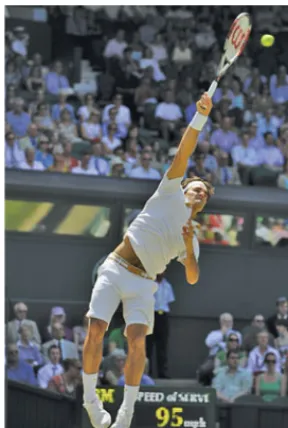
Force of a tennis serve. For a top player, a ten-nis ball may leave the racket on the serve with a speed of (about
), Fig. 7–1. If the ball has a mass of 0.060 kg and is in contact with the racket for about 4 ms estimate the average force on the ball. Would this force be large enough to lift a 60-kg person?
APPROACH We write Newton’s second law, Eq. 7–2, for the average force as
where and are the initial and final momenta. The tennis ball is hit when its initial velocity is very nearly zero at the top of the throw, so we set and we assume is in the horizontal direction. We ignore all other forces on the ball during this brief time interval, such as gravity, in comparison to the force exerted by the tennis racket.
SOLUTION The force exerted on the ball by the racket is
This is a large force, larger than the weight of a 60-kg person, which would
require a force to lift.
NOTE The force of gravity acting on the tennis ball is
which justifies our ignoring it compared to the enormous force the racket exerts.
NOTE High-speed photography and radar can give us an estimate of the contact time and the velocity of the ball leaving the racket. But a direct measure-ment of the force is not practical. Our calculation shows a handy technique for determining an unknown force in the real world.
0.59N,
mg=(0.060kg)A9.8m兾s2B = mg = (60kg)A9.8m兾s2B L 600N
L 800N.
Favg = ¢
p
¢t =
mv2 - mv1
¢t =
(0.060kg)(55m兾s) - 0 0.004s
v2 = 55m兾s
v1 = 0, v1
mv2 mv1
Favg = ¢
p
¢t = mv
2 - mv1
¢t ,
A4 * 10–3sB,
120mi兾h
55m兾s
EXAMPLE 7;1 ESTIMATE
172
CHAPTER 7 Linear Momentumv= 20 m/s
x
FIGURE 7;2 Example 7–2. FIGURE 7;1 Example 7–1.
Washing a car: momentum change and force. Water leaves a hose at a rate of with a speed of and is aimed at the side of a car, which stops it, Fig. 7–2. (That is, we ignore any splashing back.) What is the force exerted by the water on the car?
APPROACH The water leaving the hose has mass and velocity, so it has a momentum in the horizontal (x) direction, and we assume gravity doesn’t pull the water down significantly. When the water hits the car, the water loses this momentum We use Newton’s second law in the momentum form, Eq. 7–2, to find the force that the car exerts on the water to stop it. By Newton’s third law, the force exerted by the water on the car is equal and opposite. We have a continuing process: 1.5 kg of water leaves the hose in each 1.0-s time interval. So let us write where and
SOLUTION The force (assumed constant) that the car must exert to change the momentum of the water is
The minus sign indicates that the force exerted by the car on the water is oppo-site to the water’s original velocity. The car exerts a force of 30 N to the left to stop the water, so by Newton’s third law, the water exerts a force of 30 N to the right on the car.
NOTE Keep track of signs, although common sense helps too. The water is moving to the right, so common sense tells us the force on the car must be to the right.
F = ¢¢pt = pfinal -¢tpinitial = 0 - 30kg⭈m兾s
1.0s = –30N. mvinitial = (1.5kg)(20m兾s) = 30kg⭈m兾s.
¢t = 1.0s, F = ¢p兾¢t
Apfinal = 0B.
pinitial
20m兾s 1.5kg兾s
SECTION 7–2 Conservation of Momentum
173
CONSERVATION OF MOMENTUM (two objects colliding)mA A mB B A
B B
B
x A
A
mAvBAⴕ mBvBⴕB v
B
vB
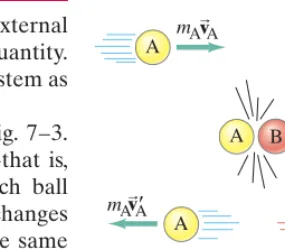
FIGURE 7;3 Momentum is conserved in a collision of two balls, labeled A and B.
7–2
Conservation of Momentum
The concept of momentum is particularly important because, if no net external force acts on a system, the total momentum of the system is a conserved quantity. This was expressed in Eq. 7–2 for a single object, but it holds also for a system as we shall see.
Consider the head-on collision of two billiard balls, as shown in Fig. 7–3. We assume the net external force on this system of two balls is zero—that is, the only significant forces during the collision are the forces that each ball exerts on the other. Although the momentum of each of the two balls changes as a result of the collision, the sumof their momenta is found to be the same before as after the collision. If is the momentum of ball A and the momentum of ball B, both measured just before the collision, then the total momentum of the two balls before the collision is the vector sum
Immediately after the collision, the balls each have a different velocity and momentum, which we designate by a “prime” on the velocity: and The total momentum after the collision is the vector sum No matter what the velocities and masses are, experiments show that the total momentum before the collision is the same as afterward, whether the collision is head-on or not, as long as no net external force acts:
(7;3)
That is, the total vector momentum of the system of two colliding balls is conserved: it stays constant. (We saw this result in this Chapter’s opening photograph.)
Although the law of conservation of momentum was discovered experimen-tally, it can be derived from Newton’s laws of motion, which we now show.
Let us consider two objects of mass and that have momenta and before they collide and and after they collide, as in Fig. 7–4. During the collision, suppose that the force exerted by object A on object B at any instant is Then, by Newton’s third law, the force exerted by object B on object A is During the brief collision time, we assume no other (external) forces are acting (or that is much greater than any other external forces acting). Over a very short time interval we have
and
We add these two equations together and find
This means
or
This is Eq. 7–3. The total momentum is conserved.
We have put this derivation in the context of a collision. As long as no exter-nal forces act, it is valid over any time interval, and conservation of momentum is always valid as long as no external forces act on the chosen system. In the real world, external forces do act: friction on billiard balls, gravity acting on a tennis ball, and so on. So we often want our “observation time” (before and after) to be small. When a racket hits a tennis ball or a bat hits a baseball, both before and after the “collision” the ball moves as a projectile under the action of gravity and air resistance.
pBœ
A + pBBœ = pBA + pBB.
pB
B
œ - pB
B + pBAœ - pBA = 0,
0 = ¢p B
B + ¢pBA
¢t =
ApBBœ - pBBB + ApBAœ - pBAB
¢t .
–FB = ¢p
B
A
¢t =
pBœA - pBA
¢t .
F B
= ¢p
B
B
¢t =
pBœ
B - pBB
¢t
¢t
FB –FB.
FB.
pB
B
œ
pB
A
œ
pB
B A= mBvBBB
pB
A A= mAvBAB
mB
mA
C©FBext = 0D mAvBA + mBvBB = mAvBAœ + mBvBBœ .
momentum before = momentum after mAvBAœ + mBvBBœ .
mBvBBœ .
mAvBAœ
mAvBA + mBvBB.
mBvBB
mAvBA
Before collision
At collision
After collision
mA
mA
mA
mB mB
mB −FB
FB pBA pB B
pBⴕB
pⴕA
B
FIGURE 7;4 Collision of two objects. Their momenta before collision are and and after collision are and At any moment during the collision each exerts a force on the other of equal magnitude but opposite direction.
pB
B
œ .
pB
Aœ
pB
B,
pB
However, when the bat or racket hits the ball, during the brief time of the colli-sion those external forces are insignificant compared to the collicolli-sion force the bat or racket exerts on the ball. Momentum is conserved (or very nearly so) as long as we measure and just before the collision and and immediately after the collision (Eq. 7–3). We can not wait for external forces to produce their effect before measuring and
The above derivation can be extended to include any number of interacting objects. To show this, we let in Eq. 7–2 represent the total momen-tum of a system—that is, the vector sum of the momenta of all objects in the system. (For our two-object system above, ) If the net force on the system is zero [as it was above for our two-object system, ], then from Eq. 7–2, so the total momentum doesn’t change. The general statement of the law of conservation of momentum is
The total momentum of an isolated system of objects remains constant.
By a system, we simply mean a set of objects that we choose, and which may interact with each other. An isolated systemis one in which the only (significant) forces are those between the objects in the system. The sum of all these “internal” forces within the system will be zero because of Newton’s third law. If there are
external forces—by which we mean forces exerted by objects outsidethe system—
and they don’t add up to zero, then the total momentum of the system won’t be conserved. However, if the system can be redefined so as to include the other objects exerting these forces, then the conservation of momentum principle can apply. For example, if we take as our system a falling rock, it does not conserve momentum because an external force, the force of gravity exerted by the Earth, accelerates the rock and changes its momentum. However, if we include the Earth in the system, the total momentum of rock plus Earth is conserved. (This means that the Earth comes up to meet the rock. But the Earth’s mass is so great, its upward velocity is very tiny.)
Although the law of conservation of momentum follows from Newton’s second law, as we have seen, it is in fact more general than Newton’s laws. In the tiny world of the atom, Newton’s laws fail, but the great conservation laws— those of energy, momentum, angular momentum, and electric charge—have been found to hold in every experimental situation tested. It is for this reason that the conservation laws are considered more basic than Newton’s laws.
¢pB = ©FB¢t = 0,
F B
+ (–FB) = 0
©FB pB = mAvBA + mBvBB.
(©FB = ¢pB兾¢t) pB
pBBœ. pBAœ
pBBœ pBAœ
pBB pBA
174
CHAPTER 7 Linear MomentumLAW OF CONSERVATION OF MOMENTUM
vB= 0 (at rest)
v′ =?
(b) After collision (a) Before collision
x
x vA=24.0 m/s
A B
B A
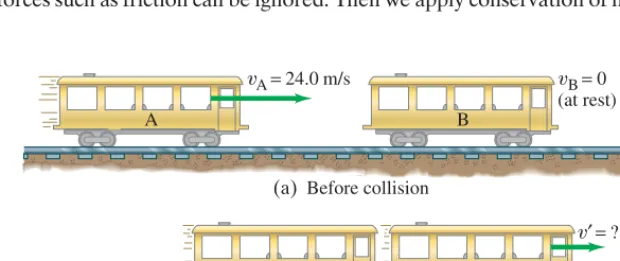
FIGURE 7;5 Example 7–3.
Railroad cars collide: momentum conserved. A 10,000-kg railroad car, A, traveling at a speed of strikes an identical car, B, at rest. If the cars lock together as a result of the collision, what is their common speed just afterward? See Fig. 7–5.
APPROACH We choose our system to be the two railroad cars. We consider a very brief time interval, from just before the collision until just after, so that external forces such as friction can be ignored. Then we apply conservation of momentum.
24.0m兾s
SOLUTION The initial total momentum is
because car B is at rest initially The direction is to the right in the direction. After the collision, the two cars become attached, so they will have the same speed, call it Then the total momentum after the collision is
We have assumed there are no external forces, so momentum is conserved:
Solving for we obtain
to the right. Their mutual speed after collision is half the initial speed of car A.
NOTE We kept symbols until the very end, so we have an equation we can use in other (related) situations.
NOTE We haven’t included friction here. Why? Because we are examining speeds just before and just after the very brief time interval of the collision, and during that brief time friction can’t do much—it is ignorable (but not for long: the cars will slow down because of friction).
v¿ = m mA
A + mBvA = a
10,000kg
10,000kg + 10,000kgb(24.0m兾s) = 12.0m兾s, v¿,
mAvA = AmA + mBBv¿.
pinitial = pfinal
pfinal = AmA + mBBv¿.
v¿.
±x AvB = 0B.
pinitial = mAvA + mBvB = mAvA
SECTION 7–2 Conservation of Momentum
175
EXERCISE C In Example 7–3, so in the last equation,
Hence What result do you get if (a) (b) is much larger than and (c)mB V mA?
mA AmB WmAB,
mB mB = 3mA, v¿ = 1
2vA.
mA兾AmA + mBB = 1 2.
mA = mB,
EXERCISE D A 50-kg child runs off a dock at (horizontally) and lands in a waiting rowboat of mass 150 kg. At what speed does the rowboat move away from the dock?
2.0m兾s
The law of conservation of momentum is particularly useful when we are dealing with fairly simple systems such as colliding objects and certain types of “explosions.” For example,rocket propulsion, which we saw in Chapter 4 can be understood on the basis of action and reaction, can also be explained on the basis of the conservation of momentum. We can consider the rocket plus its fuel as an isolated system if it is far out in space (no external forces). In the reference frame of the rocket before any fuel is ejected, the total momentum of rocket plus fuel is zero. When the fuel burns, the total momentum remains unchanged: the back-ward momentum of the expelled gases is just balanced by the forback-ward momentum gained by the rocket itself (see Fig. 7–6). Thus, a rocket can accelerate in empty space. There is no need for the expelled gases to push against the Earth or the air (as is sometimes erroneously thought). Similar examples of (nearly) isolated systems where momentum is conserved are the recoil of a gun when a bullet is fired (Example 7–5), and the movement of a rowboat just after a package is thrown from it.
P H Y S I C S A P P L I E D
Rocket propulsion
rocket gas
(a)
(b)
= 0
pB pB
pB FIGURE 7;6 (a) A rocket, containing fuel, at rest in some reference frame. (b) In the same reference frame, the rocket fires and gases are expelled at high speed out the rear. The total vector momentum,
remains zero. pBgas+ pBrocket,
Falling on or off a sled. (a) An empty sled is sliding on frictionless ice when Susan drops vertically from a tree down onto the sled. When she lands, does the sled speed up, slow down, or keep the same speed? (b) Later: Susan falls sideways off the sled. When she drops off, does the sled speed up, slow down, or keep the same speed?
RESPONSE (a) Because Susan falls vertically onto the sled, she has no initial horizontal momentum. Thus the total horizontal momentum afterward equals the momentum of the sled initially. Since the mass of the system has increased, the speed must decrease.
(b) At the instant Susan falls off, she is moving with the same horizontal speed as she was while on the sled. At the moment she leaves the sled, she has the same momentum she had an instant before. Because her momentum does not change, neither does the sled’s (total momentum conserved); the sled keeps the same speed.
(sled + person)
CONCEPTUAL EXAMPLE 7;4
C A U T I O N
EXERCISE E Return to the Chapter-Opening Questions, page 170, and answer them again now. Try to explain why you may have answered differently the first time.
176
CHAPTER 7 Linear Momentum(b) After shooting
B B R
(a) Before shooting (at rest) x
R p
B
pB
v
B
v
B
FIGURE 7;7 Example 7–5.
Rifle recoil. Calculate the recoil velocity of a 5.0-kg rifle that shoots a 0.020-kg bullet at a speed of Fig. 7–7.
APPROACH Our system is the rifle and the bullet, both at rest initially, just before the trigger is pulled. The trigger is pulled, an explosion occurs inside the bullet’s shell, and we look at the rifle and bullet just as the bullet leaves the barrel (Fig. 7–7b). The bullet moves to the right and the gun recoils to the left. During the very short time interval of the explosion, we can assume the external forces are small compared to the forces exerted by the exploding gunpowder. Thus we can apply conservation of momentum, at least approximately.
SOLUTION Let subscript B represent the bullet and R the rifle; the final veloc-ities are indicated by primes. Then momentum conservation in the xdirection gives
We solve for the unknown and find
Since the rifle has a much larger mass, its (recoil) velocity is much less than that of the bullet. The minus sign indicates that the velocity (and momentum) of the rifle is in the negative xdirection, opposite to that of the bullet.
vRœ = –mBvB
œ
mR = –
(0.020kg)(620m兾s)
(5.0kg) = –2.5m兾s. vRœ ,
mBvB + mRvR = mBvBœ + mRvRœ
0 + 0 = mBvBœ + mRvRœ . momentum before = momentum after
(±x), 620m兾s,
EXAMPLE 7;5
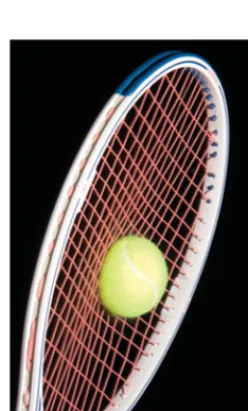
FIGURE 7;8 Tennis racket striking a ball. Both the ball and the racket strings are deformed due to the large force each exerts on the other.
Δ
F
orce,
F
(N)
0 Time, t(ms) tΔ FIGURE 7;9 Force as a function of time
during a typical collision.Fcan become very large; is typically milliseconds for macroscopic collisions.
¢t
7–3
Collisions and Impulse
Collisions are a common occurrence in everyday life: a tennis racket or a baseball bat striking a ball, billiard balls colliding, a hammer hitting a nail. When a collision occurs, the interaction between the objects involved is usually far stronger than any external forces. We can then ignore the effects of any other forces during the brief time interval of the collision.
During a collision of two ordinary objects, both objects are deformed, often considerably, because of the large forces involved (Fig. 7–8). When the collision occurs, the force each exerts on the other usually jumps from zero at the moment of contact to a very large force within a very short time, and then rapidly returns to zero again. A graph of the magnitude of the force that one object exerts on the other during a collision, as a function of time, is something like the red curve in Fig. 7–9. The time interval is usually very distinct and very small, typically milliseconds for a macroscopic collision.
SECTION 7–4
177
F
F
0 ti
t tf t Δ
FIGURE 7;10 The average force acting over a very brief time interval gives the same impulse
as the actual force. (f¢t)
¢t
f
From Newton’s second law, Eq. 7–2, the netforce on an object is equal to the rate of change of its momentum:
(We have written instead of for the net force, which we assume is entirely due to the brief but large average force that acts during the collision.) This equa-tion applies to eachof the two objects in a collision. We multiply both sides of this equation by the time interval and obtain
(7;4)
The quantity on the left, the product of the force times the time over which the force acts, is called the impulse:
(7;5)
We see that the total change in momentum is equal to the impulse. The concept of impulse is useful mainly when dealing with forces that act during a short time interval, as when a bat hits a baseball. The force is generally not constant, and often its variation in time is like that graphed in Figs. 7–9 and 7–10. We can often approximate such a varying force as an average force acting during a time interval as indicated by the dashed line in Fig. 7–10. is chosen so that the area shown shaded in Fig. 7–10 (equal to ) is equal to the area under the actual curve of Fvs.t, Fig. 7–9 (which represents the actual impulse).
f * ¢t f
¢t,
f Impulse = FB¢t.
¢t
FB FB¢t = ¢pB.
¢t,
©FB F
B FB = ¢p
B
¢t.
EXERCISE F Suppose Fig. 7–9 shows the force on a golf ball vs. time during the time interval when the ball hits a wall. How would the shape of this curve change if a softer rubber ball with the same mass and speed hit the same wall?
FIGURE 7;11 Example 7–6. Karate blow. Estimate the impulse and the
average force delivered by a karate blow that breaks a board (Fig. 7–11). Assume the hand moves at roughly when it hits the board.
APPROACH We use the momentum-impulse relation, Eq. 7–4. The hand’s speed changes from to zero over a distance of perhaps one cm (roughly how much your hand and the board compress before your hand comes to a stop, and the board begins to give way). The hand’s mass should probably include part of the arm, and we take it to be roughly
SOLUTION The impulse equals the change in momentum
We can obtain the force if we know The hand is brought to rest over the dis-tance of roughly a centimeter: The average speed during the
impact is and equals Thus
or 2 ms. The average force is thus (Eq. 7–4) about
f = ¢p
¢t =
10kg⭈m兾s
2 * 10–3s L 5000N = 5kN.
A10–2mB兾(5m兾s)=2*10–3s ¢x兾¢t ¢t = ¢x兾v L
. v = (10m兾s + 0)兾2 = 5m兾s
¢x L 1cm.
¢t.
f¢t = ¢p = m¢v L (1kg)(10m兾s - 0) = 10kg⭈m兾s. F¢t
m L 1kg.
10m兾s
10m兾s
EXAMPLE 7;6 ESTIMATE
7–4
Conservation of Energy and
Momentum in Collisions
178
CHAPTER 7 Linear MomentumA B
A B A B
A B
′A
′A
A B ′B (a)Approach
(b)Collision
(c)If elastic
(d)If inelastic
′B v
B vB
vB
vB vB
vB
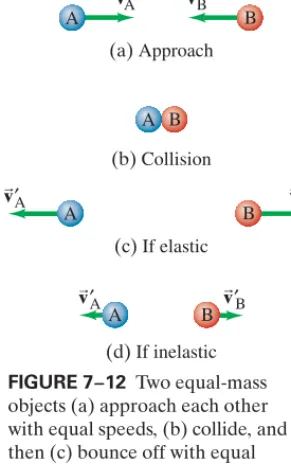
FIGURE 7;12 Two equal-mass objects (a) approach each other with equal speeds, (b) collide, and then (c) bounce off with equal speeds in the opposite directions if the collision is elastic, or (d) bounce back much less or not at all if the collision is inelastic (some of the KE is transformed to other forms of energy such as sound and heat).
x y
A B
x y
mA
(a)
mB
mA mB
(b)
′A ′B
vB vB
vB vB FIGURE 7;13 Two small objects of masses and (a) before the collision and (b) after the collision.
mB,
mA
†Note that Eqs. (i) and (ii), which are the conservation laws for momentum and kinetic energy, are
both satisfied by the solution and This is a valid solution, but not very interesting. It corresponds to no collision at all—when the two objects miss each other.
vBœ =vB. vAœ = vA
But if we compare the total kinetic energy just before the collision with the total kinetic energy just after the collision, and they are found to be the same, then we say that the total kinetic energy is conserved. Such a collision is called anelastic collision. If we use the subscripts A and B to represent the two objects, we can write the equation for conservation of total kinetic energy as
[elastic collision] (7;6)
Primed quantities mean after the collision, and unprimed mean before the collision, just as in Eq. 7–3 for conservation of momentum.
At the atomic level the collisions of atoms and molecules are often elastic. But in the “macroscopic” world of ordinary objects, an elastic collision is an ideal that is never quite reached, since at least a little thermal energy is always produced during a collision (also perhaps sound and other forms of energy). The col-lision of two hard elastic balls, such as billiard balls, however, is very close to being perfectly elastic, and we often treat it as such.
We do need to remember that even when kinetic energy is not conserved,
thetotalenergy is always conserved.
Collisions in which kinetic energy is not conserved are said to be inelastic collisions. The kinetic energy that is lost is changed into other forms of energy, often thermal energy, so that the total energy (as always) is conserved. In this case,
See Fig. 7–12, and the details in its caption.
7–5
Elastic Collisions in One Dimension
We now apply the conservation laws for momentum and kinetic energy to an elastic collision between two small objects that collide head-on, so all the motion is along a line. To be general, we assume that the two objects are moving, and their velocities are and along the xaxis before the collision, Fig. 7–13a. After the collision, their velocities are and Fig. 7–13b. For any the object is moving to the right (increasing x), whereas for the object is moving to the left (toward decreasing values of x).
From conservation of momentum, we have
Because the collision is assumed to be elastic, kinetic energy is also conserved:
We have two equations, so we can solve for two unknowns. If we know the masses and velocities before the collision, then we can solve these two equations for the velocities after the collision, and We derive a helpful result by rewriting the momentum equation as
(i)
and we rewrite the kinetic energy equation as
Noting that algebraically we write this last equation as
(ii)
We divide Eq. (ii) by Eq. (i), and (assuming and )† obtain vA + vAœ = vBœ + vB.
vB Z vBœ
vA Z vAœ
mAAvA - vAœ BAvA + vAœB = mBAvBœ - vBBAvBœ + vBB.
Aa2- b2B =(a-b)(a+b), mAAvA2 - vAœ2B = mBAvBœ2 - vB2B.
mAAvA - vAœ B = mBAvBœ - vBB,
vBœ .
vAœ
1
2mAvA2 + 12mBvB2 = 21mAvAœ2 + 12mBvBœ2.
mAvA + mBvB = mAvAœ + mBvBœ .
v 6 0,
v 7 0,
vBœ ,
vAœ
vB
vA
keA + keB = keAœ + keBœ + thermaland other forms of energy. (¿)
1
2mAvA2 + 1
2mBvB2 = 1
2mAvAœ2 + 1 2mBvBœ2.
SECTION 7–5 Elastic Collisions in One Dimension
179
C A U T I O N
Relative speeds (one dimension only)
We can rewrite this equation as
or
[head-on (1-D) elastic collision] (7;7)
This is an interesting result: it tells us that for any elastic head-on collision, the relative speed of the two objects after the collision has the same magnitude (but opposite direction) as before the collision, no matter what the masses are.
Equation 7–7 was derived from conservation of kinetic energy for elastic collisions, and can be used in place of it. Because the v’s are not squared in Eq. 7–7, it is simpler to use in calculations than the conservation of kinetic energy equation (Eq. 7–6) directly.
AvAœ - vBœB
vA - vB = –AvAœ - vBœB.
vA - vB = vBœ - vAœ
Equal masses. Billiard ball A of mass m moving with speed collides head-on with ball B of equal mass. What are the speeds of the two balls after the collision, assuming it is elastic? Assume (a) both balls are moving initially ( and ), (b) ball B is initially at rest
APPROACH There are two unknowns, and so we need two indepen-dent equations. We focus on the time interval from just before the collision until just after. No net external force acts on our system of two balls (mgand the normal force cancel), so momentum is conserved. Conservation of kinetic energy applies as well because we are told the collision is elastic.
SOLUTION (a) The masses are equal so conservation of momentum gives
We need a second equation, because there are two unknowns. We could use the conservation of kinetic energy equation, or the simpler Eq. 7–7 derived from it:
We add these two equations and obtain
and then subtract the two equations to obtain
That is, the balls exchange velocities as a result of the collision: ball B acquires the velocity that ball A had before the collision, and vice versa.
(b) If ball B is at rest initially, so that we have
and
That is, ball A is brought to rest by the collision, whereas ball B acquires the original velocity of ball A. See Fig. 7–14.
NOTE Our result in part (b) is often observed by billiard and pool players, and is valid only if the two balls have equal masses (and no spin is given to the balls).
vAœ = 0.
vBœ = vA
vB = 0,
vAœ = vB.
vBœ = vA
vA - vB = vœB - vAœ .
vA + vB = vAœ + vBœ .
AmA = mB = mB
vBœ ,
vAœ
AvB = 0B.
vB
vA
vA
EXAMPLE 7;7
180
CHAPTER 7A nuclear collision. A proton (p) of mass (unified atomic mass units) traveling with a speed of has an elastic head-on collision with a helium (He) nucleus initially at rest. What are the velocities of the proton and helium nucleus after the collision? (As mentioned in Chapter 1, but we won’t need this fact.) Assume the collision takes place in nearly empty space.
APPROACH Like Example 7–7, this is an elastic head-on collision, but now the masses of our two particles are not equal. The only external force could be Earth’s gravity, but it is insignificant compared to the powerful forces between the two particles at the moment of collision. So again we use the conservation laws of momentum and of kinetic energy, and apply them to our system of two particles.
SOLUTION We use the subscripts p for the proton and He for the helium nucleus. We are given and We want to find the velocities and after the collision. From conservation of momentum,
Because the collision is elastic, the kinetic energy of our system of two particles is conserved and we can use Eq. 7–7, which becomes
Thus
and substituting this into our momentum equation displayed above, we get
Solving for we obtain
The other unknown is which we can now obtain from
The minus sign for tells us that the proton reverses direction upon collision, and we see that its speed is less than its initial speed (see Fig. 7–15).
NOTE This result makes sense: the lighter proton would be expected to “bounce back” from the more massive helium nucleus, but not with its full original velocity as from a rigid wall (which corresponds to extremely large, or infinite, mass).
vpœ
= –2.15*104m兾s. vpœ = vHeœ -vp = A1.45*104m兾sB-A3.60*104m兾sB
vpœ,
= 1.45 * 104m兾s. vHeœ =
2mpvp
mp + mHe =
2(1.01u)A3.60 * 104m兾sB
(4.00u + 1.01u) vHeœ ,
mpvp = mpvHeœ - mpvp + mHevHeœ .
vpœ = vHeœ - vp,
vp - 0 = vHeœ - vpœ.
mpvp + 0 = mpvpœ + mHevHeœ .
vHeœ
vpœ
vp = 3.60 * 104m兾s.
vHe = 0
1u = 1.66 * 10–27kg,
AmHe = 4.00uB
3.60 * 104m兾s
1.01u
EXAMPLE 7;8
He
(a)
′
(b)
′He p
p
p v
B
v
B
vB
FIGURE 7;15 Example 7–8: (a) before collision, (b) after collision.
7–6
Inelastic Collisions
Collisions in which kinetic energy is not conserved are called inelastic collisions. Some of the initial kinetic energy is transformed into other types of energy, such as thermal or potential energy, so the total kinetic energy after the collision is less than the total kinetic energy before the collision. The inverse can also happen when potential energy (such as chemical or nuclear) is released, in which case the total kinetic energy after the interaction can be greater than the initial kinetic energy. Explosions are examples of this type.
SECTION 7–6 Inelastic Collisions
181
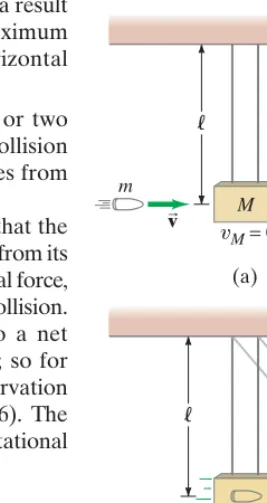
Ballistic pendulum. The ballistic pendulumis a device used to measure the speed of a projectile, such as a bullet. The projectile, of mass m, is fired into a large block (of wood or other material) of mass M, which is suspended like a pendulum. (Usually,Mis somewhat greater than m.) As a result of the collision, the pendulum and projectile together swing up to a maximum heighth, Fig. 7–16. Determine the relationship between the initial horizontal speed of the projectile,v, and the maximum height h.
APPROACH We can analyze the process by dividing it into two parts or two time intervals: (1) the time interval from just before to just after the collision itself, and (2) the subsequent time interval in which the pendulum moves from the vertical hanging position to the maximum height h.
In part (1), Fig. 7–16a, we assume the collision time is very short, so that the projectile is embedded in the block before the block has moved significantly from its rest position directly below its support. Thus there is effectively no net external force, and we can apply conservation of momentum to this completely inelastic collision. In part (2), Fig. 7–16b, the pendulum begins to move, subject to a net external force (gravity, tending to pull it back to the vertical position); so for part (2), we cannot use conservation of momentum. But we can use conservation of mechanical energy because gravity is a conservative force (Chapter 6). The kinetic energy immediately after the collision is changed entirely to gravitational potential energy when the pendulum reaches its maximum height,h.
SOLUTION In part (1) momentum is conserved:
(i)
where is the speed of the block and embedded projectile just after the colli-sion, before they have moved significantly.
In part (2), mechanical energy is conserved. We choose when the pendulum hangs vertically, and then when the pendulum–projectile system reaches its maximum height. Thus we write
or
(ii)
We solve for
Inserting this result for into Eq. (i) above, and solving for v, gives
which is our final result.
NOTE The separation of the process into two parts was crucial. Such an analysis is a powerful problem-solving tool. But how do you decide how to make such a division? Think about the conservation laws. They are your tools. Start a problem by asking yourself whether the conservation laws apply in the given situation. Here, we determined that momentum is conserved only during the brief colli-sion, which we called part (1). But in part (1), because the collision is inelastic, the conservation of mechanical energy is not valid. Then in part (2), conservation of mechanical energy is valid, but not conservation of momentum.
Note, however, that if there had been significant motion of the pendulum during the deceleration of the projectile in the block, then there wouldhave been an external force (gravity) during the collision, so conservation of momen-tum would not have been valid in part (1).
v = m m+ Mv¿ = m +mM22gh,
v¿
v¿ = 22gh.
v¿:
1
2(m + M)v¿2 + 0 = 0 + (m + M)gh.
(ke + pe) just after collision = (ke + pe) at pendulum’s maximum height
y = h y = 0
v¿
mv = (m + M)v¿,
total p before = totalp after
EXAMPLE 7;9 P H Y S I C S A P P L I E D
Ballistic pendulum
l
M + m
h l
vM = 0
M m
(a)
(b) v
B
′
v
B
FIGURE 7;16 Ballistic pendulum. Example 7–9.
Railroad cars again. For the completely inelastic collision of the two railroad cars that we considered in Example 7–3, calculate how much of the initial kinetic energy is transformed to thermal or other forms of energy.
APPROACH The railroad cars stick together after the collision, so this is a completely inelastic collision. By subtracting the total kinetic energy after the collision from the total initial kinetic energy, we can find how much energy is transformed to other types of energy.
SOLUTION Before the collision, only car A is moving, so the total initial
kinetic energy is After the
collision, both cars are moving with half the speed, by conserva-tion of momentum (Example 7–3). So the total kinetic energy afterward is
Hence the energy transformed to other forms is
which is half the original kinetic energy.
A2.88 * 106JB - A1.44 * 106JB = 1.44 * 106J,
1
2(20,000kg)(12.0m兾s)2 = 1.44 * 106J. ke¿ = 12AmA+ mBBv¿2 =
v¿ = 12.0m兾s,
1
2mAvA2 = 1
2(10,000kg)(24.0m兾s)2 = 2.88 * 106J. EXAMPLE 7;10
182
CHAPTER 7 Linear Momentum†The objects may begin to deflect even before they touch if electric, magnetic, or nuclear forces act
between them. You might think, for example, of two magnets oriented so that they repel each other: when one moves toward the other, the second moves away before the first one touches it.
FIGURE 7;17 A recent color-enhanced version of a cloud-chamber photograph made in the early days (1920s) of nuclear physics. Green lines are paths of helium nuclei (He) coming from the left. One He, highlighted in yellow, strikes a proton of the hydrogen gas in the chamber, and both scatter at an angle; the scattered proton’s path is shown in red.
′B θ ′A θ mB
mB mA
′A pB
′B p
B A
pB mA
y
x
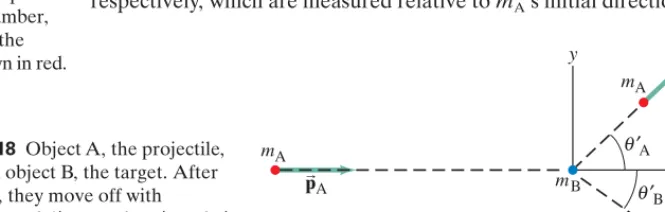
FIGURE 7;18 Object A, the projectile, collides with object B, the target. After the collision, they move off with
momenta and at pB angles and uAœ uBœ .
Bœ
pB
Aœ
Let us apply the law of conservation of momentum to a collision like that of Fig. 7–18. We choose the xyplane to be the plane in which the initial and final momenta lie. Momentum is a vector, and because the total momentum is conserved, its components in the x and y directions also are conserved. The
xcomponent of momentum conservation gives
or, with
(7;8a)
where primes refer to quantities afterthe collision. There is no motion in the y direc-tion initially, so the ycomponent of the total momentum is zero before the collision.
(¿)
mAvA = mAvAœ cosuAœ + mBvBœ cosuBœ ,
pBx = mBvBx = 0,
pAx + pBx = pAœx + pBœx
7–7
Collisions in Two Dimensions
Conservation of momentum and energy can also be applied to collisions in two or three dimensions, where the vector nature of momentum is especially important. One common type of non-head-on collision is that in which a moving object (called the “projectile”) strikes a second object initially at rest (the “target”). This is the common situation in games such as billiards and pool, and for experiments in atomic and nuclear physics (the projectiles, from radioactive decay or a high-energy accelerator, strike a stationary target nucleus, Fig. 7–17).
Figure 7–18 shows the incoming projectile, heading along the x axis toward the target object, which is initially at rest. If these are billiard balls,
strikes not quite head-on and they go off at the angles and respectively, which are measured relative to mA’s initial direction (the xaxis).†
uBœ ,
uAœ
mB
mA
mB,
mA,
*SECTION 7–7 Collisions in Two Dimensions
183
A
B
B A
A
′A= 45° θ
′B= ? ′A= ?
′B= −45° θ
v
B
v
B
v
B y
x
FIGURE 7;19 Example 7–11.
C A U T I O N
Equation 7–7 applies only in 1-D
The ycomponent equation of momentum conservation is then
or
(7;8b)
When we have two independent equations, we can solve for two unknowns at most. 0 = mAvAœ sinuAœ + mBvBœ sinuBœ .
pAy + pBy = pAœy + pBœy
Billiard ball collision in 2-D. Billiard ball A moving with speed in the direction (Fig. 7–19) strikes an equal-mass ball B initially at rest. The two balls are observed to move off at 45° to the xaxis, ball A above the xaxis and ball B below. That is, and in Fig. 7–19. What are the speeds of the two balls after the collision?
APPROACH There is no net external force on our system of two balls, assuming the table is level (the normal force balances gravity). Thus momentum con-servation applies, and we apply it to both the xandy components using the
xycoordinate system shown in Fig. 7–19. We get two equations, and we have two unknowns, and From symmetry we might guess that the two balls have the same speed. But let us not assume that now. Even though we are not told whether the collision is elastic or inelastic, we can still use conservation of momentum.
SOLUTION We apply conservation of momentum for the xandycomponents, Eqs. 7–8a and b, and we solve for and We are given
so
(forx) and
(fory)
The m’s cancel out in both equations (the masses are equal). The second equation yields [recall from trigonometry that ]:
So they do have equal speeds as we guessed at first. The xcomponent equation gives [recall that ]:
solving for (which also equals ) gives
vAœ = 2 cos(45°)vA =
3.0m兾s
2(0.707) = 2.1m兾s. vBœ
vAœ
vA = vAœ cos(45°) + vBœ cos(45°) = 2vAœ cos(45°);
cos(–u) = cosu vBœ = –vAœ
sin(45°)
sin(–45°) = –vA
œ a sin 45°
–sin 45°b = vA
œ .
sin(–u) = –sinu
0 = mvAœ sin(45°) + mvBœ sin(–45°). mvA = mvAœ cos(45°) + mvBœ cos(–45°)
mA = mBA= mB,
vBœ .
vAœ
vBœ .
vAœ
uBœ = –45°
uAœ = 45°
±x vA = 3.0m兾s
EXAMPLE 7;11
If we know that a collision is elastic, we can also apply conservation of kinetic energy and obtain a third equation in addition to Eqs. 7–8a and b:
or, for the collision shown in Fig. 7–18 or 7–19 (where ),
[elastic collision] (7;8c)
If the collision is elastic, we have three independent equations and can solve for three unknowns. If we are given (and if it is not zero), we can-not, for example, predict the final variables, and because there are four of them. However, if we measure one of these variables, say then the other three variables ( and ) are uniquely determined, and we can determine them using Eqs. 7–8a, b, c.
A note of caution: Eq. 7–7 (page 179) does notapply for two-dimensional collisions. It works only when a collision occurs along a line.
uBœ
vAœ ,vBœ ,
uAœ ,
uBœ ,
vAœ ,vBœ ,uAœ ,
vB,
mA, mB, vA
1 2mAvA
2 = 1 2mAvAœ
2 + 1 2mBvBœ
2
.
(a)
(b)
FIGURE 7;20 The motion of the diver is pure translation in (a), but is translation plus rotation in (b). The black dot represents the diver’s CMat each moment.
7–8
Center of Mass (CM
)
Momentum is a powerful concept not only for analyzing collisions but also for analyzing the translational motion of real extended objects. Until now, when-ever we have dealt with the motion of an extended object (that is, an object that has size), we have assumed that it could be approximated as a point particle or that it undergoes only translational motion. Real extended objects, however, can undergo rotational and other types of motion as well. For example, the diver in Fig. 7–20a undergoes only translational motion (all parts of the object follow the same path), whereas the diver in Fig. 7–20b undergoes both translational and rotational motion. We will refer to motion that is not pure translation as
general motion.
Observations indicate that even if an object rotates, or several parts of a system of objects move relative to one another, there is one point that moves in the same path that a particle would move if subjected to the same net force. This point is called the center of mass(abbreviatedCM). The general motion of an extended object (or system of objects) can be considered as the sum of the
translational motion of the CM, plus rotational,vibrational, or other types of motion
about the CM.
As an example, consider the motion of the center of mass of the diver in Fig. 7–20; the CMfollows a parabolic path even when the diver rotates, as shown in Fig. 7–20b. This is the same parabolic path that a projected particle follows when acted on only by the force of gravity (projectile motion, Chapter 3). Other points in the rotating diver’s body, such as her feet or head, follow more complicated paths.
184
CHAPTER 7 Linear Momentumonly an xaxis.) It is often convenient to choose the axis in the direction of one object’s initial velocity.
5. Apply the momentum conservationequation(s):
You have one equation for each component (x,y,z): only one equation for a head-on collision. [Don’t for-get that it is the totalmomentum of the system that is conserved, not the momenta of individual objects.]
6. If the collision is elastic, you can also write down a conservation of kinetic energyequation:
[Alternatively, you could use Eq. 7–7:
if the collision is one dimensional (head-on).]
7. Solve for the unknown(s).
8. Checkyour work, check the units, and ask yourself whether the results are reasonable.
vBœ - vAœ ,
vA - vB =
total initial ke = total final ke. total initial momentum = total final momentum. ±x
P
R
O
B
L
E
M
S
O
LV I
N G
Momentum Conservation
and Collisions
1. Choose your system. If the situation is complex, think about how you might break it up into separate parts when one or more conservation laws apply. 2. Consider whether a significant net external force
acts on your chosen system; if it does, be sure the time interval is so short that the effect on momentum is negligible. That is, the forces that act between the interacting objects must be the only significant ones if momentum conservation is to be used. [Note: If this is valid for a portion of the problem, you can use momentum conservation only for that portion.] 3. Draw a diagramof the initial situation, just before the interaction (collision, explosion) takes place, and represent the momentum of each object with an arrow and a label. Do the same for the final situation, just after the interaction.
4. Choose a coordinate system and “ ” and “ ” directions. (For a head-on collision, you will need – ±
SECTION 7–8 Center of Mass (CM)
185
FIGURE 7;21 Translation plus rotation: a wrench moving over a smooth horizontal surface. The CM, marked with a red cross, moves in a straight line because no net force acts on the wrench.
Figure 7–21 shows a wrench acted on by zero net force, translating and rotating along a horizontal surface. Note that its CM, marked by a red cross, moves in a straight line, as shown by the dashed white line.
We will show in Section 7–10 that the important properties of the CMfollow from Newton’s laws if the CMis defined in the following way. We can consider any extended object as being made up of many tiny particles. But first we consider a system made up of only two particles (or small objects), of masses and We choose a coor-dinate system so that both particles lie on the xaxis at positions and Fig. 7–22. The center of mass of this system is defined to be at the position given by
where is the total mass of the system. The center of mass lies on the line joining and If the two masses are equal then
is midway between them, because in this case
If one mass is greater than the other, then the CMis closer to the larger mass. If there are more than two particles along a line, there will be additional terms:
(7;9a)
whereMis the total mass of all the particles.
CM of three guys on a raft. On a lightweight (air-filled) “banana boat,” three people of roughly equal mass msit along the xaxis at
posi-tions and measured from the left-hand
end as shown in Fig. 7–23. Find the position of the CM. Ignore the mass of the boat.
APPROACH We are given the mass and location of the three people, so we use three terms in Eq. 7–9a. We approximate each person as a point particle. Equivalently, the location of each person is the position of that person’s own CM.
SOLUTION We use Eq. 7–9a with three terms:
The CMis 4.0 m from the left-hand end of the boat.
EXERCISE G Calculate the CMof the three people in Example 7–12, taking the origin at the driver on the right. Is the physical location of the CMthe same?
Note that the coordinates of the CMdepend on the reference frame or coordinate system chosen. But the physical location of the CMis independent of that choice.
If the particles are spread out in two or three dimensions, then we must specify not only the xcoordinate of the CM but also the yandzcoordinates, which will be given by formulas like Eq. 7–9a. For example, the ycoordinate of the CMwill be
(7;9b)
whereMis the total mass of all the particles.
ycm = mAyA + mByB + p
mA + mB + p =
mAyA + mByB + p
M AxcmB,
AxC = 0B
= (1.0m + 5.0m + 6.0m)
3 =
12.0m
3 = 4.0m. xcm = mxAm++mxmB++mmxC =
mAxA + xB + xCB
3m xC = 6.0m,
xB = 5.0m,
xA = 1.0m,
EXAMPLE 7;12
xcm = mAxA + mBxB + mCxC + p
mA + mB + mC + p =
mAxA + mBxB + mCxC + p
M ,
xcm =
mAxA + xBB
2m =
AxA + xBB
2 .
xcm
AmA = mB = mB,
mB.
mA
M = mA + mB
xcm = mAxA + mBxB
mA + mB =
mAxA + mBxB
M ,
xcm, xB,
xA
mB.
mA
y
x mA
xA xB
xCM
mB FIGURE 7;22 The center of mass of a two-particle system lies on the line joining the two masses. Here
so the CMis closer to than to mB.
mA
mA 7 mB,
0 5.0 m
x = 0 1.0 m 6.0 m
x
5.0 m 6.0 m x y
0 1.0 m
A concept similar to center of massiscenter of gravity(CG). An object’s CGis that point at which the force of gravity can be considered to act. The force of gravity actually acts on allthe different parts or particles of an object, but for purposes of determining the translational motion of an object as a whole, we can assume that the entire weight of the object (which is the sum of the weights of all its parts) acts at the CG. There is a conceptual difference between the center of gravity and the center of mass, but for nearly all practical purposes, they are at the same point.†
It is often easier to determine the CMorCGof an extended object experimen-tally rather than analytically. If an object is suspended from any point, it will swing (Fig. 7–24) due to the force of gravity on it, unless it is placed so its CG lies on a vertical line directly below the point from which it is suspended. If the object is two dimensional, or has a plane of symmetry, it need only be hung from two different pivot points and the respective vertical (plumb) lines drawn. Then the center of gravity will be at the intersection of the two lines, as in Fig. 7–25. If the object doesn’t have a plane of symmetry, the CGwith respect to the third dimen-sion is found by suspending the object from at least three points whose plumb lines do not lie in the same plane.
For symmetrically shaped objects such as uniform cylinders (wheels), spheres, and rectangular solids, the CMis located at the geometric center of the object.
To locate the center of mass of a group of extended objects, we can use Eqs. 7–9, where the m’s are the masses of these objects and the x’s, y’s, and z’s are the coordinates of the CMof each of the objects.
186
CHAPTER 7 Linear Momentum†There would be a difference between the
CMandCGonly in the unusual case of an object so large that the acceleration due to gravity,g, was different at different parts of the object.
Pivot point
m CG
gB
FIGURE 7;24 The force of gravity, considered to act at the CG, causes this object to rotate about the pivot point; if the CGwere on a vertical line directly below the pivot, the object would remain at rest.
CG FIGURE 7;25 Finding the CG.
7–9
CM for the Human Body
For a group of extended objects, each of whose CMis known, we can find the CMof the group using Eqs. 7–9a and b. As an example, we consider the human body. Table 7–1 indicates the CMand hinge points (joints) for the different compo-nents of a “representative” person. Of course, there are wide variations among people, so these data represent only a very rough average. The numbers represent
apercentageof the total height, which is regarded as 100 units; similarly, the total
mass is 100 units. For example, if a person is 1.70 m tall, his or her shoulder joint would be (1.70m)(81.2兾100) = 1.38m above the floor.
*
TABLE 7;1 Center of Mass of Parts of Typical Human Body, given as
(full height and )
Distance of Hinge Hinge Points (•) Center of Mass ( ) Percent Points from Floor (%%) (Joints) (%%Height Above Floor) Mass
ⴛ
massⴝ100units
% %
elbow 62.2%‡
wrist 46.2%‡
Head 93.5% 6.9%
Trunk and neck 71.1% 46.1% Upper arms 71.7% 6.6% Lower arms 55.3% 4.2%
Hands 43.1% 1.7%
Upper legs (thighs) 42.5% 21.5%
Lower legs 18.2% 9.6%
Feet 1.8% 3.4%
91.2% Base of skull on spine 81.2% Shoulder joint
52.1% Hip joint
28.5% Knee joint
4.0% Ankle joint
BodyCM 58.0% 100.0%
‡For arm hanging vertically.
*SECTION 7–10 CM and Translational Motion
187
A leg’s CM. Determine the position of the CMof a whole leg (a) when stretched out, and (b) when bent at 90°. See Fig. 7–26. Assume the person is 1.70 m tall.
APPROACH Our system consists of three objects: upper leg, lower leg, and foot. The location of the CMof each object, as well as the mass of each, is given in Table 7–1, where they are expressed in percentage units. To express the results in meters, these percentage values need to be multiplied by
When the leg is stretched out, the problem is one dimensional and we can solve for the xcoordinate of the CM. When the leg is bent, the problem is two dimensional and we need to find both the xandycoordinates.
SOLUTION (a) We determine the distances from the hip joint using Table 7–1 and obtain the numbers (%) shown in Fig. 7–26a. Using Eq. 7–9a, we obtain (u upper leg, etc.)
Thus, the center of mass of the leg and foot is 20.4 units from the hip joint, or from the base of the foot. Since the person is 1.70 m tall, this is above the bottom of the foot. (b) We use an xycoordinate system, as shown in Fig. 7–26b. First, we calculate how far to the right of the hip joint the CMlies, accounting for all three parts:
For our 1.70-m-tall person, this is from the hip joint. Next, we calculate the distance, of the CMabove the floor:
or Thus, the CMis located 39 cm above the floor and 25 cm to the right of the hip joint.
NOTE The CMlies outside the body in (b). (1.70m)(23.0兾100) = 0.39m.
ycm =
(3.4)(1.8) + (9.6)(18.2) + (21.5)(28.5)
3.4 + 9.6 + 21.5 = 23.0units, ycm,
(1.70m)(14.9兾100) = 0.25m
xcm =
(21.5)(9.6) + (9.6)(23.6) + (3.4)(23.6)
21.5 + 9.6 + 3.4 = 14.9units. (1.70m)(31.7兾100) = 0.54m
52.1 - 20.4 = 31.7units
= (21.5)(9.6) + (9.6)(33.9) + (3.4)(50.3)
21.5 + 9.6 + 3.4 = 20.4units.
xcm =
mulxul + mllxll + mfxf
mul + mll + mf
=
l
(1.70m兾100).
EXAMPLE 7;13
Knowing the CMof the body when it is in various positions is of great use in studying body mechanics. One simple example from athletics is shown in Fig. 7–27. If high jumpers can get into the position shown, their CMcan pass below the bar which their bodies go over, meaning that for a particular takeoff speed, they can clear a higher bar. This is indeed what they try to do.
50.3 33.9 9.6
23.6 9.6
28.5
18.2
1.8 (a)
(b) y
x
FIGURE 7;26 Example 7–13: finding the CMof a leg in two different positions using percentages from Table 7–1. ( represents the calculatedCM.)
䊟
CM
FIGURE 7;27 A high jumper’s CM may actually pass beneath the bar.
P H Y S I C S A P P L I E D
The high jump
7–10
CM and Translational Motion
As mentioned in Section 7–8, a major reason for the importance of the concept of center of mass is that the motion of the CMfor a system of particles (or an extended object) is directly related to the net force acting on the system as a whole. We now show this, taking the simple case of one-dimensional motion (xdirection) and only three particles, but the extension to more objects and to three dimensions follows the same reasoning.
188
CHAPTER 7 Linear MomentumSuppose the three particles lie on the xaxis and have masses
and positions From Eq. 7–9a for the center of mass, we can write
where is the total mass of the system. If these particles are in motion (say, along the xaxis with velocities and respectively), then in a short time interval each particle and the CMwill have traveled a dis-tance so that
We cancel and get
(7;10)
Since is the sum of the momenta of the particles of the system, it represents the total momentumof the system. Thus we see from Eq. 7–10 that the total (linear) momentum of a system of particles is equal to the
product of the total mass M and thevelocity of the center of mass of the system.
Or,the linear momentum of an extended object is the product of the object’s mass
and thevelocity of its CM.
If forces are acting on the particles, then the particles may be accelerating. In a short time interval each particle’s velocity will change by an amount
If we use the same reasoning as we did to obtain Eq. 7–10, we find
According to Newton’s second law, and
where and are the net forces on the three particles, respectively. Thus we get for the system as a whole or
(7;11)
That is,the sum of all the forces acting on the system is equal to the total mass of
the system times the acceleration of its center of mass. This is Newton’s second
lawfor a system of particles. It also applies to an extended object (which can be thought of as a collection of particles). Thus the center of mass of a system of particles (or of an object) with total mass Mmoves as if all its mass were concen-trated at the center of mass and all the external forces acted at that point. We can thus treat the translational motion of any object or system of objects as the motion of a particle (see Figs. 7–20 and 7–21). This result simplifies our analysis of the motion of complex systems and extended objects. Although the motion of various parts of the system may be complicated, we may often be satisfied with knowing the motion of the center of mass. This result also allows us to solve certain types of problems very easily, as illustrated by the following Example.
Macm = Fnet.
Macm = FA + FB + FC,
FC
FB,
FA,
mCaC = FC,
mBaB = FB,
mAaA = FA,
Macm = mAaA + mBaB + mCaC.
¢v = a¢t.
¢t,
mAvA + mBvB + mCvC
Mvcm = mAvA + mBvB + mCvC.
¢t
Mvcm¢t = mAvA¢t + mBvB¢t + mCvC¢t.
¢x = v¢t,
¢t vA,vB, vC,
M = mA + mB + mC
Mxcm = mAxA + mBxB + mCxC,
xC.
xA,xB,
mC,
mA,mB,
NEWTON’S SECOND LAW (for a system)
d
I II
II Pa
th
of I
II
d I
I
Path ofC
M
Path of II
FIGURE 7;28 Example 7–14.
A two-stage rocket. A rocket is shot into the air as shown in Fig. 7–28. At the moment the rocket reaches its highest point, a horizontal distance dfrom its starting point, a prearranged explosion separates it into two parts of equal mass. Part I is stopped in midair by the explosion, and it falls vertically to Earth. Where does part II land? Assume gB = constant.
Summary
189
P H Y S I C S A P P L I E D
Distant planets discovered
The linear momentum, of an object is defined as the product of its mass times its velocity,
(7;1)
In terms of momentum,Newton’s second lawcan be written as
(7;2)
That is, the rate of change of momentum of an object equals the net force exerted on it.
When the net external force on a system of objects is zero, the total momentum remains constant. This is the law of conservation of momentum. Stated another way, the total momentum of an isolated system of objects remains constant.
The law of conservation of momentum is very useful in dealing with collisions. In a collision, two (or more) objects interact with each other over a very short time interval, and the force each exerts on the other during this time interval is very large compared to any other forces acting.
The impulsedelivered by a force on an object is defined as
(7;5)
where is the average force acting during the (usually very short) time interval The impulse is equal to the change in momentum of the object:
(7;4)
Total momentum is conserved in anycollision as long as any net external force is zero or negligible. If and are the momenta of two objects before the collision and mAvBAœ
mBvBB
mAvBA
Impulse = FB¢t = ¢pB. ¢t.
FB
Impulse = FB¢t, ©FB = ¢p
B
¢t. pB = mvB.
p B ,
Summary
EXERCISE H A woman stands up in a rowboat and walks from one end of the boat to the other. How does the boat move, as seen from the shore?
An interesting application is the discovery of nearby stars (see Section 5–8) that seem to “wobble.” What could cause such a wobble? It could be that a planet orbits the star, and each exerts a gravitational force on the other. The planets are too small and too far away to be observed directly by telescopes. But the slight wobble in the motion of the star suggests that both the planet and the star (its sun) orbit about their mutual center of mass, and hence the star appears to have a wobble. Irregularities in the star’s motion can be measured to high accuracy, yielding information on the size of the planets’ orbits and their masses. See Fig. 5–30 in Chapter 5.
and are their momenta after, then momentum conserva-tion tells us that
(7;3)
for this two-object system.
Total energy is also conserved. But this may not be helpful unless kinetic energy is conserved, in which case the c