Impact of Mobile Learning in the Cloud on Learning
Competencies of Engineering Students
https://doi.org/10.3991/ijoe.v15i09.10671
Ramananda Mallya K (*) Bharathiar University, Coimbatore, India
MITE, Moodbidri, India.
B Srinivasan
Gobi Arts & Science College, Gobichettipalayam, India
Abstract—It has been acknowledged that the mobile learning concept has extended numerous opportunities for teachers as well as students, as it makes way for an active learning atmosphere anywhere and anytime. Mobile learning technology can be resourcefully improvised by extending the cloud technology into it. This study is an attempt to analyze the impact of mobile cloud compu-ting on learning competencies of engineering students. The main intention is to experiment whether mobile learning using cloud technology has an impact on student’s performance by investigating the influence of this innovative teaching technique on course outcomes. The results illustrated that use of cloud based mobile learning in studying an engineering subject is rewarding and does has an encouraging impact on learning competencies of students. The results distinc-tively indicate that cloud based mobile learning can be effecdistinc-tively used for learning engineering subjects that results in superior attainment of course out-comes.
Keywords—Mobile cloud computing, mobile learning, course outcomes, engi-neering, education
1
Introduction
In the recent times, there is a great tendency for the engineering educational institu-tions to adapt new methods of learning along with the traditional methods. Engineer-ing education sector has been enterEngineer-ing into a new technical era of modern days due to the rapid revolution in information and communications technologies. The existing traditional in-class learning is being complemented with electronic learning and mo-bile learning making the learning process more effective [1].
com-munity. Mobile learning is one of the trends in the educational field that equips the educational system with the modern technology [2].
Mobile learning is a learning system, which uses mobile devices in the manage-ment and enhancemanage-ment of the learning process. Mobile learning does not intend to replace the existing learning system; it aims to complement it. Mobile learning has many advantages like flexibility and openness. It will be certainly going to become a revolutionary system of education in the coming days [3].
In the existing web based mobile learning systems, the system creation, infrastruc-ture building and maintenance are to be performed by the organization itself. This requires considerable amount of investment and it also leads in a lot of maintenance overhead. Hence, the education institutions are trying to find new alternative tech-niques which can provide enhanced and inexpensive services for learning.
Another technology that is expected to show its presence in the education system in the coming years is cloud computing [4]. Cloud computing was developed enabling the users to lessen their concerns about device requirements so as to run the latest software applications. The cloud enables information to be shared without the re-quirement of complex and expensive hardware because the computations are per-formed in the cloud.
It has also became a reality that the two fields namely cloud computing and mobile computing have joined together creating a new technology named mobile cloud com-puting. Mobile cloud computing can be a solution to provide greater capabilities to platforms involving mobile communication and access [5].
Mobile cloud computing is the hot research topic among organizations and re-searchers, as it provides several advantages such as convenience and ease of use [6]. It has altered the outlook of internet into a different computing paradigm, having a wid-er development prospectus. The application region of mobile cloud computing has extended in nearly every area including education.
This paper explains leveraging a mobile learning system using cloud computing concept, by using a simple infrastructures enriched with mobile devices such as smart phones. The system supports institutions with varied learning styles in diverse learn-ing contexts to facilitate learnlearn-ing supportlearn-ing information and knowledge sharlearn-ing uslearn-ing cloud computing. The system provides uninterrupted learning solutions to the engi-neering students enabling anytime and anywhere learning facility, extending learning beyond the classrooms. An experimental research design was used to test the impact of cloud based mobile learning on learning competencies of engineering students, based on the attainment level of course outcomes.
2
Background
2.1 Mobile cloud computing
data in the cloud and out of the mobile, bringing applications to not just sophisticated mobile users but a wide broader range of mobile users.
There are a number of articles about the architecture of mobile cloud computing in the literature. Most prominent among them is the service oriented architecture of mo-bile cloud, which was explained by the authors of [8].
Since mobile cloud computing is a new technology, it is associated with a number of challenges. These challenges are associated with resources, network and security. Mobile cloud computing is a union between two different technologies, mobile com-puting and cloud comcom-puting. The cloud is extremely operational having maximum computing facilities, whereas the computing capability of mobile devices is inade-quate. In [9] the authors have elaborated a number of challenges faced by Mobile cloud. These challenges include limited computing power and battery of mobile de-vices, network problems such as latency and bandwidth and data security.
Regardless of all these hurdles and challenges, the mobile cloud computing has ob-tained popularity and is widely used by many users all over the world. Today mobile cloud is being used in a wide range of applications as discussed in [10]. Common applications of mobile cloud include email, mobile commerce, mobile healthcare, mobile gaming and mobile learning.
2.2 Mobile learning
Mobile learning provides tailored learning anywhere and anytime using a mobile device. It facilitates association and communication with participant learners in a professional manner. Mobile learning has got the ability to expand the learning even outside the classrooms and support convenient learning for the learners.
According to [11], mobile learning can be defined as any sort of learning system, in which the learner need not be at a fixed, predetermined location or learning that hap-pens when the learner utilizes the advantage of the learning offered by mobile devic-es.
During the last decade, a large number of mobile learning projects were developed. In [12], the authors have recognized nearly hundred such projects. They concluded that mobile learning provides the support for learning rather than just providing learn-ing content for the learners.
Despite all these developments have happened in the mobile learning technology, still it lacks the rigid guidelines in order to properly implement mobile learning. Like any other new technology, mobile learning has also its own advantages and disad-vantages as discussed in [13].
The advantages of mobile learning include anytime and anywhere learning, support for learning even after class hors, interaction with tutors even when moving, possibil-ity of study review whenever needed using video lectures
2.3 Mobile learning in the mobile cloud
Mobile learning was on the climb in the last decade and efforts have been put to improve its performance. In general, implementation of mobile learning involves a lot of investments and resources. Hence to reduce the investments involved in mobile learning some alternatives were required to be implemented. The mobile cloud com-puting was found to be the ideal technology for the same.
In mobile cloud computing, hardware resources and storage location reside outside the mobile device. Thus mobile cloud based learning overcomes device resource and storage limitations. Also mobile cloud reduces the cost involved in the implementa-tion of M-Learning.
In [14], the author has thought of introducing cloud computing in the education sector and discussed the possible benefits and drawbacks of introducing the cloud technology to the education field. He compared the usage of different public cloud platforms in education and listed the positive impacts of the same.
An electronic learning architecture in cloud computing was coined by the authors of [15]. Based on this novel architecture e-learning system was implemented using the cloud and performance of the proposed system was evaluated.
Similar to electronic learning and cloud combinations, the idea of mobile learning and mobile cloud combinations were evolved over time. The authors of [16] have used the concept of cloud in the implementation of mobile learning and the analysis of the proposed architecture has also been done.
The authors of [17] have elaborated a number of benefits in the implementation of mobile learning using the concept of mobile cloud. The advantages of mobile learning using mobile cloud are:
• Improved data sharing: Since the data resides in the cloud, it can be accessed anywhere and anytime
• Reduced cost: Certain cloud vendors offer free applications for mobile learning. This results in reduced investment.
• Versatility: There are a vast number of applications available that support mobile learning.
• Improved reliability: The data loss problems are reduced, since the data resides in the cloud
Eventually, the implementation of mobile learning using the mobile cloud faces several challenges. These challenges are related to the mobile user who uses the ser-vices provided by the cloud. The issues and challenges as discussed by the authors of [18] are:
• Privacy: Since user data resides in the cloud server, it results in data privacy issues. The user data will get exposed due to cloud.
• Interoperability: When using the cloud, the users may be using different mobile devices. Application development that fits all these devices is a tedious task.
• Security: Since cloud uses the internet, accessing the cloud leads to many security issues including Virus, Malwares, and Trojan horses.
3
Methodology
A Mobile learning system was developed using the cloud computing technology for the students of 8th semester students undergoing graduation in Information and Science Engineering at Mangalore Institute of Technology and Engineering, Mood-bidri, Karnataka, India. The faculties were made to upload the study materials includ-ing lecture notes and video lectures to the cloud. The students can download the study materials and video lectures as and when required and make use of them.
The participants were 40 undergraduate Engineering students studying at Manga-lore Institute of Technology and Engineering, Moodbidri, Karnataka, India. An exper-imental research design was used to test the impact of using cloud based mobile learn-ing on learnlearn-ing outcomes.
In this study, the simplest type of research design was used where there are two conditions, namely A (traditional) and B (mobile). We divide the subjects into two groups, Group 1 and Group 2 depending on the condition as shown in Table 1.
Table 1. The two groups
Group 1 Group 2 Time span
Condition A (Traditional) B (Mobile Cloud) 6 Weeks
Assessment Course Outcomes Course Outcomes
This study investigates the impact of using cloud based mobile learning used to teach the Engineering subject namely System Modeling and Simulation of the under-graduate course at Mangalore Institute of Technology and Engineering, Moodbidri, Karnataka, India. Students are expected to attain a minimum course outcome of 60%. The experiment was conducted within a period of 6 weeks.
First, two conditions of teaching methodology were prepared; A: traditional learn-ing and B: cloud based mobile learnlearn-ing. In condition A, the traditional, classroom based face-to-face method of learning was used. In condition B, cloud based mobile learning was used by using a mobile phone that can access internet.
Second, the sample was divided into two groups namely, Group 1 and Group 2 with 20 students in each group, and both groups were tested in six weeks.
Table 2. Participant’s performance in test
Condition Course Outcomes Mean Standard Deviation
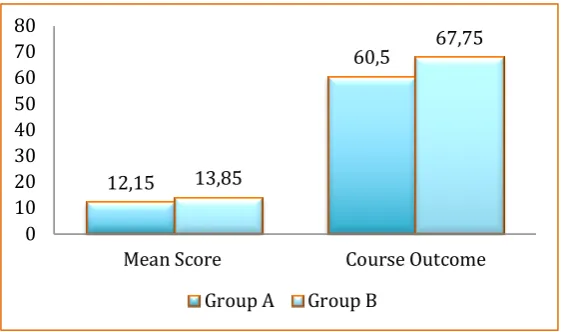
A (Traditional) 60.50 12.15 3.02
B (Mobile Cloud) 67.75 13.85 3.12
4
Discussion
The data analysis reveals that the mean score of Group B students who followed cloud based mobile learning is 1.70 more than Group A students who followed only traditional learning. The standard deviation of Group B is 3.12 which are better than 3.02 measured in case of Group A students. The study also reveals that the average course outcome of Group B students who is 7.25% more than Group A students as shown in Figure 1.
Fig. 1. Result analysis using Mean and Course Outcomes
From the analysis it is evident that the students who used their mobile phones out-side the classroom to learn the subject have scored more marks and attained better course outcomes. According to the results, cloud based mobile learning helped them a great deal in understanding the problems and eventually helped them to score more.
The findings show that using cloud based mobile learning is effective as the results indicate that their overall performance generally improved. Thus cloud based mobile learning improves students’ performance greatly especially when compared to tradi-tional methods of learning.
5
Conclusion
The results indicated that smart phones can be successfully used to teach and learn engineering subjects in an efficient manner, even after the class hours. The main aim
12,15
60,5
13,85
67,75
0 10 20 30 40 50 60 70 80
Mean Score Course Outcome
of this study was to discover the impact of mobile cloud computing technology on learning competencies of Engineering students. The main purpose is to test whether cloud based mobile learning has any impact on student’s performance by investigating the influence of such teaching practice on course outcomes. The results showed that use of cloud based mobile learning in learning an engineering subject is productive and does has an positive impact on learning competencies of students. The results specifically indicate that cloud based mobile learning can be used for effective learn-ing of engineerlearn-ing subjects which will result in improved attainment of course out-comes.
6
References
[1]Baran E. (2014). A Review of Research on Mobile Learning in Teacher Education. Journal of Educational Technology & Society, 17(4):17-32.
[2]Kwang B L, Raied S. (2012). The Design and Development of Mobile Collaborative Learning Application Using Android. Journal of Information Technology and Application in Education, 1(1):1-8.
[3]Kukulska-Hulme, Sharples Milrad, Arnedillo-S´anchez, Inmaculada Vavoula. (2009). In-novation in Mobile Learning: European perspective. International Journal of Mobile and Blended Learning, 1(1):13–35. https://doi.org/10.4018/jmbl.2009010102
[4]Buyya R, Yeo C S, Venugopal S, Broberg J, Brandic I. (2009). Cloud Computing and Emerging IT Platforms: Vision, Hype, and Reality for Delivering Computing as the 5th Utility. Journal on Future Generation Computer Systems, 25(6): 599–616. https://doi.org/10.1016/j.future.2008.12.001
[5]Fernando N, Seng W L, Rahayu W. (2013). Mobile Cloud Computing: A Survey. Future Generation Computer Systems, 29(1):84-106. https://10.1016/j.future.2012.05.023
[6]Mallya K R, Srinivasan B. (2018). Mobile Learning in the Cloud: A New Stage for Knowledge Management. International Journal of Computer Sciences and Engineering, 6(6):1454-1458. https://doi.org/10.26438/ijcse/v6i6.14541458
[7]Xiaopeng Fan, Jiannong Cao, Haixia Mao. (2011). A Survey of Mobile Cloud Computing. ZTE Communications, 9(1):4-8.
[8]Khan A U R, Othman M, Madani S A, Khan S U. (2014). A Survey of Mobile Cloud Computing Application Models. IEEE Communications Surveys and Tutorials, 16(1):393-413. https://10.1109/surv.2013.062613.00160
[9]Talal H N, Sherali Z, Abdullah A, Quan Z S. (2018). Mobile Cloud Computing: Challeng-es and Future RChalleng-esearch Directions. Journal of Network and Computer Applications, 115(1):70-85. https://doi.org/10.1016/j.jnca.2018.04.018
[10]Hoang T D, Chonho L, Dusit N, Ping W. (2013). A Survey of Mobile Cloud Computing: Architecture, Applications, and Approaches. Wireless Communications and Mobile Com-puting, 13(18):1587-1611. https://doi.org/10.1002/wcm.1203
[11]Osman M, El-Hussein M. Cronje J. (2010). Defining Mobile Learning in Higher Education Landscape. Educational Technology & Society, 13(3):12-21.
[12]Frohberg D, Goth C, Schwabe G. (2009). Mobile Learning Projects – A Critical Analysis of the State of the Art. Journal of Computer Assisted Learning, 25(4):307-311. https://doi.org/10.1111/j.1365-2729.2009.00315.x
[14]Sultan N. (2010). Cloud Computing for Education: A New Dawn? International Journal of Information Management, 30(2):109-116.
[15]Masud A, Huang X. (2012). An E-Learning System Architecture Based on Cloud Compu-ting. World Academy of Science, Engineering and Technology, 6:736-740.
[16]Masud A, Huang X. (2013). A Cloud Based M-Learning Architecture for Higher Educa-tion. Archives Des Sciences, 66(1):751-760.
[17]Mallya K R, Srinivasan B. (2018). Securing Data Using Touch Stroke Authentication in the Mobile Cloud. International Journal of Applied Engineering Research, 13(15):11810-11815.
[18]Velev D G. (2014). Challenges and Opportunities of Cloud-based Mobile Learning. Inter-national Journal of Information and Education Technology, 4(1):49-53. https://doi.org/10.7763/ijiet.2014.v4.367
7
Authors
Ramananda Mallya K is pursuing his PhD in the area of Mobile Cloud
Compu-ting. He is working as Senior Assistant Professor in Information Science & Engineer-ing Department at MITE, Moodbidri. He has Eighteen years of teachEngineer-ing experience and has twelve research publications to his credit.
B Srinivasan Associate Professor, PG & Research Department of Computer
Sci-ence, Gobi Arts & Science College (Autonomous), Gobichettipalayam, Erode District, Tamil Nadu, India. He received his Ph.D. Degree in Computer Science in 2010. He has authored and co-authored more than 70 technical papers and conference presenta-tions. He is a reviewer for several scientific journals. His research interests include automated biometrics, computer networking, Internet security, and performance eval-uation.