Development of almond seed extractor for whole kernel recovery
Sunday Ojolo
*, Adebayo Ogundare, Abdujaleel Adesina, Osasuwa Ibhadode
(Department of Mechanical Engineering, University of Lagos, P.M.B 56, Akoka-Yaba, Lagos, Nigeria)
Abstract: Almond seed extraction from whole kernel recovery is a process which is usually performed manually thus making it laborious and time consuming. The purpose of this paper is to investigate a means for almond seed extraction for whole kernel recovery to close the gap in domestic, commercial and industrial demand of almond seeds for food and industrial processing. The machine comprises of four units: the hopper; the cracking chamber which embeds the shaft, the hammer and electric motor. SolidWorks software was used to determine the responses of the machine critical elements. The sample of almond fruit used was picked from the premises of the University of Ilorin, Kwara State. The fruit (almond) was properly prepared by removing the fleshy parts from it and subjecting its seeds to a drying period of 7 days to 10 days at an average temperature of 35oC before was loaded into the extractor where cracking of the seeds was effected. Performance evaluation of the machine was conducted; its efficiency was found to be 82% with a throughput capacity of 42 kg h-1 and whole kernel recovery of 70%. The machine is affordable to both peasant farmers and process industries.
Keywords: almond seed, kernel, impact strength, compressive strain and stress
Citation: S. Ojolo, A. Ogundare, A. Adesina, and O. Ibhadode. 2018. Development of almond seed extractor for whole kernel recovery. Agricultural Engineering International: CIGR Journal, 20(4): 195–201.
1 Introduction
The almond tree is a highly herbaceous annual crop
and native of the tropical region of Western Asia and
North Africa and is vastly distribution extends to near
coastal areas of the Indian Ocean, through tropical Asia,
and into the Pacific Ocean. The three is also grown in Italy,
Spain, Morocco, France, Greece and Iran. It is
predominantly a cultivated in the south-south and
south-west regions of Nigeria (Akpakpan and Akpabio,
2012; Agunbiabe and Olanlokun, 2006). The almond fruit
comprises of the outer skin (exocarp), the flesh (mesocarp)
and the nut. The nut comprises of the shell (endocarp) and
the kernel. The kernel or the seed is the edible part of the
fruit with a lot of nutritional benefits (Thompson and
Evans, 2006). The kernel is an important source of energy
having 6 kcal g-1, protein 15.64% and oil content from
35.27% to 40% (Pankaj and Robert, 2008). Oil of almond
kernel is an important source of oleic acid with 40%
Received date: 2018-02-22 Accepted date: 2018-07-15
* Corresponding author: S. Ojolo, Ph.D., Mechanical Engineering Department, University of Lagos, Nigeria. Email: [email protected]. Tel: 08034265189.
(Aydin, 2003). Sweet almond oil is used in cosmetics
products, while the cake from sweet almond kernel is
used in animal feed (Akpakpan and Akpabio, 2012).
Cakes and biscuits from Almond flour are used by diabetic
patients because of zero starch content, and can also help
lower cholesterol (Agunbiabe and Olanlokun, 2006).
The kernel is obtained by shelling the nut after the
outer skin has been removed. The conventional,
traditional or manual method of shelling almond is not
only injurious but is also inefficient, tedious and time
consuming, coupled with low output rates (Umogbai et al.,
2011; Nkakini et al., 2007).
Thus, the quest for a satisfactory, cheap and effective
means such as mechanized shelling technique.
Sustainable means of production and the use of modern
technological advancement to provide easier means of
production in replacement of the traditionally adopted
system (Ojolo et al., 2015) is thus ineffitable. The
objective of the machine is to extract the almond seed
from the whole kernel, thus saving energy and time being
consumed while using the manual method.
In this study, a time and energy saving shelling
the almond fruit. The performance of the extractor was
evaluated using dry almond fruits contained for 7 days
and 10 days placeded in both longitudinal and transverse
orientations.
2 Materials and methods
The machine is simple-to-operate device which
allows for adjustment and proper alignment of the seeds
before cracking them. The machine major parts are the
hopper, which is detachable and consist of baffles to
permit adjustment and alignment before cracking; the
cracking chamber which house the shaft; the hammer
blades and motor unit. The machine is constructed using
locally available engineering materials and all the
elements are made and joined to form a unit using basic
engineering manufacturing techniques.
2.1 Design consideration
Two preliminary tests were first carried out. The first
test is to determine the moisture contents of the almond
nuts while the second test is an impact load test. These
were done for 10 samples of almond seeds; the wet
samples were handpicked and washed, after which the
weight was taken and the fleshy part of the seed was
scrapped off using a knife. The samples were divided into
two and dried under the sun. Sample A was dried for
7 days and sample B was dried for 10 days in both
longitudinal and transverse orientations.
2.1.1 Moisture content calculation
The average weight of the seed before drying was
measured to be 18.89 g while the average weight of
samples A and B were measured to be 6.66 g and 5.81 g
respectively.
% Moisture content
(Weight before drying Weight after drying) 100% Weight before drying
=
− × (1)
The percentage moisture content for samples A and B
was estimated to be 69.24% and 64.74% respectively.
2.1.2 Impact load test
The impact load test was conducted using the Instrom
universal testing machine located at the Centre for Energy
Research and Development CERD, Ile-Ife, Osun State,
Nigeria. This test is to determine the various stress, strain
and energy required to break the seed upon impact at both
longitudinal and transverse orientations of the seed due to
the tumbling action desired for cracking the seeds. The
impact load test was carried out to check for different
behaviour of the nut in both longitudinal and transverse
orientations for both samples A and B.
Table 1(a) Compressive stress at break point for longitudinal orientation
Sample A Sample B
X σB PB eB x σB PB eB
1 9.4836 9.0726 3448.80 0.1733 9.9836 6.1645 2343.32 0.1814 2 9.1418 7.9251 3012.63 0.1554 9.8501 7.0405 2676.33 0.1842 3 8.0749 7.4654 2837.83 0.1424 9.3419 8.4748 3221.56 0.1582 Mean 8.9001 8.1544 3099.75 0.1570 9.7252 7.2266 2747.10 0.1746
Table 1(b) Compressive stress at break point for transverse orientation
Sample A Sample B
X σB PB eB x σB PB eB
1 10.3253 7.9872 3036.19 0.1815 9.7503 6.6271 2519.16 0.1728 2 10.3753 7.0622 2684.59 0.1849 9.9001 7.0987 2698.44 0.1767 3 10.4086 8.2353 3130.49 0.1854 11.3836 8.4732 3220.96 0.1896 Mean 10.3697 7.7616 2950.42 0.1839 10.3447 7.3997 2812.85 0.1797
Note: x = Extension at Maximum compressive stress (mm); σB = Compressive Stress at Break (MPa); PB = Compressive Load at Break (N); eB = Compressive Strain at Break.
2.2 Design analysis
The materials for the fabrication of the machine were
chosen based on strength, suitability, availability, overall
weight and the resistance to corrosion and rust. The
machine elements were carefully chosen and designed
without compromising the efficiency of the machine and
to reduce cost so that it could be affordable for both
2.2.1 Determination of crushing torque
The torque required by the crusher necessary for
cracking the seed is estimated as (Ojolo et al., 2015):
Mt =FMCL×x (2)
where, FMCL is the Mean compressive load at break
estimated to be 3099.75 N from Table 1; and x has been
deduced to be 0.06 m.
The crushing torque Mt is 186 Nm.
2.2.2 Shaft design
The driven pulley is mounted on the shaft on one end
and the hammer blade on the opposite end.
The shaft is designed to ensure satisfactory strength
and rigidity when the shaft is transmitting power under
different operating and loading conditions. The shaft
diameter is determined using ASME code equation for
solid shaft design (Ologunagba, 2012).
3 16 2 2
[( b b) ( t t) ] s
d k M k M
πS
= + (3)
where, d is shaft diameter; Mb is maximum bending
moment; Kb is combined shock and fatigue factor applied
to bending and is taken to be 2; Kt is the combined shock
and fatigue factor applied to torsional moment is taken to
be 1.5 and Ss is the ultimate stress of mild steel with
feather key way taken to be 40 N m-2.
The shaft diameter is estimated to be 32.99 mm but
for safe value, a shaft diameter of 40 mm is selected.
2.2.3 Determination of shaft/ driven pulley speeds
Torque, Mt applied on shaft and the Radius, r of shaft
has been estimated to be 186 Nm and 0.02 m respectively.
The force, F applied on the shaft is obtained by (Ojolo et
al., 2015):
Mt = F×r (4)
Thus, the force, F is estimated to be 9300 N.
F= mw2r
(5)
where, m, the mass of shaft/crusher is 1.48 kg and w is
the angular speed of the shaft.
Thus, we can estimate w to be 396.35 rad s-1 from
Equation (5)
2 60
s
πN
w= (6)
Ns is the rotational speed of the shaft and is estimated
from Equation 6 as 3784 rpm.
The shaft pulley diameter, Ds and the driven pulley
diameter, Dp2 are 40 mm and 150 mm respectively, thus
the driven pulley rotational speed can be obtained from
(Khurmi, 2005): 2 2 p s p s N D
D = N (7) Np2 is 1010 rpm.
2.2.4 Power delivered by the crushing shaft
The power developed by the crushing shaft is
estimated as (Childs, 2004):
Power,
60 t M w
P= (8)
P = 1.23 kW.
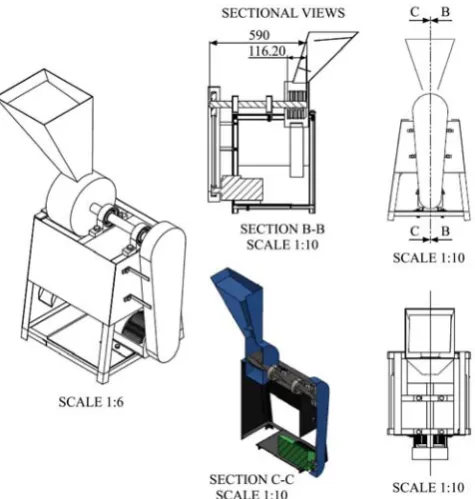
2.2.5 Feed hopper design
The hopper is made up of four welded mild steel
metal sheets slanting towards the smaller opening. It has
two openings that can hold a reasonable amount of
almond seeds and the outlet throat connects the hopper to
the feeder line (Figures 1-2). The hopper is detachable to
allow varying sizes of hopper to be used on the machine
as well as making it compact. The material used for its
construction is mild steel sheet. The hopper is designed
such that the almond seed finds its way into the feeder
line through two sets of baffles to reduce the inflow so as
not to clog the cracking chamber and thereby improving
the efficiency of machine. Inside the hopper feeder line
are baffles to control the feed rate as recommended by
Ghafari et al. (2011).
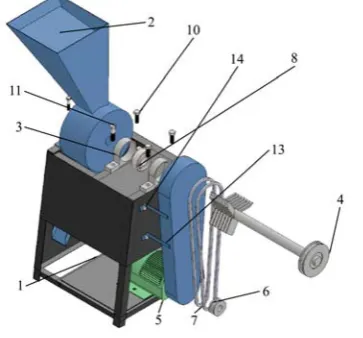
1. Electric motor base 2. Hopper 3. Bearing casing 4. Shaft pulley 5. Electric motor 6. Electric motor pulley 7. Belt 8. Bearing 9. Bolt 10. Assembly bolt 11. Belt casing 12. Casing hanger
Figure 2 Exploded view of machine showing its components
3 Results and discussion
3.1 Impact load tests
The results of impact load tests (Figures 3-4) show
that the different samples had similar Young’s modulus
and an average of 3099 N and 2747 N compressive is
load required to break the almond seed in the longitudinal
orientation for both Sample A and B respectively.
However, the results for Sample A in longitudinal
orientation were used in the design to accommodate
extreme case scenario that may be encountered.
Figure 3 Compressive stress against compressive strain after 7 days drying
Figure 4 Compressive stress against compressive strain after 10 days drying
3.2 Shaft and Hammer responses
The hammer blade in Figure 5 impacting on the
almond seed for a period of 2 seconds produces a
response due to the reactive force of the shaft against the
wall of the cylindrical slot as the almond seeds are
approach the hammer blades. The response is shown
Figure 6, from which it was observed that between 0 and
0.6 second, there are quantifiable reactive forces by the
shaft. This is the period of reaction between the hammer
blades and the almond seeds during the simulation. The
maximum reactive force experienced by the shaft against
the cylindrical wall during this period is 33 N.
Figure 5 Concentric mate condition between the shaft and cylindrical slot in the cracking chamber
3.3 Almond seed responses
An important response observed is the reactive force
on the seed resulting from the impact of the hammer
blade. This gives an idea of the cracking force on the seed
at the rotational speed of the shaft and hammer blade.
Figure 7 shows the reactive force on two almond seeds
represented by red and blue plots. For duration of
2 seconds, it is observed that there are substantive
reactive forces on each of the seeds which are at 489 and
245 N for the red and blue plots respectively. The values
of the kinetic energy of the two seeds are very low as
shown in Figure 8 due to the small mass of the seeds. For
the red plot, the kinetic energy increases steadily but
significantly relative to the blue plot after 0.2 seconds.
This shows considerable impact after 2 seconds.
Figure 7 Almond seed reaction force
Figure 8 Kinetic Energy of two almond seeds investigated
3.4 The machine test and performance evaluation
The almond seed extractor (Figure 9) was tested and
its performance was evaluated by the cracking efficiency,
whole kernel recovery and throughput capacity. The
feeding efficiency was found to be dependent on the
feeding rate (nuts/minute) which in turn determined the
throughput of the machine. The baffles in the hopper
control the feed rate to about 2 nuts per second. Tables
2-3 show the results obtained from the machine
performance evaluation.
Throughput capacity = Average mass (kg) ×
Cracking rate (hr) × 1hr (9)
Whole kernel recovered
Whole kernel recovery 100%
Total seeds fed
= ×
(10)
Cracking efficiency
Completely cracked seed (average) 100% Total seeds fed
=
× (11)
Table 2 Volume of feed variation with efficiency
Sample Volume (mm3) Efficiency (%)
1 18794.91 68.6 2 29123.33 82.5 3 15581.93 62.5 4 12258.92 50.35 5 12397.00 53.4
Table 3 Number of seed variation with efficiency
Sample Number of undamaged kernel
Number of completely cracked nuts
Cracking Efficiency (%)
1 26 30 75
2 30 34 85
3 28 32 80
4 30 35 88
5 27 33 83
The throughput capacity, whole kernel recovery, and
cracking efficiency were estimated to be 42 kg hr-1, 71%,
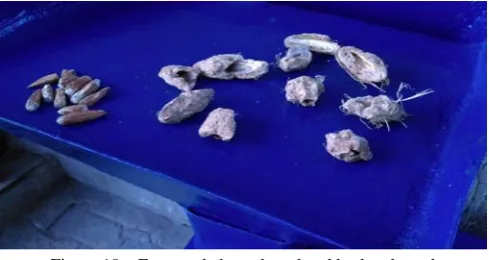
and 82% respectively. Figure 10 shows the shelled
almond fruits and the seeds obtained from from them.
Figure 10 Extracted almond seed and broken kernel
3.5 Discussion
The cracking efficiency was evaluated (Tables 2-3)
based on the number of completely cracked seeds in a
batch of 40 seeds, with an average of 33 seeds completely
cracked at single feed to give a cracking efficiency of
82%. The throughput capacity was obtained to be
approximately 42 kg hr-1 with 2 nuts sec-1 cracking rate.
The whole kernel recovery was also evaluated based
on the number of unbroken seeds recovered per batch of
the feed and stands at 71%. It was also observed that with
a small sized almond seed (2.234×10⁻⁵ m3) an efficiency
of 55.5% is attained, however, for a medium sized seed
(2.92×10⁻⁵ m3) an improved efficiency was obtained.
Moreover, observations reveal that the feed rate was a
major influence on the efficiency, with the best efficiency
obtained when two seeds were fed into the machine and a
far lower efficiency obtained when fifteen seeds was fed.
However, a close observation shows that the lesser
amount of seed per time gives a better efficiency and
much larger throughput capacity.
No wet sample could be cracked due to high moisture
content plus high fiber content of the seeds. Thus, for
effective cracking the seeds must be dry for effective
cracking since the performance evaluation of this
machine is dependent on the physical state of the almond
seeds.
4 Conclusions
The almond seed extractor performs satisfactorily
with a throughput capacity, whole kernel recovery, and
cracking efficiency of 42 kg hr-1, 70%, and 82%
respectively with 33 seeds of 40 seeds completely
cracked at a rate of two seeds per seconds. This design is
a major feat in the agricultural products processing and
postharvest preservation for peasant farmers and
processing industries. The material used in developing
this machine were sourced locally thereby reducing cost
of production hence making it affordable by peasant
farmers and processing industries. The machine is safe,
easy to operate with little maintenance required as all
moving parts are well guarded.
References
Agunbiade, S. O., and J. O. Olanlokun. 2006. Evaluation of some nutritional characteristics of Indian almond (Prunus amygdalus) nut. Pakistan Journal of Nutrition, 5(4): 316–318.
Akpakpan, A. E., and U. D. Akpabio. 2012. Evaluation of proximate composition, mineral element and anti-nutrient in almond (Terminalia catappa) seeds. Research Journal of Applied Sciences, 7(9-12): 489–493.
Aydin, C. 2003. Physical properties of almond nut and kernel. Journal of Food Engineering, 60(3): 315 320.
Childs, P. 2004. Mechanical Design. Oxford: Elsevier Ltd.
Ghafari, A., K. Vahdati, J. Khazaei, and G. R. Chegini. 2011. Design, construction and performance of a walnut cracking machine. International Journal of Nuts and Related Sciences, 2(1): 11–16.
Khurmi, R. S., and J. K. Gupta. 2005. A Textbook of Machine Design. New Delhi, India: Eurasia, Publishing House (PVT),
LTD.
Nkakini, S. O., M. J. Ayotamuno, G. P. Maeba, S. O. Ogaji, and S. D. Probert. 2007. Manually powered continuous flow maize sheller. Applied Energy, 84(12): 1175–1186.
Ojolo, S., A. Ogundare, and A. Adegbiji. 2015. Development of a variable size nut cracker. Agricultural Engineering International CIGR Journal, 17(3): 159–165.
Ologunagba, F. O. 2012. Design and Evaluation of a horizontal shaft palm nut cracking machine. Journal of Engineering and Applied Sciences, 4: 80–86.
Oudhia, P., and Paull, R. E. 2008. West Indian almond terminalia catappa L. Combretaceae. In Encyclopedia of Fruit and Nuts,
273–276. Wallingford: CABI
Thomson, L. A., and B. Evans. 2006. Terminalia catappa (tropical almond). Species Profiles for Pacific Island Agroforestry, 2: 1–20.