Ahmed Fahli
Hassan I University, Settat, Morocco
Mohammed Moussetad
Hassan II University, Casablanca, Morocco
Ahmed Naddami
Hassan I University, Settat, Morocco
Abstract—Remote laboratories are important in education because they pro-vide access to equipment that some institutions cannot afford to purchase or main-tain, reduce the need for dedicated physical space for equipment and personnel to staff laboratories. But more than just fill the absence of real physical laborato-ries; remote laboratories can improve the users experience through the use of adaptive and specific. An important element in supporting shared access is coor-dinating the scheduling of the laboratory usage. Optimized scheduling can sig-nificantly decrease access waiting times and improve the utilization level of re-mote laboratories resources, with associated reductions in per-use costs.
The user management systems that exist so far are limited, and not compatible with all remote lab interface development software. For that, we worked on the development of a new user management system for remote laboratories.
This paper proposes a model and set of diagrams that define the new reserva-tion system and a new Queuing for remote laboratories for educareserva-tional purposes.
Keywords—Remote labs, queuing, reservation, ELAB FSBM, internet, UML
1
Introduction
the problem of student massification. These distributed systems allow the sharing of material and human resources by putting online practical works accessible in real time [6-7-8]. These laboratories are computing environments and / or materials complemen-tary to conventional training. They allow students to manipulate real devices (measure-ment or analysis instru(measure-ments, real or robotic mechanisms, etc.)[9]. The develop(measure-ment of such facilities allows hands-on learning for a growing number of students, despite the limited material and coaching resources [10]. They can also allow for the sharing of heavy and expensive tools and equipment across multiple institutions nationally or in-ternationally and they protect students from dangerous manipulations. This new oppor-tunity to perform real remote laboratory experiments allows more flexible learning and also extends the didactic means of presentation [11].
It has been identified as a major enabler in both education and research across the range of science and engineering disciplines [12-13-14]. The recent emergence of re-mote laboratories provides an additional approach to supporting this access. Rere-mote laboratories provide remote access, typically across the internet, to a physical laboratory that has been appropriately instrumented so that the equipment can be controlled and monitored by the user [15-19].
This work relates to the modeling, design and implementation of an 'ELAB FSBM' platform as well as the installation of a queue for user management.
2
Modeling and Conception of the Platform
For the conception of our application we directed our choice to UML, who is a way to express models object by disregarding their implementation, that is the model sup-plied by UML is valid for any programming language.
UML tools can be used to generate code in different languages from diagram de-scriptions. UML has a direct relationship with object-oriented analysis and design and has become an OMG standard [16]. UML includes a graphical notation that can be used to create an abstract model of a system.
[17] UML's overall goal is to make the system easy to understand and use for users and developers [16].
The conception of the platform was schematized according, before being modeled, according to several diagrams: diagram of case of use, diagram of class, diagram of sequence etc., before being modeled.
2.1 Diagram of case of use
Fig. 1. Use case diagram
Our use case diagram is shown in Figure 1, it is based on three main actors, visitors, users and the administrator. Each actor will have specific spots:
The spots of a visitor: Our platform allows the visitor to make the registration on the navigation with the possibility of downloading all the proposed documents, without any authorization to enter the laboratory.
Spots of a user: The user is a visitor who made the registration in the platform, after this registration the user will be able to reserve a representation to manipulate the avail-able practical class.
Spots of an administrator: He's the actor who manages the data of the platform altogether.
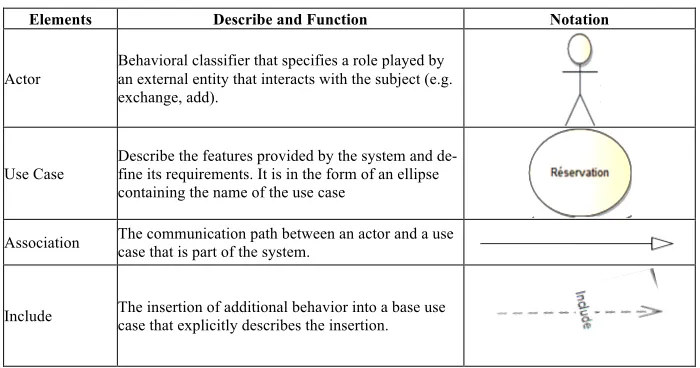
Table 1. Description of the elements
Elements Describe and Function Notation
Actor
Behavioral classifier that specifies a role played by an external entity that interacts with the subject (e.g. exchange, add).
Use Case
Describe the features provided by the system and de-fine its requirements. It is in the form of an ellipse containing the name of the use case
Association The communication path between an actor and a use case that is part of the system.
2.2 Class diagram
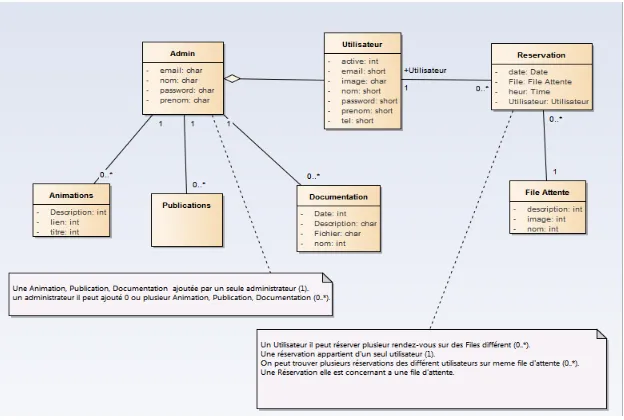
The various spots of the administrator can be presented according to a diagram called "Class Diagram" Fig 2. This diagram shows that the administrator plays a role very important for the management of the platform while assuring [20-21]:
• The management of the accounts of users as well as the data of users; he can accept as he can refuse the registration of a learner by an e-mail of confirmation.
• The management of the reservations: after the registration the learner has to make a reservation to cross a precise manipulation, thus the role of the administrator is to manage this reservation according to the priority of access by taking into account the spare time of the manipulation proposed by the system.
• The management of the queue: a faith the confirmation of reservation is made, the demand of the learner passes in the queue to cross the chosen manipulation.
• The management of documents and theoretical publications of every manipulation.
• The management of the security of the platform.
• The maintenance
Fig. 2. Class Diagram
2.3 Sequence diagram
The registration in our platform requires to fill the online registration form which contains some personal information (Name, Surname, Password, Email, Telephone, Es-tablishment,), and wait for the registration validation by the 'administrator. .
Fig. 3. Sequence Diagram (Inscription)
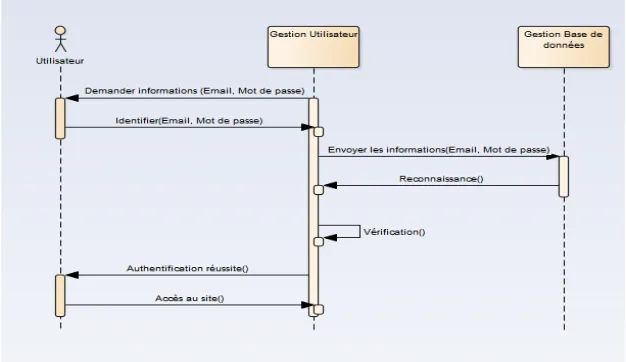
The user can easily access our platform by entering his username and password. If the user forgets his username, he can retrieve it easily thanks to our password recovery system integrated into our platform.
Fig. 4. Sequence Diagram (authentification)
These diagrams will be programmed based on the programming languages. This al-lowed us to implement our platform.
3
Implementation of the Platform and the Queue
3.1 Elab FSBM Platform
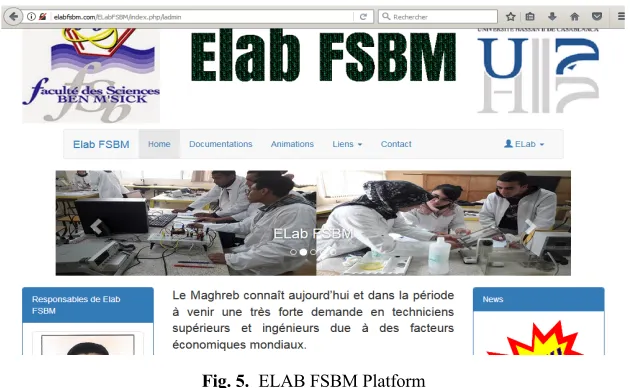
practical guide) of each experiment and their simulated animations that allow the user a clear idea of the experiment before moving on to the experimental part, as well as to protect the laboratory instruments when using them.
Fig. 5. ELAB FSBM Platform
3.2 Inscription and Reservation (Calendar Booking)
When the learner asks for a registration in our platform, a form of the personal data will be shown.
Fig. 6. Registration Form
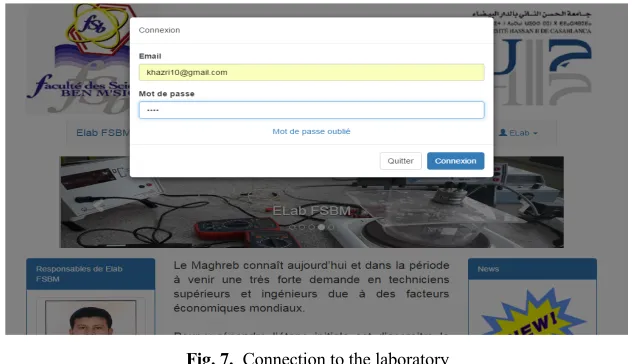
Fig. 7. Connection to the laboratory
This form of access request allows users to make a reservation offering guaranteed access to an experience (or group of experiences) at a given time. Resource allocations occur as follows [22-23-24]:
• The user requests a registration in the platform, he completes a registration form, this form sends to the administrator who will accept and authorize this request (Fig 7).
• The user attempts to connect to the ELAB FSBM server, is authenticated (Fig 8), and then receives a list of platforms (and platform pools) for which he has the nec-essary permissions.
• The user selects an experiment (or group of experiments), then sees the current status of the installation and the possibility of making a reservation or queuing for access (Fig. 8).
• If the user selects "Access", the booking page appears with the available slots.
• Once the slot is selected, the reservation will be created. A confirmation message will appear and an e-mail will be sent to the user with the details of the booking. The platform reservation page displays the reserved locations (in gray) for all future ac-cesses. The system can be configured to limit the number of active reservations that can be made by a user and prevent the user from making multiple simultaneous res-ervations on multiple types of platforms.
• When a user is logged in and a reservation is pending (within a configurable time), their main screen changes to provide a countdown at the beginning of their session. As soon as the time of the reservation arrives, the user is assigned to the device, the device page appears and the test session will be active.
3.3 Access to the laboratory (Priority Queuing)
manipulation by clicking on "access" or just to see a small description of the manipula-tion by clicking on "descripmanipula-tion"[25].
Fig. 8. Access to the laboratory
After choosing an experiment, the system will ask the learner to specify an appoint-ment for the handling, ie to make the reservation of the date and time (Fig 9). Each booked appointment will be illegal for another learner, which means that the manipu-lation will be available for a single user.
Fig. 9. Reservation of date and time
Queuing supports "on-demand" requests from users, providing "fastest available", access to an experiment. The queuing process is as follows:
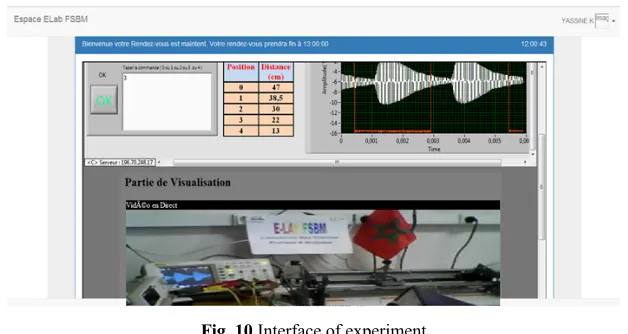
• Once a user is assigned to a platform, the platform page appears and the test session starts, including a timer with system-defined session time (Fig 9).
Fig. 10.Interface of experiment
In both types of scheduling, once the platform is assigned, the platform session will begin immediately. If the user is currently logged in, they will be redirected to the ap-propriate rig access page. If the user is not logged in after 10 minutes, the session will expire. The latter will also be closed when the user logs off or remains idle for a con-figurable duration, or if the allowed session time is completed and no further extension is allowed (a session can usually be extended by a finite number of times).
If no queued user wants to use the platform or no reservation is pending for this platform.
4
Conclusion
Furthermore, they provide additional benefits such as supporting distance learning, improving lab accessibility to handicapped people, and increasing safety for dangerous experimentation [28].
In this article, we have described the implementation of the ELAB FSBM platform for learners / teachers in a distance learning activity. This environment allows teachers to supervise learners and learners to consult and carry out practical work in an individ-ual or collaborative remote way. As well as, we have proposed an informatics solution for the management of queue of users (learners / teachers) in our platform ELAB FSBM.
First of all, we started with the UML design of our platform, for that we built the use case diagram which represents the main elements of our platform. After we presented the class diagram and the sequence diagram of the platform. As a result, we have chron-ologically shown the steps to follow from inscription to manipulation.
5
References
[1]Karsenti, Thierry et Charlin, Bernard. Analyse des impacts des technologies de l’information et de la communication sur l’enseignement et la pratique de la médecine. Pédagogie Médi-cale, 2010, vol. 11, no 2, p. 127-141. https://doi.org/10.1051/pmed/2010012
[2]Hussain, Aftab M. et Hussain, Muhammad M. CMOS-technology-enabled flexible and stretchable electronics for internet of everything applications. Advanced Materials, 2016, vol. 28, no 22, p. 4219-4249. https://doi.org/10.1002/adma.201504236
[3]Lee, In et LEE, Kyoochun. The Internet of Things (IoT): Applications, investments, and challenges for enterprises. Business Horizons, 2015, vol. 58, no 4, p. 431-440.
https://doi.org/10.1016/j.bushor.2015.03.008
[4]Misra, Gourav, Kumar, Vivek, Agarwal, Arun, et al. Internet of things (iot)–a technological analysis and survey on vision, concepts, challenges, innovation directions, technologies, and applications (an upcoming or future generation computer communication system technol-ogy). American Journal of Electrical and Electronic Engineering, 2016, vol. 4, no 1, p. 23-32.
[5]KIM, Taekyun, Sotirova, Evdokia, Shannon, Anthony, et al.Interval valued intuitionistic fuzzy evaluations for analysis of a student’s knowledge in university e-learning courses. In-ternational Journal of Fuzzy Logic and Intelligent Systems, 2018, vol. 18, no 3, p. 190-195.
https://doi.org/10.5391/ijfis.2018.18.3.190
[6]Poliakov, Mykhailo, Henke, Karsten, et Wuttke, Heinz-Dietrich. The augmented function-ality of the physical models of objects of study for remote laboratories. In : Online engineer-ing & Internet of Thengineer-ings. Sprengineer-inger, Cham, 2018. p. 151-159. https://doi.org/10. 1007/978-3-319-64352-6_15
[7]Machado, Guido Soprano, Silva, Yuri Motta Lopes Rodrigues, et De Lucena, Vicente Fer-reira. A Tool for the Automatic Selection of Mechatronics Remote Laboratories based on their Actual Effective Costs. In: 2018 IEEE Frontiers in Education Conference (FIE). IEEE, 2018. p. 1-5. https://doi.org/10.1109/fie.2018.8658732
[12]Lowe, David. Integrating reservations and queuing in remote laboratory scheduling. IEEE Transactions on Learning Technologies, 2013, vol. 6, no 1, p. 73-84. https://doi. org/10.1109/tlt.2013.5
[13]Hegarty, Elizabeth H. Levels of scientific enquiry in university science laboratory classes: Implications for curriculum deliberations. Research in Science Education, 1978, vol. 8, no 1, p. 45-57. https://doi.org/10.1007/bf02558676
[14]Hofstein, Avi et Lunetta, Vincent N. The role of the laboratory in science teaching: Ne-glected aspects of research. Review of educational research, 1982, vol. 52, no 2, p. 201-217.
https://doi.org/10.3102/00346543052002201
[15]Lowe, D. et Orou, N. Interdependence of booking and queuing in remote laboratory sched-uling. In: 2012 9th International Conference on Remote Engineering and Virtual Instrumen-tation (REV). IEEE, 2012. p. 1-6. https://doi.org/10.1109/rev.2012.6293100
[16]Tutorials point, “UML overview,” [Online] http://www.umldiagrams.org/use-case-diagrams.html, December 2014.
[17]MediaGroup1 LLC, “Unified modeling language planning with diagrams,” [Online]
http://www.dreamincode.net/forums/topic/49062-unifiedmodeling-language/, December 2014.
[18]Mohmed Salah, Razwan, ALVES, Gustavo R., Guerreiro, Pedro, et al. Using UML models to describe the VISIR system. International Journal of Online Engineering, 2016, vol. 12, no 06, p. 34. https://doi.org/10.3991/ijoe.v12i06.5707
[19]Farag, Wael. An innovative remote-lab framework for educational experimentation. Inter-national Journal of Online Engineering (iJOE), 2017, vol. 13, no 02, p. 68-86.
https://doi.org/10.3991/ijoe.v13i02.6609
[20]Spilakova, Petra et Schauer, Frantisek. Remote laboratory management system remlabnet and its booking system. In: 2015 Forth International Conference on e-Technologies and Net-works for Development (ICeND). IEEE, 2015. p. 1-5. https://doi.org/ 10.1109/icend.2015.7328544
[21]AK, Ayça, Topuz, Vedat, Altikardeş, Aysun, et al. Development of a Remote Laboratory Infrastructure and LMS for Mechatronics Distance Education. EURASIA Journal of Math-ematics, Science and Technology Education, 2018, vol. 14, no 6, p. 2493-2508.
https://doi.org/10.29333/ejmste/89947
[22]Jović, Nikola et Matijević, Milan. Design of WEB Laboratory for Programming and Use of an FPGA Device. In: Online Engineering & Internet of Things. Springer, Cham, 2018. p. 809-821. https://doi.org/10.1007/978-3-319-64352-6_75
[23]SLAPP III, Robert J. Virtual classroom management delivery system and method. U.S. Pa-tent Application No 10/187,192, 22 janv. 2019.
[25]Khazri, Yassine, Al Sabri, A., Sabir, B., et al. Development and Management of a Remote Laboratory in Physics for Engineering Education (E-LAB FSBM). In: Proceedings of the 2nd international Conference on Big Data, Cloud and Applications. ACM, 2017. p. 103.
https://doi.org/10.1145/3090354.3090460
[26]Heradio, Ruben, De La Torre, Luis, Galan, Daniel, et al. Virtual and remote labs in educa-tion: A bibliometric analysis. Computers & Education, 2016, vol. 98, p. 14-38.
https://doi.org/10.1016/j.compedu.2016.03.010
[27]Potkonjak, Veljko, Gardner, Michael, Callaghan, Victor, et al. Virtual laboratories for edu-cation in science, technology, and engineering: A review. Computers & Eduedu-cation, 2016, vol. 95, p. 309-327. https://doi.org/10.1016/j.compedu.2016.02.002
[28]Montgomery, Douglas C. Design and analysis of experiments. John wiley & sons, 2017.
6
Authors
Yassine Khazri is with Hassan II University at Casablanca city in Morocco. His mail is [email protected]
Ahmed Fahli is with Hassan I University at Settat in Morocco.
Mohammed Moussetad is with Hassan II University at Casablanca in Morocco.
Ahmed Naddami is with Hassan I University at Settat in Morocco.