PhD Dissertation
International Doctorate School in Information and Communication Technologies
DISI - University of Trento
Energy-Efficient Medium Access Control
Protocols and Network Coding in Green
Wireless Networks
Raul Palacios-Trujillo
Advisor:
Prof. Fabrizio Granelli
University of Trento
Abstract
Wireless networks are a popular means of communications in daily
so-cial and business activities of many users nowadays. However, current
estimates indicate that wireless networks are expected to significantly
con-tribute to the rapidly increasing energy consumption and carbon emissions
of the Information and Communication Technologies (ICT) sector. Crucial
factors leading to this trend are the continuous growth of wireless network
infrastructure coupled with the increased number of user wireless devices
equipped with various radio interfaces and batteries of extremely limited
capacity (e.g., smartphones). The serious problem of energy consumption
in wireless networks is mainly related to the current standard designs of
wireless technologies. These approaches are based on a stack of protocol
layers aiming to maximize performance-related metrics, such as
through-put or Quality of Service (QoS), while paying less attention to energy
ef-ficiency. Although the focus has shifted to energy efficiency recently, most
of the existing wireless solutions achieve energy savings at the cost of some
performance degradation.
This thesis aims at contributing to the evolution of green wireless networks
by exploring new approaches for energy saving at the Medium Access
Con-trol (MAC) protocol layer and the combination of these with the integration
of the Network Coding (NC) paradigm into the wireless network protocol
stack for further energy savings. The main contributions of the thesis are
design and performance analysis and evaluation of novel energy-efficient
distributed and centralized MAC protocols for Wireless Local Area
Net-works (WLANs). The second part of the thesis turns the focus to the
de-sign and performance analysis and evaluation of new NC-aware
energy-efficient MAC protocols for wireless ad hoc networks. The key idea of the
proposed mechanisms is to enable multiple data exchanges (with or without
NC data) among wireless devices and allow them to dynamically turn on
and off their radio transceivers (i.e., duty cycling) during periods of no
transmission and reception (i.e., when they are listening or overhearing).
Validation through analysis, computer-based simulation, and
experimenta-tion in real hardware shows that the proposed MAC soluexperimenta-tions can
signif-icantly improve both the throughput and energy efficiency of wireless
net-works, compared to the existing mechanisms of the IEEE 802.11 Standard
when alone or combined with the NC approach. Furthermore, the results
presented in this dissertation help understand the impact of the on/off
tran-sitions of radio transceivers on the energy efficiency of MAC protocols based
on duty cycling. These radio transitions are shown to be critical when the
available time for sleeping is comparable to the duration of the on/off radio
transitions.
Keywords
[Wireless network, energy efficiency, medium access control protocol,
A mi familia.
Acknowledgments
This PhD dissertation would not have been possible without the help
and support of many people. Herein, I would like to express my gratitude
to all of them.
First of all, I would like to thank Prof. Claudio Sacchi, Prof. Tommaso
Pecorella, and Prof. Igor Bisio for accepting the invitation to be part of
my PhD defense committee.
I would also like to thank my advisor, Prof. Fabrizio Granelli, for his
guidance during the last three years of the PhD degree and for giving
me the opportunity to work and grow as a researcher at the University of
Trento within the framework of the GREENET European research project.
You have always been very kind with me and have always tried to provide
me with all the materials and tools I needed to properly carry out my
research. I feel that you have been far more than my mentor and, besides
a great professor and researcher, I believe that you are a very nice person.
I wish you all the best for the future and hope we can continue working
together for many years.
I would like to extend my gratitude to the GREENET project for
sev-eral reasons. One is the financial support from the project through the
University of Trento, which allowed me to purchase equipment to conduct
top-notch research and attend the project meetings and many
interna-tional conferences and workshops. Another reason is the top-level training
organized by the partners of the project, exchange activities such as visits
and secondments to other partners of the project, and the organization
and participation to workshops and industrial dissemination days. Finally,
the third reason is the multi-cultural and multi-disciplinary network of
tal-ented young researchers and top-level research scientists from whom I have
learned to be a better researcher and person and with whom I have spent
many hours of work but also some of fun during the social dinners of the
project meetings.
More specifically related to the previous point, I would like to thank the
GREENET coordinators, Prof. Luis Alonso Zarate, Dr. Christos
Verik-oukis, and Melani Gurdiel Garcia, for managing such a fantastic project
and making it by all of us together a success story. Also, I wish to
ac-knowledge all the GREENET supervisors, Harald Haass, Marco di Renzo,
Fabrizio Graziosi, Andreas Foglar, Hugo Marques, Jonathan Rodriguez,
Gerrit Shulte, Kimon Kontovasilis, and Cristophe Gruet, for all their
valu-able comments and suggestions regarding my research activities. A special
thanks goes to Marco di Renzo, who was the president of my qualifying
exam committee at the end of the first year of the PhD degree and gave
me very interesting comments and ideas to complete this thesis.
In addition, I would like to thank Andreas Foglar for organizing my
sec-ondment in his company, InnoRoute Gmbh, located in Munich (Germany)
and for believing in me and my ideas to prepare and submit a patent. I
would like to extend my gratitude to the rest of the InnoRoute team, Klaus
Starnberger, Christian Liss, Tamas Fendler, Daniel Scharfen, Lorenzo di
Gregorio, and Danica Gajic, with whom I felt very comfortable during the
months I spent there. Related to my secondment, I also spent few weeks at
CTTC to work with Francisco Vazquez Gallego for the implementation of
my ideas on programmable wireless platforms. I would like to thank him
to express my special thanks to Dr. Verikoukis for authorizing me to have
such a great experience at CTTC.
I will never forget all the former and current GREENET researchers,
Konstantinos Ntontin, Athanasios Stavridis, Xiping Wu, Danica Gajic,
Saud Althunibat, Alexandra Bousia, Agapi Mesodiakaki, Vasileios
Mili-otis, Riccardo Bassoli, Victor Sucasas, Eleni-Constantina Davri, Dereje
Assefa, Xeonofon Foucas, Gergo Ertli, Pol Torres Compta, Marium Jalal
Chaudhry, Sandeedp Narayanan, and Xavier Pons Masbernat, for the great
moments we had together during these three years.
Likewise, I cannot forget my main research collaborators during these
three years: Jesus Alonso Zarate, Luis Alonso, Dzmitry Kliazovich, Janus
Heide, and Frank H. P. Fitzek. I would like to thank you all for all your very
useful comments and suggestions to improve our papers and my research
in general. I look forward to continuing our fruitful collaboration in the
future.
The work presented in this thesis could not have been possible
with-out the invaluable collaboration of some of my bachelor and master’s
stu-dents: Moatez Larbaa, Alessandro De Rossi, Habte Haile, Peter Nakeba,
Francesco Franch, and Gedlu Mengistie. Thank you all for your
valu-able contributions to some parts of the thesis. Also, I want to take this
opportunity to thank Mbiika Ceriano (as a former master’s student),
Car-los Astudillo (as an exchange master’s student), and my current master’s
students (Robel Endeshaw, Biniam Hailu, Habte Dechasa, and Mamun
Rashid) for all what I have learned from you to become a better supervisor
and person for the future. I must say that I have been very lucky to meet
you all and wish you all the best for your future careers.
Also, I wish to acknowledge the great work that all the staff of the DISI
department at the University of Trento do, who have made possible that
gratitude goes to Mirella Collini, Andrea Stenico, and Manuel Zucchelini,
who have always been available to help me whenever I have had a problem.
My stay at the University of Trento has also left me very good friends,
such as, Qi Wang, Le Dieu Thu, and Mai Anh Nguyen, among others. I
thank you all for the time being together where we enjoyed multi-cultural
dinners and had very interesting discussions about research, the PhD, and
life in general. Also, I cannot forget to thank all my colleagues of ”open
space” from the DISI department with whom I have shared PhD courses,
seminars, and talks.
I would also like to thank my close friends, who, since the time they
knew I was going to Trento to do research and pursue the PhD degree at
the University of Trento, they have always been supporting me.
As in every step forward in my life, I cannot forget that this achievement
could not have been possible without the support of my family: my parents
and my sister. You have always been there with me throughout all my life
and thanks to your teachings and advice I have become the man who I
am today. Without you, I would not be where I am now. In particular, I
would like to dedicate this work to my dear father, who few time ago was
able to recover from a serious illness. You are a very nice man and are a
very important person in my life. I wish you from the deepest of my heart
a long, healthy, and happy life from now on.
Finally, I would like to thank Susana for her admirable patience during
the last three years, for being always there for me, and for helping me in
every sense to finish this thesis. You are the most important person in my
life and I hope you will be with me for the rest of my life to help me achieve
new goals in the future.
I would like to finish these acknowledgments by extending my gratitude
to everyone else who, directly or not, consciously or not, has contributed
A mi familia. Para Susana.
Como en cada paso hacia adelante en mi vida, no puedo olvidar que este
logro no hubiera sido posible sin el apoyo incondicional de mi familia: mis
padres y mi hermana. Vosotros hab´eis estado siempre a mi lado a lo largo
de toda mi vida y gracias a vuestras ense˜nanzas y consejos me he convertido
en el hombre que soy hoy en d´ıa. Sin vosotros, no hubiera llegado a donde
estoy ahora. En particular, me gustar´ıa dedicar este trabajo a mi querido
padre, el cual ha sido capaz de recuperarse de una grave enfermedad hace
poco tiempo. T´u eres un buen hombre y eres una persona muy importante
en mi vida. Te deseo desde lo m´as profundo de mi coraz´on una vida feliz,
saludable, y duradera de ahora en adelante.
Finalmente, quiero agradecer a Susana por su admirable paciencia
du-rante estos tres ´ultimos a˜nos, por estar siempre a mi lado, y por ayudarme
en todos los sentidos a acabar esta tesis. T´u eres la persona m´as
impor-tante en mi vida y espero que sigas a mi lado el resto de mi vida para
Contents
List of Tables xvii
List of Figures xxi
1 Introduction 1
1.1 Context . . . 1
1.2 Problem Statement . . . 6
1.3 Contributions . . . 11
1.4 Innovative Aspects . . . 14
1.5 Dissemination of Results . . . 19
1.6 Structure of the Thesis . . . 22
2 State of the Art 25 2.1 Introduction . . . 25
2.2 Wireless Networks: Background . . . 26
2.2.1 Architectures . . . 26
2.2.2 Protocol Layers . . . 28
2.3 Research Challenges . . . 31
2.3.1 Energy Saving Through the MAC Layer . . . 31
2.3.2 Network Coding Integration for Energy Efficiency . 50 2.4 State-of-the-art Solutions . . . 55
2.4.1 Review of Energy-Efficient MAC Protocols . . . 55
2.5 Summary and Conclusions . . . 75
2.5.1 Energy-Efficient MAC Protocols . . . 75
2.5.2 Network Coding Protocols . . . 79
3 Energy-Efficient Distributed MAC Protocols 83 3.1 Introduction and Related Work . . . 83
3.2 Contention-Based Channel Access Methods . . . 92
3.2.1 The Legacy Distributed Coordination Function (DCF) 92 3.2.2 The New Bidirectional MAC Protocol (BidMAC) . 95 3.2.3 The New Green Bidirectional MAC Protocol (Green-Bid) . . . 98
3.3 Theoretical Analysis . . . 103
3.3.1 System Model and Assumptions . . . 103
3.3.2 Simplified Approach . . . 110
3.3.3 Bianchi-Based Approach . . . 119
3.4 Simulations Framework . . . 136
3.4.1 MAC Protocols Simulation . . . 136
3.4.2 Analytical and Simulation Results . . . 139
3.5 Experiments Framework . . . 160
3.5.1 MAC Protocol Implementation . . . 161
3.5.2 Experimental Setup . . . 164
3.5.3 Analytical and Experimental Results . . . 167
3.6 Conclusions . . . 170
4 Energy-Efficient Centralized MAC Protocols 175 4.1 Introduction . . . 175
4.2 Related Work . . . 181
4.3 Polling-Based Channel Access Methods . . . 183
4.3.1 The Legacy Point Coordination Function (PCF) . . 183
4.3.3 The New Green Polling MAC Protocol (GreenPoll) 187
4.4 Theoretical Analysis . . . 190
4.4.1 System Layout and Assumptions . . . 190
4.4.2 Throughput . . . 194
4.4.3 Energy Efficiency . . . 196
4.5 Simulations Framework . . . 202
4.5.1 MAC Protocols Simulator . . . 203
4.5.2 Analytical and Simulation Results . . . 205
4.6 Conclusions . . . 225
5 Network Coding-Aware Energy-Efficient MAC Protocols 229 5.1 Introduction and Related Work . . . 229
5.2 NC-Aware Channel Access Mechanisms . . . 239
5.2.1 The Reference COPE Protocol (DCF+NC) . . . 239
5.2.2 The New Bidirectional NC-Aware MAC Protocol (BidCode) . . . 242
5.2.3 The New Green Bidirectional NC-Aware MAC Pro-tocol (GreenCode) . . . 247
5.3 Theoretical Analysis . . . 249
5.3.1 Reference Scenarios and Assumptions . . . 249
5.3.2 Alice and Bob Scenario . . . 253
5.3.3 Cross Scenario . . . 259
5.3.4 Generalized Scenario . . . 268
5.4 Simulations Framework . . . 278
5.4.1 NC-Aware MAC Protocols Simulation . . . 279
5.4.2 Analytical and Simulation Results . . . 282
5.5 Experiments Framework . . . 303
5.5.1 NC-Aware MAC Protocols Implementation . . . 305
5.5.3 Analytical and Experimental Results . . . 317
5.6 Conclusions . . . 320
6 Conclusions and Future Work 323
6.1 Summary and Conclusions . . . 323
6.2 Future Work . . . 329
List of Acronyms 335
Bibliography 341
Appendices 357
A Wireless Open-Access Research Platform (WARP) 359 B Mango 802.11 Reference Design for WARP v3 Hardware 361 C Energino: A Hardware and Software Energy Consumption
List of Tables
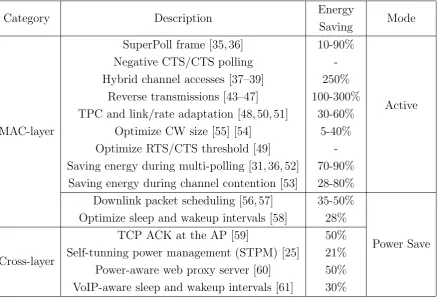
2.1 Summary of Existing Energy-Efficient MAC designs for
WLANs . . . 66
2.2 Variants of the IEEE 802.11 PSM MAC Protocol . . . 68
3.1 ERP-OFDM PHY Modes and Transmission Times for RTS, CTS, and ACK Control Packets and DATA Packets (1500-Byte Payload) in IEEE 802.11n . . . 104
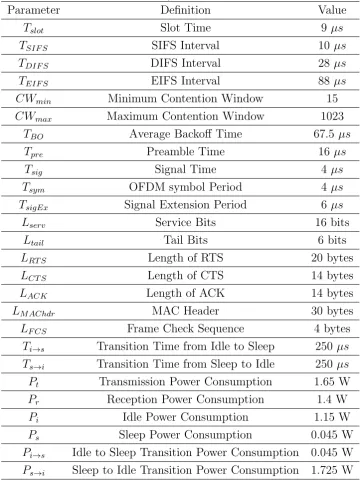
3.2 System Parameters . . . 106
3.3 Maximum Gains vs. Traffic Load . . . 140
3.4 Maximum Gains vs. MSDU Length . . . 145
3.5 Maximum Gains vs. PHY Data Rate . . . 149
3.6 Maximum Gains vs. Number of STAs . . . 152
3.7 Maximum Energy Efficiency Gains vs. Wakeup Transition Coefficient . . . 156
3.8 Maximum Energy Efficiency Gains vs. Awake/Sleep Tran-sitions Time . . . 159
4.1 ERP-OFDM PHY Modes and Transmission Times for Man-agement, Control, and Data Packets (1500-Byte Payload) in IEEE 802.11n . . . 191
4.2 System Parameters . . . 193
4.3 Maximum Gains vs. Traffic Load . . . 207
4.4 Maximum Gains vs. MSDU Length . . . 211
4.6 Maximum Gains vs. Number of STAs . . . 218
4.7 Maximum Energy Efficiency Gains vs. Wakeup Transition
Coefficient . . . 222
4.8 Maximum Energy Efficiency Gains vs. Awake/Sleep
Tran-sitions Time . . . 225
5.1 ERP-OFDM PHY Modes and Transmission Times for
Con-trol, Data and XOR Data Packets (1500-Byte Payload) in
IEEE 802.11n . . . 250
5.2 System Parameters . . . 252
5.3 Alice and Bob: Maximum Gains vs. Traffic Load . . . 285
5.4 Alice and Bob: Maximum Gains vs. MSDU Length . . . . 287
5.5 Alice and Bob: Maximum Gains vs. PHY Data Rate . . . 289
5.6 Cross: Maximum Gains vs. Traffic Load . . . 292
5.7 Cross: Maximum Gains vs. MSDU Length . . . 296
5.8 Cross: Maximum Gains vs. PHY Data Rate . . . 298
5.9 Cross: Maximum Gains vs. Wakeup Transition Coefficient 301
List of Figures
1.1 ICT carbon footprint by sector [1] . . . 2
1.2 Global telecommunications carbon footprint by sub-sector [1] 3
1.3 Growth and energy consumption of Wi-Fi APs . . . 5
1.4 Normalized energy consumption of several entities in a
Nokia N95 smartphone [2] . . . 6
1.5 Use and type of Wi-Fi-enabled devices in Wi-Fi networks . 7
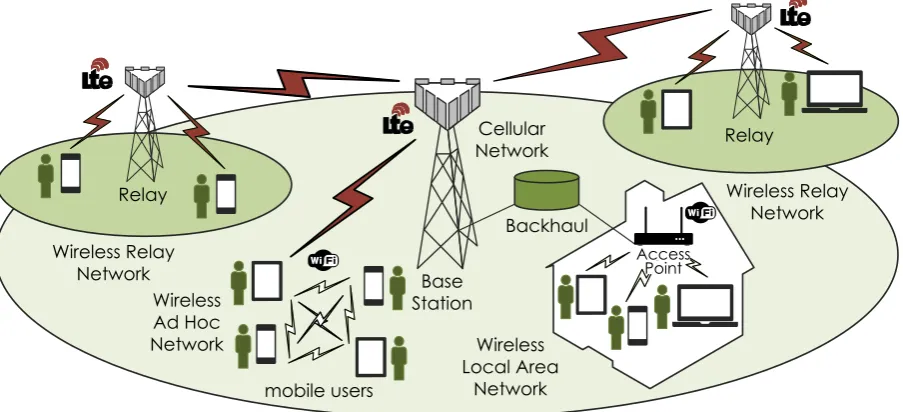
2.1 Reference scenarios: a relay-aided cellular network, an
in-frastructure wireless local area network, and a wireless ad
hoc network . . . 27
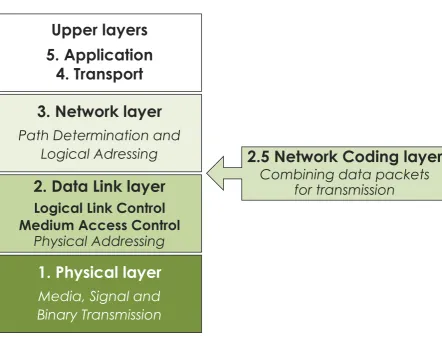
2.2 Protocol stack of a wireless network and integration of
net-work coding . . . 29
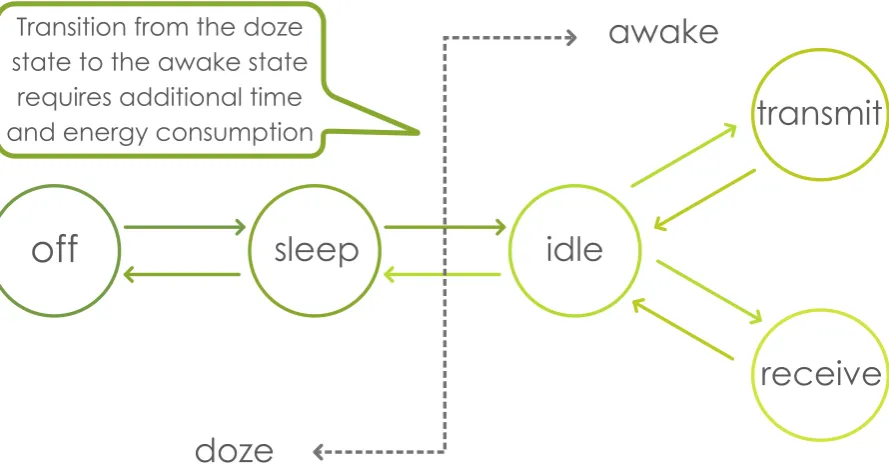
2.3 Operational states of a wireless interface . . . 33
2.4 Power characteristics of a Lucent IEEE 802.11 WaveLAN
card [3–5] . . . 34
2.5 Time and power consumption during the transitions
be-tween idle and sleep modes for a WaveLAN interface [4] . . 35
2.6 Example of operation of the PSM of the IEEE 802.11 in the
infrastructure mode when no PCF is operating . . . 47
2.7 An example of network coding in the Alice and Bob network 52
2.8 General picture of existing energy-efficient MAC designs for
2.9 MAC-layer evolution of the IEEE 802.11 Standards towards
high-throughput and high energy-efficient WLANs . . . 67
3.1 Problems of energy efficiency in an infrastructure WLAN
operating under the legacy DCF . . . 84
3.2 Example of operation of the DCF MAC protocol . . . 95
3.3 Example of operation of the BidMAC protocol . . . 99
3.4 Example of operation of the GreenBid MAC protocol . . . 102
3.5 IEEE 802.11n ERP-OFDM packet format . . . 105
3.6 Time and power consumption during the transitions
be-tween idle and sleep states: (a) and (c) correspond to an
ab-straction of real measurements reported in [3–5]) for a
Wave-LAN interface whereas (b) and (d) represent the adopted
awake/sleep transition model for the analysis . . . 109
3.7 Throughput and energy efficiency of the contention-based
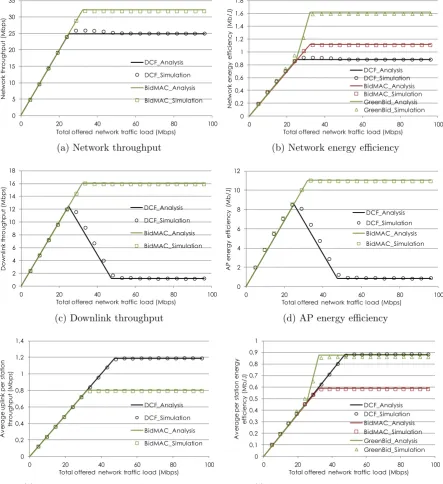
MAC protocols versus the traffic load . . . 141
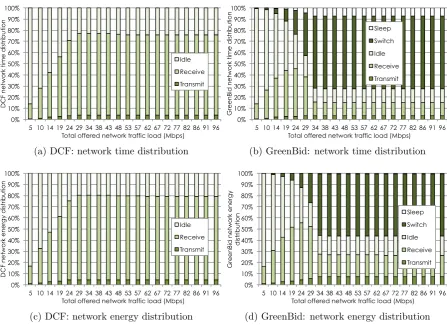
3.8 Distribution of time and energy consumption of the
contention-based MAC protocols versus the traffic load . . 143
3.9 Saturation throughput and energy efficiency of the
contention-based MAC protocols versus the MSDU length 144
3.10 Distribution of time and energy consumption of the
contention-based MAC protocols versus the MSDU length 147
3.11 Saturation throughput and energy efficiency of the
contention-based MAC protocols versus the PHY data rate 148
3.12 Distribution of time and energy consumption of the
contention-based MAC protocols versus the PHY data rate 150
3.13 Saturation throughput and energy efficiency of the
contention-based MAC protocols versus the number of STAs
3.14 Distribution of time and energy consumption of the
contention-based MAC protocols versus the number of STAs
in the network . . . 154
3.15 Energy efficiency and time and energy distributions of the
contention-based MAC protocols versus the wakeup
transi-tion coefficient . . . 155
3.16 Energy efficiency and time and energy distributions of
the contention-based MAC protocols versus the total
awake/sleep transitions time . . . 158
3.17 The testbed layout. . . 166
3.18 Experimental throughput and energy efficiency of the
contention-based MAC protocols versus the traffic load . . 169
3.19 Experimental throughput and energy efficiency of the
contention-based MAC protocols versus the MSDU length
and PHY data rate . . . 171
4.1 Typical deployment of a WLAN in the infrastructure mode
where the PCF can be executed. . . 176
4.2 Coexistence of the DCF and PCF through a CFP repetition
interval . . . 184
4.3 Example of operation of the PCF MAC protocol . . . 185
4.4 Example of operation of the BidPoll MAC protocol . . . . 187
4.5 Example of operation of the GreenPoll MAC protocol . . . 190
4.6 Throughput and energy efficiency of the polling-based MAC
protocols versus the traffic load . . . 206
4.7 Distribution of time and energy consumption of the
polling-based MAC protocols versus the traffic load . . . 209
4.8 Saturation throughput and energy efficiency of the
4.9 Distribution of time and energy consumption of the
polling-based MAC protocols versus the MSDU length . . . 212
4.10 Saturation throughput and energy efficiency of the
polling-based MAC protocols versus the PHY data rate . . . 213
4.11 Distribution of time and energy consumption of the
polling-based MAC protocols versus the PHY data rate . . . 216
4.12 Saturation throughput and energy efficiency of the
polling-based MAC protocols versus the number of STAs in the
network . . . 217
4.13 Distribution of time and energy consumption of the
polling-based MAC protocols versus the number of STAs in the
network . . . 220
4.14 Energy efficiency and time and energy distributions of the
polling-based MAC protocols versus the wakeup transition
coefficient . . . 221
4.15 Energy efficiency and time and energy distributions of the
polling-based MAC protocols versus the total awake/sleep
transitions time . . . 224
5.1 Reference scenarios: Alice and Bob and cross topologies,
(a) and (c) without network coding and (b) and (d) with
network coding . . . 230
5.2 Examples of operation of the DCF and COPE (DCF+NC)
protocols in the Alice and Bob scenario . . . 241
5.3 Examples of operation of the DCF and COPE (DCF+NC)
protocols in the Cross scenario . . . 242
5.4 MAC activities and time and energy behaviors of DCF and
COPE (DCF+NC) in the Alice and Bob scenario . . . 243
5.5 Examples of operation of the BidMAC and BidCode
5.6 Examples of operation of the BidMAC and BidCode
proto-cols in the Cross scenario . . . 245
5.7 MAC activities and time and energy behaviors of BidMAC
and BidCode in the Alice and Bob scenario . . . 246
5.8 Examples of operation of the GreenBid and GreenCode
pro-tocols in the Cross scenario . . . 248
5.9 Throughput, energy efficiency, and energy consumption of
the NC-aware MAC protocols versus the traffic load in the
Alice and Bob topology . . . 283
5.10 Throughput, energy efficiency, and energy consumption of
the NC-aware MAC protocols versus the MSDU length in
the Alice and Bob topology . . . 286
5.11 Throughput, energy efficiency, and energy consumption of
the NC-aware MAC protocols versus the PHY data rate in
the Alice and Bob topology . . . 288
5.12 Throughput, energy efficiency, and time and energy
distri-butions of the NC-aware MAC protocols versus the traffic
load in the Cross topology . . . 290
5.13 Throughput, energy efficiency, and time and energy
distri-butions of the NC-aware MAC protocols versus the MSDU
length in the Cross topology . . . 294
5.14 Throughput, energy efficiency, and time and energy
distri-butions of the NC-aware MAC protocols versus the PHY
data rate in the Cross topology . . . 297
5.15 Throughput, energy efficiency, and energy consumption of
the NC-aware MAC protocols versus the wakeup transition
5.16 Throughput, energy efficiency, and energy consumption of
the NC-aware MAC protocols versus the awake/sleep
tran-sition time in the Cross topology . . . 302
5.17 The testbed layout. . . 315
5.18 Experimental throughput and energy efficiency of the
NC-aware MAC protocols versus the traffic load, MSDU length
and PHY data rate . . . 318
A.1 WARP v3 and its hardware features [6, 7]. . . 360
B.1 Architecture of the IEEE 802.11 reference design [6, 7]. . . 363
C.1 Energino shield on top of the Arduino UNO board [8, 9]. . 367
C.2 Visual interface of the custom-design software in LabVIEW
Chapter 1
Introduction
This chapter introduces the problem and provides its positioning in the
framework of the main research areas of ICT. The structure of the chapter
is described as follows. Section 1.1 describes the context within which
the thesis is positioned. The research problem addressed in the thesis is
detailed in Section 1.2. Section 1.3 presents the main contributions of the
thesis. Then, Section 1.4 discusses how the thesis improves the state of
the art. Finally, a description of the structure of the thesis is presented in
Section 1.6.
1.1
Context
Climate change and energy consumption are widely recognized by
soci-ety as the most important issues for sustainable economic growth in both
developed and developing countries. To enable the low-carbon economy in
Europe, the European Commission set ambitious targets in 2008 to reduce
greenhouse gas emissions by 20% and to improve energy efficiency by 20%,
both by 2020 [10]. Indeed, the ICT sector can play an important role to
meet these challenges by improving energy efficiency in all economic
sec-tors. However, the energy consumption and carbon emissions of the sector
1.1. CONTEXT
28 14 57
2002 % of 0.53
% of GtCO2e
37 14 49
2007 % of 0.83
25 18 57
2020 % of 1.43
Telecoms infrastructure and devices
Data centers
PCs, peripherals and printers
Figure 1.1: ICT carbon footprint by sector [1]
efficiency of ICT has recently gained significant attention from both the
European Union and the ICT industry to achieve green ICT.
Currently, the global ICT carbon footprint represents roughly 3% of the
worldwide energy consumption and 2% of the total carbon emissions [1,11].
This rather small amount of ICT carbon emissions is, however, comparable
to the total carbon emissions caused by international air traffic, or one
quarter of global carbon emissions by cars [11]. Analyzing the ICT carbon
emissions by sector in Fig. 1.1, it can be seen that the carbon footprint
of both telecommunications infrastructure and devices (32% of total ICT
carbon emissions in 2002) has been significantly increasing since 2002, in
comparison with those of other ICT sub-sectors like Personal Computers
(PCs) and data centers.
Also, as it is reported in Fig. 1.2, while the share of wired networks
have remained almost constant year after year, the increasing contribution
of wireless networks is expected to dominate the total telecommunications
carbon footprint by 2020. This prediction is mainly based on the rapid
growth of wireless network infrastructure, the increased number of wireless
devices, and the last projections of wireless data traffic growth. Thus,
developing energy-efficient wireless networking solutions becomes urgent
CHAPTER 1. INTRODUCTION
42%
3% 43%
12%
20%
14%
51% 15%
2002 100% = 151 MtCO2e
2020 100% = 349 MtCO2e
Mobile (66 MtCO2e) Fixed narrowband (64 MtCO2e)
Telecom devices (18MtCO2e)
Fixed broadband (4MtCO2e)
Mobile (66 MtCO2e) Fixed narrowband (64 MtCO2e)
Telecom devices (18MtCO2e)
Fixed broadband (49MtCO2e)
Figure 1.2: Global telecommunications carbon footprint by sub-sector [1]
Wireless networks have become an essential means of communications in
our daily social and business activities, since they allow mobility while
sup-porting a wide range of services, such as voice, video, web access, and
peer-to-peer content sharing. Commonly used wireless networks among users
are infrastructure wireless networks like cellular networks and WLANs and
wireless ad hoc (infrastructure-less) networks.
Infrastructure wireless networks are managed by central nodes, referred
to as Base Stations (BSs) in cellular networks or Access Points (APs) in
WLANs, that are responsible for coordinating access to one or several
transmission channels among user wireless devices located in their
cov-erage areas. These nodes usually provide access to the Internet for the
connected users through a wired network infrastructure. In infrastructure
wireless networks, wireless communications occur in the last hop between
the central nodes (a BS or an AP) and the user devices (i.e., single-hop
communications).
On the other hand, wireless ad hoc networks are coordinated in a
dis-tributed manner by wireless devices that are located within the
transmis-sion range of each other and dynamically maintain network connectivity
among them to exchange data through a shared wireless channel. One of
1.1. CONTEXT
the Internet for the rest of network devices. In wireless ad hoc networks,
all devices participate in routing by forwarding data for other devices (i.e.,
multi-hop communications).
There exist various wireless technologies defined by several standards
that specify the interconnection and interoperability of wireless devices in
different wireless networks. For example, standardization bodies like the
3rd Generation Partnership Project (3GPP) and the Institute of Electrical
and Electronics Engineers (IEEE) provide, respectively, the standards of
the Universal Mobile Telecommunications System (UMTS) and Long Term
Evolution (LTE) technologies for cellular networks and the standard of the
802.11 technology for WLANs, also known as Wireless Fidelity (Wi-Fi).
The specifications of these wireless technologies by the standards are based
on the traditional Open Systems Interconnection (OSI) protocol stack of
the International Organization for Standardization (ISO). As it is defined
in the ISO/OSI model, the main functions of a wireless network are split
into protocol layers that are independently designed, implemented, and
optimized and only then interconnected to work as a whole.
With currently employed wireless technologies, the main problems of
energy consumption can be associated with the two main actors operating
wireless networks: central coordinators (wireless network infrastructure)
and wireless devices.
Wireless network infrastructure
One of the largest mobile telecommunications operators maintains
238.000 BS sites worldwide. Each site contains multiple BSs continuously
operating to serve different radio access technologies. Overall, they account
for 60% of the total energy consumption and carbon emissions caused by
the company as a whole [12]. In addition, Wi-Fi APs have been
exten-sively deployed in public and private areas, such as, university campuses,
CHAPTER 1. INTRODUCTION
1%
1%
2009 2010 2011 2012 2013 2014 2015
0.5 0.8 1.3
2.1
3.3 4.5
5.8
350%
Number of Wi-Fi Public Hotspots in the World (in million), 2009-2015
Metro & Core Networks Data centers
Local (Wi-Fi Home/Wi-Fi Hotspots) Mobile access networks (4G LTE)
2012 2015 Lo 2015 Hi
9173 32424 42957 57% 55% 59% 16% 26% 1% 34% 31% 10% 9%
Total Annual Wireless Cloud Energy Consumption (GWh), 2012-2015
(a) Number of Wi-Fi public hotspots in the world (in million), 2009-2015 [13]
1%
1%
2009 2010 2011 2012 2013 2014 2015
0.5 0.8 1.3
2.1
3.3 4.5
5.8
350%
Number of Wi-Fi Public Hotspots in the World (in million), 2009-2015
Metro & Core Networks Data centers
Local (Wi-Fi Home/Wi-Fi Hotspots) Mobile access networks (4G LTE)
2012 2015 Lo 2015 Hi 9173 32424 42957 57% 55% 59% 16% 26% 1% 34% 31% 10% 9%
Total Annual Wireless Cloud Energy Consumption (GWh), 2012-2015
(b) Total annual wireless cloud energy consumption (GWh), 2012-2015 [14]
Figure 1.3: Growth and energy consumption of Wi-Fi APs
constantly on to provide users with a continuous seamless connection to
the Internet, hence consuming significant amounts of energy. More than
3 million Wi-Fi public APs were expected to be deployed worldwide in
2013 and this figure is expected to increase by 75% in 2015, as shown in
Fig. 1.3a. As a consequence, Wi-Fi homes and hotspots will contribute by
31-34% to the overall yearly cloud energy consumption by 2015, being the
second main contributor after mobile networks, as it can be seen in Fig.
1.3b. With growing energy prices, energy saving methods for BSs and APs
are thus of paramount importance for telecommunications operators and
business and home users to limit the annual electricity bill.
Wireless devices
Currently, a wide variety of portable devices, e.g. laptops, tablets, and
smartphones, are equipped with multi-standard radio interfaces, such as
UMTS/LTE, Wi-Fi, and Bluetooth, to provide users with a flexible and
powerful wireless connection. Unfortunately, multi-standard devices,
espe-cially those of limited size (like smartphones), require a significant amount
of their energy resources for maintaining two or more radio interfaces,
hence quickly depleting their batteries. For instance, downloading data
using UMTS or Wi-Fi consumes more energy than what is consumed by
1.2. PROBLEM STATEMENT
N95 8GB
Downloading data using HSDPA Downloading data using WLAN Sending an SMS Making a voice call Playing an MP3 file Display backlight
N
o
rm
a
lis
e
d
e
ne
rg
y
c
o
ns
um
p
tio
n
(%
)
100
90
80
70
60
50
40
30
20
10
0
Figure 1.4: Normalized energy consumption of several entities in a Nokia N95 smartphone [2]
as it is shown in Fig. 1.4. In addition, laptops and smartphones are the
most commonly used Wi-Fi-enabled devices in Wi-Fi hotspots, as shown in
Fig. 1.5a. But more importantly, smartphones are increasingly used year
after year (see Fig. 1.5b). Despite the evolution on battery technology, the
progress on scaling and circuit design, and the development of novel
ther-mal and cooling techniques, new approaches for energy saving (not only
hardware but also software) are needed in order to prolong the operational
time of battery-powered devices.
1.2
Problem Statement
The fact that the current standard designs of wireless networks are based
on the ISO/OSI protocol stack makes them be unsuitable to face new
challenges in wireless networks, such as minimizing energy consumption
while guaranteeing the highest possible performance. Currently operating
performance-CHAPTER 1. INTRODUCTION
Laptops 48% Smart
phones 36%
Tablets 10%
Other Wi-Fi-enabled devices 6% Devices used in Wi-Fi hotspots, 2011
Laptop Smart phone Tablet
Q1 2011 Q1 2012 Public Wi-Fi connections by
device, 2012 70%
55%
21% 31%
9% 14%
(a) Devices used in Wi-Fi hotspots [15] Laptops
48% Smart
phones 36%
Tablets 10%
Other Wi-Fi-enabled devices 6% Devices used in Wi-Fi hotspots, 2011
Laptop Smart phone Tablet
Q1 2011 Q1 2012 Public Wi-Fi connections by
device, 2012 70%
55%
21% 31%
9% 14%
(b) Public Wi-Fi connections by device, 2012 [14]
Figure 1.5: Use and type of Wi-Fi-enabled devices in Wi-Fi networks
related metrics, such as, throughput, QoS, and reliability, while usually
paying less attention to energy efficiency. The future designs of wireless
networks need to consider energy efficiency across all layers of the protocol
stack in a cross-layer approach, where the protocol layers are aware of the
requirements of lower and upper layers to maximize energy efficiency.
Many solutions have been proposed to improve the energy efficiency of
wireless networks by introducing changes in all the layers of the protocol
stack. In this thesis, the focus has been put on the cross-layer interactions
between Physical (PHY) and data link layers and data link and network
layers of the protocol stack. More specifically, the MAC sublayer of the
data link layer directly interfaces to the PHY layer and is responsible for
managing access to one or several wireless channels shared among multiple
wireless devices. The channel access control is performed by the MAC
protocol, which defines the rules that wireless devices need to obey to
communicate within a multiple access network. The MAC protocol takes
decisions that determine how the wireless interfaces of network devices are
used to perform channel access control. Since the wireless interface has
1.2. PROBLEM STATEMENT
the MAC sublayer is thus considered as a central point of the protocol
stack for energy consumption control and energy saving through cross-layer
methods.
The IEEE 802.11 Standard [16] for WLANs (Wi-Fi) specifies a set of
MAC protocols that have been widely investigated over the last years.
Ba-sically, two main mechanisms are defined for sharing access to the wireless
channel: a mandatory contention-based distributed channel access
mech-anism called Distributed Coordination Function (DCF) and an optional
polling-based centralized channel access mechanism called Point
Coordi-nation Function (PCF). Unfortunately, these MAC protocols have not
been optimized for energy efficiency. As a result, wireless devices
imple-menting them, referred to as Wireless Stations (STAs) in the terminology
of the Standard, consume a significant amount of energy for keeping their
radio transceivers always on (i.e., constant channel listening) and receiving
data addressed to other destinations (i.e., overhearing).
To reduce the energy consumption of wireless devices, the Standard
also defines an optional power saving mechanism called Power Save Mode
(PSM) that exploits the capability of some wireless interfaces to enable
a low-power sleep state where the radio transceiver is turned off. This
yields energy savings at the cost of not being able to either transmit or
receive data when in this state. Typically, the STAs executing the PSM
periodically alternate between awake (i.e., the radio transceiver is turned
on) and sleep states to listen to selected beacons periodically transmitted
by the AP that contain information about data buffered for them in the
AP. Also, they may wake up to transmit data at any time. Unfortunately,
this MAC protocol may produce high control packet overhead for retrieving
data from the AP and may also cause some performance degradation due
to the dependency on the beacon and selected listen intervals. In addition,
CHAPTER 1. INTRODUCTION
where they may execute either the DCF or the PCF.
Therefore, new energy-efficient distributed and centralized MAC
pro-tocols need to be investigated aiming to boost both the throughput and
energy efficiency of WLANs when either the standard DCF, PCF, or PSM
are executed.
In addition, the NC paradigm [17] has emerged as a ground-breaking
technology for the efficient operation of wireless networks. In multi-hop
(relay-aided) wireless networks, information is delivered from a source node
to a destination node by routing through intermediate (or relay) nodes of
the network. Each intermediate node is simply required to store and
for-ward the received information to the next intermediate node until
reach-ing the final destination node. In contrast with simple store-and-forward
schemes, the basic principle of NC is to allow intermediate nodes to take
several received packets and combine them into a single coded packet for
transmission by exploiting the broadcast channel. Packets are coded by
applying linear coding operations (e.g, XOR) and using an encoding
vec-tor added to the header of the transmitted coded packet to allow potential
receiver nodes to perform successful decoding, thus introducing additional
overheard. Despite the coding overhead, the NC operation allows
increas-ing the information content of each transmission and reducincreas-ing the total
number of channel accesses, hence improving throughput and energy
effi-ciency.
NC has been extensively studied in the literature. The first work dealing
with the theory of NC was presented in [17], which showed that combining
multiple information flows in wireless network nodes can provide multicast
capacity. Since then, NC has gained increasing attention and has been
applied to multiple wireless network scenarios, showing improvements in
terms of throughput, energy efficiency, robustness, and security. So far,
1.2. PROBLEM STATEMENT
on important assumptions related to the structure of the network or the
channel access scheme. As an important step forward to bridge the gap
between theory and practice, the inspiring work in [18] introduces COPE as
the first implementation of a practical NC protocol in Wi-Fi networks (i.e.,
based on the IEEE 802.11 Standard). COPE seamlessly integrates an NC
layer between the data link and network layers of the protocol stack that
identifies coding opportunities to forward multiple packets from different
sources in a single transmission.
In [18] the authors show that there exist important practical
consider-ations that should be taken into account for the proper implementation of
NC in currently operating wireless networks. More specifically, NC
aware-ness of the MAC protocol is essential for the proper NC operation.
Unfor-tunately, the widely used IEEE 802.11 MAC protocol (DCF) presents some
limitations to efficiently work with NC: (i) lack of per-node and per-packet
channel access priority for NC, (ii) lack of reliable and collision avoidance
mechanisms to broadcast coded packets, (iii) retransmission schemes
un-aware of NC, and (iv) need for continuous channel sensing for coding and
decoding opportunities (channel listening and overhearing).
COPE addresses some of these issues by introducing various
mecha-nisms that do not require any modifications of the IEEE 802.11 MAC
protocol. Unfortunately, COPE still shares most of the limitations of the
IEEE 802.11 DCF MAC protocol, which are mainly control packet
over-head, collisions, contentions, and continuous channel sensing. The results
presented in [18] indicate that the interactions between opportunistic NC
and the MAC protocol have to be carefully studied and new enhancements
at the MAC layer need to be proposed to achieve high cooperation with the
NC protocol layer. Furthermore, new approaches for minimizing the time
that nodes spend in channel listening and overhearing while ensuring the
CHAPTER 1. INTRODUCTION
Therefore, new NC-aware energy-efficient MAC protocols need to be
in-vestigated aiming to boost the throughput and energy efficiency of wireless
networks when the NC operation is executed.
1.3
Contributions
This thesis aims at contributing to the field of green wireless networks
by investigating new mechanisms at the MAC layer for energy saving and
the combination of these with the NC approach for higher energy savings.
The main contributions of the thesis can be divided into two parts. The
first part of the thesis is focused on the design and performance analysis
and evaluation of novel energy-efficient distributed and centralized MAC
protocols for WLANs. The second part of the thesis shifts the focus to the
design and performance analysis and evaluation of new NC-aware
energy-efficient MAC protocols for wireless ad hoc networks.
In the first part, the new energy-efficient distributed MAC protocols
are the Bidirectional MAC protocol (BidMAC) and the Green
Bidirec-tional MAC protocol (GreenBid). The basic idea behind BidMAC is to
enable receiver-initiated bidirectional transmissions between the AP and
the STAs in a contention-free manner once one of them has gained access
to the wireless channel. This approach is very suitable for scenarios with
bidirectional traffic as it reduces contention in the wireless channel when
compared to the case when the standard DCF is executed. Furthermore,
GreenBid extends the BidMAC operation by exploiting the longer
dura-tion of bidirecdura-tional transmissions to allow those STAs not involved in the
communication to go to sleep, in a way similar to the standard PSM. This
approach is able to significantly improve both the throughput and energy
efficiency of STAs in highly dense networks and with heavy traffic
1.3. CONTRIBUTIONS
the PSM or other power saving mechanisms to achieve energy saving when
the number of STAs and the traffic load in the network are both low. Note
that the fact that both MAC protocols are based on the DCF makes them
also suitable for wireless ad hoc networks, although the extensions of the
MAC protocols for this scenario has been left as a possible future line of
research.
In addition, in this first part of the thesis the Bidirectional Polling
MAC protocol (BidPoll) and the Green Polling MAC protocol (GreenPoll)
are proposed as the new energy-efficient centralized MAC protocols. The
basic idea behind BidPoll is to enable contention free periods, based on
polling with beacons, during which the AP and the STAs can be reserved
slots for sequential downlink and uplink transmissions with a very low
overhead of control packets, when compared to the case when the PCF is
executed. Moreover, GreenPoll is an extension of BidPoll that allows the
STAs involved in a contention free period to save energy by turning off
their radio transceiver after exchanging data with the AP, in a way similar
to the PSM. In addition, those STAs not involved in data transfer can
also enter the sleep state until the contention free period completes. Like
GreenBid, GreenPoll can increase throughput and significantly improve the
energy efficiency of the STAs during periods of high network activity, while
being able to work in combination with the PSM or other power saving
mechanisms during periods of low network activity.
The performances of the new BidMAC, GreenBid, BidPoll, and
Green-Poll MAC protocols are evaluated by means of theoretical analyses and
computer-based simulations in terms of throughput and energy efficiency
in a WLAN consisting of an AP and a finite number of STAs.
Rele-vant system parameters, such as, the traffic load, data packet length, data
transmission rate, and number of STAs in the network, are used for the
CHAPTER 1. INTRODUCTION
DCF and PCF. Furthermore, an experimental performance evaluation of
BidMAC is carried out in a proof-of-concept network formed by an AP
and two STAs in order to validate the high performance of the new MAC
protocol in real environments when compared to standard DCF.
Regarding the second part of the thesis, the new NC-aware
energy-efficient MAC protocols are the Bidirectional NC-aware MAC protocol
(BidCode) and the Green NC-aware MAC protocol (GreenCode). The
ba-sic idea behind BidCode is to allow intermediate nodes to combine several
received packets into coded packets and immediately forward them upon
successful reception of data (i.e., receiver-initiated bidirectional
transmis-sions involving coded data). This approach is very suitable for congested
relay nodes that have coded data ready to be transmitted because they do
not need to contend for channel access with other nodes in their coverage
areas, as it would be the case with standard DCF and COPE. Furthermore,
GreenCode extends the BidCode operation to allow potential overhearing
nodes of a bidirectional coded data transmission to go to sleep when they
recognize that the transmitted coded data do not provide any new
infor-mation. This approach eliminates unnecessary overhearing and increases
energy efficiency with no performance degradation of the NC operation.
BidCode and GreenCode can be considered as extensions of BidMAC and
GreenBid with NC awareness for wireless ad hoc networks.
The performances of the new BidCode and GreenCode NC-aware MAC
protocols are evaluated by means of theoretical analyses and
computer-based simulations in terms of throughput and energy efficiency in various
wireless ad hoc network scenarios. Important system parameters, e.g., the
traffic load, data packet length, and data transmission rate, are considered
for the evaluation and comparison of the new NC-aware MAC protocols
with the standard DCF and COPE and new BidMAC and GreenBid,
Bid-1.4. INNOVATIVE ASPECTS
Code is carried out in a proof-of-concept network formed by two sources
nodes and a relay node in order to validate the high performance of the new
NC-aware MAC protocol in real environments when compared to standard
DCF and COPE.
1.4
Innovative Aspects
In the last years, strong efforts from both research and standardization
communities have been devoted to the development of new MAC-layer
en-hancements to achieve high throughput and energy efficiency in WLANs.
There are some survey papers that attempt to summarize the major
con-tributions in [19, 20]. Existing energy-efficient MAC solutions for WLANs
address the problems of energy consumption of both the DCF and PCF
during active periods (or in active mode) and the PSM during low-power
periods (or in PS mode). In active mode, the proposed MAC schemes aim
at reducing the overhead of control packets and silent periods, reducing the
number of contentions and collisions, and minimizing the time for
chan-nel monitoring. In PS mode, the proposed solutions minimize the control
packet overhead and awake time of STAs to retrieve downlink data from the
AP and maximize the sleep period based on prediction of packet arrivals
from upper layers.
Despite the huge amount of work on energy efficiency at the MAC layer
in WLANs, none of the existing MAC solutions jointly address all the
problems of energy consumption during both active and low-power periods
and, at the same time, are able to improve the overall WLAN performance.
For example, most of the proposed solutions in active mode do not solve the
problems of channel listening and overhearing, hence suffering from yet low
energy efficiency. In contrast, those that solve these by enabling low-power
CHAPTER 1. INTRODUCTION
from scalability limitations in densely populated WLANs. Similarly, most
of the proposed solutions in PS mode do not solve the problems of energy
consumption when the STAs in PS mode need to be awake to transmit
or receive data. Also, the dependency on the beacon and listen intervals
may introduce performance degradation and scalability limitations when
the number of STAs and the traffic load in the network are high.
In contrast with the state-of-the-art solutions, the energy-efficient
dis-tributed and centralized MAC protocols proposed in this thesis are able
to achieve high throughput and high energy efficiency in WLANs during
both active and low-power periods. The key features of the novel MAC
protocols are:
• Avoid the use of listen intervals and beacons attaching information
about buffered downlink data to overcome performance and scalability
limitations when the number of STAs and the traffic load are high.
This feature can be enabled as long as all the STAs operate in active
mode.
• Exploit the time that the channel will remain busy to allow the STAs
not involved in data transmission or reception (i.e., overhearing) to
opportunistically enter the sleep state to save energy. The sleep
op-eration is feasible provided that the amount of time for sleeping (i.e.,
the duration of a data transmission) is longer than the time required
by the radio transceivers of STAs to switch between on and off states.
This feature can be applied to STAs in either active or PS mode. The
data transmission time depends on the amount of data to be
transmit-ted and the data transmission rate used whereas the duration of the
on/off radio transitions, which is typically in the order of hundreds of
microseconds [2, 21, 22], depends on the radio hardware design.
op-1.4. INNOVATIVE ASPECTS
eration in overhearing STAs by enabling bidirectional transmissions
or in general any MAC techniques that allow increasing the amount
of transmitted data (e.g., batch transmissions and frame aggregation).
This also improves the overall network throughput for reducing the
overhead of control packets and silent periods and the number of
con-tentions in the network.
In addition, various MAC-layer enhancements being aware of the NC
approach have been proposed over the last years in order to achieve higher
energy savings by reducing the negative effects of the IEEE 802.11 MAC
protocol on the performance of NC. Survey papers that cover this topic
at a high level are [23, 24]. Existing NC-aware MAC-layer solutions can
be classified into three categories. In the first category, the proposed
ap-proaches manage the transmission queues to give a higher transmission
priority to coded packets (i.e., queue-level priority access). The second
category deals with solutions that provide a higher channel access priority
for relay nodes that have coded packets ready to send by adjusting channel
access parameters based on different network indicators (i.e., channel-level
priority access). Finally, approaches that combine power saving strategies
and NC are included in the third category (i.e., low-power overhearing).
It should be note that, despite the strong research efforts, none of the
existing NC-aware MAC solutions jointly address all the cross-layer issues
of NC with IEEE 802.11 MAC in order to improve both the throughput and
energy efficiency of wireless networks. For example, the solutions based on
queue-level prioritization are limited by the fair channel access
distribu-tion of the IEEE 802.11 DCF MAC protocol among all competing nodes.
Also, those based on channel-level prioritization can only provide a higher
channel access priority on average, i.e., probabilistic or relative (not
abso-lute) and, as a result, they cannot guarantee immediate channel accesses
CHAPTER 1. INTRODUCTION
Furthermore, none of these approaches minimize the time that the nodes
spend in channel listening and overhearing in order to achieve further
en-ergy savings. On the other hand, those that solve this problem by enabling
sleeping periods in conjunction with NC may introduce performance
degra-dation and additional delays.
In contrast with the state-of-the-art solutions, the NC-aware
energy-efficient MAC protocols presented in this thesis are able to boost the
throughput and energy efficiency of wireless networks when the NC
oper-ation is executed. The key features of the novel NC-aware MAC protocols
are:
• Allow congested relay nodes to transmit combined data without
com-peting for channel access by exploiting bidirectional channel accesses
upon successful reception of data. This approach ensures an
immedi-ate channel access for a relay node when it has a coded packet ready
to send as soon as it receives a data packet from any other node
lo-cated in its coverage range. It is also possible to combine the approach
with batch coded data transmissions and coded data aggregation for
a more efficient operation.
• Allow overhearing nodes to decide when they can go to sleep during
a coded data transmissions based on whether they will benefit or not
from overhearing the transmission. This approach saves energy while
maintaining high cooperation with the NC operation. As explained
earlier for the new energy-efficient MAC protocols, the sleep operation
can only be realized if the (either coded or not) data transmission time
is longer than the duration of the on/off radio transitions.
Also, it is worth mentioning that the analysis of the on/off radio
transi-tions is an important aspect that has been neglected in many works
1.4. INNOVATIVE ASPECTS
off states require a certain time and need extra power consumption that
should not be neglected, especially, the off-on or wakeup transition whose
power consumption is significantly high. In this thesis, they are carefully
analyzed to understand their impact on the potential energy saving of the
novel MAC protocols based on low-power states.
Finally, another important aspect to be taken into account is that most
of the existing works related to this thesis have been based on
theoreti-cal studies supported by computer-based simulations. Whereas theoretitheoreti-cal
models typically adopt simplified assumptions for mathematical
tractabil-ity, computer-based simulations usually lack PHY-layer modeling
accu-racy, thus possibly leading to inaccurate results and conclusions. However,
a new trend is arising recently focused on experimentally evaluating and
measuring the benefits of novel strategies for green wireless networks, such
as, [25, 26]. Real-world implementation can help reveal unexpected
chal-lenges to the development of new energy-efficient MAC protocols alone or
combined with the NC approach and also provide new insights in the
op-eration of communication protocols. This is one of the main motivations
for the work presented in this thesis where several proposed solutions (i.e.,
BidMAC and BidCode) are implemented in real hardware to demonstrate
that their superior performances compared to the reference mechanisms
(i.e., standard DCF and COPE) can also be attained in real environments.
Specifically, among the various available wireless platforms for
proto-typing at the MAC layer [27], the Wireless Open-Access Research
Plat-form (WARP) [28] has been selected because it provides a reference design
that can interact with commercial Wi-Fi devices, acting as either AP or
STA. The DCF MAC source code of the reference design has been
mod-ified to implement the proposed BidMAC and BidCode protocols. The
focus has been put on the evaluation of energy efficiency, which has been
CHAPTER 1. INTRODUCTION
1.5
Dissemination of Results
All the contributions of this thesis have been published in top-level
international conferences. The list of publications is presented as follows:
• R. Palacios, F. Franch, F. Vazquez-Gallego, J. Alonso-Zarate, and F.
Granelli, ”Experimental Evaluation of Reverse Direction
Transmis-sions in WLAN Using the WARP Platform,” in IEEE International
Conference on Communications (ICC’15), June 2015, submitted -
un-der review.
• R. Palacios, G. M. Mekonnen, J. Alonso-Zarate, D. Kliazovich, and
F. Granelli, ”Analysis of an Energy-Efficient MAC Protocol Based on
Polling for IEEE 802.11 WLANs,” in IEEE International Conference
on Communications (ICC’15), June 2015, submitted - under review.
• R. Palacios, H. Haile, J. Alonso-Zarate, and F. Granelli, ”Analysis of a
Network Coding-Aware MAC Protocol for IEEE 802.11 Wireless
Net-works with Reverse Direction Transmissions,” in IEEE Global
Com-munications Conference (GLOBECOM’14), Dec. 2014, pp. 1230–
1236.
• R. Palacios, E. M. B. Larbaa, J. Alonso-Zarate, and F. Granelli,
”Per-formance Analysis of Energy-Efficient MAC Protocols using
Bidirec-tional Transmissions and Sleep Periods in IEEE 802.11 WLANs,” in
IEEE Global Communications Conference (GLOBECOM’14), Dec.
2014, pp. 1269–1275.
• R. Palacios, D. Kliazovich, and F. Granelli, ”Reverse Direction
Trans-missions and Network Coding for Energy-Efficient Wi-Fi Networks,”
in IEEE International Workshop on Computer-Aided Modeling
Anal-ysis of Design of Communication Links and Networks (CAMAD’14),
1.5. DISSEMINATION OF RESULTS
• R. Palacios, F. Granelli, A. Paramanathan, J. Heide, and F. H. P.
Fitzek, ”Coding-aware MAC: Providing Channel Access Priority for
Network Coding with Reverse Direction DCF for IEEE 802.11-based
Wireless Networks,” in IEEE International Conference on
Communi-cations (ICC’14), June 2014, pp. 1272-1277.
• R. Palacios, F. Granelli, D. Kliazovich, L. Alonso, and J.
Alonso-Zarate, ”An Energy Efficient Distributed Coordination Function
Us-ing Bidirectional Transmissions and Sleep Periods for IEEE 802.11
WLANs,” in IEEE Global Communications Conference
(GLOBE-COM’13), Dec. 2013, pp. 1641-1647.
• R. Palacios, F. Granelli, D. Kliazovich, L. Alonso, and J.
Alonso-Zarate, ”Energy Efficiency of an Enhanced DCF Access Method Using
Bidirectional Communications for Infrastructure-based IEEE 802.11
WLANs,” in IEEE International Workshop on Computer-Aided
Mod-eling Analysis of Design of Communication Links and Networks
(CA-MAD’13), Sept. 2013, pp. 38-42.
• R. Palacios, F. Granelli, D. Gajic, C. Li, and D. Kliazovich, ”An
Energy-Efficient Point Coordination Function Using Bidirectional
Transmissions of Fixed Duration for Infrastructure IEEE 802.11
WLANs,” in IEEE International Conference on Communications
(ICC’13), June 2013, pp. 1036-1041.
• R. Palacios, F. Granelli, D. Gajic, and A. Foglar, ”An Energy-
Ef-ficient MAC Protocol for Infrastructure WLAN Based on Modified
PCF/DCF Access Schemes Using a Bidirectional Data Packet
Ex-change,” in IEEE International Workshop on Computer-Aided
Mod-eling Analysis of Design of Communication Links and Networks
CHAPTER 1. INTRODUCTION
Although not directly related to the contents of the thesis, it is also
worth mentioning another contribution published in a top-level
interna-tional conference:
• R. Palacios, J. Heide, F. H. P. Fitzek, and F. Granelli, ”Design and
Performance Evaluation of Underwater Data Dissemination
Strate-gies using Interference Avoidance and Network Coding,” in IEEE
In-ternational Conference on Communications (ICC’12), June 2012, pp.
1410-1415.
Besides the main contributions of this thesis, a number of other research
works have been carried out in collaboration with other researchers while
this thesis was being written. These works have been focused on energy
efficiency in cognitive radio, anonymous, smart grid, and cellular networks.
They have been published in top-level international conferences and
jour-nals:
• Q. Wang, R. Palacios, F. Granelli, ”Power Saving in Smart Meters
Data Transmission via Scheduling Strategy in Future Smart Grid,” in
IEEE International Conference on Communications (ICC’15), June
2015, pp. 1–6, submitted - under review.
• A. Ortega, R. Palacios, F. Granelli, A. S. Akira, and C. M. Schweitzer,
”Performance Evaluation of the DNP3 Protocol for Smart Grid
Appli-cations over IEEE 802.3/802.11 Networks and Heterogeneous Traffic,”
in IEEE International Conference on Communications (ICC’15), June
2015, pp. 1–6, submitted - under review.
• X. Pons i Masbernat, R. Palacios, C. Gruet, L. Naviner, H.
Mar-ques, J. Rodriguez, and F. Granelli, ”Uplink Energy Efficiency in LTE
Systems,” IEEE International Workshop on Computer-Aided
Model-ing Analysis of Design of Communication Links and Networks
1.6. STRUCTURE OF THE THESIS
• Q. Wang, R. Palacios, and F. Granelli, ”A Novel Architecture for
the Distribution Section of Smart Grid with Renewable Sources and
Power Storage,” IEEE International Conference on Computer
Com-munications and Networks (ICCCN’13), July 2013, pp. 1–5.
• V. Sucasas, R. Palacios, F. Granelli, H. Marques, J. Rodriguez, and R.
Tafazolli, ”An Energy Efficient Cooperative Approach for Anonymous
Wireless Communications,” European Wireless (EW), Apr. 2013, pp.
1-6.
• S. Althunibat, R. Palacios, and F. Granelli, ”Performance
Optimisa-tion of Soft and Hard Spectrum Sensing Schemes in Cognitive Radio,”
IEEE Communications Letters, vol. 16, no. 7, pp. 998-1001, 2012.
• S. Althunibat, R. Palacios, and F. Granelli, ”Energy-Efficient
Spec-trum Sensing in Cognitive Radio Networks by Coordinated Reduction
of the Sensing Users,” in IEEE International Conference on
Commu-nications (ICC’12), June 2012, pp. 1399-1404.
1.6
Structure of the Thesis
The thesis is divided into the following chapters:
• Chapter 2 presents the background of wireless networks considered
throughout the thesis, describes how to achieve energy saving through
the MAC layer and how to integrate NC into the wireless network
operation for high energy efficiency, and comprehensively reviews the
state of the art of energy-efficient MAC protocols and NC protocols.
• Chapter 3 presents the new energy-efficient distributed MAC protocols
(i.e., BidMAC and GreenBid) and provides a detailed description of
CHAPTER 1. INTRODUCTION
throughput and energy efficiency and a comprehensive performance
evaluation by means of analysis, computer-based simulation, and
real-life experimentation.
• Chapter 4 describes the new energy-efficient centralized MAC
pro-tocols (i.e., BidPoll and GreenPoll) and theoretically analyzes and
comprehensibly evaluates the throughputs and energy efficiencies of
the novel MAC protocols via analysis and computer-based simulation.
• Chapter 5 introduces the new NC-aware energy-efficient MAC
proto-cols (i.e., BidCode and GreenCode) and presents a detailed description
of each new approach along with the mathematical model of
through-put and energy efficiency and a comprehensive performance evaluation
through analysis, computer-based simulations, and experiments
per-formed on real hardware.
• Chapter 6 concludes the thesis, summarizes the main findings, and
Chapter 2
State of the Art
2.1
Introduction
The rapid growth of wireless networks, such as cellular networks and
WLANs, in the last few decades has been possible thanks to the strong
research and standardization efforts mainly driven by academia and
indus-try to design and optimize new wireless networking solutions that support
more and more sophisticated wireless services. For many years, major
re-search efforts related to wireless networks have been focused on improving
throughput, delay, and fairness or achieving some degree of QoS.
How-ever, recently energy efficiency has become a major design objective, being
a hot research topic nowadays, due to the wide spread of portable wireless
devices equipped with extremely limited battery capacities (e.g.,
smart-phones). Therefore, this chapter is aimed at providing a comprehensive
review of existing energy-efficient network protocols for wireless networks.
The main focus has been put on the MAC layer and the NC paradigm as
key elements that properly combined can significantly improve the energy
efficiency of wireless networks.
The chapter is structured as follows:
• Section 2.2 describes two commonly-used wireless network
2.2. WIRELESS NETWORKS: BACKGROUND
of the protocol stack of a generic wireless network is included together
with a brief description of each individual protocol layer.
• Section 2.3 discusses the ma
![Figure 1.4: Normalized energy consumption of several entities in a Nokia N95 smartphone[2]](https://thumb-us.123doks.com/thumbv2/123dok_us/541332.2053585/36.595.62.508.127.346/figure-normalized-energy-consumption-entities-nokia-n-smartphone.webp)
![Figure 2.4: Power characteristics of a Lucent IEEE 802.11 WaveLAN card [3–5]](https://thumb-us.123doks.com/thumbv2/123dok_us/541332.2053585/64.595.67.502.128.342/figure-power-characteristics-lucent-ieee-wavelan-card.webp)
![Figure 3.6: Time and power consumption during the transitions between idle and sleepstates: (a) and (c) correspond to an abstraction of real measurements reported in [3–5]) fora WaveLAN interface whereas (b) and (d) represent the adopted awake/sleep transitionmodel for the analysis](https://thumb-us.123doks.com/thumbv2/123dok_us/541332.2053585/139.595.89.538.131.442/consumption-transitions-sleepstates-correspond-abstraction-measurements-represent-transitionmodel.webp)