PhD Dissertation
International Doctorate School in Information and Communication Technologies
DISI - University of Trento
Supporting Concept Extraction and
Identifier Quality Improvement through
Programmers’ Lexicon Analysis
Surafel Lemma Abebe
Advisor:
Prof. Paolo Tonella
Software Engineering Unit, Fondazione Bruno Kessler
Acknowledgement
It gives me great pleasure to acknowledge the people who have supported me and made their contributions in realizing this thesis. First and foremost, I would like to extend my sincere gratitude to my advisor Prof. Paolo Tonella for his constant guidance, scholarly inputs and support throughout my research work. He has always made himself available to clarify my doubts despite his busy schedules and has helped me develop my research skills.
In my PhD journey, thanks to my advisor, I have got a number of op-portunities to collaborate with professors and researchers in different labs. The collaborations have helped me to develop my communication skills and were great experiences from which I learnt a lot. This thesis is also the result of the contributions of my collaborators, Prof. Andrian Marcus, Prof. Giuliano Antoniol, Prof. Anna Corazza, Sonia Haiduc, Anita Ali-cante, and Venera Arnaoudova, and I do hereby like to acknowledge and extend my special thanks to all of them. I would also like to express my gratitude to Prof. Anna Perini who gave me invaluable feedback during the early stage of my research.
I would like to sincerely thank Prof. Anna Corazza, Prof. Paolo Giorgini, and Prof. Lori L. Pollock for accepting to be in my examining committee, and spending their valuable time in evaluating my thesis.
and colleague Fitsum Meshesha who is always there for me when I need him the most and helped me to think out of the box. I would like to thank all my friends who gave me moral support and encouraged me to move forward. My special thanks goes to Birhanu Mekuria for giving me his thoughtful feedback on my work, Ephrem Teshale and Gashaw Tadesse for listening to my ideas and helping me balance my life outside work, and Tibebe Akalu for accommodating my time constraints in his program and letting me share his important life mile stone.
Abstract
Identifiers play an important role in communicating the intentions asso-ciated with the program entities they represent. The information captured in identifiers support programmers to (re-)build the “mental model” of the software and facilitates understanding. (Re-)building the “mental model” and understanding large software, however, is difficult and expensive. Be-sides, the effort involved in the process heavily depends on the quality of the programmers’ lexicon used to construct the identifiers.
This thesis addresses the problem of program understanding focusing on (i) concept extraction, and (ii) quality of the lexicon used in identifiers. To address the first problem (concept extraction), two ontology extraction ap-proaches exploiting the natural language information captured in identifiers and structural information of the source code are proposed and evaluated. We have also proposed a method to automatically train a natural language analyzer for identifiers. The trained analyzer is used for concept extraction. The evaluation was conducted on a program understanding task, concept location. Results show that the extracted concepts increase the effectiveness of concept location queries. Besides extracting concepts from the source code, we have investigated information retrieval (IR) based techniques to filter domain concepts from implementation concepts.
and developed a suite of tools to automatically detect them. LBS indicate some potential lexicon construction problems that can be addressed through refactoring. The impact of LBS on concept location and the contribution they can give to fault prediction have been studied empirically. Results indicate that LBS refactoring has a significant positive impact on IR-based concept location task and contributes to improve fault prediction, when used in conjunction with structural metrics. In addition to detecting LBS in identifiers, we try also to fix them. We have proposed an approach which uses the concepts extracted from the source code to suggest names which can be used to complete or replace an identifier. The evaluation of the approach shows that it provides useful suggestions, which can effectively support programmers to write consistent names.
Keywords
Contents
1 Introduction 1
1.1 Research problem . . . 3
1.2 Contribution . . . 4
1.3 Structure of the thesis . . . 5
2 Concept extraction 7 2.1 Identifier parsing . . . 8
2.1.1 Syntactic analysis . . . 9
2.1.2 Sentence construction in UIA . . . 13
2.1.3 Syntactic analyzers . . . 20
2.1.4 Training . . . 22
2.2 NLP based extraction . . . 26
2.2.1 The isA ontological relation . . . 27
2.2.2 The <verb > ontological relation . . . 28
2.2.3 The hasProperty ontological relation . . . 29
2.2.4 The hasState ontological relation . . . 30
2.3 Structural based extract. . . 32
2.4 Concept location . . . 35
2.4.1 Information retrieval . . . 37
2.4.2 Regular expression matching . . . 38
2.5 Evaluation . . . 38
2.5.2 Comparison of NLP vs. structural based concept
extraction . . . 68
2.5.3 Threats to validity . . . 75
2.6 Conclusion . . . 78
3 Domain concept filtering 81 3.1 Non-interactive . . . 82
3.2 Interactive . . . 84
3.3 Topic based filtering . . . 86
3.4 Evaluation . . . 88
3.4.1 Procedure . . . 90
3.4.2 Subjects . . . 95
3.4.3 Results . . . 96
3.4.4 Discussion . . . 104
3.4.5 Threats to validity . . . 105
3.5 Conclusion . . . 107
4 Lexicon bad smells 109 4.1 Catalog . . . 110
4.1.1 Extreme contraction . . . 110
4.1.2 Identifier construction rules . . . 111
4.1.3 Inconsistent identifier . . . 112
4.1.4 Meaningless terms . . . 113
4.1.5 Misspelling . . . 113
4.1.6 No hyponymy/hypernymy in class hierarchies . . . 114
4.1.7 Odd grammatical structure . . . 115
4.1.8 Overloaded identifiers . . . 116
4.1.9 Synonym and similar terms . . . 117
4.1.10 Terms in wrong context . . . 118
4.1.12 Whole-part . . . 119
4.2 Detectors . . . 120
4.3 Evaluation . . . 122
4.3.1 Accuracy of detectors . . . 122
4.3.2 Effect of lexicon bad smells on concept location . . 134
4.3.3 Effect of lexicon bad smells on class bug proneness 150 4.4 Conclusion . . . 169
5 Automated identifier compl. 171 5.1 Candidates . . . 173
5.2 Prioritization . . . 176
5.3 Evaluation . . . 177
5.3.1 Methodology . . . 179
5.3.2 Subjects . . . 181
5.3.3 Results . . . 182
5.3.4 Discussion . . . 189
5.3.5 Threats to validity . . . 191
5.4 Conclusion . . . 191
6 Related works 193 6.1 Concept extraction . . . 193
6.2 Identifier quality improvement . . . 197
7 Conclusions and future works 203 7.1 Conclusions . . . 203
7.2 Future works . . . 206
Bibliography 209
List of Tables
2.1 Rules to generate sentences from term lists . . . 15 2.2 Rules for extracting structural ontology from object oriented
(Java) source code . . . 33 2.3 Summary of pairs used to answer RQ1 and RQ3 hypotheses 42 2.4 Summary of systems . . . 49 2.5 Basic vs. enhanced queries; best queries . . . 50 2.6 Basic vs. enhanced queries; average queries . . . 52 2.7 Examples of best queries, with the corresponding results
taken from two of our case studies . . . 54 2.8 Average number of keywords in the most effective queries
used with Grep. . . 55 2.9 Pair wise comparison between UIA ontology and the
remain-ing three types of ontologies (UPA, TPA and TIA) . . . . 57 2.10 Pair wise comparison between UPA, TPA and TIA ontologies 58 2.11 Enhanced vs. enhanced queries; best queries . . . 61 2.12 Detailed comparison of enhanced vs. enhanced queries; best
queries . . . 62 2.13 Enhanced vs. enhanced queries; average queries . . . 63 2.14 Detailed comparison of enhanced vs. enhanced queries;
2.16 Comparison of the union of concepts and relations extracted using NLP and structural approach with the individual
ap-proaches. . . 72 2.17 Average precision(P), recall (R) and F-measure (F) of
con-cept location using the enhanced queries . . . 73
3.1 Manually collected gold concepts for WinMerge and FileZilla. 93 3.2 Domain-implementation filtering confusion matrix . . . 93 3.3 Summary of systems. . . 95 3.4 Gold Concepts in the Source code (GCS) and ratio of the
domain ontology concepts filtered to the total number of
concepts in the corresponding ontology. . . 97 3.5 Effectiveness of keyword and interactive keyword based
fil-tering techniques for top 15 keywords. . . 99 3.6 Effectiveness of keyword and interactive keyword based
fil-tering techniques for top 50 keywords. . . 100 3.7 Effectiveness of keyword and interactive keyword based
fil-tering techniques for top 100 keywords. . . 101 3.8 Average delta percentage of interactive over non-interactive
keyword based filtering technique for top 100 keywords across systems. . . 101 3.9 Topic based filtering . . . 103 3.10 Concept location using the NLPStr ontology filtered with
the top 100 keywords retrieved automatically (top) and semi-automatically (bottom) as compared to using the unfiltered
NLPStr ontology . . . 104
4.1 Features of the subject systems . . . 123 4.2 Sample results of extreme contraction detector and the
4.3 Accuracy of detectors . . . 126
4.4 Examples of identifier construction LBS. . . 127
4.5 Examples of inconsistent identifier LBS. . . 127
4.6 Example results of misspelling LBS detector. . . 129
4.7 Example results of odd grammatical structure detector. . . 130
4.8 Example results of overloaded identifiers detector. . . 131
4.9 Example results of synonym and similar terms LBS detector. 132 4.10 Example results of useless types LBS detector. . . 133
4.11 Example results of whole-part LBS detector. . . 133
4.12 Number of identifiers containing bad smells in the target classes and number of refactored identifier occurrences in FileZilla and OpenOffice . . . 139
4.13 Types of actions performed to fix the lexicon bad smells and the corresponding number of identifiers on which they are applied. . . 141
4.14 The rank of changed classes in the list of search results when using LSI and Lucene on the original and refactored FileZilla source code. . . 142
4.15 The rank of changed classes in the list of search results when using LSI and Lucene on the original and refactored OpenOffice source code. . . 143
4.16 Summary statistics for the rank delta in FileZilla and OpenOf-fice . . . 144
4.17 Example of refactoring that led to a significant improvement in rank for the target class. . . 148
4.18 List of considered structural metrics. . . 153
4.19 Prediction confusion matrix . . . 156
4.20 Summary of the systems. . . 159
4.22 LBS ranked first in the retained principal components . . . 161
4.23 Detailed results of PCA for ArgoUML v0.16. . . 162
4.24 Average values of each model while using the CK metrics as independent variable . . . 165
4.25 CK and CK + LBS prediction capability comparison using SVM. . . 166
4.26 Ranked LBS according to SVM. . . 168
5.1 Suggestions using prefix information . . . 174
5.2 Suggestions using prefix and neighboring concepts information175 5.3 Ranked suggestions . . . 177
5.4 Features of the subject systems . . . 181
5.5 Term prefix results. . . 185
5.6 Neighboring concepts results. . . 186
5.7 Concept prefix results. . . 187
List of Figures
1.1 Structure of the thesis . . . 6
2.1 Examples of dependency analysis for two identifiers . . . . 12 2.2 Architecture of Untrained Integrated Analyzer (UIA) . . . 13 2.3 Architecture of Untrained Pipeline Analyzer (UPA) . . . . 13 2.4 Architecture of Trained Pipeline Analyzer (TPA) . . . 14 2.5 Architecture of Trained Integrated Analyzer (TIA) . . . . 14 2.6 Running example: A fragment code of a Bank System . . . 16 2.7 Parse tree forSubjects get size which is generated using SEA
(Minipar) . . . 21 2.8 Mapping rule for NN-specifier or mod relation to an isA
relation, S is a specifier/modifier . . . 27 2.9 Concept and relation extraction from the NLP parse tree of
the sentence “current account is a thing” . . . 28 2.10 Mapping rules for <verb > ontological relation . . . 29 2.11 The NLP parse tree of the sentence Subjects calculate
inter-est and the corresponding ontological concepts and relation
extracted . . . 29 2.12 Mapping rules for hasProperty, (a), and hasState, (b),
onto-logical relations . . . 30 2.13 NLP parse trees and the corresponding ontological concepts
and relations extracted for the sentences Subjects get
2.14 An ontology extracted for the running example code
frag-ment shown in Figure 2.6 using the NLP based approach. . 31
2.15 An ontology extracted for the running example code frag-ment shown in Figure 2.6 using the structural approach . . 36
2.16 Parse trees generated by UPA (top) and TPA (bottom) for the JEdit method name findMatchingBracket in class Tex-tUtilities . . . 60
3.1 The filtered ontology produced for the NLP ontology which is shown in Figure 2.14. . . 84
3.2 The filtered ontology produced for the structural ontology which is shown in Figure 2.15. . . 85
3.3 Overview of ontology filtering and evaluation process. . . . 91
3.4 Effectiveness of non-interactive Keyword (K) and Interac-tive Keyword (IK) based filtering techniques across systems for top 100 keywords. . . 102
4.1 Example: Extreme contraction . . . 111
4.2 Example: Useless type . . . 112
4.3 Example: Inconsistent identifier . . . 112
4.4 Example: Inconsistent identifier . . . 113
4.5 Example: Misspelled identifier . . . 113
4.6 Example: No hyponymy/hypernymy in class hierarchy . . 114
4.7 Example: Odd grammatical structure . . . 115
4.8 Example: Overloaded identifier . . . 116
4.9 Example: Similar and synonym terms . . . 117
4.10 Example: Terms in wrong context . . . 118
4.11 Example: Useless type . . . 119
4.12 Example: Whole-part . . . 120
4.14 Eclipse: Average of the evaluation metrics for same version
prediction. . . 165 4.15 Eclipse: Average of the evaluation metrics for next version
prediction. . . 167 4.16 All systems: Evaluation metrics for same version prediction. 167
Chapter 1
Introduction
To understand and maintain a software, developers try to explore and gather information from various software artifacts such as the source code, the design, and requirement documents. Artifacts such as design and re-quirement documents however are often not available or up-to-date. Hence, developers opt to rely on the source code as their primary source of infor-mation [104].
The source code is a formalized representation of a solution to a given requirement in a domain. Despite the formalization, the source code con-tains a lot of textual information which is not strictly formal. In fact, ap-proximately 70% of the source code is composed of identifiers [39], which are freely chosen by developers to communicate their intentions [98]. Un-derstanding the source code requires a developer to acquire the intention embedded in the identifiers and (re-)building a “mental model”of the sys-tem/domain.
CHAPTER 1. INTRODUCTION
conducted by Furnas et al. [46] has shown that the probability of two peo-ple naming the same object with the same name is between 7% and 18%. This characteristics apply also to developers naming a concept and results in identifiers which are not consistent and concise in representing a given concept. Often there is no way of knowing how developers represent their intention other than by reading the code. Reading the code of a large program and building a “mental model”on the other hand is an expensive activity, highly influenced by the quality of the identifiers [107].
Quality is subjective and its definition is relative to the person receiving
the final product [107]. Developers usually agree on some quality attributes of the source code and use them by convention. For example some compa-nies and open source communities have adopted coding conventions such as the Java coding conventions1. Despite the effort and agreements on con-ventions, some source codes contain poor quality identifiers. For instance, in some legacy systems Sneed [106] has observed that programmers often choose to name procedures after their girlfriends or favorite sportsmen.
If the quality of identifiers is poor, it hinders the process of reading and understanding the source code which has a negative impact on maintenance and evolution of the software. Realizing the difficulty associated with poor quality identifiers on reading and understanding the source code, some de-velopers rename identifiers to meaningless names to obfuscate their source code, and hence protect their intellectual property from being copied [109]. While such obfuscation is done before distributing the software, the qual-ity of identifiers in the source code on which the developers are working is supposed to be good. This is often true for open source software, where developers located at different places collaborate to maintain and evolve a common code base.
The theory of broken windows [113] states that if a window in a building
1
CHAPTER 1. INTRODUCTION 1.1. RESEARCH PROBLEM
is broken and is left unrepaired, all the rest of the windows will soon be broken. Like wise in the source code being unable to easily identify de-veloper’s intentions and to re-build her “mental model”, and having poor quality identifiers could be an indication and a driving factor for other serious problems. Hence, we believe that addressing these problems have a twofold advantage: (a) it prevents developers from misunderstanding the code functionality and introducing new problems and (b) it improves or maintains the quality of the source code over time. In this thesis, we present techniques and methodologies which help developers in extracting the knowledge embedded in the source code through reverse engineering, in locating problems related to the quality of identifiers and in preventing them from being introduced.
1.1
Research problem
Problem 1: Concept extraction. Understanding a program involves learning the concepts implemented in the source code and the relations among them. When programmers are given a task, they have to decide how to structure and implement the knowledge they have about the solution domain. This knowledge is encoded in program syntax, comments, but most of all in identifiers. For maintainers and even for the first developers of the software, after some time, (re-)acquiring the encoded knowledge from the source code and understanding the program may be a difficult and expensive task, especially for large systems. In fact different programmers model the concepts of a domain, and the relations among them in various ways, and represent them in the source code differently. We intend to address the problem of extracting the concepts from the source code to help program understanding.
iden-1.2. CONTRIBUTION CHAPTER 1. INTRODUCTION tifiers. The effort put to read and understand a program depends on the quality of the lexicon used to represent the concepts in the identifier. Despite the fact that programmers are free to use any lexicon to give a name to a concept in their mind, they try to follow commonly adopted conventions to make the name meaningful and consistent. However, due to various factors, the lexicon selected to give names to different program elements is not always consistent and concise in conveying the intended meaning. In addition, different programmers might also follow different naming patterns, which create confusion to the reader of the program. Such a misunderstanding could also introduce ambiguous representations of concepts during maintenance. Hence, it adds more difficulties to the already difficult problem of program understanding. In this regard, we intend to identify and suggest ways to improve the programmer’s lexicon used in identifiers, which may compromise the quality of the source code.
1.2
Contribution
The main contributions of this thesis are techniques and methodologies for extracting concepts and inter-concept relations from the source code and for improving the quality of identifiers.
CHAPTER 1. INTRODUCTION 1.3. STRUCTURE OF THE THESIS
In addition to extracting concepts used in source code, we have in-vestigated information retrieval (IR) based approaches to separate (filter) domain concepts from implementation concepts.
Improving the quality of the lexicon used in identifiers. We have introduced the notion of “lexicon bad smell”, which indicates some bad practices on the choice of the lexicon and on the construction of identifiers. We have created a catalog of lexicon bad smells and developed a publicly available suite of detectors to locate them. We have also proposed sugges-tions which can be used to refactor the identifiers with a bad smell and to improve their quality.
Identifier suggestion. To support programmers in writing good quality identifiers, we have formalized a new approach to suggest identifiers. The suggestion can be used to replace an existing identifier or to complete a new identifier. The approach exploits the concepts extracted from the source code following our natural language based approach and ranks the suggested names taking into account the context in which the identifier is written.
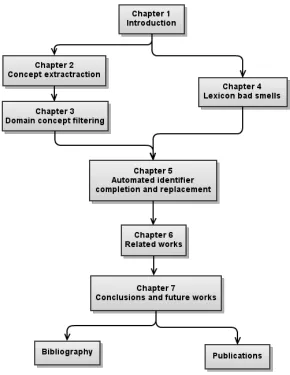
1.3
Structure of the thesis
1.3. STRUCTURE OF THE THESIS CHAPTER 1. INTRODUCTION
a new identifier is presented. Chapter 6 discusses the related works in con-cept extraction from the source code and methods proposed to improve the quality of identifiers. The conclusion of the thesis and future works are presented in Chapter 7.
Chapter 2
Concept extraction
Program understanding involves (re-)building the mental model of the knowledge captured in a program. Rebuilding the mental model of a pro-gram requires identifying the concepts in the source code and the relations among them. However, this task may be difficult for programmers having different perceptions and representations of the concepts introduced during the development and evolution of the source code.
One way for programmers to represent and communicate the intended meaning of program elements is through identifiers [98] which constitute approximately 70% of the source code [39]. Different approaches have been proposed to analyze and exploit the information captured in identifiers to support program understanding. Ratiu et al. [102] have developed an approach to automatically extract a domain ontology from different domain specific APIs that target the same domain. The extracted ontology is composed of all prevalent domain concepts in the APIs. In other works [83, 97, 105, 47] the authors have proposed approaches which minimize the effort required to go through the source code and understand parts of the source code relevant to a concept.
understand-2.1. IDENTIFIER PARSING CHAPTER 2. CONCEPT EXTRACTION
ing. The first approach exploits the natural language information captured in the identifiers [4], while the second approach exploits the structural re-lations among source code elements. Based on the level of formality, an ontology can vary from a simple taxonomy with almost no formalization, to one which uses a rigorously formalized theory [110]. Ontology in this context is a “lightweight ontology” which is in between these two extremes and does not include axioms supporting formal reasoning, but only consid-ers concepts and relations connecting the concepts. Lightweight ontology which is built using only concepts and relations connecting the concepts without any formalization is sometimes referred to as “concept map”. Here after we refer to such lightweight ontology as ontology.
To exploit the natural language information captured in the identifiers, we use natural language analyzers. A natural language analyzer is a natural language tool which takes an input sentence, that is a string of words, and returns its syntactic analysis. To carry out syntactic analysis on identifiers and exploit the information captured in the identifiers, we have investigated an approach to train natural language analyzers for use with identifiers. We present our proposed approach which adapts natural language analyzers to identifiers in Section 2.1. Section 2.2 and 2.3 discuss the approaches we propose to extract concepts and build an ontology from the identifiers and the structure of the source code, respectively. The comparisons of the different types of analyzers, and the two types of concept extraction approaches are presented in Section 2.5.
2.1
Identifier parsing
iden-CHAPTER 2. CONCEPT EXTRACTION 2.1. IDENTIFIER PARSING
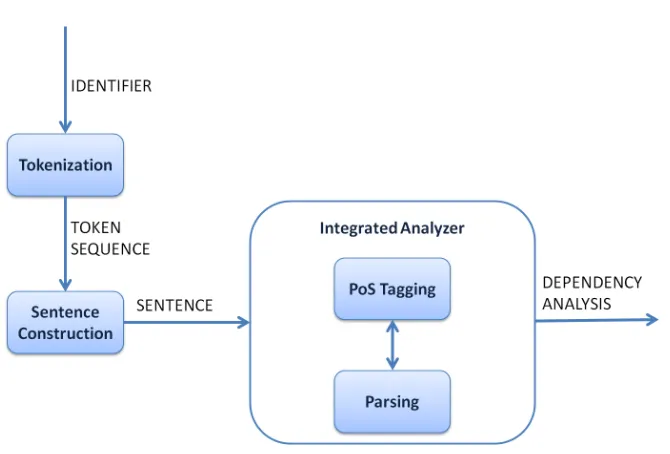
tifier term list into a sentence [4], so that it can be handled by a general purpose parser which we call Standard English Analyzer (SEA). We also investigate an analyzer constructed to directly work on the identifier term list.
In the following sub-sections, we describe the syntactic analysis ap-proaches followed to parse identifiers, including the analyzers and the cor-responding training sets. The steps involved in the construction of the sentences which are used by SEA are also described below.
2.1.1 Syntactic analysis
In NLP it is well known that a syntactic analysis is necessary to reconstruct the meaning of the input sentence. In our case, the relations between the entities (concepts) included in the identifier term list depend on the syntactic and semantic role of each token. A syntactic parse is therefore necessary for further processing.
The construction of the syntactic analysis for an input identifier can be performed in different ways and requires several steps. The first step in all cases, however, is tokenization. Tokenization is the process of splitting a text into words or linguistic elements called tokens or terms. Identifiers are composed of one or more terms. In order to identify the compos-ing terms and tokenize identifiers, we take advantage of the commonly used term separators, such as camel casing (e.g., FileItem) and underscore
(e.g., file item). This can also be achieved using more sophisticated
tech-niques proposed by Lawrie et al. [72], and Corazza et al. [36]. When the terms used to construct the identifiers are abbreviations or contractions, they can be expanded using existing approaches [70, 73, 57, 71, 36]. For example, by tokenizing the identifier fileItem, we get the term list <file, item>.
2.1. IDENTIFIER PARSING CHAPTER 2. CONCEPT EXTRACTION
The former assigns a label corresponding to the function of the word in the sentence, such as noun, verb, and so on, to each token, while the lat-ter constructs a syntactic analysis of the whole sentence. The syntactic analysis can be hierarchically organized phrases, if a constituency based approach is adopted, or a set of dependencies between word pairs compos-ing a directed graph in case of a dependency based approach. In the latter case, by dependency relationship we mean an asymmetric binary relation-ship between a token called head, and another token called modifier (see Lin [78]). In our case we consider a dependency parser where the analysis is formed of dependencies between pairs of input words. The dependency
parseris chosen over theconstituency parserbecause it allows a more direct
reconstruction of relations between concepts.
The two modules can be organized to work in a pipeline or integrated. While in the pipeline analyzer PoS tagging is completed before the syn-tactic parse is built, in the integrated schema a list of possible PoS tags is associated to each token in the input by consulting the lexicon, and the choice of the best PoS tags is performed during parsing. In other words, in the integrated analyzer the parser is also involved in the decision of the PoS tag which is more likely in the considered sentence.
Some NLP systems use a data-driven natural language parser which requires a training phase to learn how to process the input tokens. The advantage of such data-driven parsers is that they can easily learn how to parse different (novel) languages and their variants from a collection of suitable parse trees, called treebank.
CHAPTER 2. CONCEPT EXTRACTION 2.1. IDENTIFIER PARSING
them to the identifier language, and only differ in the architecture, being
pipeline or integrated.
Training is performed on an annotated set which should be as similar as possible to the actual input set, hence, in our case, to tokenized identifiers. Indeed, the string of tokens extracted from an identifier is very different from a natural language sentence as identifiers usually do not correspond to complete sentences. In addition to that, they also have a different structure depending on their function: method names are more likely to describe actions and therefore their structure resembles the Verbal Phrases (VPs), while attribute and class names usually aim at indicating things, in a way similar to Noun Phrases (NPs). This is, for example, the case of the two examples reported in Figure 2.1 which shows the analysis of two identifiers:
TextPanel and removeFile. The former corresponds to a class identifier
while the latter to a method name. Such distinction is expected to affect the syntactic analysis, but not the PoS tagging. Therefore, we will consider a unique PoS tagger, but a different parser for each of the two classes of identifiers, namely a VP-parser for method names and an NP-parser for all the others (classes and attributes). Consistently, we construct two different training treebanks, one for each parser. In Section 2.1.4, we present details of the training set construction.
All in all we therefore consider four NLP systems:
1. Untrained Integrated Analyzer (UIA): consists of an SEA integrating
PoS tagging and dependency analysis, applied to complete sentences built by padding the token sequence produced by the tokenizer. The system architecture is shown in Figure 2.2;
2. Untrained Pipeline Analyzer (UPA): to overcome the need for
2.1. IDENTIFIER PARSING CHAPTER 2. CONCEPT EXTRACTION
Figure 2.1: Examples of dependency analysis for two identifiers: (a) the class name composed by two tokens, text panel, and (b) the method name formed by two tokens,
remove file. Each graph node is labeled by one token of the identifier and the PoS tag assigned to the token. The edge labels are dependency relationships extracted by the analyzer, namely dobj - direct object and nn - noun-noun specifier.
from the input identifier: the analysis in this case is obviously more difficult than in the previous case and a more accurate analyzer is required. The pipeline architecture is depicted in Figure 2.3;
3. Trained Pipeline Analyzer (TPA): both syntactic analysis modules,
namely PoS tagger and parser, are retrained to adapt them to the token language and then they are combined in a pipeline and directly applied to the tokenizer output (see Figure 2.4). Note that in this case two different parsers (i.e., VP and NP) are used, depending on the function of the input identifier;
4. Trained Integrated Analyzer (TIA): this system is identical to the
pre-vious one, except that the two syntactic analysis modules are inte-grated together to improve robustness towards PoS tagging errors, as depicted in Figure 2.5.
CHAPTER 2. CONCEPT EXTRACTION 2.1. IDENTIFIER PARSING
Figure 2.2: Architecture of Untrained Integrated Analyzer (UIA).
Figure 2.3: Architecture of Untrained Pipeline Analyzer (UPA): the two analyzer modules are applied as distributed, without retraining, and in a pipeline.
output.
2.1.2 Sentence construction in UIA
The sentence construction step in the UIA system (see Figure 2.2) aims at constructing a sentence which is used as an input to the integrated analyzer.
2.1. IDENTIFIER PARSING CHAPTER 2. CONCEPT EXTRACTION
Figure 2.4: Architecture of Trained Pipeline Analyzer (TPA): a pipeline of the two re-trained modules is directly applied to the tokenizer output.
Figure 2.5: Architecture of Trained Integrated Analyzer (TIA): the two modules are retrained and applied in an integrated modality.
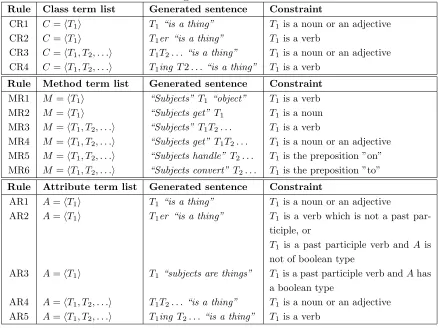
three main identifier types: class, method, and attribute. A rule is applied to a given type of identifier term list when the corresponding constraint is satisfied. To know the parts of speech of the terms and see if a constraint is satisfied, we have used WordNet [89, 44]. If none of the constraints are satisfied, the list of terms is used as it is. Based on the rules we defined, for a given term list, at most two candidate sentences are generated. Of the two candidate sentences one is selected for further processing.
CHAPTER 2. CONCEPT EXTRACTION 2.1. IDENTIFIER PARSING
Table 2.1: Rules to generate sentences from term lists. Rule Class term list Generated sentence Constraint
CR1 C=hT1i T1“is a thing” T1 is a noun or an adjective
CR2 C=hT1i T1er “is a thing” T1 is a verb
CR3 C=hT1, T2, . . .i T1T2. . . “is a thing” T1 is a noun or an adjective
CR4 C=hT1, T2, . . .i T1ing T2. . .“is a thing” T1 is a verb
Rule Method term list Generated sentence Constraint MR1 M =hT1i “Subjects” T1 “object” T1 is a verb
MR2 M =hT1i “Subjects get” T1 T1 is a noun
MR3 M =hT1, T2, . . .i “Subjects” T1T2. . . T1 is a verb
MR4 M =hT1, T2, . . .i “Subjects get” T1T2. . . T1 is a noun or an adjective
MR5 M =hT1, T2, . . .i “Subjects handle” T2. . . T1 is the preposition ”on”
MR6 M =hT1, T2, . . .i “Subjects convert” T2. . . T1 is the preposition ”to”
Rule Attribute term list Generated sentence Constraint
AR1 A=hT1i T1“is a thing” T1 is a noun or an adjective
AR2 A=hT1i T1er “is a thing” T1 is a verb which is not a past
par-ticiple, or
T1 is a past participle verb and A is
not of boolean type
AR3 A=hT1i T1“subjects are things” T1is a past participle verb andAhas
a boolean type
AR4 A=hT1, T2, . . .i T1T2. . . “is a thing” T1 is a noun or an adjective
AR5 A=hT1, T2, . . .i T1ing T2. . .“is a thing” T1 is a verb
Generating candidate sentences
Class term list: A class term list is converted to sentences using the rules
shown in Table 2.1 (top). Class identifiers are usually constructed from a noun, multiple nouns or adjectives followed by nouns. The rules take ad-vantage of this general nature of class identifiers to suggest the formulation of sentences. To construct a sentence from the list of terms produced from a class name, we append “is a thing” at the end of the list. When the first term in the sequence can (also) be used as a verb, we add either “er” or “ing” to it. “er” is appended if the phrase has only one term while “ing” is appended when there is more than one term.
2.1. IDENTIFIER PARSING CHAPTER 2. CONCEPT EXTRACTION
public c l a s s CurrentAccount extends Account
implements D i g i t a l C h e q u e {
private double b a l a n c e ;
private boolean c l o s e d ;
public double g e t B a l a n c e ( ){
return b a l a n c e ;
}
public double tr a n s a c ti o n P a y m e n t (double amount ){
S e r v i c e C h a r g e s c =new S e r v i c e C h a r g e ( ” c u r r e n tA c c o u n t ” ) ;
double c h a r g e = s c . c a l c u l a t e ( ) ; . . .
}
public void withdraw ( Money m){. . .}
public void c l o s e ( ) {. . .}
public boolean i s C l o s e d ( ){. . .}
public double c a l c u l a t e I n t e r e s t ( ){. . .}
. . .
}
public c l a s s BankSystem{
. . .
public void main ( ){
. . . .
CurrentAccount ca = new CurrentAccount ( ) ;
. . .
ca . withdraw (new Money ( ” 10 ” , ” Euro ” ) ) ;
. . .
ca . c l o s e ( )
}
. . .
private void a u t h e n t i c a t e ( User u s e r ){
Login l o g i n = new Login ( ) ;
. . .
l o g i n . a u t h e n t i c a t e ( u s e r ) ; . . .
} }
Figure 2.6: Running example: A fragment code of aBank System.
CR2, we get “account is a thing” and “accounter is a thing” respectively, since account can be used as both a noun and a verb. If the class list of terms has more than one term, for example <current, account> (as in Figure 2.6), we will have “current account is a thing” by applying CR3.
As current can only be used as an adjective or a noun, rule CR4 is not
CHAPTER 2. CONCEPT EXTRACTION 2.1. IDENTIFIER PARSING
Method term list: Method identifiers often consist of a single term which can be a verb or a noun, or multiple terms which start with a verb, followed by nouns, which usually serve as the object of the verb. In addition to these, we have included two special types of method name term lists which are commonly used to describe methods that deal with events and conversion. The former type of methods usually starts with the preposition “on” while the latter starts with “to”. The possible sentences generated for these term lists are shown in Table 2.1 (middle).
If a method name is constructed from a single term which can be used as a verb or a noun, we apply rules MR1 and MR2. When the term is considered as a noun and a missing verb is anticipated (MR2) “get” is used to construct the sentence. For example, if we take the term <close> extracted from the method name of our running example (see Figure 2.6), two candidate sentences are generated by applying rules MR1 and MR2:
“Subjects close object” and “Subjects get close”, since the term close can
be used as both a verb and a noun. For term lists containing two or more terms, we apply rule MR3 if the first term is a verb and rule MR4 if it is a noun. For MR3, if the first term in the term list is the verb
is, we use Subject instead of Subjects while constructing the sentence. In our running example, for the method term list <transaction, payment>, the sentence “Subjects get transaction payment” is generated by applying MR3. No alternative candidate sentence is generated for this term list as the term “transaction” can only be used as a noun. In addition to these rules, we have two special rules, MR5 and MR6, for the two most commonly used prepositions in method names. If the leading term of a method name is the preposition “on” or “to”, we replace them with the equivalent verbs “handle” and “convert”, respectively, during sentence construction. If for example we have the method term list <on, click> and
2.1. IDENTIFIER PARSING CHAPTER 2. CONCEPT EXTRACTION
euro” are generated using rules MR5 and MR6, respectively.
Attribute term list: Attribute identifiers are usually similar in nature to
class identifier. They are mostly constructed from a noun, multiple nouns, adjectives followed by nouns, or a verb which is in its past participle form and has a boolean return type. To construct a sentence from the list of terms created from attribute identifiers, we follow similar construction techniques as for the class identifiers. The sentences are generated by appending “is a thing” or “subjects are things” at the end of each term list. The latter sentence is used when we have an attribute term list composed of a single term which is in its past participle form and has a boolean type (AR3). AR3 is a special case where the verb becomes a modifier of the subject in the clause “subjects are things”. The first term in the list is also modified by adding “er” or “ing” when we have a verb that is not in its past participle form and the associated attribute has a boolean type. “er” is appended if the term list is constructed from only one term, while “ing” is appended when there is more than one term. The summary of these rules is shown in Table 2.1 (bottom).
If we take attribute name <balance> as an example from our running example, we generate two candidate sentences “balance is a thing” and “balancer is a thing” using rules AR1 and AR2, since the term balance can be used as both a noun and a verb. By applying AR3, the boolean attribute <activated> will generate the candidate sentence “activated subjects are things”.
Candidate sentence selection
CHAPTER 2. CONCEPT EXTRACTION 2.1. IDENTIFIER PARSING
the selection of a sentence is the generation of dependency trees for the initial candidate sentences using a SEA (e.g., Minipar). Once parse trees are available for the candidate sentences, we apply the following selection criteria, in the given order (the first match is applied, without considering the next ones). If we have only one candidate sentence, it is automatically selected.
a. If only one of the sentences is correctly parsed, select the sentence whose parse tree is correct. When SEA is not able to identify a term in a sentence and parse the sentence correctly, Unknown (U, for short) is reported. Hence, if just one of the two sentences has a U, the sentence without U is selected.
b. If both sentences do not have a U and the source of the terms is a method, the method name is checked against the attributes of the en-closing class. If a match is found, the sentence with the verb get is selected.
c. If both sentences do not have a U, the sentence satisfying the following priority rules is selected: If the two sentences have been generated for a method term list, the sentence constructed using either rule MR1 or MR3 is selected. For sentences generated from a class term list, the sentences generated following either rule CR1 or CR3 is given priority, while for attribute term lists, either rule AR1 or AR4 has priority.
d. If both sentences have a U, selection criterion c is applied.
For the method term list<close>of our running example, two candidate sentences are generated using rules MR1 and MR2: S1 = “Subjects close
object” and S2 = “Subjects get close”. These two sentences are parsed
2.1. IDENTIFIER PARSING CHAPTER 2. CONCEPT EXTRACTION
attribute name in the containing class. Hence, based on the third criterion, sentence S1 is selected for further analysis.
2.1.3 Syntactic analyzers
As our analyzers, we use two tools, namely Minipar which has an inte-grated PoS tagger and the Malt parser, which we employ together with
the SVMTool PoS tagger. Minipar is used in UIA while Malt/SVMTool
are used in UPA, TPA, and TIA. Minipar is quite robust with respect to natural language variability but is available as is, and can not be adapted in any way to new tasks. Since we aim at adapting the analyzer to identi-fier analysis, we consider the combination of the latter two state-of-the-art tools: Malt parser and SVMTool. Malt parser and SVMTool are based on data-driven NLP approaches. We have applied them both in their stan-dard English version, referred to as untrained, and after re-training on a text which is similar to the token sequences generated from identifiers. Details of these tools are presented in the following sub-sections.
Minipar
Minipar1 is a broad-coverage principle based parser for the English lan-guage (see Lin [77]), in which the grammar is represented as a network. It adopts an integrated strategy: a list of possible PoS tags is associated to each word in the lexicon and the resulting tag is chosen during parsing. The lexicon used by Minipar contains 130,000 entries which are composed of the lexicon from WordNet [89, 44] and additional proper names. Its frequency and possible PoS tags are associated to each lexicon entry. Af-ter parsing a sentence, Minipar outputs information about the individual components of the sentence and the structural relations between such com-ponents, including their mutual dependencies. In addition to specifying the
1
CHAPTER 2. CONCEPT EXTRACTION 2.1. IDENTIFIER PARSING
relationship between terms, Minipar labels each term with one of the PoS based on its role in the sentence.
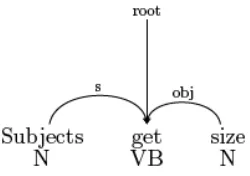
The PoS which are of interest to us, to extract concepts and relations, and to build the ontology, are nouns (N), verbs (V) and adjectives (A). Minipar generates a list of tuples. Each tuple provides information about the term, w, represented by the node, its category (N, V, A, etc.), the head (root) term it modifies, and the dependency relationship between the modified term (the head) and w (see Lin [77]). In this study we are mainly interested in the dependency relations between verbs and their respective objects, and the nouns and their modifiers. The former dependency rela-tion is referred to as object relarela-tion (obj) in Minipar, while the latter as a modifier (mod) or noun-noun specifier (NN) relation. Figure 2.7 shows a graphical representation of the tuples generated by Minipar for the sen-tence Subjects get size.
Figure 2.7: Parse tree for Subjects get size which is generated using SEA (Minipar).
SVMTool PoS tagger
2.1. IDENTIFIER PARSING CHAPTER 2. CONCEPT EXTRACTION
In fact, SVMTool is composed of two modules: SVMLearn and SVMTag-ger. The former is used to train the models and it is based on SV Mlight, a library for SVM implemented by Thorsten Joachims [63]. The latter is used to tag the input sentences, and in our case it is applied to tokenized sentences. In the UPA NLP system, the standard English tagger is ap-plied to the token sequence output by the tokenizer, while in the TPA and TIA systems it is applied after training the models on the training set, as discussed in Section 2.1.4.
Malt parser
Malt parser2 [92, 91] is a data-driven dependency parser, which, similarly to SVMTool, can be applied either with a standard English model or trained on a training set. In this case, however, the training set is represented by a collection of sentences annotated with the corresponding analysis, called
treebank. While Minipar also includes a PoS tagger, the input to Malt
parser must be tagged. The final output of Malt parser is quite similar to that of Minipar.
2.1.4 Training
In NLP tools based on machine learning, a model is learned from a training set and then it is applied to the input. This is the means we employ in this work to adapt generic natural language tools to process the list of tokens extracted from an identifier. The crucial point in this approach, however, is the construction of a training set which can describe the task at hand. Each training set should be collected from a domain as similar as possible to the one considered, and then annotated with the information necessary for the model. In our case, annotation should include both PoS tagging
2
CHAPTER 2. CONCEPT EXTRACTION 2.1. IDENTIFIER PARSING
and dependency analysis. We looked for collections of identifiers available together with their analysis (PoS tags and parse trees). The closest data we got is the class identifier data set built by Butler et al. [27]. It is a treebank which has been employed for class and attribute names. This data set contains 120,000 class identifiers extracted from 60 Java open source projects. It has been used to understand the Java class identifier naming conventions used in practice [27]. Since the first step of training is identifying grammatical patterns in names based on a part of speech (PoS) tagging, we use the identifiers of this data set, which are already tokenized and tagged using the Stanford Log-linear PoS tagger3.
As larger training sets are usually better than smaller ones, a good train-ing set is obtained as a trade-off between the need for a large amount of data and the requirement that such data accurately describe the task at hand. Unfortunately, manual annotation is a very expensive process, and therefore it is very difficult to obtain large training sets for tokenized iden-tifiers. Furthermore no large collection of program identifiers annotated with PoS tags and associated with the respective parse trees is publicly available. We have therefore designed an automatic procedure to con-struct the necessary annotations without manual intervention. We used natural language texts available from the documentation of the considered software projects to build our training sets. Such documentation typically includes comments extracted from the source code, user manuals, system documentation, and FAQs describing howtos of the system.
As already mentioned above, while only PoS annotations are needed to train the PoS tagger, for the parsers we need a treebank. In a similar way to syntactic parsers, treebanks can also follow the constituency or
depen-dency framework. The latter suits well ontology construction, as it builds
dependency relations between words. On the other hand, the constituency
3
2.1. IDENTIFIER PARSING CHAPTER 2. CONCEPT EXTRACTION
approach produces a sentence parse tree, which is easier to transform to ob-tain the kind of simplified sentences corresponding to identifiers. We have used both approaches during the construction of the training sets for both the PoS tagger and the dependency parser. In fact, the transformations necessary to build a potential identifier from a natural language sentence are more intuitively expressed in the constituency framework. Eventu-ally, the so obtained constituency treebank has been transformed into an equivalent dependency one, necessary to train Malt parser.
The construction of the training set by means of transformations ap-plied to a natural language treebank has also the advantage of allowing a stronger adaptation to the considered software system. Indeed, it can be automatically applied to any natural language description of the system, such as comments and documentation. While designing the transforma-tions to be applied to these texts in order to simulate identifiers, we have considered the fact that identifiers have different structures depending on their function. For example, method names are more likely to describe actions and therefore their structure resembles VPs, while attribute and class names usually aim at indicating things, in a way similar to NPs. Such distinction is expected to affect the syntactic analysis, but not the PoS tag-ging. Therefore, a unique training set including all sentences is considered to train the PoS tagger, while two different, disjoint training sets (VP-like sentences for method names and NP-(VP-like sentences for class/attribute names) are considered to train two parsers, a VP-parser and an NP-parser.
CHAPTER 2. CONCEPT EXTRACTION 2.1. IDENTIFIER PARSING
cheap and the error rates of both tools are low enough to be sure that the introduced errors will not deteriorate too much the resulting treebank. All determiners are then deleted from the treebank, since no determiner is usually included in identifiers. Although a similar transformation could also be applied to other PoS tags, only this one resulted to be effective in some preliminary tests. This is probably due to the fact that the other infrequent PoS tags are nearly absent from the simplified text which we use for training the parser. However, the deletion must be performed in such a way that a consistent parse tree is produced even after the transformation. An important property of parse trees is that only leafs are labeled with PoS tags. Therefore, after deletion, every internal node must still have one or more children.
As noted before, we aim at obtaining two different parsers, namely the VP-parser to apply to method identifiers and the NP-parser for class/at-tribute identifiers. Therefore, we need two different training sets, one con-taining only parse trees of VP’s and the other of NP’s. As identifier struc-tures are usually quite simple, we also impose that all NP’s and VP’s composing our training treebanks are minimal in the sense that they do not contain any other subtree with the same root. Such trees are called
non-recursive. Then, all non-recursive VP subtrees are collected from the
parsed project documentation to form the VP training set, while all non-recursive NP subtrees form the NP training set. Eventually, the parse trees are converted into equivalent dependency graphs, used to train the data-driven dependency parser.
2.2. NLP BASED EXTRACTION CHAPTER 2. CONCEPT EXTRACTION
Stanford parser
The constituency parser used for the construction of the training tree-bank is the Stanford parser [67, 68] with the English grammar distributed together with the software. It is based on probabilistic context-free gram-mars whose probabilities are estimated during training and used during parsing to output the most probable derivation with the Viterbi algo-rithm. This package is implemented in Java and can be freely downloaded fromhttp://nlp.stanford.edu/software/lex-parser.shtml. To build the training treebanks for NP-parser and VP-parser, we use another tool distributed by the Stanford lab, namely the Tsurgeon4, a tree transforma-tion tool which maintains the consistency of parse trees when non-recursive subtrees are extracted.
2.2
NLP based concept extraction
The concepts which are used in building the ontology are derived mainly from the nouns and adjectives found in the term lists. The ontological relations are obtained by mapping the linguistic relations in the depen-dency tree produced by the analyzers to ontological relations. Additional ontological relations are obtained from verbs.
The resulting ontological relations are:
a. isA: a relation between a general and more specific concept.
b. <verb>: a context specific relation between a concept, usually the doer, and the object on which the verb acts.
c. hasProperty: a relation between a concept and its properties.
d. hasState: a relation between a concept and its state.
4
CHAPTER 2. CONCEPT EXTRACTION 2.2. NLP BASED EXTRACTION
The details of how these ontological relations are extracted by map-ping the linguistic relations (dependencies) is presented in the remaining of this section. To graphically demonstrate the mappings we have used the linguistic relations produced by UIA (Minipar).
2.2.1 The isA ontological relation
An isA ontological relation is mapped to nn and mod linguistic relations produced by UIA (Minipar) as shown in Figure 2.8. If the analyzer used is UPA, TPA, or TIA (Malt parser), it is mapped to nn, amod (adjectival
modifier) or partmod (participial modifier) natural language dependencies.
The isA ontological relation sub-tree is obtained by first taking the root noun (the most general concept) which is modified/specified in the sentence parse tree and the descendant (more specialized) sub-concepts are obtained by incrementally adding all specifiers/modifiers down the sub-tree.
Figure 2.8: Mapping rule for NN-specifier or mod relation to an isA relation, S is a specifier/modifier.
If we take the sentence generated using rule CR3 for the class identifier
currentAccount of our running example, “current account is a thing”,
2.2. NLP BASED EXTRACTION CHAPTER 2. CONCEPT EXTRACTION
Figure 2.9: Concept and relation extraction from the NLP parse tree of the sentence
“current account is a thing”. The shaded box shows the terms taken from the class name
of the running example and the linguistic relation among them.
2.2.2 The <verb > ontological relation
The <verb > relation is a context specific relation between the doer con-cept, usually the class name, and the object (another concept in the rela-tion) on which the verb acts (see Figure 2.10a). The object and relation are identified and extracted from the verb phrase dependency tree of the sentence constructed for method names. The <verb> relation is mapped to the verb of the verb phrase while the object is identified by looking at the object of the verb, which is connected to it using the NLP dependency
obj produced by UIA (Minipar), or the NLP dependency dobj (direct
ob-ject) or pobj (preposition object) produced by UPA, TPA and TIA. For
example, from the parse tree of the sentence Subjects calculate interest
which is constructed for the method term list <calculate, interest> cre-ated from the method name calculateInterest in the class CurrentAccount, we can extract the ontological relation calculate(current account, interest)
(see Figure 2.11).
This ontological relation is not generated if the verb in the sentence is
an accessor (get or set). When there is no obj NLP dependency in the
verb phrase, e.g., due to a method name constructed from only one verb, we use the following steps to identify the possible object of the verb.
CHAPTER 2. CONCEPT EXTRACTION 2.2. NLP BASED EXTRACTION
Figure 2.10: Mapping rules for<verb > ontological relation. C is the concept related to the class containing the method M for which the sub-parse tree is shown, P is the concept representing the program and S is a specifier/modifier. S* means zero or more repetitions of S. T is the type of the formal parameter t of method M.
type (see Figure 2.10(c)).
ii. If the method has one or more formal parameters and the type of the first formal parameter is not a user defined type, we take the parameter name as an object (see Figure 2.10(c)).
iii. If the method does not have any formal parameter, the class name is considered as the object. In this case the doer concept is the concept represented by the program name (see Figure 2.10(b)).
Figure 2.11: The NLP parse tree of the sentence Subjects calculate interest and the corresponding ontological concepts and relation extracted. The shaded box shows the terms taken from the method name of the running example and the linguistic relation among them.
2.2.3 The hasProperty ontological relation
The hasProperty ontological relation is extracted in a similar way as the
2.2. NLP BASED EXTRACTION CHAPTER 2. CONCEPT EXTRACTION
Figure 2.12: Mapping rules for hasProperty, (a), and hasState, (b), ontological relations. C is the concept related to the class containing the method M for which the sub-parse tree is shown and S is a modifier/specifier. S* means zero or more repetitions of S.
verb in the verb phrase of the sentence is either of the two access verbs,
get or set. The concepts involved in this relation are those associated with the class name and the object in the verb phrase which represents the property (see Figure 2.12(a)). An example of such an extraction is shown in Figure 2.13(a) for the statement Subjects get balance. The ontological relation extracted from the corresponding parse tree is hasProperty(current account, balance).
Figure 2.13: NLP parse trees and the corresponding ontological concepts and relations extracted for the sentences Subjects get balance, (a), and Subject is closed, (b).
2.2.4 The hasState ontological relation
The hasState ontological relation is a relation generated from a parse tree
CHAPTER 2. CONCEPT EXTRACTION 2.2. NLP BASED EXTRACTION
verb and the corresponding object (when available) are used as concepts that represent the state of the concept associated with the class containing the method (see Figure 2.12(b)). Figure 2.13(b) shows the ontological relation and concepts extracted, hasState(current account, closed), for the sentence “Subject is closed” which is generated for the method term list <is, closed >.
2.3. STRUCTURAL BASED EXTRACT. CHAPTER 2. CONCEPT EXTRACTION
An example ontology
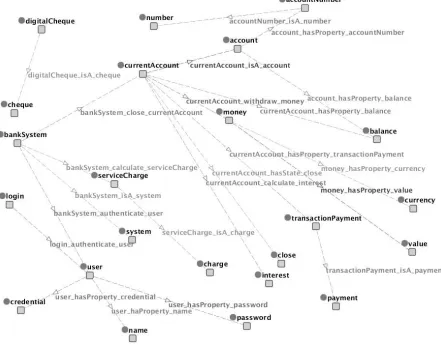
Figure 2.14 depicts the ontology 5 generated for the code fragment shown in Figure 2.6, following the steps described above. We have concepts con-nected using theisArelation such asisA(service charge, charge),isA(digital
cheque, cheque), and isA(current account, account) where one of the three
is also captured in the source code syntax (class CurrentAccount extends class Account).
In addition, the ontology provides information about the properties and actions of a concept. For example, the concept current account, hasbalance
as its property and calculates interest as an action it can perform. The ontology also captures states of a concept through its hasState relation (e.g., hasState(current account, closed)).
2.3
Structural based concept extraction
Programmers who use the object oriented paradigm to write their code fol-low certain structural rules and design guidelines supported by the paradigm. This, in turn, influences the way they think and model their knowledge of the solution during the implementation. In this section, we describe how we use the rules and structure associated with the object oriented paradigm to extract an ontology which models the knowledge captured in the source code structure. The summary of the mapping rules from the structure of the source code to the ontology concepts and relations is presented in Table 2.2 for the Java programming language. Similar rules can be easily defined for other object oriented languages (e.g., C++).
The first syntactic relation listed in Table 2.2 isextends. Extends is used to introduce an inheritance relationship between two classes. The corre-sponding ontological relation which captures this characteristic is isA(S1).
5
CHAPTER 2. CONCEPT EXTRACTION 2.3. STRUCTURAL BASED EXTRACT.
Table 2.2: Rules for extracting structural ontology from object oriented (Java) source code. (C=class, M=method, A=attribute, T=type, I=interface, p=formal parameter, UDC= user defined class)
Rule Structural Ontological
Source Relation Target Concepts Relation
S1 C1 extends C2 C1,C2 isA(C1, C2)
S2 C1 implements I C1,I isA(C1, I)
S3 C1 has A:T, C1,A hasProperty(C1,A)
attribute T 6= boolean
S4 C1 has A:T, C1,A hasState(C1,A)
attribute T = boolean
S5 C1::M1 Calls C2::M2() C1,C2 <M2>(C1,C2)
S6 C1::M1 Calls C2::M2(T p, ...) C1,T,p <M2>(C1,T), ifT ǫU DC
<M2>(C1,p), otherwise
S7 C1 has get/set M2 C1,m2; hasProperty(C1,m2)
method m2 isM2
without get/set prefix
In some programming languages, such as Java, multiple inheritance is not allowed. However, Java provides multiple sub-typing using the implements
construct. We map such a relation to theisA ontological relation as shown
in Rule S2. In the ontological relation, the class which is extended or the
interface which is implemented is taken as the general concept, while the class which extends or implements it is the more specific concept. In our running example, shown in Figure 2.6, there is an extends relation be-tween the child class CurrentAccount and the parent class Account, and there is an implements relation between the class CurrentAccount and the interface DigitalCheque. These two syntactic relations are used to extract
the isA(current account, account) and isA(current account, digital cheque)
ontological relations, respectively.
Attributes are used to represent properties and states of a class. As
2.3. STRUCTURAL BASED EXTRACT. CHAPTER 2. CONCEPT EXTRACTION
relations to capture them in the ontology. The concepts involved in this relation are the attribute and the class containing the attribute. If the attribute is of type boolean, the ontological relation used is hasState while when it is not, hasProperty is used. For example, following Rule S3 the ontological relation hasProperty(current account, balance) is extracted for our running example from class CurrentAccount and its attribute balance
(see Figure 2.6). Properties of a class which are the result of a computation are usually represented using accessor methods. We capture also such properties using the hasProperty ontological relation (S7). In such cases, the concepts involved in the relation are the class containing the accessor method and the method name without the prefix get or set. For example, if we have a classRectangle with a method getArea, we extract the ontological relation hasProperty(rectangle, area) using Rule S7.
Methods are used as a means of communication and interaction with
other classes. Such interaction is captured in our ontology through the method name involved in the call relation between two classes (see Rules S5
and S6). When the called method does not take any argument, we create a relation between the concepts represented by the caller class and the type of the object on which the method is invoked (Rule S5). The relation connecting the two concepts is a context specific relation represented by the called method name. In cases where the called method has a parameter, we create a relation between the concepts associated with the caller class and the type of the first parameter, if it is a user defined type. Otherwise the relation will be between the concept representing the caller class and the name of the first parameter (Rule S6). In both cases the relation used to connect the concepts is a context specific relation represented by the called method name, like in Rule S5. For example, from the method
call calculate() on object sc in method transactionPayment of our running
CHAPTER 2. CONCEPT EXTRACTION 2.4. CONCEPT LOCATION
service charge) using Rule S5. From the method call withdraw(...) on
the object ca, the ontological relation withdraw(bank system, money) is obtained following Rule S6.
Object oriented languages support polymorphic calls. As a consequence, the declared type of the target object involved in a method call may be different from its actual type (as determined at object creation time). This might result in some degree of imprecision, when extracting C2 according
to Rules S5 and S6, which only consider the declared type of the object
on which a method is invoked or the declared type of the first method parameter. The ontology extractor might be improved by resorting to points-to analysis [88] or to the object flow graph [108].
An example ontology
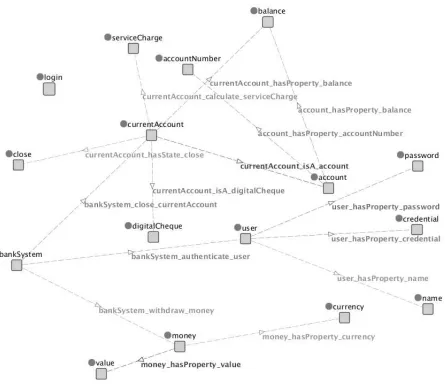
By applying the rules described above to the code fragment shown in Figure 2.6, we obtain the ontology shown in Figure 2.15. The ontol-ogy shows the concepts and relations among them, as captured by the structural relations in the code. For example, the inheritance relation-ship shown between currentAccount and account is also present in the ontology, where it is represented as an isA relation. The ontology cap-tures also the attributes of each class through the hasProperty relation
(e.g., hasProperty(currentAccount, balance)). Context specific relations,
such as close(bankSystem, currentAccount), capture the communication relations appearing in the code as method calls.
2.4
Concept location
2.4. CONCEPT LOCATION CHAPTER 2. CONCEPT EXTRACTION
Figure 2.15: An ontology extracted for the running example code fragment shown in Figure 2.6 using the structural approach
to identify the location where a change is to start in response to a change request, such as, a bug report or a new feature request. It involves for-mulating a query composed of one or more keywords which a programmer thinks are related or refer to the concept to be searched. While formulat-ing a query, the programmer resorts to her prior knowledge, as well as any information associated with the concept to be searched.
CHAPTER 2. CONCEPT EXTRACTION 2.4. CONCEPT LOCATION
the result, based on the newly acquired knowledge, she may decide to reformulate the query or to further filter the results (see Petrenkoet al. [94] and Hill et al. [58]). Successive filtering and reformulation of the query continues until the programmer is satisfied with the result.
To carry out a concept location task, the developer can employ various approaches which exploit textual and dynamic information. In this sec-tion, we discuss two text based approaches which are used in our studies: information retrieval (IR) and regular expression matching.
2.4.1 Information retrieval
IR-based approaches treat the source code as a document corpus and use methods such as latent semantic indexing (LSI) to index the corpus [83, 97, 95, 47]. A document corpus which corresponds to the source code is created by extracting the identifiers and comments at a developer-defined granularity level (classes, methods, etc.). In the corpus, one document is mapped to a code entity at the chosen granularity level. While creating the corpus, identifiers are split to their composing terms. For example,
userName is split to user and name. In some cases, common English
words are also filtered from the corpus.
The document corpus is then transformed to the corresponding math-ematical representation and indexed using techniques such as LSI and Lucene6. To transform the corpus to the corresponding mathematical rep-resentation, scoring methods such as term frequency and term frequency inverse document frequency (TF-IDF) are used. The indexed corpus is then searched using queries formulated by developers.
In response to a query, IR-based approaches return a ranked list of doc-uments which correspond to the entities at the selected granularity level. The rank to each document is given based on the similarity of the
doc-6
2.5. EVALUATION CHAPTER 2. CONCEPT EXTRACTION
ument to the query. Similarity between the query and the documents is computed using similarity measures such as cosine similarity. The docu-ments ranked close to the top are those relatively similar to the query, and they are considered relevant to the query.
2.4.2 Regular expression matching
In regular expression matching the query formulated by the developers is directly matched against the content of the files in the code base. The matching is conducted using tools such as grep7. The result of the query, in this case, is a set of files which contain all the terms (keywords) in the query.
2.5
Evaluation
2.5.1 Comparison of natural language analyzers
In Section 2.1, we have presented four types of analyzers which can be used to syntactically analyze, and extract the information captured in the identifiers to build ontologies. In this section, we asses the impact of using different analyzers to generate ontologies. The assessment is conducted using a case study in the context of a program understanding task, namely concept location.
One of the applications in which concept location is widely used is bug fixing. When users of a program encounter a problem, they communicate it to the developers of the program by filing a bug report. The bug report contains several data, among which a title, a bug description and (option-ally) a set of keywords. It is reasonable to assume that developers will use this information to formulate a query, used to retrieve files which are
7
CHAPTER 2. CONCEPT EXTRACTION 2.5. EVALUATION
relevant for the bug to be fixed. In our study, we call such queries basic queries.
In our previous work [4], we have proposed to enhance basic queries using concepts taken from the ontology ex