Research Article
© 2017 Ifaistion et.al. This is an open access article licensed under the Creative Commons Attribution-NonCommercial-NoDerivs License (http://creativecommons.org/licenses/by-nc-nd/3.0/).
Comparative Analysis of Recruitment Systems in the Public Sector in Greece and
Europe: Trends and Outlook for Staff Selection Systems in the Greek Public Sector
Papapolychroniadis Ifaistion
Dr Rossidis Ioannis
Functionary in the Ministry of Finance, Lecturer at the University of the AegeanDr Aspridis George
Associate Professor in Business Administration, University of Applied Sciences of Thessaly/TEI of ThessalyDoi:10.5901/ajis.2017.v6n1p21
Abstract
The current economic, social, political and technological conditions and the ever-increasing demands for higher growth, form the perpetual need for improvement of the public sector administrative operations. One of the major problems to be overridden by the Greek public administration (from which originated numerous pathogens) is the dysfunctional recruitment system. For decades, the Greek recruitment system faced widespread problems such as lack of meritocracy and corruption because of the intense patronage state. The current system has undergone many improvements, but certain deficiencies and pathogens of the past continue to exist to a large extent. This article provides a comparative analysis of recruitment systems in Greece and in Europe attempting to reduce good practices to improve the existing selection process in the Greek public sector. The ultimate goal of the study is to contribute to the strengthening of the recruitment systems in Greece, supporting respectively the effort to improve the overall efficiency of the country’s public administration.
Keywords: Public sector, Personnel selection systems, Meritocracy, Public Servants
1. Introduction
The current economic, social, political and technological conditions and the ever-increasing demands for higher growth, form the perpetual need for improvement of the public sector administrative operations. One of the major problems that are required to be overridden by the Greek public administration (from which originated numerous pathogens) is the dysfunctional recruitment system. For decades, the Greek recruitment system faced widespread problems such as lack of meritocracy and corruption because of the intense patronage state. (Kondylis, 2011).
During the decade of 2000 in an effort to address this problematic system, a meritocratic but very static recruitment system was configured and it was based on the rule of formal qualifications and recruitment competitions. The configurable administrative system managed to reduce the patronage to some extent. However, the system led to inefficient methods where the selected staff was not the appropriate / most capable, but the candidate with higher credit points or with the highest marks in exams, which had little relevance with the object of the post. The one-dimensional system and the problems that arose made clear that further improvement was needed (Lymperopoulou, 2016).
candidate, planning of the human resource e.t.c.) (Papalexandri and Bourantas, 2003).
The present study attempts to analyze this problem and propose solutions for the administrative efficiency of the Greek public sector. The research methodology was based on a comparative analysis of the Greek recruitment systems compared respectively with systems used in other countries of the European Union. The choice of the other EU countries is based on the fact that they represent a variety of recruitment systems. The research aims to bring together good practices that - under appropriate conditions - could constitute a restructuring tool of the recruitment systems in Greek public sector.
2. Analysis of the Greek Public Sector Recruitment System
In Greek public sector the personnel selection process are done in the following ways: a) the director of the relative department will make the choice, b) by an electoral college established for this purpose, c) by a written recruitment competition, d) following graduation from an officer’s and public service training school (such as the National School of Public Administration) and e) by selection based on criteria (automatic selection) (Spiliotopoulos and Chrysanthakis, 2013). According to the personnel education level we can divide the personnel in four categories (University graduates (PE), Technical Institute graduates (TE), High School graduates (DE) and elementary school or junior high school graduates (YE)) (Spiliotopoulos et al, 2013).
The recruitment systems and the positions can be divided into permanent positions, positions for a specific job and career systems. Under the permanent positions system, the duration of the service is determined by the age of the public servant. Under the specific job position system, the public servant knows the salary, the rank he/she holds and the duties carried out until the end of the service. In career position systems, the employee holds the lower rank position or some mid-level position, depending on the qualification for the position, and will be able to rise hierarchically if they have the skills and qualifications to perform the duties of a higher position (Spiliotopoulos et al, 2013, Makrydimitris and Pravita, 2012).
For instance, the higher education institutions are using an Electoral College in order to select teaching staff/personnel. Another method of staff selection process and candidate appraisal are recruitment competitions assessing the knowledge of the candidates, which can be either written or oral. There is the possibility that the choice is made by the head of the department who determines the adequacy of the candidate's profile. In other cases, a special body will be formed for the personnel selection process. The selection process based on candidate formal qualifications, or "automatic selection," is based on selecting the candidate on the basis of their university degree grade, possessing a postgraduate and/or PhD degree, marital status, and other merits. Finally, in other cases the appointment is carried out after successful graduation of an officer’s and public service training school, such as the Military Academy (S.M.Y. and Evelpidon, e.t.c.) and the National Centre for Public Administration and Local Government with the National School of Public Administration and Local Government (Spiliotopoulos et al, 2013 · Panagopoulos, 2008).
2.1 Statute frame work
In Greece, the Presidential Decree 1811/1951 dictated that outside the formal qualifications of the candidate a written recruitment examination was required. Presidential Decree 1811/1951 was codified by the Presidential Decree 611/1977 and recruitment competition was introduced for the selection process of civil servant and public entities of public law staff. There are three kinds of recruitment competitions: the special competitions, the prefectural competitions and the common competition. By law 1320/1983 the selection is made with the automatic selection method without any award credit point for the undergraduate degree grades. In the same year (1983) the National School of Public Administrator part of N.C.P.B. (National Centre of Public Administration) was founded. In order for a candidate to be admitted at the N.S.P.A. an entry examination is required (entry competition) and after graduation, graduates are employed in permanent posts in the public sector (Spiliotopoulos et al, 2013, Panagopoulos, 2008).
By law No 1735/1987 the grade of the undergraduate university degree is awarded credit points. The minimum age of recruitment for those who have completed the military service is 21 years old. Transparency during the selection process and the assessment of the candidate of the public sector returns with the law No 1943/1991 when the recruitment competitions are being reintroduced. In addition to the recruitment competitions, the undergraduate degree grade, postgraduate qualifications and residency among other qualifications are taken into consideration (Spiliotopoulos et al, 2013· Chrysanthakis, 2001).
Administrative Authority), subject to the Ministry of Presidency of the Government (Aspridis, 2013). The selection process is done by a written recruitment competition, interview or by the system of automatic selection. Law no 2190/1994 is modified by law no. 3051/2002 which specifically allows multiple choice exams at the recruitment competitions (article 7, paragraph. 1). If the candidate has work experience equal or greater of four semesters acquired at the same specialisation of the post advertised, then 40% bonus credit points are earned. The results of the tests /recruitment competitions of ASEP (Supreme Council for Civil Personnel Selection) are valid for a period of three years. The Law. 2190/1994 continues to be amended. Law 3260/2004 recognises work experience of self-employed candidates provided a licence to exercise their profession (professional qualification) is required and under the condition that the relative social security organisation confirms that the candidate is insured. It also determines that in case of equal award credit points among the candidates a public drawing will take place for the selection. (Spiliotopoulos et al, 2013· Makrydimitris et al, 2012· available at https://www.asep.gr/).
Law 3320/2005 introduce interviews as a mean and criterion for the selection of the candidate. The interview is conducted after the agency requests an interview. The three-member committee who are called to conduct the interview consists of members from ASEP or the agency. The purpose of the interview committee is to form an opinion about the personality of the candidate and the suitability for the post. Additionally, the bonus for work experience raised to 50% from 40% if it was acquired in the same or similar specialisation and to 55% if the period of work experienced is equal or longer than 18 months for job positions at Civilian Service Centre (Κ.Ε.Π.) when the work experience was acquired at C.S.C. of the agency for which the post was announced. By law 3812/2009, article 4, the 50% bonus of the work experience is abolished. The results from the ASEP (Supreme Council for Civil Personnel Selection) recruitment examinations are valid for 10 years. Due to the economic crisis and thus creditors order, article 11 of law no. 3833/2010 sets a limit on personnel recruitment and hiring, rule five (5) to one (1), i.e. for every five persons retired or withdrawn from their service and posts one person will be recruited. (Spiliotopoulos et al, 2013· available at http://www.forologikanea.gr/pages/display/arthro-37-ruthmiseis-gia-ton-periorismo-ton-proslipseon-stous-kratikous-foreis---kefalaio-e/).
Law. 4210/2015 provides the opportunity to cover regular staff positions without new notice of competition and applications procedures, but from a reserve list of the previous recruitment competition of ASEP and candidates do not need to apply for new posts. A reasonable period of time is set after the initial announcement until the appointment of successful candidates from the reserve list, where candidates may have acquired more qualifications, a fact that places them higher on the ranking list if a new notice of recruitment competition was published.1
With the modifications and the establishment of ASEP, candidates are assessed based on their qualifications, with more meritocracy and objective criteria. The feeling of meritocracy is satisfied by written recruitment competitions and by selecting personnel with the automatic selection process. Personnel are also selected from a reserve list of previous competitions, even though in some cases the time period between the notice and the appointment is long. Finally, despite the fact that technology has evolved and part of the procedures are being completed electronically, the candidate in addition to the online application should file a printed version of the electronic form along with the necessary supporting documents certifying the qualifications in order for the process to be completed. This process is deemed time-consuming and polluting. (Rossidis and Petropoulakos, 2014· Makrydimitris et al, 2012· Chrysanthakis, 2001).
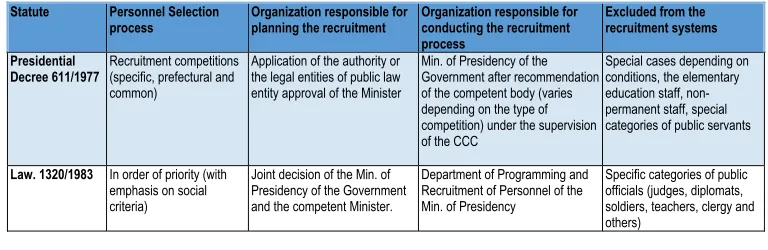
Table 1: Comparative presentation of the statute framework of the recruitment systems
Statute Personnel Selection
process Organization responsible for planning the recruitment Organization responsible for conducting the recruitment process
Excluded from the recruitment systems
Presidential
Decree 611/1977 Recruitment competitions (specific, prefectural and common)
Application of the authority or the legal entities of public law entity approval of the Minister
Min. of Presidency of the Government after recommendation of the competent body (varies depending on the type of competition) under the supervision of the CCC
Special cases depending on conditions, the elementary education staff, non-permanent staff, special categories of public servants
Law. 1320/1983 In order of priority (with emphasis on social criteria)
Joint decision of the Min. of Presidency of the Government and the competent Minister.
Department of Programming and Recruitment of Personnel of the Min. of Presidency
Specific categories of public officials (judges, diplomats, soldiers, teachers, clergy and others)
Law. 1735/1987 In order of priority (emphasis on academic qualifications)
Joint decision of the Min. of Presidency of the Government and the competent Minister.
Min. Presidency of the
Government Specific categories of public officials (judges, diplomats, soldiers, teachers, clergy, artists, the House of Parliament staff, NHS staff and others)
Law. 1943/1991 Recruitment ompetition taking into consideration individual increments (degree grade, postgraduate qualifications, residency)
Annual recruitment planning by designated bodies (taking into consideration the opinion of trade unions). Submitting and assessing proposals to the Ministry of President and Finance
Central Competition Committee consisting of one supreme judge and 4 university professors (from the field of legal, financial, administrative and technical science)
Special categories of public officials (judges, artists, staff of Ministry of Foreign Affairs and Ministry of Presidency, soldiers, clerics, the House of Parliament staff, NHS staff, special advisers, staff with special nature and mission and others)
Ν. 2190/1994 Recruitment competition or in order of priority (mixed recruitment system)
Application of the Ministry and approval from the Ministry of Finance
Supreme council for Civil Personnel Selection (ASEP)
Special categories of public officials (judges, teachers, staff of the NHS, the Olympics and the TAB business, artists, staff of the Ministry of Foreign Affairs, the Parliament and the Presidency, military, clergy, are directly appointed to managerial grades and others)
Source: Rossidis et al, 2014
3. Comparative Presentation of European Countries Recruitment Systems
3.1 Cyprus
The recruitment, promotion, working conditions, rights and other public sector issues were set by the Law on Public Service in 1990. There are three categories of job positions. First Appointment, Promotion and a combination of First appointment and Promotion posts. According to article 32, advisory committees are created for the filling of the job positions for the first two job categories -where the committee members hold positions higher than those that will be covered by the appointment- except the department director positions. The Advisory Committee will be responsible for the examination of the candidates both written and oral and then a preliminary list containing four times the number of the vacant posts will be created. Shortlisted candidates of the above list will go through an oral examination. According to Article 35 for the promotion positions written examination is not conducted. The position will be filled by the immediately lower position in the hierarchy scale of the same department. Candidates are assessed based on the recommendations of their superiors, seniority, if they have committed a disciplinary offense during the last two years, the opinion of the Committee that results from the oral examination of the candidate, and finally whether they have the necessary qualifications at the time the post was announced (Republic of Cyprus, 2006).
3.2 United Kingdom
3.3 France
Job security in the public sector in France is established by the large number of persons sit for the entry examinations. The exams are open to everyone, and the right to sit on the exams are also offered to those who are not working in the public sector and also concern promotions. The form of the examination and the test material that the exams are based vary according to the post and the agency. Positions are open for citizens of the member states of European Union with the exception of the positions related to national security issues and defense, where French nationality is required. Additionally, there are no nationality restrictions for positions in education such as teachers in high school or hospital positions such as doctors (DPADM, DESA, UN, Republic of France, 2006). Regarding promotion positions, the formal qualifications of the employee, assessments and years of service play a vital role. Provided that they meet the above criteria candidates may take the exams (OECD - France, 2012 · Chandler, 2003).
3.4 Germany
The principle of the professional civil service emerged with the Basic Law of 1949. In the 18th century the German Civil Service began to take root, when the servants of sovereigns were servants of the state. During the 19th century, the public administration was formed as we know it today. The Weimar Constitution 1919, Article 130 set the freedom of civil servants to have political views and that the civil servants were servants of society and not the party. Furthermore, it highlighted the impartiality of civil servants and bring an end to the monarchy. All these freedoms and rights during the period 1933 – 1945 were restricted (Federal Ministry of the Interior, 2014). Every German citizen has the right to participate in the procedures that are required for employment in the public sector. Employees can be divided into four categories. Administrative, executive, clerical and sub-clerical service (DPADM, DESA, UN, Federal Republic of Germany 2006). Whereas there is no central body responsible for selection of federal personnel and there are no binding rules for the selection process, each authority applies its own procedures. The agencies and bodies themselves are responsible for personnel selection. In order for a position to be filled, the candidates have to succeed in examination for the position. The recruitment process usually begins with the announcement of vacancy and is open to everyone (Chandler, 2003).
3.5 Portugal
Portugal uses a career based recruitment system. Candidates are assessed on basis of examinations with which non-suitable candidates are excluded. The examinations are based on general and specific subjects, but candidates may also be required to go through psychological tests as well (OECD – Portugal, 2012). Staff selection process is done with open recruitment competitions. The Decree and law 204/1998 defined the recruitment of civil servants. Candidates must be 18 years of age or older, alongside the candidates should hold the Portuguese nationality or be a national of a European Union country and have completed their military service obligations or have been legally exempted (Baptista, 2006). There is a similarity to Greek Public Sector where male candidates must have complete the military service obligations or legally exempt from service. Another requirement is to be mentally and physically fit to perform the duties that will be assigned thereto (Baptista, 2006).
3.6 Spain
The needs of personnel are determined on an annual basis. The public employment office receives the requirements that are send by the ministries, and the process, which is considered to be centralized, begins. (DPADM, DESA, UN, Kingdom of Spain, 2006). According to Article 23.2 of the Constitution, all citizens have equal opportunities for employment in the public sector. On an official state newspaper, the available positions will be published. Candidates with citizenship form a European Union country have the right to apply for the positions but not for the positions concern to national security issues where Spanish nationality is required. Candidates must speak the Spanish language or one of the official dialects, must not have criminal record and must be older than 18 years of age (Perez, 2006). The assessment process includes both a written and oral examination.
3.7 Lithuania
Administration. Candidates must have the Lithuanian citizenship, to be between the age range of 18 to 62.5, knowledge of the language and to possess the required formal qualifications for the available position. For career based positions, recruitment examinations are carried out. In other cases, and depending on the advertised position, there is a corresponding assessment method. Candidates must file an application, their curriculum vitae, ID information, certifications – degrees and a completed specialized questionnaire. Usually the recruitment competitions are written or also include an interview. Vacancies are published in the Government Gazette (Šarmavičius, 2006).
3.8 Sweden
The most reform efforts took place during the decade of 1990s (EUPAN, 2014). The recruitment systems can be characterized as decentralized. The system is based on candidate abilities and is meritocratic. The hiring criteria for positions concerning central government are defined by the Constitution. For positions in the public sector, according to the law on employment in the public sector, the aptitudes and skills of the candidate are assessed. For positions that are filled by the promotion system, various criteria are taken into consideration depending on the position. The positions are announced publicly, and the department of human resource will form a candidate list in order to select the more suitable candidate. For support staff, clerical and professional positions, any degrees that are held are assessed. For other positions candidate’s appraisal is taken into account regarding the promotion. (OECD-Sweden, 2012, Chandler, 2003).
3.9 Poland
According to the principle of public service, the recruitment process should be open to all citizens and based on the principle of competitiveness. Operating in this manner the candidate who could offer the maximum possible in the position will be chosen and the agency will achieve the goals (Civil Service Department, 2011). According to the Act of 1998 participation must be opened to everyone and the competiveness must be guaranteed (Cardona, 2006). The system can be characterized as decentralized, because ministries and regional - central services play a key role in recruitment. The announcements of the positions include all the information that the candidates need to know, including job description for the available position, required qualifications candidates need to possess, and documents that are required as well as the manner in which these must be filled. (DPADM, DESA, UN Republic of Poland, 2004).
4. Comparative Presentation of Greece and Member States of E.U. Recruitment Schemes
By a comprehensive review on the subject, it could be said that the recruitment systems are divided into two categories: centralized and decentralized. In most countries the recruitment systems are decentralized and ministries develop their own processes, such as for example in Lithuania and in the United Kingdom. In countries where recruitment depend on a body or a committee as in Greece or by a Ministry as in France and Spain the system is centralized. However, there are countries that have elements of both centralised and decentralised recruitment systems. In the United Kingdom the recruitment systems are decentralized, while in Greece the responsibility lies primarily with the ASEP (Supreme Council for Civil Personnel Selection) which is the central body whereas in France and Spain a relative ministry is responsible (Van-Biesen, 2006).
The Europe recruitment systems can be divided into career positions, positions for a specific purpose or positions that have elements of both categories. As concerns positions for a specific purpose usually best suited candidates are recruited to carry out the work while in the prospective career positions candidates expect to remain in the post until retirement (Human Resources Management Working Party, 2004).
The minimum age for recruitment is usually 18 years of age, and also for senior positions a degree of higher education institute is deemed necessary. The access should be open to every citizens and publications of vacancies must be effected in such a manner to ensure the awareness and participation of everyone who is interested.
At a time, which is distinguished by the technological revolution, several countries are trying to handle part of the recruitment procedures electronically. Countries such as Germany and the United Kingdom prefer to conduct computer based tests (such as reasoning, personality, simulation exercises and other tests). (Van-Biesen, 2006). The candidates are being pre-selected on a basis of the supporting documents filed by them and their assessment to open recruitment competitions (written and oral) that are adjusted to the needs of the position. These exams work as an exclusion method for the non-suitable candidates (Van-Biesen, 2006).
qualifications of candidates. According to Sullivan, 2002 (as stated in the Goldfinch and Wallis, 2009) this system may exclude candidates who do not possess the necessary qualifications but demonstrate exceptional performance in past positions. Candidates should be assessed on the basis of the criteria of the position and less emphasis should be placed on formal qualifications wherever possible. In this manner, candidates who will be able to carry out very effectively the duties they will undertake but do not hold the formal qualifications will not be excluded.
Every country places weigh and focus on different elements during the recruitment procedures. Countries such as France, Greece and Spain place weight on education and the results of recruitment competitions. In contradiction to that, countries such as United Kingdom and Sweden place emphasis on work experience and on specialized recruitment competitions. (Aspridis, 2012· Human Resources Management Working Party, 2004).
Nationality is another criterion that countries take under consideration when recruitment takes place. The movement of employees has become easier with the establishment of the European Union. Countries such as Spain, Germany and the United Kingdom, enable European Union citizens to occupy positions in the public sector. Specifically, in Germany, positions in the army and the police, and posts regarding the foreign policy and others position are excluded while in Luxemburg, candidates may be recruited in the sectors of education, telecommunications and health but they may not hold positions that concern national security and positions that involve the exercise of public authority (power) / control (Pravita, 2010). In Spain positions concerning the national security are also excluded and in Italy since 1993, candidates are allowed to occupy a place in public sector if they are not Italian citizens with the exception of positions that involve the exercise of public authority (power) (Pravita, 2010). It should be noted that in France European Union citizens may hold positions in the army, diplomatic corps and other areas if the duties are exclusively of clerical or operational nature while in the United Kingdom citizens of the European Union and from third countries may be recruited in the public sector (Pravita, 2010).
Regarding senior-level positions, such as a special purpose positions or for a specific project experience plays an important role. This is the reason that lead countries (such as Poland, Sweden, Cyprus and others) to recognize work experience gained outside the public sector (Kuperus and Rode, 2008). In Greece, something similar was established with law 3260/2004 and the Presidential Decree 69/2016 that recognizes candidates work experience gained as freelancer or in general in private sector after attestation of the social security agency.
The federal personnel selection office in Belgium, is responsible for the recruitment of senior civil servants. In Spain, Poland and France recruitment is carried out by the corresponding National Schools of Public Administration (Kuperus et al, 2008). Similarly, in Greece the National School of Public Administration may supply the public sector with senior-level executives. In countries such as United Kingdom, candidates before recruitment must go through structured interview and file reference letters. In Greece however, candidates do not file reference letters and they are assed based on their formal qualifications, recruitment competition and interviews (where applicable). The use of reference letters will allow a more detailed assessment of candidates professional and personal skills of candidates taking into consideration the views of previous employers (along the lines of the private sector) (Aspridis, 2012 · Kuperus et al, 2008).
Finally, the manner European countries select the senior-level officials differs. Candidates in Poland are selected primarily from a pool of candidates that has been created for this purpose. In the Netherlands and in Poland responsibility positions can be held by employees (for a predetermined period of time) via a selection from a pool of candidates (with possibility of renewal of contract) (Kuperus et al, 2008). In these procedures the risk of party / political exploitation always exists. However, this risk tends to be avoided on account of the adaptation of management and administrative systems. (see cases such as the United Kingdom) (Kuperus et al, 2008). In Spain and in Portugal civil servants compete with external candidates for vacant positions of responsibility. In Cyprus the employee is given the option to be promoted to a higher position, according to the rank they hold (Kuperus et al, 2008).
5. Conclusions
In recent years there has been an effort to reform and streamline the recruitment system in Greece, but their significant difficulties still exist (such as the absence of an incentive policy, poor job description, limited expertise in personnel selection issues, the lack of know-how in strategic issues, programming with respect to personnel management, etc.). Despite ongoing reforms, the personnel selection process remains problematic. Even today the recruitment systems have malaises in many areas, such as:
• There are still "loopholes" in recruitment systems, enhancing cronyism (law n. 3812/2009 was established to give a solution to this problem).
• The current recruitment procedures, posed the objectivity but fall short in terms of modernization compared to modern methods according to the operational management (James, 1998)
The personnel selection process is one of the key functions of public administration. The effectiveness has a direct impact not only on the long term operation and efficiency of the organisation, but also in shaping public opinion, reducing corruption and poor management. With the optimization of the recruitment systems of the public sector only the suitable candidates to perform the required tasks effectively will be selected. The identified best practices of European Union countries in the present analysis may serve as examples to be followed that will bring the necessary improvements that the Greek public administration urgently needs. Particularly the following practices as a form of suggestion can be identified:
1. Emphasis should be placed on the planning of staff selection/recruitment process and on the jobs design. 2. Use of modern methods in the recruitment selection process according to the operational management
standards (reasoning tests, work simulation, multi-level interviews etc.).
3. Assignment of the recruitment process exclusively to the independent authority ASEP (Supreme Council for Civil Personnel Selection).
4. Disclosure of names and profession of members of personnel selection committees at the standards of many European Union countries.
5. In the quiver of the recruitment procedures the criterion of evaluation of recommendation and reference letters could be used significantly supporting the appointment of suitable persons to corresponding positions acquiring a clearer picture of the special professional knowledge and personality of candidates (Employment Practice Division, Civil Service Capability Group, Cabinet Office, 2007).
6. The contribution of technology could bring substantial improvements to the existing recruitment system. The time needed for the recruitment process can be drastically reduced by choosing candidates correctly and promptly (but also unimpeachable) by using information systems and restoring the prestige of the Greek public sector to a great extent to the public of equal treatment to all social groups promoting and showing out the unimpeachable, objective and merit-based shield of technology (Aspridis et al, 2013).
7. Assessing the skills and abilities of candidates through assessment centres and particular tests could have a significant result on the staff selection process. This technique can be applied to specific positions where special skills or particular results are required. In this manner, it is possible to locate the suitable candidate who will have the ability to perform specialized tasks. Under such techniques, when candidates interact with other co-candidates, their assessment in simulated working conditions and the emphasis of their true characteristics will give the competent human resources management agencies the opportunity to identify the persons who will be the most suitable for the post. In this manner, the assessment /selection committee will draw assumptions about how the candidates react in conditions that are similar to the actual working environment (Dessler, 2012).
8. The use of a pool of staff is also a very successful practice which could provide the public sector, with highly competent personnel matching skills with the requirements of the post2.
The improvement of the recruitment systems in the public sector, could “shake off” the corruption in the Greek public sector in a high degree. At the same time, it will lead to significant benefits with respect to the efficiency of public administration, particularly in relation to the problem of the multi-level low productivity of personnel, which to a great extent is due to the selection of unsuitable candidates.
References
Aspridis, G. (2003). Introduction to the political and administrative organisation of the Hellenic State, Athens: Propompos. Chandler, J.A., (2003). Public Administration – Comparative Analysis, Athens: Papazisis.
Dessler, G., (2012). Human resources management – Basic meanings and modern trends, Athens: Kritiki.
National Bank of Greece (1998) Committee for the examination of long-term economic policy, Quality in Public Administration: Proposal for Changes. Athens.
2At this point of it should be noted that a similar policy for the establishment of the "National Register of Corporate Executives of the
James, P. (1998) Total Quality Management. Athens: Kleidarithmos publications.
Republic of Cyprus, (2006). The Laws on Public Service from 1990 to 2006 – Unification, Nicosia: Office of the Law Commissioner. Kondylis, P., (2011). The causes of the decline of modern Greece, Athens: Themelio.
Lymperopoulou, F., (2016). «Customer relations, reforms and austerity», [online] available at http://www.huffingtonpost.gr/fenia-lyberopoulou/, accessed on 28/12/2016.
Makrydimitris, Ant. and Pravita, M.I., (2012). Public administration. Elements of administrative organisation, Athens – Thessaloniki: Sakkoulas.
Panagopoulos, Th., (2008). Civil service law, Athens : Stamoulis.
Papalexandri, N., and Bourantas, D., (2003). Human Resources Management, Athens: Benos.
Rossidis I., and Petropoulakos S., (2014). «Reforms of the recruitment systems of the public sector in Greece from 1974 to present day,
assessment and proposals, minutes of the 4th Conference on Administrative sciences entitled Reforms in public administration:
Capabilities, Prospects, Weaknesses, Athens – Komotini: Ant. Sakkoulas.
Spiliotopoulos, E., and Chrysanthakis, Ch., (2013). Main institutions of civil service law, H’ issue, Athens: Nomiki Vivliothiki. Chrysanthakis, Ch., (2001). The systems of recruitment of civil servants, Athens – Komotini: Ant. Sakkoulas.
Aspridis, G., (2012). “The evaluation of HR in modern public management in the countries of SEE”, Journal of Modern Accounting and Auditing, Vol 8, n. 1 (136 – 46).
Aspridis, G., Kazantzi, V., καιKyriakou, D., (2013). “Social Networking websites and their effect in contemporary HRM – A research
approach”, Mediterranean Journal of Social Science 4(1).
Cardona, F., (2006). "Recruitment in Civil Service Systems Of EU Members And In Some Candidate States", Seminar on “Civil Service Recruitment Procedures” Vilnius 21-22/3/2006, [online] available at http://www.sigmaweb.org/publications/36762218.pdf,
accessed on στις 5/2/2017.
Civil Service Department, (2011). “Employment in the Civil Service”, [online] available at https://dsc.kprm.gov.pl/en/employment-in-the-civil-service, accessed on 5/2/2017.
DPADM, DESA, UN, (2006). “Federal Republic of Germany Public Administration Country Profile”, [online] available at http://unpan1.un. org/intradoc/groups/public/documents/un/unpan023309.pdf, accessed on 6/2/2017.
DPADM, DESA, UN, (2006). "Kingdom of Spain, Public Administration Country Profile", [online] available at http://unpan1.un.org /intradoc/groups/public/documents/un/unpan023322.pdf, accessed on 4/2/2017.
DPADM, DESA, UN, (2006). “Republic of France Public Administration Country Profile”, [online] available at unpan1.un.org/intradoc/ groups/public/documents/un/unpan023308.pdf, accessed on 31/1/2017.
DPADM, DESA, UN, (2004). "Republic of Poland, Public Administration Country Profile", [online] available at http://unpan1.un.org/ intradoc/groups/public/documents/un/unpan023221.pdf, accessed on 3/2/2017.
DPADM, DESA, UN, (2006). “United Kingdom Public Administration Country profile”, [online] available at unpan1.un.org/intradoc/ groups/public/documents/un/unpan023325.pdf, accessed on 7/2/2017.
Employment Practice Division, Civil Service Capability Group, Cabinet Office, (2007). Civil Service Nationality Rules Guidance On Checking Eligibility, [online] available at https://www.gov.uk/government/uploads/system/uploads/attachment_data/file/536134/ civil_service-nationality_rules_20_june__2016.pdf, accessed on 30/1/2017.
EUPAN, (2014). “Thematic Paper Series, Lithuanian Presidency of EUPAN June 2013-January 2014”, [online] available at http://www.eupan.eu/files/repository/2013121685729_Thematic_Papers_Series_LT_Presidency.pdf, accessed on 6/2/2017. Fast Stream, (2016). What’s the civil service?[online] available at http://www.faststream.gov.uk/, accessed on 7/2/2017.
Federal Ministry of the Interior, (2014). "The federal public service", [online] available at https://www.bmi.bund.de/SharedDocs/ Downloads/EN/Broschueren/2014/federal-public-service.pdf?__blob=publicationFile, accessed on 5/2/2017.
Goldfinch, S., και Wallis, J., (2009). International Handbook of Public Management Reform. Edward Elgar : Cheltenham, UK,
Northampton, USA
Van-Biesen, G., (2006). “Overview of Civil Service Selection Procedures in EU Context”, Belgium Seminar on “Civil Service Recruitment Procedures”, Vilnius, 21-22/3/2006, [online] available at www.oecd.org/countries/lithuania/36762418.pdf, accessed on 29/1/2017.
Human Resources Management (HRM), Working Party, (2004). "Trends In Human Resource Management Policies In OECD Countries An Analysis Of The Results Of The OECD Survey On Strategic Human Resources Management", available at: www.oecd.org/officialdocuments/publicdisplaydocumentpdf/?cote=GOV/PGC/HRM(2004)3&docLanguage=En, accessed on 1/2/2017.
Kuperus, H., και Rode A., (2008). Top Public Managers in Europe. Management and Working Conditions of the Senior Civil Servants in
the European Union Members States, [online] available at https://dsc.kprm.gov.pl/sites/default/files/2_study_on_senior_ civil_service.pdf, accessed on 2/2/2017.
OECD, (2012). Human Resources Management Country Profiles, France, [online] available at https://www.oecd.org/gov/pem/OECD %20HRM%20Profile%20-%20France.pdf, accessed on 31/1/2017.
OECD, (2012). Human Resources Management Country Profiles, Germany, [online] available at http://www.oecd.org/gov/pem/OECD% 20HRM%20Profile%20-%20Germany.pdf, accessed on 7/2/2017.
OECD, (2012). Human Resources Management Country Profiles, Portugal,[online] available at http://www.oecd.org/gov/pem/OECD% 20HRM%20Profile%20-%20portugal.pdf, accessed on 8/2/2017.
20HRM%20Profile%20-%20Sweden, accessed on 9/2/2017.
Perez, J., (2006). "Legal Framework And Practical Procedure And Mechanisms For Selection In Spain", Seminar on “Civil Service RecruitmentProcedures”, Vilnius, 21-22/3/2006, [online] available at http://www.oecd.org/countries/lithuania/36762550.pdf, accessed on 5/2/2017.
Pravita, M. I., (2010). "The access of EU citizens to the Public Service : A comparative analysis”, Review of European Studies Vol. 2, No. 2, [online] available at www.ccsenet.org/journal/index.php/res/article/view/8436/6266, accessed on 5/2/2017.
Šarmavičius, Ο., (2006). “Presentation on civil service recruitment: Why to change?” Seminar on “Civil Service Recruitment Procedures”,
Vilnius, 21-22/3/2006, Lithuania, [online] available at http://www.oecd.org/countries/lithuania/36763896.pdf, accessed on 5/2/2017.
Internet Sources
[online] available at https://www.asep.gr/, accessed on 7/2/2017.
[online] available at http://www.forologikanea.gr/pages/display/arthro-37-ruthmiseis-gia-ton-periorismo-ton-proslipseon-stous-kratikous-foreis---kefalaio-e/, accessed on 7/2/2017.