Optimization of variables for maximizing efficacy and efficiency in aerial
spray application to cotton using unmanned aerial systems
Juan Liao
1,2,3,4,
Ying Zang
1,2,3*,
Xiwen Luo
1,2,3,
Zhiyan Zhou
1,2,3,
Yubin Lan
1,2,3,
Yu Zang
1,2,3,
Xiuyan Gu
1,2,3,
Weiming Xu
5,
Andrew John Hewitt
4(1. College of Engineering, South China Agricultural University, Guangzhou 510642, China; 2. Key Laboratory of Key Technology on Agricultural Machine and Equipment (South China Agricultural University), Ministry of Education, Guangzhou 510642, China;
3. National Joint Research Center for Precision Agricultural Aviation Application Technology, Guangzhou 510642, China; 4. The University of Queensland, Gatton, Queensland 4343, Australia; 5. Guizhou University, Guiyang 550025, China)
Abstract: Aerial spraying can support efficient defoliation without crop contact. With the recent introduction to unmanned aerial system (UAS) for aerial spraying in China, there is a need to determine the optimum application variables to achieve high efficacy and efficiency with low costs. The present research involved field studies across two annual cotton production seasons in North Xinjiang, China. Four factors, including volume rate (A), tank mix including spray adjuvants (B), flight altitude (C), flight speed (D) and three levels of L9 (34) orthogonal arrays were carried out to optimize the application parameters for three types of UASs. These included different numbers of rotors as follows: four-rotors, six-rotors and eight-rotors. Spray coverage, distribution uniformity (coefficient of variation (CV) of droplet coverage), rates of cotton defoliation and boll opening, application efficiency and cost were measured and assessed. Results showed that: (1) the rates of defoliation and boll opening by aerial cotton defoliant application could meet the requirement of cotton mechanized harvesting; (2) the optimal scenario for the three UASs was A3B2C1D3, Volume rate (A3): 48 L/hm2; Tank mix and concentration (B2): (Tuotulong 225 + Sujie 750 + Ethephon 2250) mL/hm2, Flight altitude (C1): 1.5 m, and Flight speeds (D3) for unmanned helicopters with four-rotors, six-rotors and eight-rotors were 3.12 m/s, 2.51 m/s and 3.76 m/s, respectively. These results can provide guidance for cotton defoliant aerial spraying in China using UAS.
Keywords: unmanned aerial system (UAS), unmanned aerial vehicle (UAV), unmanned electric helicopter (UEH), cotton defoliant, aerial spraying, parameter optimization
DOI: 10.25165/j.ijabe.20191202.4288
Citation: Liao J, Zang Y, Luo X W, Zhou Z Y, Lan Y B, Zang Y, et al. Optimization of variables for maximizing efficacy and efficiency in aerial spray application to cotton using unmanned aerial systems. Int J Agric & Biol Eng, 2019; 12(2): 10–17.
1 Introduction
Cotton production is a labor-intensive, low efficient and time-consuming process. In addition to planting, most cotton production processes, including cotton harvesting are mostly dependent on manual work in China. In recent years, with rising costs of labor and agricultural materials, cotton production is in need of mechanization[1]. Chemical cotton defoliant sprays, which can promote the process of cotton defoliation, providing important support to cotton mechanical harvesting[2].
Agricultural aviation is common for chemical spraying in cotton and other crops in many parts of the word. Hopkins et al.[3]
Received date: 2018-04-02 Accepted date: 2019-01-11
Biographies:Juan Liao, Post-doctor, research interests: agricultural aviation
application, Email: [email protected]; Xiwen Luo, Professor, research interests: agricultural equipment, precision agriculture, Email: xwluo@ scau.edu.cn; Zhiyan Zhou, Professor, research interests: agricultural aviation application, Email: [email protected]; Yubin Lan, Professor, research interests: precision agriculture, agricultural aviation application, Email: [email protected]; Yu Zang, PhD candidate, research interests: agricultural aviation application, Email: [email protected]; Xiuyan Gu, Master, research interests: agricultural aviation application, Email: [email protected];
Weiming Xu, Associate Professor, research interests: pesticide application,
Email: [email protected]; Andrew John Hewitt, Professor, research interests: pesticide application, Email: a.hewitt@ uq.edu.au.
*Corresponding author: Ying Zang, PhD, Professor, research interests:
agricultural mechanization and agricultural aviation application. College of Engineering, South China Agricultural University, Guangzhou 510642, China. Tel: +86-20-38676975, Email: [email protected].
tested aerial application with ultra-low-volume (undiluted) technical insecticides and successfully suppressed populations of cotton aphid. Chester et al.[4] studied the occupational exposure and drift hazard of aerial application of paraquat to cotton in California, USA. Martin et al.[5] researched aerial electrostatic spray deposition and canopy penetration in cotton. In addition, aerial pesticide spraying has been applied in Swaziland[6], Australia[7], Brazil[8] and other countries. Xin et al.[9] studied the effects of dosage and spraying volume on cotton defoliants efficacy using Unmanned Aerial Vehicle (UAV) in China. Unmanned Aerial System (UAS) has been developing rapidly in spraying in China in recent years[10]. With advantages through vertical take-off and landing without a runway, high performance efficiency, low flight altitude, operating flexibility and ready adaptation to different application environments, mini-micro UAS have being increasingly used in crop spraying for many crop varieties[11]. Numerous studies have been reported on aerial spraying for plant protection in rice, maize, wheat and other crops. However, currently, in China, cotton defoliant application is mostly performed by ground sprayers, which only offer limited efficacy and efficiency of cotton defoliant application. Aerial spraying has great potential in cotton defoliant spraying. However, the potential of aerial pesticide application is still not fully realized in China[12].
type, spray pressure, flight altitude and speed)[13], the physical and chemical properties of the tank mix[14] and the meteorological conditions such as air temperature, relative humidity, wind velocity and direction[15]. Hewitt et al.[16] have shown the relative effects of the nozzle and application parameters compared to the tank mix physical properties in affecting the size spectrum of the droplets in sprays applied by air. Zhang et al.[17] have researched the influence of application parameters of unmanned aircraft on droplet deposition, showing that the optimum application parameters for a UAV WPH 642 were flight altitude of 2 m and flight speed of 1.5 m/s when spraying rice crop with 0.01% w/w dye in water.
The optimization of various parameters of aerial cotton defoliant spraying has significant importance for improving cotton production, but not many reports about this research have been published so far. The present study is aiming to improve the efficacy and efficiency of aerial spraying using three typical UAS models in China. These sprayers would be used to study the relative effects of different application and tank mix systems in aerial cotton defoliant spraying, to support future optimization by applicators of application volume rate, tank mix and concentration, flight altitude and flight speed to be considered when spraying. Four-rotor aircraft would be used for verifying the feasibility of cotton defoliant aerial spraying using UAS and optimizing parameters range in the first year of study, four-rotor, six-rotor and eight-rotor aircraft would be used for efficacy evaluation and parameters optimization in the second year of study.
2 Materials and methods
2.1 UAS for cotton defoliant spraying
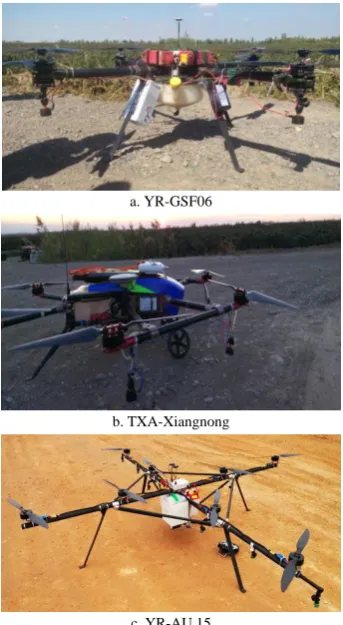
Cotton defoliant aerial spraying applications were performed by multiple-rotor UASs (Figure 1).
a. YR-GSF06
b. TXA-Xiangnong
c. YR-AU 15
Note: Four-rotor UAS (model no. YR-GSF06) and eight-rotor UAS (model no. YR-AU15) were provided by Xinjiang Tianshan Yuren Agricultural Aviation Technology Co., Ltd, China. The six-rotor UAS (model no. TXA-Xiangnong) was provided by Guangzhou Tianxiang Aviation Technology Co., Ltd, China.
Figure 1 Three types of UAS used in the experiments
The specifications of three UASs are shown in Table 1. UAS consist of spray bar, water-pump, water-pipe, nozzle and other components. Four flat-fan nozzles distribute on four spray bars of YR-GSF06, with space of 0.5 m, and perpendicular to the aircraft axes. Five flat-fan nozzles distribute on four spray bars of TXA-Xiangnong, with space of 0.5 m, and perpendicular to the aircraft axes. Six flat-fan nozzles distribute equidistantly along spray bar and perpendicular to the aircraft axis of YR-AU 15, with space of 0.5 m.
Table 1 Specifications of three types of UAS for experiments. Normally, size, weight, total volume, payload, nozzle, nozzle angle, liquid flow rate, spray pressure, application swath width and flight velocity are the main parameters which influence the
application efficacy and efficiency
Parameters
UAS
YR-GSF06 TAX-Xiangnong YR-AU 15 Size/mm×mm×mm 2185×2185×375 2396×600×300 3800×3800×850
Weight/kg 8.8 10 16.5
Payload/L 10 16 18
The number of Nozzles four flat-fan nozzles
five flat-fan nozzles
six flat-fan nozzles
Nozzle orifice/mm 0.6 0.6 0.6
Nozzle angle vertical vertical vertical Nozzle orientation downward downward downward Flowrate/L·min-1
9.6 (2.4×4) 12.0 (2.4×5) 14.4 (2.4×6)
Spray swath width/m 3-5 4-6 5-7
Time of endurance/min 13 13 12
Flight speed/m·s-1 0-8 0-6 0-8
The swath widths of three UASs were measured before the experiments. For this assessment, five rows with 21 equally spaced deposition locations were put in place. The aircraft sprayed over the central cards. Swath widths were evaluated based on the swath width analysis method described by Zhang et al.[18]
2.2 Tank mix
A tank mix in pesticide application includes one or more active ingredient products in a carrier such as water or oil, as well as any adjuvants intended to enhance the performance of the spray. Some of the most common cotton defoliants and adjuvants in China were used in this study, as follows: (1) Cotton defoliant Tuotulong, active ingredient 36% w/w Thidiazuron+18% w/w Diuron, provided by Bayer Crop Sciences, Monheim, Germany; (2) cotton defoliant Ruituolong, active ingredient: 80% w/w Thidiazuron, provided by Jiangsu Repont Pesticide Factory, China; (3) adjuvant Sujie, active gradient: 335 g/L Lecithin + 345 g/L methylacetic missible oil, provided by Kunsheng Agricultural Development Company, Fujian Province, China; (4) adjuvant Kesheng, a non-ionic adjuvant, active ingredient 30% w/w Tebuconazole + w/w 30% thiram, provided by Jiangsu Kesheng Group Limited Liability Company; (5) dedicated adjuvant for Ruituolong, an organosilicone adjuvant, provided by Repont Pesticide Factory, China; (6) Ethephon, 40% w/w Ethephon.
2.3 GNSS (Global Navigation Satellite System) station
the mobile station systems carried by itself.
2.4 Weather station
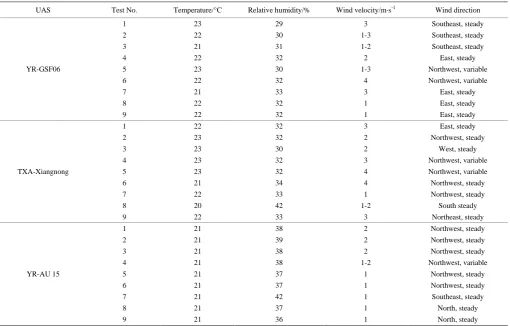
Meteorological conditions such as wind velocity, wind direction, air temperature and relative humidity are important factors affecting aerial and ground spraying. Given the dynamic nature of meteorological variables in the field, an ideal experimental design would be to apply all treatments simultaneously. However, this is usually not practical[20]. The flight route of the aircraft when spraying each treatment was set according to the local ambient wind direction. Meteorological variables were monitored using a Watch Dog Weather Station with sensors at a height of 4 m above ground. The weather station was positioned approximately 100 m downwind of the flight line directly alongside the sampling line[21,22].
2.5 Deposition cards
Spray coverage was assessed using deposition cards known as Water Sensitive Paper (WSP)[23] with the size of 26 mm×76 mm, provided by Syngenta. This paper is coated with a layer of Bromoethyl Blue which changes in color from yellow to blue when hydrated by water droplets, thereby, spray characteristic values such as droplet size, coverage, deposition density, deposition rate and other values could be obtained by image processing and other methods[24].
2.6 Experimental site arrangement
Cao et al.[25] suggested that the optimal dates for cotton defoliant spraying in north Xinjiang are normally around 5-15 September. On this basis, the spray applications were made on 5 September and the assessment dates for ranking cotton defoliation and boll opening rates were 5 September to 5 October. The test field is in the cotton base of China National Cotton Group, located at 87°17′87″E; 44°40′94″N, Changji Autonomous Prefecture, Xinjiang Uygur Autonomous Region, China. Field with uniform, orderly and stable vigor cotton plants was selected as experimental plots. The cotton variety for experiments was No. 9813 of Chinese cotton, which is one of main cotton varieties in North Xinjiang. The cotton plants were in boll opening stage, with average plant height of 50 cm and plant density of 14800 plants/hm2.
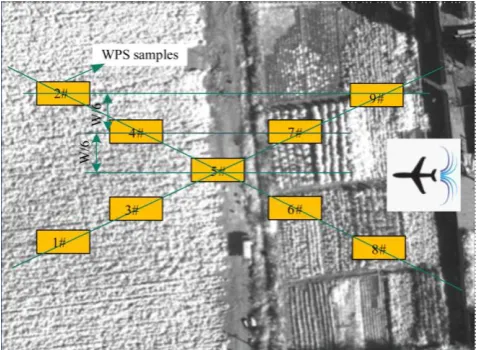
27 plots were setup for experiments (nine plots × three UAS), and the layout of each plot was 8 m×100 m, as shown in Figure 2. Nine sampling points were set for each experimental plot and arranged as a ‘X-shape’ layout. WSPs were placed in the lower region of the cotton canopy for assessing spray deposition, 10 cm above ground. Two contrast plots[26] (CK: control check group, and tractor spraying group) were set for cotton defoliation and boll opening rates contrasting with aerial spraying plots. The cotton plants in the CK plot were in natural growth without cotton defoliant application, and the Tractor Plot was sprayed by a ground boom application system had five flat fan nozzles (orifice 0.6 mm) per side spaced at 0.5 m intervals. The swath width was 5 m and spray pressure was 300 kPa. The spray mixture comprised two active ingredient products (Tuotulong 225+Ethephon 2250) mL/hm2. The application volume rate was 180 L/hm2, the forward velocity of the tractor was 1.2 m/s. L9(34) orthogonal arrays[27] were carried out for parameter optimization for three UAS. Factors and levels of orthogonal tests are shown in Table 2.
40-80 L/hm2 volume rate was observed as the optimal range of volume rate in the first year of study, then 48 L/hm2, 72 L/hm2, and 96 L/hm2 volumes rates were setup as spraying volumes in the second year of study. Tuotulong performed better than other cotton defoliant in cotton defoliation on No. 9813 of Chinese cotton, and it was selected in the second year of study. It was
observed in the first year of study that the optimal flight altitude for aerial spraying using UAS was 1.5-2.0 m. Pressures of 200 kPa, 300 kPa and 400 kPa corresponded to respective application volume rates of 48 L/hm2, 72 L/hm2 and 96 L/hm2. It should be noted that at higher spray pressures, the droplet size would be expected to get smaller which in turn could improve coverage based on prior research.
Note: 27 treatment plots were setup, and nine water sensitive paper samples were setup in bottom of cotton plants for droplets collection in each plot. 27 plots represented 27 treatments (nine treatments for each UAS respectively). The intervals of samples are W/6, W is the swath width of aircraft.
Figure 2 Layout of the plots
Table 2 Four factors: Volume rate (A), Tank mix and concentration (B), Flight altitude (C), Flight speed (D), and three levels of L9(34) orthogonal arrays[24] was used for sprays
optimization of cotton defoliant spraying using three types of UAS
Level
Factor A Factor B Factor C Factor D Volume
rate/L·hm-2
Tank mix and concentration/mL·hm-2
Flight altitude/m
Flight speed/m·s-1
1 96 Tuotulong 225+Ethephon 2250 1.5 1.0 2 72 Tuotulong 225 + Sujie 750
+Ethephon 2250 2.0 2.0
3 48 Tuotulong 225+Kesheng 750
+Ethephon 2250 2.5 3.0
2.7 Data processing and sprays assessing methods
After spraying, WSP samples were collected and placed in sealed bags once dry. They were scanned to produce 600 dpi digital images using a Canon 4200F scanner in the laboratory. DepositScan[28] software was used to obtain the droplet deposition characteristic values from the images. Spray application quality is commonly assessed by the droplet size spectrum, deposition density, percentage coverage and distribution uniformity across the swath[29,30]. In the present study, cotton defoliant sprays were assessed based on droplet coverage and CV[31,32]. CV was calculated to evaluate the distribution uniformity of droplets at each sampling point using the follow calculation formulae[33]:
100%
SD CV
X
(1)
i X X
n
(2)2 2 ( )
1
i i
X X
n SD
n
where, SD is the standard deviation of sampling points of each experimental plot; Xi is the droplet coverage at sampling points (the
percentage of droplets on WSP); X is the mean value of droplet coverage at each sampling point; n is the number of sampling points in each experimental plot.
Cotton defoliation and boll opening rates of experimental plots and control plots were assessed after 7 d, 14 d, and 25 d of spraying, using the following equations:
100%
a i
a
L L
Cotton defoliation rate L
(4)
100%
opening boll number Boll opening rate
boll number
(5)
where, La is the number of leaves before cotton defoliant spraying;
Li is the number of leaves after i days of cotton defoliant spraying.
Gray correlation analysis[34] was used for parameter optimization in this study. Gray correlation analysis can overcome the partiality of range and variance analysis. The following steps were carried out:
(1) Sequence setting: in this step, the reference sequence was set as X0={X0(1), X0(2), … X0(n)}, while experimental plot sequences were set as Xi={Xi(1), Xi(2), …Xi(n)}, where i is the test
number, which is from 1 to 9, and n is the index number which is 7 in this study.
(2) Data dimensionless procession: in this step, indices were
processed to be dimensionless using the equation 0( )
( ) i i X n X X n .
(3) Sequential difference value calculation: in this step, the difference values between experimental plot sequence and reference sequence were calculated to obtain the minimum and maximum difference values.
(4) Correlation coefficients between experimental plot sequences and reference sequence were calculated by the equation:
0 0
0 0
min min | ( ) ( ) | max max | ( ) ( ) | ( )
| ( ) ( ) | max max | ( ) ( ) |
j j
j i j i
i
j j
j i
x l x l P x l x l
η k
x k x k P x l x l
(6)
where, ηi(k) is correlation coefficient; |x0(k)–xj(k)| is the absolute
difference value between No. k index of No. j experimental plot and the value of No. k index of reference sequence;
0
min min | ( ) j( ) |
j i x l x l and min |i x l0( )x lj( ) | were the
minimum difference values of two-stage and one-stage respectively;
0
max max | ( ) j( ) |
j i x l x l is the two-stage maximum difference
value; P is the resolution ratio, the value of P was set to 0.5 in this study; |x0(l)|–xj(l)| is the absolute difference value between No. l
index of No. j of experimental plot and the value of No. l index of reference sequence.
(5) Correlation degrees: these aimed to observe the correlation level of different indices. The correlation degrees of each index for the three aircraft were calculated using the following equation:
1
1
( )
n
i k i
r η k
n
(7)where, ri is the correlation degree of index i.
(6) Weight coefficient calculation, correlation degrees were uniformized to obtain the weight coefficient of each index.
Spraying efficacy was assessed by droplet coverage, distribution uniformity, rates of cotton defoliation and boll opening. Working cost including tank mix cost and battery power consumption. The cost of water, Tuotulong, Ethephon, Sujie and
Kesheng are 0.0028 CNY/L, 0.15, 0.06, 0.26 and 0.14 CNY/mL respectively. Working efficiency is calculated by spraying swath width and flight speed of aircraft by the following equation:
E=S×W (8) where, E is efficiency, m2/s; S is flight speed, m/s; and W is swath width, m.
Droplet coverage, CV, cotton defoliation rate, boll opening rate, battery consumption, pesticide cost and working efficiency were set as seven indices for parameter optimization and numbered from 1# to 7#. Reference sequence and seven index sequences were set for the analysis of gray correlation degree.
3 Results and discussion
Experimental scenarios and results of three UASs are shown in Table 3. Statistical analysis, based on parameters of droplet coverage and distribution uniformity (CV), was assessed for four factors (Volume rate, Tank mix and concentration, Flight altitude and Flight speed).
3.1 Influence of meteorological variables on spray
As shown in Table 3, the CV of most experimental plots were under 40%, except in the 6th experimental plot of YR-GSF06, the CV was 40.46%. For the 5th and 6th experimental plots of TAX-Xiangnong, the CVs were 44.90% and 42.16% respectively. The meteorological data show that the wind velocity during the periods of these three experiments was 4 m/s, and the wind direction was not stable, suggesting that the uniformity of droplet distribution is influenced by the wind velocity and variability of wind direction. The observed increase of CV with wind velocity suggested that the droplet distribution became non-uniform when the wind velocity exceeded 4 m/s and the wind direction was not stable.
3.2 Analysis of cotton defoliation and boll opening rates
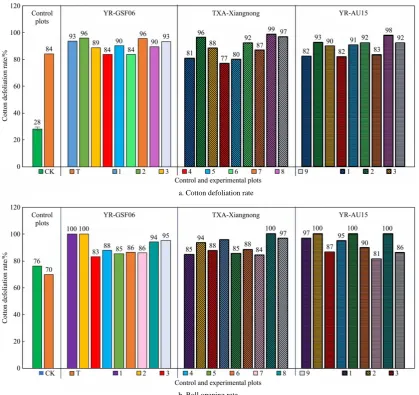
After 25 d of cotton defoliant application, the cotton defoliation and boll opening rates of CK group were 28% and 76% respectively, while respective values for the tractor plot were 84% and 70%. Figure 4 shows that all experimental plots (sprayed by aircraft) have greater cotton defoliation and boll opening rates than the CK plot. Most experimental plots have greater cotton defoliation and boll opening rates than the tractor spraying plot, except the cotton defoliation rates of 1st, 4th and 6th plots sprayed by YR-GFS06, 4th and 6th sprayed by TXA-Xiangnong. The 1st, 4th and 7th plots sprayed with YR-AU 15 show slightly lower defoliation and boll opening rates than respective values of the tractor plot. It was noticed that the 1st plot of YR-GFS06 and YR-AU 15, and 4th plot of three types of aircraft were sprayed without adjuvant. The wind velocity of 6th plots of YR-GFS06 and TXA-Xiangnong exceeded 4 m/s. The 7th plot of YR-AU 15 was sprayed without adjuvant and at the flight altitude of 2.5 m. Because these experimental plots leaded to relative lower cotton defoliation, it is proved that, adjuvant could improve spraying efficacy, high wind velocity (exceed 4 m/s) results in lower spraying efficacy, and 2.5 m flight altitude is not appropriate for cotton defoliant aerial spraying using UAS.
Table 3 Experimental scenarios and results of three UASs
Note: L9(34) orthogonal arrays were performed by YR-GSF06, TXA-Xiangnong and YR-AU 15 respectively, each UAS has performed nine treatments of cotton
defoliant spraying, parameters and results of each treatment are listed. VR, Volume Rate; TM, Tank Mix and concentration; FA, Flight Altitude; FS, Flight Speed; DC, Droplet Coverage; CV, Coefficient of Variance; PC, Power Consuming; C, Cost; E, Efficiency; OR, Overall rating (Score).
Table 4 Meteorological data were collected and recorded by the weather station throughout the experimental treatments
UAS Test No. Temperature/°C Relative humidity/% Wind velocity/m·s-1 Wind direction
YR-GSF06
1 23 29 3 Southeast, steady
2 22 30 1-3 Southeast, steady
3 21 31 1-2 Southeast, steady
4 22 32 2 East, steady
5 23 30 1-3 Northwest, variable
6 22 32 4 Northwest, variable
7 21 33 3 East, steady
8 22 32 1 East, steady
9 22 32 1 East, steady
TXA-Xiangnong
1 22 32 3 East, steady
2 23 32 2 Northwest, steady
3 23 30 2 West, steady
4 23 32 3 Northwest, variable
5 23 32 4 Northwest, variable
6 21 34 4 Northwest, steady
7 22 33 1 Northwest, steady
8 20 42 1-2 South steady
9 22 33 3 Northeast, steady
YR-AU 15
1 21 38 2 Northwest, steady
2 21 39 2 Northwest, steady
3 21 38 2 Northwest, steady
4 21 38 1-2 Northwest, variable
5 21 37 1 Northwest, steady
6 21 37 1 Northwest, steady
7 21 42 1 Southeast, steady
8 21 37 1 North, steady
9 21 36 1 North, steady
UAS Test
No. VR/L·hm
-2 TM/mL·hm-2 FA/m FS/m·s-1 DC/% CV/% PC/V C/CNY E/m2·s-1 OR
YR-GSF06
1 1(96) 1(Tuotulong 225) 1(1.5) 1(1.42) 10.51 37.82 1.35 169.0188 4.26 0.7370 2 1(96) 2(Tuotulong 225 +Sujie 750) 2(2.0) 2(2.33) 16.01 30.74 1.46 364.0188 9.32 0.7130 3 1(96) 3(Tuotulong 225 +Kesheng 750) 3(2.5) 3(3.12) 10.52 33.90 1.52 274.0188 15.60 0.7088 4 2(72) 1(Tuotulong 225) 2(2.0) 3(3.12) 4.32 25.07 1.11 168.9516 12.48 0.7559 5 2(72) 2(Tuotulong 225 +Sujie 750) 3(2.5) 1(1.42) 3.08 20.46 1.21 315.2016 7.10 0.6704 6 2(72) 3(Tuotulong 225 +Kesheng 750) 1(1.5) 2(2.33) 4.04 40.46 1.00 247.7016 6.99 0.5531 7 3(48) 1(Tuotulong 225) 3(2.5) 2(2.33) 1.84 27.42 0.92 168.8844 11.65 0.7615 8 3(48) 2(Tuotulong 225 +Sujie 750) 1(1.5) 3(3.12) 1.59 34.74 0.80 266.3844 9.36 0.8140*
9 3(48) 3(Tuotulong 225 +Kesheng 750) 2(2.0) 1(1.42) 2.48 25.14 0.88 221.3844 5.68 0.7432
TXA-Xiangnong
1 1(96) 1(Tuotulong 225) 1(1.5) 1(1.31) 10.92 15.42 2.84 169.0188 5.24 0.7927 2 1(96) 2(Tuotulong 225 +Sujie 750) 2(2.0) 2(2.01) 13.96 25.25 2.74 364.0188 10.05 0.7523 3 1(96) 3(Tuotulong 225 +Kesheng 750) 3(2.5) 3(2.51) 11.84 19.97 2.94 274.0188 15.06 0.7919 4 2(72) 1(Tuotulong 225) 2(2.0) 3(2.51) 3.62 44.90 2.10 168.9516 12.55 0.7529 5 2(72) 2(Tuotulong 225 +Sujie 750) 3(2.5) 1(1.31) 5.04 42.16 1.82 315.2016 7.86 0.6601 6 2(72) 3(Tuotulong 225 +Kesheng 750) 1(1.5) 2(2.01) 4.81 14.54 1.77 247.7016 8.04 0.7832 7 3(48) 1(Tuotulong 225) 3(2.5) 2(2.01) 1.47 26.24 1.25 168.8844 12.06 0.7940 8* 3(48) 2(Tuotulong 225 +Sujie 750) 1(1.5) 3(2.51) 2.48 28.37 1.11 266.3844 10.04 0.7941*
9 3(48) 3(Tuotulong 225 +Kesheng 750) 2(2.0) 1(1.31) 3.51 29.20 1.00 221.3844 6.55 0.7938
YR-AU 15
1 1(96) 1(Tuotulong 225) 1(1.5) 1(2.08) 7.63 30.35 2.85 169.0188 10.40 0.7987 2 1(96) 2(Tuotulong 225 +Sujie 750) 2(2.0) 2(2.79) 9.43 29.37 2.47 364.0188 16.74 0.7901 3 1(96) 3(Tuotulong 225 +Kesheng 750) 3(2.5) 3(3.76) 5.86 29.06 2.94 274.0188 26.32 0.7841 4 2(72) 1(Tuotulong 225) 2(2.0) 3(3.76) 4.65 32.92 2.19 168.9516 22.56 0.8114 5 2(72) 2(Tuotulong 225 +Sujie 750) 3(2.5) 1(2.08) 4.27 32.63 2.54 315.2016 14.56 0.7384 6 2(72) 3(Tuotulong 225 +Kesheng 750) 1(1.5) 2(2.79) 6.08 17.86 1.94 247.7016 13.95 0.8176 7 3(48) 1(Tuotulong 225) 3(2.5) 2(2.79) 3.10 30.69 1.23 168.8844 19.53 0.8121 8* 3(48) 2(Tuotulong 225 +Sujie 750) 1(1.5) 3(3.76) 1.65 35.48 0.90 266.3844 18.80 0.8194*
a. Cotton defoliation rate
b. Boll opening rate
Figure 3 Cotton defoliation rate and boll opening rate of experimental plots and control plots were investigated on the spraying day, 7 d, 14 d, and 25 d after the spraying day
a. CK plot b. plot spraying with ground rig c. plot spraying with UAS
Figure 4 Plots of CK, spraying with ground rig and UAS after 25 d of cotton defoliant application
3.3 Spray optimization
The present paper provides an assessment of spray performance to help guide optimization of parameters which can be controlled by an applicator such as application technique, acceptable meteorological conditions, selection of application volume rate,
tank mix and concentration, and the spraying system. It should be noted that this assessment is only a partial evaluation because any final decision-making on spraying will also depend on other factors such as cotton variety, UAS type and so on. The correlation degrees and weight coefficients[35] were calculated (Table 5).
Table 5 Correlation degrees and weight coefficients of seven indices
Aircrafts Indices 1 2 3 4 5 6 7
YR-GSF06 Correlation degree 0.5268 0.5886 0.9000 0.8726 0.6648 0.7334 0.6181
Weight coefficient 0.1074 0.1200 0.1835 0.1779 0.1356 0.1495 0.1260 TXA-Xiangnong Correlation degree 0.6889 0.6170 0.9297 0.9212 0.6023 0.7502 0.7283 Weight coefficient 0.1315 0.1178 0.1775 0.1759 0.1150 0.1432 0.1390
YR-AU 15 Correlation degree 0.7386 0.6326 0.9709 0.9441 0.5294 0.7624 0.7797
Overall rating of different experimental plots of three UASs are shown in Table 3. It could be concluded from the overall rating that the optimum parameters for the three UAS were: Volume rate (A3): 48 L/hm2, Tank mix and concentration (B2): (Tuotulong 225 + Sujie 275 + Ethephon 2250) mL/hm2, Flight altitude (C1): 1.5 m, Flight speeds (D3) for YR-GSF06, TXA-Xiangnong and YR-AU 15 were 3.12 m/s, 2.51 m/s, 3.76 m/s respectively.
4 Conclusions
Incremental field experiments have been conducted across a two year period to evaluate the relative spraying performance of aerial cotton defoliant applications using UASs of four-rotor, six-rotor and eight-rotor. Orthogonal test arrays of L9(34) were carried out for the field experiments. Gray correlation analysis was used for evaluating spraying efficacy and efficiency in order to recommend optimal setups and application scenarios.
It was observed that: (1) cotton defoliant aerial spraying using UAS is feasible and providing logistical advantages over ground spraying; (2) the optimal scenarios for the three aircraft under the use conditions in this study involve the application of a tank mix containing (Tuotulong 225 + Sujie 750 +Ethephon 2250) mL/hm2 at a total application volume rate of 48 L/hm2, with an aircraft flight altitude of 1.5 m. Optimal flight speeds for the three aircraft were as follows: YR-GSF06, 3.12 m/s, TAX, 2.51 m/s and YR-AU 3.76 m/s. The results of this study will facilitate the development of cotton defoliant aerial spraying in China using UAS.
The authors have tested a range of application scenarios that is typical at the time of this study. It should be noted that there are many more choices available to applicators which may give different performance than that observed in the present study and we do not intend to recommend or endorse any products over others. Our research has provided examples of some application scenarios. Applicators have a wide, and ever-growing choice of systems for their specific spraying, and additional research in the future should test additional cases as appropriate.
Acknowledgements
The authors acknowledge that this work was financially supported by the Science and Technology Plan of Guangdong
Province of China (Project No. 2017B090907031,
2017B090903007, 2015B020206003), and Innovative Research Team of Guangdong Province Agriculture Research System (2017LM2153).
[References]
[1] Liu H L. The reason for decreasing of cotton plant positivity. China Cooperation Times, 2013; 4: 1–2. (in Chinese)
[2] Gilbert C. Mechanization of Cotton Production since World War II. Agricultural History, 1980; 54(1):190-207.
[3] Hopkins A R, Taft H M. Control of cotton pests by aerial application of ultra-low-volume (undiluted) technical insecticides. Journal of Economic Entomology, 1967; 60(60): 561–565.
[4] Chester G, Ward R J. Occupational exposure and drift hazard during aerial application of paraquat to cotton. Arch Environ Contam Toxicol, 1984; 13(5): 551–563.
[5] Martin D E, Latheef M A. Aerial electrostatic spray deposition and canopy penetration in cotton. Journal of Electrostatics, 2017; 90: 38–44. [6] Johnstone D R, Johnstone K A. Aerial Spraying of Cotton in Swaziland.
Pans Pest Articles & News Summaries, 1977; 23(1): 13–26.
[7] Nicholls J W, Dorr G J, Woods N. Improving the ground and aerial application of pesticides in cotton: an Australian experience. Aspects of Applied Biology, 2004; 71: 509–515.
[8] Favoreto L, Faleiro V O, Freitas M A, Brauwers L R, Rafael G, Homiak J A, et al. First report of Aphelenchoides besseyi infecting aerial part of cotton plants in Brazil. Plant Disease, 2018.
[9] Xin F, Zhao J, Zhou Y, Wang G, Han X, Fu W, et al. Effects of dosage and spraying volume on cotton defoliants efficacy: a case study based on application of unmanned aerial vehicles. Agronomy, 2018; 85(8): 1–15. [10] He X, Bonds J, Herbst A, Langenakens, J. Recent development of
unmanned aerial vehicle for plant protection in East Asia. Int J Agric & Biol Eng, 2017; 10(3): 18–30.
[11] Stevens M N, Coloe B, Atkins E M. Platform-Independent geofencing for low altitude UAS operations: 15th AIAA Aviation Technology, Integration, and Operations Conference, Dallas, 2015.
[12] Wang S L, Song J L, He X K, Song L, Wang X N, Wang C L, et al. Performances evaluation of four typical unmanned aerial vehicles used for pesticide application in China. Int J Agric & Biol Eng, 2017; 10(4): 22–31.
[13] Czaczyk Z, Fritz B K, Hoffmann W C, Majewski S. Settings parameters for aerial pesticides application using Gyroplane: IX International Scientific Symposium on Farm Machinery and Processes Management in Sustainable Agriculture, Lublin, Poland, 2017.
[14] Lefebvre A H, McDonell V G. Atomization and sprays. Boca Raton, Florida: CRC Press, 2017.
[15] Gil E, Gallart M, Balsari P, Marucco P, Almajano M P, Llop J. Influence of wind velocity and wind direction on measurements of spray drift potential of boom sprayers using drift test bench. Agricultural and Forest Meteorology, 2015; 202: 94–101.
[16] Hewitt A J. Droplet size spectra classification categories in aerial application scenarios. Crop Protection, 2008; 27(9): 1284–1288. [17] Zhang J, He X K, Song J L, Zeng A J, Liu Y J, Li X F. Influence of
spraying parameters of unmanned aircraft on droplets deposition. Transactions of the CSAM, 2011; 43(12): 94–96. (in Chinese)
[18] Zhang D Y, Lan Y B, Chen L P, Hoffmann C W, Zhang R R, Xu G, et al. Measurement and analysis of aviation spraying key parameters for M-18B Dromader and Thrush 510G aircraft. 2014 ASABE and CSBE/SCGAB Annual International Meeting, Montreal, Quebec Canada, 2014.
[19] Chen S D, Lan Y B, Li J Y, Zhou Z Y, Liu A M. Effect of wind field below unmanned helicopter on droplet deposition distribution of aerial spraying. Int J Agric & Biol Eng, 2017; 10(3): 67–77.
[20] Hewitt A J, Johnson D R, Fish J D, Hermansky C G, Valcore D L. Development of the spray drift task force database for aerial application. Environmental Toxicology and Chemistry, 2002; 21(3): 648–658. [21] Fritz B K. Meteorological effects on deposition and drift of aerially
applied sprays. Transactions of the ASABE, 2006; 49(5): 1295–1301. [22] Brain R A, Perine J, Cooke C, Ellis C B, Harrington P, Lane A, et al.
Evaluating the effects of herbicide drift on nontarget terrestrial plants: A case study with mesotrione. Environmental Toxicology and Chemistry, 2017; 36(9): 2465–2475.
[23] Cerruto E, Failla S, Longo D, Longo D, Manetto G. Simulation of water sensitive papers for spray analysis. Agric Eng Int: CIGR Journal, 2016; 18(4): 22–29.
[24] Qin W C, Qiu B J, Xue X Y, Chen C, Xu Z F, Zhou Q Q. Droplet deposition and control effect of insecticides sprayed with an unmanned aerial vehicle against plant hoppers. Crop Protection, 2016; 85: 79–88. [25] Cao Y, Yan Y P, Feng Z X, Zhang Y, Zhu B, Guo H L, Fang R. Cotton
defoliant application test and methods analysis of efficacy improvement. Crops, 2012; 4: 144–147.
[26] Spina D, Ahluwalia A, Spina D, Ahluwalia A, Alexander S P A, Giembycz M A, et al. Experimental design and analysis and their reporting: new guidance for publication in BJP. British Journal of Pharmacology, 2015; 172(14): 3461–3471.
2018; 27(2): 281–286.
[28] Xu G, Chen L P, Zhang R R. An image processing system for evaluation of aerial application quality. Proceedings of the 2016 International Conference on Intelligent Information Processing, Wuhan, China, 2016. [29] Ferguson J C, Chechetto R G, O Donnell C C, Fritz B K, Hoffmann W C,
Coleman C E, et al. Assessing a novel smartphone application–SnapCard, compared to five imaging systems to quantify droplet deposition on artificial collectors. Computers and Electronics in Agriculture, 2016; 128: 193–198.
[30] Carroll J H. The effects of sprayer speed and droplet size on herbicide burndown efficacy. University of Arkansas, Arkansas, US, 2017. [31] Fritz B K, Hoffmann W C, Czaczyk Z, Bagley W, Henry R. Measuring
droplet size of agricultural spray nozzles-measurement distance and airspeed effects. Journal of Plant Protection Research, 2012; 52(4): 447–457.
[32] ANSI/ASAE S572.1. Spray nozzle classification by drop spectra. ASABE Standards, St. Joseph, MI, USA, 2009.
[33] MHT Standards 1040-2011: Determining application rates and distribution patterns from aerial application equipment, Beijing: MHT, 2011. [34] Shan Z C. The gray correlation analysis of agricultural products logistics
and its influence factors. Systems Engineering, 2012; 10: 19.