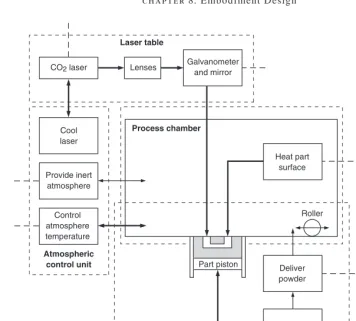
Chap.1 – The Engineering Design Process Chap.2 – The Product Development Process Chap.3 – Problem Defi nition and Need
Identifi cation
Chap.4 – Team Behavior and Tools Chap.5 – Gathering Information Chap.6 – Concept Generation
Chap.7 – Decision Making and Concept Selection
Chap.8 – Embodiment Design Chap.9 – Detail Design
Chap.10 – Modeling and Simulation
Chap.11 – Materials Selection Chap.12 – Design with Materials Chap.13 – Design for Manufacturing Chap.14 – Risk, Reliability, and Safety Chap.15 – Quality, Robust Design,
and Optimization Chap.16 – Cost Evaluation
Chap.17 – Legal and Ethical Issues in Engineering Design* Chap.18 – Economic Decision
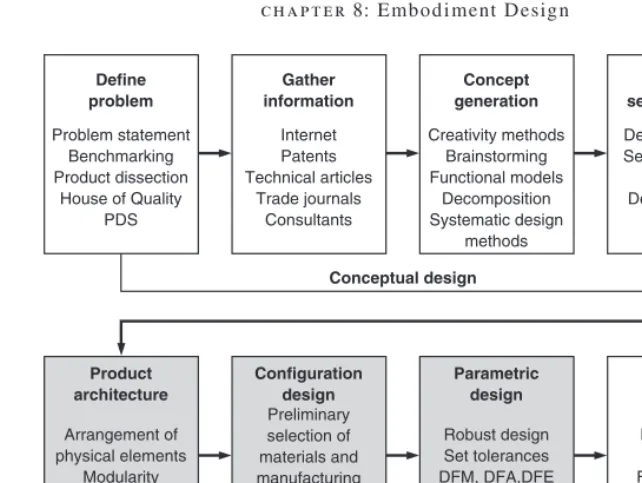
Making* *see www.mhhe.com/dieter Define problem Problem statement Benchmarking Product dissection
House of Quality PDS Gather information Conceptual design Internet Patents Technical articles Trade journals Consultants Concept generation Creativity methods Brainstorming Functional models Decomposition Systematic design methods Evaluate & select concept Decision making Selection criteria Pugh chart Decision matrix AHP Product architecture Arrangement of physical elements Modularity Configuration design Preliminary selection of materials and manufacturing processes Modeling Sizing of parts
Parametric design Robust design Set tolerances DFM, DFA, DFE
Tolerances Detail design Engineering drawings Finalize PDS Embodiment design
10 11 12
11 12
13 13 14 15 16 9 16
8
3 4 5
8
6 7
die37039_ch98_ifc.indd 1
die37039_ch00_fm.indd i
ENGINEERING DESIGN
FOURTH EDITION
George E . Dieter
University of Maryland
Linda C . Schmidt
University of Maryland
die37039_ch00_fm.indd iii
Published by McGraw-Hill, a business unit of The McGraw-Hill Companies, Inc., 1221 Avenue of the Americas, New York, NY 10020. Copyright © 2009 by The McGraw-Hill Companies, Inc. All rights reserved. Previous editions © 2000, 1991, 1983. No part of this publication may be reproduced or distributed in any form or by any means, or stored in a database or retrieval system, without the prior written consent of The McGraw-Hill Companies, Inc., including, but not limited to, in any network or other electronic storage or transmission, or broadcast for distance learning.
Some ancillaries, including electronic and print components, may not be available to customers outside the United States.
This book is printed on acid-free paper. 1 2 3 4 5 6 7 8 9 0 DOC/DOC 0 9 8 ISBN 978–0–07–283703–2
MHID 0–07–283703–9
Global Publisher: Raghothaman Srinivasan
Senior Sponsoring Editor: Bill Stenquist
Director of Development: Kristine Tibbetts
Developmental Editor: Lorraine K. Buczek
Senior Project Manager: Kay J. Brimeyer
Senior Production Supervisor: Laura Fuller
Associate Design Coordinator: Brenda A. Rolwes
Cover Designer: Studio Montage, St. Louis, Missouri
Cover Illustration: Paul Turnbaugh
(USE) Cover Image: Group of Students: © 2007, Al Santos, Photographer; Vacuum Roller: © Brian C. Grubel; Machinery: © John A. Rizzo/Getty Images; Gears and Machinery: © Nick Koudis/Getty Images; University Students Using Library Computers: BananaStock/ Jupiter Images
Compositor: Newgen
Typeface: 10.5/12 Times Roman
Printer: R. R. Donnelley Crawfordsville, IN
Library of Congress Cataloging-in-Publication Data
Dieter, George Ellwood.
Engineering design / George E. Dieter, Linda C. Schmidt. — 4th ed. p. cm.
Includes bibliographical references and indexes.
ISBN 978-0-07-283703-2 — ISBN 0-07-283703-9 (hard copy : alk. paper) 1. Engineering design. I. Schmidt, Linda C. II. Title.
TA174.D495 2009 620⬘.0042—dc22
2007049735
www.mhhe.com
die37039_ch00_fm.indd iv
ABOUT THE AUTHORS
G E O R G E E . D I E T E R is Glenn L. Martin Institute Professor of Engineering at the University of Maryland. The author received his B.S. Met.E. degree from Drexel University and his D.Sc. degree from Carnegie Mellon University. After a stint in industry with the DuPont Engineering Research Laboratory, he became head of the Metallurgical Engineering Department at Drexel University, where he later became Dean of Engineering. Professor Dieter later joined the faculty of Carnegie Mellon University as Professor of Engineering and Director of the Processing Research Insti-tute. He moved to the University of Maryland in 1977 as professor of Mechanical Engineering and Dean of Engineering, serving as dean until 1994.
Professor Dieter is a fellow of ASM International, TMS, AAAS, and ASEE. He has received the education award from ASM, TMS, and SME, as well as the Lamme Medal, the highest award of ASEE. He has been chair of the Engineering Deans Council, and president of ASEE. He is a member of the National Academy of Engi-neering. He also is the author of Mechanical Metallurgy, published by McGraw-Hill, now in its third edition.
L I N DA C . S C H M I D T is an Associate Professor in the Department of Mechani-cal Engineering at the University of Maryland. Dr. Schmidt’s general research inter-ests and publications are in the areas of mechanical design theory and methodology, design generation systems for use during conceptual design, design rationale capture, and effective student learning on engineering project design teams.
Dr. Schmidt completed her doctorate in Mechanical Engineering at Carnegie Mellon University with research in grammar-based generative design. She holds B.S. and M.S. degrees from Iowa State University for work in Industrial Engineering. Dr. Schmidt is a recipient of the 1998 U.S. National Science Foundation Faculty Early Career Award for generative conceptual design. She co-founded RISE, a summer research experience that won the 2003 Exemplary Program Award from the Amer-ican College Personnel Association’s Commission for Academic Support in Higher Education.
die37039_ch00_fm.indd v
Dr. Schmidt is active in engineering design theory research and teaching engi-neering design to third- and fourth-year undergraduates and graduate students in mechanical engineering. She has coauthored a text on engineering decision-making, two editions of a text on product development, and a team-training curriculum for faculty using engineering student project teams. Dr. Schmidt was the guest editor of the Journal of Engineering Valuation & Cost Analysis and has served as an Associ-ate Editor of the ASME Journal of Mechanical Design. Dr. Schmidt is a member of ASME, SME, and ASEE.
die37039_ch00_fm.indd vi
vii
BRIEF CONTENTS
Chapter 1
Engineering Design
1
Chapter 2
Product Development Process
39
Chapter 3
Problem
Defi nition and Need Identifi cation
75
Chapter 4
Team Behavior and Tools
116
Chapter 5
Gathering Information
158
Chapter 6
Concept Generation
196
Chapter 7
Decision Making and Concept Selection
262
Chapter 8
Embodiment Design
298
Chapter 9
Detail Design
386
Chapter 10
Modeling and Simulation
411
Chapter 11
Materials Selection
457
Chapter 12
Design with Materials
515
Chapter 13
Design for Manufacturing
558
Chapter 14
Risk, Reliability, and Safety
669
Chapter 15
Quality, Robust Design, and Optimization
723
Chapter 16
Cost Evaluation
779
Chapter 17
Legal and Ethical Issues in Engineering Design
828
Chapter 18
Economic Decision Making
858
Appendices
A-1
Author & Subject Indexes
I-1
die37039_ch00_fm.indd vii
viii
DETAILED CONTENTS
Preface xxiii
Chapter 1
Engineering Design
1
1.1 Introduction 1
1.2 Engineering Design Process 3
1.2.1 Importance of the Engineering Design Process 4
1.2.2 Types of Designs 5
1.3 Ways to Think About the Engineering Design Process 6
1.3.1 A Simplifi ed Iteration Model 6
1.3.2 Design Method Versus Scientifi c Method 8
1.3.3 A Problem-Solving Methodology 10
1.4 Considerations of a Good Design 14
1.4.1 Achievement of Performance Requirements 14
1.4.2 Total Life Cycle 17
1.4.3 Regulatory and Social Issues 18
1.5 Description of Design Process 19
1.5.1 Phase I. Conceptual Design 19
1.5.2 Phase II. Embodiment Design 20
1.5.3 Phase III. Detail Design 21
1.5.4 Phase IV. Planning for Manufacture 22 1.5.5 Phase V. Planning for Distribution 23
1.5.6 Phase VI. Planning for Use 23
1.5.7 Phase VII. Planning for Retirement of the
Product 23
1.6 Computer-Aided Engineering 24
1.7 Designing to Codes and Standards 26
1.8 Design Review 29
1.8.1 Redesign 30
1.9 Societal Considerations in Engineering Design 31
die37039_ch00_fm.indd viii
1.10 Summary 35
New Terms and Concepts 36
Bibliography 37
Problems and Exercises 37
Chapter 2
Product Development Process
39
2.1 Introduction 39
2.2 Product Development Process 39
2.2.1 Factors for Success 43
2.2.2 Static Versus Dynamic Products 46
2.2.3 Variations on the Generic Product Development
Process 46
2.3 Product and Process Cycles 47
2.3.1 Stages of Development of a Product 47 2.3.2 Technology Development and Insertion Cycle 48
2.3.3 Process Development Cycle 50
2.4 Organization for Design and Product Development 51
2.4.1 A Typical Organization by Functions 53
2.4.2 Organization by Projects 54
2.4.3 Hybrid Organizations 55
2.4.4 Concurrent Engineering Teams 57
2.5 Markets and Marketing 58
2.5.1 Markets 59
2.5.2 Market Segmentation 60
2.5.3 Functions of a Marketing Department 63
2.5.4 Elements of a Marketing Plan 63
2.6 Technological Innovation 64
2.6.1 Invention, Innovation, and Diffusion 64 2.6.2 Business Strategies Related to Innovation and
Product Development 67
2.6.3 Characteristics of Innovative People 68 2.6.4 Types of Technology Innovation 69
2.7 Summary 71
New Terms and Concepts 72
Bibliography 72
Problems and Exercises 73
Chapter 3
Problem Defi nition and Need Identifi cation
75
3.1 Introduction 75
3.2 Identifying Customer Needs 77
3.2.1 Preliminary Research on Customers Needs 79 3.2.2 Gathering Information from Customers 80
3.3 Customer Requirements 86
3.3.1 Differing Views of Customer Requirements 87 3.3.2 Classifying Customer Requirements 89
die37039_ch00_fm.indd ix
3.4 Establishing the Engineering Characteristics 91
3.4.1 Benchmarking in General 93
3.4.2 Competitive Performance Benchmarking 95 3.4.3 Reverse Engineering or Product Dissection 96
3.4.4 Determining Engineering Characteristics 97
3.5 Quality Function Deployment 98
3.5.1 The House of Quality Confi gurations 100 3.5.2 Steps for Building a House of Quality 102
3.5.3 Interpreting Results of HOQ 107
3.6 Product Design Specifi cation 109
3.7 Summary 111
Bibliography 113
New Terms and Concepts 114
Problems and Exercises 114
Chapter 4 Team Behavior and Tools
116
4.1 Introduction 116
4.2 What It Means to be an Effective Team Member 117
4.3 Team Roles 118
4.4 Team Dynamics 119
4.5 Effective Team Meetings 122
4.5.1 Helpful Rules for Meeting Success 123
4.6 Problems with Teams 124
4.7 Problem-Solving Tools 126
4.7.1 Applying the Problem-Solving Tools in Design 140
4.8 Time Management 145
4.9 Planning and Scheduling 146
4.9.1 Work Breakdown Structure 147
4.9.2 Gantt Chart 147
4.9.3 Critical Path Method 149
4.10 Summary 154
New Terms and Concepts 155
Bibliography 155
Problems and Exercises 156
Chapter 5 Gathering Information
158
5.1 The Information Challenge 158
5.1.1 Your Information Plan 159
5.1.2 Data, Information, and Knowledge 160
5.2 Types of Design Information 162
5.3 Sources of Design Information 162
5.4 Library Sources of Information 166
5.4.1 Dictionaries and Encyclopedias 167
5.4.2 Handbooks 169
5.4.3 Textbooks and Monographs 169
die37039_ch00_fm.indd x
5.4.4 Finding Periodicals 169 5.4.5 Catalogs, Brochures, and Business Information 171
5.5 Government Sources of Information 171
5.6 Information From the Internet 172
5.6.1 Searching with Google 174
5.6.2 Some Helpful URLs for Design 176
5.6.3 Business-Related URLs for Design and
Product Development 178
5.7 Professional Societies and Trade Associations 180
5.8 Codes and Standards 181
5.9 Patents and Other Intellectual Property 183
5.9.1 Intellectual Property 184
5.9.2 The Patent System 185
5.9.3 Technology Licensing 187
5.9.4 The Patent Literature 187
5.9.5 Reading a Patent 189
5.9.6 Copyrights 191
5.10 Company-Centered Information 192
5.11 Summary 193
New Terms and Concepts 194
Bibliography 194
Problems and Exercises 194
Chapter 6
Concept Generation
196
6.1 Introduction to Creative Thinking 197
6.1.1 Models of the Brain and Creativity 197 6.1.2 Thinking Processes that Lead to Creative Ideas 201
6.2 Creativity and Problem Solving 202
6.2.1 Aids to Creative Thinking 202
6.2.2 Barriers to Creative Thinking 205
6.3 Creative Thinking Methods 208
6.3.1 Brainstorming 208
6.3.2 Idea Generating Techniques Beyond Brainstorming 210
6.3.3 Random Input Technique 212
6.3.4 Synectics: An Inventive Method Based on
Analogy 213
6.3.5 Concept Map 215
6.4 Creative Methods for Design 217
6.4.1 Refi nement and Evaluation of Ideas 217
6.4.2 Generating Design Concepts 219
6.4.3 Systematic Methods for Designing 221
6.5 Functional Decomposition and Synthesis 222
6.5.1 Physical Decomposition 223
6.5.2 Functional Representation 225
6.5.3 Performing Functional Decomposition 229 6.5.4 Strengths and Weaknesses of Functional Synthesis 232
die37039_ch00_fm.indd xi
6.6 Morphological Methods 233 6.6.1 Morphological Method for Design 234 6.6.2 Generating Concepts from Morphological Chart 236
6.7 TRIZ: The Theory of Inventive Problem Solving 237
6.7.1 Invention: Evolution to Increased Ideality 238 6.7.2 Innovation by Overcoming Contradictions 239
6.7.3 TRIZ Inventive Principles 240
6.7.4 The TRIZ Contradiction Matrix 243
6.7.5 Strengths and Weaknesses of TRIZ 247
6.8 Axiomatic Design 249
6.8.1 Axiomatic Design Introduction 249
6.8.2 The Axioms 250
6.8.3 Using Axiomatic Design to Generate a Concept 251 6.8.4 Using Axiomatic Design to Improve an
Existing Concept 253
6.8.5 Strengths and Weaknesses of Axiomatic Design 257
6.9 Summary 258
New Terms and Concepts 259
Bibliography 260
Problems and Exercises 260
Chapter 7 Decision Making and Concept Selection
262
7.1 Introduction 262
7.2 Decision Making 263
7.2.1 Behavioral Aspects of Decision Making 263
7.2.2 Decision Theory 266
7.2.3 Utility Theory 269
7.2.4 Decision Trees 273
7.3 Evaluation Methods 274
7.3.1 Comparison Based on Absolute Criteria 275
7.3.2 Pugh Concept Selection Method 277
7.3.3 Measurement Scales 280
7.3.4 Weighted Decision Matrix 282
7.3.5 Analytic Hierarchy Process (AHP) 285
7.4 Summary 292
New Terms and Concepts 294
Bibliography 294
Problems and Exercises 294
Chapter 8
Embodiment Design
298
8.1 Introduction 298
8.1.1 Comments on Nomenclature Concerning
the Phases of the Design Process 299
8.1.2 Oversimplifi cation of the Design Process Model 300
die37039_ch00_fm.indd xii
8.2 Product Architecture 301
8.2.1 Types of Modular Architectures 303
8.2.2 Modularity and Mass Customization 303 8.2.3 Create the Schematic Diagram of the Product 305 8.2.4 Cluster the Elements of the Schematic 306
8.2.5 Create a Rough Geometric Layout 307
8.2.6 Defi ne Interactions and Determine Performance
Characteristics 308
8.3 Confi guration Design 309
8.3.1 Generating Alternative Confi gurations 312 8.3.2 Analyzing Confi guration Designs 315 8.3.3 Evaluating Confi guration Designs 315
8.4 Best Practices for Confi guration Design 316
8.4.1 Design Guidelines 317
8.4.2 Interfaces and Connections 321
8.4.3 Checklist for Confi guration Design 324
8.4.4 Design Catalogs 325
8.5 Parametric Design 325
8.5.1 Systematic Steps in Parametric Design 326 8.5.2 A Parametric Design Example: Helical Coil
Compression Spring 328
8.5.3 Design for Manufacture (DFM) and Design for
Assembly (DFA) 336
8.5.4 Failure Modes and Effects Analysis (FMEA) 337 8.5.5 Design for Reliability and Safety 337 8.5.6 Design for Quality and Robustness 338
8.6 Dimensions and Tolerances 338
8.6.1 Dimensions 339
8.6.2 Tolerances 340
8.6.3 Geometric Dimensioning and Tolerancing 350 8.6.4 Guidelines for Tolerance Design 355
8.7 Industrial Design 356
8.7.1 Visual Aesthetics 357
8.8 Human Factors Design 358
8.8.1 Human Physical Effort 359
8.8.2 Sensory Input 361
8.8.3 Anthropometric Data 364
8.8.4 Design for Serviceability 364
8.9 Design for the Environment 365
8.9.1 Life Cycle Design 366
8.9.2 Design for the Environment (DFE) 368
8.9.3 DFE Scoring Methods 370
8.10 Prototyping and Testing 370
8.10.1 Prototype and Model Testing Throughout the
Design Process 371
8.10.2 Building Prototypes 372
die37039_ch00_fm.indd xiii
8.10.3 Rapid Prototyping 373
8.10.4 RP Processes 374
8.10.5 Testing 377
8.10.6 Statistical Design of Testing 378
8.11 Design for X (DFX) 380
8.12 Summary 382
New Terms and Concepts 382
Bibliography 383
Problems and Exercises 383
Chapter 9 Detail Design
386
9.1 Introduction 386
9.2 Activities and Decisions in Detail Design 387
9.3 Communicating Design and Manufacturing Information 391
9.3.1 Engineering Drawings 391
9.3.2 Bill of Materials 394
9.3.3 Written Documents 395
9.3.4 Common Challenges in Technical Writing 398
9.3.5 Meetings 399
9.3.6 Oral Presentations 400
9.4 Final Design Review 402
9.4.1 Input Documents 402
9.4.2 Review Meeting Process 403
9.4.3 Output from Review 403
9.5 Design and Business Activities Beyond Detail Design 403
9.6 Facilitating Design and Manufacturing with
Computer-Based Methods 406
9.6.1 Product Lifecycle Management (PLM) 407
9.7 Summary 408
New Terms and Concepts 408
Bibliography 409
Problems and Exercises 409
Chapter 10 Modeling and Simulation
411
10.1 The Role of Models in Engineering Design 411
10.1.1 Types of Models 412
10.1.2 Iconic, Analog, and Symbolic Models 413
10.2 Mathematical Modeling 414
10.2.1 The Model-Building Process 414
10.3 Dimensional Analysis 423
10.3.1 Similitude and Scale Models 425
10.4 Finite-Difference Method 429
10.5 Geometric Modeling on the Computer 432
10.6 Finite Element Analysis 434
10.6.1 The Concept Behind FEA 435
10.6.2 Types of Elements 439
die37039_ch00_fm.indd xiv
10.6.3 Steps in the FEA Process 442
10.6.4 Current Practice 444
10.7 Simulation 446
10.7.1 Introduction to Simulation Modeling 446
10.7.2 Simulation Programming Software 447
10.7.3 Monte Carlo Simulation 449
10.8 Summary 452
New Terms and Concepts 453
Bibliography 454
Problems and Exercises 454
Chapter 11
Materials Selection
457
11.1 Introduction 457
11.1.1 Relation of Materials Selection to Design 458
11.1.2 General Criteria for Selection 460
11.1.3 Overview of the Materials Selection Process 460
11.2 Performance Characteristics of Materials 461
11.2.1 Classifi cation of Materials 462
11.2.2 Properties of Materials 463
11.2.3 Specifi cation of Materials 470
11.2.4 Ashby Charts 471
11.3 The Materials Selection Process 472
11.3.1 Design Process and Materials Selection 474 11.3.2 Materials Selection in Conceptual Design 476 11.3.3 Materials Selection in Embodiment Design 476
11.4 Sources of Information on Materials Properties 478
11.4.1 Conceptual Design 479
11.4.2 Embodiment Design 479
11.4.3 Detail Design 482
11.5 Economics of Materials 482
11.5.1 Cost of Materials 482
11.5.2 Cost Structure of Materials 485
11.6 Overview of Methods of Materials Selection 486
11.7 Selection with Computer-Aided Databases 487
11.8 Material Performance Indices 488
11.8.1 Material Performance Index 489
11.9 Materials Selection with Decision Matrices 494
11.9.1 Pugh Selection Method 495
11.9.2 Weighted Property Index 496
11.10 Design Examples 499
11.11 Recycling and Materials Selection 503
11.11.1 Benefi ts from Recycling 504
11.11.2 Steps in Recycling 504
11.11.3 Design for Recycling 506
11.11.4 Material Selection for Eco-attributes 508
die37039_ch00_fm.indd xv
11.12 Summary 510
New Terms and Concepts 511
Bibliography 512
Problems and Exercises 512
Chapter 12
Design with Materials
515
12.1 Introduction 515
12.2 Design for Brittle Fracture 516
12.2.1 Plane Strain Fracture Toughness 518
12.2.2 Limitations on Fracture Mechanics 522
12.3 Design for Fatigue Failure 523
12.3.1 Fatigue Design Criteria 524
12.3.2 Fatigue Parameters 525
12.3.3 Information Sources on Design for Fatigue 528
12.3.4 Infi nite Life Design 529
12.3.5 Safe-Life Design Strategy 531
12.3.6 Damage-Tolerant Design Strategy 536
12.3.7 Further Issues in Fatigue Life Prediction 538
12.4 Design for Corrosion Resistance 539
12.4.1 Basic Forms of Corrosion 539
12.4.2 Corrosion Prevention 541
12.5 Design Against Wear 544
12.5.1 Types of Wear 544
12.5.2 Wear Models 546
12.5.3 Wear Prevention 547
12.6 Design with Plastics 549
12.6.1 Classifi cation of Plastics and Their Properties 549
12.6.2 Design for Stiffness 552
12.6.3 Time-Dependent Part Performance 553
12.7 Summary 555
New Terms and Concepts 556
Bibliography 556
Problems and Exercises 556
Chapter 13 Design for Manufacturing
558
13.1 Role of Manufacturing in Design 558
13.2 Manufacturing Functions 560
13.3 Classifi cation of Manufacturing Processes 562
13.3.1 Types of Manufacturing Processes 563
13.3.2 Brief Description of the Classes of Manufacturing
Processes 564
13.3.3 Sources of Information on Manufacturing
Processes 565
13.3.4 Types of Manufacturing Systems 565
13.4 Manufacturing Process Selection 568
13.4.1 Quantity of Parts Required 569
13.4.2 Shape and Feature Complexity 573
die37039_ch00_fm.indd xvi
13.4.3 Size 576 13.4.4 Infl uence of Material on Process Selection 577
13.4.5 Required Quality of the Part 579
13.4.6 Cost to Manufacture 583
13.4.7 Availability, Lead Time, and Delivery 586 13.4.8 Further Information for Process Selection 586
13.5 Design for Manufacture (DFM) 593
13.5.1 DFM Guidelines 594
13.5.2 Specifi c Design Rules 597
13.6 Design for Assembly (DFA) 597
13.6.1 DFA Guidelines 598
13.7 Role of Standardization in DFMA 601
13.7.1 Benefi ts of Standardization 601
13.7.2 Achieving Part Standardization 603
13.7.3 Group Technology 603
13.8 Mistake-Proofi ng 606
13.8.1 Using Inspection to Find Mistakes 606
13.8.2 Frequent Mistakes 607
13.8.3 Mistake-Proofi ng Process 608
13.8.4 Mistake-Proofi ng Solutions 609
13.9 Early Estimation of Manufacturing Cost 610
13.10 Computer Methods for DFMA 617
13.10.1 DFA Analysis 617
13.10.2 Concurrent Costing with DFM 620
13.10.3 Process Modeling and Simulation 624
13.11 Design of Castings 624
13.11.1 Guidelines for the Design of Castings 626
13.11.2 Producing Quality Castings 627
13.12 Design of Forgings 629
13.12.1 DFM Guidelines for Closed-Die Forging 631
13.12.2 Computer-Aided Forging Design 632
13.13 Design for Sheet-Metal Forming 633
13.13.1 Sheet Metal Stamping 633
13.13.2 Sheet Bending 634
13.13.3 Stretching and Deep Drawing 635
13.13.4 Computer-Aided Sheet Metal Design 637
13.14 Design of Machining 637
13.14.1 Machinability 640
13.14.2 DFM Guidelines for Machining 640
13.15 Design of Welding 643
13.15.1 Joining Processes 643
13.15.2 Welding Processes 643
13.15.3 Welding Design 646
13.15.4 Cost of Joining 649
13.16 Residual Stresses in Design 650
13.16.1 Origin of Residual Stresses 650
13.16.2 Residual Stress Created by Quenching 652
die37039_ch00_fm.indd xvii
13.16.3 Other Issues Regarding Residual Stresses 654
13.16.4 Relief of Residual Stresses 656
13.17 Design for Heat Treatment 656
13.17.1 Issues with Heat Treatment 657
13.17.2 DFM for Heat Treatment 658
13.18 Design for Plastics Processing 659
13.18.1 Injection Molding 659
13.18.2 Extrusion 660
13.18.3 Blow Molding 661
13.18.4 Rotational Molding 661
13.18.5 Thermoforming 661
13.18.6 Compression Molding 661
13.18.7 Casting 662
13.18.8 Composite Processing 662
13.18.9 DFM Guidelines for Plastics Processing 663
13.19 Summary 664
New Terms and Concepts 666
Bibliography 666
Problems and Exercises 666
Chapter 14
Risk, Reliability, and Safety
669
14.1 Introduction 669
14.1.1 Regulation as a Result of Risk 671
14.1.2 Standards 672
14.1.3 Risk Assessment 673
14.2 Probabilistic Approach to Design 674
14.2.1 Basic Probability Using the Normal Distribution 675
14.2.2 Sources of Statistical Tables 677
14.2.3 Frequency Distributions Combining Applied
Stress and Material Strength 677
14.2.4 Variability in Material Properties 679
14.2.5 Probabilistic Design 682
14.2.6 Safety Factor 684
14.2.7 Worst-Case Design 685
14.3 Reliability Theory 685
14.3.1 Defi nitions 688
14.3.2 Constant Failure Rate 688
14.3.3 Weibull Frequency Distribution 690 14.3.4 Reliability with a Variable Failure Rate 692
14.3.5 System Reliability 696
14.3.6 Maintenance and Repair 699
14.3.7 Further Topics 700
14.4 Design for Reliability 701
14.4.1 Causes of Unreliability 703
14.4.2 Minimizing Failure 703
14.4.3 Sources of Reliability Data 706
14.4.4 Cost of Reliability 706
die37039_ch00_fm.indd xviii
14.5 Failure Mode and Effects Analysis (FMEA) 707
14.5.1 Making a FMEA Analysis 710
14.6 Defects and Failure Modes 712
14.7.1 Causes of Hardware Failure 713
14.7.2 Failure Modes 713
14.7.3 Importance of Failure 715
14.7 Design for Safety 715
14.9.1 Potential Dangers 716
14.9.2 Guidelines for Design for Safety 717
14.9.3 Warning Labels 718
14.8 Summary 718
New Terms and Concepts 719
Bibliography 719
Problems and Exercises 720
Chapter 15 Quality, Robust Design, and Optimization
723
15.1 The Concept of Total Quality 723
15.1.1 Defi nition of Quality 724
15.1.2 Deming’s 14Points 725
15.2 Quality Control and Assurance 726
15.2.1 Fitness for Use 726
15.2.2 Quality-Control Concepts 727
15.2.3 Newer Approaches to Quality Control 729
15.2.4 Quality Assurance 729
15.2.5 ISO 9000 730
15.3 Quality Improvement 730
15.3.1 Pareto chart 731
15.3.2 Cause-and-Effect Diagram 732
15.4 Process Capability 734
15.4.1 Six Sigma Quality Program 738
15.5 Statistical Process Control 739
15.5.1 Control Charts 739
15.5.2 Other Types of Control Charts 742
15.5.3 Determining Process Statistics from
Control Charts 743
15.6 Taguchi Method 743
15.6.1 Loss Function 744
15.6.2 Noise Factors 747
15.6.3 Signal-to-Noise Ratio 748
15.7 Robust Design 749
15.7.1 Parameter Design 749
15.7.2 Tolerance Design 755
15.8 Optimization Methods 755
15.8.1 Optimization by Differential Calculus 758
15.8.2 Search Methods 762
15.8.3 Nonlinear Optimization Methods 767
15.8.4 Other Optimization Methods 770
die37039_ch00_fm.indd xix
15.9 Design Optimization 772
15.10 Summary 774
New Terms and Concepts 775
Bibliography 775
Problems and Exercises 775
Chapter 16
Cost Evaluation
779
16.1 Introduction 779
16.2 Categories of Costs 780
16.3 Overhead Cost 784
16.4 Activity-Based Costing 787
16.5 Methods of Developing Cost Estimates 789
16.5.1 Analogy 790
16.5.2 Parametric and Factor Methods 790
16.5.3 Detailed Methods Costing 791
16.6 Make-Buy Decision 795
16.7 Manufacturing Cost 796
16.8 Product Profi t Model 797
16.8.1 Profi t Improvement 801
16.9 Refi nements to Cost Analysis Methods 802
16.9.1 Cost Indexes 802
16.9.2 Cost-Size Relationships 803
16.9.3 Learning Curve 805
16.10 Design to Cost 808
16.10.1 Order of Magnitude Estimates 809 16.10.2 Costing in Conceptual Design 809
16.11 Value Analysis in Costing 811
16.12 Manufacturing Cost Models 814
16.12.1 Machining Cost Model 814
16.13 Life Cycle Costing 818
16.14 Summary 822
New Terms and Concepts 823
Bibliography 823
Problems and Exercises 823
Chapter 17 Legal and Ethical Issues in Engineering Design
(see www.mhhe.com/dieter)
828
17.1 Introduction 828
17.2 The Origin of Laws 829
17.3 Contracts 830
17.3.1 Types of Contracts 830
17.3.2 General Form of a Contract 831
17.3.3 Discharge and Breach of Contract 832
17.4 Liability 833
17.5 Tort Law 834
die37039_ch00_fm.indd xx
17.6 Product Liability 835 17.6.1 Evolution of Product Liability Law 836
17.6.2 Goals of Product Liability Law 836
17.6.3 Negligence 837
17.6.4 Strict Liability 837
17.6.5 Design Aspect of Product Liability 838 17.6.6 Business Procedures to Minimize Risk of
Product Liability 839
17.6.7 Problems with Product Liability Law 839
17.7 Protecting Intellectual Property 840
17.8 The Legal and Ethical Domains 841
17.9 Codes of Ethics 843
17.9.1 Profession of Engineering 844
17.9.2 Codes of Ethics 844
17.9.3 Extremes of Ethical Behavior 848
17.10 Solving Ethical Confl icts 848
17.10.1 Whistleblowing 850
17.10.2 Case Studies 851
17.11 Summary 852
New Terms and Concepts 854
Bibliography 854
Problems and Exercises 855
Chapter 18 Economic Decision Making
(see www.mhhe.com/dieter)858
18.1 Introduction 858
18.2 Mathematics of Time Value of Money 859
18.2.1 Compound Interest 859
18.2.2 Cash Flow Diagram 861
18.2.3 Uniform Annual Series 862
18.2.4 Irregular Cash Flows 865
18.3 Cost Comparison 867
18.3.1 Present Worth Analysis 867
18.3.2 Annual Cost Analysis 869
18.3.3 Capitalized Cost Analysis 870
18.3.4 Using Excel Functions for Engineering
Economy Calculation 872
18.4 Depreciation 872
18.4.1 Straight-Line Depreciation 873
18.4.2 Declining-Balance Depreciation 874
18.4.3 Sum-of-Years-Digits Depreciation 874 18.4.4 Modifi ed Accelerated Cost Recovery
System (MACRS) 874
18.5 Taxes 876
18.6 Profi tability Of Investments 880
18.6.1 Rate of Return 880
18.6.2 Payback Period 882
die37039_ch00_fm.indd xxi
18.6.3 Net Present Worth 882
18.6.4 Internal Rate of Return 883
18.7 Other Aspects of Profi tability 887
18.8 Infl ation 888
18.9 Sensitivity and Break-Even Analysis 891
18.10 Uncertainty in Economic Analysis 892
18.11 Benefi t-Cost Analysis 894
18.12 Summary 896
New Terms and Concepts 898
Bibliography 898
Problems and Exercises 898
Appendices
A-1
Author & Subject Indexes
I-1
die37039_ch00_fm.indd xxii
xxiii
PREFACE TO FOURTH EDITION
T h e f o u r t h e d i t i o n of Engineering Design represents the reorganization and expansion of the topics and the introduction of a coauthor, Dr. Linda Schmidt of the Mechanical Engineering Department, University of Maryland. As in previous editions, Engineering Design is intended to provide a realistic understanding of the engineer-ing design process. It is broader in content than most design texts, but it now contains more prescriptive guidance on how to carry out design. The text is intended to be used in either a junior or senior engineering course with an integrated hands-on design project. The design process material is presented in a sequential format in Chapters 1 through 9. At the University of Maryland we use Chapters 1 through 9 with junior students in a course introducing the design process. Chapters 10 through 17 present more intense treatment of sophisticated design content, including materials selection, design for manufacturing, and quality. The complete text is used in the senior capstone design course that includes a complete design project from selecting a market to creat-ing a workcreat-ing prototype. Students move quickly through the first nine chapters and emphasize chapters 10 through 17 for making embodiment design decisions.
The authors recognize deterrents to learning the design process. Design is a complex process to teach in a short amount of time. Students are aware of a myr-iad of design texts and tools and become overwhelmed with the breadth of design approaches. One challenge of the design instructor’s task is to convey to the student that engineering design is not a mathematical equation to be solved or optimized. Another is to provide students with a cohesive structure for the design process that they can use with a variety of design methods and software packages. Toward that end, we have adopted a uniform terminology throughout and reinforced this with a new section at the end of each chapter on New Terms and Concepts. We have empha-sized a cohesive eight-step engineering design process and present all material in the context of how it is applied. Regardless, we are strong in the belief that to learn design you must do design. We have found that Chapter 4, Team Behavior and Tools, is help-ful to the students in this regard. Likewise, we hope that the expanded discussion of design tools like benchmarking, QFD, creativity methods, functional decomposition
die37039_ch00_fm.indd xxiii
and synthesis, and the decision process and decision tools will benefi t the students who read this book.
Many new topics have been added or expanded. These include: work break-down structure, tolerances (including GD&T), human factors design, rapid prototyp-ing, design against wear, the role of standardization in DFMA, mistake-proofi ng, Six Sigma quality, and the make-buy decision. Finally we have introduced different approaches to the steps of design so that students appreciate the range of practice and scholarship on the topic of engineering design.
The authors hope that students will consider this book to be a valuable part of their professional library. In order to enhance its usefulness for that purpose, many references to the literature have been included, as well as suggestions for useful design software and references to websites. Many of the references have been updated, all of the websites from the third edition have been checked for currency, and many new ones have been added. In a book that covers such a wide sweep of material it has not always been possible to go into depth on every topic. Where expansion is appropriate, we have given a reference to at least one authoritative source for further study.
Special thanks go to Amir Baz, Patrick Cunniff, James Dally, Abhijit Dasgupta, S.K. Gupta, Patrick McCloskey, and Guangming Zhang, our colleagues in the Mechan-ical Engineering Department, University of Maryland, for their willingness to share their knowledge with us. Thanks also go to Greg Moores of Black & Decker, Inc. for his willingness to share his industrial viewpoint on certain topics. We must also thank the following reviewers for their many helpful comments and suggestions: Charles A. Bollfrass, Texas A&M University; Peter Jones, Auburn University; Cesar A. Luongo, Florida State University; Dr. Michelle Nearon, Stony Brook University; John E. Renaud, University of Notre Dame; Robert Sterlacci, Binghamton University; Daniel T. Valentine, Clarkson University; and Savas Yavuzkurt, Penn State University.
George E . Dieter and Linda C . Schmidt College Park, MD
2007
die37039_ch00_fm.indd xxiv
1
1
ENGINEERING DESIGN
1.1
INTRODUCTION
What is design? If you search the literature for an answer to that question, you will fi nd about as many defi nitions as there are designs. Perhaps the reason is that the pro-cess of design is such a common human experience. Webster’s dictionary says that to design is “to fashion after a plan,” but that leaves out the essential fact that to design is to create something that has never been. Certainly an engineering designer practices design by that defi nition, but so does an artist, a sculptor, a composer, a playwright, or many another creative member of our society.
Thus, although engineers are not the only people who design things, it is true that the professional practice of engineering is largely concerned with design; it is often said that design is the essence of engineering. To design is to pull together something new or to arrange existing things in a new way to satisfy a recognized need of soci-ety. An elegant word for “pulling together” is synthesis . We shall adopt the following formal defi nition of design: “Design establishes and defi nes solutions to and pertinent structures for problems not solved before, or new solutions to problems which have previously been solved in a different way.” 1 The ability to design is both a science and an art. The science can be learned through techniques and methods to be covered in this text, but the art is best learned by doing design. It is for this reason that your de-sign experience must involve some realistic project experience.
The emphasis that we have given to the creation of new things in our introduction to design should not unduly alarm you. To become profi cient in design is a perfectly attainable goal for an engineering student, but its attainment requires the guided ex-perience that we intend this text to provide. Design should not be confused with dis-covery. Discovery is getting the fi rst sight of, or the fi rst knowledge of something, as
1. J. F . Blumrich , Science, vol. 168, pp. 1551–1554 , 1970 .
die37039_ch01.indd 1
1
when Columbus discovered America or Jack Kilby made the fi rst microprocessor. We can discover what has already existed but has not been known before, but a design is the product of planning and work. We will present a structured design process to as-sist you in doing design in Sec. 1.5.
We should note that a design may or may not involve invention . To obtain a legal patent on an invention requires that the design be a step beyond the limits of the exist-ing knowledge (beyond the state of the art). Some designs are truly inventive, but most are not.
Look up the word design in a dictionary and you will fi nd that it can be either a noun or a verb. One noun defi nition is “the form, parts, or details of something accord-ing to a plan,” as in the use of the word design in “My new design is ready for review.” A common defi nition of the word design as a verb is “to conceive or to form a plan for,” as in “I have to design three new models of the product for three different over-seas markets.” Note that the verb form of design is also written as “designing.” Often the phrase “design process” is used to emphasize the use of the verb form of design . It is important to understand these differences and to use the word appropriately.
Good design requires both analysis and synthesis. Typically we approach complex problems like design by decomposing the problem into manageable parts. Because we need to understand how the part will perform in service, we must be able to calculate as much about the part’s expected behavior as possible before it exists in physical form by using the appropriate disciplines of science and engineering science and the neces-sary computational tools. This is called analysis . It usually involves the simplifi cation of the real world through models. Synthesis involves the identifi cation of the design elements that will comprise the product, its decomposition into parts, and the combi-nation of the part solutions into a total workable system.
At your current stage in your engineering education you are much more famil-iar and comfortable with analysis. You have dealt with courses that were essentially disciplinary. For example, you were not expected to use thermodynamics and fl uid mechanics in a course in mechanics of materials. The problems you worked in the course were selected to illustrate and reinforce the principles. If you could construct the appropriate model, you usually could solve the problem. Most of the input data and properties were given, and there usually was a correct answer to the problem. However, real-world problems rarely are that neat and circumscribed. The real prob-lem that your design is expected to solve may not be readily apparent. You may need to draw on many technical disciplines (solid mechanics, fl uid mechanics, electro mag-netic theory, etc.) for the solution and usually on nonengineering disciplines as well (economics, fi nance, law, etc.). The input data may be fragmentary at best, and the scope of the project may be so huge that no individual can follow it all. If that is not diffi cult enough, usually the design must proceed under severe constraints of time and/or money. There may be major societal constraints imposed by environmental or energy regulations. Finally, in the typical design you rarely have a way of knowing the correct answer. Hopefully, your design works, but is it the best, most effi cient design that could have been achieved under the conditions? Only time will tell.
We hope that this has given you some idea of the design process and the environ-ment in which it occurs. One way to summarize the challenges presented by the de-sign environment is to think of the four C’s of design. One thing that should be clear
die37039_ch01.indd 2
1
by now is how engineering design extends well beyond the boundaries of science. The expanded boundaries and responsibilities of engineering create almost unlimited op-portunities for you. In your professional career you may have the opportunity to create dozens of designs and have the satisfaction of seeing them become working realities. “A scientist will be lucky if he makes one creative addition to human knowledge in his whole life, and many never do. A scientist can discover a new star but he cannot make one. He would have to ask an engineer to do it for him.” 2
1.2
ENGINEERING DESIGN PROCESS
The engineering design process can be used to achieve several different outcomes. One is the design of products, whether they be consumer goods such as refrigerators, power tools, or DVD players, or highly complex products such as a missile system or a jet transport plane. Another is a complex engineered system such as an electrical power generating station or a petrochemical plant, while yet another is the design of a building or a bridge. However, the emphasis in this text is on product design because it is an area in which many engineers will apply their design skills. Moreover, examples taken from this area of design are easier to grasp without extensive specialized knowl-edge. This chapter presents the engineering design process from three perspectives. In Section 1.3 the design method is contrasted with the scientifi c method, and design is presented as a fi ve-step problem-solving methodology. Section 1.4 takes the role of design beyond that of meeting technical performance requirements and introduces the idea that design must meet the needs of society at large. Section 1.5 lays out a cradle-to-the-grave road map of the design process, showing that the responsibility of the engineering designer extends from the creation of a design until its embodiment is
The Four C’s of Design
Creativity
● Requires creation of something that has not existed before or has not existed in
the designer’s mind before
Complexity
● Requires decisions on many variables and parameters
Choice
● Requires making choices between many possible solutions at all levels, from
basic concepts to the smallest detail of shape Compromise
● Requires balancing multiple and sometimes confl icting requirements
2 . G. L . Glegg , The Design of Design, Cambridge University Press, New York, 1969 .
die37039_ch01.indd 3
1
disposed of in an environmentally safe way. Chapter 2 extends the engineering design process to the broader issue of product development by introducing more business– oriented issues such as product positioning and marketing.
1.2.1 Importance of the Engineering Design Process
In the 1980s when companies in the United States fi rst began to seriously feel the impact of quality products from overseas, it was natural for them to place an empha-sis on reducing their manufacturing costs through automation and moving plants to lower-labor-cost regions. However, it was not until the publication of a major study of the National Research Council (NRC) 3 that companies came to realize that the real key to world-competitive products lies in high-quality product design. This has stimu-lated a rash of experimentation and sharing of results about better ways to do product design. What was once a fairly cut-and-dried engineering process has become one of the cutting edges of engineering progress. This text aims at providing you with insight into the current best practices for doing engineering design.
The importance of design is nicely summed up in Fig. 1.1. This shows that only a small fraction of the cost to produce a product (⬇5 percent) is involved with the de-sign process, while the other 95 percent of cost is consumed by the materials, capital, and labor to manufacture the product. However, the design process consists of the ac-cumulation of many decisions that result in design commitments that affect about 70 to 80 percent of the manufactured cost of the product. In other words, the decisions made beyond the design phase can infl uence only about 25 percent of the total cost. If the design proves to be faulty just before the product goes to market, it will cost a great deal of money to correct the problem. To summarize: Decisions made in the design process cost very little in terms of the overall product cost but have a major effect on the cost of the product .
The second major impact of design is on product quality. The old concept of prod-uct quality was that it was achieved by inspecting the prodprod-uct as it came off the pro-duction line. Today we realize that true quality is designed into the product. Achiev-ing quality through product design will be a theme that pervades this book. For now we point out that one aspect of quality is to incorporate within the product the perfor-mance and features that are truly desired by the customer who purchases the product. In addition, the design must be carried out so that the product can be made without defect at a competitive cost. To summarize: You cannot compensate in manufacturing for defects introduced in the design phase .
The third area where engineering design determines product competitiveness is product cycle time. Cycle time refers to the development time required to bring a new product to market. In many consumer areas the product with the latest “bells and whistles” captures the customers’ fancy. The use of new organizational methods, the widespread use of computer-aided engineering, and rapid prototyping methods are contributing to reducing product cycle time. Not only does reduced cycle time
3 . “Improving Engineering Design,” National Academy Press, Washington, D.C. , 1991 .
die37039_ch01.indd 4
1
crease the marketability of a product, but it reduces the cost of product development. Furthermore, the longer a product is available for sale the more sales and profi ts there will be. To summarize: The design process should be conducted so as to develop quality, cost-competitive products in the shortest time possible .
1.2.2 Types of Designs
Engineering design can be undertaken for many different reasons, and it may take different forms.
● Original design , also called innovative design . This form of design is at the top of
the hierarchy. It employs an original, innovative concept to achieve a need. Some-times, but rarely, the need itself may be original. A truly original design involves invention. Successful original designs occur rarely, but when they do occur they usually disrupt existing markets because they have in them the seeds of new tech-nology of far-reaching consequences. The design of the microprocessor was one such original design.
● Adaptive design . This form of design occurs when the design team adapts a known
solution to satisfy a different need to produce a novel application . For example, adapting the ink-jet printing concept to spray binder to hold particles in place in a rapid prototyping machine. Adaptive designs involve synthesis and are relatively common in design.
● Redesign . Much more frequently, engineering design is employed to improve an
existing design. The task may be to redesign a component in a product that is fail-ing in service, or to redesign a component so as to reduce its cost of manufacture. Often redesign is accomplished without any change in the working principle or concept of the original design. For example, the shape may be changed to reduce a
Percentage of product cost committed
Market
development Conceptual
design
Product design Manufacturing
Product use
Time (nonlinear)
Cost incurred Cost committed
0 20 40 60 80 100
FIGURE 1.1
Product cost commitment during phases of the design process. ( After Ullman. )
die37039_ch01.indd 5
1
stress concentration, or a new material substituted to reduce weight or cost. When redesign is achieved by changing some of the design parameters, it is often called variant design.
● Selection design. Most designs employ standard components such as bearings,
small motors, or pumps that are supplied by vendors specializing in their manu-facture and sale. Therefore, in this case the design task consists of selecting the components with the needed performance, quality, and cost from the catalogs of potential vendors.
● Industrial design. This form of design deals with improving the appeal of a product
to the human senses, especially its visual appeal. While this type of design is more artistic than engineering, it is a vital aspect of many kinds of design. Also encom-passed by industrial design is a consideration of how the human user can best inter-face with the product.
1.3
WAYS TO THINK ABOUT THE ENGINEERING DESIGN PROCESS
We often talk about “designing a system.” By a system we mean the entire combina-tion of hardware, informacombina-tion, and people necessary to accomplish some specifi ed task. A system may be an electric power distribution network for a region of the na-tion, a complex piece of machinery like a newspaper printing press, or a combination of production steps to produce automobile parts. A large system usually is divided into subsystems , which in turn are made up of components or parts .
1.3.1 A Simplifi ed Iteration Model
There is no single universally acclaimed sequence of steps that leads to a workable de-sign. Different writers or designers have outlined the design process in as few as fi ve steps or as many as 25. One of the fi rst to write introspectively about design was Mor-ris Asimow. 4 He viewed the heart of the design process as consisting of the elements shown in Fig. 1.2. As portrayed there, design is a sequential process consisting of many design operations. Examples of the operations might be (1) exploring the alternative concepts that could satisfy the specifi ed need, (2) formulating a mathematical model of the best system concept, (3) specifying specifi c parts to construct a subsystem, and (4) selecting a material from which to manufacture a part. Each operation requires information, some of it general technical and business information that is expected of the trained professional and some of it very specifi c information that is needed to produce a successful outcome. Examples of the latter kind of information might be (1) a manufacturer’s catalog on miniature bearings, (2) handbook data on the proper-ties of polymer composites, or (3) personal experience gained from a trip to observe a new manufacturing process. Acquisition of information is a vital and often very
4 . M . Asimow , Introduction to Design Prentice-Hall, Englewood Cliffs, NJ, 1962 .
die37039_ch01.indd 6
1
fi cult step in the design process, but fortunately it is a step that usually becomes easier with time. (We call this process experience. ) 5 The importance of sources of informa-tion is considered more fully in Chap. 5.
Once armed with the necessary information, the design team (or design engineer if the task is rather limited) carries out the design operation by using the appropri-ate technical knowledge and computational and/or experimental tools. At this stage it may be necessary to construct a mathematical model and conduct a simulation of the component’s performance on a computer. Or it may be necessary to construct a full-size prototype model and test it to destruction at a proving ground. Whatever it is, the operation produces one or more alternatives that, again, may take many forms. It can be 30 megabytes of data on a memory stick, a rough sketch with critical dimensions, or a 3-D CAD model. At this stage the design outcome must be evaluated, often by a team of impartial experts, to decide whether it is adequate to meet the need. If so, the designer may go on to the next step. If the evaluation uncovers defi ciencies, then the design operation must be repeated. The information from the fi rst design is fed back as input, together with new information that has been developed as a result of ques-tions raised at the evaluation step. We call this iteration.
The fi nal result of the chain of design modules, each like Fig. 1.2, is a new work-ing object (often referred to as hardware) or a collection of objects that is a new sys-tem. However, the goal of many design projects is not the creation of new hardware or systems. Instead, the goal may be the development of new information that can be used elsewhere in the organization. It should be realized that few system designs are carried through to completion; they are stopped because it has become clear that the objectives of the project are not technically and/or economically feasible. Regard-less, the system design process creates new information which, if stored in retrievable form, has future value, since it represents experience.
The simple model shown in Fig. 1.2 illustrates a number of important aspects of the design process. First, even the most complex system can be broken down into a
General information
Design operation
NO YES
Feedback loop
Outcome
Evaluation
GO TO THE NEXT STEP Specific
information
FIGURE 1.2
Basic module in the design process. ( After Asimow .)
5 . Experience has been defi ned, perhaps a bit lightheartedly, as just a sequence of nonfatal events.
die37039_ch01.indd 7
1
sequence of design objectives. Each objective requires evaluation, and it is common for this to involve repeated trials or iterations. The need to go back and try again should not be considered a personal failure or weakness. Design is an intellectual pro-cess, and all new creations of the mind are the result of trial and error. Of course, the more knowledge we have and can apply to the problem the faster we can arrive at an acceptable solution. This iterative aspect of design may take some getting used to. You will have to acquire a high tolerance for failure and the tenacity and determination to persevere and work the problem out one way or the other.
The iterative nature of design provides an opportunity to improve the design on the basis of a preceding outcome. That, in turn, leads to the search for the best pos-sible technical condition—for example, maximum performance at minimum weight (or cost). Many techniques for optimizing a design have been developed, and some of them are covered in Chap. 14. Although optimization methods are intellectually pleas-ing and technically interestpleas-ing, they often have limited application in a complex de-sign situation. Few dede-signers have the luxury of working on a dede-sign task long enough and with a large enough budget to create an optimal system. In the usual situation the design parameters chosen by the engineer are a compromise among several alterna-tives. There may be too many variables to include all of them in the optimization, or nontechnical considerations like available time or legal constraints may have to be considered, so that trade-offs must be made. The parameters chosen for the design are then close to but not at optimum values. We usually refer to them as near-optimal values , the best that can be achieved within the total constraints of the system.
1.3.2 Design Method Versus Scientifi c Method
In your scientifi c and engineering education you may have heard reference to the sci-entifi c method, a logical progression of events that leads to the solution of scisci-entifi c problems. Percy Hill 6 has diagramed the comparison between the scientifi c method and the design method (Fig. 1.3). The scientifi c method starts with a body of exist-ing knowledge based on observed natural phenomena. Scientists have curiosity that causes them to question these laws of science; and as a result of their questioning, they eventually formulate a hypothesis. The hypothesis is subjected to logical analysis that either confi rms or denies it. Often the analysis reveals fl aws or inconsistencies, so the hypothesis must be changed in an iterative process.
Finally, when the new idea is confi rmed to the satisfaction of its originator, it must be accepted as proof by fellow scientists. Once accepted, it is communicated to the community of scientists and it enlarges the body of existing knowledge. The knowl-edge loop is completed.
The design method is very similar to the scientifi c method if we allow for differ-ences in viewpoint and philosophy. The design method starts with knowledge of the state of the art. That includes scientifi c knowledge, but it also includes devices, com-ponents, materials, manufacturing methods, and market and economic conditions.
6 . P. H . Hill , The Science of Engineering Design, Holt, Rinehart and Winston, New York , 1970 .
die37039_ch01.indd 8
1
Rather than scientifi c curiosity, it is really the needs of society (usually expressed through economic factors) that provide the impetus. When a need is identifi ed, it must be conceptualized as some kind of model. The purpose of the model is to help us predict the behavior of a design once it is converted to physical form. The outcomes of the model, whether it is a mathematical or a physical model, must be subjected to a feasibility analysis, almost always with iteration, until an acceptable product is produced or the project is abandoned. When the design enters the production phase, it begins to compete in the world of technology. The design loop is closed when the product is accepted as part of the current technology and thereby advances the state of the art of the particular area of technology.
A more philosophical differentiation between science and design has been ad-vanced by the Nobel Prize–winning economist Herbert Simon. 7 He points out that science is concerned with creating knowledge about naturally occurring phenomena and objects, while design is concerned with creating knowledge about phenomena and objects of the artifi cial . Artifi cial objects are those made by humans (or by art) rather than nature. Thus, science is based on studies of the observed, while design is based on artifi cial concepts characterized in terms of functions, goals, and adaptation.
In the preceding brief outline of the design method, the identifi cation of a need requires further elaboration. Needs are identifi ed at many points in a business or or-ganization. Most organizations have research or development departments whose job it is to create ideas that are relevant to the goals of the organization. A very important
Existing knowledge
Scientific curiosity
Hypothesis
Logical analysis
Proof
Scientific method
Communication
State of the art
Identification of need
Conceptualization
Feasibility analysis
Production
Design method
Acceptance
FIGURE 1.3
Comparison between the scientifi c method and the design method. ( After Percy Hill .)
7 . H. A . Simon , The Sciences of the Artifi cial , 3rd ed., The MIT Press, Cambridge, MA , 1996 .
die37039_ch01.indd 9
1
avenue for learning about needs is the customers for the product or services that the company sells. Managing this input is usually the job of the marketing organization of the company. Other needs are generated by government agencies, trade associations, or the attitudes or decisions of the general public. Needs usually arise from dissatis-faction with the existing situation. The need drivers may be to reduce cost, increase reliability or performance, or just change because the public has become bored with the product.
1.3.3 A Problem-Solving Methodology
Designing can be approached as a problem to be solved. A problem-solving methodol-ogy that is useful in design consists of the following steps. 8
● Defi nition of the problem ● Gathering of information
● Generation of alternative sol