doi: 10.5681/rdme.2012.008 http://journals.tbzmed.ac.ir/rdme
Introduction
*Corresponding authors: Mohammad Naghavi Behzad, Email: [email protected]
Lecture-based Versus Problem-Based Learning Methods in Public
Health Course for Medical Students
In the present rapidly growing world, health systems should be robust enough to respond appropriately to a wide range of new challenges and threats.1 Health
work-force composes the backbone of the health system; so, any flaw in terms of the human resource numbers or skills would adversely affect the performance of the system2 So,
the level of knowledge and the way of acting in the system are crucial for Iranian health networks in which medical graduates are working as a health-care providers, system managements and academicians; as implied by the name "Ministry of Health and Medical Education".2
Previous studies have shown widespread diminutions in public health training for medical students and consequently health management incompetence in Iranian health system.2,3 In order to achieve the Millennium
development goals (MDGs) and improve the health
standards, there is a demand to reform medical schools’ curriculum and educational methods in order to enable them to provide integrated health care services.4 Therefore,
medical educators are being encouraged with new learning methods to meet expanded needs.5
Problem-based learning (PBL) is possibly one of the most innovative methods in medical training which has been progressed in recent decades as an alternative to learning by the traditional lecture-based learning (LBL) method.6 LBL isn't mostly a student-base process and the
emphasis is on examination oriented learning of details7,
while in PBL, students play an active role in learning and are assisted to change a basic understanding of information at the knowledge and comprehension levels to a higher level of understanding.5 Totally, PBL is a
student-centered, problem-based, inquiry-based, integrated, and collaborative learning.8 Whereby, small groups of students,
guided by tutors, focus on real-world case scenarios and Hossein Jabbari1,2, Fariba Bakhshian3, Mahasti Alizadeh1, Hossein Alikhah4, Mohammad Naghavi Behzad5*
1Department of Social Medicine, Faculty of Medicine, Tabriz University of Medical Sciences, Tabriz, Iran 2Health Services Management Research Center (NPMC), Tabriz University of Medical Sciences, Tabriz, Iran 3Researcher, Tabriz University of Medical Sciences, Tabriz, Iran
4Medical Philosophy and History Research Center, Tabriz University of Medical Sciences, Tabriz, Iran 5Students’ Research Committee, Faculty of Medicine, Tabriz University of Medical Sciences, Tabriz, Iran
A RT I C L E I N F O A B S T R A C T
Article Type:
Research Article
Article History: Received: 07 Sep. 2012 Revised: 17 Sep. 2012 Accepted: 23 Sep. 2012 ePublished: 25 Dec. 2012 Keywords:
Course
Problem-based learning Lecture-based Learning Education
Public health
independently study to solve "the case" with their newly acquired medical knowledge.9 Evidences demonstrate that
graduates of PBL curricula have equivalent or superior professional competencies in comparison with graduates of more traditional curricula.
Studies in this area have been mostly carried out in other countries6,9-19 and there is a little information about the
effects of PBL in learning outcomes in Iran.10-13,20 Also,
replication with a larger sample is recommended in most of researches. Furthermore, in spite of passing public health course as a part of basic science courses in Iran,21
this course is repeated as a workshop during internship. To tackle with the problems in learning of public health concepts and methods, department of Community Medicine conducted the PBL method for teaching the public health course in order to compare the results of PBL and LBL methods.
Methods
The present cross-sectional study was carried out on 267 medical, pharmacy, and dentistry students participating in public health course from Feb 2007 to Jan 2008.
The course of public health is delivered in the first year for all three groups of students in Tabriz University of Medical Sciences with a same curriculum and professors. In this course students are expected to be prepared for working as a health team member, health service provider, and manager. Furthermore Students become familiar with health system, primary health care, Iranian health networks, and delivering health services such as immunization, occupational health, and mother-child health programs during this course.13
Since the public health course introduced for three groups of students with the same faculty members and educational packages, but different methods, a case-control study approach was used. There were112 medical students, 101 pharmacy students and 54 dentistry student in the first (PBL), the second (LBL) and the third (LBL) groups respectively. Students had a similar basic knowledge of public health as they had have the same high school background and achieved similar scores in national university entrance exam.
All of 267 students have participated in the final exam. Scores of students in final exam, a quiz with 10 similar-root questions and participations’ attitude toward educational methods (for evaluating the short-time outcome), national exam scores at the end of the second year, and another informal exam with 10 similar-root questions (after three years) compared in three groups (for evaluating the median-time outcome). Learning attitudes were measured by a 10-item questionnaire, each with five-point Likert scale22 developed by the investigators. Faculty members
were evaluated based on a routine faculty evaluation system in all three groups.
Statistical analysis was performed by SPSS version 11.0 for windows (SPSS Inc., Chicago, USA). The scores were presented as mean, and frequency was shown as number. The independent sample t-test was used for testing the hypotheses and comparing the groups. P value less than 0.05 was statistically considered significant.
Results
Comparison of students’ scores in final course exam, simi-lar root questions, showed that scores of students in PBL group was significantly higher than those of LBL group. In other words in general health course the score of PBL group (16.02 ±2.03) was higher than LBL group (14.47 ±2.03 and 14.25 ±1.72) (Table 1). The percentage of cor-rect responses to 10 same root questions in three groups indicated that the percentage of correct responses in PBL were significantly higher than that of LBL.
Groups
Final exam Similar-root Q
No of
Q Mean score P No of Q Mean score P
PBL 40 16.02
<0.001 10 6.68 <0.001
LBL 40 14.25 10 6.24
Table1. Scores of students in PBL and LBL groups in short-term outcomes.
PBL: problem-based learning, LBL: lecture-based learning, Q: questions.
Students’ scores in national basic science exam (after two years) and recent informal exam (after three years) compared as a median time effects (Table 2). Even after two and three years, students of PBL group had significantly higher scores than students of LBL group. The comparison of national basic science exam suggested that the overall points of PBL group (58.25%) were higher than those of LBL (51.20%).
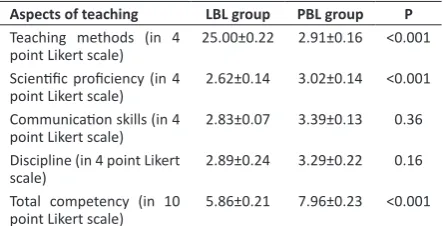
The scores of faculty members which were evaluated based on a routine faculty evaluation system showed that students attitude toward teachers were better in PBL group (p<0.001) in all two major aspects of teaching (teaching methods and scientific competency). The results obtained from the evaluation of faculty members are compared in Table 3.
The results of students’ attitude assessment toward PBL showed high motivation and successful learning experiences (more than 95% asked for using this method in other courses).
the group size.
Collectively, students’ responses about learning were very high and moderate in 21.5% and 14.5% in PBL and LBL groups, respectively. Students indicated the effect of the group discussion on learning very high and high in 37.5%, moderated in 12.5%.
Groups
National exam (after two
years) Similar-root Q (after three years)
No of
Q. Mean Score P No of Q Mean Score P
PBL 18 11.65
<0.001
10 7.17
<0.001
LBL 18 9.23 10 6.12
Table 2. Scores of students in PBL and LBL groups in median-term outcomes.
PBL: problem-based learning, LBL: lecture-based learning, Q: questions.
Aspects of teaching LBL group PBL group P Teaching methods (in 4
point Likert scale) 25.00±0.22 2.91±0.16 <0.001 Scientific proficiency (in 4
point Likert scale) 2.62±0.14 3.02±0.14 <0.001 Communication skills (in 4
point Likert scale) 2.83±0.07 3.39±0.13 0.36
Discipline (in 4 point Likert
scale) 2.89±0.24 3.29±0.22 0.16
Total competency (in 10
point Likert scale) 5.86±0.21 7.96±0.23 <0.001
Table 3. Students view about faculty members in two groups.
PBL: problem-based learning, LBL: lecture-based learning.
Discussion
In the present study, results showed a significant difference between knowledge scores of PBL and LBL groups in short and medium time. Consistent with Lorna Dodd et al14 and Kuo-Inn Tsou et al15 studies, PBL has a significant
impact on how students find and use information. Results of a study in Esfahan - Iran showed that PBL is preferable to LBL. Likewise, Hwang in University of Illinois showed that PBL was more effective for improving students’ knowledge and satisfactions. Qualitative studies indicated that it was feasible to conduct PBL online.13 However,
Khan (2002) mentioned students in PBL and LBL produced similar MCQ test scores18 which is different from
our finding in national exam at the end of second year. Also in other research by Miller in NEVADA, there were no significant differences between groups for any of the items measured.20
The score of final exam and similar-root questions as well as similar-root questions after three years indicated successfulness of PBL method in our research that was compatible with Gurpinar et al. study in Turkey who found that the mean total evaluation score in the PBL group
was 4.5 points higher than that of LBL group.11 Another
experience during pharmacology course in Germany showed that students in PBL were more successful than students in LBL even in standardized national tests12
which is similar with our finding in standardized national tests especially in public health item.
Giving positive scores to the teachers (by students) in our study, in PBL group had 2 points more than that of LBL group which was completely in agreement with German studies with 1 point difference.12
However, a research in Pakistan showed no significant differences between the test scores by PBL or LBL; but PBL received significantly higher student rating (P<0.05) than LBL in self- study time, library time, number of books and computer consults, enthusiasm for the topic, group discussion, depth of knowledge, and interest taken in the teaching format.18 Yet, in other study in this country
students showed slightly healthier attitudes towards health research in PBL compared to LBL students.7 However, it
must be noted that comparison among studies was difficult due to differences in target sample, subject matter, and physical environment in which the PBL method was implemented.
In section of student's attitude toward PBL, our study indicated that students were highly motivated to learning in small groups which other studies are also supporting this finding.9,10,23 In an interview on a sample of 88 students in
medical faculty by Tisonova et al.19 65% of students found
the amount of information concerning pharmacotherapy not sufficient for their future clinical practice and 83.3% were not able to use the knowledge obtained – more than 90% of students did not see enough opportunities for pharmacotherapy training during clinical subject course. Findings of the similar study about perception of graduated GPs about accordance of teaching programs with real work environment needs (IRAN health networks) also showed that a great number of health training courses were not efficient.24 So, they had problems in using their knowledge
in clinical work. These results are in support of our orientation teaching towards the PBL. Using a problem-based Learning (PBL) approach was recommended to the acquisition of basic public health competencies.1 Hence
we propose the development of PBL method in order to improve efficiency.
Conclusion
The present study which has been designed to determine outputs of two different educational methods revealed that students of PBL method were good at different exams in the same year and two to three years later. In other words, in order to improve the quality of health care as a central mission of medical education, we could develop PBL as the main stem of education in health system.
into two groups randomly for administrational reasons, acquisition of knowledge, and clinical performance.
Acknowledgement
The authors appreciate the head and personnel of Education Development Center (EDC) of Tabriz Medical University who prepared large hall and related workshop rooms during the course.
References
1. Loureiro I, Sheriff N, Davies JK. Developing public health competencies through building a problem-based learning projects. J Public Health 2009;17:417–424.
2. Omar M, Gerein N, Tarin E, Butcher C, Pearson S , Heidari G. Training evaluation: a case study of training Iranian health managers. Human Resources for Health 2009;7:20. 3. Jabbari H, Bakhshian F. Evaluation of social
medicine department educational programs in view of physicians working in the health fields in East Azerbaijan [Abstract]. In: The first international congress on reform and change management in medical education 2004. Iran: Tehran; 2004.[Persian]
4. Bahar-Ozvaris S, Sonmez R, Sayek I. Assessment of knowledge and skills in primary health care services: senior medical students' self-evaluation. Teach Learn Med 2004;16:34-8.
5. Lauver LS, West MM, Campbell TB, Herrold J, Wood GC. Toward evidence-based teaching: evaluating the effectiveness of two teaching strategies in an associate degree nursing program. Teaching and Learning in Nursing 2009;4:133–138.
6. Hwang SY, Kim MJ. A comparison of problem-based learning and lecture-problem-based learning in an adult health nursing course. Nurse Education Today 2006;26:315-321.
7. Khan H, Taqui AM, Khawaja MR, Fatmi Z. Problem-based versus conventional curricula: influence on knowledge and attitudes of medical students towards health research. PloS One 2007;2:e632.
8. Reich S, Simon JF, Ruedinger D, Shortall A, Wichmann M, Frankenberger R. Evaluation of Two Different Teaching Concepts in Dentistry Using Computer Technology. Adv Health Sci Educ Theory Pract 2007;12:321-329.
9. Schlett CL, Doll H, Dahmen J, Polacsek O, Federkeil G, Fischer MR, Bamberg F, Butzlaff M. Job requirements compared to medical school education: differences between graduates from problem-based learning and conventional curricula. BMC Medical
Education 2010;10:1.
10. Maudsley G, Williams EM, Taylor DC. Problem-based learning at the receiving end: A ‘mixed methods’ study of junior medical students’ perspectives. Adv Health Sci Educ Theory Pract 2008;13:435-451.
11. Gurpinar E, Musal B, Aksakoglu G, Ucku R. Comparison of knowledge scores of medical students in problem-based learning and traditional curriculum on public health Topics. BMC Med Educ 2005;5:7.
12. Michel MC, Bischoff A, Zu Heringdorf M, Neumann D, Jakobs KH. Problem- vs. lecture-based pharmacology teaching in a German medical school. Naunyn Schmiedebergs Arch Pharmacol 2002;366:64-8.
13. Valaitis RK, Sword WA, Jones B, Hodges A. Problem-Based Learning Online: Perceptions of Health Science Students. Adv Health Sci Educ Theory Pract 2005;10:231-52.
14. Dodd L. The impact of problem-based learning on the information behavior and literacy of veterinary medicine students at university college Dublin. Journal of Academic Librarianship 2007;33:206–216.
15. Tsou KI, Cho SL, Lin CS, Sy LB, yang LK, Chan TY, Chiang HS. Short-term outcomes of a near-full PBL curriculum in a new Taiwan medical school. Kaohsiung J Med Sci 2009;25:282-293.
16. Neville AJ. Problem-based learning and medical education forty years on. A review of its effects on knowledge and clinical performance. Med Princ Pract 2009;18:1-9.
17. Koleini N, Farshidfar F, Shams B, Salehe M. Problem based learning or lecture, a new method of teaching biology to first year medical students: an experience. Iranian Journal of Medical Education 2003;3:57-63.[Persian] 18. Khan I, Fareed A. Problem-based learning
variant: Transition phase for a large institution. J Pak Med Assoc. 2001;51:271-4.
19. Tisonova J, Hudec R, Szalayova A, Bozekova L, Wawruch M, Lassanova M, Vojtko R, Jezova D, Kristova V, Kriska M. Experience with problem oriented teaching in pharmacology. Bratisl lek listy 2005;106:83-7.
20. Miller SK. Comparison of student outcomes following problem-based learning instruction versus traditional lecture learning in a graduate pharmacology course. J Am Acad Nurse Pract
2003;15:550-6.
21. Ministry of Health and Medical Education of Iran. Core curriculums of public health (1) curse for general physicians and pharmacologists [Internet]. Tehran: Ministry of Health and Medical Education;2007 [updated 2007 Jan; cited 2012 May]. Available from: http://www.behdasht.gov.ir/ 22. Likert R. A technique for the measurement of
study of medical educators' views of problem-based learning. BMC Med Educ 2009;9:66.