w w w . i j m r e t . o r g I S S N : 2 4 5 6 - 5 6 2 8 Page 24
www.ijmret.org Volume 3 Issue 1 ǁ January 2018.
A Test of the Technology Acceptance Model in Electoral Activities:
The Nigerian Experience
Omoleke Muslim
Independent National Electoral Commission (INEC) Abuja, Nigeria
ABSTRACT : The paper examined Technology Acceptance Model (TAM) within the context of electoral process in Nigeria, with a view to determining the characteristics of users of technology in the country. Data for the study were obtained through the primary and secondary sources. Primary source include the use of questionnaire, interview of respondents and observation. The study revealed that age, education, training, experience and user involvement are the major demographic variables that can determine acceptance of technology as its relates to electoral process. User involvement, experience, training need for achievement and education were equally the most prominent determinants of acceptance of technology across all thesis geo-political zones. The study concluded that these determinants should be considered by the Independent National Electoral Commission in determining the choice of technology for voting in the nearest future.
KEYWORDS–Technology, Electoral Process, Technology Acceptance Model, Nigeria.
I. INTRODUCTION
In designing a new technology, it is pertinent to consider what characteristics users of new technology should possess. Technology Acceptance Model attempted to examine the motivations and perceptions of people using such technology. The Independent National Electoral Commission had deployed series of technologies since independence and intends to deploy more as the commission approaches 2019 general elections. Technologies deployed since independent include but not limited to Direct Data Capture Machine, Smart Card Readers, electronic transmission of
results from registration area and Local
Government Areas.
Understanding the factors that determine user acceptance of information technology is of paramount importance both to researchers in a variety of fields as well as procurement of technology for large organizations. While Millions of naira have been spent on the deployment of technologies in Nigeria particularly in electoral process, for over a decade, it is doubtful whether the Independent National Electoral Commission, has ventured to determine the acceptability of these technologies.
Despite the massive deployment of these technologies in electoral process in the country, effort has not been empirically made to determine those sociological, demographic, psychological and technological characteristics of the users that could enhance the design and procurement of appropriate
technology and consequently guarantee
acceptability. Hence this study. It should however be noted that deployment of technology in the electoral process is relatively new in Nigeria, hence literature review on the social acceptability of technologies in this context is sparse.
w w w . i j m r e t . o r g I S S N : 2 4 5 6 - 5 6 2 8 Page 25
www.ijmret.org Volume 3Issue 1 ǁ January 2018.
III. METHODOLOGY
Data for the study were obtained through the primary and secondary sources. Primary sources included the use of questionnaire, interview of respondents and observation. A multi-stage sampling procedure and purposive sampling were used for the study. States with the highest registrants in the voter registration in 2006 in the six geo political zones were purposively selected for the study. They include: South east –Anambra, North Central – Benue, North East – Bauchi, North West – Kano, South South – Rivers and South West – Lagos. From each states 0.05% of registrants in the local government with the highest registrable adults was sampled. The total sample size was 716. Finally the major stakeholders in electoral process were purposively selected for interview. This was to complement information from questionnaire. These stakeholders included Nigerian Bar Association, National Council for Women’s Societies (NCWS), The Academic Staff Union of Universities (ASUU), Nigerian Union of Teachers, NigerianLabour Congress among others.
IV. ANALYSIS OF DATA
w w w . i j m r e t . o r g I S S N : 2 4 5 6 - 5 6 2 8 Page 26
www.ijmret.org Volume 3Issue 1 ǁ January 2018.
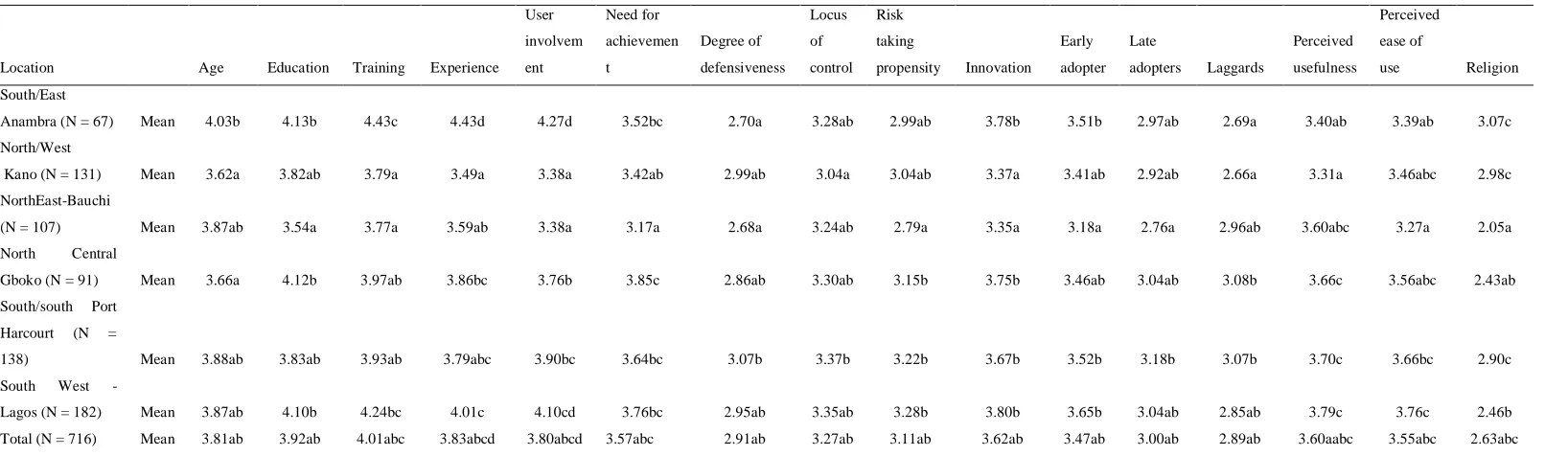
Table I: Determination of Acceptability of Technology for Electoral Activities in the Six Geo Political Zones
Location Age Education Training Experience User
involvem
ent
Need for
achievemen
t
Degree of
defensiveness Locus
of
control Risk
taking
propensity Innovation Early
adopter Late
adopters Laggards
Perceived
usefulness
Perceived
ease of
use Religion
South/East
Anambra (N = 67) Mean 4.03b 4.13b 4.43c 4.43d 4.27d 3.52bc 2.70a 3.28ab 2.99ab 3.78b 3.51b 2.97ab 2.69a 3.40ab 3.39ab 3.07c
North/West
Kano (N = 131) Mean 3.62a 3.82ab 3.79a 3.49a 3.38a 3.42ab 2.99ab 3.04a 3.04ab 3.37a 3.41ab 2.92ab 2.66a 3.31a 3.46abc 2.98c
NorthEast-Bauchi
(N = 107) Mean 3.87ab 3.54a 3.77a 3.59ab 3.38a 3.17a 2.68a 3.24ab 2.79a 3.35a 3.18a 2.76a 2.96ab 3.60abc 3.27a 2.05a
North Central
Gboko (N = 91) Mean 3.66a 4.12b 3.97ab 3.86bc 3.76b 3.85c 2.86ab 3.30ab 3.15b 3.75b 3.46ab 3.04ab 3.08b 3.66c 3.56abc 2.43ab
South/south Port
Harcourt (N =
138) Mean 3.88ab 3.83ab 3.93ab 3.79abc 3.90bc 3.64bc 3.07b 3.37b 3.22b 3.67b 3.52b 3.18b 3.07b 3.70c 3.66bc 2.90c
South West -
Lagos (N = 182) Mean 3.87ab 4.10b 4.24bc 4.01c 4.10cd 3.76bc 2.95ab 3.35ab 3.28b 3.80b 3.65b 3.04ab 2.85ab 3.79c 3.76c 2.46b
Total (N = 716) Mean 3.81ab 3.92ab 4.01abc 3.83abcd 3.80abcd 3.57abc 2.91ab 3.27ab 3.11ab 3.62ab 3.47ab 3.00ab 2.89ab 3.60aabc 3.55abc 2.63abc
Source:
Field Survey, November (2009)
Key:
1
=
Not agreed
2
=
Slightly agreed
3
=
Moderately agreed
4
=
Agreed
5
=
Strongly agreed
w w w . i j m r e t . o r g I S S N : 2 4 5 6 - 5 6 2 8 Page 27
www.ijmret.org Volume 3 Issue 1 ǁ January 2018.
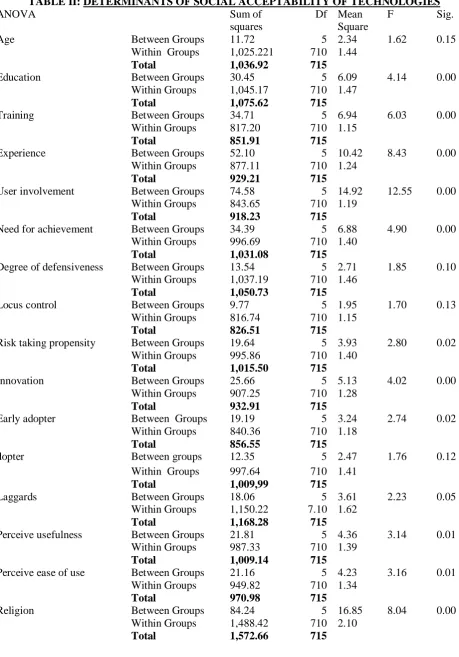
TABLE II: DETERMINANTS OF SOCIAL ACCEPTABILITY OF TECHNOLOGIES
ANOVA Sum of
squares
Df Mean Square
F Sig.
Age Between Groups 11.72 5 2.34 1.62 0.15
Within Groups 1,025.221 710 1.44
Total 1,036.92 715
Education Between Groups 30.45 5 6.09 4.14 0.00
Within Groups 1,045.17 710 1.47
Total 1,075.62 715
Training Between Groups 34.71 5 6.94 6.03 0.00
Within Groups 817.20 710 1.15
Total 851.91 715
Experience Between Groups 52.10 5 10.42 8.43 0.00
Within Groups 877.11 710 1.24
Total 929.21 715
User involvement Between Groups 74.58 5 14.92 12.55 0.00
Within Groups 843.65 710 1.19
Total 918.23 715
Need for achievement Between Groups 34.39 5 6.88 4.90 0.00
Within Groups 996.69 710 1.40
Total 1,031.08 715
Degree of defensiveness Between Groups 13.54 5 2.71 1.85 0.10
Within Groups 1,037.19 710 1.46
Total 1,050.73 715
Locus control Between Groups 9.77 5 1.95 1.70 0.13
Within Groups 816.74 710 1.15
Total 826.51 715
Risk taking propensity Between Groups 19.64 5 3.93 2.80 0.02
Within Groups 995.86 710 1.40
Total 1,015.50 715
Innovation Between Groups 25.66 5 5.13 4.02 0.00
Within Groups 907.25 710 1.28
Total 932.91 715
Early adopter Between Groups 19.19 5 3.24 2.74 0.02
Within Groups 840.36 710 1.18
Total 856.55 715
dopter Between groups 12.35 5 2.47 1.76 0.12
Within Groups 997.64 710 1.41
Total 1,009,99 715
Laggards Between Groups 18.06 5 3.61 2.23 0.05
Within Groups 1,150.22 7.10 1.62
Total 1,168.28 715
Perceive usefulness Between Groups 21.81 5 4.36 3.14 0.01
Within Groups 987.33 710 1.39
Total 1,009.14 715
Perceive ease of use Between Groups 21.16 5 4.23 3.16 0.01
Within Groups 949.82 710 1.34
Total 970.98 715
Religion Between Groups 84.24 5 16.85 8.04 0.00
Within Groups 1,488.42 710 2.10
w w w . i j m r e t . o r g I S S N : 2 4 5 6 - 5 6 2 8 Page 28
www.ijmret.org Volume 3 Issue 1 ǁ January 2018.
V. DETERMINANTS OF ACCEPTANCE OF NEW TECHNOLOGY
[5] Suggest that it is important to consider user factors in determining technology acceptance in order to arrive at the choice, design and operation of a technology. He went further saying that while ability to use any technology is obviously necessary, it is not sufficient to ensure acceptability and many technologies that are demonstrably usable ones are never accepted by the target user. He further identified the most relevant user factors determining technology acceptance as cognitive style, personality, demographics and user situational variables.
In the same manner, [6] also identified
education, location, age, income, gender,
government assistance (political will), employment status, and race as socio cultural factors that can affect adoption of a new technology. He however suggested that age, education and location have the greater effect. It was in the light of the above that the study consider and adopted these factors as important in determining the acceptability of a new technology in the management of electoral process in Nigeria.
For the purpose of reporting this analysis, a mean above 3.5 was regarded as an important factor determining the social acceptability of technology. This is because 3.5 is close to the benchmark of 5 [7].
TablesI and II reveal analyses based on ANOVA and Duncan Multiple Range Test (DMRT). Age had the highest mean of (4.03) in Anambra, an indication that age is an important determining factor. Age was not significantly different in Bauchi, Portharcourt and Lagos (F=1.62, P<0.1). Also there is equality in the opinion of respondents in Kano and Benue (Gboko). The least weighted mean was found in North Central Gboko (3.66). Hence, it can be inferred that age is an important determinant of social acceptability across the six geopolitical Zones.
Also, level of Education was not significantly different in all the zones except Bauchi and Kano (F = 4.14, P < 0.05). Anambra had the highest mean of 4.13 in the six zones while Bauchi has the least mean of 3.54. Invariably, all
the means in the six zones point to the fact that education is an important factor.
For training, there was no significant difference between Kano and Bauchi and also between Benue (Gboko) and Rivers (Portharcourt) (F = 6.03, P < 0.05). The results also shows that the weighted means were more than 3.5 with the highest in Anambra (4.43) and the least in Bauchi (3.77). This indicates that training is a very important factor. However, there is significant difference in the view of respondents on experience as a determinant across the six geopolitical zones(F=8.43, P<0.05). The highest weighted mean for experienced in Anambra was (4.43) while the least was 3.49 from Kano. With the exception of Kano, it can be inferred that experience is an important determinant of social responsibility of technology in the zones.
Furthermore, there exist no significant difference between Kano and Bauchi in terms of users involvement (F = 12.55, P < 0.05). Anambra had the highest mean of 4.27 while Kano and Bauchi had the least weighted mean of 3.38. However, user involvement is an important factor determining social acceptability because the weighted means in all the zones are above 3.5 except in Kano and Bauchi where the means were 3.38.
Under personality traits, the need for achievement is not significantly different in Anambra, Portharcourt and Lagos (F = 4.90, P<0.05). This factor was important in all the zones except Kano and Bauchi where the means are less than 3.5. Other personality traits such as degree of defensiveness, locus of control and risk taking propensity are not so important factors because their means are less than 3.5.
Innovation appears to be the most significant determinant among user situational variables. It shows that there exists no significant
difference in Benue (Gboko), Rivers
w w w . i j m r e t . o r g I S S N : 2 4 5 6 - 5 6 2 8 Page 29
www.ijmret.org Volume 3Issue 1 ǁ January 2018.
are mostly below 3, an indication that the respondents did not see them as good determinants.
In Table II, user involvement (F= 12.55, P < 0.05); experience, (F = 8.43, P < 0.05); training, (F = 6.03, P < 0.05); need for achievement, (F = 4.90, P < 0.05); education, (F= 4.14, P < 0.05); and innovation, (F = 4.02, P< 0.05) and age (F = 1.62, P < 0.05) were not significantly different in most of the geopolitical zones with the means above 3.5. Hence, they are the most important determinants of social acceptability of technology. Also, perceived usefulness is not significantly different in Gboko and Portharcourt (F = 3.14, P < 0.1). This confirms the work of Rogers (1995) that education, training, experience and user involvement correlate well with the acceptance of new technology. Looking at some of the variables considered to be important in the acceptability of new technology, age, education and training are some of the variables that the commission should consider most in the acquisition and deployment of new technologies in the future. For example, youth plays a very important role in politics in Nigeria. They form about more than 50% of the Population in Nigeria - National Population Commission. Hence the design of the technology should consider the interest of the youth. Similarly, education and training cannot be left out. There are many illiterates in the country and probably they may form the bulk of the users of this technology. The technology therefore needs to be user-friendly to accommodate the illiteracy level in the country. Similarly, emphasis should be placed on training of users and operators of the equipment. Other factors include perceived usefulness which is the degree to which a user believes that using the system will enhance his or her performance. Perceived ease of use on the other hand means the degree to which the user believe that using a system will pose no problem or will be free from effort. All these should be considered before designing and choosing a new technology for voting in the country.
VI. CONCLUSION
The study concludes that demographic variables as well as situational trait such as age, education, training, perceived usefulness, perceived ease of use are important factors to be considered in the choice of appropriate technology for the commission.
VII. RECOMMENDATION
1. The Independent National Electoral
Commission, should take into consideration the result of this research by paying attention to the identified demographic, personality traits as well as situational variables which are paramount in the determination of social acceptability of new technology. This becomes relevant because of the urge by the Commission to move towards electronic voting in Nigeria.
2. Raising the literacy level as well as
emphasizing training are very important before acquiring new technology. Illiteracy level in Nigeria is presently put at about 36.1% of the population UNESCO. Specifically, about 65 million Nigerians are illiterates. Hence, the technology should not be too complex for people to operate.
REFERENCES
[1] Davis, D.M. (1994) “Gendered Applications
of Telecommunication Technologies:
Empowerment or Entrenchment?” Presented at the 6th MacBride Round Table.
[2] Davis, F., Bagozzi, R., &Warshaw, P. (1992). Extrinsic and Intrinsic Motivation to
Use Computers in the Workplace. Journal of
Applied Social Psychology, 22(14), 1111-1132.
[3] Davis, F.D. (1989)“Perceived Usefulness, Perceived Ease of Use, and User Acceptance of Information Technology”, MIS Quarterly, September 1989, pp. 319-339.
[4] Alavi, M, and Joachimsthaler, E.A. (1992): “Revisiting DSS implementation research: A metal Analysis of Reseacher” MIS quarterly Journal, vol.2 April 1992, ppl-24
[5] Peter,S. and Stephen, J. (1997): “An Analysis of Technology used and Electronic
delivery of Government Services in
Kentucky”. A paper presentation in Kentucky http/www/kltprc.net/books/circuit.
[6] Taylor, S., & Todd, P. (2001).
Understanding Information Technology
Usage: A Test of Competing Models. Information Research, 6(2), 144-176. [7] Rogers, E. (1995). The Diffusion of
w w w . i j m r e t . o r g I S S N : 2 4 5 6 - 5 6 2 8 Page 30
www.ijmret.org Volume 3Issue 1 ǁ January 2018.
AUTHOR’S PROFILE
Dr. (Barr.) Omoleke Muslim was
born in Ikire, Irewole Local
Government area of Osun State,
Nigeria. He attended Ife City
Collegebetween 1976 and 1980 wherehe obtained his West African School Certificate with Division One. He later proceeded to the University of Ife between 1981 and 1985 and came out with B.Sc Education /Economics. He also acquired the following qualifications from the same university: Master of Business Administration (MBA) in 1995, Master of Philosophy (M. Phil) in Management and Accounting in 2001 and a Doctor of Philosophy degree in Technology Management (Ph. D) in 2010. Because of his flair for academics, Dr. Omoleke went back to read Law at the same university and got his LLB in 2002. He also read Master degree in Law (LLM) with Specialization in criminology and Penology. Furthermore, he attended The Nigerian Law School, Abuja and was called to the Nigerian Bar in 2004. Dr. Omoleke works with the Independent National Electoral
Commission as a Director of