Engineering and Technology Journal ISSN: 2456-3358
Impact Factor: 4.449
Exploring Education Theme in Teaching Learning Transformation:
An Expectation in Software Engineering
Mayur Rathi1, Shefali Sonavane2, Deepika Chavan3
1,3
Assistant Prof. Dept. of Information Technology, Walchand College of Engineering, Sangli, Maharashtra
2
Associate Prof., Dept. of Information Technology, Walchand College of Engineering, Sangli, Maharashtra
ARTICLE INFO ABSTRACT
Corresponding Author:
Mayur Rathi
Asst. professor Department of Information Technology, WCE, Sangli-4164215(M.S
The worldwide expansion of software industry highly demands for professional skills with fundamental aptitude. In response to the necessity, the paper tries to emphasis on the outcome based course delivery for ‘Software Engineering and Design’. The described teaching learning process ensures the expected professional skill demands raised by the industry in software design and development. The evolutionary process of course learning outcomes is defined for assessment evaluation and its attainment. The average attainment in comparison with target value helps for achieving iterative progress in teaching learning process. The main objective of this paper is to create basis for strengthening IT based professional skills with respect to the crucial aspects of software engineering where creativity of students needs to be enhanced.
KEYWORDS:Outcome Based Education (OBE), task, skill and knowledge
I. INTRODUCTION
Education process consists of teaching and learning in which knowledge, skills and good quality of habits are delivered by teacher and those are accepted by learners. A teacher facilitates student using various pedagogical techniques which helps students in their learning in educational institutes, colleges and schools [1]. With the establishment of close connect between the industry and higher engineering educational institutions, the industry imminent demands a skill man power in the field of soft core branch. Outcome based teaching learning process is proved as an essential need for improvement of professional skill and fundamental knowledge. It is believed that,curriculum undergoes for teaching learning process; is to be measured in terms of
metrics which could be mapped with recent trends in Information Technology [2].
In soft core profession, availability of measures for outcomes are very few which address the assessment of the teaching process [3].
The paper attempts to explore metric based teaching learning process which reflects attainment of professional skills and fundamental knowledge in soft core course, ‘Software Engineering and Design’.
II. TEACHING LEARNING PROCESS
towards optimal design of learning outcomes . In view OBE implementation, it becomes necessary to concentrate equally on the mode of delivery of the designed curriculum. The delivery mechanism can be handled by scheduling the curriculum into the Tasks, Skills, Knowledge and
Themes components [2].
The concept of Task, Skill, Knowledge and Themes can be illustrated as follows:
Tasks: Task is an identifiable and an essential bit of the course content
T1: Identify software problem
T2: Design process model
T3: State characteristics of software process
T4: Formulate software engineering requirement
T5: Integrate software requirement
T6: Design software requirement specification
T7: Describe cost estimation and planning
T8: Select and implement planning
T9: Design software principle
T10: Artifact detail design document T11: Identify various software metrics
T12: Describe fundamentals of manual and automated testing
T13: Describe types of IT based testing
T14: Identify various versions of agile process T15: Design dynamic system development T16: Design feature development process T17: Design scrum process
T18: Describe class, objects and interfaces T19: Design object oriented class diagrams T20: Design object oriented sequence diagrams T21: Describe behavioural modeling
T22: Describe architectural modeling
Skills: Skill is the ability to communicate practiced task [1]
S1: Analyzing complex engineering problems
(T1)
S2: Selecting process model for software
solution (T1, T2)
S3: Designing software requirement
specification document (SRS) (T5)
S4: Designing software quality assurance plan
for software application (T5, T6)
S5: Researching on risk management and
monitoring (T5)
S6: Applying software principles for object
oriented design (T9)
S7: Artifact and implement the design
documents (T10)
S8: Mapping design into software programming
development (T8)
S9: Classifying various agile development (T12)
(T13)
S10: Applying agile model for business specific application (T14)
S11: Designing risk plan for dynamic
development process (T15)
S12: Designing and implementing class diagram (T18)
S13: Optimizing various relationships of classes (T18)
S14: Designing and implementing UML based object diagrams (T19)
S15: Designing and implementing use case diagrams (T20)
S16: Designing and implementing activity
diagrams (T21)
S17: Designing and implementing sequence
diagrams (T21)
S18: Designing and implementing sequence
diagrams (T22)
S19: Designing and implementing component diagrams (T22)
S20: Integrating design models (T20) (T21) (T22)
Knowledge: knowledge is about facts, information and skill acquire through understanding of the course [2]
K1: Software requirement and solutions (T1)
K2: Basics of software engineering process (T2)
(T3)
K3: Methods of cost estimation (T5) (T4)
K4:Methods of monitoring and planning (T3) (T6)
K5: Basics of modular design (T9) (T10)
(T6)
K7: Basics of project management (T6) (T7)
K8: Team work management (T5) (T11)
K9: Design of agile process model (T14) (T15)
(T16)
K10: Basics of object oriented design (T18) K11: Methods of structural modelling (T18) (T19) (T20)
K12: Methods of behavioural modelling (T21) K13: Methods of architectural modelling (T22)
Theme: Theme is the central idea of the context for course delivery projected from Knowledge and Skills[2]
Th1: Software Process (K1) (K2) (K3) (K7) Th2: Software design (K4) (K5) (K11) (K12) Th3: Agile development (K9)
Th4: Design modelling (K10) (S12) (S15) (K15)
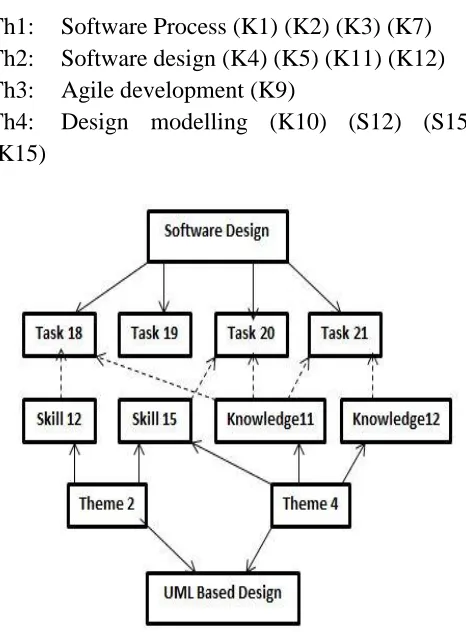
Figure 1: A sample dependency graph in teaching learning process
Consider the instance of UML Based Design. The
module undergoes for teaching learning process where software design is the broad description of overall content.
Task T18 (Describe class, objects and interfaces),
T19 (Design object oriented class diagrams), T20 (Design object oriented sequence diagrams) and T21 (Describe behavioural modelling) are executed as a part of the process. Skill and Knowledge are blended from the related Task. The orientation is shown by dependency arrow (dotted arrows) in figure 1. Skills are defined as S12 (Design and implement class diagram T18)), S15 (Design and implement use case diagrams (T20)) in reference with Tasks. In similar way Knowledge is defined with locus of Tasks. Skill and Knowledge are mapped to Theme 2 (Software design (K4) (K5) (K6) (K8)) and in similar way, Theme 4 is contended from Knowledge and Skills [2][4].
III. ESSENTIAL COMPONENTS OF COURSE
The Course learning Outcomes (CO) are the statements that describe the objectives to be protracted by a novice to the proficient level. It
provides pre-defined parameters for course
evaluation noticeably.
A. Learning Outcomes
There are three important components while designing CO; as follows [7]:
Action verb: The verb should be SMART that is
Specific, Measurable, Achievable, Realistic and
Time framed. It is expected that the verb should count some action succeeding cognitive levels defined in the
Bloom’s Taxonomy [8].
Condition: It describes the behavioural environment
under which learner’s performance is to be ensured.
Standard: Standard supports the metric or criteria
for acceptable satisfactory level of the learner’s performance.
Following example shows the stepwise advancement while framing the CO. One can improve the CO by considering verb, condition and standard.
Step 1: Plan and design software structural modeling.
Step 2: Plan and design software structural
modelling using UML.
Step 3: Plan and design software structural
modelling with classes and objectsusing UML
In step 1 ‘plan and design’ is an action verb which implies the Bloom’s Taxonomy sixth level as ‘creating’. Step 2; ‘using UML’ is the condition by which student should be able to design structural UML at the end of the course. Step 3 infers the combination of three main components. The
‘classes and objects’ specifies the standard which
reflects the criteria for acceptable level of performance than steps 1 and 2.
It is very clear that step 3 is better to map with graduate attributes (GA) and programme specific outcomes expected in accreditation manual [6]. The described example relates to few GAs viz, Problem Solving, Critical Thinking and Usage of Modern Tools. The mapping can further be precised by assigning appropriate weight factors. To obtain the attainment of the defied CO these weight factors can be involved for further formulation.
B. Average Attainment Process
Considering the case study for “Software Engineering and Design”, at WCE Sangli; the process for course evaluation is described in this section. The said course is one of the professional core courses which aims to assess the attainment of target CO fulfilling the rations towards OBE expectations.
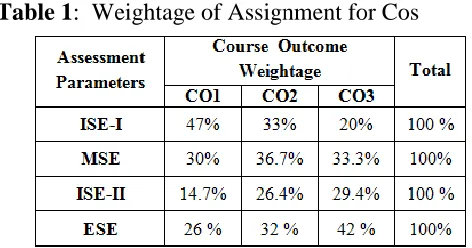
Average attainment of COs gives the performance of the students. In continuous evaluation pattern major four assessment parameters are framed for the course. These are In Semester Evaluation (ISE-I, II), Mid Semester Evaluation (MSE) and End Semester Evaluation (ESE) as shown in Table I.
Table 1: Weightage of Assignment for Cos
Table I also indicates the weightages of assigned COs to overall 100% evaluation process in one semester. The weightages can be varied as per the scope and the requirement of the evaluator [5]. For illustration purpose, the actual marks obtained by a class of 75 students are used. Accordingly, Table II lists the component of the marks obtained by an individual student on roll in CO1 assessment. Equation 1 calculates the average attainment of a class with total number (n=75) of students.
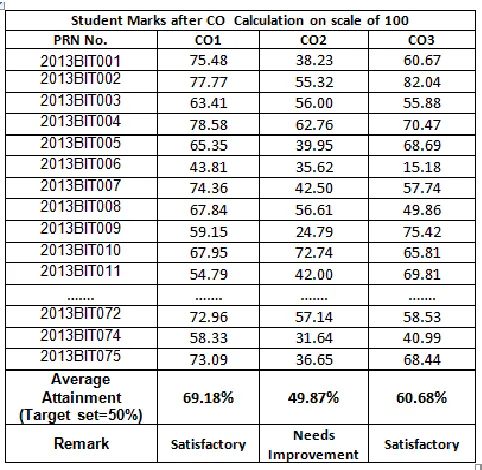
Average attainment calculated for CO1, CO2 and CO3 is listed in Table III for individual student. Significance of average attainment is to get overall performance of individual student and class in course.
The Calculations sum up with some average attainment index of the class. If expected attainment level is set with some predefined target (e.g. 50% in Table III) then the range of the average attainment.
Average attainment of Course Outcome can be given as:
Table 3: Student Marks after CO Calculation on scale of 100
Benefits further to introspect and improvise if performance is not ‘satisfactory’. The exercise unertaken also helps to analyze comparatively over the successive years for progresssive and continual enhancements in the teaching learning process.
In general, the equation calculates average of the ratio of the marks assigned and the marks obtained for each CO. In similar way, the average attainemt is calculated for CO1, CO2, CO3 ( Or upto COm) and is listed in Table III.
CONCLUSIONS
The paper is outlined with the perspective of defined methodology for overall handling of the
teaching learning process for the course ‘Software Engineering and Design’. The curriculum design, execution and its assessment is overviewed catering to the needs raised by the software industry.
While assessing knowledge or professional skills, only qualitative judgements are not sufficient but are required to be mapped with some quantitative indices. Hence, turning to the standard formulations become important to assess the entire performance over a common scale in OBE terminology.
It is planned to develop a customized tool with supporting rubrics to ensure the wide usage of the described platform.
ACKNOWLEDGMENT
This research was supported by Department of Information Technology, Walchand College of Engineering, Sangli. We thank our colleagues from WCE, Sangli who provided insight and expertise that greatly assisted the research, although they may not agree with all of the conclusions of this paper.
REFERENCES
1. Sudhanshu S Gonge, Ashok A.Ghatol,”An
Art of Teaching in Teaching-Learning Process: An Important Part for Educational Accreditation, Quality and Assessment”, IEEE International Conference on MOOC, Innovation and Technology in Education
(MITE), 2014,pp. 237-242.
2. Joanna Napieralska, Jozef
Modelski,”Syllabus Design for Multimedia Art and Engineering Education – Problem
Oriented Approach”, IEEE International
Conference on e-Learning, 2015, pp. 78-85.
3. Sanjiba Kumar Bisoyi, Parveen P Terang,
“Analysis of Course Outcomes of PE-A tool for Assessment of Programme Outcomes”,
International Conference on MOOCs,
Innovation and Technology in Education
(MITE), 2015, pp. 88-91.
4. S. Selvakumar, Kanchana Rajaram,
Education through Improved
Teaching-Learning Process”, IEEE International
Conference on Teaching, Assessment, and
Learning for Engineering (TALE), 2015,
pp 247-252.
5. Campbell, J.O., “Interactive Distance
Learning: Issues and Current Work,”
Journal of Instruction Delivery Systems,