ISSN 2373-2156 (Print) 2373-2164 (Online) Copyright © The Author(s). 2015. All Rights Reserved. Published by American Research Institute for Policy Development DOI: 10.15640/jpesm.v3n1a6 URL: https://doi.org/10.15640/jpesm.v3n1a6
Cranial Limbs as a Predictor of Precision in Handball
Siniša Karišik1, Slobodan Goranović2, Ljubo Milićević3, Danijel Božić4
Abstract
The paper aims to examine how the dimensions of the cranial limbs, arm length and dimensions of the hand, affect the accuracy and strength of the ball throwing in handball. The sample of examinees consists of 75 handball players of the Premier League (30 examinees) and the First League of Republic of Srpska (45 examinees), aged between 17 and 37. To estimate the cranial extremities of handball players, we used a set of five variables (length of hands, wrist diameter, planimetric parameter of the fist, arm span and arm length) and for the assessment of precision and power of ball throwing we used three variables (precision from seven meters from the stand variable, precision from nine meters from the jump and throwing the ball from the seating position). Regression analysis showed that a planimetric parameter of the hand variable has a large influence on the accuracy of handball, with a statistical significance of p = .000, while the length of the arm reaches borderline statistical significance with the strength of throw at the level of p = .06. The results clearly show us that anthropometric measures of cranial extremity significantly affects the accuracy and power of throwing the ball at the level of statistical significance of p <.01. The greatest impact was reached by the measures of arm length and planimetric parameter of the hand.
Keywords: Handball, handball players, precision, specific motor skills.
1
Faculty of Physical Education and Sport, East Sarajevo, Bosnia and Herzegovina. [email protected]
2
Faculty of Physical Education and Sport, Banja Luka, Bosnia and Herzegovina.
3
Faculty of Physical Education and Sport, East Sarajevo, Bosnia and Herzegovina.
4
1.Introduction
We may say that handball game has experienced a transformation and that from passive play, during the period when the game was based mainly on positional attacks and exhausting circling of the ball around zone defense, it transitioned into the modern, highly active game of modern handball, where the emphasis of the game is focused on the fast attacks (Czerwinski, J. 2000), the attacks on the disorganized play and positional attacks with a lot of fast movement, sharp passes and strong duel games. Defense adapted to such a structure of attack, where the reaction of the defender was replaced by action and maximum aggression. In such a constellation of defense and attack, attack players are finding fewer opportunities and space to create a favorable position for the shot.
It usually indicates a shot from greater distances or with contact play, which directly affects the very quality of impact, and success in implementation. Precision and power of throw are getting greater and greater importance in the outcome of the game. By analyzing the success depending on the actions which were used on XX World Championship for Men (Valdevit, Z. 2009), the author concluded that the players achieved the highest efficiency by kicking of penalty shots, 71%, while the efficiency of the throw while in the game percentage was about 60%.
These data tell us that in practice there is still much room for upgrading and improving of the precision in the handball game. Since the very aim of the game sorts shooting among the most important elements of handball game that determine the success of the score, it is no coincidence that more and more authors base their research on the factors affecting the quality of shooting. A positive impact of motor skills on the speed of the ball, especially the explosive strength, confirmed the
investigation (Rogulj, N. et al 2007; Foretić, N. et al, 2005). Previous studies have
shown that the technique of shooting, throw of the ball (Zvonarek, N, Vuleta, D and Hraski, Ž. 1997), as well as the movement of the hand with a ball during the shoot
(Jovanović, B., Đukić, M. 2007) have high correlation with efficiency of the ball
Materials and Methods
The sample of examinees in this study consists of 75 handball players, members of the men's clubs of B & H Premier League (30 examinees) and the First League of Republic of Srpska (45 examinees), aged between 17 and 37, engaged in systematic training for at least two years without long pauses.
Table 1. Average height and age of examinee
N Minimum Maximum Mean
ATV 75 170 205 186,51
AGE 75 17 37 22,33
To estimate the precision, the subjects were throwing the ball at right triangles whose legs had a length of 50 cm and were placed within the frame of the goal in the upper and lower corners of the goal. Each examinee had two attempts per corner, a total of eight attempts per test. Shooting was done by a handball ball, size 3, at a distance of 7 meters from standing position from the ground (SMP7M) and 9 meters from the jump (SMP9M). The test of throwing the ball from a seated position was used to estimate the power of the throw (SMBLS).
To estimate the dimensions of the cranial limbs, variables of arm length (ADR), wrist diameter (ADRZ), the length of the hand (ADŠ), planimetric parameter of the hand (APLP) and arm span (ARS) were used. In order to determine the statistical significance, all data is processed on the univariate level, basic descriptive parameters were calculated, and then the regression analysis was applied on multivariate level and relevant parameters were defined. For the dependent variables, precision tests were taken from seven and nine meters and the test of throwing the ball from the seating position. Data were analyzed using the SPSS / 20 packages.
Results
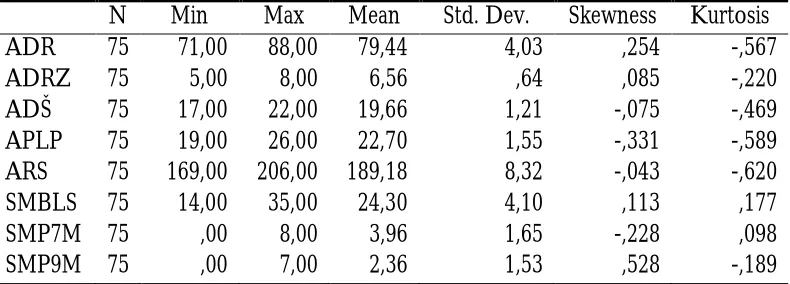
Table 2: Results of descriptive statistics
By inspection of results (Table 2), we note that the four variables have a negative (hipokurtic) asymmetry, which means that the number of the better the results is higher, and four variables have a positive (epikurtic) asymmetry which tells us that these variables have a larger number of weaker results. If we observe the normality of distribution of results over the value of kurtosis, it can be observed that six of the eight are variables with a negative sign and that the results tend to be rambly, and that two variables that had a positive sign indicate that the distribution is leptokurtic, which means that in these variables there are more average results. By analyzing the dispersion parameter variables, it is observed that the group of examinees expressed the greatest homogeneity in variables ADRZ, ADŠ, SMP9M, APLP and SMP7M (0.64 - 1.65) and the lowest homogeneity of the results of the group of examinees showed the variables ADR, SMBLS and ARS (4.03 - 8.32).
The results of regression analysis (Table 3, 4 and 5) clearly show us that anthropometric measures of cranial limbs significantly affects the accuracy and power of the throw of the ball at the level of statistical significance of p <.01. The greatest impact was realized by the measure of the arm length and planimetric parameter of the hand.
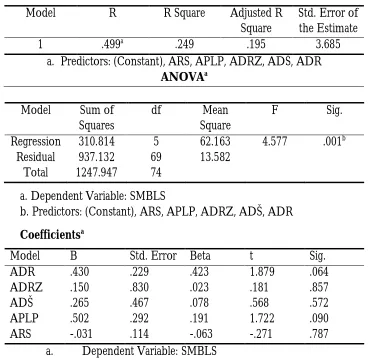
Regression analysis of the SMBLS criterion variable (Table 3), we came to the conclusion that multiple correlation coefficient is R = .50, which indicates the degree of correlation with the system of the predictor set at the multivariate level. This connection is at the level of statistical significance Q = 0.01.
N Min Max Mean Std. Dev. Skewness Kurtosis
ADR 75 71,00 88,00 79,44 4,03 ,254 -,567
ADRZ 75 5,00 8,00 6,56 ,64 ,085 -,220
ADŠ 75 17,00 22,00 19,66 1,21 -,075 -,469
APLP 75 19,00 26,00 22,70 1,55 -,331 -,589
ARS 75 169,00 206,00 189,18 8,32 -,043 -,620
SMBLS 75 14,00 35,00 24,30 4,10 ,113 ,177
SMP7M 75 ,00 8,00 3,96 1,65 -,228 ,098
On the basis of five anthropometric space variables, 25% of common variance of criterion variable is explained. The remaining 75% in explaining the common variability can be attributed to some other anthropometric characteristics of the examinees that were not the subject of this research and other dimensions of the anthropological area, which were not the subject of these investigations.
Table 3: Regression analysis of throwing the ball from sitting position variables (SMBLS)
Model Sum of
Squares
df Mean
Square
F Sig.
Regression 310.814 5 62.163 4.577 .001b
Residual 937.132 69 13.582
Total 1247.947 74
a. Dependent Variable: SMBLS
b. Predictors: (Constant), ARS, APLP, ADRZ, ADŠ, ADR
Coefficientsa
Model B Std. Error Beta t Sig.
ADR .430 .229 .423 1.879 .064
ADRZ .150 .830 .023 .181 .857
ADŠ .265 .467 .078 .568 .572
APLP .502 .292 .191 1.722 .090
ARS -.031 .114 -.063 -.271 .787
a. Dependent Variable: SMBLS
Results of partial regression coefficients (Beta) and its significance on the univariate level, indicate that statistically significant relationship with the criterion variable have predictor variables in the area of border significance, arm length ADR (BETA) = .42, which is significant at the level of p = 0.06 and planimetric parameter of hands APLP (BETA) = .19 which is significant at the level of p = 0.09.
Model R R Square Adjusted R
Square
Std. Error of the Estimate
1 .499a .249 .195 3.685
By regression analysis SMP7M criterion variables (Table 4) and SMP9M (Table 5) we have come to the fact that a complete system of the predictor set of anthropometric measures on the multivariate level, with this the criterion variables shows statistical significance at the level of Q = 00:00.
Table 4: Regression analysis of precision with seven meters from the stand variable (SMP7M)
a. Predictors: (Constant), ARS, APLP, ADRZ, ADŠ, ADR ANOVAa
Model Sum of
Squares
df Mean
Square
F Sig.
Regression 77.860 5 15.572 7.854 .000b
Residual 136.807 69 1.983
Total 214.667 74
a. Dependent Variable: SMP7M
b. Predictors: (Constant), ARS, APLP, ADRZ, ADŠ, ADR
Coefficientsa
Model B Std. Error Beta t Sig.
ADR .158 .087 .374 1.805 .075
ADRZ .307 .317 .116 .970 .336
ADŠ -.085 .178 -.061 -.479 .633
APLP .592 .111 .541 5.310 .000
ARS -.051 .044 -.249 -1.167 .247
a. Dependent Variable: SMP7M
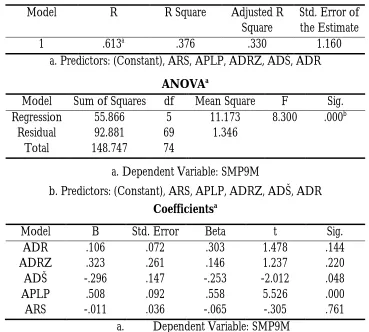
In relation to the precision from seven meters from the ground, predictor variables use 36%, and compared to the precision from nine meters from the jump they use 38% of the total variability of criterion variable. It should be noted that only one variable from the system of predictor set of variables, planimetric parameter of the hand, on the univariate level, significantly affects both of the criterion variables that had dealt with the precision of the ball throw.
Model R R Square Adjusted R
Square
Std. Error of the Estimate
The partial regression coefficient for this precision variable from seven meters from the stand is .54, and for the precision from nine meters from the jump it is .56 and statistically it has a significance on the level of p = .00. The results indicate that the arm length predictor variable affects the precision from seven meters criterion variable, in the area of border significance of p = .07, while the length of the hand variable has a statistically significant effect p = .05 on the precision from nine meters criterion variable.
Table 5: Regression analysis of precision from nine meters variable (SMP9M)
ANOVAa
Model Sum of Squares df Mean Square F Sig.
Regression 55.866 5 11.173 8.300 .000b
Residual 92.881 69 1.346
Total 148.747 74
a. Dependent Variable: SMP9M
b. Predictors: (Constant), ARS, APLP, ADRZ, ADŠ, ADR Coefficientsa
Model B Std. Error Beta t Sig.
ADR .106 .072 .303 1.478 .144
ADRZ .323 .261 .146 1.237 .220
ADŠ -.296 .147 -.253 -2.012 .048
APLP .508 .092 .558 5.526 .000
ARS -.011 .036 -.065 -.305 .761
a. Dependent Variable: SMP9M
Discussion
Shot efficiency depends on the technique (mechanics) of the shot, constitution of the player, physical predisposition, psychological characteristics and
shot selection (Mikić, B., Alic-Partić, M. 2002).
Model R R Square Adjusted R
Square
Std. Error of the Estimate
1 .613a .376 .330 1.160
This research was based on elements of the constitution of players, namely the impact of cranial limbs on the efficiency, or force and precision of the shots. Obtained information is related to the strength of the throw of the ball and are primarily conditions by the length of the arm. Basically, each ball throw is based on biomechanical frame, depending on the type of the chosen shot.
Throws in handball, and many movements in the game, as well as throws in an everyday life, is not conducted by individual segments, but the kinetic chains. The consequence of using the kinetic chains, or a large number of joints in the throwing of the ball, is increasing of the speed of movement of its open end, in our case, our hand. In this way, the ends of the kinetic chains develop significantly higher speeds than those which can be developed by any other segment of our body’s individually
(Jarić, S. 1997).
Ball speed depends on the length of the route in which the body has an effect on the ball during the throwing movement; it depends on the amount of the involved musculature, as well as the speed and consistency of contraction and relaxation of muscles that are used in the release of the ball. Therefore, the player who operates the ball with strength for a longer period will give it a greater amount of kinetic energy. It is obvious that players with longer lever or the players who achieve greater amplitude of throwing movement will be able to accomplish a longer traveling of the ball. It is this conclusion that confirms the result obtained from this research, that the players, who had longer cranial limbs, achieved significant results in the length of the throwing of the ball. Throwing of the ball in handball is characterized as an open successive kinetic chain.
In the handball jargon, as well as professional, this scheme is called "whip" technique of throwing the ball, because, like in the movement of a whip, in the direction of the movement, the segments with the backing are the first to move, then the adjacent segments, until in the end the last segment moves, which is, in our case, the hand with the ball. On the other side, when throwing the ball from the jump, the kinetic chain is rather short, the force is acting on the short path, and the impact of the ground reaction is smaller than when you throw the ball from the ground. The aim of using this method of throwing the ball, in addition to achieving the maximum possible speed of the throw, is also achieving specially accurate movement. In the basics of every throw of the ball, an important element is the quality of holding the ball. In order to get the ball have thrown towards the goal with quality and at high speed, it must have a considerable level of contact with the hand.
Conclusions
Holding of the ball is the specificity of the handball, and dimensions of the hand (length of hand and planimetric parameter of the hand) directly affect the quality of holding the ball. The results showed that the planimetric parameter of the hand to an exceptional extent determine the quality of the throwing of the ball, which influences the final result of the precision of the shot. This parameter is the distance from the tip of the thumb to the tip of the little finger when the hand is open, and preferably that distance is in the form of a straight line. The players are able to improve this hand parameter by training and it should be insisted on during the training process, because it directly or indirectly affects the efficiency of technical and tactical actions.
Reference
Berjan, B. B., Pazin, N., Bozic, P., Mirkov, D., Kukolj, M., Jaric, S. (2012). Evaluarion of a Composite Test of Kicking Performance. Journal of Strength and Condition
Research.26(7):1945-52.
Czerwinski, J. (2000). Statistical Analyisis and Remarks on the Game Character Based on the European Championship in Croatia. EHF Periodical for Coaches, Referees
and Lectures, No. 1, Vienna.
Ćeleš, N., Vojvodić, M. & Skender, N. (2014). Komparativna analiza efikasnosti
šutiranja u rukometu na EP 2012. godine. SPORTS SCIENCE AND
Foretić, N., Erceg, M., Bradarić, A., & Tocilj, J. (2005). Povezanost nekih motoričkih
sposobnosti i brzine udarca kod rukometaša predadolescentne dobi. (Ur.)
International Symposium „Sport-rekreacija-fitness“, Split, 2005.
Goranović, S., Karišik, S., Valdevit, Z. (2013). Tehnika u rukometu. Textbook, Faculty of
Physical Education and Sport, Banja Luka.
Jarić, S. (1997). Biomehanika humane lokomocije sa biomehanikom sporta. Beograd
Jovanović, B., Đukić, M. (2007). Skok-Šut u rukometu: Biomehanička analiza kretanja
šake sa loptom za veme izbačaja. XV International Interdisciplinary Symposium
Ecology, sport, physical activity and health of young people, Collected texts – University of Novi Sad, Novi Sad.
Mikić, B., Alić Partić, M. (2002). Biomehanička i strukturalna analiza tehnike rukometa.
Tuzla: Off – Set. 7.
Ohnjec, K., Vuleta, D., Pušić – Koroljević, N. (2013). Analiza pokazatelja situacijske
efikasnosti vanjskih napadačica hrvatske ženske rukometne reprezentacije na
svjetskomprvenstvu 2011. U Brazilu.11th Annual International Conference
CONDITION PREPARATION OF ATHLETES, Zagreb.
Rogulj, N., Foretić, N. , Srhoj V., Čavala M ., & Papić V. (2007). Utjecaj nekih
motoričkih sposobnosti na brzinu lopte kod udaraca u rukometu. Acta
Kinesiologica (1) 2:71-75.
Valdevit, J. Z. (2009). Modelne karakteristike tehničko-taktičkih aktivnosti u fazi
napada u rukometu. Doctoral dissertation, Beograd.
Vuleta, D., Simenc, Z. (2004). Kanonička povezanost između mehanizma za
energetsku regulacijui situacijske efikasnosti u rukometu. Rukomet znanstvena
istraživanja. Zagreb, Faculty of Physical Education, University of Zagreb, 183-96.
Zvonarek, N., Vuleta, D., & Hraski, Ž. (1997) Kinematička analiza dviju različitih
tehnika izvođenja skok šuta u rukometu. U D. Milanović (Ur.) 1st International
Scientific Conference “Kineziologija – sadašnjost i budućnost”, Dubrovnik, 1997, (p.p. 180-182).
Zvonarek, N., Hraski, Ž. (1996). Kinematic Basics of the Jump Shot. Handball, EHF