ISSN: 2372-4978 (Print), 2372-4986 (Online) Copyright © The Author(s). All Rights Reserved. Published by American Research Institute for Policy Development DOI: 10.15640/ijat.v4n1a1 URL: https://doi.org/10.15640/ijat.v4n1a1
Accounting for Internally Generated Intangible Assets
Steven W. Smalt, PhD, CPA1 & J. Marshall McComb II, MAcc, CPA2
Abstract
Intangible assets have become a major factor driving value creation in the modern global economy. Despite this, many inconsistencies exist in the presentation of intangible assets in financial statements, often under representing internally generated intangible assets as compared to purchased intangible assets. These inconsistencies in accounting treatments make comparisons both in the current period as well as future periods pronounced and material. This article compares and contrasts current treatment requirements of both IFRS and US GAAP and proposes an alternative that provides consistent accounting application and greater comparability of essentially identical transactions.
Keywords: Intangible assets, research and development costs, cost versus fair value
I. Introduction
In today’s economy, there has been a considerable shift in the nature of assets used by major businesses to generate revenue and provide returns for their investors. Increasingly, businesses worldwide in a wide range of industries such as pharmaceuticals, information technology, and consumer products generate a great deal of value from investments in assets that are intangible in nature. In the year 2000, several major companies such as Microsoft, Intel, GE, and Merck each had estimated knowledge capital of over $100 billion and the Federal Reserve Bank of Philadelphia estimated that over $1 trillion was invested in intangible assets (Siegel & Borgia, 2007).
1
Associate Professor of Accounting and Information Systems, School of Accountancy, Coles College of Business, Kennesaw State University, Burruss Building MD 0402, 560 Parliament Garden Way, Kennesaw, GA 30144-5591, Tel (470) 578-6386 Fax (470)578-9018 [email protected]
2 Lecturer of Accounting, School of Accountancy, Coles College of Business, Kennesaw State
In 2002, the “total expenditure in intangible capital was larger than the investment in tangible capital” for firms in the United States and Finland (Zéghal & Maaloul, 2011). Additionally, some point to the upward trend of market-to-book ratios as evidence of a continually developing knowledge-based economy with greater unrecognized intangible assets (AASB, 2008; Lev, 2001).
This trend has been identified by many accounting regulatory and research agencies and has resulted in a number of changes in the standards used to account for intangible assets over the last decade. However, despite the importance of intangible assets in the current economy, the existing standards largely “recognize those assets only when they are acquired from others” (Upton, 2001). As such, current accounting policies for internally generated intangible assets allow for several measurement and reporting inconsistencies that can diminish the primary characteristics and goals of financial statements. The objective of this review is to examine current intangible accounting methods from a conceptual and empirical standpoint and suggest conceptual approaches to initial intangible asset accounting that could improve overall financial reporting quality.
2. Key Concepts and Issue
Conservatism can be described as “the accountant’s tendency to require a higher degree of verification to recognize good news as gains than to recognize bad news as losses” (Basu, 1997). Approaches to accounting for internally generated intangible assets often necessitate estimates in their valuation, which leaves some opportunity for management discretion, and as a result, the accounting conservatism principle is viewed as opposed to capitalization (Uzma, 2011).
These trade-offs have led, in part, to several inconsistencies in the current accounting standards for intangible assets. One major inconsistency is the different accounting treatments of intangible assets developed internally compared to those acquired through a business transaction. Under current standards, in most cases US accounting standards do not allow capitalization of internally generated intangible assets and costs associated with their research and development are expensed during the current period. For international standards, IAS 38 requires the expensing of research costs, but does allow capitalization of development costs subject to certain restrictive criteria. While IAS 38 allows either a cost or a valuation model for the recording of these assets, because of the active market restriction placed on the valuation model only a very limited number of assets qualify (Zéghal & Maaloul, 2011). In contrast, because many separable intangible assets acquired through a purchase have a verifiable fair value due to the transaction price, IFRS 3, IAS 38 and ASC 805-20-25-10 currently require their capitalization when separable from goodwill. This divergent treatment of what may otherwise be an identical intangible asset is inconsistent with the qualities of useful financial reporting and decreases uniformity.
The full costs option allows the capitalization of exploratory costs regardless of their success because unsuccessful efforts were seen as a cost of successful explorations. By this logic, the primary research costs of many companies, such as pharmaceutical companies, could be seen as a necessary cost of successful product development (Eckstein, 2004). These discrepancies decrease overall comparability, uniformity, and neutrality of the financial statements of many businesses and may diminish their relevance.
As a result of a perceived inadequate accounting treatment for internally generated intangibles, several studies provide evidence of decreased value-relevance over the last few decades as intangible assets became a greater part of the economy. Based on the relevance of financial statement information to market value, Lev & Zarowin (1999) document a decline in the usefulness of financial information to investors between 1977 and 1996 that they attribute to the inability to recognize the information contained in intangible assets. Despite the strong conservative approach to intangible assets, it has been observed that when investments in intangible assets are expensed instead of capitalizing, the benefits that result from the expense are usually recorded during a later period (Lev, 2003).
This can result in a distorted periodic matching of expense with revenue, which could potentially affect the value-relevance of financial information in particular the ability to assess future cash flows. Similarly, it has been demonstrated that early conservative statements would eventually become aggressive through inflated earnings because, when applied consistently, no accounting practice can be conservative throughout a company’s life (Lev, Sarath, & Sougiannis, 2005). As a result, the widely held view that expensing intangible investments always results in conservative earnings is a misconception in the long-term (Zéghal & Maaloul, 2011). As such, it seems plausible that the current conservative treatment of intangible assets decreases overall relevance of financial statements, especially for companies with significant intangibles.
Several studies have commented on an increase in information asymmetry between inside and outside investors (Zéghal & Maaloul, 2011). As inside traders take advantage of their knowledge for favorable portfolio adjustments, this information asymmetry can lead to an increased cost of capital and harm outside investors (Easley & O’Hara, 2004). These insider gains have been demonstrated to be significantly higher for research and development intensive companies compared to other companies with a smaller focus on intangible assets (Aboody & Lev, 2000).
Aside from these drawbacks to the current treatment of intangibles under IFRS and US GAAP, several empirical studies have documented benefits when internally generated intangibles are capitalized. Prior to the adoption of IFRS, the accounting treatment of intangibles in Australia was unique in that it permitted the recognition of both purchased and internally generated intangibles assets, revaluations of these assets, indefinite and definite life options, and capitalization of both research and development costs. One study of reported intangibles found that for the average Australian company prior to IFRS, the financial information was value relevant to investors but was not highly reliable (Dahmash, Durand, & Watson, 2009). Another study focused on value relevance found that prior to IFRS adoption, firms with relatively more certain intangible assets signaled this fact by capitalizing them, leading to greater analyst following, decreased forecasting error, and lower forecast dispersion (Matolcsy & Wyatt, 2006).
Overall, the current treatment of internal intangible assets under US GAAP and IFRS has conceptual inconsistencies that diminish the usefulness of prepared financial statements. These deficiencies have been empirically observed in several studies that suggest loss of relevance, comparability, consistency, and neutrality. Additionally, studies of more inclusive capitalization of intangible assets have documented benefits in terms of increased relevance and information value to investors. Based on these facts and the considerable market value of intangibles in the current global environment, an examination of the initial reporting of intangible assets with the intent to improve on current standards is worthwhile and could improve the overall quality of financial reporting.
3. Approach of Analysis
In examining the accounting treatment for intangible assets, it is useful to consider separately each major step in the process including identification, recognition, and measurement. While there are interconnections between these stages, examining them separately allows for a more focused consideration of the issues affecting each step in the process. Additionally, both the IASB and FASB Conceptual Frameworks consider cost-based and valuation-based models in the preparation of financial statements. Although historical cost has widely been used in the past when recognizing assets and liabilities, in light of the recent work involving fair-market value as in IFRS 13 and ASC 820 and the specific unique characteristics of intangible assets, evaluating a fair-value based approach is prudent as well. Based on this, it is useful to consider each stage from both a cost-based and a valuation-based approach. The following sections conceptually approach the issue of initial accounting for intangible assets with these considerations in mind, focused on improving current accounting standards and removing existing inconsistencies.
4. Definition and Identification of Intangible Assets
However, this definition of an intangible asset must be interpreted concurrently with the definition of an asset in general.
Both SFAC 6 and the IFRS Framework generally agree on the definition of an asset as “a resource controlled by the enterprise as a result of past events and from which future economic benefits are expected to flow to the entity” (IAS 38, 2013). Some difficulties arise due to the control aspect of intangible assets, especially in the case of worker skill and knowledge. Because firms do not own their employees or the ideas in their heads, there is a lack of contractual certainty and if employees switch employers other firms will benefit and intangible assets associated with them do not qualify as an asset (Lev, 2001).
Based on these concepts, an intangible asset that a firm holds in order to deny other entities access rather than to use itself, may also fit this definition(AASB, 2008).Additionally, neither the definition of an asset or intangible asset make a distinction based on how the asset was acquired, leading Upton (2001) to comment that “genealogy is not an essential characteristic of an asset.” Further, many interviewers commented on the inconsistent treatment of internally generated and acquired assets in a recent study (Lightfoot, 2013). On this basis, efforts should attempt to account for acquired and internally generated intangible assets in such a way that they are presented in a similar manner on financial statements.
One proposed method is to consider a hypothetical business combination in which the firm would take steps similar to identifying intangible assets under current IAS 38, IFRS 3, and ASC 805-25-10 standards with their own firm as the acquisition target (AASB, 2008). While this method could potentially be costly to initially implement, presumably managers of the firm will have better information available than an outside firm which will reduce difficulties involved and provide useful information.
5. Recognition of Intangible Assets
After identifying an intangible asset, it must be determined if it useful and appropriate to recognize the asset in financial statements. As mentioned previously, under current FASB standards most intangible assets costs must be expensed (ASC 730-10-25-1) except development, costs of computer software that can be capitalized (ASC 985-55-4). IAS 38 generally allows recognition of intangible assets if probable future economic benefits to the firm attributable to the asset exist and the cost of the asset can be measured reliably. However, only costs associated with the development phase are allowed to be capitalized for internally generated assets and are subject to several restricting requirements (Siegel & Borgia, 2007). In contrast, separately acquired intangible assets are always considered to satisfy the probability of future benefits requirement, and are valued at their purchase price under IFRS. Additionally, IFRS 3 states that if acquired intangible assets are separable or arise from contractual or legal rights, sufficient information exists to reliably measure the fair value of the asset. This statement is inconsistent with the restrictive reliability requirements for internally generated intangible assets.
Additionally, because fair values are often forward-looking or based on present market data, a valuation approach would potentially allow for the recognition of identified unplanned intangible assets (AASB, 2008).
Based on these factors, from a conceptual basis, internally generated intangible assets should be recognized based on the same requirements as if they were acquired in a hypothetical business combination. However, should the identification and recognition of intangible assets based on a hypothetical business combination prove too costly, an alternative to consider would be to instead recognize assets identified by a discrete plan, though this approach has the disadvantage of excluding unplanned assets that otherwise would be identified in a business combination.
6. Measurement of Intangible Assets (6)
At present, computer software development costs under US GAAP are measured and capitalized based on the costs associated with the creation of the asset. In contrast, IAS 38 allows the entity to choose between the cost model and the revaluation model for each class of intangible assets. However, because IAS 38 specifies that under the revaluation model the fair value of the intangible asset be measured in reference to an active market, this limits the intangible assets that qualify for this approach. Additionally, under both accounting standards, intangible assets with finite lives are amortized over their useful life and intangible assets with indefinite useful lives are tested for impairment.
The capitalization of all costs from the beginning to the end of a plan is most consistent with the treatment of other assets and would likely give the most useful results out of the cost-based approaches.
However, there are several compelling arguments for the use of a valuation-based measurement method. US GAAP has consistently been moving in the direction of including more value-relevant information (Uzma, 2011). Additionally, fair value practices are endorsed in many circumstances by the FASB and IASB and both have recently issued guidance on the topic in the form of ASC 820 and IFRS 13. The standards suggest three different possible valuation techniques. The market approach uses price comparisons to other market transactions of other identical or comparable assets. A cost approach would reflect the current replacement cost of the asset. Lastly, an income approach would use discounted future cash flow expectations to determine an appropriate present value (Sharma, 2012).
Conceptually the best current approach to the measurement of internally generated intangible assets would therefore be a fair value model due to the improved relevance, comparability, and consistency compared to current standards or a cost-based approach. However, as there are practical implementation concerns in regards to a fair value approach, additional research and improvement of valuation techniques may be warranted before a full transition to this method. Correspondingly, a cost-based approach that capitalizes all attributable costs to a planned internally generated asset subject to impairment would be a cost-effective improvement over current standards in the interim.
7. Case Illustration
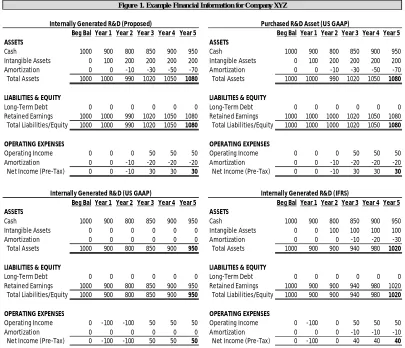
As can be seen in Figure 1, the financial statement information presented using the proposed changes and through current acquisition are both identical. However, the information presented under IFRS and US GAAP are both noticeably different from each other. Both US GAAP and IFRS present a lower or nonexistent value for the intangible asset, which results in a lower overall level of total assets.
The large negative net income due to the expensing of the intangible investment under current FASB and IASB standards strongly stands out. Because the internally generated intangible asset was not capitalized under US GAAP, it was not subsequently amortized, which results in less amortization expense and higher reported net income in future periods.
Beg Bal Year 1 Year 2 Year 3 Year 4 Year 5 Beg Bal Year 1 Year 2 Year 3 Year 4 Year 5
ASSETS ASSETS
Cash 1000 900 800 850 900 950 Cash 1000 900 800 850 900 950
Intangible Assets 0 100 200 200 200 200 Intangible Assets 0 100 200 200 200 200
Amortization 0 0 -10 -30 -50 -70 Amortization 0 0 -10 -30 -50 -70
Total Assets 1000 1000 990 1020 1050 1080 Total Assets 1000 1000 990 1020 1050 1080
LIABILITIES & EQUITY LIABILITIES & EQUITY
Long-Term Debt 0 0 0 0 0 0 Long-Term Debt 0 0 0 0 0 0
Retained Earnings 1000 1000 990 1020 1050 1080 Retained Earnings 1000 1000 1000 1020 1050 1080
Total Liabilities/Equity 1000 1000 990 1020 1050 1080 Total Liabilities/Equity 1000 1000 1000 1020 1050 1080
OPERATING EXPENSES OPERATING EXPENSES
Operating Income 0 0 0 50 50 50 Operating Income 0 0 0 50 50 50
Amortization 0 0 -10 -20 -20 -20 Amortization 0 0 -10 -20 -20 -20
Net Income (Pre-Tax) 0 0 -10 30 30 30 Net Income (Pre-Tax) 0 0 -10 30 30 30
Beg Bal Year 1 Year 2 Year 3 Year 4 Year 5 Beg Bal Year 1 Year 2 Year 3 Year 4 Year 5
ASSETS ASSETS
Cash 1000 900 800 850 900 950 Cash 1000 900 800 850 900 950
Intangible Assets 0 0 0 0 0 0 Intangible Assets 0 0 100 100 100 100
Amortization 0 0 0 0 0 0 Amortization 0 0 0 -10 -20 -30
Total Assets 1000 900 800 850 900 950 Total Assets 1000 900 900 940 980 1020
LIABILITIES & EQUITY LIABILITIES & EQUITY
Long-Term Debt 0 0 0 0 0 0 Long-Term Debt 0 0 0 0 0 0
Retained Earnings 1000 900 800 850 900 950 Retained Earnings 1000 900 900 940 980 1020
Total Liabilities/Equity 1000 900 800 850 900 950 Total Liabilities/Equity 1000 900 900 940 980 1020
OPERATING EXPENSES OPERATING EXPENSES
Operating Income 0 -100 -100 50 50 50 Operating Income 0 -100 0 50 50 50
Amortization 0 0 0 0 0 0 Amortization 0 0 0 -10 -10 -10
Net Income (Pre-Tax) 0 -100 -100 50 50 50 Net Income (Pre-Tax) 0 -100 0 40 40 40
Internally Generated R&D (US GAAP) Internally Generated R&D (IFRS) Figure 1. Example Financial Information for Company XYZ
This example illustrates several previously discussed topics. In the case of the proposed fair value accounting method, the identical presentation and recognition compared to those of a purchase setting demonstrate increased understandability, comparability, and overall relevance of the financial statements compared to under current US GAAP and IFRS. Additionally, the large early negative net income and inflated positive net income in subsequent periods found in the statements prepared under US GAAP and IFRS demonstrate the point observed earlier regarding the shortcomings of a strictly conservative treatment of intangible assets. As Lev et al. (2005) demonstrated, the early conservative values became aggressive later and inflated earnings compared to the purchased intangible asset. Due to the inflated net income, reduced assets, and reduced equity, several common financial analysis ratios used to evaluate firm performance such as return-on-assets and return-on-equity will be inflated in subsequent years. These large variances in net income diminish the relevance and comparability of the financial statements and may contribute to greater difficulty faced by investors regarding informed financial decisions.
8. Conclusion
Intangible assets have become a major factor driving value creation in the modern global economy. Despite this, many inconsistencies exist in the presentation of intangible assets in financial statements, often under representing internally generated intangible assets. In recognition of the growing magnitude of intangible assets, both the FASB and IASB have included projects to address them on their agendas during the last decade.
Conceptually, the relevance and consistency of financial statements derived from the treatment of internally generated intangible assets would be most improved by using a fair value measurement approach that brings their presentation in line with acquired intangible assets. However, at present, uncertainties exist regarding the reliability and verifiability of statements prepared using these fair value measurements due to limited active markets for comparison and considerable management discretion and uncertainty. As such, while a cost-based approach would be limited in the identification, recognition, and measurement of only planned internally generated intangible assets and would not necessary result in values that were as relevant to acquired intangible assets, the simpler adoption and expected greater reliability of this method could provide a method that improves overall usefulness of financial statements in the interim until further research and refinement of a value-based model can be achieved.
References
AASB. (2008). Initial Accounting for Internally Generated Intangible Assets.
Aboody, D. & Lev, B. (2000). Information asymmetry, R&D, and insider gains. The journal of Finance, 55(6), 2747–2766.
Basu, S. (1997). The conservatism principle and the asymmetric timeliness of earnings. Journal of Accounting and Economics, 24(1), 3–37.
Chalmers, K., Clinch, G., Godfrey, J. M. & Wei, Z. (2012). Intangible assets, IFRS and analysts’ earnings forecasts. Accounting & Finance, 52(3), 691 – 721. Dahmash, F. N., Durand, R. B. & Watson, J. (2009). The value relevance and
reliability of reported goodwill and identifiable intangible assets. The British Accounting Review, 41(2), 120–137.
Easley, D. & O’Hara, M. (2004). Information and the Cost of Capital. Journal of Finance, 59(4), 1553 – 1583.
Eckstein, C. (2004). The measurement and recognition of intangible assets: then and now. Accounting Forum, 28(2), 139–158.
Lev, B. (2001). Intangibles: Management, measurement and reporting. Brookings Institution Press.
Lev, B. (2003). Remarks on the measurement, valuation, and reporting of intangible assets. FRBNY Economic Policy Review.
Lev, B. & Zarowin, P. (1999). The Boundaries of Financial Reporting and How to Extend Them. Journal of Accounting Research, 37(2), 353 – 385.
Lightfoot, S. (2013). Research into the accounting for intangible assets. Charter, 84(1), 44 – 45.
Matolcsy, Z. & Wyatt, A. (2006). Capitalized intangibles and financial analysts. Accounting & Finance, 46(3), 457–479.
Sharma, N. (2012). Intangible Assets : A Study of Valuation Methods. BVIMR
Management Edge, 5(1), 61 – 69.
Siegel, P. & Borgia, C. (2007). The measurement and recognition of intangible assets. Journal of Business and Public Affairs, 1(1).
Upton, W. S. (2001). Business and financial reporting. Challenges from the new economy. Financial Accounting Series (FASB). Special report (219-A).
Uzma, S. H. (2011). Challenges of Reporting Intangible Assets in Financial Statements. IUP Journal of Accounting Research & Audit Practices, 10(4), 28 – 38.