A Study on the Purpose of E-Resource: an
Emerging Trend Among Students
D. Hema Shanmuga Priya Mrs. K. R. Mahalaxmi
Student Assistant Professor
Department of Management Studies Department of Management Studies Anna University (BIT campus), Trichy-620024 Anna University (BIT campus), Trichy-620024
Abstract
E-resources is the emerging trend in the current scenario among students. As the technology grows, the trend is changing then and there. Since this is the period of mobile technology and internet. The study purpose may get more effective by obtaining a recent and practical research. This paper is based on the purpose of using e-resources and the various type of e-resources is more regularly used among the students and the difficulties faced by them while accessing the various types of e-resources. For this study, a structured questionnaire is framed and it is distributed around the sample size of 150 respondents who uses e-resource services and facilities. This paper analyzed about independency between the variables and provides a importance of using e-resources.
Keywords: E-resources, VLEs, SPSS
_______________________________________________________________________________________________________
I. INTRODUCTION
Information is the key source of knowledge. The means of accessing the information is the changing one from time to time. It starts with storing of information by use of papers and continues to grow till with the use of digital source. Among those E -resource is one of the emerging technologies in collecting, storing and retrieving the information. This is due to the continuous development of Information Technology and its impact on information collection development policies due to improved demand of users for updated information within a short time. With the growing trends of e-resources, the traditional libraries are gradually moving from print documents to e-resources. This has forced libraries to rethink about their collection and storing methods. Applications of Information communication technology in libraries have provided more opportunities for e-resource development and designed in the manner that the users prefer. Among e-resources, e-journals, e-books, e-thesis is mostly in demand by the users among students. This trend has overcome the shortcoming of traditional methods. Now the access of information is not limited to particular library alone. The libraries can enable worldwide access to the distributed information and knowledge in electronic form that is consistently available, easily updated and convenient to use.
II.VARIOUS ELEMENTS OF E-RESOURCES
For the research we are defining e‐resources in the broadest sense. This includes Virtual Learning Environments (VLEs), platforms (such as XCRI), research software tools (such as NVivo, Endnote or SPSS), and various e‐resources (such as the use of Web 2.0 technologies, social networking technologies or mobile phone technologies) as they relate to systems used to help in learning, teaching, administration or management.
E-Journals E-Manuscripts E-Maps CDs/DVDs E-Books E-Magazines
E-Thesis/Dissertation Online Databases E-Newspaper
E-Research Paper/ Project
Objective of the Study:
To know the purpose of using the e-resources.
To find out which type of e-resources is regularly used.
III. SCOPE OF THE STUDY
The study is limited to college students who use e-resource, it includes undergraduate students, post graduate students, diploma students, research scholars.
Research Methodology
Descriptive research methodology is used. The descriptive research is concerned with describing the characteristics of a particular individual or of a group. It is also concerned with specific predictions with narration of facts and characteristic concerning individual, group or situation. The questions used is open end questions and closed end questions The scaling used is summated scales or likert type scales.
Data Collection
The data used is primary and secondary data. The primary data are the those which are collected a fresh and for the first time and thus happens to be original in character. In this study, the collection of primary data is through questionnaire and interview method. The secondary data are those which have already been collected by someone else and which have already been passed through statistical process.
Data Analysis
Table – 1
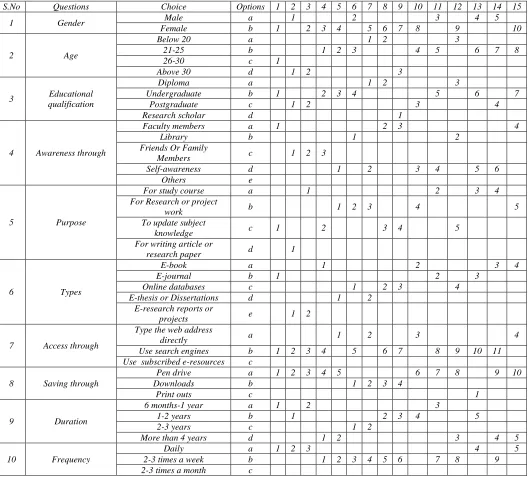
S.No Questions Choice Options 1 2 3 4 5 6 7 8 9 10 11 12 13 14 15
1 Gender Male a 1 2 3 4 5
Female b 1 2 3 4 5 6 7 8 9 10
2 Age
Below 20 a 1 2 3
21-25 b 1 2 3 4 5 6 7 8
26-30 c 1
Above 30 d 1 2 3
3 Educational
qualification
Diploma a 1 2 3
Undergraduate b 1 2 3 4 5 6 7
Postgraduate c 1 2 3 4
Research scholar d 1
4 Awareness through
Faculty members a 1 2 3 4
Library b 1 2
Friends Or Family
Members c 1 2 3
Self-awareness d 1 2 3 4 5 6
Others e
5 Purpose
For study course a 1 2 3 4
For Research or project
work b 1 2 3 4 5
To update subject
knowledge c 1 2 3 4 5
For writing article or
research paper d 1
6 Types
E-book a 1 2 3 4
E-journal b 1 2 3
Online databases c 1 2 3 4
E-thesis or Dissertations d 1 2
E-research reports or
projects e 1 2
7 Access through
Type the web address
directly a 1 2 3 4
Use search engines b 1 2 3 4 5 6 7 8 9 10 11
Use subscribed e-resources c
8 Saving through
Pen drive a 1 2 3 4 5 6 7 8 9 10
Downloads b 1 2 3 4
Print outs c 1
9 Duration
6 months-1 year a 1 2 3
1-2 years b 1 2 3 4 5
2-3 years c 1 2
More than 4 years d 1 2 3 4 5
10 Frequency
Daily a 1 2 3 4 5
2-3 times a week b 1 2 3 4 5 6 7 8 9
Once in a month d 1
11 Place of access
At Home a 1 2 3
At college library b 1 2 3 4 5 6 7 8 9
At computer centre c 1 2 3
12 learn to handle
Training through college
library a 1 2 3 4 5 6 7 8
Guidance from colleagues
and friends b 1 2 3
Self instruction c 1 2 3 4
13 Difficulties faced
Speed a 1 2 3 4 5 6 7
Non user friendly interface b 1 2 3 4 5
Privacy problem c
No problems Faced d 1 2
Others e 1
14 Diminish Yes a 1 2 3 4 5 6
No b 1 2 3 4 5 6 7 8 9
15 comparison
Time saving a 1 2 3 4 5 6 7 8 9 10 11 12 13
Time consuming b 1 2
More informative c 1 2 3 4 5 6 7 8 9 10 11
Less informative d 1 2 3 4
More expensive e 1 2 3 4 5 6 7
Less expensive f 1 2 3 4 5 6 7 8
Easy to use g 1 2 3 4 5 6 7 8 9 10 11 12 13 14
Complicated h 1
More preferred i 1 2 3 4 5 6 7 8 9 10 11 12 13 14
Less preferred j 1
More flexible k 1 2 3 4 5 6 7 8 9
Less flexible l 1 2 3 4 5 6
Easy to handle m 1 2 3 4 5 6 7 8 9 10 11 12 13 14 15
Complicated n
More effective o 1 2 3 4 5 6 7 8 9 10 11 12 13 14 15
Less effective p
16 Satisfaction with
e-resources
Highly satisfied a 1 2 3
Satisfied b 1 2 3 4 5 6 7
Neutral c 1 2
Dissatisfied d 1 2
Chi-Square Test
A statistical method assessing the goodness of fit between a set of observed values and those expected theoretically. Based on this the independency can be easily identified.
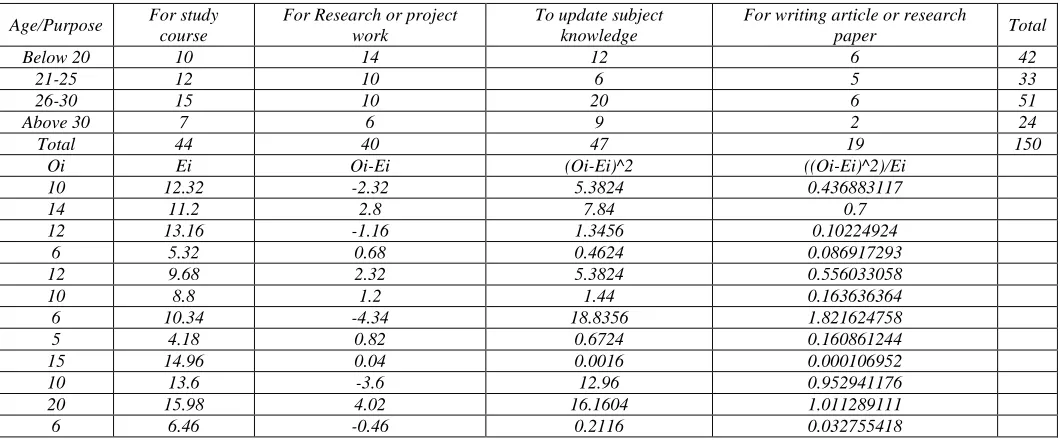
1) H0= There is no significant difference between the Age of the respondent and the purpose of using the e-resources. H1= There is a significant difference between the Age of the respondent and the purpose of using the e-resources.
Table – 2
Age/Purpose For study
course
For Research or project work
To update subject knowledge
For writing article or research
paper Total
Below 20 10 14 12 6 42
21-25 12 10 6 5 33
26-30 15 10 20 6 51
Above 30 7 6 9 2 24
Total 44 40 47 19 150
Oi Ei Oi-Ei (Oi-Ei)^2 ((Oi-Ei)^2)/Ei
10 12.32 -2.32 5.3824 0.436883117
14 11.2 2.8 7.84 0.7
12 13.16 -1.16 1.3456 0.10224924
6 5.32 0.68 0.4624 0.086917293
12 9.68 2.32 5.3824 0.556033058
10 8.8 1.2 1.44 0.163636364
6 10.34 -4.34 18.8356 1.821624758
5 4.18 0.82 0.6724 0.160861244
15 14.96 0.04 0.0016 0.000106952
10 13.6 -3.6 12.96 0.952941176
20 15.98 4.02 16.1604 1.011289111
7 7.04 -0.04 0.0016 0.000227273
6 6.4 -0.4 0.16 0.025
9 7.52 1.48 2.1904 0.291276596
2 3.04 -1.04 1.0816 0.355789474
sum 6.697591074
deg of freedom (m-1)(n-1) 9
Table value 16.919
2) H0= There is no significant difference between the gender and the type of e-resources used regularly. H1= There is a significant difference between the gender and the type of e-resources used regularly.
Table – 3:
gender/types E-book E-journal Online databases E-thesis or Dissertations E-research reports or projects
Male 29 14 5 4 7
Female 40 17 17 8 9
Total 69 31 22 12 16
Oi Ei Oi-Ei (Oi-Ei)^2 ((Oi-Ei)^2)/Ei
29 27.14 1.86 3.4596 0.127472
14 12.19333333 1.806666667 3.264044444 0.267691
5 8.653333333 -3.653333333 13.34684444 1.542393
4 4.72 -0.72 0.5184 0.109831
7 6.293333333 0.706666667 0.499377778 0.07935
40 41.86 -1.86 3.4596 0.082647
17 18.80666667 -1.806666667 3.264044444 0.173558
17 13.34666667 3.653333333 13.34684444 1.000013
8 7.28 0.72 0.5184 0.071209
9 9.706666667 -0.706666667 0.499377778 0.051447
sum 3.505611
deg of freedom (m-1)(n-1) 3
Table value 7.815
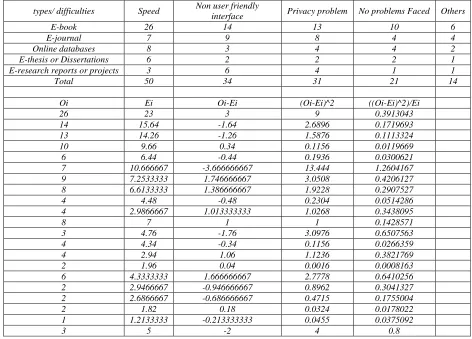
3) H0= There is no significant difference between the type of resource and the difficulties faced while accessing the e-resource.
H1= There is a significant difference between the type of e-resource and the difficulties faced while accessing the e-resource. Table – 4:
types/ difficulties Speed Non user friendly
interface Privacy problem No problems Faced Others
E-book 26 14 13 10 6
E-journal 7 9 8 4 4
Online databases 8 3 4 4 2
E-thesis or Dissertations 6 2 2 2 1
E-research reports or projects 3 6 4 1 1
Total 50 34 31 21 14
Oi Ei Oi-Ei (Oi-Ei)^2 ((Oi-Ei)^2)/Ei
26 23 3 9 0.3913043
14 15.64 -1.64 2.6896 0.1719693
13 14.26 -1.26 1.5876 0.1113324
10 9.66 0.34 0.1156 0.0119669
6 6.44 -0.44 0.1936 0.0300621
7 10.666667 -3.666666667 13.444 1.2604167
9 7.2533333 1.746666667 3.0508 0.4206127
8 6.6133333 1.386666667 1.9228 0.2907527
4 4.48 -0.48 0.2304 0.0514286
4 2.9866667 1.013333333 1.0268 0.3438095
8 7 1 1 0.1428571
3 4.76 -1.76 3.0976 0.6507563
4 4.34 -0.34 0.1156 0.0266359
4 2.94 1.06 1.1236 0.3821769
2 1.96 0.04 0.0016 0.0008163
6 4.3333333 1.666666667 2.7778 0.6410256
2 2.9466667 -0.946666667 0.8962 0.3041327
2 2.6866667 -0.686666667 0.4715 0.1755004
2 1.82 0.18 0.0324 0.0178022
1 1.2133333 -0.213333333 0.0455 0.0375092
6 3.4 2.6 6.76 1.9882353
4 3.1 0.9 0.81 0.2612903
1 2.1 -1.1 1.21 0.5761905
1 1.4 -0.4 0.16 0.1142857
sum 9.2028698
deg of freedom (m-1)(n-1) 16
Table value 26.296
Findings
The calculated value is 6.697591 and the table value is 16.919. Thus the table value is greater than the calculated value. H0 is accepted. Therefore the age of the respondents is independent of purpose of using the e-resources.
The calculated value is 3.505611 and the table value is 7.815. Thus the table value is greater than the calculated value. H0 is accepted. Therefore the gender of the respondents is independent of the types of e-resource used regularly.
The calculated value is 9.20287 and the table value is 26.296. Thus the table value is greater than the calculated value. H0 is accepted. Therefore the type of e-resources is independent of the difficulties faced while accessing the e-resources.
IV. CONCLUSION
Thus from the study it is clear that the respondents using various e-resources for different purpose of the study in academic courses. E-resources is being helpful in academic as well as for research purpose, articles and various project works. At the same time there are various difficulties faced by the users while accessing to e-resources such as speed, privacy problems and non-user friendly interface. Thus from the study it is concluded that age of the respondent is not depending upon the purpose of the study. And difficulties faced are common for all types of e-resources. And both men and women are using the e-resources at same frequency.
REFERENCE
[1] M. T. Dastforoush, and Y. Venkatesha, Dependency on electronic and print journals: A case study, SRELS Journal of Information Management, 48(4), 2011, 441-448. [4].
[2] M. Tahir, K. Mahmood, and F. Shafique, Use of electronic information resources and facilities by humanities scholars, The Electronic Library, 28(1), 2010, 122-136. [5].
[3] H. Dilek-Kayaoglu, Use of electronic journals by faculty at Istanbul University, Turkey: The results of a survey, The Journal of Academic Librarianship, 34(3), 2008, 239-247.
[4] Maharana, B., Choudhury, B.K., Dutta, S. (2004). Collection development of electronic information resources in the R & D libraries in Kolkata city: A survey. Library Herald, 42(3), 235-246.
[5] Das, Pragyan. (2007). Collection management of electronic information resources of engineering college libraries of Bhubaneswar City: A Survey. [6] Varalakshmi, R. S. R. (2004). Collection Management in Digital Environment: Policy statement for University Libraries in India. SRELS Journal of
Information Management, 41(1),79-90.