I
I
n
n
t
t
e
e
r
r
n
n
a
a
t
t
i
i
o
o
n
n
a
a
l
l
J
J
o
o
u
u
r
r
n
n
a
a
l
l
o
o
f
f
P
P
h
h
a
a
r
r
m
m
a
a
S
S
c
c
i
i
e
e
n
n
c
c
e
e
s
s
Vol. 5, No. 4 (2015): 1220-1225Research Article Open Access
I
ISSSSNN::22332200--66881100
Development and Validation of Stability Indicating
RP-HPLC Method for Simultaneous Estimation of
Pyrantel Pamoate and Albendazole in Bulk and
Tablet Dosage Form
N.V.V. Jagan Mohan Reddy* and S. Ganapaty
University College of Pharmaceutical Sciences, Andhra University, Visakhapatnam, India.
* Corresponding author: N.V.V. Jagan Mohan Reddy, e-mail: [email protected]
ABSTRACT
The purpose of the investigation was to develop a new RP-HPLC method for simultaneous estimation of Pyrantel pamoate and Albendazole in pharmaceutical dosage forms. Chromatography was carried out on an BDS C-18 column (4.6 x 250mm, 5μ particle size) with a isocratic mobile phase composed of phosphate buffer, Acetonitrile (55:45:v/v) at a flow rate of 1 mL/min. The column temperature was maintained at 30°C and the detection was carried out using a PDA detector at 246 nm. Validation parameters such as system suitability, linearity, precision, accuracy, specificity, limit of detection (LOD), limit of quantification (LOQ), Stability of sample and standard stock solutions and robustness were studied as reported in the International Conference on Harmonization guidelines. The retention times for Pyrantel pamoate and Albendazole and were 2.514 min and 3.328 min respectively. The percentage recoveries of Pyrantel pamoate and Albendazole were 99.83% and 100.52% respectively. The relative standard deviation for assay of tablets was found to be less than 2%. The method was fast, accurate, precise and sensitive hence it can be employed for routine quality control of tablets containing both drugs in quality control laboratories and pharmaceutical industries.
Keywords:
RP-HPLC, Pyrantel pamoate, Albendazole.1. INTRODUCTION
Pyrantel pamoate is chemically named as 4-[(3-Carboxy-2-hydroxynaphthalen-1-yl)methyl]-3-hydroxy naphthalene-2-carboxylic acid; 1-methyl-2-[(E)-2-thiophen-2-ylethenyl]-5,6-dihydro-4H-pyrimidine. It is used as a deworming agent in the treatment of hookworms (all species) and roundworms (Ascaris lumbricoides, aka ascarids in humans) in domesticated animals such as horses, cattle, sheep, pigs, cats, dogs, and many other species [1-3]. Albendazole is chemically named as Methyl [5-(propylthio)-1H-benzoimidazol-2-yl]carbamate. Albendazole causes degenerative alterations in the tegument and intestinal cells of the worm by binding to the colchicine-sensitive site of tubulin, thus inhibiting its polymerization or assembly into microtubules [4-6]. Various UV & HPLC assay methods are also reported in the literature for the estimation of Pyrantel pamoate [12-16] and
Albendazole [7-11] individually and in-combination with other drugs. According to literature survey there is no official method for the simultaneous estimation of Pyrantel pamoate and Albendazole by RP-HPLC in combined tablet dosage forms. Hence, an attempt has been made to develop new method for simultaneous estimation and validation of Pyrantel pamoate and Albendazole in tablet formulation in accordance with the ICH guidelines [17].
2. MATERIALS AND METHODS
2.1 Chemicals and Reagents
The reference samples of Pyrantel pamoate and Albendazole were provided as gift samples from Spectrum pharma research solutions, Hyderabad. HPLC grade acetonitrile, HPLC grade methanol and all other chemicals were obtained from Merck chemical division, Mumbai. HPLC grade water obtained from Milli-Q
water purification system was used throughout the study. Commercial tablets (Wormazan; Dosage: Pyrantel Pamoate -100 mg & Albendazole- 300 mg) were purchased from the local pharmacy.
Figure 1: Chemical Structure of Pyrantel pamoate
Figure 2: Chemical Structure of Albendazole
2.2 Instrument and chromatographic conditions
RP-HPLC waters 2695 separation module equipped with 2996 Photodiode Array Detector was employed in this method. The Empower 2 software was used for LC peak integration along with data acquisition and data processing. The column used for separation of analytes is Hypersil BDS C18, (250 x 4.6 mm, 5). Mobile phase consisting of Phosphate Buffer: Acetonitrile in the ration of 65:35 % v/v at a flow rate of 1.0 ml/min. It was filtered through 0.45μm nylon filter and sonicated for 5 min in ultrasonic bath. Samples were analysed at 246 nm at an injection volume of 10 μL.
2.3 Preparation of Phosphate Buffer pH 3.5
Accurately weighed 1.36gm of Potassium dihyrogen Ortho phosphate in a 1000ml of Volumetric flask add about 900ml of milli-Q water added and degas to sonicate and finally make up the volume with water then added 1ml of orthophosphoric acid then PH adjusted to 3.5 with dil. Orthophosphoric acid solution.
2.4 Preparation of Solutions:
2.4.1 Pyrantel pamoate stock preparation (400µg/ml): Accurately weighed and transferred 10 mg of Pyrantel Pamoate in to 25ml of clean dry volumetric flask, add 17ml of diluent (water : methanol 50:50), then sonicated for 10min and make up the volume with diluent.
2.4.2 Albendazole stock preparation (1200µg/ml): Accurately weighed 30mg of Albendazole and transferred into 25ml of clean dry volumetric flask, add
17ml of diluent (water : methanol 50:50), then sonicated for 10 min and make up the final volume with diluent.
2.5 Standard Preparations:
2.5.1 Pyrantel pamoate Standard Preparation
(40µg/ml):
From the above Pyrantel Pamoate stock solution 1ml was pipette out into 10ml of clean dry volumetric flask and make up the final volume with diluent.
2.5.2 Albendazole standard Preparation (120µg/ml): From the above Albendazole stock solution 1ml was pipette out into a 10ml clean dry volumetric flask and make up the final volume with diluent.
2.6 METHOD VALIDATION
The validation of the method was carried out as per ICH Guidelines [17]. The parameters assessed were
specificity, linearity, precision, accuracy, stability, LOD and LOQ.
2.6.1 Specificity
Specificity is the ability of the analytical method to measure the analyte response in the presence of interferences including degradation products and related substances.
2.6.2 Accuracy
The accuracy was determined by calculating % recoveries of Pyrantel pamoate and Albendazole. It was carried out by adding known amounts of each analyte corresponding to three concentration levels (50, 100, and 150%) of the labelled claim to the excipients. At each level, six determinations were performed and the accuracy results were expressed as percent analyte recovered by the proposed method.
2.6.3 Precision
Precision of an analytical method is usually expressed as the standard deviation. The repeatability studies were carried out by estimating response of Pyrantel pamoate and Albendazole six times. The intra-day and inter-day precision studies (intermediate precision) were carried out by estimating the corresponding responses three times on the same day and on three different days for three different concentrations and the results are reported in terms of relative standard deviation.
2.6.4 Linearity
2.6.5 Robustness
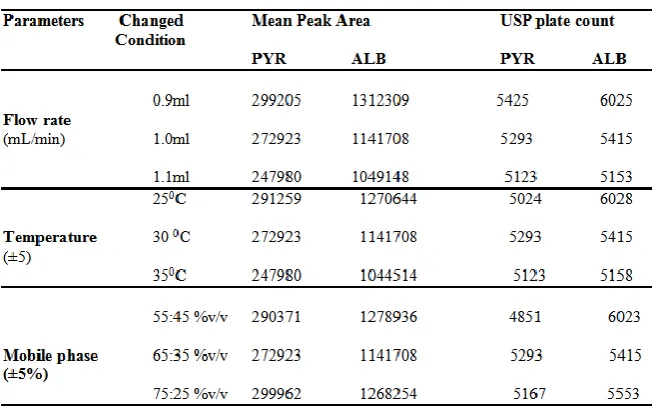
Robustness of the method was investigated under a variety of conditions including changes of composition of buffer in the mobile phase, flow rate and temperature. This deliberate change in the method has no effect on the peak tailing, peak area and theoretical plates and finally the method was found to be robust.
2.6.6 Limit of Detection & Limit of Quantitation
The LOD can be defined as the smallest level of analyte that gives a measurable response and LOQ was determined as the lowest amount of analyte that was reproducibly quantified. These two parameters were calculated using the formula based on the standard deviation of the response and the slope. LOD and LOQ
were calculated by using equations, LOD=3.3 × s/s and LOQ=10 × s/s, where s = standard deviation, S= slope of the calibration curve.
2.6.7 Assay of Pyrantel pamoate and Albendazole in Tablet
Assay of marketed product was carried out by using the developed method. Sample solutions were prepared and injected into RP-HPLC system. The sample solution was scanned at 246 nm. The % drug estimated was found to be 99.83 for Pyrantel Pamoate & 100.52 for Albendazole. The chromatogram showed two single peaks of Pyrantel pamoate and Albendazole was observed with retention times of 2.514 and 3.328 min (Figure 3).
Figure 3: A typical chromatogram of Pyrantel pamoate and Albendazole in tablet dosage form
Figure 4: Standard Chromatogram of Pyrantel pamoate and Albendazole
Figure 6: Linearity curve of Albendazole
2.7 Forced Degradation studies
Stress studies are performed according to ICH guidelines under conditions of hydrolysis (acidic and alkaline), photolysis, oxidation, and thermal studies.
2.7.1 Oxidation:
To 1 ml of stock solution of Pyrantel pamoate and Albendazole, 1 ml of 20% hydrogen peroxide (H2O2) was added separately. The solutions were kept for 30 min at 600c. For HPLC study, the resultant solution was
diluted to obtain 40µg/ml & 120µg/ml solution and 10 µl were injected into the system and the chromatograms were recorded to assess the stability of sample.
2.7.2 Acid Degradation Studies:
To 1 ml of s tock s solution Pyrantel pamoate and Albendazole, 1ml of 2N Hydrochloric acid was added and refluxed for 30mins at 600c .The resultant solution
was diluted to obtain 40µg/ml & 120µg/ml solution and 10 µl solutions were injected into the system and the chromatograms were recorded to assess the stability of sample.
2.7.3 Alkali Degradation Studies:
To 1 ml of stock solution Pyrantel pamoate and Albendazole, 1ml of 2N sodium hydroxide was added and refluxed for 30mins at 600c. The resultant solution
was diluted to obtain 40µg/ml & 120µg/ml solution and 10 µl were injected into the system and the chromatograms were recorded to assess the stability of sample.
2.7.4 Dry Heat Degradation Studies:
The standard drug solution was placed in oven at 1050c
for 6 h to study dry heat degradation. For HPLC study, the resultant solution was diluted to 40µg/ml & 120µg/ml solution and 10µl were injected into the system and the chromatograms were recorded to assess the stability of the sample.
2.7.5 Photo Stability studies:
The photochemical stability of the drug was also studied by exposing the 40µg/ml & 120µg/ml solution to UV Light by keeping the beaker in UV Chamber for 7days or 200 Watt hours/m2 in photo stability chamber.
For HPLC study, the resultant solution was diluted to obtain 40µg/ml & 120µg/ml solutions and 10 µl were injected into the system and the chromatograms were recorded to assess the stability of sample.
Table 1: Optimized Chromatographic conditions
Parameter Condition
Mobile Phase Phosphate Buffer: Acetonitrile (65:35 % V/V) pH adjusted to 3.6
Column BDS C18, 250 x 4.6 mm, 5.
Wave length 246nm
Flow rate 1.0 mL/min
Injection volume 10µL
Run time 10 min
Diluent Water: Acetonitrile (50:50)
Table 2: Results of Forced Degradation Studies
S.No Injection Pyrantal Pamoate Albendazole % Assay % Degradation % Assay %Degradation
1 Acid Degradation 93.30 6.70 96.39 3.61
2 Base Degradation 96.37 3.63 97.42 2.58
3 Peroxide 95.05 4.95 95.63 4.37
Table 3: Precision method of proposed RP-HPLC method
Drug Mean Area % RSD
PYRANTAL PAMOATE 272848 0.8
ALBENDAZOLE 1136817 0.6
Table 4: % Recovery Data for Pyrantel pamoate and Albendazole
Drug Spiked Level % % Recovery % RSD PYRANTEL PAMOATE 50 101.62 1.06
100 101.30 1.85
150 101.39 1.89
ALBENDAZOLE 50 100.59 1.17
100 99.31 1.08
150 100.18 0.27
Table 5: Results of Linearity
S.No Conc. (µg/ml)Pyrantal Pamoate Peak Area Conc. Albendazole (µg/ml) Peak Area
1 10 6776 30 305628
2 20 128252.3 60 617067.7
3 30 188825.3 90 916928.3
4 40 259991.3 120 1221630
5 50 326288.7 150 1511908
6 60 385927.7 180 1828897
Table 6: Robustness Data
Table 7: Results of LOD and LOQ
Drug LOD (µg/ml) LOQ (µg/ml) PYRANTEL PAMOATE 0.135 0.409
ALBENDAZOLE 0.367 0.113
3. RESULTS AND DISCUSSION
To establish and validate an efficient method for analysis of these drugs in pharmaceutical formulations, preliminary tests were performed. Different chromatographic conditions were employed for the analysis of the Pyrantel pamoate and Albendazole in both bulk and pharmaceutical dosage form. Finally the analysis was performed by using Phosphate Buffer: Acetonitrile in the ration of 65:35 % v/v at a flow rate 1.0 ml/min. Samples were analysed at 246nm at an injection volume of 10 μL and separation was carried by using Hypersil BDS C18, (250 x 4.6 mm, 5) column. The proposed method was optimized to give a sharp peak with minimum tailing for Pyrantel pamoate and
Albendazole. (Fig 4). The optimized conditions were given in table 1.
Forced degradation studies were performed to establish the stability indicating property and specificity of the proposed method. Degradation studies were carried out under conditions of hydrolysis, dry heat, oxidation, UV light and photolysis and the drug substances were degraded in all conditions. Acid and base hydrolysis was performed by exposing the drug substances with 2N HCl and 2N NaOH at 60 oC for
Degradation studies under oxidative conditions were performed by heating the drug sample with 20% H2O2
at 60 oC and degraded product peaks were observed.
Both Pyrantel pamoate and Albendazole are sensitive to acid and alkali and there was no degradation occurs under UV light and thermal conditions. The results of forced degradation studies were given in table 2. Precision was evaluated by a known concentration of Pyrantel pamoate and Albendazole was injected six times and corresponding peaks were recorded and % RSD was calculated and found within the limits. The low % RSD value was indicated that the method was precise and reproducible and the results were shown in the table (Table 3). Accuracy of the method was proved by performing recovery studies on the commercial formulation at 50, 100 and 150% level. % Recoveries of Pyrantel pamoate and Albendazole ranges from 101.36% to 100.02% in simultaneous equation method and the results were shown in the (Table 4). Linearity was established by analyzing different concentrations of Pyrantel pamoate and Albendazole respectively. The calibration curve was plotted with the area obtained versus concentration of both Pyrantel pamoate and Albendazole (Fig 5&6). In the present study six concentrations were chosen ranging between 10-60 µg/mL of Pyrantel pamoate and 30-50 µg/mL of Albendazole. The regression equation and correlation coefficient for Pyrantel pamoate and Albendazole was found to be y=6452x+307.2. And R2=0.9990 and
y=10124x-3457. and R2=0.9990 respectively and
results were given in table 5. Robustness of the method is the ability of the method to remain unaffected by small deliberate changes in parameters like flow rate, mobile phase composition and column temperature. To study the effect of flow rate of the mobile phase it was changed to 0.1 units from 1.0 mL to 0.9 mL and 1.1 mL. The effect of column temperature also checked by changing temperature to ± 5 oC. This deliberate change
in the above parameters has no significant effect on chromatographic behaviour of the samples and results were given in table 6. LOD and LOQ of Pyrantel pamoate and Albendazole were evaluated based on relative standard deviation of the response and slope of the calibration curve. The detection limits were found to be 0.135µg/mL and 0.367 µg/mL for Pyrantel pamoate and Albendazole respectively. The quantitation limits were found to be 0.409µg/mL and 0.113µg/mL for Pyrantel pamoate and Albendazole respectively. The results were given in the table 7.
4. CONCLUSION
A new stability- indicating RP-HPLC method has been developed for estimation of Pyrantel pamoate and Albendazole in bulk and pharmaceutical dosage form. The developed method was validated and it was found to be simple, sensitive, precise, robust and it can be used for the routine analysis of Pyrantel pamoate and Albendazole in both bulk and pharmaceutical dosage forms. The forced degradation studies were carried out
in accordance with ICH guidelines and the results revealed suitability of the method to study stability of Pyrantel pamoate and Albendazole under various degradation conditions like acid, base, oxidative, thermal, UV and photolytic degradations. Finally it was concluded that the method is simple, sensitive and has the ability to separate the drug from degradation products and excipients found in the dosage form.
5. REFERENCES
1. http://en.wikipedia.org/wiki/albendazole
2. http://www.scbt.com/datasheet- CAS 54965-21-8.html 3. http://www.drugbank.ca/drugs/DB00518 (APRD00782) 4. http://en.wikipedia.org/wiki/pyrantel pamoate
5. http://www.scbt.com/datasheet-CAS 22204-24-6 pyrantel pamoate .html
6. http://www. ChEMBL.ca/drugs/CHEMBL1599768
7. Valois ME, Takayanagui OM, Bonato PS, Lanchote VL, Carvalho D. (1994). Determination of albendazole metabolites in plasma by HPLC. J Anal Toxicol., 18(2):86-90. 8. Elena GO, Nica A. (2011). Development and validation of a
rp–hplc method for quantization studies of albendazole suspension dosage forms. Veterinary Drug., 5 (2).
9. Shreya RS, Deyb D, Prasanna P, Jaina H.K, Umesh M, Upadhyaya. (2014) Method development and validation for simulataneous estimation of albendazole and praziquantel in bulk and in a synthetic mixture . J Taibah University for Science, 8(1): 54–63.
10.Khalil.Z , ME karbane , M. Azougagh , JE harti, J. Taoufik . (2014). HPLC method for simultaneous determination of Albendazole metabolites in plasma . J Chem and Pharma Res., 6(11): 860-865.
11.Nathan R, Ivy Chungb, Badar Shaikha. (2011). Determination of albendazole, fenbendazole, and their metabolites in mouse plasma by high performance liquid chromatography using fluorescence and ultraviolet detection. J Liquid Chroma Related Tech., 34(18): 2211-2223.
12.Argekar AP, Raj SV, Kapadia SU, (1997) Simultaneous determination of mebendazole and pyrantel pamoate from tablets by high performance liquid chromatography-reverse phase (RP-HPLC) Talanta. J pharma bio analysis, 44(11):1959-65.
13.Morovján G, Csokán P, Makranszki L, Abdellah-Nagy EA, Tóth K. (1998). Determination of fenbendazole, praziquantel and pyrantel pamoate in dog plasma by high-performance liquid chromatography . J Chromatogr A.,797(1-2):237-44. 14.Lucie H, Ivana B, Dalibor Š, Ludmila M, Alena L, Zdeněk
O, Petr Solicha. (2012). Optimisation of an HPLC method for the simultaneous determination of pyrantel pamoate,
praziquantel, fenbendazole, oxfendazole and
butylhydroxyanisole using a phenyl stationary phase. Anal Methods., 4: 1592-1597
15.Peter C , Peter C ,László M , Abdellah N. (1998). Determination of fenbendazole, praziquantel and pyrantel pamoate in dog plasma by high-performance liquid chromatography. J Chroma., 797(1-2):237-44.
16.Esra T, Gökhan A, İlkay K, (2015) Development and validation of a RP-HPLC method for quality control of oxantel pamoate, pyrantel pamoat and praziquantel in tablets . Marmara Pharma J., 19: 27-35.
17.http://www.ich.org/products/guidelines/quality/article/qu ality-guidelines.html.
*****
© 2015; AIZEON Publishers; All Rights Reserved