Volume 1
Issue 4 Summer 2013 Article 4
August 2013
Children with Developmental Disabilities and their Motivation to
Children with Developmental Disabilities and their Motivation to
Play
Play
Lindsey Askins
Midwestern University - USA, [email protected]
Brittany Diasio
Midwestern University - USA, [email protected]
Dagmara Szewerniak
Midwestern University - USA, [email protected]
Susan M. Cahill
Midwestern University - USA, [email protected]
Follow this and additional works at: https://scholarworks.wmich.edu/ojot
Part of the Occupational Therapy Commons
Recommended Citation Recommended Citation
Askins, L., Diasio, B., Szewerniak, D., & Cahill, S. M. (2013). Children with Developmental Disabilities and their Motivation to Play. The Open Journal of Occupational Therapy, 1(4). https://doi.org/10.15453/ 2168-6408.1062
This document has been accepted for inclusion in The Open Journal of Occupational Therapy by the editors. Free, open access is provided by ScholarWorks at WMU. For more information, please contact
Children with Developmental Disabilities and their Motivation to Play Children with Developmental Disabilities and their Motivation to Play
Abstract Abstract
The purpose of this qualitative study was to examine how and when children with developmental disabilities aged nine to 12 years spontaneously demonstrated play behaviors indicative of intrinsic motivation. Data was collected from six child participants and four parent participants through the use of the Pediatric Volitional Questionnaire (PVQ) and semi-structured photo-elicitation interviews. Overall, the children who participated in this study sought out play experiences with which they were familiar in their natural environments. Specifically, they sought out experiences that afforded them the opportunity to exercise control over their environment and create a sense of predictability. Each of the children assumed the role of “orchestrator” and conducted his or her engagement in play occupations. The children
demonstrated some spontaneous play within their social environment; however, many developmentally age-appropriate behaviors were not observed.
Keywords Keywords
Play, Volition, Developmental Disabilities, Occupational Therapy
Credentials Display
Lindsey Askins; Brittany Diasio; Dagmara Szewerniak; Susan M. Cahill, Ph.D., OTR/L
Copyright transfer agreements are not obtained by The Open Journal of Occupational Therapy (OJOT). Reprint permission for this Applied Research should be obtained from the
corresponding author(s). Click here to view our open access statement regarding user rights and distribution of this Applied Research.
DOI: 10.15453/2168-6408.1062
Engagement in play is a critical factor
related to a child’s development (Lane & Bundy,
2012; Vandenberg & Kielhofner, 1982; Piaget,
1962). Play affords children the opportunity to
explore their environment and acquire skills that
will benefit them through the course of their
lifetimes (Piaget, 1962; Takata, 1971). Play
provides children with opportunities to develop
competence and experience mastery, which then
motivates them to seek new challenges and develop
more advanced skills (Andersen, Kielhofner, & Lai,
2005; Mistrett, Lane, & Goetz, 2000). Intrinsic
motivation is thought to be associated with a child’s
overall well-being and is a key hallmark of play in
typically developing children (Andersen et al.,
2005).
The literature suggests that children with
developmental disabilities often struggle with
decreased motivation to interact with objects in the
context of play (Andersen et al., 2005; Mastrangelo,
2009; Mistrett et al., 2000; Reynolds, Bendixen,
Lawrence, & Lane, 2011). According to Missiuna
and Pollock (1991), children with disabilities who
have limited play repertories develop an extreme
disadvantage compared to their typically developing
peers who have robust play repertoires. As a result,
children with disabilities may experience increased
dependence on others and a sense of incompetence
when they attempt to produce effects in their
environment (Missiuna & Pollock, 1991; Mistrett et
al., 2000).
A supportive social environment may be
more critical to a child’s intrinsic motivation to
engage in play than any other factor (Skard &
Bundy, 2008). While some literature suggests that
parents of children with disabilities are particularly
adept at anticipating their child’s needs and
adjusting their style of interaction to facilitate play
(Hamm, 2006), much of the research points in the
opposite direction. Parents of children with
developmental disabilities experience high levels of
stress (King et al., 2003) and, as a result, may play
less with their children than parents of children
without disabilities (Rogers, 1988; Kogan & Tyler,
1973). More research, however, is needed to
determine if other factors related to the social
environment can be enhanced to support the
intrinsic motivation of children with developmental
disabilities to play.
Theoretical Background
Mary Reilly (1974), a prominent leader in
the field of occupational therapy, identified play as
a multidimensional phenomenon and the primary
vehicle for the cultivation of skills in young
children. According to Reilly (1974), play
cultivates feelings of mastery as the child confronts
conflict in a series of hierarchical stages that
include: a) exploration, b) competency, and c)
achievement. The exploration phase of play arises
from an inherent interest in the environment (Riley,
1974). Intrinsic motivation guides a child through
the phase of exploration and sensory experiences
enhance this motivation (Reilly, 1974). The
sensory aspects of the environment often provide
the foundation for play and may include features of
the physical and social environment. Some
examples of these aspects include lighting, available
animals). As children move beyond exploring their
environment, they are innately drawn to seek
challenges, meet the demands of a situation, and
produce effects in order to receive feedback (Riley,
1974). This second phase, termed competency, may
be observed when a child develops a preference for
a certain play object and seeks to produce effects
with the play object purposefully as well as
repeatedly. Children who are operating in the phase
of competency seek control of their environment
and are active in pursuing their own agendas
(Reilly, 1974). When children begin to recognize
the consequences of their behavior based on
successes or failures, they move on to the phase of
achievement. Achievement in play requires
children to take risks and reflect on their skills
(Reilly, 1974). A child in the achievement phase of
play will challenge his or her own abilities and the
amount of effort needed to bring about a desired
outcome.
Contemporary occupational therapy scholars
have expanded on the early work done by Reilly.
The three phases of play development that she
identified have become the cornerstone of one of
the most widely used occupational therapy models
to explain human engagement in daily activities,
which is the Model of Human Occupation (MOHO)
(Lee, Taylor, Kielhfoner, & Fisher, 2008).
Kielhofner’s (2008) construct of volition, which is a
prominent facet of MOHO, parallel’s Reilly’s work.
Occupational therapists view volitional
development as being crucial to independence and
self-determination. According to Cahill and
Kielhofner (2008), “the thoughts and feelings that
comprise volition in childhood are concerned with
personal competence and control, enjoyment and
pleasure in doing, and the value assigned to doing”
(p. 299). Kielhofner’s construct of volition is
comprised of an individual’s values and interests, as
well as his sense of personal causation. Personal
causation is defined as a child’s sense of
effectiveness or competence in his or her abilities
(Kielhofner, 2008).
Personal causation is thought to consist of a
sense of efficacy and a sense of capacity
(Kielhofner, 2008). Whereas a sense of efficacy
refers to the child’s perception of his or her ability
to produce desired outcomes, a sense of capacity
refers to what the child believes he or she can do
and what abilities he or she has (Cahill &
Kielhofner, 2008). Children’s development of
personal causation within their meaningful daily
activities and pursuits supports their sense of
independence. When children have a positive sense
of self-efficacy, they are motivated to participate in
occupations and seek new challenges. When
children have a poor sense of self and low
self-efficacy, they are hesitant to explore within their
environment or to seek further challenges to
develop their sense of independence. The
environment and the opportunities available within
a given context impact volitional development in
children. According to MOHO (Kielhofner, 2008),
the environment includes not only the physical
spaces, but also the social elements of the
environment, such as people or animals.
The purpose of this descriptive qualitative
study was to examine how and when children with
developmental disabilities spontaneously
demonstrated play behaviors indicative of volition,
or intrinsic motivation. In addition, the
investigators sought to uncover characteristics of
the social environment that supported and inhibited
such play.
Methods Methodology
The investigators entered into this study
using a narrative approach (Clandinin & Connelly,
2004). Investigators use a narrative approach when
they want to understand how participants are
supported or inhibited by social factors and how
they interact within their social environment
(Chase, 2005). This approach encourages
participants to share their experiences or stories
with regard to the phenomenon under investigation.
Participants
The targeted population for this study was
children with developmental disabilities aged two to
13 years and their parents. Once Institutional
Review Board approval was obtained from the
authors’ university, the investigators recruited study
participants via flyer distribution and through
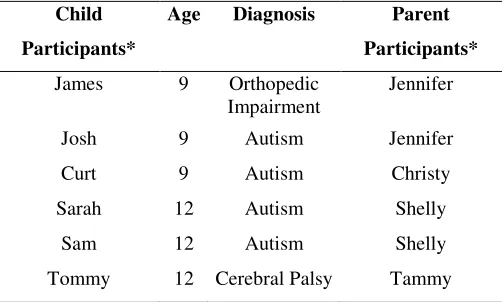
professional networks. Six children and four
parents took part in the study. Five of the children
were males, and all of the children were aged nine
to 12 years. Four of the children had a diagnosis of
autism spectrum disorder, and two children had
physical disabilities, which included cerebral palsy
and orthopedic impairments (Table 1).
Table 1
Participants
Child Participants*
Age Diagnosis Parent Participants*
James 9 Orthopedic Impairment
Jennifer
Josh 9 Autism Jennifer Curt 9 Autism Christy Sarah 12 Autism Shelly
Sam 12 Autism Shelly Tommy 12 Cerebral Palsy Tammy * Pseudonyms
Data Collection
Observations in the natural environment
along with semi-structured interviews served as the
primary means of data collection. This technique
allowed the parents to share their subjective and
personalized perspectives of their child’s specific
experiences, intentions, and actions across time
(Hamilton, 2007; Patton, 2002). The Pediatric
Volitional Questionnaire (PVQ) (Basu, Kafkes,
Schatz, Kiraly, & Kielhofner, 2008) was utilized to
assess the volitional behaviors demonstrated by
each of the children as they played in their natural
home environments. The PVQ has been found to be
valid in measuring a child’s volition and capturing
the effect that the social environment has on the
child’s engagement in play (Andersen et al., 2005).
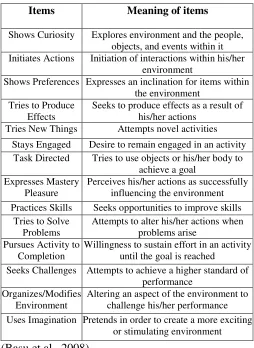
The PVQ consists of 14 items that facilitate the
understanding of how features of the environment
support or hinder a child’s volitional development.
The items of the PVQ are strategically aligned with
the child’s sense of ability and control within his or
her daily life activities and follow Reilly’s stages of
achievement). Each child was observed two times
for 30-60 min using the PVQ. The observations
were conducted by two of the four investigators and
inter-rater reliability was established at 90% for all
of the observations. During the PVQ observations,
the investigator did not interact with the child.
Table 2
Pediatric Volitional Questionnaire Items
Items Meaning of items
Shows Curiosity Explores environment and the people, objects, and events within it Initiates Actions Initiation of interactions within his/her
environment
Shows Preferences Expresses an inclination for items within the environment
Tries to Produce Effects
Seeks to produce effects as a result of his/her actions
Tries New Things Attempts novel activities Stays Engaged Desire to remain engaged in an activity
Task Directed Tries to use objects or his/her body to achieve a goal
Expresses Mastery Pleasure
Perceives his/her actions as successfully influencing the environment Practices Skills Seeks opportunities to improve skills
Tries to Solve Problems
Attempts to alter his/her actions when problems arise
Pursues Activity to Completion
Willingness to sustain effort in an activity until the goal is reached
Seeks Challenges Attempts to achieve a higher standard of performance
Organizes/Modifies Environment
Altering an aspect of the environment to challenge his/her performance Uses Imagination Pretends in order to create a more exciting
or stimulating environment
(Basu et al., 2008)
In addition, parents were asked to take
photos of their child during play and were prompted
to follow a picture-taking guide that outlined the
volitional behaviors included in the PVQ (Table 2).
The investigators then used the photos to frame
semi-structured photo-elicitation interviews
(Epstein, Stevens, McKeever, & Baruchel, 2006)
with each parent participant. The interviews ranged
between 25 and 40 min. All of the interviews were
audio-recorded and transcribed verbatim. Once the
transcripts were completed, the investigators
compared the transcripts to the audio-recording and
revised them for accuracy. Researchers also took
notes, kept a research diary, and met as a group
throughout the data collection period (Patton, 2002).
The group meetings served as an opportunity to
evaluate the fidelity of the research protocol, make
necessary adjustments to the protocol, and discuss
emerging themes. Pseudonyms were assigned to
each child and parent during the data collection
process to protect their identity.
Data Analysis
In keeping with previous research using the
PVQ, the item scores were analyzed using modes
(Harris & Reid, 2005). The PVQ scores were
compared against the themes that were identified
based on the qualitative data and later used to
substantiate our findings. In addition, a thematic
analysis was conducted using constant comparative
methods (Glaser & Strauss, 1999; Miles &
Huberman, 1994). The constant comparative
method consists of four activities that are completed
simultaneously as new data is collected. These
steps include comparing segments of data to coding
categories, associating categories and their
properties with other categories and properties,
combining categories under higher level concepts,
and generating theory (Glasser & Strauss, 1999).
Informal data analysis began after the first interview
was conducted. The data collection and data
analysis involved in this study were not separate
from each other, but rather iterative (Dillaway,
Lysack, & Luborsky, 2006). The data was
organized using within-case (i.e., all of the children
and their parents) displays and cross-sub-case
displays (i.e., each child-parent dyad) based on
different themes that emerged (Miles &
Hubermann, 1994). Member checking, which
involved the parent reviewing a summary of his or
her interview, was completed four to six weeks after
each interview (Patton, 2002).
Results
All of the children were observed in their
home, and all were considered to have more than
adequate access to play objects. Play objects
ranged from squirt bottles and toy microwaves to
sports equipment and technological devices (e.g.,
iPads, computers, Wii game consoles). In addition,
all of the children had pets, specifically dogs. The
dogs served both as a play partner (e.g., playing
fetch) and as a play object (i.e., something that can
be directed and manipulated). All of the children
demonstrated a preference for certain play objects.
The physical and social environment supported
these preferences, as the objects were readily
accessible to the children, and the children had the
opportunity to initiate interactions with the objects.
The objects that were the focus of the children’s
preferences were those that offered each participant
control over establishing the parameters of play.
Examples of the parameters established by the
children include where the play experience would
take place, the duration of the play, and how the
objects would be used in the play experience.
Four out of six participants (67%) showed
spontaneous behaviors on the following PVQ items:
shows preferences, tries to produce effects, shows
curiosity, and expresses mastery pleasure.
Spontaneous behaviors are those that are
demonstrated without the need for direct support or
engagement by another individual. The items that
were most frequently rated as passive, that is, the
child does not engage in the behavior even when
provided with support and encouragement, included
pursues activities to completion, directs oneself to
the task, seeks challenges, and tries new things.
The PVQ items most frequently not observed were
practicing skills and trying to solve problems.
Spontaneous Behaviors
Shows preferences. All of the parent participants expressed that their child showed
preferences, gravitated toward specific types of
play, and engaged in play the longest when the play
was predictable and the child could maintain control
of both the process and the outcome of the play.
For example, when Christy was asked about what
aspects of the social environment motivate her child
to engage in play the most, she mentioned Curt’s
play with the family’s dogs:
I think when it comes to the dogs, or playing
with the dogs, because he can control the
situation more, he can control the toys, he
can control the throwing, he can do more of
that. That’s when he likes to engage in a lot
of play with them. Which obviously they’re
dogs, they’re very fine with that, they’re
very [easy going and like] any kind of love
that you show them. I think that’s huge for
Curt because I think that he can control the
play, and he’s able to feel like he has
some other children or even his brothers and
sister, he doesn’t have that same
unconditional love. . . it doesn’t matter if we
are throwing a ball or what we are doing.
Tries to produce effects. The parents described their child as trying to produce effects in
the environment. All of the parents spoke about
their child’s use of technology as a means to
produce effects. Other parents spoke about more
traditional play objects. Tammy spoke of blending
a traditional play object, a trampoline, with a switch
toy (i.e., “music cube”) and how her son, who has
limited mobility, tried to produce an effect in his
environment. Tammy said: “I had [Tommy] off the
trampoline. He loves the music cube. It’s a cause
and effect toy… it was on the trampoline and he
actually physically turned around and [reached] up
to the trampoline to get it.”
Shelly described how her daughter, Sarah,
tried to produce effects by cutting up vegetables to
make soup. Although Sarah was not able to
complete the task of making soup entirely by herself
(i.e., needing help to turn on the stove), she knew
that the vegetables needed to be cut into a certain
size, and she proceeded to do that. Shelly said:
So [in this picture] they are getting ready [to
make the soup]. They are chopping carrots.
I think we had just gone to the produce
store… I think it is like the next day. So,
she had all of these ingredients in her
head…and then she asks me usually to turn
the oven on for her, whereas [my son] just
does it himself.
Shows curiosity. The parents talked about
different ways that their child demonstrated
curiosity during play. For some children, play
meant interacting with a dog or a play object, and in
other cases it meant using technology. Jennifer
described James’ curiosity when working on the
computer:
[When James] is on the computer and he is
looking something up…he might be playing
a game on the computer or looking up
something for school, sometimes they have
to do that for homework for school. …You
know that he’s very interested in sports and
sports figures so he likes to learn about
football players, baseball players, things like
that… so, just learning, learning about those
sorts of things. He’s curious about who’s on
what team and things like that.
Jennifer also described how her son, Josh,
who has more significant needs, demonstrates
curiosity when exploring the sensory characteristics
of his environment:
I can just see the expression on his face, hear
it in his voice, and by the things he’s saying, I can
tell he’s happy. Josh doesn’t get involved in a lot of
play. He is mostly a sensory seeker I would say.
So he is squeezing his water bottle or he’s
wandering around a lot right now…trying to touch
things…he’s nonverbal, so maybe he’ll make happy
sounds, so that you can tell that he enjoys that.
Mastery Pleasure. The parents talked about different ways that their child demonstrated
mastery pleasure, or the impact of their actions on
the environment. The parents described how their
child expressed mastery pleasure with activities
such as cooking recipes of their own creation,
playing video games, and getting play objects to
function in the way that they intended. Shelly
described how Sarah demonstrated mastery pleasure
when she was selected to raise the flag at her
school:
She’s just excited to do it because they
never, she hasn’t done it in two years. I don’t know
how they pick the kids [that get to raise the
flag]…so she’s excited to do it and (referring to
picture) she’s posing for me for the pictures. She’s
smiling…it’s her proud flag raising.
Behaviors Frequently Not Observed
Although some of the children were able to
demonstrate practicing skills and solving problems,
these two skills were the most frequently not
observed items during the PVQ administrations.
Three of the six child participants were not
observed practicing skills in at least one of the PVQ
observations, and none of the children were rated as
spontaneous for this item during either PVQ
observation. For example, Tammy described how
her son, Tommy, would benefit from practicing the
use of specific motor plans to make mobility and
engaging in the environment more efficient: “It’s
not as easy as most kids. Like [other kids] get it
one time and then [they think] I want to practice this
so I’ll do it over again. [Tommy] doesn’t do that so
then you have to set up the environment [for him].”
Five of the six children were not observed
problem solving in at least one of the PVQ
observations, and two of the six children were not
observed engaging in problem solving during either
PVQ observation. The parents reported that their
child struggled with trying to seek challenges,
remaining task-directed, trying to solve problems,
and pursuing activities to completion. In addition,
they identified instances where they needed to
facilitate play in order for their child to have a
successful experience and experience more control.
For example, Jennifer mentioned how interacting
with siblings in the context of play was often
frustrating for her son, James, due to losing a game.
Jennifer explained how she was the problem solver
in this situation. Jennifer stated:
[He] likes to play with any sort of video
game, the Wii, iPod or iTouch, but he also
likes sports. When he plays with his other
brother, his other brother is usually winning
by a lot more than he is, so he gets frustrated
a lot with that. He gets upset. He’ll usually
stop and come downstairs and then we’ll try
to figure out something else, kind of talk
about it and try and figure out something
else, maybe call his other brother down to
discuss how we can change the game a little
bit.
More than half of the participants in this
study spontaneously showed preferences, tried to
produce effect, showed curiosity, and expressed
mastery pleasure. Toys and other play objects were
readily available to all of the children. In addition,
the children sometimes used their pet dogs as play
partners. Both the physical and social aspects of the
environment were supportive of play and allowed
the children to establish control over the parameters
by which this occupation was carried out.
Discussion
This study sought to examine how children
years spontaneously demonstrated play behaviors
indicative of intrinsic motivation within their social
environment. Most of the children in this study
were able to spontaneously show preferences, try to
produce effects, show curiosity, and express
mastery pleasure. Overall, the children
demonstrated these behaviors in their natural
environments, ones with which they were already
familiar. Despite familiarity with the social
environment, and even when many resources were
made available to them (e.g., toys, pets, and
siblings), the children in this study often required
additional support to try new things, seek
challenges, remain task directed, and pursue
activities to completion. Further, the children
tended to seek out play experiences that afforded
them the opportunity to exercise control over their
social environments and create a sense of
predictability.
The children’s hesitancy to try new things
and seek challenges supports the notion that
children with disabilities tend to have limited play
repertoires and require more support from others
during play (Missiuna & Pollock, 1991; Mistrett et
al., 2000). However, the children’s sense of
curiosity, their desire to produce effects, and their
desire to control their social environments seems to
suggest that children with disabilities could have
more robust play repertoires given the appropriate
supports. Further, it is possible that the
demonstration of spontaneous volitional behaviors
may be the prerequisite that lead them from being
dependent on others during play to becoming
interdependent and independent. More research is
needed to explore why children with disabilities
have such limited repertoires. Specifically, research
should be done to distinguish between a child’s
need for physical assistance and modifications
during a new play activity and a child’s ability to
independently orchestrate such play. While some
literature suggests that parents of children with
disabilities are particularly skilled at facilitating
their children’s play (Hamm, 2006), more research
is needed to determine when and how the parents
themselves approach new play tasks, and how they
facilitate play with unfamiliar objects.
Despite the small sample size, the results of
this study suggest that children with developmental
disabilities spontaneously demonstrate some
behaviors associated with the intrinsic motivation to
play in social environments, particularly when they
have the opportunity to control specific
environmental parameters and orchestrate events.
In order to increase participation and develop
competency in play, occupational therapists should
create opportunities that complement the child’s
natural desire for control, yet challenge the child to
expand his or her play repertoire in order to further
develop skills. Occupational therapists and other
practitioners should collaborate with parents to
determine the child’s next just right challenge
(Reilly, 1974) and grade the affordances provided in
the social environment to maximize opportunities
for development. Further research is needed to
understand how children with disabilities develop
play repertoires and how parents support the
development of play skills.
References
Andersen, S., Kielhofner, G., & Lai, J-S. (2005). An examination of the measurement properties
of the Pediatric Volitional Questionnaire. Physical & Occupational Therapy in
Pediatrics, 25(1-2), 39-57.
Basu, S., Kafkes, A., Schatz, R., Kiraly, A., & Kielhofner, G. (2008). The Pediatric Volitional
Questionnaire (Version 2.1). Chicago: University of Illinois at Chicago.
Cahill, S., & Kielhofner G. (2008). Volition: Child-oriented intervention for the upper extremity.
In A. Eliasson and P. Burtner (Eds.), The child with cerebral palsy: Management of the
upper extremity (pp. 298-307). London: Mac Keith Press.
Chase, S. E. (2005). Narrative inquiry: Multiple lenses, approaches, voices. In. N. Denzin & Y.
S. Lincoln (Eds.), The Sage handbook for qualitative research (pp. 651-680). Thousand
Oaks, CA: SAGE.
Clandinin, D. J., & Connelly, F. M. (2004). Narrative inquiry: Experience and story in
qualitiative research. San Francisco: Jossey-Bass.
Dillaway, H., Lysack, C., & Luborsky, M. (2006). Qualitative approaches to interpreting and
reporting data. In G. Kielhofner (Ed.), Research in occupational therapy: Methods of
inquiry for enhancing practice (pp.372-388). Philadelphia, PA: F. A. Davis.
Epstein, I., Stevens, B., McKeever, P., & Baruchel, S. (2006). Photo Elicitation Interview (PEI):
Using photos to elicit children’s perspectives. International journal of qualitative
methods, 5(3), 1-11.
Glaser, B., & Strauss, A. (1999). The discovery of grounded theory: Strategies for qualitative
research. New York: Aldine de Gruyter.
Hamilton, T. B. (2007). Narrative reasoning. In B. A. B. Schell & J. W. Schell (Eds.), Clinical
and professional reasoning in occupational therapy (pp. 125-168). Baltimore, MD:
Lippincott, Williams, & Wilkins.
Hamm, E. (2006). Playfulness and the environmental support of play in children with and
without developmental disabilities. OTJR: Occupation, Participation, and Health, 26(3),
88-96.
Harris, K., & Reid, D. (2005). The influence of virtual reality play on children’s motivation.
Canadian Journal of Occupational Therapy, 72(1), 21-29.
MD: Lippincott, Williams, & Wilkins.
King, G., Law, M., King, S., Rosenbaum, P., Kertoy, M., & Young, N. L. (2003). A conceptual
model of the factors affecting the recreation and leisure participation of children with
disabilities. Physical & Occupational Therapy in Pediatrics, 23(1), 63-90.
Kogan, K. L., & Tyler, N. (1973). Mother-child interaction in young physically handicapped
children. American Journal of Mental Deficiency, 77(5), 492-497.
Lane, S., & Bundy, A. (2012). Kids can be kids: A childhood occupations approach. F. A. Davis:
Philadelphia.
Lee, S. W., Taylor, R., Kielhofner, G., & Fisher, G. (2008). Theory use in practice: A national
survey of therapists who use the Model of Human Occupation. American Journal of
Occupational Therapy, 62(1), 106-117.
Mastrangelo, S. (2009). Harnessing the power of play: Opportunities for children with autism
spectrum disorders. Teaching Exceptional Children, 42(1), 34-44.
Miles, M. B., & Huberman, A. M. (1994). Qualitative data analysis: An expanded sourcebook
(2nd ed.). Thousand Oaks, CA: SAGE.
Missiuna, C., & Pollock, N. (1991). Play deprivation in children with physical disabilities: The
role of the occupational therapist in preventing secondary disability. The American
Journal of Occupational Therapy, 45(10), 882-888.
Mistrett, S., Lane, S., & Goetz, A. (2000). A professional’s guide to assisting families in creating
play environments for children with disabilities. Retrieved from:
http://letsplay.buffalo.edu/products/PlayManual.pdf
Patton, M. (2002). Qualitative research and evaluation methods (3rd ed.). Thousand Oaks, CA:
SAGE.
Piaget, J. (1962). Play, dreams, and imitation in childhood. New York: W. W. Norton and
Company.
Reilly, M. (Ed.). (1974). Play as exploratory learning. Beverly Hills, CA: Sage Publications.
Reynolds, S., Bendixen, R., Lawrence, T., & Lane, S. (2011). A pilot study examining activity
participation, sensory responsiveness, and competence in children with high functioning
autism spectrum disorder. Journal of Autism & Developmental Disorders, 41(11),
1496-1506.
Rogers, S. J. (1988). Characteristics of social interactions between mothers and their disabled
infants: A review. Child: Care, Health and Development, 14(5), 301-317.
Skard, G., & Bundy, A. (2008). Test of playfulness. In L. D. Parham & L. Fazio (Eds.), Play in
occupational therapy for children (2nd ed., pp. 71-93). St. Louis: Mosby/Elsevier.
Takata, N. (1971). The play milieu: A preliminary appraisal. American Journal of Occupational
Therapy, 15(6), 281-284.
Vandenberg, B., & Kielhofner, G. (1982). Play in evolution, culture, and individual adaptation: