International Journal of Advances in Engineering Research http://www.ijaer.com (IJAER) 2015, Vol. No. 10, Issue No. IV, October e-ISSN: 2231-5152/ p-ISSN: 2454-1796
60 INTERNATIONAL JOURNAL OF ADVANCES IN ENGINEERING RESEARCH
TO STUDY THE STRENGTH CHARACTERISTICS OF
CONCRETE BY REPLACING CURING WATER WITH
SELF CURING COMPOUNDS
SIDDHARTH JAIN, S.P. SHARMA
Civil Engineering Department, KIET School of Engineering and Technology, Ghaziabad-Meerut Highway, Ghaziabad-201206, India
ABSTRACT
In today’s world, concrete is most popular and widely used material in construction sector due to its good compressive strength and durability. Depending upon its usability the mix proportion (cement, fine aggregate, coarse aggregate and water) are prepared to produce plain concrete. Plain concrete needs ambient atmosphere for curing for a minimum period of 28 days in order to attain desired strength. Any laxity in curing will badly affect the strength and durability of concrete. Self-curing concrete is one of the special concretes in mitigating insufficient curing due to human negligence, paucity of water in arid areas, inaccessibility of structures in difficult terrains and in areas where the presence of fluorides in water will badly affect the characteristics of concrete. The present study involves the use of shrinkage reducing admixtures like POLYETHYLENE GLYCOL (PEG 400) as internal curing compound and CUREFREE-C as external curing compound. These curing compounds are used in concrete which helps in self curing and helps in better hydration and hence good compressive strength. They trap the moisture within the structure and prevent it from evaporation (by creating a thin film or by block the pores containing water) which normally occurs due to the hydration process .In the present study, the affect of curing compounds on compressive strength and flexural strength is studied. From the previous studies by various researchers, we vary the percentage of PEG by weight of cement from 0% to 2% as the dosage of internal curing compound and 0.25% of CUREFREE-C by weight of cement was fixed as the dosage of external curing compound The test results were studied both for M25 and M30 mixes .The results shows that PEG 400 and CUREFREE-C could help in self curing by giving strength on par with that of the conventional curing method.
Keywords: Curing, Polyethyelene Glycol, Curefree-C, Strength Characteristics
INTRODUCTION
International Journal of Advances in Engineering Research http://www.ijaer.com (IJAER) 2015, Vol. No. 10, Issue No. IV, October e-ISSN: 2231-5152/ p-ISSN: 2454-1796
61 INTERNATIONAL JOURNAL OF ADVANCES IN ENGINEERING RESEARCH
concrete. Therefore, the need to develop self-curing agents attracted several researchers. The concept of self-curing agents is to reduce the water evaporation from concrete, and hence increase the water retention capacity of the concrete compared to conventional concrete. These compounds will rise to the finished concrete surface and effectively seal the surface against evaporation. It was found that water soluble polymers can be used as self-curing agents in concrete.
The use of self-curing admixtures is very important from the point of view that water resources are getting valuable every day (i.e., each 1 m3 of concrete requires about 3 m3 of water for construction most of which is for curing).The benefit of self-curing admixtures is more significant in desert areas where water is not adequately available.
OBJECTIVE
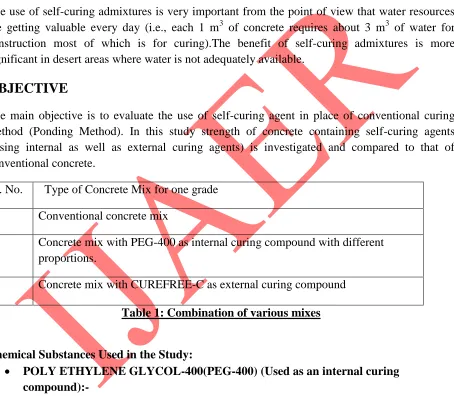
The main objective is to evaluate the use of self-curing agent in place of conventional curing method (Ponding Method). In this study strength of concrete containing self-curing agents (Using internal as well as external curing agents) is investigated and compared to that of conventional concrete.
S. No. Type of Concrete Mix for one grade
1 Conventional concrete mix
2 Concrete mix with PEG-400 as internal curing compound with different
proportions.
3 Concrete mix with CUREFREE-C as external curing compound
Table 1: Combination of various mixes
Chemical Substances Used in the Study:
POLY ETHYLENE GLYCOL-400(PEG-400) (Used as an internal curing compound):-
Polyethylene glycol is a condensation polymer of ethylene oxide and water with the general formula H(OCH2CH2)nOH, where n is the average number of repeating oxyethylene groups
non-International Journal of Advances in Engineering Research http://www.ijaer.com (IJAER) 2015, Vol. No. 10, Issue No. IV, October e-ISSN: 2231-5152/ p-ISSN: 2454-1796
62 INTERNATIONAL JOURNAL OF ADVANCES IN ENGINEERING RESEARCH
volatile and non-irritating and is used in a variety of pharmaceuticals. Thus, it is a shrinkage reducing admixture.
CUREFREE-C (Used as an external curing compound):-
It is a Liquid membrane-forming curing compound and is used on the principle that concrete gets enough water from pre-matured concrete for uninterrupted hydration after placement. For application on freshly cast concrete or newly exposed concrete surface after removal of formwork to form a temporary membrane which will provide sufficient moisture for effective curing to take place. The membrane eventually breaks down and disintegrate after which the surface can be painted. It is useful for large areas of concrete such as pavements, runways, bridge decks and industrial floors. It is also used for vertical or sloping surface as of chimneys, towers, silos, canal lining, columns and beams where water curing is difficult or unreliable.
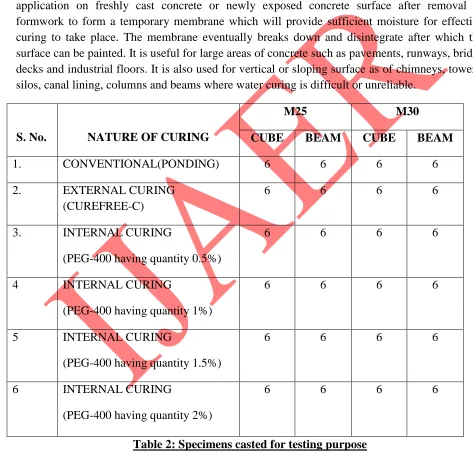
S. No. NATURE OF CURING
M25 M30
CUBE BEAM CUBE BEAM
1. CONVENTIONAL(PONDING) 6 6 6 6
2. EXTERNAL CURING
(CUREFREE-C)
6 6 6 6
3. INTERNAL CURING
(PEG-400 having quantity 0.5%)
6 6 6 6
4 INTERNAL CURING
(PEG-400 having quantity 1%)
6 6 6 6
5 INTERNAL CURING
(PEG-400 having quantity 1.5%)
6 6 6 6
6 INTERNAL CURING
(PEG-400 having quantity 2%)
6 6 6 6
International Journal of Advances in Engineering Research http://www.ijaer.com (IJAER) 2015, Vol. No. 10, Issue No. IV, October e-ISSN: 2231-5152/ p-ISSN: 2454-1796
63 INTERNATIONAL JOURNAL OF ADVANCES IN ENGINEERING RESEARCH Experimental work conducted:
Various test were done on the ingredients of concrete to collect data require for mix design as well as to study their physical properties. The proportions of ingredients for M25 and M30 for all the three types of mixes were determined by mix design and same proportions were used for casting the concrete specimens (cubes and beams).
I. Mix designs were done as per IS: 10262-2009. II. Materials were weighed by weigh batching.
III. Each set consists of 2 specimens (cubes and beams) and the test strength of the sample has been taken as the average strength of the specimens.
IV. 72 numbers of cubes 150mm x 150mm x 150mm were casted to determine the compressive strength of various mixes of concrete at the end of 7 and 28 days.
V. 72 numbers of beams 100mm x 100mm x 500mm were casted to determine the flexural
strength of various mixes of concrete at the end of 7 and 28 days.
The details of all the mix design are shown in the table below:-
MIX W/C RATIO CEMENT WATER FA CA
Kg Kg Kg Kg
Conventional 0.50 395 195.24 642.62 1164.14
PEG-400 0.50 395 195.24 642.62 1164.14
CUREFREE-C 0.50 395 195.24 642.62 1164.14
Table 3 Mix design proportions of various mixes for M25 grade of concrete
MIX W/C
RATIO
CEMENT WATER FA CA
Kg Kg Kg Kg
Conventional 0.45 438 195.57 611.25 1159.2
PEG-400 0.45 438 195.57 611.25 1159.2
CUREFREE-C 0.45 438 195.57 611.25 1159.2
International Journal of Advances in Engineering Research http://www.ijaer.com (IJAER) 2015, Vol. No. 10, Issue No. IV, October e-ISSN: 2231-5152/ p-ISSN: 2454-1796
64 INTERNATIONAL JOURNAL OF ADVANCES IN ENGINEERING RESEARCH
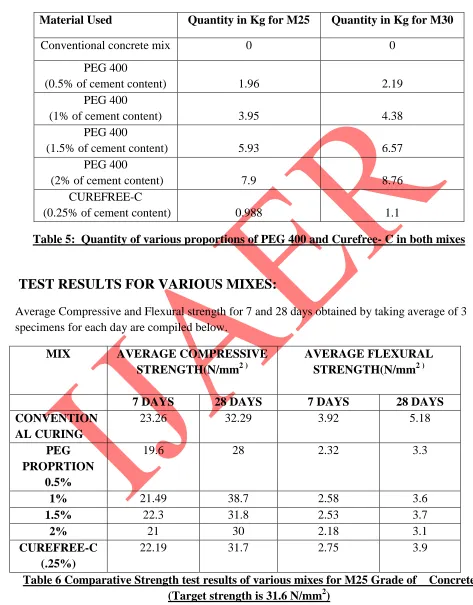
Material Used Quantity in Kg for M25 Quantity in Kg for M30
Conventional concrete mix 0 0
PEG 400
(0.5% of cement content) 1.96 2.19
PEG 400
(1% of cement content) 3.95 4.38
PEG 400
(1.5% of cement content) 5.93 6.57
PEG 400
(2% of cement content) 7.9 8.76
CUREFREE-C
(0.25% of cement content) 0.988 1.1
Table 5: Quantity of various proportions of PEG 400 and Curefree- C in both mixes
TEST RESULTS FOR VARIOUS MIXES:
Average Compressive and Flexural strength for 7 and 28 days obtained by taking average of 3 specimens for each day are compiled below.
MIX AVERAGE COMPRESSIVE
STRENGTH(N/mm2 )
AVERAGE FLEXURAL STRENGTH(N/mm2 )
7 DAYS 28 DAYS 7 DAYS 28 DAYS
CONVENTION AL CURING
23.26 32.29 3.92 5.18
PEG PROPRTION
0.5%
19.6 28 2.32 3.3
1% 21.49 38.7 2.58 3.6
1.5% 22.3 31.8 2.53 3.7
2% 21 30 2.18 3.1
CUREFREE-C (.25%)
22.19 31.7 2.75 3.9
International Journal of Advances in Engineering Research http://www.ijaer.com (IJAER) 2015, Vol. No. 10, Issue No. IV, October e-ISSN: 2231-5152/ p-ISSN: 2454-1796
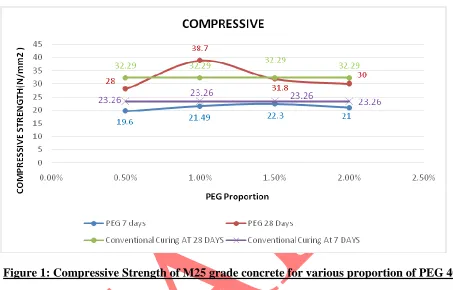
65 INTERNATIONAL JOURNAL OF ADVANCES IN ENGINEERING RESEARCH Analysis and comparative study of Compressive strength for various proportion of PEG 400 for M25 grade of concrete
Figure 1: Compressive Strength of M25 grade concrete for various proportion of PEG 400
International Journal of Advances in Engineering Research http://www.ijaer.com (IJAER) 2015, Vol. No. 10, Issue No. IV, October e-ISSN: 2231-5152/ p-ISSN: 2454-1796
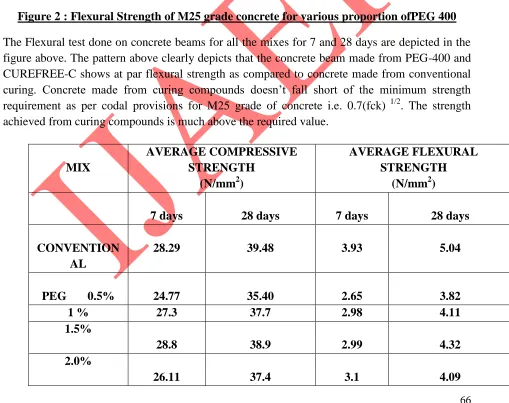
66 INTERNATIONAL JOURNAL OF ADVANCES IN ENGINEERING RESEARCH Figure 2 : Flexural Strength of M25 grade concrete for various proportion ofPEG 400
The Flexural test done on concrete beams for all the mixes for 7 and 28 days are depicted in the figure above. The pattern above clearly depicts that the concrete beam made from PEG-400 and CUREFREE-C shows at par flexural strength as compared to concrete made from conventional curing. Concrete made from curing compounds doesn’t fall short of the minimum strength requirement as per codal provisions for M25 grade of concrete i.e. 0.7(fck) 1/2. The strength achieved from curing compounds is much above the required value.
MIX
AVERAGE COMPRESSIVE STRENGTH
(N/mm2)
AVERAGE FLEXURAL STRENGTH
(N/mm2)
7 days 28 days 7 days 28 days
CONVENTION AL
28.29 39.48 3.93 5.04
PEG 0.5% 24.77 35.40 2.65 3.82
1 % 27.3 37.7 2.98 4.11
1.5%
28.8 38.9 2.99 4.32
2.0%
International Journal of Advances in Engineering Research http://www.ijaer.com (IJAER) 2015, Vol. No. 10, Issue No. IV, October e-ISSN: 2231-5152/ p-ISSN: 2454-1796
67 INTERNATIONAL JOURNAL OF ADVANCES IN ENGINEERING RESEARCH
Table7 Comparative Strength test results of various mixes for M30 grade of concrete (Target strength is 38.25 N/mm2)
Analysis and comparative study of Compressive strength for various proportion of PEG 400 for M30 grade of concrete
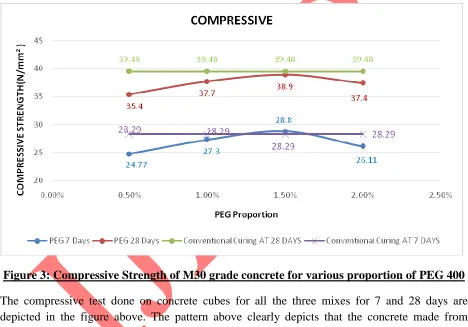
Figure 3: Compressive Strength of M30 grade concrete for various proportion of PEG 400
The compressive test done on concrete cubes for all the three mixes for 7 and 28 days are depicted in the figure above. The pattern above clearly depicts that the concrete made from internal and external curing agents shows at par strength as compared to concrete made from normal (conventional) curing. Concrete made from curing compounds doesn’t fall short of the minimum strength requirement i.e. 30 MPa. The strength achieved from curing compounds is much above 30 MPa.
CUREFREE-C
International Journal of Advances in Engineering Research http://www.ijaer.com (IJAER) 2015, Vol. No. 10, Issue No. IV, October e-ISSN: 2231-5152/ p-ISSN: 2454-1796
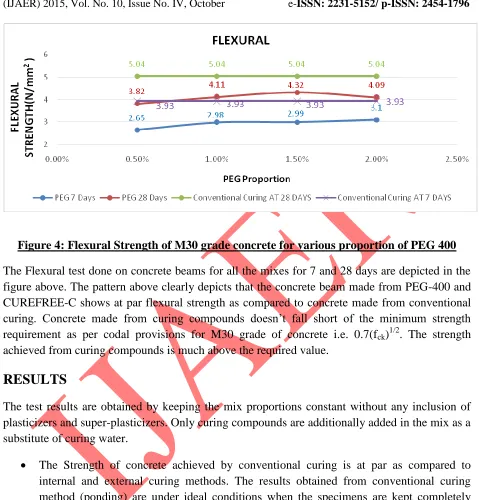
68 INTERNATIONAL JOURNAL OF ADVANCES IN ENGINEERING RESEARCH Figure 4: Flexural Strength of M30 grade concrete for various proportion of PEG 400
The Flexural test done on concrete beams for all the mixes for 7 and 28 days are depicted in the figure above. The pattern above clearly depicts that the concrete beam made from PEG-400 and CUREFREE-C shows at par flexural strength as compared to concrete made from conventional curing. Concrete made from curing compounds doesn’t fall short of the minimum strength requirement as per codal provisions for M30 grade of concrete i.e. 0.7(fck)1/2. The strength
achieved from curing compounds is much above the required value.
RESULTS
The test results are obtained by keeping the mix proportions constant without any inclusion of plasticizers and super-plasticizers. Only curing compounds are additionally added in the mix as a substitute of curing water.
The Strength of concrete achieved by conventional curing is at par as compared to internal and external curing methods. The results obtained from conventional curing method (ponding) are under ideal conditions when the specimens are kept completely submerged in water for 7 days and 28 days. Such long and ideal curing conditions may not be possible under actual site conditions. Thus these results do not give a true picture of conditions existing at construction sites.
International Journal of Advances in Engineering Research http://www.ijaer.com (IJAER) 2015, Vol. No. 10, Issue No. IV, October e-ISSN: 2231-5152/ p-ISSN: 2454-1796
69 INTERNATIONAL JOURNAL OF ADVANCES IN ENGINEERING RESEARCH
the PEG-400 and CUREFREE-C is comparable for both types of mix i.e. M25 and M30. The results obtained after the use of curing compounds show a better picture of the actual site conditions in comparison to those obtained from conventional curing techniques. Only the environmental conditions existing at site and laboratory may vary. Rest all parameters are more or less the same.
The Compressive Strength achieved by cubes and beams cured through curing compound (both PEG-400 and CUREFREE-C) is 20% more than that achieved through conventional curing method for M25 and is nearly 99% of that achieved through conventional curing method for M30 grade of concrete.
The Flexural Strength achieved by cubes and beams cured through curing compound (both PEG-400 and CUREFREE-C) is nearly 71% of that achieved through conventional curing method for M25 and is 86% of that achieved through conventional curing method for M30 grade of concrete.
The extra cost of procuring water from deep underground or far off sources specially in developing areas can be saved by the use of curing compounds. Also conditions supervision by labour to ensure good moisture and temperature conditions for maintaining satisfactory curing conditions is avoided. Thus any fault or delay in curing would not affect the structural strength in the long run.
CONCLUSIONS
On the basis of Experimental tests results and observations, following conclusions are made:
1.As per the results compiled in tables 5.4& 5.5,compressive strength of various mixes for M25 and M30 Grade of concrete we conclude that the compressive strength of mixes using self curing compounds (PEG-400& CUREFREE) are at par with that of the concrete with conventional curing.
2. As per the results in figure 5.2 and 5.4 flexural strength of various mixes for M25 and M30 Grade of concrete we conclude that the flexural strength of mixes using self curing compounds (PEG-400 & CUREFREE) are at par with that of the concrete with conventional curing.
3. The compressive strength achieved through curing compound (CUREFREE-C) is 20% more than that achieved through conventional curing method for M25 and is nearly 99% of that achieved through conventional curing method for M30 grade of concrete.
International Journal of Advances in Engineering Research http://www.ijaer.com (IJAER) 2015, Vol. No. 10, Issue No. IV, October e-ISSN: 2231-5152/ p-ISSN: 2454-1796
70 INTERNATIONAL JOURNAL OF ADVANCES IN ENGINEERING RESEARCH
method for M25 and is 86% of that achieved through conventional curing method for M30 grade of concrete.
5. It can be seen that the minimum strength as per the codal provisions has been achieved by the specimens cured through curing compounds. The strength achieved by the PEG-400 and CUREFREE-C is comparable for both types of mix i.e. M25 and M30. The results obtained after the use of curing compounds show a better picture of the actual site conditions in comparison to those obtained from conventional curing techniques.
6. Any laxity in curing badly affects the strength and durability of concrete. India has predominantly hot climate for most of the year. Within 2 or 3 hours, high ambient temperature and evaporation causes rapid shrinkage on freshly completed concrete structures, resulting in shrinkage cracks.
7. Depletion of water resources at a very fast rate is a very big concern these days. Water resources needs to be conserved specially in arid regions where there is a lot of water scarcity. It is said that 1m3 of concrete requires nearly 3 m3 of water for construction most of which is for curing.
All this led to the need to develop self-curing agents. The concept of self-curing agents is to reduce the water evaporation from concrete, and hence increase the water retention capacity of the concrete compared to conventional concrete. These compounds will rise to the finished concrete surface and effectively seal the surface against evaporation.
The aim of the project was to compare the test results based on curing conditions only. No changes have been done in the mix design for the mix. The results achieved from the tests conducted on specimen casted using curing compounds are very satisfactory. Results show that there is continuous increase in the strength of specimens for a period of 28 days. Higher strength results can be easily achieved by the use of plasticizers and super–plasticizers, reduction of water cement ratio and the addition of external cementitious compounds. Curing compound has the advantage of being used and left with no further maintenance. The strength results of conventionally cured specimens have been obtained after 28 days of proper curing which may not be possible at site as continuous vigilance is required to see that the surface moisture is not lost. In this regard, the strength results obtained by the use of self curing compounds are at par with that of site conditions.
International Journal of Advances in Engineering Research http://www.ijaer.com (IJAER) 2015, Vol. No. 10, Issue No. IV, October e-ISSN: 2231-5152/ p-ISSN: 2454-1796
71 INTERNATIONAL JOURNAL OF ADVANCES IN ENGINEERING RESEARCH
will become very common and curing compounds will again a lot of importance in the upcoming years.
REFERENCES
[1] IS 10262 (2009), “Indian Standard Concrete Mix Proportioning Guidelines (First revision)”.
[2] IS 456 (2000), “Indian Standard Code of Practice for Plain and Reinforced Concrete (Fourth revision)”.
[3] IS 383 (1997), “Indian Standard Specification for Coarse and Fine Aggregates from Natural Sources for Concrete”.
[4] Sathanandham.T, Gobinath.R, Naveen Prabhu. M, Gnanasundar.S, Vajravel.K , Sabariraja.G, Manojkumar.R and Jagathishprabhu .R, “Preliminary Studies of Self Curing Concrete with Addition of Polyethylene Glycol”, IJERT, Vol: 2, Issue: 11, November 2013.
[5] M. Manoj Kumar and D. Maruthachalam, “Experimental Investigation of Self Curing Concrete”, IJASTR, Vol: 2, Issue: 3, March-April 2013.
[6] Akeem Ayinde Raheem,Aliu Adebayo Soyingbe and Amaka John Emenike, “Effect of Different Curing Methods on Density and Compressive Strength of Concrete”, IJAST, Vol: 3, No: 4, April- 2013.
[7] Nirav R Kholia, Prof. Binita A Vyas and Prof. T. G. Tank “Effect on Concrete by Different Curing Method and Efficiency of Curing Compounds”, IJAET, Vol: 4, Issue: 2, April-June 2013. [8] Nagesh Tabota Suryavanshi, “Assessment of the Properties of Self Cured Concrete”, Concrete Engineering and Research Papers, 29 April 2013.
[9] A. Aielstein Rozario, Dr. C. Freeda Christy and M. Hannah Angelin, “Experimental Studies on Effects of Sulphate Resistance on Self-Curing Concrete”, IJERT, Vol: 2, Issue: 4, April 2013 [10] Amal Francis and Jino John, “Experimental Investigation on Mechanical Properties of Self Curing Concrete”, IJETED, Vol: 2, Issue: 3, March 2013.
[11] M.V. Jagannadha Kumar, M.Srikanth, Dr.K.Jagannadha Rao, “Strength Characteristics of self-curing concrete”, IJRET, Vol: 1, Issue: 1,pp 51-57, September 2012.
[12] A.S. El-Dieb, “ Self-curing concrete: Water retention, hydration and moisture transport”, Elsevier-Construction and building materials, Vol: 21, pp 1282-1287, September 2006.
[13] Neville A.M., “The Failure of Concrete Test Specimens”, Civil Engineering July, 1957. [14] Bentz, D.P., Halleck, P.M., Grader, A.S., and Roberts, J.W., “Direct Observation of Water Movement during Internal Curing Using X-ray Microtomography,” Concrete International, 28 (10), 39-45, 2006.
International Journal of Advances in Engineering Research http://www.ijaer.com (IJAER) 2015, Vol. No. 10, Issue No. IV, October e-ISSN: 2231-5152/ p-ISSN: 2454-1796
72 INTERNATIONAL JOURNAL OF ADVANCES IN ENGINEERING RESEARCH
[16] Geiker, M.R., Bentz, D.P., and Jensen, O.M., “Mitigating Autogenous Shrinkage by Internal Curing,” High Performance Structural Lightweight Concrete, SP-218, J.P. Ries and T.A. Holm, eds., American Concrete Institute, Farmington Hills, MI, pp. 143-154, 2004.
[17] Kewalramani, M.A.; Gupta, R, “Experimental study of concrete strength through an eco-friendly curing technique,” Advances in concrete technology and concrete structures for the future. Dec 18-19, 2003. Annamalainagar.
[18] Hoff, G.C., “Internal Curing of Concrete Using Lightweight Aggregates,” Theodore Bremner Symposium, Sixth CANMET/ACI, International Conference on Durability, Thessaloniki, Greece, June 1-7 (2003).
[19] Bilek, B et al, “The possibility of self-curing concrete Proc Name Innovations and developments in concrete materials and construction.” Proc. Intl Conf. University of Dundee,U.K.9-11 September 2002.
[20] De Jesus Cano Barrita, F.; Bremner, T.W.; Balcom, B.J., “Use of magnetic resonance imaging to study internal moist curing in concrete containing saturated lightweight aggregate,” High-performance structural lightweight concrete. ACI fall convention, Arizona, October 30, ACI SP 218,2002.