video application by Genetic Algorithm in LTE
Network
[1]
Bharati.Nidasheshi,
[2]S. V.Saboji
[1] [2]
Department of CSE Basaveshwara Engineering College Bagalkot, India.
[1] [email protected], [2][email protected]
Abstract
:
As the Long Term Evolution (LTE) network is one of the growing technology with providing high data speed for transmission. The one of the challenging issue can be found as to provide good quality of service (QoS) to the users within the delay bound for the resources to the users. In this paper, we explored the problem as optimizing the quality of the video application or files for the users and to schedule that video application to the users within the delay. Taking the video applications with the downlink, when the user wants to download a video file the user must get the good quality with less noise and the delay requirement must be satisfied. To solve this scheduling problem the Genetic algorithm (GA) scheduling method is used. By using GA the results shown that it enhanced the video quality and resource block reached the users with the less delay and with low loss of blocks the resources are scheduled to the users.Keywords:LTE,QoS, Scheduling, Genetic algorithm.
I. INTRODUCTION
LTE is one of the fastest growing technologies which is the third generation partnership project (3GPP). The LTE network provides fastest cellular data to the users. The video applications used are like video conferencing, video streaming and the file transfer, Voice over Internet protocol (VOIP). The network is capable of providing the applications with the bandwidth requirements such as delay, packet loss rate (PLR) and the good quality of the frame. LTE is the 4G communication network for mobile equipments. The goal is to provide the good quality of service to the users and to schedule the resource to the users within the required delay bound according to the bandwidth of the users. The features of LTE network for the downlink is the Orthogonal Frequency Division Multiple Access (OFDMA) and for the uplink the Single Carrier-FDMA (SC-FDMA) is used for the access of the resources.
A. LTE Network Architecture
The LTE network architecture has three main components they are:
i)
User Equipment (UE)
ii)
Evolved UMTS Terrestrial Radio access Network (E-UTRAN)
iii)
Evolved Packet Core( EPC)
Figure 1.1 LTE Network Architecture
B. The Radio Protocol Architecture
The protocol architecture is separated as control plane and the user plane. The application creates the data packets or the resource blocks to the users that must be processed by the protocol such as TCP, IP and UDP. The messages that are to be passed between the base station (eNodeB) and the User Equipment (UE) are written by the radio resource control protocol.
In wireless networks the scheduling is important for the Quality of Service (QoS). The characteristics for the wireless scheduling are that the channels are unreliable and cannot be successfully transmitted over the radio link. For this the efficient scheduling algorithm is necessary. For the downlink the Orthogonal frequency division multiple access (OFDMA) access scheme is used, the data or the resource blocks are transmitted over number of narrow band sub-carriers. For the allocating of the resources to the multiple users, the time slot is maintained. For the allocation of resource blocks to the users the good scheduling algorithm is needed. For the allocation of resource blocks, the resource block has different channel quality that is signal to Noise ratio (SNR). The good modulation and coding scheme is used for the link adaptation.
II LITERATURE SURVEY
Paper [1] discusses the problem of the LTE system based allocations of resources problem. The author discussed and proposed the allocation of resources scheduling for QoS constrained in three steps as follows, for the first step, they applied a time domain scheduler (TD) for different QoS classes. The delay constraints for services are noted. At the second stage the frequency domain scheduler is used based on the channel quality (SNR) for the UE services and the available resource blocks from the system is calculated. At the third stage the appropriate modulation technique is used for the resource block optimization. The results showed the better performance.
Paper [2] discusses that how to use the traffic models with the combination of strategies of different scheduling algorithm and compared to improve the delay with the other two new approaches with the proportional fair scheduling. In the second applied approach, the decreasing exponential factor is added for the prioritizing the packets with their delay constraint. From the result they showed that the performance of delay and the throughput was increased. The result analysis is satisfied. Paper [3] discusses the scheduling of resource block to the users. The resource constrained for the optimization of the quality of the video applications. The resource blocks taken are the video streaming applications. The rate distortion method is used for the quality check that is to remove the noise from the frames. The genetic algorithm approach is used for the scheduling. The resource blocks are assigned to the users using the genetic algorithm iterations. The results showed that the approach gave a good results and the comparison is done with the other algorithms. The performance of delay and the Peak-Signal to Noise Ratio (PSNR) is better.
Paper [4] discusses the novel based two-level scheduling algorithm that is used for solving the optimization problem of downlink communication for the real time. The two levels are upper level and lower level, the upper level showed a new approach on control theory of linear on discrete time. In the lower level, the scheduler assigned a maximum throughput. By the simulations, the results showed that the proposed method complexity and the performance is evaluated. The analysis of the results showed and discussed that the approach is effective.
Paper [5] discusses that by using the Token Bucket scheduler it can differentiate the services of real time and it provides the QoS information that determines the system to allocate the number of resource blocks to the users. The author discussed for QoS the applications such as VoIP, Video and the parameter they discussed are packet loss rate and the delay. They compared with the different scheduling algorithms and the performance is compared.
Paper [6] introduces the technique for the improvement of QoS in the downlink scheduling for the LTE Network. For the multimedia applications the power saving is done at the user equipment that is they discussed on the saving of the battery life of the user. The proposed method discussed a opportunistic scheduling method and the parameters compared are packet losses, delay and the throughput. The simulation results and the analysis showed that the fairness and the throughput among the users are better.
Paper [7] discusses a Cross Layer Design Packet Scheduling Architecture (CLPSA) with two added functionalities for long term evolution downlink transmission. The first function is service specific queue sorting algorithms for service level performance optimization and second adaptive Time Domain (TD) prioritizing algorithm for network level performance optimization. A better result is achieved between throughput and fairness.
bearers with the queue size, packet delay for the flows to the users. The approach showed that the performance was average in the packet loss rate and the fairness among the users was somewhat better.
Paper [9] discusses the Token Bucket Algorithm for the downlink in LTE Network. The schedulers are divided into the form of frequency and the time domains. At the frequency domain to improve the spectral efficiency they used the Token Bucket algorithm to provide good quality of service to the users and then it is separated into Guaranteed bit rate (GBR) and the Non-GBR. They discussed on the traffic management. By the simulations the results shows that the performance was little good. Paper [10] discusses a resource allocation or scheduling of resource block to the users in the downlink as a cross layer method at the data link layer with the QoS information. They compared it with the fair and fixed algorithms for the allocation into two parts. In the first part the allocation algorithms are assigned to individual sub-carriers to the users while through the second, the allocation algorithm assigns individual resource blocks to the users. The analysis of results showed that the proposed algorithm performance is better for the fair allocation. And the approach provides better QoS.
Paper [11] discusses a new scheduling algorithm that is the QoS aware two layer downlink algorithm. That is for the delay sensitive traffic. By introducing the dynamic QoS factors, the algorithm divides the streaming scheduling and the sorting of packets. The QoS factors are the packet urgency and the fairness to the users. At the base stations the scheduler determines the order of transmissions for the multi-streams. The transmission of the packets at the base station is ensured by the packet sorting. The performance analysis showed that the parameter such as the throughput and delay performance is better to the users.
In Paper [12] for the video streaming in the LTE network systems a QoS driven downlink scheduling method is taken. Concentrating on the video deadlines with the Hard Hand Off (HO) service, fairness and the QoS. The different design for the transmission dead line control (TDC), Hand Off control (HOC), it provides the consumer scheduling to multimedia a good quality of service with guaranteed scheduling and during the hard hand off it provides the fairness to the users. The analysis results showed that the fairness among the users was not much satisfied.
Issues/challenges
From the above literature survey the challenges and issues can be identified are as follows:
i) Mobility:As the users are extremely mobile in wireless networks. So this may cause frequent disconnection.
ii) Battery life: shorter battery life in early smart phones due to new technology, consumption of more data and needing both 3G and 4G radio connections.
iii) Quality of Service (QoS): The QoS requirements such as throughput, fairness among the users and delay factor are observed. The user may receive the resource blocks after some delay. For the scheduling of resource blocks to the user the delay may occur.
iv) The Peak-Signal to Noise ratio(PSNR) is for the quality of the frames or to remove the noise.the delay for the users and the packet loss can also be identified as issues.
B. Problem definition
III.MODELOFTHESYSTEM
A. LTE downlink Model
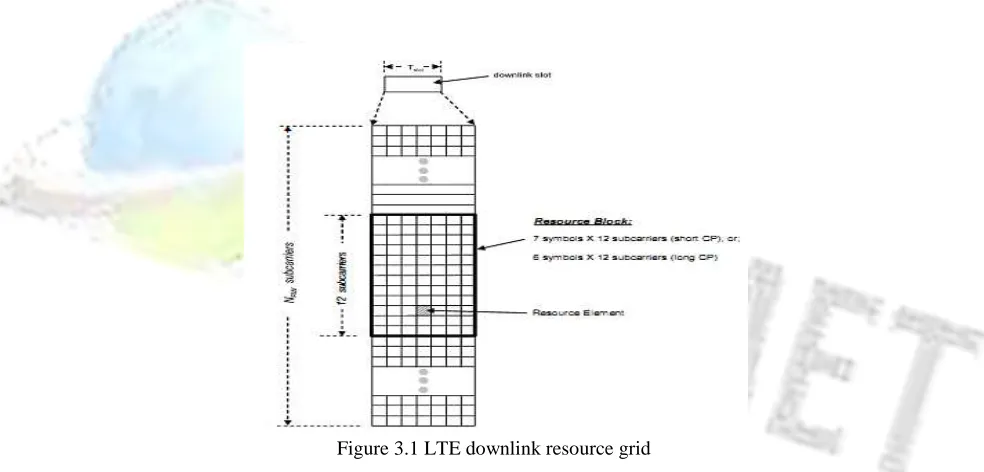
The bandwidth for the transmission can be divided from 1.25MHz to 20MHz with a spacing of sub-carriers as . The duration of radio frame is 10ms each is of 1ms. Transmission time interval (TTI) is the sub frame and two slots are divided further 0.5ms for each. The transmitted signal of the downlink has NBW sub-carriers of the Tslot duration. The
resource grid is shown in below Figure.3.1. the scheduler at the base station assigns the resource blocks to the user equipments (UE’s).
LTE scheduling
The LTE is based on OFDM. The scheduler works on the base station that is at the eNodeB. The scheduler at the base station has to distribute the available bandwidth in the frequency and time domains. The dynamic change can be made in resource allocation. At the frequency domain the orthogonal frequency is used. In the time domain the frame is divided into time slots in milliseconds.
The downlink is carried by Orthogonal frequency division multiple access (OFDMA) and uplink by the SC-FDMA. The algorithm that is used for scheduling must decide which resource block must be allocated to the users. Due to the mobility of the user equipments the channel quality may change.
Figure 3.1 LTE downlink resource grid
Channel Model
A flat fading channel is taken here which is slowly varying. Its quality is checked by the parameter called SNR (Signal to Noise Ratio). To characterize the downlink channel the Rayleigh model is used.
Adaptive Modulation and Coding
To enhance the system throughput the Adaptive modulation and coding has adopted. It is a technique for link adaptation. By adjusting the transmission parameters the AMC maximizes the data rate. The modulation used is QAM16.
Rate-Distortion Based Video Quality Estimation
Where
is source variance.
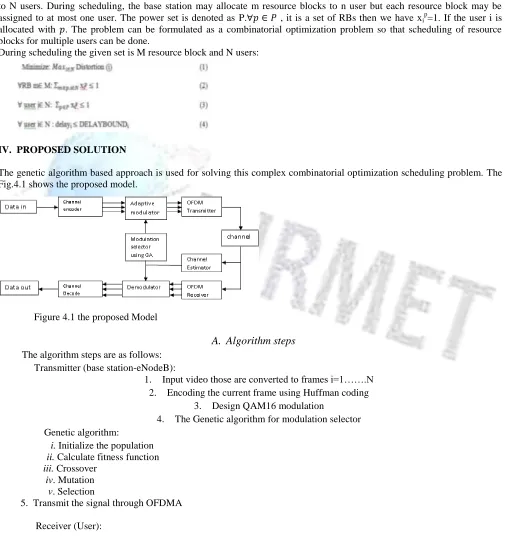
From the above we take a single cell that has one base station eNodeB where the bandwidth for the downlink is divided into M resource blocks (RBs). The N active users are served by the base station. The M resource blocks are assigned to N users. During scheduling, the base station may allocate m resource blocks to n user but each resource block may be assigned to at most one user. The power set is denoted as P. , it is a set of RBs then we have xip=1. If the user i is
allocated with . The problem can be formulated as a combinatorial optimization problem so that scheduling of resource blocks for multiple users can be done.
During scheduling the given set is M resource block and N users:
IV. PROPOSED SOLUTION
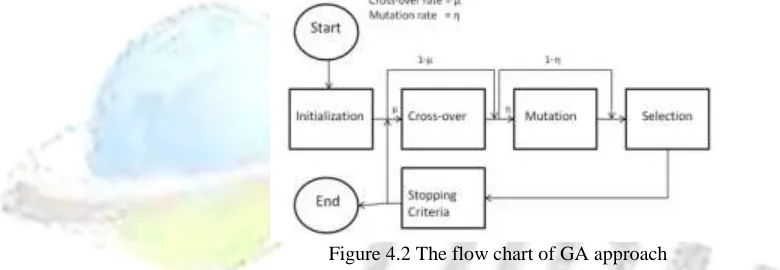
The genetic algorithm based approach is used for solving this complex combinatorial optimization scheduling problem. The Fig.4.1 shows the proposed model.
Figure 4.1 the proposed Model
A.
Algorithm steps
The algorithm steps are as follows:Transmitter (base station-eNodeB):
1. Input video those are converted to frames i=1…….N 2. Encoding the current frame using Huffman coding
3. Design QAM16 modulation
4. The Genetic algorithm for modulation selector Genetic algorithm:
i. Initialize the population ii. Calculate fitness function iii. Crossover
iv. Mutation v. Selection
5. Transmit the signal through OFDMA
6. Receive the signal from channels through OFDMA 7. Demodulate the signal Using Genetic algorithm
8. Huffman decoding 9. Construct the data into frames
10. Compare transmitted frames and received frames using correlation and PSNR.
B. Genetic Algorithm
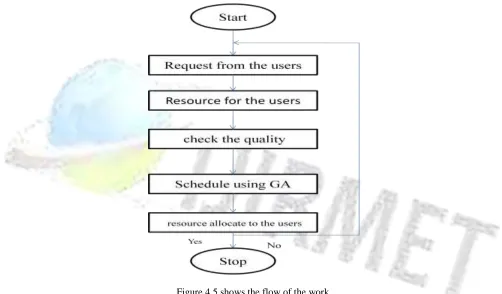
Genetic algorithm is the population based and for solving the optimization problems in the search space. It is based on the survival of the fittest principle. To allocate the resources to the users the GA based downlink scheduler is proposed. The flow chart for the GA is shown in Figure 4.2. First the chromosomes are generated for the solutions. To generate individuals for the generation of the next generation the crossover and mutation is carried out. Each resource block in the chromosome are called gene. In the selection step the resource blocks or the genes with high fitness values are taken and others are eliminated. The above steps are carried out until the process reaches the stopping criteria or termination.
Figure 4.2 The flow chart of GA approach
i. Solution representation and Initialization: First for the solution representation we have to define the gene and give the solution for those genes i.e., resource blocks. The genes are with a set of chromosomes that is the genes are the resource blocks that must be allocated to the users. In this we have M resource blocks and N users. For this the chromosome must be defined. For example we can take 5 resource blocks for 4 users.
ii. Evaluation: to evaluate the resource blocks the fitness function is used. The higher the fitness value the better is the solution. In this the video distortion is minimized.
iii. Selection: In this step, we go through the fitness values, the resource block with the high fitness values are selected to pass to the next generations that means that means the genes that have high fitness values are selected to pass to the next future generations. In this the tournament selection isconsidered which chooses m resource blocks from the population with their fitness values. By repeating the above many times a new population is generated and selected. The size for this selection is two.
iv. Cross over: In this step the two genes or resource blocks from the parents are considered and those are passed to the next generations. In this, the resource blocks are chosen randomly to become parents and those resource blocks of the chromosomes are exchanged for the users giving two new resource blocks for the schedules. The Figure 4.3 represents the cross over.
v. Mutation: In this step the mutation is carried out with rate of μ that is 0.1. In this the resource block is selected randomly. During scheduling the resource block selected is allocated to the users next it is allocated to the different user than itwas in scheduling of the last. The Figure 4.4 shows the mutation process.
Figure 4.4 Mutation
vi. Termination: In this step the termination is carried out. The stopping condition is for the iterations after all the process is carried out after carring all the iterations the process is terminated.
C. Flow of Work
Figure 4.5 shows the flow of the work
The Figure 4.5 shows the flow of work for the proposed method. The steps for this as follows: Step 1: Start the process and the creation of network.
Step 2: Request from the users for the resources that is video. Step 3: Resources for the users.
Step 4: Check the video quality using rate distortion method. Step 5: Scheduling the resources using genetic algorithm.
Step 6: The scheduled resources are allocated to the users. If not, the process repeats from step 2.
We use MATLAB to experiment the simulation for the above approach. The simulation is done for the many users and taking the resource as video application such as the sports clip of 25 frames per second with 1000kbps and with delay bound of 25ms. The performance parameters considered are delay, PSNR, and the packet loss rate. The GA approach is compared with the previous M-LWDF scheduling scheme. The parameters are compared.
A. Performance Metrics
In this performance metrics, the comparison for three parameters is discussed. The parameters include the PSNR , delay and the packet loss.
The first is to create the network with ths users and the base station. The Figure 5.1 below shows this:
Figure 5.1 the base station and users
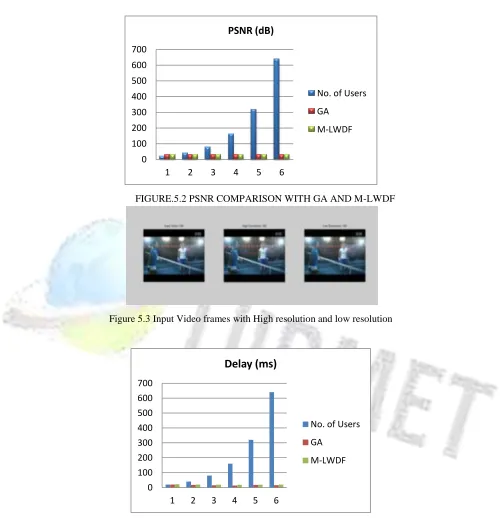
The Figure5.2 shows the comparison PSNR values for the Genetic algorithm and the M-LWDF algorithm for all users. The Modified largest weighted delay first (M-LWDF) scheduler is used for different real time users. The scheduler allocates resource blocks to different users by using the proportional fair rule.
i. Peak- Signal to Noise Ratio (PSNR): it is abbreviated as PSNR It is the ratio between the maximum possible power of a signal and the power of corrupting noise that affects the fidelity of its representation. It is expressed as logarithmic decibel (dB). The PSNR is used to measure the quality of the frames. If the PSNR value indicates that the reconstructed image quality may be higher or may not. PSNR is defined as the mean squared error (MSE). Given the noise free frame I of size m× n and noisy approximation K, MSE is defined as:
The PSNR (dB) is:
MAXI is the maximum possible pixel value of the frame. The values for the PSNR in lossy frame, video compression is
between 30 to 50 dB as the bit depth is 8 bits. The higher is better. The 20dB to 25 dB are the values of the transmission quality loss in wireless network.
The comparison of the image quality is shown in Figure 5.3. The Input Video frames with High resolution and low resolution.
ii) Delay : The delay can be defined as the average time taken by the source or the resource block at the base station to reach the destination or the users. The delay may be different types such as queuing delay, processing delay and the propagation delay. The graphs for the delay for all the users are compared with both the algorithms. By comparing we can observe that the users are within the expected delay bound. The fairness is achieved and satisfied.
FIGURE.5.2 PSNR COMPARISON WITH GA AND M-LWDF
Figure 5.3 Input Video frames with High resolution and low resolution
FIGURE 5.4 Comparison of Delay with GA and M-LWDF
iii) Packet Loss rate: Packet loss occurs when one or more packets of data travelling across the network fail to reach their destination. By the network congestion the packet loss occurs. It is measured as the percentage of packet lost with respect to the packets sent. The packet loss is detected by the Transmission Control Protocol (TCP) and performs retransmissions to ensure reliable messaging. Packet loss can reduce throughput for a given sender due to malfunction of network. And to balance available bandwidth between multiple senders. The packet loss can be measured as frame loss rate defined as the percentage of frames that should have been forwarded by a network. Packet loss rate is considered with the quality of service considerations and is related to the erlang unit of measure.
0 100 200 300 400 500 600 700
1 2 3 4 5 6
PSNR (dB)
No. of Users
GA
M-LWDF
0 100 200 300 400 500 600 700
1 2 3 4 5 6
Delay (ms)
No. of Users
GA
The Figure 5.5 shows the graph for average packet loss for the users and comparison with the both the algorithms. The packet loss for the GA is less compared with the M-LWDF algorithm.
Figure 5.5 Comparison for the Packet loss ratio for the GA and M-LWDF
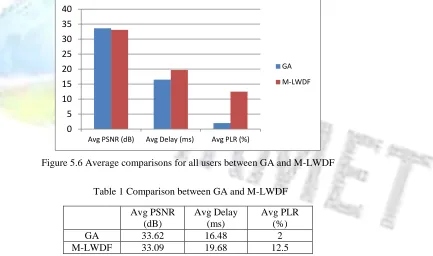
The overall comparison average for all the users for both the algorithms is shown in Figure 5.6. The Table 1 gives the values for comparison of GA and the M-LWDF algorithms for average PSNR, PLR and the delay.
Figure 5.6 Average comparisons for all users between GA and M-LWDF
Table 1 Comparison between GA and M-LWDF
By observing the above graph and comparing the parameters such as delay, packet loss and the peak –signal to noise ratio(PSNR) the results for the genetic algorithm is good as compared with the modified largest weighted delay first scheduling rule or algorithm. So, by analyzing the results for PSNR (dB) the results when compared are better with the GA than M-LWDF. The results for the delay(ms) is more for the M-LWDF than the GA. The delay for the users is less in genetic algorithm. The third parameter is the packet loss , the result analysis showed that the packet loss is less with the GA than the compared M-LWDF algorithm. By observing all the result analysis it can be shown that the genetic algorithm scheduling is good than the other algorithms.
V .CONCLUSION AND FUTURE WORK
This paper presents the genetic algorithm approach for solving the complex combinatorial optimization scheduling problem. The problem identified was the scheduling of the downlink radio resources and allocation problem for video applications in
0 200 400 600 800
1 2 3 4 5 6
Packet Loss rate
No. of Users
GA
M-LWDF
0 5 10 15 20 25 30 35 40
Avg PSNR (dB) Avg Delay (ms) Avg PLR (%)
GA
M-LWDF
Avg PSNR (dB)
Avg Delay (ms)
Avg PLR (%)
GA 33.62 16.48 2
network. The video quality is observed as the scheduling at the application layer. The experiment demonstrates that the use of rate distortion method for the quality of the video and the approach of the genetic algorithm used to solve the optimization scheduling is better than the other approaches. The result analysis shows that it can enhance the quality of the video at the receiver or the user and the delay is satisfied. The fairness is good among the users. For the quality optimization scheduling problem the genetic algorithm approach is used. In the future one can enhance the quality of the frames can be done with the other methods. While applying the genetic algorithm for the optimization scheduling problem some of the resource block may go to other users to stop this mechanism.
REFERENCES
[1] Hung-Chin Jang,Yun-Jun Lee, “ QoS-Constrained Resource allocation scheduling for LTE Network”, Department of Computer Science National Chengchi University Taipei, Taiwan.
[2] Martin Klaus Muller, Stefan Schwarz and Markus Rupp , “ QoS Investigation of proportional fair scheduling in LTE Networks” , Institute of Telecommunications, IEEE 2013.
[3] Xiaolin Cheng, Prasant Mohapatra “ Quality optimized Downlink scheduling for video streaming applications in LTE Network” , IEEE , 2012.
[4]Giuseppe Piro, Luigi Alfredo Grieco, Gennaro Boggia, and Pietro Camarda “A Two-level Scheduling Algorithm for QoS Support in the Downlink of LTE cellular networks”, IEEE,2010.
[5] Liqun Zhao, Yang Qin, Maode Ma, Xiaoxiong Zhong, Li Li, “QoS Guaranteed Resource Block Allocation Algorithm in LTE Downlink” ,2012 7th International ICST Conference on Communications and Networking in China (CHINACOM), IEEE, 2012.
[6] M. Sajid Mushtaq Image, Abdussalam Shahid and Scott Fowler, “QoS-Aware LTE Downlink Scheduler for VoIP with Power Saving”, 2012 IEEE 15th International Conference on Computational Science and Engineering. 2012 IEEE DOI 10.1109/ICCSE.2012.41
[7] R. Kausar, Y. Chen and K. K. Chai , “QoS Aware Packet Scheduling with Adaptive Resource Allocation for OFDMA Based LTE-Advanced Networks” ,Proceedings of ICCTA2011.
[8] Moustafa M. Nasralla and Maria G. Martini, “A Downlink Scheduling Approach for Balancing QoS in LTE Wireless Networks” , 2013 IEEE 24th International Symposium on Personal, Indoor and Mobile Radio Communications: MAC and Cross-Layer Design Track, IEEE 2013.
[9] Yashar Farzaneh , Ahmad Mardi , Seyed Ali Ghorashi , “A QoS-Aware Downlink Packet Scheduler Using Token Bucket Algorithm for LTE Systems”, The 22nd Iranian Conference on Electrical Engineering (ICEE 2014), May 20-22, IEEE 2014. [10] Mohsen M. Tantawy, Adly S. Tag ELdien, and Rokaia Mounir Zaki, “QoS-based resource allocation algorithm for Long Term Evolution (LTE) system” ,Journal of Engineering Sciences, Assiut University, Vol. 39, No 6, pp.1449-1461, November 2011.
[11] Tony Tsang, “Performance Analysis for QoS-Aware Two-Layer Scheduling in LTE Networks” , International Journal of Emerging Trends & Technology in Computer Science (IJETTCS), Volume 2, Issue 2, March – April 2013.