International Journal of Current Research in
Biosciences and Plant Biology
Volume 4 ●Number 6 (June-2017) ● ISSN: 2349-8080 (Online)
Journal homepage: www.ijcrbp.com
Review Article doi: https://doi.org/10.20546/ijcrbp.2017.406.011
Evaluation of
Jatropha curcas
as Potential Biocide and Biopesticide
Neha Sharma*
University of Delhi, Delhi-110 007, India
*Corresponding author.
A b s t r a c t A r t i c l e I n f o
Jatropha curcas (Linnaeus) belongs to the family of Euphorbiaceae and has been widely known as biofuel crop. Apart from being considered as biofuel crop, Jatropha is also known to possess insecticidal/antifeedant activity. This biopesticide property of Jatropha
can be attributed to its specific chemical constituents that can target pest during different stages of life cycle. Chemical constituents such as phorbol esters and terpenoid compounds are responsible for high bioactivity of Jatropha. This paper attempts to evaluate potential of Jatropha as biocide and biopesticide. This study highlights importance of Jatropha as an ideal potential option for incorporation into pest management program.
Accepted: 28 May 2017 Available Online: 06 June 2017
K e y w o r d s
Antifeedant Biopesticide Insecticidal activity
Jatropha curcas
Introduction
Jatropha curcas (Linnaeus) belongs to the family of
Euphorbiaceae and has been widely known as biofuel crop (Openshaw, 2000). Jatropha is originally native of tropical America, but now is widely common in many parts of the tropics and sub-tropics in Africa/Asia. Another important advantage with this crop is that it is easy to establish, grows relatively quickly and is hardy and also drought tolerant. It can grow well even in marginal/poor soil. It is easy to establish, grows relatively quickly and lives, producing seeds for 50 years. Oil content in seeds of Jatropha is 37%. The oil derived from seeds can be used as fuel without being refined. This oil has potential to undergo combustion with clear smoke-free flame. It has been tested successfully as fuel for simple diesel engine. Jatropha
curcas is becoming the future source of biodiesel for
India. It is found to be growing in many parts of the
country, and can grow with minimum inputs (Mittelbach, 1983). Among the various oil seeds,
Jatropha curcas has been found more suitable for
biodiesel production. It is possible to grow this plant under stress condition and the oil of these species have various characteristics which makes it suitable for biodiesel production. Jatropha oil has higher cetane no. (51) as compared to other oils which make it an ideal alternative fuel for engine (Jain and Sharma, 2010).
considered to be good forage material. Moreover this plant is highly pest and disease resistant. Jatropha is also important from ecological point of view as it removes carbon from the atmosphere, stores it in the woody tissues and assists in the build-up of soil carbon. The plant also holds application to prevent and/or control erosion, to reclaim land, to act as a live fence, especially to contain or exclude farm animals and to be planted as a commercial crop. It is not browsed by animals as its leaves and stems are distasteful to animals. However, after treatment, the seeds or seed cake could be used as an animal feed. All parts of the plant are of medicinal value. Bark of Jatropha contains tannin which attracts bees and thus the plant has a honey production potential. Wood and fruit of this plant can be used for numerous purposes including fuel production. Its fruit contain viscous oil that can be used for soap making, in the cosmetics industry and as a diesel/kerosene substitute or extender. Its use as bio-diesel is important because it can be considered as practical substitutes for fossil fuels to counter greenhouse gas accumulation. However, the full potential of Jatropha has not been fully realized due to several reasons. Firstly, the growing and management of
Jatropha is poorly documented. Secondly, there are
fewer efforts put forward towards marketing its products. Therefore, actual or potential growers are generally reluctant to invest time and money in a crop that only has promise rather than concrete rewards.
Primarily, Jatropha has been well studied for its properties to serve as biodiesel in future (Kumar and Sharma, 2008). It is well known that Jatropha oil can be used as fuel in diesel engines directly and by blending it with methanol (Gubitz et al., 1999). Experimental testing of engines with Jatropha oil in Thailand has revealed satisfactory engine performance (Takeda, 1982). A technique to produce biodiesel with high free fatty acids contents (15% FFA) from Jatropha has been developed by Berchmans and Hirata (2008) and Tiwari et al. (2007). This technique involved two-stage transesterification process to improve methyl ester yield. The first stage involved the acid pretreatment process to reduce the FFA level of crude Jatropha seed oil to less than 1% and second was the alkali base catalyzed trans-esterification process which gave 90% methyl ester yield. Efforts have also been put forward by researchers to reduce cost of biofuel production from Jatropha. In this regard, the lipase producing whole cells of Rhizopus
oryzae immobilized onto biomass support particles was
used and found to be a promising biocatalyst for
producing biodiesel (Tamalampudi et al., 2007). Higher oil extraction can result in more profit since oil sells for more than the residual seed cake. In order to increase such profits, efforts have also been done by researchers to innovate new techniques to increase oil percentage. Higher % of oil from the Jatropha seeds can be extracted using more efficient expeller system. The simple technology specially developed for this chemical process can also be performed in less industrialized countries (Mittelbach et al., 1983; Connemann, 1994). Application of methyl ester of Jatropha oil and dual fuel operation with methanol induction can give better performance and reduced smoke emissions than the blend. Sarin et al. (2007) have examined the blends of
Jatropha and Palm biodiesel for their physico-chemical
properties to get optimum mix of them to enhance oxidation stability needed for South Asian and South East-Asian countries.
Apart from potential of Jatropha as biofuel, Jatropha
has insecticidal/antifeedant activity therefore making it ideal potential option for incorporation into pest management program.
Jatropha as biocide and biopesticide
Phorbol ester present in this plant is a member of the tigliane family of diterpenes (Makkar et al., 2007). Phorbol ester in Jatropha show biocidal as well as insecticidal activity due to the stimulation of the cellular target protein Kinace C (PKC). This fraction has also
application as a plant-derived protectant of a variety of crops, from a range of pre-harvest and post-harvest insect pests (Ratnasdass and Wink, 2012). Jatropha
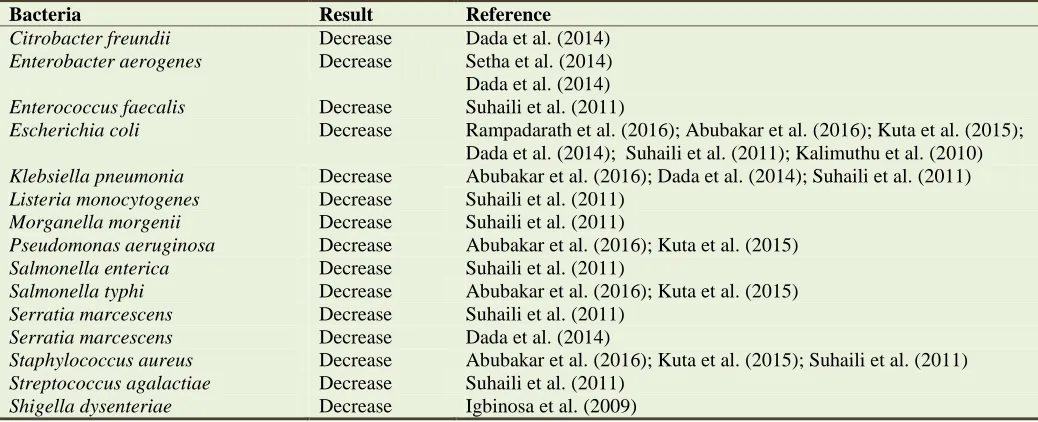
extract inhibit growth of various bacteria as summarized in Table 1.
Table 1. Effect of Jatropha extract on growth of bacteria.
Bacteria Result Reference
Citrobacter freundii Decrease Dada et al. (2014)
Enterobacter aerogenes Decrease Setha et al. (2014)
Dada et al. (2014)
Enterococcus faecalis Decrease Suhaili et al. (2011)
Escherichia coli Decrease Rampadarath et al. (2016); Abubakar et al. (2016); Kuta et al. (2015);
Dada et al. (2014); Suhaili et al. (2011); Kalimuthu et al. (2010)
Klebsiella pneumonia Decrease Abubakar et al. (2016); Dada et al. (2014); Suhaili et al. (2011)
Listeria monocytogenes Decrease Suhaili et al. (2011)
Morganella morgenii Decrease Suhaili et al. (2011)
Pseudomonas aeruginosa Decrease Abubakar et al. (2016); Kuta et al. (2015)
Salmonella enterica Decrease Suhaili et al. (2011)
Salmonella typhi Decrease Abubakar et al. (2016); Kuta et al. (2015)
Serratia marcescens Decrease Suhaili et al. (2011)
Serratia marcescens Decrease Dada et al. (2014)
Staphylococcus aureus Decrease Abubakar et al. (2016); Kuta et al. (2015); Suhaili et al. (2011)
Streptococcus agalactiae Decrease Suhaili et al. (2011)
Shigella dysenteriae Decrease Igbinosa et al. (2009)
Jatropha curcas has significant properties to be
considered as biopesticide. Its seed oil has also been used to reduce infestation of insect pests [Aphids
crassivora Koch (Hemiptera: Aphididae), Marucates
tulalis F. (Lepidoptera: Crambidae) and Megalurothrips
sjostedti Trybom (Thysanoptera: Thripidae)] in cowpea
(Ahuchaogu et al., 2014). In another study the acetonolic, ethanolic and water extracts of the root and seeds of Jatropha curcas exhibited satisfactory insecticidal bioactivity which can successfully substitute chlorpyrifos (synthetic insecticide) in the control of insect Oecophylla longinoda (Ojiako et al., 2015).
Insecticidal activities of Jatropha curcas plant parts have also been reported against mosquitoes, Anopheles
arabiensis Patton (Diptera: Culicidae) (Zewdneh et al.,
2011), Sitophilus zeamais Motschulsky (Coleoptera: Curculionidae) (Ojiako et al., 2014), mites,
Rhipicephalus (Boophilus) annulatus (Ixodida:
Ixodidae) (Juliet et al., 2012), cockroaches, Periplaneta
americana Linnaeus (Blattodea: Blattidae) (Lateef et al.,
2014), Desert locusts, Schistocerca gregaria Forskal (Orthoptera: Acrididae) (Bashir and Shafie, 2013),
Busseola fusca Fuller (Lepidoptera: Noctuidae) and
Sesamia calamistis Hampson (Lepidoptera: Noctuidae)
(Makkar et al., 2007), Helicoverpa zea Boddie (Lepidoptera: Noctuidae) (Olapeju et al., 2008),
termites; Coptotermes (Blattodea: Rhinotermitidae) and
Odontotermes obesus Rambur (Blattodea: Termitidae)
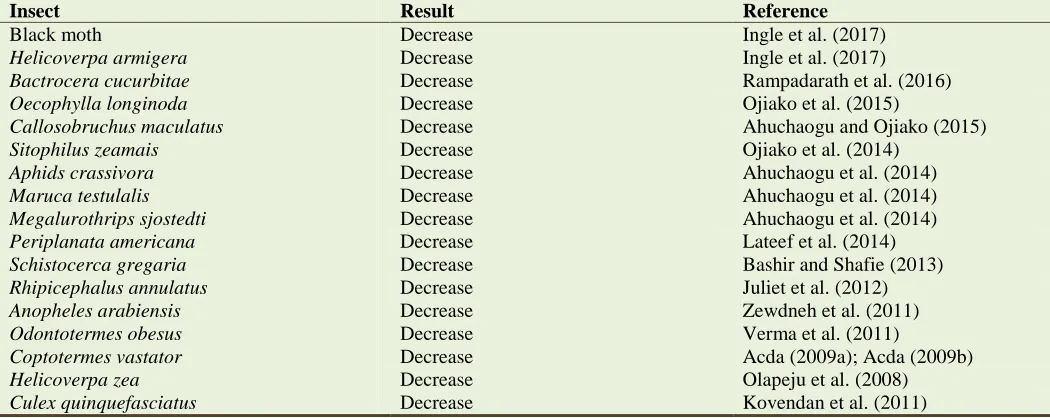
(Acda, 2009a, 2009b; Verma et al., 2011). Table 2 summarizes effect of Jatropha extract on growth of different insects.
Biopesticide property of seed oil of Jatropha can be attributed to its specific chemical constituent which can target pest during different stages of life cycle. Seed oil derived from Jatropha have been reported to effect oviposition deterrence and inhibited egg hatching in potato tuber moth, Phthorimaea operculella Zeller (Lepidoptera: Gelechiidae) (Shelke et al., 1987). It also inhibited growth of tobacco hornworm, Manduca sexta
Linnaeus (Lepidoptera: Sphingidae) larvae (Sauerwein et al., 1993). Application of Jatropha seed oil had resulted in anti-ovipositional activity and longterm protective ability of treated cowpeas against the seed beetle Callosobruchus maculatus F. (Coleoptera: Chrysomelidae: Bruchinae) (Adebowale and Adedire, 2006). Moreover its application has reduced the number of tested insect pests (Aphids crassivora,
Maruca testulalis and Megalurothrips sjostedti) in a
Table 2. Effect of Jatropha extract on growth and number of different insects.
Insect Result Reference
Black moth Decrease Ingle et al. (2017)
Helicoverpa armigera Decrease Ingle et al. (2017)
Bactrocera cucurbitae Decrease Rampadarath et al. (2016)
Oecophylla longinoda Decrease Ojiako et al. (2015)
Callosobruchus maculatus Decrease Ahuchaogu and Ojiako (2015)
Sitophilus zeamais Decrease Ojiako et al. (2014)
Aphids crassivora Decrease Ahuchaogu et al. (2014)
Maruca testulalis Decrease Ahuchaogu et al. (2014)
Megalurothrips sjostedti Decrease Ahuchaogu et al. (2014)
Periplanata americana Decrease Lateef et al. (2014)
Schistocerca gregaria Decrease Bashir and Shafie (2013)
Rhipicephalus annulatus Decrease Juliet et al. (2012)
Anopheles arabiensis Decrease Zewdneh et al. (2011)
Odontotermes obesus Decrease Verma et al. (2011)
Coptotermes vastator Decrease Acda (2009a); Acda (2009b)
Helicoverpa zea Decrease Olapeju et al. (2008)
Culex quinquefasciatus Decrease Kovendan et al. (2011)
This high bioactivity of Jatropha oil can be attributed to the presence of phorbol esters in the kernels, stem, flowers, buds, roots, bark (outer brown and inner green) skins and wood (Makkar et al., 1998). Jatropha species also contain terpenoid compounds, among which are diterpenoid compounds with about 68 diterpenes (Devappa et al., 2010a).
Majority of these diterpenes are cytotoxic, antitumor and antimicrobial activities while the phorbol ester, lignans, cyclic peptides, terpenes and Jatropherol display insect deterrent and a broad range of biological activities (Devappa et al., 2010b). Further phytochemical analysis of the root, stem and petiole of the plant showed the presence of alkaloids, saponins, tannins, terpenoids, steroids, glycosides, phenols and flavonoids (Sharma et al., 2012) which are known to have bactericidal, fungicidal and antimicrobial properties (Rachana et al., 2012; Narayani et al., 2012; Egharevba and Kunle, 2013). The seed is known to possess a generous amount of curcintoxalbumin (Stirpe et al., 1976) which is known to inhibit protein synthesis in-vitro. The modification of amino acids (arginine, lysine, and tryptophan) in the active site results in loss of the inhibitor activity (Weike et al., 2006) which may be fatal to insects.
Conclusion
The present paper indicates that Jatropha has an immense potential for biocide and biopesticide. Since this crop is drought tolerant and can survive harsh climatic conditions, therefore it can play an important for developing green biocide in future. This plant has
biocide as well as biopesticide property which can be utilized further by including it into pest management program.
Conflict of interest statement
Author declares that there is no conflict of interest.
References
Abubakar, S., Akanbi, B.O., Osuji, C., Phillip, E.A., 2016. Evaluation of pharmacological potentials of
Jatropha curcas Linn sap Euphorbiaceae family.
Pharmaceut. Biol. Evaluat. 3(3), 334-342.
Acda, M.N., 2009a. Toxicity, tunnelling and feeding behavior of the termite, Coptotermes vastator Light (Isoptera: Rhinotermitidae) in sand treated with oil of the physic nut, Jatropha curcas. J. Insect Sci. 9, 1-8. Acda, M.N., 2009b. Evaluation of oil of the physic nut,
Jatropha curcas L. (Malpighiales: Euphorbiceae)
against the Philippine milk termite, Coptotermes
vastator Light (Isoptera: Rhinotermitidae). J. Insect
Sci. 9, 1-8.
Adebowale, K.O., Adedire, C.O., 2006. Chemical composition and insecticidal properties of the underutilized Jatropha curcas seed oil. Afr. J. Biotechnol. 5(10), 901-906.
Ahuchaogu, C.E., Ojiako, F.O., 2015. Comparative study of the toxic effects of Jatropha curcas L. extracts and actellic 25 e.c® on Callosobruchus
maculatus (Fabricius) (Coleoptera: Chrysomelidae:
Ahuchaogu, C.E., Ojiako, F.O., Kabeh, J.D., 2014. Evaluation of Jatropha curcas Lam. extracts in the control of some field insect pests of cowpea (Vigna
unguiculata L. Walp). Int. J. Scient. Technol. Res.
3(3), 136-141.
Ashraf, M.A., Ullah, S., Ahmad, I., Qureshi, K., Balkhair, K.S., Rehman, M.A., 2013. Green biocides, a promising technology: current and future applications to industry and industrial processes. J. Sci. Food Agric. 94, 388-483.
Bashir E. M., Shafie, H.A.F., 2013. Insecticidal and antifeedant efficacy of Jatropha oil extract against the desert locust, Schistocerca gregaria (Forskal) (Orthoptera: Acrididae). Agric. Biol. J. North Amer. 4(3), 260-267.
Berchmans, H.J., Hirata, S., 2008. Biodiesel production from crude Jatropha curcas L. seed oil with a high content of free fatty acids. Bioresour. Technol. 99, 1716-1721.
Connemann, J., 1994. Biodiesel in Europa 1994. Eur. J. Lipid Sci. Technol. 96(S2), 536-548.
Dada, E.O., Ekundayo, F.O., Makanjuola, O.O., 2014. Antibacterial activities of Jatropha curcas (Linn) on coliforms isolated from surface waters in Akure, Nigeria. Int. J. Biomed. Sci. 10(1), 25-30.
Devappa, R.K, Makkar, H.P.S., Becker, K., 2010b.
Jatropha toxicity: A review. J. Toxicol. Environ.
Health. 13, 476-507.
Devappa, R.K., Makkar, H.P.S., Becker, K., 2010a.
Jatropha diterpenes: A review. J. Amer. Oil
Chemists' Soc. 88(13), 301-322.
Directive 98/8/EC of the European Parliament and of the Council concerning the placing of biocidal products on the market (2013). [http://ec.europa.eu/ environment/biocides].
Egharevba, H.O., Kunle, O.F., 2013. Broad spectrum antimicrobial activity of extracts of Jatropha curcas. J. Appl. Pharmacol. Sci. 3(04), 083-087.
Gubitz, G.M., Mittelbech, M., Trabi, M., 1999. Exploitation of tropical oil seed plant Jatropha
curcas L. Bioresour. Technol. 67, 73-82.
Igbinosa, O.O., Igbinosa, E.O., Aiyegoro, O.A., 2009. Antimicrobial activity and phytochemical screening of stem bark extracts from Jatropha curcas (Linn). Afr. J. Pharm. Pharmacol. 3(2), 58-62.
Ingle, K.P., Deshmukh, A.G., Padole, D.A., Dudhare, M.S., Moharil, M.P., Khelurkar, V.C., 2017. Screening of insecticidal activity of Jatropha curcas
(L.) against diamond back moth and Helicoverpa
armigera. J. Entomol. Zool. Stud. 5(1), 44-50.
Jain, S., Sharma, M.P., 2010. Prospects of biodiesel
from Jatropha in India: A review. Renew. Sustain. Energ. Rev. 14, 763-771.
Juliet, S., Ravindran, R.,Ramankutty, S.A., Gopalan, A.K.K., Nair, S.N., Kavillimakkil, A.K., Bandyopadhyay, A., Rawat, A.K.S., Ghosh, S., 2012. Jatropha curcas (Linn.) leaf extract—A possible alternative for population control of
Rhipicephalus (Boophilus) annulatus. Asian Pac. J.
Trop. Dis. 2, 225-229.
Kalimuthu, K., Vijayakumar, S., Senthilkumar, R., 2010. Antimicrobial activity of the biodiesel plant,
Jatropha curcas L. Int. J. Pharma BioSci. 1(3), 1-5.
Kovendan, K., Murugan, K., Vincent, S., Kamalakannan, S., 2011. Larvicidal efficacy of
Jatropha curcas and bacterial insecticide, Bacillus
thuringiensis, against lymphatic filarial vector,
Culex quinquefasciatus Say (Diptera: Culicidae).
Parasitol. Res. 109(5), 1251-1257.
Kumar, A., Sharma, S., 2008. An evaluation of multipurpose oil seed crop for industrial uses
(Jatropha curcas L.): A review. Industr. Crop Prod.
28, 1-10.
Kuta, F.A., Saidu, A.N., Aluwo, H.H., 2015. Antibacterial activity of the stem bark of Jatropha
curcas L. against four bacterial species. Braz. J.
Biol. Sci. 2(3), 75-78.
Lateef, F.A., Daudu, S.O., Jere, P., Yusuf, D., 2014. Insecticidal Effect of Jatropha curcas oil phorbol esters on the nymph, adult cockroaches and termites. Int. J. Appl. Sci. Engg. Res. 3(2), 495-503.
Makkar, H. P. S., Aderibigbe, A.O., Becker, K., 1998. Comparative evaluation of nontoxic and toxic varieties of Jatropha curcas for chemical composition, digestibility, protein degradability and toxic factors. Food Chem. 62, 207-215.
Makkar, H. P. S., Goel, G., Francis, G., Becker, K., 2007. Phorbol esters: Structure, biological activity and toxicity in animals. Int. J. Toxicol. 26, 279-288. Mittelbach, M., Pernkopf, J., Junek, H., 1983. Diesel
fuel derived from vegetable oils: preparation and use of rape oil methyl ester. Energ. Agric. 2, 369-384. Narayani, M., Johnson, M., Sivaraman, A., Janakiraman,
N., 2012. Phytochemical and antibacterial studies on
Jatropha curcas L. J. Chem. Pharmaceut. Res. 4(5),
2639-2642.
Ojiako, F.O., Dialoke, S.A., Ihejirika, G.O., Ahuchaogu, C.E., Iheaturueme, H.I., 2014. Management of stored maize against Sitophilus zeamais
Ojiako, F.O., Ihejirika, G.O., Aguwa, U.O., 2015. Comparative bioactivity of different solvent extracts of the root and seeds of Jatropha curcas L. and chlorpyrifos against tailor ants (Oecophylla
longinoda Latreille) (Hymenoptera: Formicidae).
FUTO J. Series. 1(2), 118-211.
Olapeju, O., Aiyelaagbe, O. O., James, B., Gloer, J.B., 2008. Japodic acid, A novel aliphatic acid from
Jatropha podagrica Hook. Rec. Nat. Prod. 2(4),
100-106.
Openshaw, K., 2000. A review of Jatropha curcas: An oil plant of unfulfilled promise. Biomass Bioener. 19, 1-15.
Rachana, S., Agarwal, T., Rastogi, R., Arora, N. Rastogi, M., 2012. Comparative analysis of antibacterial activity of Jatropha curcas fruit parts. J. Pharmaceut. Biomed. Sci. 15(12), 1-4.
Rampadarath, S., Puchooa, D., Jeewon, R., 2016.
Jatropha curcas L: Phytochemical, antimicrobial
and larvicidal properties. Asian Pac. J. Trop. Biomed. 6(10), 858-865.
Ratnadass, A., Wink, M., 2012. The phorbol ester fraction from Jatropha curcas seed oil: Potential and limits for crop protection against insect pests. Int. J. Mol. Sci. 13, 16157-16171.
Sarin, R., Sharma, M., Sinharay, S., Malhotra, R.K., 2007. Jatropha–Palm biodiesel blends: An optimum
mix for Asia. Fuel. 86, 1365-1371.
Sauerwein, M., Sporer, F., Wink, M., 1993. Insect- toxicity of phorbol esters from Jatropha curcas seed oil. PlantaMed. 59, A686-A686.
Setha, B., Laga, A., Mahendradatta, M., Firdaus., 2014. Antibacterial activity of leaves extracts of Jatropha
curcas Linn. against Enterobacter aerogenes. Int. J.
Scient. Technol. Res. 3(1), 129-131.
Sharma, A. K., Gangwar, M., Tilak, R., Nath, G., Sinha, A.S.K., Tripathi, Y.B., Kumar, D., 2012. Comparative in-vitro antimicrobial and phytochemical evaluation of methanolic extract of root, stem and leaf of Jatropha curcas Linn. J. Pharmacol. Pharmacotherap. 4, 34-40.
Shelke, S.S., Jadhav, L.D., Salunkhe, G.N., 1987.
Ovicidal action of some vegetable oils and extracts on the storage pest of potato, Phthorimaea
operculella Zell. Biovigyanam. 13, 40-44.
Stirpe, F.A., Pession-Brizzi, E., Lorenzoni, P., Sperti, S., 1976. Studies on the protein from seeds of Croton
tiglium and of Jatropha curcas: Toxic properties
and inhibition of protein synthesis in vitro. Biochem. J. 156, 1-6.
Suhaili, Z., Yeo, C.C., Yasin, H.N., Badaludin, N.A., Zakaria, Z.A., 2011. Antibacterial profile of
Jatropha curcas latex extracts against selected
human pathogenic bacteria. Afr. J. Microbiol. Res. 5(29), 5147-5154.
Takeda, Y., 1982. Development Study on Jatropha
curcas (Sabu Dum) Oil as a Substitute for Diesel
Engine Oil in Thailand. Interim Report of the Ministry of Agriculture, Thailand.
Tamalampudi, S., Talukder, M. R., Hama, S., Numata, T., Kondo, A., Fukuda, H., 2007. Enzymatic production of biodiesel from Jatropha oil: A comparative study of immobilized-whole cell and commercial lipases as a biocatalyst. Biochem. Engg. J. 39(1), 185-189.
Tiwari, K.A., Kumar, A., Raheman, H., 2007. Biodiesel production from Jatropha oil (Jatropha curcas) with high free fatty acids: an optimized process. Biomass Bioener. 31, 569-575.
Verma, M., Pradhan, S., Sharma, S., Naik, S. N., Prasad, R., 2011. Efficacy of karanjin and phorbol ester fraction against termites (Odontotermes obesus). Int. Biodeter. Biodegrad. 65, 877-882.
Weike, C., Qi, Z., Xingchun, C., Kexiu, W., Ying, X., Lin, T., Shenghua, W., Jie, B. A., Fang, C., 2006. Chemical modification of Jatropha curcas RIPs (curcin) and effect of the modification on relative activity of curcin. Chin. J. Appl. Environ. Biol. 12, 329-333.
Zewdneh, T., Mamuye, H., Asegid, T., Yalemtsehay, M., Beyene, P., 2011. Larvicidal effects of
Jatropha curcas L. against Anopheles arabiensis
(Diptera: Culicidae). Momona Ethiop. J. Sci. 3, 52-64.
How to cite this article: