Implementation of Digital Notice Board using
Raspberry Pi and IOT.
E. N. GANESH
VISTAS, Chennai, India.
Abstract
Notice boards are playing very important role in ourday to day life. By replacing conventional Analog type notice board with digital notice board we can make information dissemination much easier in a paperless community. Here the admin can control notice board through internet. So information can be send anywhere in the world and can be displayed within seconds. Information may be in the form of text, image, pdf etc. PC is used for sending information and Raspberry pi is connected to internet at the receiving side. In addition to this an application which is installed on the admin’s mobile phone can serve the same purpose. This application also contains a speech to text converter .So the admin can send text messages through his/ her own voice.
Oriental Journal of Computer Science and Technology
www.computerscijournal.org
CONTACT E. N. Ganesh [email protected] VISTAS, Chennai, India.
© 2018 The Author(s). Published by Oriental Scientific Publishing Company
This is an Open Access article licensed under a Creative Commons license: Attribution 4.0 International (CC-BY). Doi: http://dx.doi.org/10.13005/ojcst12.01.04
Article History
Received: 30 November 2019 Accepted: 25 February 2019
Keywords
Digital Notice Board; Internet of things; Mobile Phoine; raspberry pi.
Introduction
Notice board is an essential information gathering system in our life. In our day-to-day life we can see notice boards in various places like, educational institutions, railway stations, shopping malls, Bus stations, offices etc. So we can say that Notice boards are the places to leave public information such as advertise events, announce events or provide attention to the public, etc. Now days a Separate person is needed to stick those informations on the notice board. It will lead to lose of time as well as usage of manpower. In conventional analog type notice boards paper is the main medium
for information exchange. We know that informations counts are endless. So there is a usage of huge amount of paper for displaying those endless counts of informations.
home appliances and other items embedded with electronics. Software, which enables these objects to connect and exchange data. Each device is uniquely identifiable through its Embedded computing system but is able to inter operate within the existing Internet infrastructure For provide security, we add username and password type authentication system. So only respective authority can send informations. Raspberry pi which is the Heart of our system. A monitor is interfaced with Raspberry Pi. So informations in the form of text, image and pdf can display on the large screens. Our primary aim is to get more people’s attention on the display. By the usage of high definition display devices people can get more attention on the notice board rather than conventional notice boards. In conventional wireless notice board can display only texted messages. But in our newly implemented system can display images and pdf documents in addition to text messages. Because in Educational institutions majority of informations given from the higher authorities in the form of images or pdf format. So displaying these types of informations make our system more user friendly. Due to the utilization of internet the sender can send message anywhere in the world. There is no range limitation for the successful exchange of information.
Literature Survey
In early days GSM technology is used for displaying informations.1 Here GSM module which is located at
digital notice board is used to receive informations from the authorized user and displayed. In this work only text message is transferred .It become inefficient when we need to transfer other than text messages. By introducing the concept of Bluetooth technology2 communications become faster and
efficient. Here an android application is used for enabling Bluetooth for sending message. This work mainly focused on cable replacement and data can send up to the rate of 1 Mb per sec. Bluetooth has limited range (approximately 70m to 100 m).In order to increase the range of communication Zigbee based notice boards are introduced.3 But here data
rate is only about 250 Kb per sec.Wi-Fi based digital notice boards are currently used in many places like schools, colleges, railway stations, Airports etc. Here Raspberry pi which act as a receiver and it connected with local Wi-Fi networks. When a person wants to send information to raspberry pi, the person
first connected to corresponding Wi-Fi. So sender and receiver
must be within the Wi-Fi range. Maximum possible range of Wi-Fi is about 100 meter. Due to this range information exchange must done within the boundaries.
Design Rationale
Achieving the following criteria is the main designing goal for the architecture of the proposed system.
• Reduction of man power: Reduction in the effort of aseparate person, who has stick notices manually on the conventional notice board.
• Reduction in time: The facilities in the high speedinternet, the peoples can view transmitted informations on the display board within seconds. There is less waiting time for accessing the informations.
• Ease in accessibility: Here notice informations are accessed through internet, so there will be widespread of the information over a wide region. Also internet will give access to its respective nodes connected to its server and hence accessibility becomes easy.
• Improvement over technology: The sender andreceiver are connected with each other with the help of internet. Thus it will enable the communication over a wide range without any physical connections between them. • Reduction in the size of system: Only
Raspberry pi isused for achieving overall performance of the system. This single hardware makes the reduction in the system.
Proposed System Overview
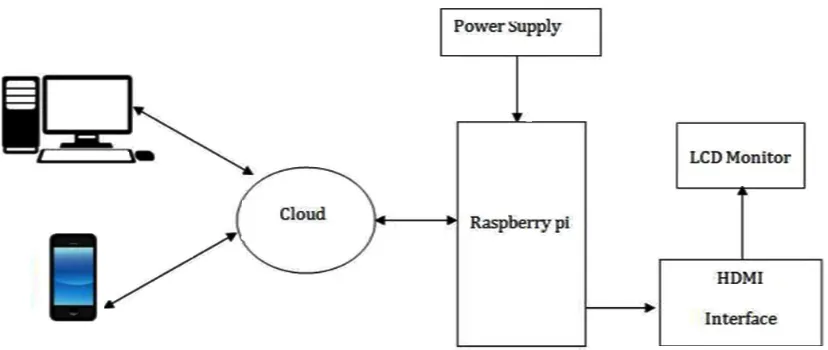
The system will sent this message to cloud. Then it passes to the notice board which is connected to internet by Wi-Fi. The processor, process it and displayed on the screen. We can send the message to all the screens or desired screen.
Methodology
The main function of the proposed system is to develop a Digital notice board that display message sent from the user through internet and to design a simple, user friendly system, which can receive and display notice in a particular manner with respect to date and time which will help the user to easily keep the track of notice board every day and each time he uses the system. System consist of two section called as sender and receiver, which shown in the figure 1. Sender is responsible for sending valuable informations through the wireless network. In order to access Digital notice board the sender must enter into the corresponding web address. For preventing unauthorized access web address we provide security authentications like username and password. If the username and password entered are invalid then the user can’t access the digital notice board. When the user enter correct password and user name web address will opened and get space for the information transmission. User can access this web address either using personal computer or mobile phone. To make the proposed system more user friendly we make an android application. By using this application sender can directly enter into the web address. In addition to this android
application contain voice to speech converter. So the sender can send text message through his own voice without typing messages. These messages including text file, image file and pdf file will send to the cloud. In the simplest terms, cloud means storing and accessing data and programs over the Internet instead of our computer's hard drive. The cloud is just a metaphor for the Internet.
In receiver section, Raspberry pi is connected on Wi-Fi for accessing internet. The Raspberry Pi is a low cost, credit-card sized computer that plugs into a computer monitor or TV, and uses a standard keyboard and mouse. It is a capable little device that enables people of all ages to explore computing, and to learn how to program in languages like Scratch and Python. It’s capable of doing everything you’d expect a desktop computer to do, from browsing the internet and playing high-definition video, to making spreadsheets, word-processing. Raspberry pi is activated by supply power around 5v. After switch on Raspberry pi, it will collect data from the cloud. The web address for collecting data from the cloud is already specified through program written in the processor. Upon receiving messages it will displayed on the monitor. Raspberry pi has no VGA port. So in order to interface LCD monitor with Raspberry pi, HDMI interface is used. The received text messages are displayed on the screen like scrolling manner. Similarly received images will display on the screen. For displaying Pdf files, first it converted into image file by the program written in the Raspberry pi. After
converting all the pdf pages in to images then it will display. Each two pages in the received pdf file will displayed at a time. To achieve this monitor screen is spitted into two sections. Each section displays each page. After a certain delay the next pages will displayed. All these messages are displayed sequentially after short delay.
In addition to this we provide Deleting and modification option at the web link. If sender wants to delete some image or pdf file, he can simply delete it by clicking the corresponding link in the web page. Also we delete or modify text messages whenever we want. After deleting the messages from the cloud it will automatically deleted on the display after a short delay. We can change the scrolling text color, text size, display graphics, delay between the messages by simply made changes on the program.
Algorithm
Following step by step procedure will explain the actual working of the system
1. Start
2. Login for access notice board.
3. If the user is valid then go to step 4 otherwise go to step 2.
4. Select Informations in the form of image, pdf and text files
5. Upload files. 6. Store the message.
7. Set the duration of displayed messages. 8. Set maximum limit for the size of image to be
displayed.
9. If the received image is less than the limit it will directly displayed. Otherwise image will resized.
10. When pdf is received it will converted to image.
11. Received image and text files
12. Display stored messages in First in first out order(FIFO)
13. Check for new notice. If it occur go to step 8.else go to step 9
14. Repeat above steps when power supply maintained.
15. Stop
Results and Discussions
The proposed system was successfully tested to demonstrate its effectiveness and feasibility. In
this paper PC and android application is used as a transmitter and Raspberry is used as a receiver. Sender and receiver is interfaced through a wireless network Display is connected a. the receiver side. Raspberry pi is connected to Wi-Fi network to access data on the cloud. After establishing connection data stored on the cloud will be displays.
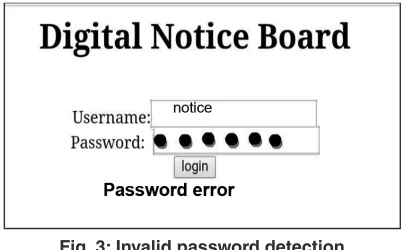
For sending information sender must enter in to the login page. Figure 2 shows the login page of our IOT based digital system. Username and Password
Fig. 2: Login page
is predetermined. If we enter wrong username and password an error will displayed on the login page, which shown in figure 3. So after typing correct username and password in the respective columns, next page will displayed in the web server
Fig. 3: Invalid password detection
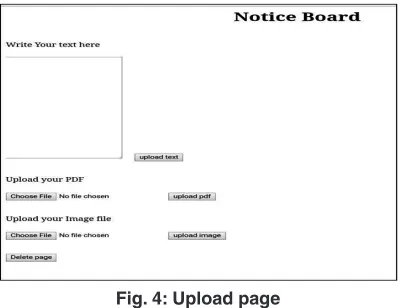
For deleting previously send data simply click on the delete page icon. A new window will contain facilities to delete documents.
Fig. 4: Upload page
In delete page which contain separate list of our previously send data. In order to delete data by simply select the corresponding data in the list and press delete icon. After a short delay deleted data will be erased in receiver section.
Fig. 6: Displaying pdf files
Received pdf files are first converted to image format. After the conversion of pdf into image it will be displayed. For making dual display on a monitor, we paste each converted page in pdf on background image at a predetermined position.
Figure 6 shows the illustration of displaying pdf files on our digital notice board. Here two pdf pages are simultaneously displayed on monitor.
When the received image size exceeds our predetermined values then it will resized to our predetermined set of values and displayed. Received text messages will display like breaking news in TV channels. Text messages can also be sending from the android application through voice. After each 10 seconds displayed messages will changes to next message. Newly send pdf, image file has high preference. So when we send a message in the form of image or pdf it will displayed first then after 10 seconds delay previously received messages will display. But in the case of texted messages newly received message is displayed followed by the previously send text message. So text message is displayed one after one in the serial manner. This process will continue as long as the power supply is maintained.
Advantages
Because of the usage of internet for the transmission of messages have lot of advantages. It includes high data transmission rate, better message quality, less waiting time etc. Username and password authentication system make the system more secure. Here raspberry pi can act as a central processing unit. So we can send not only texted messages but also can send image files in the form of Jpg, jpeg, png and pdf files with better quality. By providing deleting option it makes the newly proposed system become user friendly. This facilitates deleting any previously send data at any time. This system provide first step to achieve paperless community. Due to the reduced usage of paper in a community which make the community environmental friendly. By utilizing the advantages of Raspberry pi we can add graphics on displays. When add graphics it will get more attention from peoples. Main aims of all type of notice boards are to pass information on peoples as much as possible. So this system can pass informations on more peoples than conventional wooden type notice
boards. Due to the inbuilt memory in Raspberry pi data from the cloud is stored. This will make the system non volatile. Any failure in the power supply does not effect on the stored data. Due to these advantages the proposed system can extended to live telecasting of informations around the world.
Conclusion
Now our world is moving towards digitalization, so if we want to do some changes in the previously used system we have to use the new techniques. Wireless technology provides fast transmission over long range data transmission. It saves time, cost of cables, and size of the system. Data can be
sent from anywhere in the world. Username and password type authentication system is provided for adding securities. Previously the notice board using Wi-Fi was used. In that there was the limit of coverage area, but in our system internet is used as communication medium. So there is no problem with coverage area. Multimedia data can be stored on chip or on SD card. Text messages and multimedia data can be seen fast as possible with better quality.
Acknowledgement
We are very much thankful to the Management of VISTAS Pallavaram for funding this project.
References
1. Mr. Ramchandra K. Gurav, Mr. Rohit Jagtap, “Wireless Digital Notice Board Using GSM Technology”, International Research Journal of Engineering and Technology (IRJET), Volume: 02 Issue: 09, Dec-2015, e-ISSN: 2395 -0056.
2. Prof. Sudhir Kadam, Abhishek Saxena, Tushar Gaurav, “Android Based Wireless Notice Board and Printer”, International Journal of Innovative Research in Computer and Communication Engineering, Vol. 3, Issue 12, December 2015, ISSN(Online): 2320-9801 ISSN (Print): 2320-9798.
3. C.N.Bhoyar, Shweta Khobragade, Samiksha Neware, “Zigbee Based Electronic Notice Board”, International Journal of Engineering Science and Computing, March 2017. 4. V.P. Pati, Onkar Hajare, Shekhar Palkhe,
Burhanuddin Rangwala, “Wi-Fi Based Notification System”, The International Journal of Engineering And Science (IJES), Volume 3 ,Issue 5 ,2014.
5. S. Arulmurugan PP, S. Anitha PP, A. Priyanga PP, S. Sangeethapriya,” Smart Electronic Notice Board Using WI-FI”, - International Journal of Innovative Science, Engineering & Technology, Vol. 3 Issue 3, March 2016, ISSN 2348 – 7968.
6. Liladhar P. Bhamre, Abhinay P. Bhavsar, Dushyant V. Bhole, Dhanshree S. Gade, “Zigbee Based Notice Board”, IJARIIE, Vol-3 Issue-1 2017, ISSN(O)-2395-4396.
7. Jaiswal Rohit, Kalawade Sanket, Kore Amod, Lagad Sanket, “Digital-Notice Board”, International Journal of Advanced Research in Computer Engineering & Technology (IJARCET) Volume 4 Issue 11, November 2015.
8. Bhumi Merai, Rohit Jain, Ruby Mishra, “Smart Notice Board”, International Journal of Advanced Research in Computer and Communication Engineering Vol. 4, Issue 4, April 2015, ISSN (Online) 2278-1021. 9. Modi Tejal Prakash, Kureshi Noshin Ayaz,
Ostwal Pratiksha Sumtilal “Digital Notice Board”, International Journal of Engineering Development and Research, Volume 5, Issue 2, 2017, ISSN: 2321-9939.
10. Suma M.N., Amogh H. Kashyap, Kajal D., Sunain A. Paleka, “Voice over WiFi based smart wireless notice board”, SSRG International Journal of Electronics and Communication Engineering (SSRG-IJECE) – Volume 4 Issue 6 – June 2017.
11. P. Pavankumar, Sonita, S. Shruti, “Wireless scrolling LED display Notice board using WI-FI”, International Journal of Multidisciplinary – Innovation and Research Analysis (IJMIRA), Volume – 1; Issue 4; July-Sept 2017. 12. Prachee U. Ketkar, Kunal P. Tayade, Akash P.
3; PP: 149-155.
13. Ms. Shraddha J. Tupe, Ms. A. R. Salunke, “Multi Functional Smart Display Using Raspberry-PI” Volume 2, Special Issue (NCRTIT 2015), January 2015. ISSN 2348 – 4853.
14. Vinod B. Jadhav, Tejas S. Nagwanshi, Yogesh P. Patil, Deepak R. Patil, “Digital Notice Board Using Raspberry PI”, International Research Journal of Engineering and Technology (IRJET), Volume 3, Issue5, May 2016 W.-K.Chen, Linear Networks and Systems. Belmont, CA:Wadsworth, 1993, pp. 123–135 15. Ms. Sejal V. Gawande, Dr. Prashant R.
Deshmukh “Raspberry Pi Technology” International Journal of Advanced Research in Computer Science and Software Engineering( IJARCSSE), Volume 5, Issue
4, April 2015.
16. Rajeeb Lochan Dash, Mrs. A. Ruhan Bevi “Real-time Transmission of Voice over 802.11 Wireless Networks Using Raspberry Pi” International Journal of Engineering Development and Research (IJEDR) 2014 Volume 2, Issue 1.
17. Guo Yinan, Zhang Shuguo, Xiao Dawei “Overview of Wi-Fi Technology” The 2nd International Conference on Computer Application and System Modeling 2012, Published by Atlantis Press, Paris, France. 18. J. S. Lee, Y. W. Su, and C. C. Shen, proposed a