Active Learning Using Smooth Relative Regret
Approximations with Applications
Nir Ailon [email protected]
Ron Begleiter [email protected]
Department of Computer Science Taub Building
Technion Israel Institute of Technology Haifa 32000, Israel
Esther Ezra [email protected]
Coutrant Institute of Mathematical Science New York University
251 Mercer Street
New York, NY, 10012 USA
Editor:Yoav Freund
Abstract
The disagreement coefficient of Hanneke has become a central data independent invariant in proving active learning rates. It has been shown in various ways that a concept class with low complexity together with a bound on the disagreement coefficient at an optimal solution allows active learning rates that are superior to passive learning ones.
We present a different tool for pool based active learning which follows from the exis-tence of a certain uniform version of low disagreement coefficient, but is not equivalent to it. In fact, we present two fundamental active learning problems of significant interest for which our approach allows nontrivial active learning bounds. However, any general purpose method relying on the disagreement coefficient bounds only, fails to guarantee any useful bounds for these problems. The applications of interest are: Learning to rank from pairwise preferences, and clustering with side information (a.k.a. semi-supervised clustering).
The tool we use is based on the learner’s ability to compute an estimator of the difference between the loss of any hypothesis and some fixed “pivotal” hypothesis to within an absolute error of at mostεtimes the disagreement measure (`1distance) between the two hypotheses. We prove that such an estimator implies the existence of a learning algorithm which, at each iteration, reduces its in-class excess risk to within a constant factor. Each iteration replaces the current pivotal hypothesis with the minimizer of the estimated loss difference function with respect to the previous pivotal hypothesis. The label complexity essentially becomes that of computing this estimator.
Keywords: active learning, learning to rank from pairwise preferences, semi-supervised clustering, clustering with side information, disagreement coefficient, smooth relative regret approximation
1. Introduction
An active learner selects the instances from which it learns, contrary to standard PAC
in a stream, and in the pool setting they may collect a pool of instances and then choose a subset from which labels are requested. Although a relatively young field compared to traditional (passive) learning, there is by now a significant body of literature on the subject (see, e.g., Freund et al., 1997; Dasgupta, 2005; Castro et al., 2005; K¨a¨ari¨ainen, 2006; Balcan et al., 2006; Sugiyama, 2006; Hanneke, 2007; Balcan et al., 2007; Dasgupta et al., 2007; Bach, 2007; Castro and Nowak, 2008; Balcan et al., 2008; Dasgupta and Hsu, 2008; Cavallanti et al., 2008; Hanneke, 2009; Beygelzimer et al., 2009, 2010; Koltchinskii, 2010; Cesa-Bianchi et al., 2010; Yang et al., 2010; Hanneke and Yang, 2010; El-Yaniv and Wiener, 2010; Hanneke, 2011; Orabona and Cesa-Bianchi, 2011; Cavallanti et al., 2011; Yang et al., 2011; Wang, 2011; Minsker, 2012). Refer to the survey by Settles (2009) for a further discussion about active learning.
The disagreement coefficient of Hanneke (2007) has become a central data independent invariant in proving active learning rates. It has been shown in various ways that a concept class with low complexity together with a bound on the disagreement coefficient at an optimal solution allow active learning rates that are superior to passive rates under certain low noise conditions (see, e.g., Hanneke, 2007; Balcan et al., 2007; Dasgupta et al., 2007; Castro and Nowak, 2008; Beygelzimer et al., 2010). The best results assuming only bounded VC dimensiondand disagreement coefficientθcan roughly be stated as follows: If the sought (in-class) excess risk µ has the same order of magnitude as the optimal error ν or larger, then the number of required queries is roughly Oe(θdlog(1/µ)).1 Otherwise, the number
is roughly Oe(θdν2/µ2). Note that this results makes no assumption on the noise (except
maybe for its magnitude). Better results can be achieved by assuming certain statistical properties of the noise (especially the model of Mammen and Tsybakov, 1999; Tsybakov, 2004).
The idea behind the disagreement coefficient is intuitive and simple: If a hypothesis h
is r-close to the optimum, then the difference between their losses (the regret of h) can be computed from instances in thedisagreement region only, defined as the set of instances on which the r-ball around the optimum is not unanimous on. This means that for minimiz-ing regret, one may restrict attention to hypotheses layminimiz-ing in iteratively shrinkminimiz-ing version spaces and to instances in the corresponding disagreement regions, which are shrinking in tandem with the version spaces if the disagreement coefficient is small. As pointed out in Beygelzimer et al. (2010), ignoring hypotheses outside the version space is brittle business, because an error in computation of the version space results in a failure of the algorithm. They propose a scheme in which no version space is computed. Instead, a certain impor-tance weighted scheme is used. We also use imporimpor-tance weighting, but in the pool based setting and not in the streaming setting as they do.2
Analyzing the difference between losses of hypotheses (“relative regrets”) is used vastly in numerous theoretical work on active learning, but not attached directly. In this work we argue that a careful construction of empirical processes uniformly estimating the relative regret of all hypotheses with respect to a fixed “pivotal” hypothesis yields fast active learning rates. We call such constructions “SRRA” (Smooth Relative Regret Approximations).
1. TheOenotation suppresses polylogarithmic terms.
We also show that low disagreement coefficient and VC dimension assumptions imply such efficient constructions, and give rise to yet another proof for the usefulness of the dis-agreement coefficient in active learning. Nevertheless, our SRRA-based iterative method doesnot need to compute or restrict itself to shrinking version spaces. This is supported by presenting two fundamental pool based learning problems for whichdirect SRRA construc-tions yield superior active learning rates, whereas approaches that exploit the disagreement coefficient only (in the sense presented in Section 3), requires the practitioner to obtain labels for the entire pool (!) even for moderately chosen parameters. We conclude that the SRRA method is, up to minor factors, at least as good as the disagreement coefficient method, but can be significantly better in certain cases.
We note that another important line of design and analysis of active learning algorithms makes certain structural or Bayesian assumptions on the noise (e.g., Balcan et al., 2007; Castro and Nowak, 2008; Hanneke, 2009; Koltchinskii, 2010; Yang et al., 2010; Wang, 2011; Yang et al., 2011; Minsker, 2012). We expect that one can get yet improved analysis in our framework under these assumptions. We leave this to future work.
The rest of the paper is laid out as follows: In Section 2 we present notations and ba-sic definitions, including an introduction to our method. In Section 3 we show that low disagreement coefficients imply efficient SRRAs. Then, we present our two main applica-tions of SRRA that lie beyond the scope of disagreement coefficients: (i) learning to rank from pairwise preferences (LRPP) (Section 4), and (ii) clustering with side information in (Section 5). In Section 6 we present additional results and practical considerations, and, in particular, the application of our method with convex relaxation in case the correspond-ing ERM problems are too difficult (computationally) to optimally solve. We conclude in Section 7 and suggest future directions.
2. Definitions, Notations, and Core Results
We follow the notation of Hanneke (2011): LetX be an instance space, and letY ={0,1}be a label space. Denote byD the distribution overX × Y, with corresponding marginals DX
andDY. In this work we assume for convenience (only) that each labelY is a deterministic
function of X, so that ifX ∼ DX then (X, Y(X)) is distributed according toD.
By C we denote a concept class of functions mapping X to Y. The error rate of a hypothesis h∈ C equals
erD(h) =E(X,Y)∼D[h(X)6=Y(X)] .
The noise rate ν of C is defined as ν = infh∈CerD(h). We will focus on the scenario in
which ν is attained at an optimal hypothesis h∗, so that erD(h∗) =ν. Define the distance
dist(h1, h2) between two hypotheses h1, h2 ∈ C as PrX∼DX[h1(X) 6= h2(X)]; observe that dist(·,·) is a pseudo-metric over pairs of hypotheses. For a hypothesis h∈ C and a number
r ≥0, the ball B(h, r) around h of radius r is defined as {h0 ∈ C : dist(h, h0) ≤r}. For a set V ⊆ C of hypotheses, let DIS(V) denote
2.1 The Disagreement Coefficient
The disagreement coefficient ofh with respect to C underDX is defined as
θh= sup r>0
PrDX [DIS (B(h, r))]
r , (1)
where PrDX[W] forW ⊆ X denotes the probability measure with respect to the distribution
DX. Define the uniform disagreement coefficientθ as suph∈Cθh, namely
θ= sup
h∈C
sup
r>0
PrDX[DIS (B(h, r))]
r . (2)
Remark 1 A useful slight variation of the definitions of θh and θ can be obtained by
re-placing supr>0 with supr≥ν in (1) and (2). We will explicitly say when we refer to this
variation in what follows.
2.2 Smooth Relative Regret Approximations (SRRA)
Fix h ∈ C (which we call the pivotal hypothesis). Denote by regh : C 7→ R the function defined as
regh(h0) = erD(h0)−erD(h).
We call regh the relative regret function with respect to h. Note that for h = h∗ this is simply the usual regret, or (in-class) excess risk function.
Definition 2 Let f :C 7→Rbe any function, and 0< ε <1/5and0< µ≤1. We say that f is an (ε, µ)-smooth relative regret approximation ((ε, µ)-SRRA) with respect to h if for allh0 ∈ C,
|f(h0)−regh(h0)| ≤ε· dist(h, h0) +µ .
If µ= 0 we simply call f an ε-smooth relative regret approximationwith respect to h.
Although the definition is general, we focus here on the pool based active learning setting. Intuitively, think of f as an empirical version of regh. The definition guides us to query labels such that we cover the whole spectrum of disagreement-instances w.r.t. the pivoth, while assuring corresponding estimation accuracies with granularity proportional to inverse distances from h. Intuitively, the condition supports holistic explore-exploit query strate-gies: We cover the whole range of error ”types” (exploration), and at the same time put more querying efforts “near” the intermediate solution (exploitation). The following theo-rem and corollary constitute the main ingredient in our work. They show that a sequence of (ε, µ)-SRRA estimators define a competitive hypothesis.
Theorem 3 Leth∈ Candf be an(ε, µ)-SRRA with respect toh. Leth1 = argminh0∈Cf(h0).
Then
Proof Applying the definition of (ε, µ)-SRRA we have:
erD(h1)≤erD(h) +f(h1) +ε·dist(h, h1) +εµ
≤erD(h) +f(h∗) +ε·dist(h, h1) +εµ
≤erD(h) +ν−erD(h) +ε·dist(h, h∗) +ε·dist(h, h1) + 2εµ
≤ν+ε2dist(h, h∗) + dist(h1, h∗)
+ 2εµ . (3)
The first inequality is from the definition of (ε, µ)-SRRA, the second is from the fact that
h1 minimizes f(·) by construction, the third is again from the definition of (ε, µ)-SRRA,
and the definitions of h∗ and regh, the fourth is by the triangle inequality. The proof is completed by plugging dist(h, h∗) ≤ erD(h) +ν, and dist(h1, h∗) ≤ erD(h1) + ν into
Equation 3, subtractingε·erD(h1) from both sides, and dividing by (1−ε).
A simple inductive use of Theorem 3 proves the following corollary, bounding the excess risk of an ERM based active learning algorithm (see Algorithm 1 for corresponding pseudocode). The algorithm’s query-complexity depends on the specific constructions of (ε, µ)-SRRA estimators. Note that this algorithm never restricts itself to a shrinking version space.
Corollary 4 Leth0, h1, h2, . . . be a sequence of hypotheses inC such that for alli≥1,
hi = argminh0∈Cfi−1(h0), where fi−1 is an (ε, µ)-SRRA with respect to hi−1. Then for all
i≥0,
erD(hi) = (1 +O(ε))ν+O(εi)erD(h0) +O(εµ) . Proof Applying Theorem 3 withhi and hi−1, we have
erD(hi) = (1 +O(ε))ν+O(ε·erD(hi−1)) +O(εµ) .
Solving this recursion, one gets
erD(hi) = i X j=1
εj−1(1 +O(ε))ν+O(εi)·erD(h0) +O
i X j=1
εj
µ .
The result follows easily by bounding geometric sums.
Algorithm 1 An Active Learning Algorithm from SRRA’s
Input: an initial solution h0 ∈ C, estimation parameters ∈ (0,1/5), µ >0, and number
of iterationsT
1: fori= 0,1, . . . , T −1 do
2: hi+1 ← argminh0∈Cf(h0), where f is an (ε, µ)-smooth relative regret approximation with respect to hi
3: end for 4: return hT
X from the pool X, if the uniform disagreement coefficient θis small. This will constitute another proof for the usefulness of the disagreement coefficient in design and analysis of active learning algorithms. We then present two problems for which a direct construction of an SRRA yields a significantly better query complexity than that guaranteed using the disagreement coefficient alone.
3. Constant Uniform Disagreement Coefficient Implies Efficient SRRAs
We show that a bounded uniform disagreement coefficient implies existence of query effi-cient (ε, µ)-SRRAs. This constitutes yet another proof of the usefulness of the disagreement coefficient in design of active learning algorithms, via Algorithm 1. Plugging the resulting query efficient (ε, µ)-SRRAs into our iterative SRRA method (Algorithm 1) provides an ac-tive learning algorithm with query complexity that matches the state-of-the-art, yet does not improve it. In the following sections, however, we design two other (ε, µ)-SRRAs construc-tions that yield active learning algorithms which beats the corresponding state-of-the-art query complexity guarantees.
3.1 The Construction
Returning to our problem, assume the uniform disagreement coefficientθcorresponding to
C is finite and ν >0. Fix h∈ C and let L =dlogµ−1e. Define X0 = DIS(B(h, µ)) and for
i= 1, . . . , L define Xi to be
Xi= DIS(B(h, µ2i))\DIS(B(h, µ2i−1)) .
Let ηi = PrDX[Xi] be the measure of Xi, and δ a failure probability hyper-parameter. For each i≥0 draw a sample Xi,1, . . . , Xi,m of
m = O ε−2θ dlogθ+ log δ−1log(1/µ)
examples in Xi, each of which drawn independently from the distribution DX|Xi (with
repetitions). (By DX|Xi we mean, the distribution DX conditioned on Xi.) We will now
define an estimator functionf :C 7→Rof regh, as follows. For anyh0∈ C andi= 0,1, . . . , L
let
fi(h0) =ηim−1 m X j=1
1Y(Xi,j)6=h0(Xi,j)−1Y(Xi,j)6=h(Xi,j)
.
Our estimator is now defined asf(h0) =PL i=0fi(h
0). The estimatorf(h0) is an unbiased
em-pirical counterpart of the relative regret in which each empirical error
1Y(Xi,j)6=h0(Xi,j)−1Y(X
i,j)6=h(Xi,j)
is weighted with respect to ηi. The weights are
de-picted as different element sizes. Observe that the weight is inverse proportional to the probability of drawing Xi,j.
We next show thatf is an (ε, µ)-SRRA with respect toh. This allows us to incorporate
f into Algorithm 1 and gain a (1 +ε)ν competitive hypothesis. Thus, the query complexity will boil down to the size of the sample defining the empirical relative-regret minimizerf.
Proof A main tool to be exploited in the proof is calledrelative ε-approximations due to Haussler (1992) and Li et al. (2000). It is defined as follows. Let h ∈ X 7→ R+ be some
function, and letµh =EX∼DX[h(X)]. LetX1, . . . , Xm denote i.i.d. draws fromDX, and let ˆ
µh = m1 ·Pim=1h(Xi) denote the empirical average. Letκ >0 be an adjustable parameter.
We are going to use the following measure of distance between the true expectationµh and
its estimator ˆµh: dκ(µh,µˆh) =
|µh−µˆh| µh+ˆµh+κ.
This measure corresponds to a relative error when approximatingµh by ˆµh. Indeed, let
ε >0 be our approximation ratio, and put dκ(µh,µˆh)< ε. This easily yields
|µh−µˆh|<
2ε
1−ε·µh+ ε
1−ε·κ . (4)
In other words, this implies that |µh−µˆh|< O(ε) µh+κ
.
Let us fix a parameter 0< δ <1. AssumeC is a set of {0,1} valued functions onX of VC dimensiond. Li et al. (2000) show that if one samples
m=O ε−2κ−1(dlogκ−1+ logδ−1)
examples as above (with a sufficiently large constant of proportionality), then (4) holds uniformly for allh∈ C with probability at least 1−δ.
We consider the range space (X,C∗), defined by
C∗ = [
h0∈C
{X ∈ X :h0(X) = 0}
!
∪ [
h0∈C
{X∈ X :h0(X) = 1}
!
.
In words, C∗ is the collection of all subsets S ⊆ X, whose elementsX ∈S are mapped to the same value (0 or 1) by h0, for some h0 ∈ C. Assume (X,C∗) has VC dimension3 d, and
fixh∈ C. LetL=dlogµ−1e, and recall the definition of the disagreement setsXi.
We now apply this definition ofrelativeε-approximations, and the corresponding results within our context. For any h0, we define the following four sets of instances:
R++h0 = {X∈ X : h0(X) =Y(X) = 1, andh(X) = 0},
R+h0− = {X∈ X : h0(X) = 1, and h(X) =Y(X) = 0},
R−h0+ = {X∈ X : h0(X) = 0, and h(X) =Y(X) = 1},
R−−h0 = {X∈ X : h0(X) =Y(X) = 0, andh(X) = 1} .
Observe that the set {X ∈ X : h(X) 6= h0(X)} equals the disjoint union of R++h0 , R+h0−,
Rh−0+ and R−−h0 . For each i = 0, . . . , L and b ∈ {++,+−,−+,−−} let Rbh0,i = Rbh0 ∩ Xi.
Let Rb
i ={Rbh0,i :h0 ∈ C}. It is easy to verify that the VC dimension of the range spaces
Xi,Rbi
is at most d. Each set inRbi is an intersection of a set in C∗ with some fixed set. For any R ⊆ Xi let ρi(R) = PrX∼DX|Xi[X ∈R], and ˆρi(R) = m
−1Pm
j=11Xi,j∈R. Note
that ˆρi(R) is an unbiased estimator ofρi(R).
3. The VC dimension of (X,C∗) is the maximum cardinality of a subsetA⊆ X for which{A∩r: r∈ C∗}
By the choice of m, inequality (4), and the assumptions on θ and ν we have that with probability at least 1−δ/L, for all R⊆ R++i ∪ Ri+−∪ R−i +∪ R−−i ,
|ρi(R)−ρˆi(R)|=O(ε)· ρi(R) +θ−1
, (5)
and by the probability union bound we obtain that this uniformly holds for alli= 0, . . . , L
with probability at least 1−δ.
Now fix h0 ∈ C and let r = dist(h, h0). Let ir = dlog(r/µ)e. By the definition of Xi,
h(X) =h0(X) for allX ∈ Xi whenever i > ir. We can therefore decompose regh(h0) as:
regh(h0) = erD(h0)−erD(h)
=
L X
i=0
ηi·
Pr
X∼DX|Xi
[Y(X)6=h0(X)]− Pr
X∼DX|Xi
[Y(X)6=h(X)]
=
ir X
i=0
ηi·
Pr
X∼DX|Xi
[Y(X)6=h0(X)]− Pr
X∼DX|Xi
[Y(X)6=h(X)]
=
ir X
i=0
ηi·
−ρi(R++h0 ) +ρi(R+h0−) +ρi(Rh−0+)−ρi(R−−h0 )
.
On the other hand, we similarly have that
f(h0) =
ir X
i=0
ηi·
−ρˆi(R++h0 ) + ˆρi(R+h0−) + ˆρi(Rh−0+)−ρˆi(R−−h0 )
.
Combining, we conclude using (5) that
|regh(h0)−f(h0)| ≤O ε ir
X
i=0 ηi·
ρi(R++h0 ) +ρi(R+h0−) +ρi(R−h0+) +ρi(R−−h0 ) + 4θ−1
!
. (6)
But now notice thatPir i=0ηi·
ρi(R++h0 ) +ρi(R+h0−) +ρi(R−h0+) +ρi(R−−h0 )
equalsr, since it
corresponds to those elements X∈ X on whichh,h0 disagree. Also note thatPir
i=0ηi is at
most 2 max{PrDX [DIS (B(h, r))],PrDX [DIS (B(h, µ))]}. By the definition ofθ, this implies that the RHS of (6) is bounded byε(r+µ), as required by the definition of (ε, µ)-SRRA.4
Corollary 6 An (ε, µ)-SRRA with respect to h can be constructed, with probability at least
1−δ, using at most
m(1 +dlog(1/µ)e) =O θε−2(log(1/µ)) dlogθ+ log(δ−1log(1/µ))
label queries.
Combining Corollaries 4 and 6 (Algorithm 1), we obtain an active learning algorithm in the ERM setting, with query complexity depending on the uniform disagreement coefficient and the VC dimension. Assume δ is a constant. If we are interested in excess risk of order at least that of the optimal error ν, then we may take ε to be, say, 1/5 and achieve the sought bound by constructing (1/5, ν)-SRRA’s using O(θd(log(1/ν))(logθ)), once for each of O(log(1/ν)) iterations of Algorithm 1. If we seek a solution with error (1 +ε)ν, we would need to construct (ε, ν)-SRRA’s using O(θdε−2(log(1/ν))(logθ)) query labels, one for each of O(log(1/ν)) iterations of the algorithm. The total label query complexity is
O(θd(log2(1/ν))(logθ)), which is O(log(1/ν)) times the best known bounds using disagree-ment coefficient and VC dimension bounds only (e.g., Dasgupta et al., 2007; Beygelzimer et al., 2009).
Remark 7 (Using the uniform disagreement coefficient) We first note that in known arguments bounding query complexity using the disagreement coefficient, the disagreement coefficient θh∗ with respect to the optimal hypothesis h∗ is used in the analysis, and not
the uniform coefficient θ. Also note that in both previously known results bounding query complexity using disagreement coefficient and VC dimension bounds as well as our result, the slight improvement described in Remark 1 applies. In other words, all arguments remain valid if we replace the supremums in (1) and (2) with supr≥ν.
Remark 8 (Computing the Xi’s) Note that we show how to computeXi exactlyin poly-nomial time when dealing with linear hypotheses spaces. This is shown in Section 6.1.2 in the context of a ranking problem. Yet, it indicates that in certain cases Xi can be computed
efficiently. Additionally note that the sets Xi are defined w.r.t. a pivot (i.e., given) hypoth-esis; thus, it is possible to estimate it, for example, using ideas similar to the nice works of Balcan et al. (2006) and Dasgupta et al. (2007).
4. Application #1: Learning to Rank from Pairwise Preferences (LRPP)
“Learning to Rank” takes various forms in theory and practice of learning, as well as in combinatorial optimization. In such problems, the goal is to order a set V based on constraints.
A large body of learning literature considers the following scenario: For each v ∈ V
there is a label on some discrete ordinal scale, and the goal is to learn how to order V
so as to respect induced pairwise preferences. For example, a scale of {1,2,3,4,5}, as in hotel/restaurant star quality; where, if u has a label of 5 (“very good”) and v has a label of 1 (“very bad”), then any ordering that places v ahead ofu is penalized. Note that even if the labels are noisy, the induced pairwise preferences here are always transitive, hence no combinatorial problem arises. Our work does not deal with this setting.
When the basic unit of information consists of preferences over pairs u, v ∈ V, then the problem becomes combinatorially interesting. In case all quadratically many pairwise preferences are given for free, the corresponding optimization problem is known asMinimum
Feedback Arc-Set in Tournaments(MFAST).5MFAST has been shown to be NP-hard (Alon,
2006). Recently, Kenyon-Mathieu and Schudy (2007) showed a PTAS for this (passive
learning) problem. Several important recent works address the challenge of approximating the minimum feedback arc-set problem (Ailon et al., 2008; Braverman and Mossel, 2008; Coppersmith et al., 2010).
Here we consider a query efficient variant of the problem, in which each preference comes at a cost, and the goal is to produce a competitive solution while reducing the preference-query overhead. Other very recent work consider similar settings (Jamieson and Nowak, 2011; Ailon, 2012). Jamieson and Nowak (2011) consider a common scenario in which the alternatives can be characterized in terms of dreal-valued features and the ranking obeys the structure of the Euclidean distances between such embeddings. They present an active learning algorithm that requires, using average case analysis, as few as O(dlogn) labels in the noiseless case, andO(dlog2n) labels under a certainparametric noise model. Our work uses worst-case analysis, and assumes an adversarial noise model. In this Section we analyze the pure combinatorial problem (not assuming any feature embeddings). In Section 6 we tackle the problem with linearly induced permutation over feature space embeddings.
Ailon (2012) consider the same setting as ours. Our main result Corollary 13 is a slight improvement over the main result of Ailon (2012) in query complexity, but it provides an-other significant improvement. Ailon (2012) uses a querying method that is based on a divide and conquer strategy. The weakness of such a strategy can be explained by con-sidering an example in which we want to search a restricted set of permutations (e.g., the setting of Section 6.1). When dividing and conquering, the algorithm in Ailon (2012) is doomed to search a Cartesian product of two permutations spaces (left and right). There is no guarantee that there even exists a permutation in the restricted space that respects this division. In our querying algorithm this limitation is lifted.
4.1 Problem Definition
LetV be a set ofnelements (alternatives). The instance spaceX is taken to be the set of all distinct pairs of elements inV, namelyV×V \
(u, u) :u∈V . The distributionDX is
uniform on X. The label functionY :X 7→ {0,1} encodes a preference function satisfying
Y (u, v)= 1−Y (v, u) for all u, v∈V.6 By convention, we think of Y (u, v) = 1 as a stipulation thatu is preferred overv. For convenience we will drop the double-parentheses in what follows.
The class of solution functions C we consider is all h : X → {0,1} such that it is
skew-symmetric: h(u, v) = 1−h(v, u), and transitive: h(u, z) ≤ h(u, v) +h(v, z) for all distinct u, v, z ∈ V. This is equivalent to the space of permutations over V, and we will use the notation π, σ, . . . instead of h, h0, . . . in the remainder of the section. We also use notation u ≺π v as a predicate equivalent to π(u, v) = 1. Endowing X with the uniform measure, dist(π, σ) turns out to be (up to normalization) the well known kendall-τ distance: dist(π, σ) =N−1P
u6=v1π(u,v)6=σ(u,v), whereN =n(n−1) is the number of all ordered pairs. 4.2 The Weakness of Using Disagreement Coefficient Arguments
We first demonstrate the weakness of a disagreement coefficient approach with respect to this problem. It has been shown in Ailon (2012) that the uniform disagreement coefficient
of C is Ω(n). To see this simple fact, notice that if we start from some permutationπ and swap the positions ofany two elements u, v∈V, then we obtain a permutation of distance at most O(1/n) away from π, hence the disagreement region of the ball of radius O(1/n) aroundπ is the entire spaceX. It is also known that the VC dimension ofC isn−1 (e.g., Radinsky and Ailon, 2011). This is simply because there is always a labelingY(·) over any set ofn=|V|pairs that defines preference cycles. Thus, the set of permutations C cannot shatternpairs. Using Corollary 6, we conclude that we would need Ω(n2) preference labels to obtain an (ε, µ)-SRRA for any meaningful pair (ε, µ). This is uninformative because the cardinality of X is O(n2). A similar bound is obtained using any known active learning bound using disagreement coefficient and VC-dimension bounds only.
Remark 9 A slight improvement can be obtained using the refined definition of disagree-ment coefficients of Remark 1. Observe that the uniform disagreedisagree-ment coefficient, as well as the disagreement coefficient at the optimal solution h∗ becomes θ = θh∗ = O(1/ν), if
ν ≥ 1
n.
7 This improves the query complexity bound to O(nν−1). If ν tends to n−1 from
above, in the limit this becomes a quadratic (in n) query complexity.
Remark 10 A natural question in this context is why the optimal hypothesis cannot be approximated by sampling preference-pairs uniformly at random. In other words, is it suf-ficient for our setting to apply a passive learning method? Do we really need to apply the more sophisticated active-learning machinery? Ailon (2012, Section 2) shows that applying plain Empirical Risk Minimization approach is doomed to query the entire pool. Moreover, he shows that even when the noise is zero the uniform sampling approach will w.h.p. have to query all O(n2) possible labels.
We next show how to construct more useful (in terms of query complexity) SRRA’s for LRPP,for arbitrarily small ν.
4.3 Better SRRA for LRPP
Consider the following idea for creating anε-SRRA for LRPP,8 with respect to some fixed
π∈ C. We start by defining the following sample size parameter:
p=O ε−3log3n
. (7)
For all u ∈ V and for all i = 0,1, . . . ,dlogne, let Iu,i Denote the set of elements v such
that (2i−1)p <|π(u)−π(v)|<2i+1p where, abusing notation,π(u) is the position of uin
π. For example, π(u) is 1 if u beats all other elements, and n if it is beaten by all others. From this set, choose a random sequence Ru,i = (vu,i,1, vu,i,2, . . . , vu,i,p) ofp elements, each
chosen uniformly and independently fromIu,i.9
7. Due to symmetry, the uniform disagreement coefficient here equalsθhfor anyh∈ C.
8. Note that we can neglect the parameterµbecause taking its value equal 1/ntantamount to zero. 9. A variant of this sampling scheme is as follows: For each pair (u, v), add it to the query-set with
For distinct u, v ∈V and a permutation σ ∈ C, let costu,v(σ) denote the contribution
of the pair u, v to erD(σ), namely: costu,v(σ) =N−11σ(u,v)6=Y(u,v) . Let regu,v|σ denote the
contribution of {u, v} ∈ X to regπ(σ), that is
regu,v|σ = 2 (costu,v(σ)−costu,v(π)). (8)
Note the notation discards the dependency onπ because it is assumed to be fixed. The use of factor 2 is because costu,v ≡costv,u.
Our estimator f(σ) of regπ(σ) = erD(σ)−erD(π) is defined as
f(σ) = 1 2
X u∈V
dlogne X
i=0
|Iu,i|
p
p X
t=1
regu,vu,i,t|σ .
Clearly,f(σ) is an unbiased estimator of regπ(σ) for anyσ. Our goal is to prove that f(σ) is anε-SRRA.
Theorem 11 With probability at least 1−n−3, the function f is an ε-SRRA with re-spect toπ.
Proof The main idea is todecomposethe difference|f(σ)−regπ(σ)|vis-a-vis corresponding pieces of dist(σ, π). The first half of the proof is devoted to definition of such distance “pieces.” Then using counting and standard deviation-bound arguments we show that the decomposition is, with high probability, anε-SRRA.
We start with a few definitions. Recall that for anyπ ∈ C and u∈V,π(u) denotes the position of u in the unique permutation that π defines. For example, π(u) = 1 if u beats all other alternatives: π(u, v) = 1 for all v 6= u; Similarly π(u) = n if u is beaten by all other alternatives. For any permutation σ∈ C, we define the correspondingprofile of σ as the vector:10
prof(σ) = σ(u1)−π(u1), σ(u2)−π(u2), . . . , σ(un)−π(un)
.
Note thatkprof(σ)k1 isdSF(σ, π), the Spearman footrule distance between σ and π. For a
subsetV0ofV, we let prof(σ)[V0] denote the restriction of the vector prof(σ) toV0. Namely, the vector obtained by zeroing in prof(σ) all coordinates v6∈V0.
Now fix σ ∈ C and two distinctu, v∈V. Assume u, v is an inversion inσ with respect to π, and that |π(u)−π(v)| = b for some integer b. Then either |π(u)−σ(u)| ≥ b/2 or
|π(v)−σ(v)| ≥b/2. We will “charge” the inversion to argmaxz∈{u,v}
|π(z)−σ(z)| .11 For any u∈V, let chargeσ(u) denote the set of elementsv∈V such that (u, v) is an inversion inσ with respect toπ, which is charged toubased on the above rule. The function regπ(σ) can now be written as
regπ(σ) = X
u∈V
X v∈chargeσ(u)
regu,v|σ,
10. For the sake of definition assume an arbitrary indexing such thatV =ui:i= 1, . . . , n .
where regu,v|σ is defined in Equation 8. Indeed, any pair that is not inverted contributes nothing to the difference. Similarly, our estimator f(σ) can be written as
f(σ) =X
u∈U
dlogne X
i=0
|Iu,i|
p
p X t=1
regu,vu,i,t|σ·1vu,i,t∈chargeσ(u) .
Observe that we dropped the factor 1/2 above because we count each pair{u, v}only once. For any even integer M let Uσ,M denote the set of all elements u∈V such that
M/2<|π(u)−σ(u)| ≤M .
LetUσ,≤M denote:
[ M0≤M
Uσ,M0 .
From now on, we shall remove the subscript π, because it is held fixed. Consider the following restrictions of reg(σ) and f(σ):
reg(σ, M) = X
u∈Uσ,M
X v∈chargeσ(u)
regu,v|σ , (9)
f(σ, M) = X
u∈Uσ,M dlogne
X i=0
p X t=1
|Iu,i| p
regu,vu,i,t|σ·1vu,i,t∈chargeσ(u)
. (10)
Clearly, f(σ, M) is an unbiased estimator of reg(σ, M). Let Tσ,M denote the set of all
elements u∈V such that |π(u)−σ(u)| ≤εM. We further split the expressions in (9)-(10) as follows:
reg(σ, M) =A(σ, M) +B(σ, M), andf(σ, M) = ˆA(σ, M) + ˆB(σ, M),
where,
A(σ, M) = X
u∈Uσ,M
X v∈chargeσ(u)∩Tσ,M
regu,v|σ ,
ˆ
A(σ, M) = X
u∈Uσ,M dlogne
X i=0
|Iu,i|
p
p X t=1
regu,vu,i,t|σ·1vu,i,t∈chargeσ(u)∩Tσ,M ,
(·) is set complement inV, andB(σ, M),Bˆ(σ, M) are analogous withTσ,M instead ofTσ,M,
as follows:
B(σ, M) = X
u∈Uσ,M
X v∈chargeσ(u)∩Tσ,M
regu,v|σ ,
ˆ
B(σ, M) = X
u∈Uσ,M dlogne
X i=0
|Iu,i|
p
p X
t=1
We now estimate the deviation of ˆA(σ, M) fromA(σ, M). FixM. Notice that the expres-sion A(σ, M) is completely determined by non-zero elements of the vector prof(σ)[Uσ,≤M ∩ Tσ,M]. Let Jσ,M denote the number of nonzeros in prof(σ)[Uσ,M]. Each
nonzero coordinate of prof(σ)[Uσ,≤M∩Tσ,M] is bounded below byεM in absolute value by
definition. Let P(d, M) denote the number of possibilities for the vector prof(σ)[Tσ,M] for
σ running over all permutations satisfying dSF(σ, π) =d. We claim that
P(d, M)≤n2d/(εM) .
Indeed, there can be at mostd/(εM) nonzeros in prof(σ)[Tσ,M], and each nonzero coordinate
can trivially take at mostn values. The bound follows.
Now fix integers d and J, and consider the subspace of permutations σ such that
Jσ,M = J and dSF(σ, π) = d. Define for each u ∈ Uσ,M, i ∈ dlogne and t = 1, . . . , p
a random variableXu,i,t as follows
Xu,i,t =
|Iu,i|
p regu,vu,i,t|σ·1vu,i,t∈chargeσ(u)∩Tσ,M .
Clearly ˆA(σ, M) = P
u∈Uσ,MXu,i,t . For any u ∈ V, let iu = argmaxi{|Iu,i| ≤4M}, and
observe that, by our charging scheme,Xu,i,t = 0 almost surely, for alli > iu and t= 1. . . p.
Also observe that for allu, i, t,|Xu,i,t| ≤2N−1|Iu,i|/p≤2i+1/palmost surely. For a random
variableX, we denote bykXk∞the infimum over numbersαsuch thatX≤αalmost surely.
We conclude:
X u∈Uσ,M
iu X i=0
p X
t=1
kXu,i,tk2∞≤ X u∈Uσ,M
iu X i=0
N−2p22i+2/p2 ≤c2p−1N−2J M2
for some global c2 > 0. (We used a bound on the sum of a geometric series.) Using
Hoeffding bound, we conclude that the probability that ˆA(σ, M) deviates from its ex-pected value of A(σ, M) by more than some s > 0 is at most exp{−s2p/(2c
2J M2N−2)}.
We conclude that the probability that A(σ, M) deviates from its expected value by more thanεd/(Nlogn) is at most exp{−c1ε2d2p/(J M2log2n)}, for some globalc1 >0. Hence,
by taking p = O(ε−3d−1M Jlog3n), by union bounding over all P(d, M) possibilities for prof(σ)[Tσ,M], with probability at least 1−n−7simultaneously for allσ satisfyingJσ,M =J
and dSF(σ, π) = d,
|A(σ, M)−Aˆ(σ, M)| ≤εd/(Nlogn) . (11)
But note that, trivially, J M ≤ d, hence our choice of p in (7) is satisfactory. Finally, union bound over the O(n3logn) possibilities for the values of J and dand M = 1,2,4, ..
to conclude that (11) holds for all permutationsσ simultaneously, with probability at least 1−n−3.
Consider now ˆB(σ, M) and B(σ, M). We will need to further decompose these two ex-pressions as follows. For u ∈ Uσ,M, we define a disjoint cover (Tu,σ,M1 , Tu,σ,M2 ) of
chargeσ(u)∩ Tσ,M as follows. Ifπ(u)< σ(u), then
Otherwise,
Tu,σ,M1 ={v∈Tσ,M :σ(u) +εM < π(v)< π(u)−εM} .
Note that by definition,Tu,σ,M1 ⊆chargeσ(u). The setTu,σ,M2 is thus taken to be
Tu,σ,M2 = (chargeσ(u)∩Tσ,M)\Tu,σ,M1 .
The expressionsB(σ, M),Bˆ(σ, M) now decompose asB1(σ, M)+B2(σ, M) and ˆB1(σ, M)+ ˆ
B2(σ, M), respectively, as follows:
B1(σ, M) = X
u∈Uσ,M X v∈T1
u,σ,M
regu,v|σ ,
B2(σ, M) = X
u∈Uσ,M X v∈T2
u,σ,M
regu,v|σ ,
ˆ
B1(σ, M) = X
u∈Uσ,M dlogne
X i=0
|Iu,i| p
p X t=1
regu,vu,i,t|σ·1vu,i,t∈T1(u,σ,M) ,
ˆ
B2(σ, M) = X
u∈Uσ,M dlogne
X i=0
|Iu,i| p
p X t=1
regu,vu,i,t|σ·1vu,i,t∈T2(u,σ,M) .
Now notice that B1(σ, M) can be uniquely determined from prof(σ)[Tσ,M]. Indeed,
in order to identify Tu,σ,M1 for some u ∈ Uσ,M, it suffices to identify zeros in a subset of
coordinates of prof(σ)[Tσ,M], where the subset depends only on prof(σ)[{u}]. Additionally,
the value of Cu,v(σ)−Cu,v(π) can be “read” from prof(σ)[Tσ,M] (and, of course, Y(u, v))
if v ∈ Tu,σ,M1 . Hence, a Hoeffding bound and a union bound similar to the one used for bounding|Aˆ(σ, M)−A(σ, M)|can be used to bound (with high probability) the difference
|Bˆ1(σ, M)−B1(σ, M)|uniformly for allσ and M = 1,2,4, ..., as well.
Bounding |Bˆ2(σ, M)−B2(σ, M)|can be done using the following simple claim.
Claim 12 For u ∈ V and an integer q, we say that the sampling is successful at (u, q) if the random variable
(i, t) :π(vu,i,t)∈[π(u) + (1−ε)q, π(u) + (1 +ε)q]∪[π(u)−(1 +ε)q, π(u)−(1−ε)q]
is at most twice its expected value. We say that the sampling is successful if it is successful
at all u ∈ V and q ≤ n. If the sampling is successful, then uniformly for all σ and all
M = 1,2,4, ...,
|Bˆ2(σ, M)−B2(σ, M)|=O(εJσ,MM/N).
The sampling is successful with probability at least1−n−3 if p=O(ε−1logn).
The last assertion in the claim follows from Chernoff bounds. Note that our bound (7) on
p is satisfactory, in virtue of the claim.
Summing up the errors |Aˆ(σ, M)−A(σ, M)|,|Bˆ(σ, M)−B(σ, M)|over all M gives us the following assertion: With probability at least 1−n−2, uniformly for all σ,
where the last inequality is by Diaconis and Graham (1977). This concludes the proof.
Algorithm 2 summarizes our specific ε-SRRA construction for LRPP. Note that by the choice of the sample size p, the number of preference queries needed for computing f is
O(ε−3nlog4n). Observe that given a pivot π, our LRPP-SRRA construction is simple to implement, and is (obviously) computationally efficient.
Algorithm 2 SRRA for LRPP
Input: V,C, a pivotπ ∈ C, estimation parameter∈(0,1/5)
1: p←O ε−3log3n
2: foru∈V do
3: for i= 0,1, . . . ,dlogne do 4: Iu,i←
v: (2i−1)p <|π(u)−π(v)|<2i+1p
5: fort= 1, . . . , pdo
6: vu,i,t← a uniformly and independently sampled alternative fromIu,i 7: end for
8: end for 9: end for
10: return f :C −→ R, defined by
f(σ) = X
u∈V
dlogne X
i=0
|Iu,i| p
p X t=1
costu,vu,i,t(σ)−costu,vu,i,t(π)
,
We can now combine these LRPP ε-SRRA constructions in Algorithm 1, the SRRA’s method meta-algorithm defined in Corollary 4. This provides the following bound on the number of preference queries.
Corollary 13 There exists an active learning algorithm for obtaining a solution π ∈ C for LRPP with erD(π) ≤(1 +O(ε))ν with total query complexity of O ε−3nlog5n
. The algorithm succeeds with probability at least 1−n−2.
Corollary 13 tells us that the method of SRRA provides a solution of cost (1 +ε)ν
with query complexity that is slightly above linear in n (for constant ε), regardless of the magnitude ofν. In comparison, we saw in Section 4.2 that any known active learning results that used bounded disagreement coefficient and VC dimension arguments only guaranteed a query complexity ofO(nν−1), tending to the pool size ofn(n−1) asν becomes small. Note that ν =o(1) is quite realistic for this problem. For example, consider the following noise model. A ground truth permutation π∗ exists, Y(u, v) is obtained as a human response to the question of preference between u and v with respect to π∗, and the human errs with probability proportional to |π∗(u)−π∗(v)|−ρ. Namely, closer pairs of item in the
ground truth permutation are more prone to confuse a human labeler. The resulting noise is ν=n−ρ for someρ >0. (Note, however, our work does not assume Bayesian noise, and we present this scenario for illustration purposes only.)
Specifically, we improve the dependency on εfrom ε−6 to ε−3. Although our method pro-vides only a minor improvement it still defines the current state-of-the-art for query efficient LRPP. However, more importantly it defines the first query-efficient LRPP algorithm that is applicable over arbitrary set of permutations, C ⊆ V!. We take advantage of this fact in the Section 6.1, where we instantiate ε-SRRA’s for the set of permutations induced by half-spaces in Rd.
5. Application #2: Clustering with Side Information
Clustering with side information is a fairly new variant of clustering first described, inde-pendently, by Demiriz et al. (1999), and Ben-Dor et al. (1999). In the machine learning community it is also widely known as semi-supervised clustering. There are a few alterna-tives for the form of feedback providing the side-information. The most natural ones are the single item labels (e.g., Demiriz et al., 1999), and the pairwise constraints (e.g., Ben-Dor et al., 1999).
Here we consider pairwise side information: “must”/“cannot” link for pairs of elements
u, v ∈ V. Each such information bit comes at a cost, and must be treated frugally. In a combinatorial optimization theoretical setting known as correlation clustering there is no input cost overhead, and similarity information for all (quadratically many) pairs is available. The goal there is to optimally clean the noise (nontransitivity). Correlation clustering was defined in Bansal et al. (2004), and also in Shamir et al. (2004) under the name cluster editing. Constant factor approximations are known for various minimization versions of this problems (Charikar and Wirth, 2004; Ailon et al., 2008). A PTAS is known for a minimization version in which the number of clusters is fixed to be k (Giotis and Guruswami, 2006), as in our setting.
In machine learning, there are two main approaches for using pairwise side information. In the first approach, this information is used to fine tune or learn a distance function, which is then passed on to any standard clustering algorithm such ask-means ork-medians (see, e.g., Klein et al., 2002; Xing et al., 2002; Cohn et al., 2000; Balcan et al., 2009; Shamir and Tishby, 2011; Voevodski et al., 2012). The second approach, which is more related to our work, modifies the clustering algorithms’s objective so as to incorporate the pairwise constraints (see, e.g., Basu, 2005; Eriksson et al., 2011; Cesa-Bianchi et al., 2012). Basu (2005) in his thesis, which also serves as a comprehensive survey, has championed this approach in conjunction with k-means, and hidden Markov random field clustering algorithms. In our work we isolate the use of information coming from pairwise clustering constraints, and separate it from the geometry of the problem. In future work it would be interesting to analyze our framework in conjunction with the geometric structure of the input. Interestingly Eriksson et al. (2011) studies active learning for clustering using the geometric input structure. Unlike our setting, they assume either no noise or Bayesian noise.
5.1 Problem Definition
LetV be a set of points of sizen. Our goal now is to partitionV intoksets (clusters), where
as semi-supervised clustering, or clustering with side information, additional information comes in the form of pairwise constraints. Such a constraint tells us for a pair u, v ∈ V
whether they should be in the same cluster or in separate ones. We concentrate on using such information.
Using the notation of our framework, X denotes the set of distinct pairs of elements in V (same as in Section 4), and DX is the corresponding uniform measure. The label
Y (u, v)
= 1 means that u and v should be clustered together, and Y (u, v)
= 0 means the opposite. Assume that Y (u, v)=Y (v, u) for all u, v.12
The concept classCis the set of equivalence relations overV with at mostkequivalence classes. More precisely, Everyh∈ C is identified with a disjoint coverV1, . . . , VkofV (some
Vi’s possible empty), withh (u, v)
= 1 if and only ifu, v∈Vj for somej. As usual,Y may
induce a non-transitive relation. (For example, we could haveY (u, v)=Y (v, z)= 1 and
Y (u, z) = 0.) In what follows, we will drop the double parentheses. Also, we will abuse notation by viewing h as both an equivalence relation and a disjoint cover {V1, . . . , Vk}
of V. We take D to be the uniform measure on X. The error of h ∈ C is given as erD(h) =N−1P(u,v)∈X1h(u,v)6=Y(u,v) where, as before, N =|X |=n(n−1). We will define
costu,v(h) to be the contribution N−11h(u,v)6=Y(u,v) of (u, v) ∈ X to erD. The distance
dist(h, h0) is given as dist(h, h0) =N−1P
(u,v)∈X1h(u,v)6=h0(u,v).
5.2 The Ineffectiveness of Using Disagreement Coefficient Arguments
We demonstrate once again the weakness of a disagreement coefficient approach. It is easy to verify that the uniform disagreement coefficient ofC is Θ(n). Indeed, starting from any solutionh∈ Cwith corresponding partitioning{V1, . . . , Vk}, consider the partition obtained
by moving an element u∈V from its current part Vj to some other part Vj0 forj0 6=j. In other words, consider the clustering h0 ∈ C given by
Vj0 ∪ {u}, Vj\ {u} ∪S
i6∈{j,j0}{Vi}. Observe that dist(h, h0) = O(1/max{|Vi|}) which for a fixed k = o(n) matches O(1/n) . On the other hand, for anyv∈V and for anyu∈V there is a choice ofj0 so thath andh0
obtained as above would disagree on (u, v)∈ X. Hence, PrDX [DIS (B(h, O(1/n)))] = 1. It is also not hard to see that the VC dimension of Cis Θ(n). Indeed, any full matching over V constitutes a set which is shattered in C (as long as k ≥ 2, of course). On the other hand, any set S⊆ X of sizenmust induce an undirected cycle on the elements ofV. Clearly the edges of a cycle cannot be shattered by functions in C, because if h(u1, u2) =
h(u2, u3) =· · ·=h(u`−1, u`) = 1 for h∈ C, then alsoh(u1, u`) = 1.
Using Corollary 6, we conclude that we would need Ω(n2) preference labels to obtain an
(ε, µ)-SRRA for any meaningful pair (ε, µ). This is uninformative as the cardinality of X
is O(n2). As in the problem discussed in Section 4, this can be improved using Remark 4 to Ω(nν−1), which tends to quadratic inn asν becomes smaller.
We note that also here, uniform sampling is doomed to query the entire pool; this can be easily shown using similar arguments to the ones appear in Ailon (2012, Section 2.4). We next show how to construct more useful SRRA’s for the problem, for arbitrarily small
ν.
5.3 Better SRRA for Semi-Supervised k-Clustering
Fix h ∈ C, with h = {V1, . . . , Vk} (we allow empty Vi’s). Order the Vi’s with respect to
their sizes so that |V1| ≥ |V2| ≥ · · · ≥ |Vk|. We construct an ε-SRRA with respect to h as
follows. For each clusterVi ∈h and for each elementu∈Vi we drawk−i+ 1 independent
samples Sui, Su(i+1), . . . , Suk as follows. Each sample Suj is a subset of Vj of sizeq (to be
defined below), chosen uniformly with repetitions fromVj, where
q=c2max
ε−2k2, ε−3k logn (12)
for some global c2 >0. Note that the collection of pairs {(u, v) ∈ X :v ∈Sui for somei}
is, roughly speaking, biased in such a way that pairs containing elements in smaller clusters (with respect to h) are more likely to be selected.
We define our estimator f to be, for any h0 ∈ C,
f(h0) =
k X
i=1
|Vi| q
X u∈Vi
X v∈Sui
fu,v(h0) + 2 k X i=1
X u∈Vi
k X j=i+1
|Vj| q
X v∈Suj
fu,v(h0) , (13)
where fu,v(h0) = costu,v(h0)−costu,v(h) and costu,v(h) =N−11h(u,v)6=Y(u,v). Note that the
summations overSui above takes into account multiplicity of elements in the multiset Sui.
Theorem 14 With probability at least 1−n−3 the function f is an ε-SRRA with respect to h.
Consider another k-clustering h0 ∈ C, with corresponding partitioning {V10, . . . , Vk0} of
V. We can write dist(h, h0) as
dist(h, h0) = X
(u,v)∈X
distu,v(h, h0),
where distu,v(h, h0) =N−1(1h0(u,v)=11h(u,v)=0+1h(u,v)=11h0(u,v)=0).
Let ni denote |Vi|, and recall that n1 ≥ n2 ≥ · · · ≥ nk. In what follows, we remove
the subscript in regh and rename it reg (h is held fixed). The function reg(h0) will now be written as:
reg(h0) =
k X i=1
X u∈Vi
X v∈Vi\{u}
regu,v(h0) + 2
k X j=i+1
X v∈Vj
regu,v(h0)
,
where
regu,v(h0) = costu,v(h0)−costu,v(h).
Clearly for each h0 it holds thatf(h0) from (13) is an unbiased estimator of reg(h0). We now analyze its error. For each i, j∈[k] let Vij denote Vi∩Vj0. This captures exactly the
set of elements in the i’th cluster in h and the j’th cluster in h0. The distance dist(h, h0) can be written as follows:
dist(h, h0) =N−1
k X i=1 k X j=1
|Vij×(Vi\Vij)|+ 2 k X j=1
X 1≤i1<i2≤k
|Vi1j×Vi2j|
We call each Cartesian set product in (14) adistance contributing rectangle. Note that unless a pair (u, v) appears in one of the distance contributing rectangles, we have regu,v(h0) =
fu,v(h0) = 0. Hence we can decompose reg(h0) and f(h0) in correspondence with the
distance contributing rectangles, as follows:
reg(h0) =
k X i=1 k X j=1
Gi,j(h0) + 2 k X j=1
X 1≤i1<i2≤k
Gi1,i2,j(h
0
), (15)
f(h0) =
k X i=1 k X j=1
Fi,j(h0) + 2 k X j=1
X 1≤i1<i2≤k
Fi1,i2,j(h
0
), (16)
where
Gi,j(h0) = X u∈Vij
X v∈Vi\Vij
regu,v(h0),
Fi,j(h0) =
|Vi|
q
X u∈Vij
X v∈(Vi\Vij)∩Sui
fu,v(h0), (17)
Gi1,i2,j(h
0) = X u∈Vi1j
X v∈Vi2j
fu,v(h0),
Fi1,i2,j(h
0) = |Vi2| q
X u∈Vi1j
X v∈Vi2j∩Sui2
fu,v(h0). (18)
(Note that theSui’s are multisets, and the inner sums in (17) and (18) may count elements
multiple times.)
Lemma 15 With probability at least 1−n−3, the following holds simultaneously for all h0 ∈ C and all i, j∈[k]:
|Gi,j(h0)−Fi,j(h0)| ≤εN−1· |Vij ×(Vi\Vij)| . (19) Proof The predicate (19) (for a given i, j) depends only on the setVij =Vi∩Vj0. Given a
subsetB ⊆Vi, we say that h0 (i, j)-realizesB ifVij =B.
Now fixi, j andB⊆Vi. Assumeh0 (i, j)-realizesB. Letβ=|B|andγ =|Vi|. Consider
the random variable Fi,j(h0). Think of the sample Sui as a sequence Sui(1), . . . , Sui(q),
where each Sui(s) is chosen uniformly at random from Vi for s = 1, . . . , q. We can now
rewrite Fi,j(h0) as follows:
Fi,j(h0) =
γ q
X u∈B
q X s=1
Z Sui(s)
,
where
Z(v) =
(
fu,v(h0) v∈Vi\Vij
For all s= 1, . . . q the random variable Z Sui(s)
is bounded by 2N−1 almost surely, and its moments satisfy:
EZ Sui(s)
=1
γ
X v∈(Vi\Vij)
fu,v(h0),
E
h
Z Sui(s) 2i
≤4N
−2(γ−β)
γ .
From this we conclude using Bernstein inequality that for anyt≤6N−1β(γ−β),
Pr
Fi,j(h0)−Gi,j(h0) ≥t ≤exp − qt 2
16γβ(γ−β)N−2
.
Plugging int=εN−1β(γ−β), we conclude
Pr
Fi,j(h0)−Gi,j(h0)
≥εN−1β(γ−β)
≤exp
−qε
2β(γ −β)
16γ
.
Now note that the number of possible setsB ⊆Vi of size β is at most nmin{β,γ−β}. Using
union bound and recalling our choice of q, the lemma follows.
Proving the following is more involved.
Lemma 16 With probability at least 1−n−3, the following holds uniformly for all h0 ∈ C
and for all i1, i2, j ∈[k]with i1 < i2:
|Fi1,i2,j(h
0)−G
i1,i2,j(h
0)| ≤εN−1max
|Vi1j×Vi2j|,
|Vi1j×(Vi1\Vi1j)|
k ,
|Vi2j×(Vi2\Vi2j)|
k
.
(20)
Proof The predicate (20) (for a given i1, i2, j) depends only on the sets Vi1j =Vi1 ∩V
0
j
and Vi2j =Vi2 ∩V
0
j. Given subsets B1 ⊆Vi1 andB2⊆Vi2, we say thath
0 (i
1, i2, j)-realizes
(B1, B2) ifVi1j =B1 and Vi2j =B2.
We now fix i1 < i2, j and B1 ⊆ Vi1, B2 ⊆ Vi2. Assume h
0 (i
1, i2, j)-realizes (B1, B2).
For brevity, denote βι = |Bι| and γι = |Viι| forι = 1,2. Using Bernstein inequality as in
Lemma 15, we conclude the following two inequalities:
PrGi1,i2,j(h0)−Fi1,i2,j(h0) > t
≤exp
− c3t
2q
β1β2γ2N−2
(21)
for anytin the range
0, N−1β 1β2
, and some globalc3 >0 . Fortin the range (N−1β1β2,∞)
and some globalc4 we have
Pr
Gi1,i2,j(h0)−Fi1,i2,j(h0) > t
≤exp
− c4tq γ2N−1
. (22)
1. β1β2≥max{β1(γ1−β1)/k, β2(γ2−β2)/k}. Hence,β1 ≥(γ2−β2)/k, β2 ≥(γ1−β1)/k.
In this case, we can plugt=εN−1β1β2 in (21) to get
Pr
Gi1,i2,j(h0)−Fi1,i2,j(h0)
> εN−1β1β2
≤exp
−c3ε
2β 1β2q
γ2
. (23)
Consider two subcases: (i) Ifβ2≥γ2/2 then the RHS of (23) is at most exp n
−c3ε2β1q
2 o
. The number of possible subsets B1, B2 of sizes β1, β2 respectively is clearly at most
nβ1+(γ2−β2)≤nβ1+kβ1. Therefore, as long as q=O(ε−2klogn) then with probability at least 1−n−6 this case is taken care of in the following sense: Simultaneously for all
j, i1 < i2, all possible β1 ≤γ1 =|Vi1|, β2 ≤γ2 =|Vi2|satisfying the assumptions and for allB1 ⊆Vi1j, B2⊆Vi2j of sizesβ1, β2 respectively and for allh
0 (i
1, i2, j)-realizing
(B1, B2) we have that|Gi1,i2,j(h
0)−F
i1,i2,j(h
0)| ≤εβ 1β2 .
(ii) If β2 < γ2/2 then by our assumption, β1 ≥ γ2/2k. Hence the RHS of (23) is
at most expn−c3ε2β2q
2k o
. The number of sets B1, B2 of sizes β1, β2 respectively is
clearly at most n(γ1−β1)+β2 ≤ nβ2(1+k) . Therefore, as long as q = O(ε−2k2logn) then with probability at least 1−n−6 this case is taken care of in the following sense:
Simultaneously for allj, i1< i2, all possibleβ1 < γ1=|Vi1|,β2 < γ2=|Vi2|satisfying the assumptions and for all B1 ⊆Vi1j, B2 ⊆Vi2j of sizes β1, β2 respectively and for all h0 (i1, i2, j)-realizing (B1, B2) we have that|Gi1,i2,j(h
0)−F
i1,i2,j(h
0)| ≤εβ 1β2 .
The requirement q=O(ε−2klogn) is satisfied by our choice, Equation 12. 2. β2(γ2−β2)/k≥max{β1β2, β1(γ1−β1)/k}. We consider two subcases.
(a) εβ2(γ2−β2)/k≤β1β2. Using (21), we get Pr[|Gi1,i2,j(h
0)−F
i1,i2,j(h
0)|> εN−1β
2(γ2−β2)/k]≤exp
−c3ε
2β
2(γ2−β2)2q k2β
1γ2
.
(24)
Again consider two subcases. (i) β2 ≤ γ2/2. In this case we conclude from
Equation 24
Pr[|Gi1,i2,j(h
0
)−Fi1,i2,j(h
0
)|> εN−1β2(γ2−β2)/k]≤exp
−c3ε
2β 2γ2q
4k2β 1
. (25)
Now note that by our assumption
β1 ≤(γ2−β2)/k≤γ2/k≤γ1/k , (26)
the last inequality is in virtue of our assumption γ1 ≥γ2. Also by assumption,
β1 ≤β2(γ2−β2)/(γ1−β1)≤β2γ2/(γ1−β1) . (27)
Plugging (26) in the RHS of (27), we conclude that
β1 ≤β2γ2/(γ1(1−1/k))≤2β2γ2/γ1 ≤2β2 .
From here we conclude that the RHS of (25) is at most exp
n
−c3ε2γ2q
8k2
o
The number of sets B1, B2 of sizes β1, β2 respectively is clearly at most
nβ1+β2 ≤n2β2+β2 ≤n3γ2. Hence, as long asq =O(ε−2k2logn) (satisfied by our assumption), with probability at least 1−n−6 simultaneously for all j, i1 < i2,
all possibleβ1≤γ1 =|Vi1|,β2 ≤γ2=|Vi2|satisfying the assumptions and for all B1 ⊆Vi1j, B2 ⊆Vi2j of sizes β1, β2 respectively and for all h
0 (i
1, i2, j)-realizing
(B1, B2) we have that|Gi1,i2,j(h
0)−F
i1,i2,j(h
0)| ≤εβ
2(γ2−β2)/k . In the second
subcase (ii)β2 > γ2/2. The RHS of (24) is at most exp n
−2c3ε2(γ2−β2)2q
k2β 1
o
. By our
assumption, (γ2−β2)/(kβ1)≥1, hence this is at most exp n
−2c3ε2(γ2−β2)q
k o
. The
number of setsB1, B2 of sizesβ1, β2 respectively is clearly at mostnβ1+(γ2−β2)≤
n(γ2−β2)/k+(γ2−β2) ≤ n2(γ2−β2). Therefore, as long as q = O(ε−2klogn) (satis-fied by our assumption), then with probability at least 1−n−6, using a similar counting and union bound argument as above, this case is taken care of in the sense that: |Gi1,i2,j(h0)−Gi1,i2,j(h
0)| ≤εβ
2(γ2−β2)/k .
(b) εβ2(γ2−β2)/k > β1β2. We now use (22) to conclude
Pr[|Gi1,i2,j(h
0)−F
i1,i2,j(h
0)|> εN−1β
2(γ2−β2)/k]≤exp
−c4εβ2(γ2−β2)q kγ2
.
(28) We again consider the cases (i) β2 ≤ γ2/2 and (ii) β2 > γ2/2 as above. In (i),
we get that the RHS of (28) is at most expn−c4εβ2q
2k o
. Now notice that by our assumptions,
β1 < ε(γ2−β2)/k≤γ2/2≤γ1/2. (29)
Also by our assumptions, β1 < β2(γ2−β2)/(γ1−β1), which by (29) is at most
2β2γ2/γ1≤2β2. Hence the number of possibilities forB1, B2is at mostnβ1+β2 ≤
n3β2. In (ii), we get that the RHS of (28) is at most exp
n
−c4ε(γ2−β2)q
2k o
, and
the number of possibilities forB1, B2 is at mostnβ1+(γ2−β2) which is bounded by
n2(γ2−β2) by our assumptions. For both (i) and (ii) takingq =O(ε−1klogn) en-sures with probability at least 1−n−6, using a similar counting and union
bound-ing argument as above, case (b) is taken care of in the sense that: |Gi1,i2,j(h0)− Fi1,i2,j(h
0)| ≤εN−1β
2(γ2−β2)/k .
3. β1(γ1−β1)/k≥max{β1β2, β2(γ2−β2)/k}. We consider two subcases.
(a) εβ1(γ1−β1)/k≤β1β2. Using (21), we get Pr|Gi1,i2,j(h
0)−F
i1,i2,j(h
0)|> εN−1
β1(γ1−β1)/k
≤exp
−c3ε
2β
1(γ1−β1)2q k2β
2γ2
.
(30)
As before, consider case (i) in whichβ2 ≤γ2/2 and (ii) in whichβ2> γ2/2. For
case (i), we use the fact thatβ1(γ1−β1)≥β2(γ2−β2) by assumption and notice
that the RHS of (30) is at most expn−c3ε2β2(γ2−β2)(γ1−β1)q
k2β 2γ2
o
. This is hence at
most expn−c3ε2(γ1−β1)q
2k2
o
. The number of possibilities ofB1, B2 of sizesβ1, β2 is
n(γ1−β1)+β2 ≤ n(γ1−β1)+(γ1−β1)/k ≤ n2(γ1−β1). From this we conclude that q = O(ε−2k2logn) suffices for this case. For case (ii), we bound the RHS of (30) by expn−c3ε2β1(γ1−β1)2q
2k2β2 2
o
. Using the assumption that (γ1−β1)/β2 ≥k, the latter
expression is upper bounded by expn−c3ε2β1q
2 o
. Again by our assumptions,
β1 ≥β2(γ2−β2)/(γ1−β1)≥(ε(γ1−β1)/k)(γ2−β2)/(γ1−β1) =ε(γ2−β2)/k .
(31) The number of possibilities ofB1, B2 of sizesβ1, β2 is clearly at mostnβ1+(γ2−β2)
which by (31) is bounded bynβ1+kβ1/ε≤n2kβ1/ε. From this we conclude that as long as q =O(ε−3klogn) (satisfied by our choice), this case is taken care of in sense repeatedly explained above.
(b) εβ1(γ1−β1)/k > β1β2. Using (22), we get
Pr
Gi1,i2,j(h0)−Fi1,i2,j(h0)
> εN−1β1(γ1−β1)/k
≤exp
−c4εβ1(γ1−β1)q kγ2
.
(32) We consider two sub-cases, (i)β1 ≤γ1/2 and (ii)β1> γ1/2. In case (i), we have
that
β1(γ1−β1)
γ2
= 1 2
β1(γ1−β1)
γ2
+1 2
β1(γ1−β1)
γ2
≥ 1
2
β1γ1
2γ2
+1 2
β2(γ2−β2)
γ2
≥β1/4 + min{β2, γ2−β2}/2 .
(The last step usedγ1 ≥γ2.) Hence, the RHS of (32) is bounded above by
exp
−c4εq(β1/4 + min{β2, γ2−β2}/2) k
.
The number of possibilities ofB1, B2of sizesβ1, β2is clearly at mostnβ1+min{β2,γ2−β2},
hence as long as q = O(ε−1klogn) (satisfied by our choice), this case is taken care of in the sense repeatedly explained above. In case (ii), we can upper bound
the RHS of (32) by exp
n
−c4εγ1(γ1−β1)q
2kγ2
o
≥exp
n
−c4ε(γ1−β1)q
2k o
. The number of
possibilities of B1, B2 of sizes β1, β2 is clearly at most n(γ1−β1)+β2 which, using
our assumptions, is bounded above by n(γ1−β1)+(γ1−β1)/k ≤ n2(γ1−β1). Hence, as long as q = O(ε−1klogn), this case is taken care of in the sense repeatedly explained above.
This concludes the proof of the lemma.
As a consequence, we get the following:
Proof By the triangle inequality,
|reg(h0)−f(h0)| ≤
k X i=1 k X j=1
|Gi,j(h0)−Fi,j(h0)|+ 2 k X j=1
X 1≤i1<i2≤k
|Gi1,i2,j(h0)−Fi1,i2,j(h
0)|.
Using (15)-(16), then Lemmas 15 and 16 (assuming success of a high probability event), and rearranging the sum and finally using (14), we get:
|reg(h0)−f(h0)| ≤
k X i=1 k X j=1
εN−1|Vij×(Vi\Vij)|
+ 2εN−1
k X
j=1
X
i1<i2
|Vi1j×Vi2j|+k
−1
|Vi1j×(Vi1\Vi1j)|+k
−1
|Vi2j×(Vi2\Vi2j)|
≤ k X i=1 k X j=1
εN−1|Vij×(Vi\Vij)|+ 2εN
−1
k X
j=1
X
i1<i2
|Vi1j×Vi2j|
+ 2εN−1
k X
j=1
k X
i1<i2
k−1|Vi1j×(Vi1\Vi1j)|+ 2εN
−1 k X j=1 k X
i1<i2
k−1|Vi2j×(Vi2\Vi2j)|
≤ k X i=1 k X j=1
εN−1|Vij×(Vi\Vij)|+ 2εN−1 k X
j=1
X
i1<i2
|Vi1j×Vi2j|
+ 2εN−1
k X
j=1
k X
i1=1
kk−1|Vi1j×(Vi1\Vi1j)|+ 2εN
−1 k X j=1 k X
i2=1
kk−1|Vi2j×(Vi2\Vi2j)|
≤5εN−1
k X i=1 k X j=1
|Vij×(Vi\Vij)|+εN
−1
k X
j=1
X
i1<i2
|Vi1j×Vi2j| ≤5εdist(h, h
0 ),
as required.
We conclude that f is anε-SRRA estimator. Its construction pseudo code is presented for convenience in Algorithm 3. Clearly the number of label queries required for obtaining this ε-SRRA estimator isO(nmax{ε−2k3, ε−3k2}logn). Combining Theorem 14 with this
bound and the iterative algorithm described in Corollary 4 (Algorithm 1), we obtain the following:
Corollary 18 There exists an active learning algorithm for obtaining a solution h ∈ C for semi-supervised k-clustering with erD(h) ≤(1 +O(ε))ν with total query complexity of
O nmaxε−2k3, ε−3k2 log2n. The algorithm succeeds with success probability at least
1−n−2.
We do not believe the ε−3 factor in the corollary is tight, and speculate that it should be reduced to ε−2 using more advanced measure concentration tools. Note that we assume
Algorithm 3 SRRA for Semi-Supervised k-Clustering
Input: V,k,C, a pivoth={Vi}ki=1 ∈ C, estimation parameter∈(0,1/5)
1: q←O(max
ε−2k2, ε−3k logn)
2: Index the clusters ofh such that |V1| ≥ |V2| ≥. . .≥ |Vk| 3: foru∈Vi, i= 1, . . . , kdo
4: for j=i, . . . , k do
5: Su,j ← sample q elements from Vj independently and uniformly with repetitions 6: end for
7: end for
8: return f :C −→ R, defined by
f(h0) =
k X i=1
|Vi| q
X u∈Vi
X v∈Sui
costu,v(h0)−costu,v(h)
+ 2
k X
i=1 X u∈Vi
k X j=i+1
|Vj|
q
X v∈Suj
costu,v(h0)−costu,v(h)
6. Additional Results and Practical Considerations
We discuss two practical extensions of our results.
6.1 LRPP over Linearly Induced Permutations in Constant Dimensional Feature Space
A special class of interest is known as LRPP over linearly induced permutations in constant dimensional feature space. We use the same definition of X as in Section 4, except that now each pointv∈V is associated with a feature vector, which we denote using bold face:
v∈Rd. The concept space C now consists only of permutationsπ such that there exists a
vectorwπ ∈Rd satisfying
π(u, v) = 1 ⇐⇒ hwπ,u−vi>0 . (33)
We are assuming familiarity with the theory of geometric arrangements, and refer the reader to de Berg et al. (2008) for further details. Geometrically, each (u, v) ∈ X
is viewed as a halfspace Hu,v = {x: hx,u−vi>0}, whose (closure) supporting
hyper-plane is hu,v = {x: hx,u−vi= 0}. Let H be the collection of these n2
hyperplanes
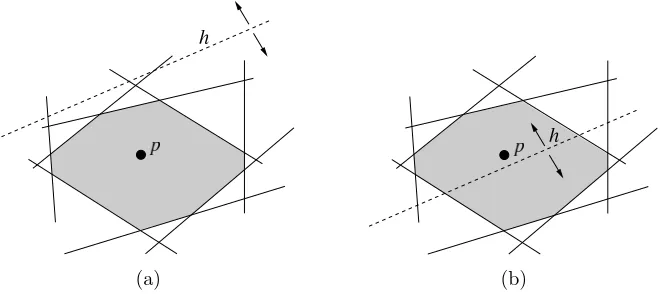
{hu,v: (u, v)∈ X }.13 The collectionC corresponds to the maximal dimensional cells in the
underlying arrangement A(H). We thus callA(H) from now on thepermutation arrange-ment, and we naturally identify full dimensional cells with their induced permutations. We denote byCπ ⊆Rd the unique cell corresponding to a permutation π ∈ C.