World Maritime University
The Maritime Commons: Digital Repository of the World
Maritime University
World Maritime University Dissertations Dissertations
2000
The training of marine engineers : present methods
and future directions in developing countries
(Africa)
Yassin Magongo Songoro World Maritime University
Follow this and additional works at:http://commons.wmu.se/all_dissertations Part of theEngineering Education Commons
This Dissertation is brought to you courtesy of Maritime Commons. Open Access items may be downloaded for non-commercial, fair use academic purposes. No items may be hosted on another server or web site without express written permission from the World Maritime University. For more information, please [email protected].
Recommended Citation
Songoro, Yassin Magongo, "The training of marine engineers : present methods and future directions in developing countries (Africa)" (2000).World Maritime University Dissertations. 397.
WORLD MARITIME UNIVERSITY
MALMÖ, SWEDEN
THE TRAINING OF MARINE ENGINEERS
Present methods and future directions in developing countries
(Africa)
By
YASSIN MAGONGO SONGORO
Tanzania, United Republic of
A dissertation submitted to the World Maritime University in partial Fulfilment of the requirements for the award of the degree of
MASTER OF SCIENCE
In
MARITIME EDUCATION AND TRAINING (Engineering)
2000
DECLARATION
I certify that all the materials in this dissertation that is not my own work has been identified, and that no material is included for which a degree has previously been conferred on me.
The content of this dissertation reflects my own personal views, and not necessarily endorsed by the University.
……….. Yassin Magongo SONGORO October 2000.
Supervised by: ……….. Mr. R. Prasad
Lecturer
World Maritime University.
Assessor: ……… Professor Toshio Hikima Associate Professor
World Maritime University.
Co- assessor: ……… Professor Kenji Ishida
ACKNOWLEDGEMENTS
Many people have been behind the success of this dissertation. It is not possible to mention each and every individual who have contributed in one way or another in this work, but I would like to take this opportunity to thank them all and express my sincere appreciation for their contributions.
I would like to convey my sincere gratitude to Professor Toshio Hikima, lecture R. Prasad, Captain F. Pardo, Susan Wangeci-Eklow, Cecilia Denne and Mr Bengt Emanuelsson for their constant advice and support in writing this dissertation.
Special thanks is to Professor Peter Muirhead who has organised the idea for the title of this dissertation.
I would like also to extend my gratitude to Tokyo Foundation for Research and Scholarships for providing me with this opportunity to study at WMU. The Ministry of Transport and Communication and the DMI for nominating my name and granting permission to attend the Master’s of Science in Maritime Education and Training at WMU.
Last, but not least, my deepest thanks to all the 2000 students, the community and people of Malmö who have made my life during the course of study at WMU peaceful and enjoyable. GOD blesses you all.
ABSTRACT
Title of dissertation: Training of Marine Engineers: Present Methods and Future
Directions in Developing Countries (Africa)
Degree: Master of Science in Maritime Education and Training (Engineering).
This dissertation is the study on technological developments, its application onboard ships of the future and its impact on the education and training of marine engineers. The roles of marine engineering practice and maintenance management systems have been briefly examined. The economics of ship operation and the role of technology in the training of marine engineers have been compared.
The growth in automation engineering and its developments in machinery space handling have changed the face of seafarers training in most part of developed world. Computers, simulators, and the information technology are increasingly replacing the traditional hands on and classroom training methodologies for seafarers of the future. The historical development of some MET systems and the development behind them have been collated and evaluated. Curricula developments have been analysed and compare with the STCW requirements.
Additionally, demands on crew reduction onboard system ships, manning
requirements, crew costs and its impact on the safety of ships have been analysed. The concluding chapters have remarked problems faced by some MET in developing countries. Financial constrains have been pointed out as the key element in the updating and developments of curricula that will determine the competency of marine engineers from developing countries. A number of recommendations on the need for the centralisation of education system, establishments of manning agency, institutional and regional co-operation have been proposed.
KEY WORDS: Impact of technology on education and training of marine engineers; Crew costs, manning and safety of ships; STCW and ILO
Requirements; Automation, maintenance management and simulator training for marine engineers.
TABLE OF CONTENTS
Declaration ii
Acknowledgements iii
Dedication iv
Abstract v
Tables of contents vi
List of Tables ix
List of Figures x
List of Abbreviations xi
1 Introduction. 1
2 Marine Engineer in the Maritime Industry 6 1.1 The Role of Marine Engineers in the Maritime Industry 6 1.2 Training requirements for Marine Engineers:
Reflection on STCW’95 Code 9
1.3 Ship owner’s responsibility in training of Marine Engineers 15 1.4 Human element (factor) in the maritime safety 19
3 The future of Marine Engineers 24
2.2.4 Workmanship Quality and the Shipboard Maintenance 38 2.3 Development in Automation and Control at Sea 39 2.3.1 Performance diagnostics in marine engineering systems 41 2.3.2 Marine engineers and the ships of the future 42
4 Modern technology in the training of Marine Engineers 47
3.1 Computer Based Training 48
3.1.2 Proto type and Full mission engine room simulators 51 3.1.3 Comparison: Hands on training and the use of simulators 53 3.1.4 Career development for marine engineers 54 3.2 Cost evaluation for the training of marine engineers 56
5 Marine Engineer’s Training. Comparison of selected countries 58 4.1 The United State Merchant Marine Academy (USMMA) 60 4.2 Kobe University of Mercantile Marine (KUMM) 62 4.3 Dar-Es-Salaam Maritime Institute- (DMI, Tanzania) 66 4.4 Maritime Education and Training in Spain 69 4.5 Maritime Education and Training in Denmark 72
6 5.0 Training of Marine Engineers in Tanzania 75
5.1 The SWOT analysis 77
5.2 Education system in Tanzania: Its impact on Marine Engineers 80 5.3 Engineers Registration Act: Registration of Marine Engineers in
Tanzania 81
5.4 The East African Co-operation (EAC): Education for seafarers 82
7 Conclusion 83
6.1 Conclusions 83
References 88
Appendices
LIST OF TABLES
LIST OF FIGURES
Figure 1 System Hierarchy 8
Figure 2 Ship’s operating costs 24
Figure 3 Maintenance Policies 32
Figure 4 The Bath Tub 36
Figure 5 Integration of ship’s Systems 44
Figure 6 Machinery Space Simulator (CBT) 48
Figure 7 Full Mission ‘Graphic’ Engine Room Simulator 50 Figure 8 Full Mission ‘Real Console’ Engine Room Simulator 51 Figure 9 WMU- Graduates in Maritime Education and Training
(1983-2000) 58
Figure 10 Maritime Education System in Japan 64 Figure 11 Engineering Course Structure at DMI
(Year 2002 Projection) 66
LIST OF ABBREVIATIONS
A Advanced (Secondary Certificate). AB Able Bodied (seamen).
ACTME Advanced Certificate of Technology (Marine Engineering). ADME Advanced Diploma in Marine Engineering.
ADTME Advanced Diploma of Technology (Marine Engineering). AMC Australian Maritime College.
B&W Bermuster & Wein.
BIMCO Baltic and International Maritime Council. BSc Bachelor of Science (degree).
CBT Computer Based Training.
CD-ROM Compact Disc-Read Only Memory. CMO Certificate in Marine Operations.
CORLEG International Convention for Colition Regulations
DK Danish Kronor.
DMA Danish Maritime Authority. DMI Dar-Es-Salaam Maritime Institute. DMTU Dar-Es-Salaam Maritime Training Unit. DOC Document of Compliance.
DPC Dual Purpose Crew.
Dr. Doctor.
E Engineer(ing).
EEZ Exclusive Economical Zone.
EU European Union.
GMDS Global Maritime Distress Safety System.
IACS International Associations for Classification Societies
IBC-Code International Code for Ships Carrying Dangerous Chemicals in Bulk
ICERS International Conference on Engine Room Simulators. ILO International Labour Organisation.
IMCO Inter Governmental Consultative Organisation. IMO International Maritime Organisation.
IOPP International Oil Pollution Prevention ISF International Shipowners Federation ISM-Code International Safety Management Code. ISO International Standards Organisation ITF International Trade Federation.
KUMM Kobe University of Mercantile Marine.
MAPEX Maintenance Performance Enhancement with Expert Knowledge. MARPOL International Convention for Prevention of
Pollution from Ships.
MEPC Maritime Environmental Protection Committee. MET Maritime Education and Training.
MNOAT Merchant Navy Officers Association Of Tanzania. MSC Maritime Safety Committee.
MV Motor Vessel
N Nautical.
NGOs’ Non Governmental Organisations. NI National Insurance.
NIT National Institute of Transport. NKK Nippon Kaiji Kyokai
NO Nitrogen Oxide
NORAD Norwegian Agency for International Development. NSD New Sulzer Diesel
O Ordinary (Secondary Certificate). P&I Protective & Indemnity.
PM Preventive Maintenance.
PMS Preventive Maintenance System. PPT Propulsion Plant Trainer.
PR People’s Republic (of). Prof. Professor.
PSC Port State Control.
RCM Reliability Centred Maintenance. DEREL Diesel Engine Reliability Database.
S Super long Stroke
SMC Safety Management Certificate.
STCW International Convention for the Standards of Training, Certification and Watchkeeping of Seafareres.
TACOSHILI Tanzania Coastal Shipping Line.
UK United Kingdom.
U United Nations. US United States.
USCG United States Coast Guard. USD United States Dollar.
USM Unattended Machinery Space.
USMMA United States Merchant Marine Academy. WMU World Maritime University.
XII 13th (Century). XIV 14th (Century).
Yrs Years.
THE TRAINING OF MARINE ENGINEERS
PRESENT METHODS AND FUTURE DIRECTIONS IN DEVELOPING COUNTRIES (AFRICA)
Introduction
The operation of merchant ships is becoming more specialised and complex following fast technological developments in this ‘science and technology’ arena.
Engineering of today is based more on automation, computerised operations and monitoring in terms of equipment design, performance and maintenance.
Traditionally, monitoring was based on manual ‘hands on’, where a piece of machinery equipment were to be striped off for inspection and determination of its life time by visual inspection and physical measurements. Compression (piston) rings, for example, were to rely on the engineering experience of the personnel on board and or the manufacturer’s instructions before they could be opened up for the necessary actions. Manual operations for equipment on board were an ideal traditional engineering practice. Time and cost was not an important element in shipboard operations because labour was relatively cheaper.
The development in automation engineering and the application of computers onboard has brought a number of changes in terms of maintenance policies to be applied and the necessary manpower to be employed. Changes in the world economy have an influence over management and operation of ships today. The manning requirements shows every indications to be in favour of ship owners who, regard less of size, wants to operate their ships with the smallest possible the number of crew. The author may suggest that the move in the increasing application of computers and automation onboard ships has been influenced by ship owners in trying to cut down ship operating costs, in particular crew costs. What impact this new science and technology has over the future of marine engineers in the shipping industry?
Traditional marine engineers were basically trained to serve on board as watch keeping officers. The developments and changes that are taking place in the shipping industry to day, training should also focus on other maritime related aspects both ashore and afloat. Flexibility in the training and education of marine engineers in developing countries needs to be reviewed in order to give competitive opportunities to other engineering and production industries ashore.
Everett. C. Hunt and Boris. S Butman, of the United State Merchant Marine Academy, addressed the training of marine engineers as, “Marine engineers to day are required not only in ship’s machinery operations, but also in decision making, ship design and research. They must be able to address qualifications of risk and uncertainty and make optimal use of resources including labour, material, capital and technology, and to apply effectively the techniques of engineering economics and cost analysis. This is because:
• Ships today cost more each year in absolute terms due to large size, greater complexity, and improved in high technology. • Ships are becoming less flexible in terms of employment as trade has become more segmented by speciality tonnage.
requirements.
• Financial resources, the life blood of capital intensive shipping, have become more difficult and costly to obtain.”
However, such developments have increased demand for technically trained personnel in the maritime industry in order to qualify for these changes. Marine engineers of the early days in the last century were basically trained on ‘hands on basis’. It was not until the early 60’s where formal training was looked as a vital process for efficient operations of machinery in merchant shipping.
Safety considerations, local and international regulations, have an increased pressure in the education and training of marine engineers who are required to work according to these requirements. The adoption of the 1971 Assembly Resolution A.248 (VII) under the then IMCO (Inter Governmental Consultative Organisation), through the conference held in London (14th June to 7TH July 1978) was the beginning of the appreciation on the importance of the formal training for the world seafarers. The objectives were to come up with uniform standards, and bring qualified personnel to a uniform level for the safety of operations and for the prevention of pollution of marine environment from ships.
The standards of Training, Certification and Watch keeping, STCW78, came into effect globally and entered into force on 28th April 1984. These guide lines, which were to be applied to all member States upon ratification and being merged into their national laws (implementation), set up a new mile stone for the appropriate training of marine engineers as indicated in Chapter III, Reg. III/1 through Reg.III/6 of the Convention.
A substantial part of this work will base on the author’s past professional experience as a marine engineer (from developing county in Africa, Tanzania to be specific), and as a lecturer in a maritime institute. Particular empathises will be directed towards the role and training of marine engineers, present methods and future directions as will be analysed through chapter I. Technological developments, ship owner’s responsibilities, maintenance management and the requirements from the International Labour Organisation (ILO), will be discussed in chapter II, looking closely to the future of marine engineers.
The application of modern technology in the training of marine engineers, Computer Based Training (CBT), simulator training, use of distant learning and their effects over the traditional ‘hands on’, will be discussed in chapter III. Chapter IV will analyse training methods, curriculum development and entry requirements from selected maritime institute, colleges and or universities from developed countries and make comparison with similar institutions in developing countries in Africa. The author, on the experience gained from field studies visited to maritime institutions, maritime administrations and maritime industries, ship building and ship research institutions as well as some few land based production industries, has realised that there is a potential need for readjustment of curriculum for METs’ in developing countries. The new curriculum should absorb not only the STCW requirements, but also improve academic qualities and qualifications for marine engineers in order to provide flexibility in employment opportunities and give them the real competency to face the challenges of the future.
It is therefore hoped that the contents of this work may highlight the problems in the educational structures for the training of seafarers from developing countries so that any identified weakness could be changed into opportunities. Curriculum development in MET institutions from Africa need to be restructured to move in pace with technological and economic changes which are taking place at a global level. The training of marine engineers should focus into other maritime related sectors. However, the idea of institutional and regional co-operation towards training and educational enhancement, on cost effectiveness and the appropriate utilisation of human resources, should be looked by maritime administrations at all levels. The source of success toward achieving the international standards as set up in the STCW’95-Code, should aim at institutional and regional co-operation.
CHAPTER I
Marine engineers in the Maritime Industry.
1.1The Role of Marine Engineers
No ship is any better than her marine engineers on board and on shore. The safety and the efficient operation of any ship, despite the advancement of technology, rest entirely on the hands of marine engineers. Safety and pollution prevention from ships has been, and will continue to be the main objectives of the IMO. Ship’s safety of operation lies on the reliability and maintenance management of equipment on board, various cargo handling gears and that of communication facilities.
Traditionally, marine engineers were needed on board only for operational purposes and as such the economic conceptions in total operating cost and design criteria (in reducing this vital part of the total ship cost), was left to shore based and ship yard personnel. The regulatory regime set up in different IMO’s Conventions over the last thirty yeas now, were all aiming in improving the safety of ships and the prevention of pollution of marine environments. The improvisation of laws, recommendations and protocols into national legislation system, were not (and still a practice for some countries today) effective because there were ignorance to the severe impact on safety and economical consideration to their society and the international community. Why bother, for example, ratification and implementation of SOLAS74 or MARPOL73 and its Protocol of 1978, while the country has no ships qualifying in to these IMO regulations!
The consequences of these un forgettable catastrophes have influenced the IMO to come up with strong and comprehensive regulations in a move to prevent its repetitions. The STCW’95 is centred towards improvements in the management of ships operations in bringing the safety standards to the highest level. Today, many countries have ratified most of IMO’s Conventions, but to some, implementation is still questionable.
The suffering caused on one hand laid on the engineering technology of the day, human factor and other an avoidable saccumstances. Marine engineers, in co-operation with engineering professional, has a great role to ply, in ship design, research, ship building and the development of various maintenance management in the promotion of safety and the prevention of maritime casualties. Ships must operate efficiently, safely, reliably and environmental friendly in order to achieve the objectives of ‘Safer Shipping and Cleaner Oceans’.
The concept of economical operation, safety and prevention of pollution of marine environment from ships is one of the major concerns of marine engineers all over the world. The progressive development of different operational and maintenance phenomenon, from traditional manual to automation engineering was put in practise. Today, computerised systems on board are becoming popular. The maritime society, ship owners, ship managers or operators and all others interested in maritime transport have witnessed the advantages of these technological innovations. Fast turn round, minimum running cost, and fast return of initial investments, gave ship owners opportunities to remain competitive in maritime transport. More important is that of safer shipping and cleaner oceans.
To give an aidears on some of the roles of marine engineers to day, consider a ship as a system and as a mode of reliable transport in the global economy.
The proceedings of a conference (7-8th June 1971) of the Institute of Marine Engineers, on the ‘Factors in the selection of marine machinery and plant with particular reference to reliability, maintenance and cost’, mentioned that; “A system may be defined as an array of interacting components which co-operate purposefully in order to accomplish a defined objective.”
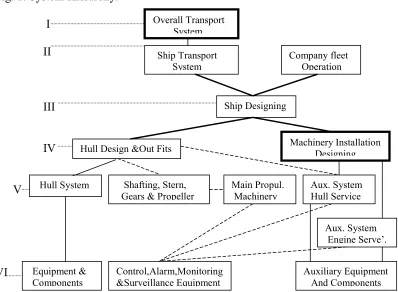
The following organisation chart may give a clear definition of the system and the way components interact to accomplish a desired objective.
Fig. 1. System Hierarchy.
I II III IV V VI
Source: Proceeding of a Conference 7/8 June 1971. Institute of Marine Engineers, London, United Kingdom.
Referring to figure 1 above, a ship is a complex system comprising individual components as indicated. The complete system should comprise all components,
Overall Transport System Ship Transport System Company fleet Operation Ship Designing Machinery Installation Designing Hull Design &Out Fits
Hull System Shafting, Stern,
Gears & Propeller Main Propul.Machinery
which interact with one another in a rhythmic manner to accomplish the desired function. At level III, it is sufficient generally to say that, the design of both ships’ hull including outfit, machinery installation including main propulsion, auxiliaries, control, and alarm and monitoring are the vital elements for a sea worthy ship. Marine engineering practice should strive to ensure that, the design, as the backbone of the whole entire system complies with the need and the safety standards. A failure of one component means a collapse of the whole system. The conference further highlighted that; “A central feature of the system design process is optimisation, i.e. the design of a system in such a way that it achieves the objective most efficiently.” Public concern over maritime activities and their impacts on human health, living organisms and the Green house effect, are the challenges putting marine engineer at their tore. Therefore there is a need to develop comprehensive research to meet the requirements of today’s world regulatory regime.
1.2 Training requirements for Marine Engineers and the revised STCW’95 Code.
When we talk of ‘sea worthiness’, a common man might suggest that, it is the construction of a ship to the highest standards. Perhaps under the ISO quality standards or that set by the International Maritime Organisation (IMO), and if he may be lucky, he may think of that of Classification Societies. Today the worthiness of the ship will mean more than this.
competent personnel on board. It is this competency of management ashore and crew onboard that will determine the quality and the degree of safety in the maritime transport sector. Empathising the subject, the International Safety Management Code (ISM-Code) was adopted by the IMO through Assembly resolution A741 (18) on 17th November 1993 and entered into force on 1st July 1998. The requirements through this Code has been made mandatory for passenger ships, high speed passenger crafts, all types of tanker, bulk carriers and all types of high speed cargo crafts above500 gt. The Code will be made mandatory for all other ships by 1st July 2002.
The Code basically deals with people on whom compliance to the safety standards depend upon and gives a substantial contributions in trying to solve the major problems the shipping industry has had for years in dealing with safety and marine pollution prevention.
Like wise, the International Convention on the Prevention of Pollution from Ships, refereed to as MARPOL73/78, Annex I through VI, has defined different measures to be taken, through various regulations contained in it to ensure ships operate safely and environmental friendly. A new Annex, (Annex VI), under this convention was adopted by the Conference through the protocol of 1997 which set out Regulations for the ‘Prevention of Air Pollution’ from ships. A technical Code on the control of emission of Nitrogen Oxides (NOx) from marine diesel engines was also developed.
The importance of these IMO Conventions and the Regulations set up within them reflected the need of having competent, trained seafarer to serve onboard merchant shipping.
safety legislation, including statutory certificates of competency (but no provision for training) in the middle of the last century.
At the global level, the International Labour Organisation (ILO), the ‘officers’ competency certificates Convention (No53) of 1936 required masters, chief engineers and officer in charge of a watch to be certified by competent authority, but on the other hand did not establish an international standards of competency.
This came with the STCW’78 following major international conventions on Load Lines (69), avoidance of collision regulation CORLEG (72), safety of life at sea (SOLAS74) and the prevention of pollution from ships (MARPOL 73/78). Now virtually all national merchant shipping legislation is based on international conventions with majority from developed countries exceed these limits.
A joint committee on Training was established in 1964 by the governing bodies of ILO and IMO’s Maritime Safety Committee. A Document for Guidance 1964 on the education and training of masters, chief engineers and seamen on the use and operation of instruments, machinery and equipment’s contributing to safety at sea was prepared.
In 1971 the IMO Council requested the MSC to give urgent consideration to the matter which resulted in the establishment of the Sub-Committee on Standards of Training, Certification and Watch keeping for seafarer which was finally adopted through Assembly resolution A248 (VII) of 15th October 1971. The Convention entered into force on 28th April 1984. This was a new mile stone for the global standards on the training of seafarer.
lecturers, assessments and certification procedures was finally interpreted to the ‘satisfaction of the Administration.’ Changes in the world economy, open registry policy, lack of human resources and commitment from Maritime Administration, especially in developing countries created differences in interpretations, which undermine the effectiveness of the STCW78 Convention.
Strict regulations and crew cost in some developed countries, saw the ‘open registry’ as a valuable opportunity to continue develop their (ship owners) economies and therefore exploited the weaknesses of the STCW. The global standards, which were the concept of STCW78, could not be achieved.
The weaknesses of the STCW78, the global economy, technological developments and crewing demand from ship owner’s standpoint, shipping disasters and pollution incidents in the late 80s’and early 90s’, gathered ideas from member states, on the consideration of a comprehensive review of the STCW. The MSC therefore, established a Sub Committee to work on a draft proposal in 1992. Finally a new code (STCW’95 Code) to the Standards of Training, Certification and Watch keeping for seafarers was realised in 1995 and came into force in 1st February 1978. The Code replaced the original annex to the convention but the original article was left intact. The aim of the amendment which resulted into the STCW Code were:
→ To establish a well balanced set of verification and control mechanism which will ensure that parties take all appropriate measures to give full and complete effect to the convention requirements.
and complete effect to the convention and therefore introduce accountability between them.
→ To clarify the skills and competency requirements.
Part A of the STCW Code have recast the fundamental knowledge requirements of the STCW78 in tabular form, competency function, methods and criteria for demonstration, and evaluating competency have been high lighted.
→ To transfer all the technical matters to the associated code which would facilitate up dating or amending the existing one, as indicated in part A and guidance on their application in part B of the code.
This may facilitate uniform interpretation on the training and competency requirements of the code.
Training of marine engineers (part A, chapter III of the code), for chief/second engineer officers and rating forming part of engine room crew, the author of this dissertation have a point to comment. The concern is on the mandatory requirements (part A chapter III) and the recommended guidance regarding provisions of the of the STCW Convention and its annex (Part B Chapter III). The following are observations to comment:
(a) Engine room simulator(s)
problem of sea service for many young engineers from developing countries has been identified as a stumbling block for their carrier progress. The resulting out come will be a severe shortage of competent seafarer, which is already existing in some part of the world. Full mission engine room simulators may be well applied to give a feeling of the real life on board and hence complement the large part on the interface in the effect of practical and the theoretical requirements. It may also keep the maritime institutions flexible to accommodate and be in readiness to comply with changes and amendment such as STCW Agenda 31. The agenda discussed among others, the validation of model training courses content (item 3- use of computer based assessments was recommended). This is an example of the changes that are due to take effect in the near future. Quality of seafarers from developing countries will for sure depend on the capacity of their maritime institution.
(b) Use of communication facilities. (Res. 697(17)).
At a managerial level a chief/second engineer officer should be in a position to use bridge equipment for communication purposes. Equipment such as GMDSS or Radial Telephony should be familiarised to at least two most senior engineer officers such that they may be able to use them under distress condition. Revelling to this point is a story with the title; A SHARK CAUGHT BY CREW BITES BACK. It says; “A Shark almost finished off all but one of the crew of the cargo ship Mint Quick. Not because it ate them, but because they ate it. Severe food poisoning struck down 10 of the 11 crew after they consume a shark they had caught earlier in the voyage says a report in the Numast Telegraph. That left the vessel steaming along off the Virgin Islands at 12 knots with only one inexperience crewmember on the bridge.
This statement should refer to Table A-III/2, column 1&2 about (a) The use of internal communication systems and (b) Operation of all internal communication systems onboard. It was not pointed out the use of other communication facilities in particular during distress conditions like one of the shark story. One may assume that the knowledge is included, should the dual-purpose is applied in the training process, but experience has shown that its effectiveness have low probability. The experience may prove that, the attitude of marine engineers at managerial level is not more than the concentration on their engineering practices. If they are involved in the safety management onboard, the participation will be on all others except distress communications.
The traditional reactive attitude applied to amend Conventions should switch over to a proactive before it is too late. IMO should not turn a deaf ear into this problem as its consequences may result into surprises!
(c) Refrigeration and Air conditioning
Table A-III/2, column 1, of the Code should emphasise about the subject above. Ship owners may bear with the author of this dissertation that, with the increasing demand in reefers and refrigeration containers in maritime transport, competency in refrigeration and air conditioning engineering is gaining more importance. It could be one of the ways, like in the dual-purpose practice, of reducing unnecessary number of engine room crew. On the other hand the knowledge may increase flexibility to marine engineers and provide more employment opportunity as far as to shore based industries.
1.3Ship owner’s responsibility in training of marine engineers.
after all, is a necessary combination of the procedures operating on their ships, in their management structure, on the certificates to be issued to their ships and company DOC and SMC. The STCW frankly, does not seem to be some thing that is of too far much direct concern to them.
Should they happen to pick up and open the STCW’95-Code, they will quickly at the section dealing with company responsibility and, in many cases they would say; Well, we are dealing with this under the ISM-Code any way, the rest of it is for some one else to worry about.
Ships’ registration by Classification Society, is a statutory requirement before being accepted by Flag Administration. That is the ship shall have a valid certificate from a recognised classification society before issued with mandatory certificates from the Administration. These certificates include Passenger ship safety, cargo ship safety construction, cargo ship safety radio, load line and more others that are relevant for granting permission and endorsed by the Administration, to operate as within the specification it was constructed for.
Flag Administration has the responsibility to survey and ascertain compliance with relevant mandatory requirements to a ship before she may be issued with the appropriate certificates mentioned above. Some Administrations may (have) delegated some or all of the survey responsibilities to class societies for which ships’ certificates may be issued on their behalf.
There is obvious a common link between class societies, Flag Administrations and ship owners on issues concerning safety of ships and all that is in her, in addition to prevention of pollution of marine environment.
Due to some differences in standards among classification societies, some ship owners took to advantage and preferred to work with societies with least requirements. This way a number of substandard ships were found in the maritime industry with the consequences of accidents and incidents which resulted into losses of lives, properties and the pollution of the marine environment.
top of the PSC, ship owners must comply in order to remain into a competitive maritime trade.
To ensure global standards on maritime safety and pollution prevention, IMO developed an International Safety Management Code (the ISM under SOLAS chapter IX) which was adopted through Assembly Resolution A596 (15) in 1987. It all concerned about shipboard and shore based management to ensure safety operations of ro-ro passenger ferries. Two years later (1989), guide lines on management for safe operation of ships and for pollution prevention was adopted (Assembly Resolution A647 (16)). Subsequent amendments took place through Assembly Resolutions; A680 (17) in1991, A741 (18) in 1993 and finally Assembly Resolution A788 (19) was adopted by IMO on recognising the need for uniform implementation of the ISM-Code. It requires Administrations to enter into agreements in respect of issuance of certificates by other Administrations. The ISM-Code has been made mandatory and entered into force on 1st July 1998.
Regulation 6 of the ISM-Code has been mandated to carry out verification and control of all the mandatory requirements though Port State Control, on safety issues and pollution control, and today, manning and crew certification as required by STCW become mandatory (STCW95-Reg. 1/14).
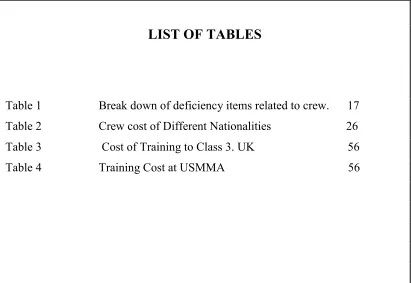
Breakdown of deficiency items related to crew. Table 1.
Deficiency Items No of Deficiencies
Certificate of Competency
30
Number/Composition (Safe Manning)
7
Medical Certificates 5
Sub-Total 42
Source: Annual Report on Port State Control 1998, NIPPON KAIJI KYOKAI Tokyo, Japan.
Chapter III, Part A of the STCW95 Code elaborates mandatory requirements on Standards regarding the engine department. In the training process for a marine engineer in charge of a watch in manned engine room, or designated duty engineer on a periodically un manned engine room, the onboard training has been emphasised. The knowledge, understanding and proficiency together with the methods for demonstrating competency have been indicated in column 2 &3 respectively.
Many maritime institutions in developing countries do not possess training vessel(s) in order to accomplish practical training process. Neither do they have engine room simulators that could be used to bring the interface on theoretical and practical training. In appreciating that developing countries will continue to be the great suppliers of seafarers in the world, a potential contribution from ship owners here becomes eminent. To provide birth onboard their vessels for training purposes not only will enable a candidate to cope with his/her training requirements but also will enable ship owners to comply with the requirements of the ISM-Code. The link between various regulatory bodies, i.e. the ISM-Code, STCW95-Code and the Port State Control dedicates the responsibility to both parties. That is to say training of marine engineers is the concern of Maritime Administrations, ship owners and shipping companies as well as the maritime institutions.
having the same goal. The STCW requirements regarding this aspect could be integrated and documented into the procedures and requirements of the safety management system. When the company has implemented and is operating a formal training system within its ISM, it would hardly be practical to maintain voluntary company training outside the scope of the ISM. The STCW Convention now shifts a major part of the responsibility for competency building related to professional
certificates over to the shipping companies, as more and more of the training of marine engineers are to be done in-service. It follows therefore that, Maritime Administrations in developing countries should dedicate their responsibilities in the training process ever been before. The consideration in shipping manning costs, requirements of the STCW-Code and the ISM-Code should establish a balance for the appropriate safe manning of the ships of the future.
1.4Human element (factor) in the maritime safety.
Over the last few years, the term human factor or human error was realised as the root cause of many accidents and incidents that have occurred in the maritime industry. The studies on different accidents that have been reported, revealed that human factor contributes to over 80% of the cause of accidents worldwide.
Human element (factor) is a complex phenomenon in terms of safety and prevention of pollution of marine environment. The author of this dissertation will not go into details of it but intends to indicate the interaction between training and education and the human element in the maritime industry.
The concept of human factor can be maintained and rectified in some way, but we should realise that;
It is all about people,
It is about people in their working and living environments,
It is about their relationship with machines and equipment, with procedures and the environment about them,
And it also about their relationship with other people.
Dr. Per Byrdorf of the Institute of Aviation Psychology of Denmark, in his presentation at the 3rd International Conference on Engine Room Simulators, held at Svendborg Denmark (26th to 30th May 1997) explained that; “After many years with focus upon technical faults and pilot errors, commercial air line companies and air force had to come to realise the importance of focussing upon human element, because it was found that three out of four air craft accidents were due to what was called human failure of one kind or another. One of the milestones in aviation Human Factors may be seen as the recognition that basic education in Human Factor was needed through out the industry. Therefore the air line industries, back in the seventies, began to focus on training of Human Factors principles and psychological subjects such as information and processing, communication, decision making, human performance and limitations were introduced.
The above comments indicates the concern and the commitments from management to the operation level at all disciplines regarding the human factor and the air lines safety issue.
may create fatigue, which generally impairs performance, misleading in decision making and finally catastrophic disasters.
Dr. Per Byrdorf further giving an example that; “Some disasters at sea are results of old fashioned leadership style. The officers either on the bridge or in the engine room do not dare to give their opinion of the situation because they knew that the captain or the chief engineer would not tolerate interference in their leadership. This kind of social interaction will often lead to incidents and accidents. The captain or the chief could also be over confident and think that he/she is invulnerable, so he/she does what he/pleases. So it was at the Tenerife accident some 25 years ago, where the captain of a Boeing 747 took off without authority from the Air Traffic Controller, and the first officer, having once already told the very much more senior pilot, he did not have the courage to intervene a second time. They hit another Boeing 747 at the run way and more than 500 people were killed.”
It has been a common trend onboard merchant ship, to find a captain or a chief engineer who does not wish to entertain ideas from their immediate junior officers for reasons similar to the one explained above. However, the increasing demand from ship owners, in favor of fewer crew onboard their vessels, and the technological growth for modern ships to day should not be left without being discussed. Why? There are two things to consider. The relationship between a man and his working environment. Firstly, is there any interaction between his ability to command the environment at his working place? The joint session of MSC/MEPC working group on human element and the formal safety assessment realise that, as fatigue increases, the brain of a human being appears to fall asleep involuntarily, against his will, especially, not exclusively, when his/her performance demands involve sustained attention and monotony. Thus the effect of fatigue on performance are based in changes in brain function.
Regulation III/1 of the STCW95-Code deals with fitness for duty, and has set up a minimum mandatory standards thus; “Each Administration shall, for the purpose of preventing fatigue:
(ii) requires that watch keeping are so arranged that the efficiency of all watch keeping personnel is not impaired by fatigue, and (iii) duties are so organised that the first watch on the
commencement of a voyage and subsequent relieving watches are sufficiently rested and otherwise fit for duty”. This implies that with fewer number of crew on modern ships today, there are likely chances to cause fatigue because this phenomenon may be a result of several reasons. Some of them have been identified as overloading, motivation, working environment, over aged personnel, poor management and lack of skill and knowledge.
Secondly are the socials needs and demand has any relation to the nature of duties at sea? The problem of fewer crews onboard may have a psychological impact in particular when the integrity of mixed crew is taken into consideration. Loneliness, different culture and lack of social integration may result into fatigue of its own kind and hence impair ones performance. Fatigue affects the ability to judge various things and may easily interact the good will of an operator resulting into accidents.
The empathise pointed out from SOLAS74 Chapter IX, on the management for safe operation of ships, which came out with the ISM-Code, will have more than one thing to do with regard to human factor. The ISM-Code has pointed out all what the shipping company need to be. The possession of valid DOC (reg. 3 par. 1 &2) and that Administrations shall issue the Safety Management Certificate on verifying that the company and her ships comply with the safety management system. A more concern to the ISM and the Administration is to establish clear definitions on how human factor training could take its position within the safety management system. The objectives for human factor training programme should be the philosophy for the crew resource management in:
(a) training of crew to recognise their own limitations.
(b) working relations among them selves including out side agencies.
(d) develop safety culture among the crew and shore based personnel.
CHAPTER II
2.0The future of Marine Engineers.
The world is experiencing drastic changes in engineering technology for the last half a century. Production industries, manufacturing companies and even the service industries have appreciated the innovations in automation engineering. Machines such as robots and computers have been gradually replacing men in various activities. Machines can work longer, and if well programmed, more efficiently and hence could give high production at reasonably lower cost. Energy industries are striving to produce more at low inputs for high profits on the output. Shipping industry is of no exception. In order to remain in a competitive shipping market, every effort has been deployed to reduce the running cost, but as it was mentioned in the introductory note of this dissertation, ships today are more costly in absolute terms and that financial resources are more costly to obtain. The technological innovations in shipping industry have influenced a relative company restructuring. Companies are becoming bigger through merging, joint venture and alliances for the purpose of cutting down cost. There is a centralisation in keeping companies by down sizing number of staff due to technological development through which human being are replaced by machines such as computers.
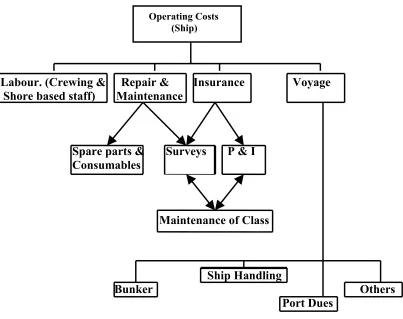
A general lay out of ship’s operating cost is indicated in figure 2 below. These costs may take different shapes according to the company policy and type of trade. For example containers, bulkier, oil tankers, passenger ferries etc, but in general, covers the major items as indicated.
Fig. 2. Ship’s operating costs.
Labour. (Crewing & Repair & Insurance Voyage Shore based staff) Maintenance
Spare parts & Surveys P & I Consumables
Maintenance of Class
Ship Handling
Bunker Others
Port Dues
According to Professor (Dr) Ma Shuo, of the World Maritime University, on his lecture on Maritime Economics, he pointed out that; “How can ship be in operational condition? First of all the ship should be technically fit and operational. This means that the ship has to be manned. A ship is still a complicated machine, which require full team of crew to operate it day and night. This includes a Captain, Chief Engineer
and other officers and seamen. The ship must also be maintained and repaired to be in a good operational condition or to be always sea worthy.
Secondly, as the ship operational involved risk activity and exposed to big accident possibilities, ships count for huge amount of capital investment.
To be financial and commercially operational, the ship needs to be covered by proper insurance. Consequently, shipping operating costs should include all the above mentioned expenditures namely labour cost, repair and maintenance costs and insurance costs.”
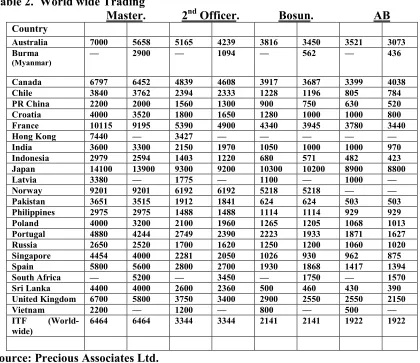
To give an aidea of scale about crew costs, refer to table 3 below.
Crew Cost of Different Nationalities Typical Rank Berth Cost-USD Per Month
(Includes basic wages, leave, overtime and Provident Fund, where appropriate)
Table 2. World wide Trading
Master. 2nd Officer. Bosun. AB Country
Australia 7000 5658 5165 4239 3816 3450 3521 3073
Burma
(Myanmar) — 2900 — 1094 — 562 — 436
Canada 6797 6452 4839 4608 3917 3687 3399 4038
Chile 3840 3762 2394 2333 1228 1196 805 784
PR China 2200 2000 1560 1300 900 750 630 520
Croatia 4000 3520 1800 1650 1280 1000 1000 800
France 10115 9195 5390 4900 4340 3945 3780 3440
Hong Kong 7440 — 3427 — — — — —
India 3600 3300 2150 1970 1050 1000 1000 970
Indonesia 2979 2594 1403 1220 680 571 482 423
Japan 14100 13900 9300 9200 10300 10200 8900 8800
Latvia 3380 — 1775 — 1100 — 1000 —
Norway 9201 9201 6192 6192 5218 5218 — —
Pakistan 3651 3515 1912 1841 624 624 503 503
Philippines 2975 2975 1488 1488 1114 1114 929 929
Poland 4000 3200 2100 1960 1265 1205 1068 1013
Portugal 4880 4244 2749 2390 2223 1933 1871 1627
Russia 2650 2520 1700 1620 1250 1200 1060 1020
Singapore 4454 4000 2281 2050 1026 930 962 875
Spain 5800 5600 2800 2700 1930 1868 1417 1394
South Africa — 5200 — 3450 — 1750 — 1570
Sri Lanka 4400 4000 2600 2360 500 460 430 390
United Kingdom 6700 5800 3750 3400 2900 2550 2550 2150
Vietnam 2200 — 1200 — 800 — 500 —
ITF (World-wide)
6464 6464 3344 3344 2141 2141 1922 1922
Source: Precious Associates Ltd.
South Africa, may well represent African continent under this race of crew costs according to nationality, and in comparison on monthly payments of say an AB, it
are cheaper. However, in order to protect the indignity of people from developed countries, a great number of ships are still flying flags of their original nationality. A policy towards second registry, as already established in some of the European countries, gives more attractive environment for a return of national flagged ships. The high labour costs of shipboard officers and crew from developed countries could be assumed to be one of the reasons that made ship owners to come with strong requirements on reduced manning level. One of the alternatives has been directed towards the developments in computer and automation engineering for shipboard operations.
Japan is the most advanced country in shipboard engineering technology and as such they have proved that it is possible to have a zero manned ship(s).
This doesn’t mean that ship owners will refrain from flying their ships under the open registry, the practice will take too many years to change.
Most shipping companies will experience multination flag in their fleet, mostly from developing countries. Panama, Liberia, Bahamas and Honduras, are the traditional foreign flag nations. The concept of trade liberalisation under reform in many developing countries may expect to bring more foreign ships flying flags from many numbers of African countries in the near future. The African continent has a lot of potential in the supply of the world seafarers should the maritime education and training be re-structured to meet the acceptable international standards.
A study carried out by the author of this dissertation during field trips in Europe and Japan, have revelled that there is a growing trend for they would be marine engineers (and other seamen in general) of loosing interest with the carrier at sea. Attractive working environments on land based industries has become an alternative for seafaring carrier.
It is quite important for those who work in the maritime transport to know and fully understand that people do not need shipping they need trade. Shipping become interesting just because it is part of trade chain.”
There is no inherent failure in maritime industry, but the environment that provides depressed freight rates, and in some sectors, extensive unemployment of tonnage will be determinant factors for ships manning requirements in the future. How much an average size of crew onboard for economical operation and for the safety consideration? This will incorporate a lot more to design criteria, technical innovation, the demand in trade, but more important, safety in ships operation. We have to accept changes rather than find it imposed upon us by economic necessity. A balance at this point should compromise with safety issues.
Once again, consideration should be made on how to determine a realistic manning level. Comparisons of manning are very difficult, bearing in mind the multitude of ship types and sizes.
Beyond the construction of ship and her engine(s), is the trade to which she is committed and the voyage length. A self-maintenance should gain priority for both economic and safety consideration. There is a considerable difference between a ship on a fixed voyage, with spare facilities at both ends, and a world-wide trading ship. There is a need to determine the maintenance policy and the extent at which, the manning will have to allow for the ship’s upkeep. It may well prove either necessary or cost effective to carry a number of engine crew sufficient to cover all or proportional for up keep and maintenance. Maintenance policies will be discussed at a later stage.
2.1The International Labour Organisation.
The International Labour Organisation, is the United Nations Agency, which deals with the rights of workers of different categories. Seafarers are among the targeted groups. Like any other UN agency, ILO has been establishing Conventions and recommendations to be followed by member states upon ratification. The objective of these various conventions is to establish balance in various elements between employers and employees in their working environment. It is not intended to mention every ILO conventions and elements contained it them, but for the purpose of this dissertation, few conventions relating to seafarer’s basic requirements, in particular working environment will be discussed.
While IMO puts more emphasis on human element, seafarers and safety through STCW’95-Code, Regulation VIII/1- ‘Fitness for duty’, and Regulation VIII/2-‘Watch keeping arrangement and principles to be observed’. The ILO have long being, establishing conventions on seafarer with regard to minimum manning level, wages, certification of marine officers etc. The 1926 Article of agreement Convention C22, which came into force on 4th April 1928, has a reflection on crew motivation. It may be looked at as a competency of its own kind. It requires a clear understanding by crew, the rights and obligation for the duty or duties assigned to them and more concerned is the number of crew the ship is going to carry, type of trade and voyage, (Article 6-sect 3(4), (5), (6) and (10)). Experts in maritime transport have identified that:
Competency + motivation = safer shipping.
and physical abilities. (See Annex… efficiency/time relation). How far practically these instruments may become effective?
Legal processes in some countries, inflation and down sizing of government departments render ineffectiveness to these conventions. Political considerations have witnessed a great amount of technical assistance from various UN agencies, NGOs’ and alike, fail to benefit targeted sectors or groups from the advice and assistance provided because of bureaucratic inertia. The advice not being appreciated by those with authority to take action, or being appreciated only by those without authority to take appropriate action. The barrier will continue to exist with an element of corruption, irresponsible and lack of human resources in some Administrations.
2.2Ship board Maintenance and Cost Effectiveness.
Much has been discussed about training of marine engineers, their role in the maritime industry with some view on the manning of modern shipboard engine rooms. The subject of safety, manning and competency of marine engineers may well come to a balance with economical consideration in ships operations. Ships of tomorrow may require lesser and lesser crew on board, but how effective the idea is, depends on the maintenance policy in practise. Researchers, maintenance managers and experienced chief engineers with varying degree of success, have proposed varieties of maintenance policies. The effectiveness of any chosen style of maintenance may be based on many factors, but the economy of shipping companies and the safety consciousness will dictate the best policy to be applied.
carried out on the basis of running hours and as a result, and in some cases company policy was overriding decisions from chief engineer(s) on the effective maintenance periods. The reliability of equipment was therefore questionable. Failure of fuel injection equipment for example, or a burnt exhaust valve, or a failure of lubricating oil system at sea may present distress and possible consequences to the safety of ship and the marine environment. Sufficient number of marine engineers was required to manage and restore the situation, but the economical pressure is bringing down this number to the size that might not be capable to cope with the situation.
However, to day’s labour, even a sailor is more expensive than engine parts. Therefore it is more economical to shift to the maintenance systems which are more cost effective, to avoid unnecessary down time, and make use of possible fewer crew for the safety of ships.
Maintenance can be briefly defined as any activity carried out on an individual component or a system in order to keep and maintain its reliability and availability. That means, to maximise the probability of a device to perform its purpose adequately under stated conditions for the period of time intended. To understand the cost effectiveness in maintenance policies, their management and the costs involved, following is a brief analysis of the maintenance systems in practice.
2.2.1The Preventive Maintenance Cost.
It will be noted that every maintenance system, planning, from management to operational and support level should be adequate.
Several practical approaches in determining the criteria in achieving the effective preventive maintenance were brought in practice with various degree of success. Scheduling as already explained, rested on the experience of management and operational personnel with close advice from equipment manufacture(s) and classification requirements. The varying degree of experience, quality of equipment manufacturing, the availability of competent labour and spare parts has an influence on the total down time of the equipment operation. Therefore it adds up to the maintenance, running and operational costs. Based on these facts, operational environment of the equipment and the risks involved at sea, scheduling was modified for more effective maintenance, monitoring maintenance scheme.
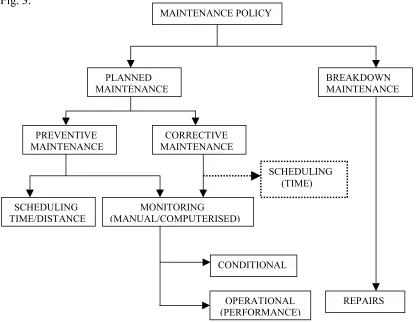
A schematic maintenance policy is indicated in the following diagram. Fig. 3.
The basis of its function depends on equipment performance, that is the amount of out put expectation relative to the desired value(s). This is the equipment efficiency. Any sign on the reduction of this value away from the desired margins (lower &
MAINTENANCE POLICY
PREVENTIVE MAINTENANCE
CORRECTIVE MAINTENANCE
REPAIRS PLANNED
MAINTENANCE
SCHEDULING TIME/DISTANCE
MONITORING
(MANUAL/COMPUTERISED)
BREAKDOWN MAINTENANCE
CONDITIONAL
OPERATIONAL (PERFORMANCE)
upper) can be used, as a criterion for the planning of the maintenance required. It involves testing and collection of data for the equipment performance and establishing safe operation margins. Different instruments to record and compare the readings with the desired values are available in the market or may be supplied by equipment manufacturers.
The knowledge and experience, supported by data, may suggest timely planning for maintenance of the equipment, far before total failure.
Further development have been carried out on preventive maintenance scheme by the United States Coast Guard (USCG) with plans to shift to condition based system to reduce labour and down time. The data collected from this system are integrated to computer database.
Main diesel engines, for example, must be overhauled periodically to maintain optimum performance level and to guard against engine failure. The determination of when to complete the overhaul is a matter of significant importance to ship owner(s). Concepts such as RCM (Reliability Centred Maintenance) which was further up graded to DEREL (Diesel Engine Reliability Database) have shown to benefit maintenance managers and engineers on board in effort to reduce unneeded labour, down time and cost. Access to electronic, as compared to machinery failure data on paper for particular ship is a big advantage. This means the engineer can make better decision on allocating scarce resources towards the maintenance of the equipment of his ship. The need for spare parts can be better forecasted and timing of repair anticipated more accurately.
2.2.2Corrective Maintenance Cost.
As its name implies, this style of maintenance today is very expensive. It falls between preventive and break down maintenance schemes. It involves immediate replacement of parts following overhauls and or breakdown of minor nature. The system does not need highly experienced and hard working engineers on board but close support with adequate materials and spare parts are needed.
Furthermore due to industrial competitions today, engine manufacturers have established a close follow up of their products already installed onboard. Besides providing with operation manual, spare parts and service manuals, where a step by step removal and replacement procedure is indicated, maintenance videotapes are supplied to support shipboard engineers with a more pictorial and verbal procedures. It is ‘just do it’ as you see from the tape. In addition to manuals and videotapes, the economy in machinery maintenance is considered in terms of pay back time and that is why some ship owners refrain from installing new features until otherwise it is reinforced by the law. However, maintenance support teams are increasingly growing with maintenance experts through information technology. Internet and mobile teams are gradually becoming popular. Is this safe and cost effective? The corrective maintenance policy remains a question of economy rather than safety and cleaner environment.
conditions of manoeuvring or at high seas, the price should not compromise with safety. Priority of equipment function in terms of safety, cost involved and time should be judged to find best method or a combination of methods to be employed for effective shipboard maintenance.
Every machine component has a lifetime in its operations and as such the replacement decisions should be considered correct. The limits of wear rates determined from metological properties and test bench analysis from manufacturers, should be considered in whichever maintenance style selected. Although people says ‘old is gold’, it is obvious to note here that, even with high quality maintenance in place, efficiency of most equipment deteriorates with time. The concept can be easily understood taking an example of a main engine cylinder liner. Different manufacturers have given different values depending on the materials employed and other parameters. An approximate figure of 0.1mm per thousand hours is acceptable for large engines. Maximum wear before renewal is usually limited to 0.6-0.8% of the original bore diameter, or less when the manufacturer advises. Therefore, the lifetime of such a cylinder can be anticipated by simple calculations, giving sufficient time to order for a replacement.
2.2.3Break Down Maintenance Cost
working environment. Consider a new cylinder liner from the previous example, fitted with new piston rings. Experience recommends to operate the machine (engine in this case) with increased lubrication and that the loading of the cylinder liner should be increased gradually for a period of time before subjecting it to the rated full load. This is necessary to give adequate time for running in. That is for small machining textures, of few microns in size, should be slowly and gradually rubbed off by a relative movement of piston rings, or otherwise they may be scooped off, causing abrasion and an obvious case that cylinder liner wear will be at vicinity. Loss of power and possible scavenge fire could render the engine un operational. The costs involved in bringing the engine back to service and restore ship’s manoeuvrability, will be extremely high associated with probable total loss and possible damage to marine environment. The Safety of Life at Sea and other regulatory, national and international laws will not entertain such a maintenance policy onboard. Not only for the benefit of ship owners, but also for the obvious reason of safety and prevention of pollution.
It can be seen from the diagram above that the probability wear for any chosen equipment is high when it has first be put in operation. It reduces with careful running in procedure to a value where, the wear rate remains almost constant and for almost its lifetime. As the equipment approach close to the end of its life in service, wear rate values increases sharply and therefore calls for a replacement.
2.2.4Workmanship Quality and the Shipboard Maintenance.
The manning requirement of ships of the future will require highly skilled engineers both at maintenance management and operational level onboard.
Maintenance management should include not only competence at technical level, but also management of spare parts and the economy of ships and the financial ability of the company. The success of maintenance policy to be adopted requires careful planning with close relation to the company objectives. Proper scheduling based on conditional monitoring, priority, and risk analysis, material management, assessments and record keeping should be in balance with competency and availability of crew both ashore and onboard in order to reduce down time and cost. It was mentioned earlier that, the choice of maintenance policy might dictate the minimum number of engineers to be carried on board and that forming a strong support ashore. If much of the work were to be carried on board, as might be suggested by the author of this dissertation, adequate number of competent and experienced engineer on the running and maintenance of merchant ships would be necessary. To bring such a manpower to the required level would need an accumulation of academic and practical experience for a period of time. In a profession that is heavily dependent on experience, you can anticipate how long it could take to achieve such qualifications.